Day: 26 May 2022

  • Top broker gives its verdict on the BHP share price post-demerger

    A female stockbroker reviews share price performance in her office with the city shown in the background through her windows

    A female stockbroker reviews share price performance in her office with the city shown in the background through her windows

    The BHP Group Ltd (ASX: BHP) share price is trading lower on Thursday afternoon.

    At the time of writing, the mining giant’s shares are down almost 1.5% to $42.43.

    Why is the BHP share price falling today?

    The softness in the BHP share price appears to have been driven by broad weakness in the resources sector today, with almost all of BHP’s peers in the red this afternoon.

    In addition, investors may be wondering how to value BHP now that its petroleum assets have been demerged into Woodside Energy Group Ltd (ASX WDS).

    Well, the good news is that analysts at Morgans have been running the rule over BHP sans petroleum and they believe the BHP share price offers plenty of value at the current level.

    According to the note, the broker has an add rating and $48.30 price target on the Big Australian’s shares. This implies potential upside of almost 14% for investors over the next 12 months.

    In addition, the broker is forecasting fully franked dividends per share of $3.95 in FY 2022. This equates to a very attractive dividend yield of 9.3%.

    What did the broker say?

    Morgans notes that while the demerger has concentrated BHP’s earnings, it has boosted its ESG profile.

    The broker explained:

    In terms of BHP’s altered earnings mix by commodity post the Petroleum divestment (where Petroleum had been 11% of EBITDA in FY22F), BHP’s new EBITDA breakdown by commodity according to our estimates is as follows: iron ore now 54% (was 49%), Copper now 25% (was 23%), Coal now 18% (was 16%) and Nickel now 2% (was 1.3%).

    Other than rebasing our expectations for life without the contribution from its Petroleum business our investment view on BHP is unchanged. We continue to see the move as likely to increase the amount of global and domestic investors willing to invest in the company, something that will be further aided by the eventual divestment of its remaining thermal coal assets.

    All in all, Morgans appears to believe the BHP share price is trading at an attractive level for investors and I would have to agree. Particularly given its world class operations and favourable commodity prices, which are underpinning bumper free cash flows.

    The post Top broker gives its verdict on the BHP share price post-demerger appeared first on The Motley Fool Australia.

    Should you invest $1,000 in BHP right now?

    Before you consider BHP, you’ll want to hear this.

    Motley Fool Investing expert Scott Phillips just revealed what he believes are the 5 best stocks for investors to buy right now… and BHP wasn’t one of them.

    The online investing service he’s run for over a decade, Motley Fool Share Advisor, has provided thousands of paying members with stock picks that have doubled, tripled or even more.* And right now, Scott thinks there are 5 stocks that are better buys.

    *Returns as of January 13th 2022

    More reading

    Motley Fool contributor James Mickleboro has no position in any of the stocks mentioned. The Motley Fool Australia’s parent company Motley Fool Holdings Inc. has no position in any of the stocks mentioned. The Motley Fool Australia has no position in any of the stocks mentioned. The Motley Fool has a disclosure policy. This article contains general investment advice only (under AFSL 400691). Authorised by Scott Phillips.

    from The Motley Fool Australia https://ift.tt/vU3N9IO

  • Why is the Zip share price beating the ASX 200 today?

    A team celebrates a win in the office.A team celebrates a win in the office.

    After hitting a multi-year low of 83 cents this week, the Zip Co Ltd (ASX: ZIP) share price is recovering some lost ground.

    In the first three days of this week, the buy now, pay later (BNPL) company’s shares recorded consecutive losses totalling 9%.

    However, investors are bidding up Zip shares today with a 4.14% rise to 88 cents apiece.

    For context, the S&P/ASX 200 Index (ASX: XJO) is down 0.31% to 7,132.7 points.

    Let’s take a look at what’s driving these gains.

    Zip stages a mini rebound

    The Zip share price is on the move following an uptick across the S&P/ASX All Technology Index (ASX: XTX).

    At the time of writing, the tech sector is up 1.37% to 2,061 points.

    While the strong ascent could be attributed to the big rise in the Appen Ltd (ASX: APX) share price following a takeover bid, many other ASX tech shares are also gaining today.

    Sezzle Inc (ASX: SZL), which Zip is still in the process of acquiring, is currently up 8.16%, while Block Inc (ASX: SQ2), the owner of Zip’s old rival Afterpay, Xero Limited (ASX: XRO), and Altium Limited (ASX: ALU) have all edged into the green

    No doubt, the rise in the Zip share price today will bring relief for shareholders who have seen the company’s shares continue to drop in value this year.

    Selling pressure has mounted on the BNPL market due to a shift in the external environment. This includes rising interest rates, dried-up government stimulus packages, and a global economic slowdown.

    In its half-year results in February, Zip reported growth across its global operations, however, investors have focussed on the bottom line.

    As such, the company registered a loss of $153.6 million compared to the $139.8 million in H1 FY21.

    Furthermore, net bad debts stood at $115.4 million, up from the $22.4 million written off in the prior comparable period.

    Zip share price summary

    Over the past 12 months, the Zip share price has plummeted 87%, and it is currently down 79% this year to date.

    This is a massive contrast to when its shares reached an all-time high of $14.53 a little more than a year ago.

    Based on today’s price, Zip presides a market capitalisation of around $580.74 million.

    The post Why is the Zip share price beating the ASX 200 today? appeared first on The Motley Fool Australia.

    Should you invest $1,000 in Zip right now?

    Before you consider Zip, you’ll want to hear this.

    Motley Fool Investing expert Scott Phillips just revealed what he believes are the 5 best stocks for investors to buy right now… and Zip wasn’t one of them.

    The online investing service he’s run for over a decade, Motley Fool Share Advisor, has provided thousands of paying members with stock picks that have doubled, tripled or even more.* And right now, Scott thinks there are 5 stocks that are better buys.

    *Returns as of January 13th 2022

    More reading

    Motley Fool contributor Aaron Teboneras has positions in Altium and Appen Ltd. The Motley Fool Australia’s parent company Motley Fool Holdings Inc. has positions in and has recommended Altium, Appen Ltd, Block, Inc., Xero, and ZIPCOLTD FPO. The Motley Fool Australia has positions in and has recommended Block, Inc. and Xero. The Motley Fool has a disclosure policy. This article contains general investment advice only (under AFSL 400691). Authorised by Scott Phillips.

    from The Motley Fool Australia https://ift.tt/9Qx6H0d

  • Will the $2 billion Telus International up its bid for ASX-listed Appen?

    Two men in business attire play chess.Two men in business attire play chess.

    The Appen Ltd (ASX: APX) share price is flying higher on Thursday after receiving a takeover proposal from a company known as Telus International. While most Australians have likely never heard of this inconspicuous Canadian tech company, it has come knocking with a $1.2 billion offer.

    However, the Appen board is viewing the $9.50 per share bid as rather opportunistic in the current market. A market where tech company valuations have been severely compressed, irrespective of whether the business is profitable or not.

    As such, management has returned to Telus International asking to cough up a better price… and by the sounds of it, they might need to.

    At the time of writing, the Appen share price is still high up in the green, trading 28% higher at

    Let’s take a closer look.

    Is there more financial fodder behind Telus?

    For starters, is it possible for Telus International to up its offer for ASX-listed Appen? Well, we can’t speak in absolutes — but let’s dig deeper into this company shrouded in mystery.

    To keep it brief, Telus International is a broader version of Appen. Rather than being focused solely on AI training data and annotation alone, the Canadian suitor encompasses digital strategy, consulting, and managed solutions.

    Like Appen, Telus is profitable — albeit on thin margins — and free cash flow positive. In the last 12 months, the extensive IT company collected US$109 million in net profits after tax. Meanwhile, the balance sheet at the end of March contained US$161 million in cash and cash equivalents and US$894 million in debt.

    In terms of market capitalisation, Telus International is approximately twice the size of Appen. This might all lead investors to think that the suitor has maybe bitten off more than it can chew. But, there is an important piece of information here.

    Telus International is owned by A$47 billion parent company Telus Corporation, the Canadian equivalent of Telstra Corporation Ltd (ASX: TLS). Therefore, if the need is there, papa Telus might tip in the extra funds if required.

    More parties coming to the table

    The chances of Telus International needing to up their bid are highly likely if rumours prove to be true.

    According to The Australian, there is at least one private equity firm showing an interest in ASX-listed Appen. At the same time, experts are suggesting private equity might wait on the sidelines — hoping the Telus deal falls through.

    The thinking is the Appen share price could fall further given Appen advised more disappointing news today. Unfortunately, the profit downgrade adds to an ongoing trend from Appen recently.

    The post Will the $2 billion Telus International up its bid for ASX-listed Appen? appeared first on The Motley Fool Australia.

    Should you invest $1,000 in Appen right now?

    Before you consider Appen, you’ll want to hear this.

    Motley Fool Investing expert Scott Phillips just revealed what he believes are the 5 best stocks for investors to buy right now… and Appen wasn’t one of them.

    The online investing service he’s run for over a decade, Motley Fool Share Advisor, has provided thousands of paying members with stock picks that have doubled, tripled or even more.* And right now, Scott thinks there are 5 stocks that are better buys.

    *Returns as of January 13th 2022

    More reading

    Motley Fool contributor Mitchell Lawler has positions in Appen Ltd. The Motley Fool Australia’s parent company Motley Fool Holdings Inc. has positions in and has recommended Appen Ltd. The Motley Fool Australia has positions in and has recommended Telstra Corporation Limited. The Motley Fool has a disclosure policy. This article contains general investment advice only (under AFSL 400691). Authorised by Scott Phillips.

    from The Motley Fool Australia https://ift.tt/kV4mM0a

  • Why return on invested capital is the most important investing metric

    This article was originally published on Fool.com. All figures quoted in US dollars unless otherwise stated.

    A male investor sits at his desk looking at his laptop screen holding his hand to his chin pondering whether to buy Macquarie shares

    This article was originally published on Fool.com. All figures quoted in US dollars unless otherwise stated.

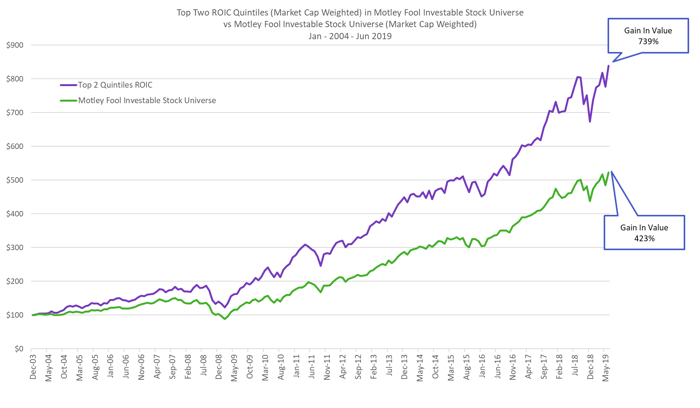
    If you want to outperform the market over the long term, buy stocks in growing companies that generate high and/or rising returns on invested capital (ROIC) at fair or better valuations.

    Chart comparing top 2 quintiles ROIC and Motley Fool investable stock uiniverse.


    Image source: The Motley Fool.

    Chart comparing top quintiles 12-month change in ROIC and Motley Fool investable stock universe.


    Image source: The Motley Fool.

    Comparing ROIC Company A Company B
    Current EPS $1 $1
    Desired EPS growth rate 5% 5%
    Return on invested capital (ROIC) 20% 10%
    Reinvestment rate (solve using G = ROIC x Reinvestment) 25% 50%
    Growth 5% 5%
    Left to distribute (100% less reinvestment rate) 75% 50%
    Free (or distributable) cash flow per $1 of EPS $0.75 $0.50

    Adapted from McKinsey & Co. book Valuation: Measuring and Managing the Value of Companies

    As the first two charts above clearly show:

    1. Companies with high ROIC outperform the market by a country mile and
    2. Companies with rising ROIC outperform the market by a light-year.

    This is because ROIC is the most important financial metric. It is the ultimate measure of profit and performance and a main driver of free cash flow (FCF), which is ultimately what we are after as investors.

    Here’s a simple formula to show you just how powerful ROIC really is. That formula is


    ROIC x Reinvestment Rate = Operating Profit Growth


    Assume we have two companies (Company A and Company B) that aim to grow earnings at a rate of 5% per year, but Company A has an ROIC of 20% and Company B has an ROIC of only 10%. Under these parameters, Company A only has to reinvest 25% of its profits to grow earnings 5% (20% x 25% = 5%), but Company B has to reinvest 50% of its profits to grow earnings at the same 5% rate (10% x 50% = 5%). See the table above for the math.

    The company with the higher ROIC has a lower reinvestment rate and will need to reinvest less capital to achieve the same level of earnings growth. And because the higher-ROIC business requires less capital (or reinvestment) to grow, it generates higher free cash flow (FCF), and free cash flow is what determines intrinsic value. Mathematically, companies with higher ROIC generate more FCF per dollar of earnings.

    Let’s all say that together: Businesses with higher ROIC generate more FCF per dollar of earnings, and growth of free cash flow is what drives growth of intrinsic value!

    Because these high-ROIC businesses generate so much FCF, they can finance their growth internally rather than relying on outside capital (other people’s money) to grow. This means less debt or less equity dilution for shareholders. They can invest more in fortifying their moats. They can invest in new initiatives to build new moats and new profitable growth streams over time. They can invest in taking care of stakeholders, including employees, customers, suppliers, communities, and the planet. They can set their own time frames, remain adaptable, and future-proof their businesses.

    Finally, some of the excess FCF can be used to pay down existing debt, and what’s left over will sit on the balance sheet to build up an even larger net cash position (for many of our companies at least), which further strengthens the balance sheet and builds optionality.

    Before moving on from the formula, it’s important to point out that a company cannot grow operating profit faster than its incremental ROIC without taking on outside financing. Basically, a business that generates an ROIC of 20% can’t grow operating profit faster than 20%, and to do so, it must reinvest 100% of its profits (20% x 100% = 20%). Remember this the next time you hear that so-and-so company can sustainably grow earnings at 40% or 50%. The answer is that it probably can’t without taking on outside financing.

    Here’s more:

    An increase in ROIC always increases intrinsic value.

    But an increase in revenue growth does not always increase intrinsic value. Growth only increases business value if a company’s ROIC is greater than its weighted average cost of capital (WACC).


    If ROIC > WACC then growth increases intrinsic value.

    If ROIC = WACC then growth neither creates nor destroys value.

    If ROIC < WACC then growth destroys intrinsic value.


    This is why return on invested capital is more important than revenue growth…an increase in ROIC is always value added, but an increase in growth can actually destroy value, which is a big reason you’re seeing some profitless growth stocks blow up and fall 50% to 70% or even more.

    Now, if ROIC is high, a percentage-point increase in revenue growth creates more value than does a percentage-point increase in an already-high ROIC. So when ROIC is high, companies should focus on growth and can even sacrifice some ROIC to drive growth (yes, some modest decline in ROIC can be a good thing). But when ROIC is low, a company must focus on increasing its ROIC (to get it above the WACC) before it shifts into growth mode.

    Don’t overthink it. Understand the basics of intrinsic value growth! Focus on finding companies with strong balance sheets, high or increasing ROIC, and growing FCF, and then just don’t pay too much.

    At the end of the day, FCF growth, what we pay for it, and having the proper mindset are pretty much all that matter for long term market-beating returns. 

    This article was originally published on Fool.com. All figures quoted in US dollars unless otherwise stated.

    The post Why return on invested capital is the most important investing metric appeared first on The Motley Fool Australia.

    Wondering where you should invest $1,000 right now?

    When investing expert Scott Phillips has a stock tip, it can pay to listen. After all, the flagship Motley Fool Share Advisor newsletter he has run for over ten years has provided thousands of paying members with stock picks that have doubled, tripled or even more.*

    Scott just revealed what he believes could be the five best ASX stocks for investors to buy right now. These stocks are trading at near dirt-cheap prices and Scott thinks they could be great buys right now.

    *Returns as of January 12th 2022

    More reading

    The Motley Fool Australia’s parent company Motley Fool Holdings Inc. has no position in any of the stocks mentioned. The Motley Fool Australia has no position in any of the stocks mentioned. The Motley Fool has a disclosure policy. This article contains general investment advice only (under AFSL 400691). Authorised by Scott Phillips.

    This article was originally published on Fool.com. All figures quoted in US dollars unless otherwise stated.

    from The Motley Fool Australia https://ift.tt/ZQsSeVm

  • Why Catapult, Costa, Endeavour, and Whitehaven Coal shares are dropping

    In afternoon trade, the S&P/ASX 200 Index (ASX: XJO) is on course to record a decline due largely to weakness in the resources sector. At the time of writing, the benchmark index is down 0.35% to 7,130 points.

    Four ASX shares that are falling more than most today are listed below. Here’s why they are dropping:

    Catapult Group International Ltd (ASX: CAT)

    The Catapult share price is down 11% to $1.02. This follows the release of a full-year result which revealed solid top line growth but widening losses. Annual contract value (ACV) was up 19.7% to US$63.9 million but Catapult’s underlying EBITDA swung from a profit of US$3.5 million in FY 2021 to a loss of US$5.8 million. Management advised that this reflects its additional investment in accelerating ACV growth.

    Costa Group Holdings Ltd (ASX: CGC)

    The Costa share price is down over 2% to $3.09. This morning the horticulture company clarified that its trading update yesterday didn’t include any concrete earnings guidance. This was in response to many media outlets mistakenly reporting the opposite.

    Endeavour Group Ltd (ASX: EDV)

    The Endeavour share price is down 4% to $7.36. Investors have been selling this drinks company’s shares following the release of its investor day update which revealed an increase to capital expenditure plans. While the market doesn’t appear pleased with this news, analysts at Goldman Sachs remain positive. They commented: “Overall, we view this announcement as being positive vs street expectations but in-line with GSe. We remain comfortable with the Group’s balance sheet ability to fund this increased capex obligation.”

    Whitehaven Coal Ltd (ASX: WHC)

    The Whitehaven Coal share price is down 4% to $5.08. This has been driven by weakness in the resources sector today, which is weighing heavily on the performance of the ASX 200 index. At the time of writing, the S&P/ASX 200 Resources index is down 1.2%.

    The post Why Catapult, Costa, Endeavour, and Whitehaven Coal shares are dropping appeared first on The Motley Fool Australia.

    Wondering where you should invest $1,000 right now?

    When investing expert Scott Phillips has a stock tip, it can pay to listen. After all, the flagship Motley Fool Share Advisor newsletter he has run for over ten years has provided thousands of paying members with stock picks that have doubled, tripled or even more.*

    Scott just revealed what he believes could be the five best ASX stocks for investors to buy right now. These stocks are trading at near dirt-cheap prices and Scott thinks they could be great buys right now.

    *Returns as of January 12th 2022

    More reading

    Motley Fool contributor James Mickleboro has no position in any of the stocks mentioned. The Motley Fool Australia’s parent company Motley Fool Holdings Inc. has positions in and has recommended Catapult Group International Ltd. The Motley Fool Australia has positions in and has recommended Catapult Group International Ltd. The Motley Fool Australia has recommended COSTA GRP FPO. The Motley Fool has a disclosure policy. This article contains general investment advice only (under AFSL 400691). Authorised by Scott Phillips.

    from The Motley Fool Australia https://ift.tt/flzREaM

  • Here’s what’s impacting the Qantas share price on Thursday

    Man sitting in a plane seat works on his laptop.

    Man sitting in a plane seat works on his laptop.

    The Qantas Airways Limited (ASX: QAN) share price is up 1.31% during afternoon trade. The flying kangaroo is currently trading for $5.42 per share.

    The Qantas share price is marching higher even as the S&P/ASX 200 Index (ASX: XJO) has returned its early gains to be down 0.39% at this same time.

    What’s impacting the Qantas share price?

    Investors could be bidding up the airline after it received positive coverage from UBS.

    The broker just added Qantas to its ‘best ideas’ list.

    If you’re not familiar with that, the list includes UBS’ most preferred ASX shares to hold over the next 12 months. Its analysts look at both the broader macro picture as well as company specific fundamentals.

    While inflation, geopolitical turmoil and rising interest rates throw up plenty of headwinds, Australia’s unemployment rate is at historic lows and households remain cashed up post the lengthy COVID restrictions.

    And it’s the strength of the Aussie economy during the reopening that has UBS bullish on the Qantas share price.

    “Qantas is also added to our most preferred as a means to fully capture the domestic economy’s reopening momentum, and the strength in Airlines globally,” UBS said.

    Higher jet fuel costs to trim capacity

    In a press release this morning, Qantas reported that rising fuel costs over the past months will see it rebalance its capacity and fares.

    Looking ahead to flying levels for July and August, the airline said domestic capacity would be reduced from 107% of pre-COVID levels to 103%.

    The reduced capacity is unlikely to have a materially negative impact on the Qantas share price. As the airline reported, “These adjustments are not expected to materially impact customers due to the large number of flights on most routes.”

    This could see its aircraft flying with fewer empty seats.

    Qantas added that it “will continue to monitor market conditions and adjust capacity as needed”.

    On the international front, capacity is forecast to remain just under 50% of pre-COVID levels by the end of the fourth quarter of FY22. Qantas expects international capacity to increase to some 70% by the end of the first quarter of FY23.

    Qantas share price snapshot

    The Qantas share price has gained 8% in 2022. That compares to a year-to-date loss of 4% posted by the ASX 200.

    The post Here’s what’s impacting the Qantas share price on Thursday appeared first on The Motley Fool Australia.

    Should you invest $1,000 in Qantas right now?

    Before you consider Qantas, you’ll want to hear this.

    Motley Fool Investing expert Scott Phillips just revealed what he believes are the 5 best stocks for investors to buy right now… and Qantas wasn’t one of them.

    The online investing service he’s run for over a decade, Motley Fool Share Advisor, has provided thousands of paying members with stock picks that have doubled, tripled or even more.* And right now, Scott thinks there are 5 stocks that are better buys.

    *Returns as of January 13th 2022

    More reading

    The Motley Fool Australia’s parent company Motley Fool Holdings Inc. has no position in any of the stocks mentioned. The Motley Fool Australia has no position in any of the stocks mentioned. The Motley Fool has a disclosure policy. This article contains general investment advice only (under AFSL 400691). Authorised by Scott Phillips.

    from The Motley Fool Australia https://ift.tt/QMfLJoi

  • What’s going on with the Australian Vanadium share price today?

    Woman looks puzzled as she types on laptop and uses phone.Woman looks puzzled as she types on laptop and uses phone.

    The Australian Vanadium Ltd (ASX: AVL) share price is slipping today, down 4.3% in afternoon trade.

    Shares in the vanadium explorer closed yesterday at 4.7 cents and are currently trading for 4.5 cents.

    Atop broader weakness in the ASX resources sector today, here’s what looks to be impacting the company.

    Share purchase plan opens today

    The Australian Vanadium share price is in the red after the company reported that its share purchase plan (SPP) is now open.

    Eligible shareholders can invest as much as $30,000 in new AVL shares at the offer price of 4.7 cents. That’s 17.5% below the Australian Vanadium share price on 17 May, the company’s last day of trading before announcing the SPP offer.

    The company is looking to raise $7.5 million but said it could raise more if there was sufficient investor appetite. And it may be the idea of unspecified additional share dilution that’s seeing the resource explorer trade lower today.

    Commenting on the reasoning behind the capital raising, Australian Vanadium chairman Cliff Lawrenson said:

    The funds raised under the Placement and SPP will be used to fund ongoing work at the company’s Australian Vanadium Project and to develop key downstream markets ahead of finalising debt financing and a Final Investment Decision, and for working capital, including costs.

    In a separate announcement this morning, the company reported that its 100% owned subsidiary, VSUN Energy, has signed a memorandum of understanding (MOU) with North Harbour Clean Energy.

    The MOU opens the door for VSUN Energy to help develop vanadium redox flow batteries being developed by North Harbour Clean Energy.

    Commenting on the agreement, Australian Vanadium managing director Vincent Algar said: “Jointly the companies aim to grow the Australian vanadium energy storage sector and do justice to this Australian invented technology.”

    Australian Vanadium share price snapshot

    The Australian Vanadium share price has come under selling pressure since hitting five-year highs of 9 cents on 1 April.

    Despite a significant retrace since those highs, shares remain up 50% year-to-date. That compares to the 7% loss posted by the All Ordinaries Index (ASX: XAO) so far in 2022.

    The post What’s going on with the Australian Vanadium share price today? appeared first on The Motley Fool Australia.

    Should you invest $1,000 in Australian Vanadium right now?

    Before you consider Australian Vanadium, you’ll want to hear this.

    Motley Fool Investing expert Scott Phillips just revealed what he believes are the 5 best stocks for investors to buy right now… and Australian Vanadium wasn’t one of them.

    The online investing service he’s run for over a decade, Motley Fool Share Advisor, has provided thousands of paying members with stock picks that have doubled, tripled or even more.* And right now, Scott thinks there are 5 stocks that are better buys.

    *Returns as of January 13th 2022

    More reading

    The Motley Fool Australia’s parent company Motley Fool Holdings Inc. has no position in any of the stocks mentioned. The Motley Fool Australia has no position in any of the stocks mentioned. The Motley Fool has a disclosure policy. This article contains general investment advice only (under AFSL 400691). Authorised by Scott Phillips.

    from The Motley Fool Australia https://ift.tt/4WST5Lg

  • What’s the outlook for ASX 200 dividend shares in the second half of 2022?

    A man happily kisses a $50 note scrunched up in his hands representing the best ASX dividend stocks in Australia todayA man happily kisses a $50 note scrunched up in his hands representing the best ASX dividend stocks in Australia today

    Owners of ASX 200 dividend shares likely saw their payments cut during the COVID-19 pandemic. But they’ve also seen their shares go through one of the most impressive recoveries in the world.

    And now, ASX 200 dividends could reach record levels in 2022. According to a new report, the second half of this year has the potential to be astronomical for dividend payments.

    Australian shareholders may be handed more than $100 billion in dividends this year, according to the latest Global Dividend Index report from Janus Henderson Group (ASX: JHG).

    Let’s take a closer look at the best ASX dividend stocks highlighted by the fund manager. These are the companies that Janus Henderson thinks are likely to continue doling out strong dividends.

    Which ASX 200 shares could keep boosting their dividends?

    ASX 200 shares could lead the way for Australia to post a record-breaking year of dividends in 2022. That’s despite the nation’s payouts plummeting during the pandemic.

    The fund manager found Australia’s dividends slumped a whopping 37.3% during the height of COVID-19 while the rest of the world’s dipped just 16.7%.

    But the reasons behind the ASX’s dividend dump also boosted payouts to a record high over the 12 months ended 31 March. Over the period, ASX companies handed investors $97.9 billion in dividends.

    So which sectors have been driving this upwards trend? Perhaps unsurprisingly, higher commodity prices saw ASX 200 mining shares highlighted as some of Australia’s biggest and best dividend stocks.

    BHP Group Ltd (ASX: BHP) was the world’s biggest dividend payer in the March quarter. It accounted for 32% of all dividends handed to ASX investors at that time. Fortescue Metals Group Limited (ASX: FMG) and Rio Tinto Limited (ASX: RIO) were also among Australia’s best ASX dividend providers.

    The fund manager expects miners’ dividends to continue growing over the rest of 2022. However, it warns that volatile commodity prices make its outlook less certain.

    ASX 200 bank shares are also behind much of Australia’s dividends. They’re also expected to stay on track in the second half.

    Commonwealth Bank of Australia (ASX: CBA) delivered the third-biggest dividend payout of the year ending March 31. Westpac Banking Corp (ASX: WBC) paid the fifth-highest dividend.

    Interestingly, CBA, Rio, Fortescue, BHP, and Westpac accounted for nearly two-thirds of all ASX dividends over the year to March. That’s likely welcome news to those invested in the ASX 200 quintet.

    However, the fund manager warned that this leaves shareholders dependant on fewer dividend stocks. This makes them vulnerable to difficulties that could cause big dividend-paying companies to cut their payouts.

    Either company-specific events or broader catastrophes like pandemics or market crashes could see Australia lose a significant portion of its dividends in one swipe due to this high level of concentration.

    The post What’s the outlook for ASX 200 dividend shares in the second half of 2022? appeared first on The Motley Fool Australia.

    Should you invest $1,000 in BHP Group right now?

    Before you consider BHP Group, you’ll want to hear this.

    Motley Fool Investing expert Scott Phillips just revealed what he believes are the 5 best stocks for investors to buy right now… and BHP Group wasn’t one of them.

    The online investing service he’s run for over a decade, Motley Fool Share Advisor, has provided thousands of paying members with stock picks that have doubled, tripled or even more.* And right now, Scott thinks there are 5 stocks that are better buys.

    *Returns as of January 13th 2022

    More reading

    Motley Fool contributor Brooke Cooper has no position in any of the stocks mentioned. The Motley Fool Australia’s parent company Motley Fool Holdings Inc. has no position in any of the stocks mentioned. The Motley Fool Australia has recommended Westpac Banking Corporation. The Motley Fool has a disclosure policy. This article contains general investment advice only (under AFSL 400691). Authorised by Scott Phillips.

    from The Motley Fool Australia https://ift.tt/4gB0ONV

  • Why are ASX coal shares sliding today?

    Older mine worker in hard hat looks upsetOlder mine worker in hard hat looks upset

    ASX coal shares are struggling on the market today.

    The Whitehaven Coal Ltd (ASX: WHC) share price is falling 3.88% — having earlier been down almost 11% — and Allegiance Coal Ltd (ASX: AHQ) is dropping 4.35%. The S&P/ASX 200 Energy Index (ASX: XEJ) is 0.74% in the red at the time of writing.

    Other ASX coal shares to fall include New Hope Corporation Limited (ASX: NHC), sliding 7%, and Coronado Global Resources Inc (ASX: CRN), falling 2.6%. Meanwhile, Yancoal Australia (ASX: YAL) is in a trading halt.

    Let’s take a look at what could be impacting ASX coal shares today

    Coal prices fall

    ASX coal shares appear to be reacting to a decline in the coal price. Coal prices have descended 1.96% to US$400 per tonne, Trading Economics data shows.

    Meanwhile, ministers from the G7 are considering phasing out coal energy by 2030. The energy, climate, and environment ministers are meeting in Berlin from Wednesday to Friday. A draft meeting document seen by Reuters states:

    We commit to phase out domestic unabated coal power generation and non-industrial coal-powered heat generation aiming at the year 2030.

    New Hope shares are declining today amid the company releasing its quarterly results. Coal sold in the quarter fell by 26.7% compared to the previous quarter.

    Unseasonal rainfall and COVID-19 impacts on the workforce led to a “challenging quarter” at the company’s Bengalla operations in NSW. This operation lost 20,354 hours due to weather and labour issues. Despite this, the company reported thermal coal prices hit record highs after the Russian invasion of Ukraine.

    In today’s AGM, Coronado Resources also highlighted Australian average index coal prices jumped by 32% in the first quarter of 2022. Spot prices hit a peak of US$670 per tonne in March.

    Chairman William Koeck said he expects coal prices to moderate in 2022 but remain higher than historical averages. He attributed this to trade restraints from Russia and China and elevated thermal coal pricing “providing a floor” for metallurgical coal prices.

    Coal miner Yancoal entered a trading halt today pending an announcement. As my Foolish colleague Aaron reported, the company share price is frozen pending a potential market transaction. Media speculates parent company Yankuang could be considering a bid for Yancoal.

    Share price snapshot

    The S&P/ASX 200 Energy Index (ASX: XEJ) has surged 27% in the past year, while it is rising 25% year to date.

    Among ASX coal shares, the Whitehaven Coal share price has surged 236% in a year, while New Hope has soared 186%. Yancoal has soared 191% in a year, while Coronado has rocketed 249% and Allegiance is holding steady.

    Meanwhile, the S&P/ASX 200 Index (ASX: XJO) has climbed 0.38% in the past year.

    The post Why are ASX coal shares sliding today? appeared first on The Motley Fool Australia.

    Wondering where you should invest $1,000 right now?

    When investing expert Scott Phillips has a stock tip, it can pay to listen. After all, the flagship Motley Fool Share Advisor newsletter he has run for over ten years has provided thousands of paying members with stock picks that have doubled, tripled or even more.*

    Scott just revealed what he believes could be the five best ASX stocks for investors to buy right now. These stocks are trading at near dirt-cheap prices and Scott thinks they could be great buys right now.

    *Returns as of January 12th 2022

    More reading

    The Motley Fool Australia’s parent company Motley Fool Holdings Inc. has no position in any of the stocks mentioned. The Motley Fool Australia has no position in any of the stocks mentioned. The Motley Fool has a disclosure policy. This article contains general investment advice only (under AFSL 400691). Authorised by Scott Phillips.

    from The Motley Fool Australia https://ift.tt/gVsnQ3S

  • The Lake Resources share price has plummeted 30% in a month. What’s going on?

    a young man sits on the floor with his back against a sofa hunched over his phone in one hand and his other hand on top of his head as though he is seeing bad news as his face looks sad and anguised.a young man sits on the floor with his back against a sofa hunched over his phone in one hand and his other hand on top of his head as though he is seeing bad news as his face looks sad and anguised.

    The Lake Resources N.L. (ASX: LKE) share price has reversed most of its gains in the past month, down 30%.

    This comes despite the company not releasing any price-sensitive news since its quarterly activities and cash flow report in April.

    However, at the time of writing, the clean lithium developer’s shares are clawing back some lost ground, currently up 4.23% to $1.48.

    Let’s take a look at what could have been driving the recent fall in the company’s share price.

    What’s happening with Lake Resources?

    The Lake Resources share price quickly rose from 96 cents at the beginning of March to reach an all-time high of $2.65 in early April.

    However, investors are now offloading Lake Resources shares after heavy falls across the broader market this month.

    This follows a series of market shocks such as China’s COVID-19 lockdown — which dented demand for lithium — the Russian war in Ukraine, and inflationary movements.

    Another possible factor is the price of lithium, with lithium carbonate now trading below the highs it achieved in late March.

    Fellow ASX lithium shares Liontown Resources Limited (ASX: LTR) and Sayona Mining Ltd (ASX: SYA) are also well in the red over the past month, down 19% and 43% respectively.

    For context, the S&P/ASX 200 Index (ASX: XJO) has tumbled 4.7% in the past 30 days.

    Furthermore, the S&P/ASX 300 Metals and Mining Industry (ASX: XMM) is down 5% over the same timeframe. The index contains companies in the top 300 ASX companies that are involved with gold, steel, and precious metals.

    Lake Resources share price summary

    Despite the recent fall, Lake Resources has been one of the best places to invest in the past year.

    The Lake Resources share price has travelled 467% higher since this time last year and is up 46% in 2022.

    Based on valuation grounds, Lake Resources commands a market capitalisation of roughly $1.99 billion.

    The post The Lake Resources share price has plummeted 30% in a month. What’s going on? appeared first on The Motley Fool Australia.

    Should you invest $1,000 in Lake Resources right now?

    Before you consider Lake Resources, you’ll want to hear this.

    Motley Fool Investing expert Scott Phillips just revealed what he believes are the 5 best stocks for investors to buy right now… and Lake Resources wasn’t one of them.

    The online investing service he’s run for over a decade, Motley Fool Share Advisor, has provided thousands of paying members with stock picks that have doubled, tripled or even more.* And right now, Scott thinks there are 5 stocks that are better buys.

    *Returns as of January 13th 2022

    More reading

    Motley Fool contributor Aaron Teboneras has no position in any of the stocks mentioned. The Motley Fool Australia’s parent company Motley Fool Holdings Inc. has no position in any of the stocks mentioned. The Motley Fool Australia has no position in any of the stocks mentioned. The Motley Fool has a disclosure policy. This article contains general investment advice only (under AFSL 400691). Authorised by Scott Phillips.

    from The Motley Fool Australia https://ift.tt/ZSEDtKM