Month: October 2022

  • Why did the Hawsons Iron share price just nosedive 62%?

    A young man clasps his hand to his head with his eyes closed and a pained expression on his face as he clasps a laptop computer in front of him, seemingly learning of bad news or a poor investment.A young man clasps his hand to his head with his eyes closed and a pained expression on his face as he clasps a laptop computer in front of him, seemingly learning of bad news or a poor investment.

    Monday has proven dire for the Hawsons Iron Ltd (ASX: HIO) share price after the company announced it’s hitting the brakes on its flagship project.

    The company will slow activity on the Hawson Iron Project’s bankable feasibility study (BFS) in an attempt to preserve cash.

    The Hawson Iron share price has dumped more than half its value in response. It has tumbled 62.16% to trade at 14 cents at the time of writing.

    Let’s take a closer look at the news dragging the Aussie iron ore developer’s stock lower on Monday.

    What’s going wrong for the iron ore developer?

    The Hawson Iron share price is plummeting to its lowest point of 2022 so far on disappointing news of the company’s namesake project.

    The company will slow down its work on the project’s BFS as it examines rising capital expenditure costs. As a result, the study will not be completed by December as was previously expected.

    Managing director Bryan Granzien said the move will allow for the analysis of the project’s capital and operating cost estimates and the review of all options for further progression, including scaling opportunities. Granzien said:

    We have been left with no other choice given the current state of global capital markets and world economy.

    Global inflation, rate hikes, and the war in Ukraine have brought “strong market headwinds”, said chair Dave Woodall. He continued:

    We, like many companies, are being challenged by the current economic climate, falling Australian dollar, supply chain cost escalations, and restricted access to equity markets which are beyond our control.

    A project slow-down is the most sensible and prudent response to preserve capital, given global cost pressures, and will allow a focus on optimising pathways in the best interests of shareholders which are reflective of deteriorating world conditions.

    Woodall also said the company’s ability to raise capital over the coming year is contingent on certain resolutions to be put to shareholders at its annual general meeting (AGM). That’s set to go ahead on 15 November.

    The company started working on a BFS for a 10 million tonne per annum project in 2021. The study was later expanded to look into upscaling the production profile to 20 million tonnes per annum.

    Hawsons Iron share price snapshot

    The Hawsons Iron share price had been on a run prior to today’s tumble.

    It gained 118% between the start of 2022 and Friday’s close. It’s currently trading 20.5% lower year to date.

    However, the stock is still 69% higher than it was this time last year.

    The post Why did the Hawsons Iron share price just nosedive 62%? appeared first on The Motley Fool Australia.

    More reading

    Motley Fool contributor Brooke Cooper has no position in any of the stocks mentioned. The Motley Fool Australia’s parent company Motley Fool Holdings Inc. has no position in any of the stocks mentioned. The Motley Fool Australia has no position in any of the stocks mentioned. The Motley Fool has a disclosure policy. This article contains general investment advice only (under AFSL 400691). Authorised by Scott Phillips.

    from The Motley Fool Australia https://ift.tt/0m1Ey4C

  • Sell Fortescue shares before they drop 20% and its dividends collapse: Goldman Sachs

    A business woman looks unhappy while she flies a red flag at her laptop.

    A business woman looks unhappy while she flies a red flag at her laptop.

    Fortescue Metals Group Limited (ASX: FMG) shares are trading lower on Monday.

    In afternoon trade, the mining giant’s shares are down almost 2% to $16.82.

    However, if one broker is to be believed, there could be plenty more declines ahead for Fortescue’s shares.

    What is the broker saying about Fortescue’s shares?

    According to a note out of Goldman Sachs, its analysts have retained their sell rating and $13.40 price target on company’s shares.

    This implies approximately 20% downside for investors over the next 12 months based on where its shares are currently trading.

    Why is Goldman bearish?

    Goldman has just attended an investor tour of the company’s Solomon and Eliwana mines, as well as being taken through the Pilbara decarbonisation investment and strategy.

    In respect to the latter, the broker commented:

    Run through of recently announced US$6.2bn Pilbara decarbonisation program (>US$7bn when including the Pilbara Energy Connect (PEC) project and Iron Bridge decarb).

    Combined with de-bottlenecking work to increase production at Eliwana and elevated mine replacement and sustaining capex, Goldman expects Fortescue’s capex to increase materially in the coming years. It also sees risks that costs could be even higher than it is forecasting. The broker explained:

    Overall, we forecast FMG’s capex to increase from ~US$3.2bn in FY23 to ~US$4bn by FY26 on mine and haul truck replacement and decarbonisation spend, but see upside risk to our estimate.

    This is expected to weigh heavily on its free cash flow and ultimately its dividends. For example, after paying a dividend of US$1.50 per share in FY 2022, Goldman expects Fortescue’s dividends to fall to 38 US cents by FY 2024, before reducing even further in the years that follow.

    FY 2024’s dividend estimate equates to a yield of just 3.6% at current levels. So, if Fortescue is going to continue to trade with big juicy yields, its shares are going to have to drop materially by then.

    What else?

    In addition, the broker continues to highlight that the Fortescue shares trade at a material premium to rivals BHP Group Ltd (ASX: BHP) and Rio Tinto Limited (ASX: RIO).

    Goldman said:

    The stock is trading at a premium to BHP & RIO; c. 1.5x NAV vs. RIO & BHP at c. 0.8x & 1x NAV, c. 6x EBITDA (vs. RIO & BHP on c. 3-5x), and c. 5% FCF vs. BHP & RIO on c. 5-10%.

    In light of this, its analysts are urging investors to buy BHP and Rio Tinto shares instead of Fortescue.

    The post Sell Fortescue shares before they drop 20% and its dividends collapse: Goldman Sachs appeared first on The Motley Fool Australia.

    More reading

    Motley Fool contributor James Mickleboro has no position in any of the stocks mentioned. The Motley Fool Australia’s parent company Motley Fool Holdings Inc. has no position in any of the stocks mentioned. The Motley Fool Australia has no position in any of the stocks mentioned. The Motley Fool has a disclosure policy. This article contains general investment advice only (under AFSL 400691). Authorised by Scott Phillips.

    from The Motley Fool Australia https://ift.tt/RhgA5Ym

  • 3 tips from Warren Buffett to get you through any bear market

    This article was originally published on Fool.com. All figures quoted in US dollars unless otherwise stated.

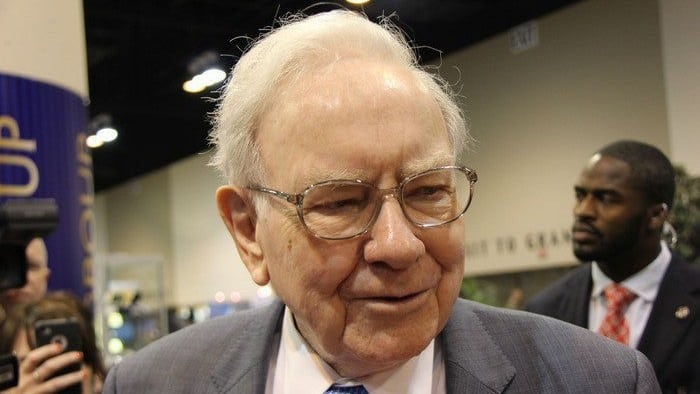
    Legendary share market investing expert and owner of Berkshire Hathaway Warren Buffett

    This article was originally published on Fool.com. All figures quoted in US dollars unless otherwise stated.

    The stock market has been on a steady decline since January, and investors are feeling the pinch. The S&P 500, the Nasdaq, and the Dow Jones Industrial Average are all in bear market territory after falling more than 20% from their peaks earlier this year. That can be unnerving for even the most seasoned investors, especially when nobody knows for certain how long this downturn will last.

    With the right strategy, though, you can give your investments the best chance possible at surviving a bear market. And famed investor Warren Buffett has a few tips that can make these challenging times a little easier.

    1. Keep a long-term outlook

    It can be tough to stay optimistic right now, as stock prices continue to drop nearly every day. But the market has seen its share of slumps and managed to recover from every one so far.

    Back in 2008, Warren Buffett penned an opinion piece for The New York Times, explaining why he was continuing to invest in stocks throughout the Great Recession. In it, the Berkshire Hathaway CEO wrote that:

    Fears regarding the long-term prosperity of the nation’s many sound companies make no sense. These businesses will indeed suffer earnings hiccups, as they always have. But most major companies will be setting new profit records 5, 10 and 20 years from now.

    Nobody — even Warren Buffett — can say for certain how the market will perform in the coming weeks or months. But over the long term, it’s extremely likely to see positive average returns.

    2. Take this opportunity to invest more

    When stock prices are falling, throwing more money into the market may be the last thing on many investors’ minds. However, continuing to invest during bear markets can be a smart way to build long-term wealth.

    During a market slump, high-priced stocks are more affordable. Some companies have seen their stock prices sink by 30%, 40%, 50%, or more so far this year, which gives investors a chance to buy high-quality stocks at a steep discount.

    Buffett also encourages investors to take advantage of these buying opportunities. “In short, bad news is an investor’s best friend,” he writes for The New York Times. “It lets you buy a slice of America’s future at a marked-down price.”

    3. Focus on quality companies

    Simply investing during a bear market is only one part of the equation. It’s equally important to ensure you’re investing in companies that are strong enough to recover from periods of volatility. The best stocks are the ones from healthy companies with solid underlying business fundamentals — such as a knowledgeable leadership team and strong financials, for example.

    Warren Buffett and his business partner Charlie Munger also follow this strategy when choosing investments. “[O]ur goal is to have meaningful investments in businesses with both durable economic advantages and a first-class CEO,” Buffett said in a 2021 Berkshire Hathaway shareholders letter. “Charlie and I are not stock-pickers; we are business-pickers.”

    Investing during a bear market isn’t easy, and it’s not the right move for everyone. If cash is tight and you can’t afford to leave your money in the market for at least a few years, it may be best to avoid investing for now.

    But if you can swing it, continuing to invest in solid stocks can be a smart move. Not only can you stock up on strong investments at a discount, but you could also see substantial gains when the market inevitably recovers. 

    This article was originally published on Fool.com. All figures quoted in US dollars unless otherwise stated.

    The post 3 tips from Warren Buffett to get you through any bear market appeared first on The Motley Fool Australia.

    More reading

    Katie Brockman has no position in any of the stocks mentioned. The Motley Fool has positions in and recommends Berkshire Hathaway (B shares). The Motley Fool recommends the following options: long January 2023 $200 calls on Berkshire Hathaway (B shares), short January 2023 $200 puts on Berkshire Hathaway (B shares), and short January 2023 $265 calls on Berkshire Hathaway (B shares). The Motley Fool has a disclosure policy. This article contains general investment advice only (under AFSL 400691). Authorised by Scott Phillips.

    This article was originally published on Fool.com. All figures quoted in US dollars unless otherwise stated.

    from The Motley Fool Australia https://ift.tt/wOVRbPn

  • 3 ASX 200 shares that turned a $5,000 investment into $1 million

    A person with a round-mouthed expression clutches a device screen and looks shocked and surprised.A person with a round-mouthed expression clutches a device screen and looks shocked and surprised.

    It’s been a rough year for Aussie investors, with the S&P/ASX 200 Index (ASX: XJO) having dived more than 12% since the start of 2022. Once bullish shareholders would be forgiven for feeling a little down in the dumps — along with their ASX 200 shares.

    But if you need a reminder of the power of investing, you’ve come to the right place.

    These three ASX 200 shares have turned a $5,000 investment into a considerable nest egg over the course of their listed life. Let’s take a look at the tried-and-true ASX 200 millionaire makers.

    These ASX 200 shares have turned a $5,000 investment into $1m

    ASX-listed company Foundational year Total return since Recent value of
    $5,000 invested
    Fortescue Metals Group Limited (ASX: FMG) 2003 85,450% $4,277,500
    CSL Limited (ASX: CSL) 1994 36,799% $1,844,934
    REA Group Limited (ASX: REA) 1999 22,822% $1,146,100

    And none of those returns has considered dividends paid out by the ASX 200 shares during their time on the market.

    That’s right, a $5,000 investment in iron ore giant Fortescue in the early 2000s would have been worth a whopping $4.28 million at last close.

    Aussie billionaire and Fortescue boss Andrew ‘Twiggy’ Forrest took control of the ASX-listed Allied Mining and Processing in 2003, quickly renaming it Fortescue.

    Back then, the stock was trading at just – wait for it – 2 cents a share, as my Fool colleague Sebastian reports. The Fortescue share price last closed at $17.11.

    Similarly, CSL floated on the ASX after its initial public offering (IPO) saw shares in the company sell for 76 cents apiece, adjusted for subsequent stock splits, as The Motley Fool Australia’s James reports.  

    As of Friday’s close, one share in CSL was priced at $280.43.

    Meanwhile, REA floated on the ASX under the name Realestate.com.au way back in the midst of the dot-com bubble.

    It hit the Aussie bourse in December 1999 after raising $6.5 million in its IPO. Some sources suggest the company’s stock was offered for 50 cents apiece under its prospectus.

    That would have been a good buy for a time. The REA share price lifted to around $1.10 before the century ended. However, it plummeted in the subsequent tech crash, dipping under 10 cents in 2001.

    But those who stuck with what has since become an ASX 200 share have been rewarded in spades. The REA share price last closed at $114.61.

    Key takeaway

    While it’s impossible to predict where the market will go from any given point, history suggests it will ultimately go up.

    The ASX 200, for instance, has posted an average annual gain of 9% over the last 30 years.

    That stands true despite major downturns.

    Over the last 30 years, we’ve seen the dot-com bust, the global financial crisis, and the COVID-19 pandemic, as well as plenty of smaller or geographically-limited dives.

    And still, the ASX 200 has continued to meander upwards, with some shares posting gains of more than 85,000% – looking at you Fortescue.

    Hopefully, that quells the minds of anxious investors and inspires others to make good use of recent volatility.

    The post 3 ASX 200 shares that turned a $5,000 investment into $1 million appeared first on The Motley Fool Australia.

    More reading

    Motley Fool contributor Brooke Cooper has no position in any of the stocks mentioned. The Motley Fool Australia’s parent company Motley Fool Holdings Inc. has positions in and has recommended CSL Ltd. The Motley Fool Australia has recommended REA Group Limited. The Motley Fool has a disclosure policy. This article contains general investment advice only (under AFSL 400691). Authorised by Scott Phillips.

    from The Motley Fool Australia https://ift.tt/BAnipJo

  • What caused this ASX 200 share to crash 20% on Monday?

    a man sitting at a computer at a desk has a look of anguish and trepidation on his face as he opens his eyes wide and made an aargh type expression with his mouth as his hair stands on end and his tie also stands on end with one part over each shoulder in what is supposed to be a humorous picture of something in a panic.

    a man sitting at a computer at a desk has a look of anguish and trepidation on his face as he opens his eyes wide and made an aargh type expression with his mouth as his hair stands on end and his tie also stands on end with one part over each shoulder in what is supposed to be a humorous picture of something in a panic.

    The Adbri Ltd (ASX: ABC) share price is having a terrible start to the week.

    In early afternoon trade, the building materials company’s shares are down 20% to $1.47.

    This makes the Adbri share price the worst performer on the ASX 200 index by some distance.

    Why is the Adbri share price crashing?

    The Adbri share price has come crashing down to earth on Monday after the company revealed the surprise exit of its CEO and provided the market with a trading update.

    In respect to the former, the company revealed that CEO and managing director, Nick Miller, will be leaving the role after the Adbri board determined that it is an appropriate time for a change in leadership.

    Experienced senior executive, Mark Irwin, has been appointed as interim CEO and will start in the role tomorrow. He was previously held executive roles with other ASX 200 companies such as BHP Group Ltd (ASX: BHP) and OZ Minerals Limited (ASX: OZL).

    Trading update

    Also putting pressure on the Adbri share price today was the release of a disappointing trading update.

    The release reveals that actions taken to address inflationary pressures have not offset external headwinds. As a result, the company’s earnings have continued to be impacted by ongoing wet weather conditions affecting volume and cost, and an escalation of input and operational costs.

    This means that company expects to record an underlying net profit after tax (excluding property and significant items) of $75 million to $85 million for FY 2022. This will be down 29% to 37% on FY 2021’s underlying net profit after tax of $119.1 million.

    Management revealed that it is implementing a number of immediate measures in response to the current operating conditions in the hope of delivering further additional cost reductions and operational efficiency improvements. It believes the appointment of Mark Irwin as interim CEO will accelerate Adbri’s ability to deliver these initiatives in the current environment.

    The post What caused this ASX 200 share to crash 20% on Monday? appeared first on The Motley Fool Australia.

    More reading

    Motley Fool contributor James Mickleboro has no position in any of the stocks mentioned. The Motley Fool Australia’s parent company Motley Fool Holdings Inc. has no position in any of the stocks mentioned. The Motley Fool Australia has no position in any of the stocks mentioned. The Motley Fool has a disclosure policy. This article contains general investment advice only (under AFSL 400691). Authorised by Scott Phillips.

    from The Motley Fool Australia https://ift.tt/tbengyq

  • I’ve already made 158% on Bitcoin. Here’s why I keep holding

    This article was originally published on Fool.com. All figures quoted in US dollars unless otherwise stated.

    Man sitting at desk with hands folded

    This article was originally published on Fool.com. All figures quoted in US dollars unless otherwise stated.

    I first purchased Bitcoin (CRYPTO: BTC) on April 24, 2020, when the price of one token was roughly $7,509. This means that my position has generated a return of 158% (as of Oct. 13) in about two and a half years. That’s impressive any way you look at it, and that figure has far outpaced popular stocks like Apple and Costco Wholesale

    Even with such an outstanding investment gain, especially when compared to the S&P 500‘s total return of 34% during the same period, I have no intention of selling my Bitcoin holdings anytime soon. Here’s why. 

    Not a good time for risky assets 

    After hitting an all-time high of nearly $69,000 per token last November, Bitcoin has fallen 72%. This has followed the general negative trajectory of the overall stock market as well. 

    Inflation started to surge more than a year ago, and it hasn’t abated. This has forced the Federal Reserve to hike interest rates to slow down rising prices across the US economy. Investors have soured on risky assets in favor of safer ones, and this shift has hurt Bitcoin and the cryptocurrency market as a whole.  

    Tightening liquidity, coupled with a softening economic environment, might pave the way for a recession in the near future. Consequently, this could mean even more downward pressure on Bitcoin in the foreseeable future. 

    Maybe I would’ve looked smart in hindsight had I exited my Bitcoin position at its peak in November last year, but it’s difficult to correctly time the market on a consistent basis or call the exact top. And sitting on a paper gain of 158% right now might encourage one to sell and take the profits. But this is not my approach. 

    Keep a long-term mindset 

    Despite its price decline, Bitcoin has still generated an incredible return of nearly 14,000% since the spring of 2013. And to be clear, I remain extremely bullish on the world’s most valuable cryptocurrency over the next decade. This is why I remain a holder. 

    Bitcoin is being viewed by a growing number of market participants as a legitimate store of value, the equivalent of digital gold. But Bitcoin is more divisible, useful, and portable than gold. And these key characteristics could propel the cryptocurrency’s current market cap of $371 billion, bringing it closer to the $12.5 trillion total value of gold worldwide. Supporting my argument here is the younger generations’ increasing familiarity with and appreciation of all things digital, a trend that will only strengthen. 

    Large corporations, like Block and MicroStrategy, have allocated portions of their balance sheets to Bitcoin. And big-time institutional investors are getting in, too. Ark Invest, the investment firm headed by Cathie Wood, is extremely bullish on Bitcoin. Additionally, Coinbase recently signed a partnership with BlackRock, giving the massive asset manager’s clients easy access to Bitcoin. Rising investor demand, especially for a digitally scarce asset like Bitcoin, helps to support a higher price over time. 

    I know the path to greater Bitcoin adoption will be full of extreme volatility, just as it has been in the past. But as long as I maintain a very long-term time horizon, as I do with my entire portfolio, then I have no doubt that I’ll be able to maintain my conviction and remain a Bitcoin holder.

    This article was originally published on Fool.com. All figures quoted in US dollars unless otherwise stated.

    The post I’ve already made 158% on Bitcoin. Here’s why I keep holding appeared first on The Motley Fool Australia.

    More reading

    Neil Patel has positions in Apple, Bitcoin, Block, Inc., and Coinbase Global, Inc. The Motley Fool Australia’s parent company Motley Fool Holdings Inc. has positions in and has recommended Apple, Bitcoin, Block, Inc., Coinbase Global, Inc., and Costco Wholesale. The Motley Fool Australia’s parent company Motley Fool Holdings Inc. has recommended the following options: long March 2023 $120 calls on Apple and short March 2023 $130 calls on Apple. The Motley Fool Australia has positions in and has recommended Block, Inc. The Motley Fool Australia has positions in and has recommended Bitcoin. The Motley Fool Australia has recommended Apple. The Motley Fool has a disclosure policy. This article contains general investment advice only (under AFSL 400691). Authorised by Scott Phillips.

    This article was originally published on Fool.com. All figures quoted in US dollars unless otherwise stated.


    from The Motley Fool Australia https://ift.tt/g0eTjrm
  • Medibank share price sinks on cyber incident and trading update

    a man weraing a suit sits nervously at his laptop computer biting into his clenched hand with nerves, and perhaps fear.

    a man weraing a suit sits nervously at his laptop computer biting into his clenched hand with nerves, and perhaps fear.The Medibank Private Ltd (ASX: MPL) share price has returned from its trading halt and dropped deep into the red.

    In morning trade, the private health insurer’s shares are down 4.5% to $3.35.

    Why is the Medibank share price falling?

    Investors have been selling down the Medibank share price today despite the company releasing a positive update on last week’s cybersecurity incident.

    Last week, Medibank revealed that it detected unusual activity on its network. In response, the company took immediate steps to contain the incident, and engaged specialised cyber security firms.

    The good news is that Medibank doesn’t believe that any customer data has been removed.

    According to the release, ongoing investigations continue to show that there remains no evidence customer data has been removed from its IT environment. As a result, normal operations have resumed. Though, Medibank will continue to investigate the incident as part of its ongoing forensic analysis.

    Management notes that as a health company providing health insurance and health services, Medibank holds a range of necessary personal information of customers. In light of this, it stressed that the protection of customers’ data security is its highest priority.

    As a result, Medibank has deployed additional security measures across its network, strengthening the integrity of its systems.

    What actually happened?

    At this stage, Medibank’s investigation indicates that its cyber security systems had detected activity consistent with the precursor to a ransomware event. This initial finding was shared with the Australian Cyber Security Centre, who provided Medibank with additional guidance in support of this conclusion.

    Medibank’s systems were not encrypted by ransomware during this incident and there is no indication that the incident was caused by a state-based threat actor.

    Trading update

    In other news, Medibank has taken this opportunity to provide the market with an update on its performance so far in FY 2023.

    Positively, during the three months to 30 September, Medibank has continued to show good momentum and is tracking in line with the FY 2023 outlook provided with its full year results.

    Management does not expect this short disruption to impact this momentum.

    The post Medibank share price sinks on cyber incident and trading update appeared first on The Motley Fool Australia.

    More reading

    Motley Fool contributor James Mickleboro has no position in any of the stocks mentioned. The Motley Fool Australia’s parent company Motley Fool Holdings Inc. has no position in any of the stocks mentioned. The Motley Fool Australia has no position in any of the stocks mentioned. The Motley Fool has a disclosure policy. This article contains general investment advice only (under AFSL 400691). Authorised by Scott Phillips.

    from The Motley Fool Australia https://ift.tt/2sCGhHa

  • IAG share price takes centre stage on $350 million buyback news

    A woman sits at her computer with her hand to her mouth and a contemplative smile on her face as she reads about the performance of Allkem shares on her computerA woman sits at her computer with her hand to her mouth and a contemplative smile on her face as she reads about the performance of Allkem shares on her computer

    The Insurance Australia Group Ltd (ASX: IAG) share price is increasing on Monday as the company announces a return of capital to shareholders.

    At the time of writing, shares in Australia’s largest general insurer are 1.6% in the green at $4.89 a pop. That may not sound spectacular at first. However, compared to the 1.5% decline in the S&P/ASX 200 Index (ASX: XJO) this morning, it’s a welcomed sight for shareholders.

    Let’s take a look at what IAG investors are cheering about today.

    More money, fewer problems

    Market participants are gazing upon the IAG share price more fondly at the start of this new week following the insurer’s latest announcements. This comes after the company entered a trading halt on Friday amid the High Court’s ruling on business interruption insurance.

    According to today’s release, IAG plans to conduct an on-market share buyback to the value of $350 million. The substantial capital return will come out of the previous provision IAG had kept up its sleeve in the event of the courts ruling mostly unfavourable verdicts for payment on claims invoked by COVID-19.

    Out of the $950 million provision allotted, IAG has determined that a $615 million buffer is sufficient. In turn, the $350 million difference will go toward buying back IAG shares.

    Additionally, the insurer said the provision is open to further adjustments in the future as more information becomes available.

    One negative for IAG from the High Court’s latest ruling is how JobKeeper payments will be considered. Reportedly, the court ruled that any such payments will not be deducted from the amount of a claim regarding business interruption.

    Furthermore, the company reiterated its satisfactory capital position in light of today’s news. Inclusive of the $350 million to be poured into buybacks, IAG still retains a CET1 ratio of 0.99. This is within the desired bound of 0.9 to 1.1.

    How does the IAG share price compare in 2022?

    Despite the raft of natural disasters (namely flooding) and deteriorating equity markets, the IAG share price has outperformed so far this year.

    While the broader market is down a disappointing 12% in 2022, the insurance company is up 10% year-to-date. For those lucky shareholders, this works out to be a sturdy outperformance of around 22%.

    On top of that, IAG shares trade on a dividend yield of approximately 1.9%. Making it even more appealing for those scouting out additional income.

    The post IAG share price takes centre stage on $350 million buyback news appeared first on The Motley Fool Australia.

    More reading

    Motley Fool contributor Mitchell Lawler has no position in any of the stocks mentioned. The Motley Fool Australia’s parent company Motley Fool Holdings Inc. has no position in any of the stocks mentioned. The Motley Fool Australia has positions in and has recommended Insurance Australia Group Limited. The Motley Fool has a disclosure policy. This article contains general investment advice only (under AFSL 400691). Authorised by Scott Phillips.

    from The Motley Fool Australia https://ift.tt/2SQ8E7V

  • How is the Woolworths share price handling the MyDeal cyberattack news?

    A woman sits on sofa pondering a question.

    A woman sits on sofa pondering a question.

    The Woolworths Group Ltd (ASX: WOW) share price is trading lower on Monday.

    In morning trade, the retail giant’s shares are down 0.5% to $33.60.

    However, this is better than the ASX 200 index, which is down 1.4% at the time of writing.

    What’s going on with the Woolworths share price?

    The Woolworths share price is holding up quite well today despite the company revealing that it has become the latest to be hit by hackers.

    According to the release, a compromised user credential was used to gain unauthorised access to the customer relationship management systems of the recently acquired MyDeal business.

    Woolworths revealed that MyDeal is now in the process of contacting an estimated 2.2 million customers that have been affected by the breach. The company has also commenced engagement with relevant authorities and government agencies.

    What has been accessed?

    The customer data which has been accessed by hackers includes customer names, email addresses, phone numbers, delivery addresses, and date of births (if provided for alcohol purchases).

    A small positive is that for 1.2 million customers included in the breach, only their email address has been exposed. Though, their spam folders will no doubt be working very hard in the coming months!

    One bigger positive is that MyDeal doesn’t store payment data, drivers’ licences, or passport numbers, so these important details have not been leaked. Furthermore, account passwords have not been compromised by the breach.

    Finally, given that MyDeal and Woolworths operate on completely separate platforms, none of the retail giant’s other businesses have been impacted by the cyberattack.

    MyDeal CEO, Sean Senvirtne, commented:

    We apologise for the considerable concern that this will cause our affected customers. We have acted quickly to identify and mitigate unauthorised access and have increased the monitoring of networks. We will continue to work with relevant authorities as we investigate the incident and we will keep our customers fully informed of any further updates impacting them.

    Woolworths’ chief security officer, Pieter van der Merwe, added:

    Woolworths Group’s cyber security and privacy teams are fully engaged and working closely with MyDeal to support the response.

    The post How is the Woolworths share price handling the MyDeal cyberattack news? appeared first on The Motley Fool Australia.

    More reading

    Motley Fool contributor James Mickleboro has no position in any of the stocks mentioned. The Motley Fool Australia’s parent company Motley Fool Holdings Inc. has no position in any of the stocks mentioned. The Motley Fool Australia has no position in any of the stocks mentioned. The Motley Fool has a disclosure policy. This article contains general investment advice only (under AFSL 400691). Authorised by Scott Phillips.

    from The Motley Fool Australia https://ift.tt/4YTnidp

  • This bear market risk indicator suggests we could head a lot lower

    This article was originally published on Fool.com. All figures quoted in US dollars unless otherwise stated.

    shadow bear with woman terrified and a falling share price

    This article was originally published on Fool.com. All figures quoted in US dollars unless otherwise stated.

    Though you probably don’t need the reminder, it’s been an abysmal year for professional and everyday investors alike. Since hitting their respective all-time highs between mid-November and the first week of January, the iconic Dow Jones Industrial Average (DJINDICES: ^DJI), benchmark S&P 500 (SNPINDEX: ^GSPC), and growth-dependent Nasdaq Composite (NASDAQINDEX: ^IXIC) have plunged by as much as 22%, 26%, and 34%, through Oct. 10, 2022, and are firmly in the grips of a bear market.

    Regardless of whether you’re a tenured or new investor, bear markets can be scary. The velocity and unpredictability of moves lower are enough to make investors question their willingness to stick around. Of course, history also shows that buying during these bear market dips is the smartest thing patient investors can do.

    The thing is, the stock market might not be anywhere near a bottom.

    This risk-focused indicator portends new lows for the stock market

    To be fair, if there were an indicator that perfectly called stock market corrections and bear markets, as well as market bottoms, everyone would be using it by now. There simply isn’t an indicator that can accurately predict where the stock market will move next 100% of the time.

    However, there are a handful of indicators with impressive track records. Select valuation-based indicators portend the S&P 500, Dow Jones, and Nasdaq will ultimately head lower. But it’s an oft-overlooked risk indicator — outstanding margin debt — that could really tell the tale of where the broader market heads next.

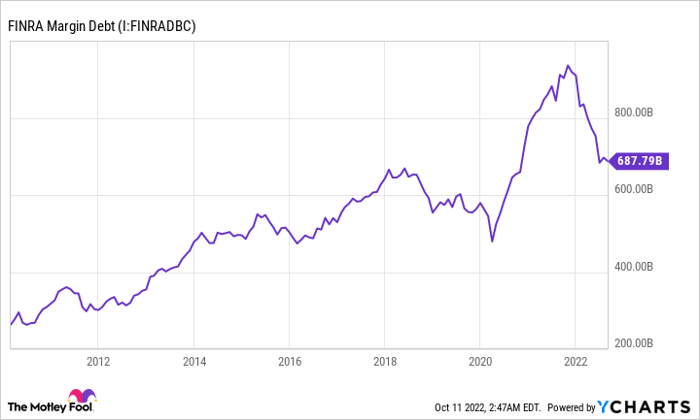
    “Margin debt” describes the amount of money investors have borrowed from their broker, with interest, to buy or short-sell securities. Although some trading activity requires the use of margin, such as short-selling, most outstanding margin debt is viewed as a snapshot of risk tolerance. In other words, margin is usually used as a tool to increase leverage or exposure to a security or the broader market.

    Over time, it’s perfectly normal for the amount of outstanding margin debt to increase in lockstep with the overall value of the stock market. What isn’t normal is when the amount of outstanding margin debt skyrockets over a short time frame.

    FINRA Margin Debt Chart.

    FINRA Margin Debt data by YCharts.

    Since the beginning of 1995, there have been three instances where margin debt surged 60% or more on a trailing-12-month (TTM) basis. This happened immediately prior to the dot-com bubble bursting, just months before the financial crisis took shape, and in March of last year. Upward percentage spikes in margin debt have preceded three of the past four bear markets (the one-month coronavirus crash being the exception).  

    Not only has outstanding margin debt been a good predictor of an eventual bear market, but it’s done a good job of forecasting bear market bottoms. When the dot-com bubble and financial crisis found their respective troughs, TTM declines in margin debt ranged between 40% and 50%. Current TTM declines in margin debt are only down a little over 20%. The implication is that we’d need to see additional unwinding of margin-based positions before a true market bottom is in place.

    For added context, the S&P 500 subsequently lost 49% and 57% of its respective value the previous two times margin debt skyrocketed by 60% or more in a 12-month stretch. It’s lost a peak of “just” 26% of its value in 2022.

    Here’s why you’re smart to buy stocks during bear market declines

    But the interesting thing about peril on Wall Street is that it also breeds opportunity. For investors, there’s been no greater ally than time.

    If you were to bet on which direction the stock market would head over the next 12 months, your chance of being correct is around 50%. But if your bet spans multiple decades, your chance of being correct goes way up.

    Every year, market analytics company Crestmont Research publishes data on the rolling 20-year total returns, including dividends paid, of the S&P 500 and expresses this data as an average annual total return. Crestmont has done this for 103 ending years (1919-2021). For example, if you wanted to know the rolling 20-year total return for 1939, Crestmont would factor in the total returns for years 1920 through 1939 and express it as an annual average total return.

    Here’s the interesting part: Out of the 103 end years examined, every single one — I repeat, every single one — produced a positive average annual total return over 20 years. No matter when you bought an S&P 500 tracking index since the beginning of 1900, you made money as long as you held onto that position for 20 years.

    Something else worth pointing out is that most folks would have made quite a bit of money. You can count on one hand the number of end years that produced an average annual total return of between 3.1% and 5%. By comparison, approximately 40% of these 103 end years delivered an average annual total return ranging from 10.9% to 17.1%. 

    In case you need even more evidence that being patient and optimistic is a winning strategy, consider this: The average double-digit percentage correction in the S&P 500 since the beginning of 1950 has lasted just 189 calendar days or about six months. Although we’re dealing with a longer bear market decline at the moment, history conclusively shows that bull markets last disproportionately longer than corrections.

    Eventually, this bear market will share the same fate as others before it and be placed in the rearview mirror by a bull market rally. 

    This article was originally published on Fool.com. All figures quoted in US dollars unless otherwise stated.

    The post This bear market risk indicator suggests we could head a lot lower appeared first on The Motley Fool Australia.

    More reading

    Sean Williams has no position in any of the stocks mentioned. The Motley Fool Australia’s parent company Motley Fool Holdings Inc. has no position in any of the stocks mentioned. The Motley Fool Australia has no position in any of the stocks mentioned. The Motley Fool has a disclosure policy. This article contains general investment advice only (under AFSL 400691). Authorised by Scott Phillips.  

    This article was originally published on Fool.com. All figures quoted in US dollars unless otherwise stated.

    from The Motley Fool Australia https://ift.tt/1M8tvIz