The first ETF for investors to look at is the BetaShares NASDAQ 100 ETF. This ETF allows investors to buy many of the highest quality companies in the world in one fell swoop. That’s because the BetaShares NASDAQ 100 ETF is home to the 100 largest non-financial shares on the famous NASDAQ exchange. Among the companies you’ll be investing in are Alphabet, Amazon, Apple, Meta, Microsoft, Netflix, and Tesla. And with the index down materially this year, now could be an opportune time to make a long term investment.
A second ETF for investors to look at is the VanEck Vectors Morningstar Wide Moat ETF. If you’re a fan of Warren Buffett, then this ETF could be for you. That’s because this ETF aims to invest in a group of fairly valued companies that have sustainable competitive advantages. This is something that Mr Buffett looks for when he invests. At present there are approximately ~50 shares included in the ETF. This includes Adobe, Alphabet, Amazon, Boeing, Constellation Brands, Microsoft, and Walt Disney.
VanEck Vectors Video Gaming and eSports ETF (ASX: ESPO)
A final ETF that could be a top option for investors is the VanEck Vectors Video Gaming and eSports ETF. This popular ETF give investors exposure to the growing video gaming market. VanEck highlights that the industry is well-positioned for growth thanks to the increasing popularity of video games and eSports. This could bode well for the companies included in the ETF such as hardware giant Nvidia and game developers Roblox, Take-Two, and Electronic Arts.
Motley Fool contributor James Mickleboro has no position in any of the stocks mentioned. The Motley Fool Australia’s parent company Motley Fool Holdings Inc. has positions in and has recommended BETANASDAQ ETF UNITS. The Motley Fool Australia has positions in and has recommended BETANASDAQ ETF UNITS. The Motley Fool Australia has recommended VanEck Vectors ETF Trust – VanEck Vectors Video Gaming and eSports ETF and VanEck Vectors Morningstar Wide Moat ETF. The Motley Fool has a disclosure policy. This article contains general investment advice only (under AFSL 400691). Authorised by Scott Phillips.
from The Motley Fool Australia https://ift.tt/ELCWowa
It can be a worrying time for Australian near-retirees when the share market falls. Many of them are intending to rely on ASX shares and other income-producing investments to fund their retirement.
So, when the S&P/ASX All Ordinaries Index (ASX: XAO) slumps by more than 12% — as it has done in 2022, retirees can get nervous.
Introducing Minchin Moore Private Wealth partner and principal, Ben Smythe, to provide some tips.
What can retirees do about market volatility?
Smythe writes in the Australian Financial Review (AFR) about “the reality of sequencing risk [becoming] more of a concern” for Australians near retirement.
Smythe said:
Sequencing risk refers to the sequence or order of returns – specifically negative returns – occurring at the same time you start to draw capital from your SMSF (self-managed superannuation fund) to fund your retirement.
A bear market in terms of investment returns at the outset of retirement can cause significant stress on the capital supporting your retirement. The amount of stress will be dictated by your living expense drawings and capital set aside …
If you are forced to sell assets that have deflated in value to fund your living expenses, the ability to recoup that realised capital loss will be incredibly difficult.
Here’s the good news… interest rates are going up
Smythe explains the importance of a cash buffer:
… recent market volatility is being driven in part by aggressive cash rate rises by central banks, which are starting to translate into higher returns on cash and term deposits.
Building a cash buffer as you approach retirement is an incredibly powerful tool to reduce the impact of sequencing risk as it allows you to draw your living expenses from your cash bucket as you enter retirement rather than solely from other asset classes which may be far more volatile.
The role of cash in your portfolio should simply be to provide liquidity and nil volatility. The added bonus now is that can also earn quite a reasonable return.
Regarding how much cash you should hold, the general rule of thumb is for retirees to aim for at least two years of living expenses.
This balance will ebb and flow with withdrawals and investment income received but if you can aim for this target, it will provide a buffer if there is a prolonged bear market affecting the other asset classes in your SMSF.
Can you buy ASX shares with your cash buffer?
Smythe says the other advantage of cash is being able to trade off some liquidity for higher returns.
… a high cash buffer allows you to better segment your investments in bond and credit holdings if you are not necessarily relying on either of these investments for liquidity.
Credit investments in particular will offer a higher return if you are happy to forgo liquidity, which could meaningfully add to the expected returns from your defensive component.
If you can capture a higher return from your defensive assets to compensate your declining growth assets, once again this will help mitigate sequencing risk causing damage to your portfolio.
‘Equity markets will have more good years than bad’
Smythe concludes:
In most cases, those long-term capital market returns should be satisfactory if the investment strategy is well-thought-out and you have a suitable plan to fund your cash flow needs in the “bad” years.
Motley Fool contributor Bronwyn Allen has no position in any of the stocks mentioned. The Motley Fool Australia’s parent company Motley Fool Holdings Inc. has no position in any of the stocks mentioned. The Motley Fool Australia has no position in any of the stocks mentioned. The Motley Fool has a disclosure policy. This article contains general investment advice only (under AFSL 400691). Authorised by Scott Phillips.
from The Motley Fool Australia https://ift.tt/g4cXjis
The battery metals trade is showing no signs of exhaustion in the second quarter of FY23. The basket’s lead child, lithium, continues to set new all-time highs, which is helping to boost ASX shares in this space.
At the time of writing, lithium carbonate futures are priced at A$115,105.09 per tonne, their highest mark on record.
This continues an extensive period of upside for the key battery ingredient whereby prices have curled up from previous lows (if you’d even call it that) in May and surpassed previous highs in late September.
Meanwhile, nickel and cobalt – two other key battery metals – have consolidated heavily over the past six to nine months and now trade just above yearly lows.
All three are seen on the chart below from September 2021 to date.
What’s next for ASX shares in this segment?
Along with the upswing in long-term lithium pricing have come numerous new entrants in the lithium sphere.
Various companies now have exposure to lithium exploration and a handful to the processing and production of battery-grade product.
Several more are on the quest to do so. The point is, there are numerous ASX shares in the battery metals space that sit at selective points along the chain.
First are the miners, then those involved in the distribution and refining processes, and then the more tech-based players that are innovating in the space, to name a few.
Key lithium players Pilbara Minerals Ltd (ASX: PLS), Lake Resources NL (ASX: LKE) and Core Lithium Ltd (ASX: CXO) have been star performers on the ASX this year.
There are also those at the larger end of town, including IGO Ltd (ASX: IGO) and the large players involved in nickel and cobalt extraction, like Cobalt Blue Holdings Ltd (ASX: COB).
What do the brokers say?
Understanding the returns of this broad range of ASX shares gives unique insights into the performance of the industry.
How about looking ahead, though? According to Refinitiv Eikon data, sentiment across the sector looks to be bullish, with many of the names above tipped to continue upwards.
For the most part, the ASX shares above are each rated a buy, suggesting that analysts are still constructive on the battery metals segment – within this basket, at least.
Name
Buy / total
Consensus Price Target
From Current price
Pilbara Minerals Ltd
3 from 10
$3.93
-16.2%
Core Lithium Ltd
3 from3
$1.60
38.5%
Lake Resources NL
5 from 5
$2.43
149.2%
IGO Ltd
11 from 14
$14.12
-7.8%
Cobalt Blue Ltd
1 from 1
$1.10
59.4%
The share prices of the above group are tipped to grow at around 44% on average over the next 12 months. However, that’s a long time in the current economic climate.
Of particular note is Lake Resources, with tremendous upside yet to be priced in, brokers say.
In the meantime, time will tell on the next moves for ASX battery metals shares. Key to the debate is the price of lithium, which is showing no signs of slowing just yet.
Motley Fool contributor Zach Bristow has no position in any of the stocks mentioned. The Motley Fool Australia’s parent company Motley Fool Holdings Inc. has no position in any of the stocks mentioned. The Motley Fool Australia has no position in any of the stocks mentioned. The Motley Fool has a disclosure policy. This article contains general investment advice only (under AFSL 400691). Authorised by Scott Phillips.
from The Motley Fool Australia https://ift.tt/87zmrkQ
This article was originally published on Fool.com. All figures quoted in US dollars unless otherwise stated.
This article was originally published on Fool.com. All figures quoted in US dollars unless otherwise stated.
It has been a terrible year for Netflix(NASDAQ: NFLX) investors. A sudden loss of paid subscribers has weighed heavily on the stock, which has lost more than 60% of its value so far in 2022. But the streaming giant could see a major turnaround in its fortunes sooner rather than later.
Netflix announced earlier this year that it plans to introduce an ad-supported subscription plan in addition to its existing tiers. The plan was expected to go live in 2023, but reports suggest that Netflix may have moved up the timeline to arrest its subscriber losses. It is hotly anticipated that the ad-supported tier could be launched as soon as Nov. 1.
Though the company is tight-lipped about the updated timeline, it reportedly expects 4.4 million subscribers on its ad-supported platform by the end of the year. However, JPMorgan analyst Doug Anmuth believes that this is just the beginning, and introducing an ad-supported tier could supercharge Netflix’s long-term revenue growth.
An ad-supported plan could be a game changer
Anmuth estimates that 7.5 million subscribers could opt for the ad-supported plan in the U.S. and Canada by 2023, helping Netflix generate $600 million in advertising revenue. While that would be a small portion of Netflix’s top line given that the company has generated $31 billion in revenue over the trailing 12 months, ad revenue is expected to jump substantially in the long run.
The JPMorgan analyst sees the ad-supported plan driving $2.65 billion in ad revenue by 2026 thanks to a solid subscriber base of 22 million. The global numbers are expected to be much higher. Netflix estimates that it could have 40 million ad-supported subscribers globally by the end of 2023, up sharply from its estimate of 4.4 million for 2022. Meanwhile, market research firm Omdia estimates that 60% of Netflix’s global subscriber base could be on an ad-supported tier by 2027.
The company could generate 14% of its global revenue through ad sales after five years, up significantly from just 1% in 2023. It remains to be seen how much revenue this new plan could bring in for the company in the long run, but it wouldn’t be surprising to see an ad-supported plan become a major growth driver for Netflix for two simple reasons.
Why this move could be a masterstroke
The first reason why an ad-supported plan could supercharge Netflix’s growth is that it could make the company’s plans more accessible. Reports suggest that Netflix could price the new plan between $7 and $9 per month. That could give customers a nice alternative to the company’s most popular plan, which costs $15.49 a month.
Netflix’s basic plan is priced at $9.99 per month, and the premium one goes for $19.99 a month in the U.S. But users are reportedly fatigued with the company’s regular price increases — as well as the surging inflation — and these factors could lead them to quit the platform. So the introduction of an ad-supported tier that undercuts Netflix’s basic plan could bring a sigh of relief to the company and help it arrest subscriber losses.
What’s more, the company will now be in a stronger position to compete against rivals with a more aggressive pricing strategy. That could give Netflix a better chance of restoring subscriber growth and bolstering its presence in the fast-growing video streaming market, which is expected to hit $139 billion in revenue by 2027, a substantial increase from this year’s estimate of $80 billion.
However, it is the second factor that I believe could be a bigger growth driver for Netflix. The company boasted nearly 221 million paid subscribers in the second quarter of 2022. The streaming platform also has high user engagement. In 2020, Netflix users were reportedly consuming 3.2 hours of video content per day, up from the pre-pandemic average of two hours.
Assuming Netflix users’ average video consumption per day has declined to the pre-pandemic levels, given its massive user base, the company still provides a robust platform to engage digital advertisers. So Netflix could be about to enter a gigantic market, as video ad spending is expected to hit $180 billion this year. By 2027, annual spending on video ads could rise to $318 billion, which would be much higher than what the video streaming market is expected to generate.
As such, the digital ad market could unlock a whole new growth frontier for Netflix. Analysts are currently anticipating just 8.8% annual growth from the company over the next five years, but it could do much better than that as it has more than just the video streaming services market to tap into now. And with the stock trading at just 20 times trailing earnings now, compared to Netflix’s five-year average multiple of 104, investors can consider accumulating this tech stock today.
This article was originally published on Fool.com. All figures quoted in US dollars unless otherwise stated.
JPMorgan Chase is an advertising partner of The Ascent, a Motley Fool company. JPMorgan Chase is an advertising partner of The Ascent, a Motley Fool company. The Motley Fool Australia’s parent company Motley Fool Holdings Inc. has positions in and has recommended JPMorgan Chase and Netflix. The Motley Fool Australia has recommended Netflix. The Motley Fool has a disclosure policy. This article contains general investment advice only (under AFSL 400691). Authorised by Scott Phillips.
This article was originally published on Fool.com. All figures quoted in US dollars unless otherwise stated.
from The Motley Fool Australia https://ift.tt/ouQvzjP
The Sayona Mining Ltd (ASX: SYA) share price has been struggling since its S&P/ASX 200 Index (ASX: XJO) debut.
Sayona shares have lost 24% since market close on 16 September and are now fetching 23 cents. Today, Sayona shares closed flat.
So what’s going on with the Sayona Mining share price?
Sayona shares fall
Sayona officially joined the ASX 200 on September 19 following the S&P DJI quarterly rebalance.
The company’s shares exploded 200% between market close on 23 June and 12 September before pulling back.
But Sayona is not the only ASX lithium share that has struggled recently.
For example, Core Lithium Ltd (ASX: CXO) shares have dived nearly 20% since market close on 16 September. Piedmont Lithium Inc (ASX: PLL) shares have lost 5% in the same time frame and Galan Lithium Ltd (ASX: GLN) shares have shed nearly 12%.
Sayona has delivered plenty of positive news to the market since joining the ASX 200.
On 4 October, Sayona announced it has launched a pre-feasibility study to produce lithium carbonate from the North American Lithium (NAL) project. Managing director Brett Lynch said the company is working towards “becoming a leading integrated producer and the largest in North America”.
However, profit-taking after recent gains and sector weakness may have impacted the Sayona share price recently, as my Foolish colleague James noted.
Looking ahead, a Resources and Energy September quarterly report is predicting both lithium hydroxide and spodumene prices to rise in 2023 before pulling back in 2024.
Sayona share price snapshot
The Sayona share price has soared 42% in the past year, while it has surged 69% year to date.
For perspective, the ASX 200 has lost 7.5% in the past year.
Sayona has a market capitalisation of more than $1.8 billion based on the current share price.
Motley Fool contributor Monica O’Shea has no position in any of the stocks mentioned. The Motley Fool Australia’s parent company Motley Fool Holdings Inc. has no position in any of the stocks mentioned. The Motley Fool Australia has no position in any of the stocks mentioned. The Motley Fool has a disclosure policy. This article contains general investment advice only (under AFSL 400691). Authorised by Scott Phillips.
from The Motley Fool Australia https://ift.tt/BLkStmy
If Australian Foundation Investment Co Ltd (ASX: AFI) shares are on your radar this October, you might be keen to know what you’d be investing in.
AFIC is a listed investment company (LIC) that trades on both the ASX and NZX, with a history dating all the way back to 1928.
The LIC invests in a portfolio of primarily ASX shares with a long-term, fundamental, bottom-up investment style. The suggested investment period is five to 10 years or longer.
While most exchange-traded funds (ETFs) passively track an index, LICs are usually actively managed investments.
The main difference between a LIC and an ETF is the structure. An ETF is open-ended, whereas a LIC is closed-ended, which means that a fixed number of shares are issued.
What’s more, ETFs tend to offer greater transparency. ETF issuers typically update their full list of holdings daily, whereas LICs usually provide a snapshot of their portfolio at the end of each month.
Compared to the S&P/ASX 200 Index (ASX: XJO), AFIC’s top 10 is less weighted towards the big banks and miners.
The ASX’s largest company, BHP, has lost its crown, being relegated to third place in AFIC’s portfolio. Australia and New Zealand Banking GroupLtd (ASX: ANZ) and Woodside Energy Group Ltd (ASX: WDS) are notably missing in action. Meanwhile, AFIC is giving Transurban a big vote of confidence.
At the end of September, AFIC’s largest sector weighting belonged to financials, which accounted for around 28% of the portfolio. Next up were materials at 15%, closely followed by health care at 14% and then industrials at 12%.
In contrast, the BetaShares Australia 200 ETF (ASX: A200), which aims to track the ASX 200 index, had a 29% weighting to financials shares at the end of September. A further 23% of the portfolio was exposed to materials, followed by health care at 11% and energy at 6%.
In terms of share price growth and dividends, AFIC has outperformed the S&P/ASX 200 Accumulation Index over a 10-year period. According to AFIC, it’s delivered an average of 11.1% per annum compared to the benchmark’s 10% per annum.
Motley Fool contributor Cathryn Goh has positions in BetaShares Australia 200 ETF. The Motley Fool Australia’s parent company Motley Fool Holdings Inc. has positions in and has recommended CSL Ltd. The Motley Fool Australia has positions in and has recommended Wesfarmers Limited. The Motley Fool Australia has recommended Macquarie Group Limited and Westpac Banking Corporation. The Motley Fool has a disclosure policy. This article contains general investment advice only (under AFSL 400691). Authorised by Scott Phillips.
from The Motley Fool Australia https://ift.tt/zf742px
The Motley Fool chats with the best in the industry so that you can get an insight into how the professionals think. In this edition, Medallion Financial managing director Michael Wayne picks the ASX shares to buy now and hold onto long term.
The ASX share for a comfortable night’s sleep
The Motley Fool: If the market closed tomorrow for four years, which stock would you want to hold?
Michael Wayne: A boring response would be to buy an index ETF, for instance. Again, you could buy an Australian index ETF — or a potentially NASDAQ — as a long-term hold wouldn’t be the worst thing at the moment, given the magnitude of the falls that we’ve seen. You can also look at different listed investment companies, that way you’re getting diverse exposure.
Because, look, it’s very difficult to say with any certainty what a company is going to be doing in four years. Obviously, there’s a lot of updates between now and then from the business but I think the company, one that I referred to earlier, like CSL Limited (ASX: CSL) is as good a bet as any, I think, on a four-year basis, if you couldn’t watch the markets or even look at it.
It’s had a wonderful track record, the business is growing at a rapid rate against the revenue line and the earnings line. Essentially, it’s a company which has a plethora of different biotech type projects under the one umbrella. You’re getting exposure to a whole range of potential kickers in growth.
It’s a company that we think has the runs on the board… has a very solid and renowned management team and also has a very good balance sheet for that. CSL will be a long-term company to hold.
MF: As you say, it’s almost like it has four or five companies in one, hasn’t it?
MW: Yeah, they’ve got all different projects and all different drug developments that they’re looking to target for all different types of medical conditions. And they’re able to allocate the funds to the projects that they believe have the biggest chance of success.
Obviously, because they’ve been doing this for so long, they have the best insight and the best experience, which improves your chances of success immeasurably, compared to if you were to go out into the market and buy an exciting biotech company. But [for] those single product biotech companies, it’s very much about finding the outcome.
Sure, they might succeed, they might go out and get FDA approval and enter all sorts of markets. But on the other hand, they might not meet those clinical trial requirements and they might end up amounting to nothing.
At least with CSL, you’re getting a diversified portfolio of biotech projects in one place. And they’re also able to fund themselves internally because they’ve got, obviously, a lot of different products, from the blood plasma to the flu vaccine, haemophilia vaccines, all sorts of things which are highly profitable. They’re able to then use the cash flow generated from those existing products to fund their research and development in new and emerging products, unlike, again, a single product biotech.
Motley Fool contributor Tony Yoo has positions in CSL Ltd. The Motley Fool Australia’s parent company Motley Fool Holdings Inc. has positions in and has recommended CSL Ltd. The Motley Fool Australia has no position in any of the stocks mentioned. The Motley Fool has a disclosure policy. This article contains general investment advice only (under AFSL 400691). Authorised by Scott Phillips.
from The Motley Fool Australia https://ift.tt/qaQ3Du8
Thus far, 2022 hasn’t been kind to investors in the share market. Although it’s well established that temperament and patience are equally as important — if not more important — than skill and knowledge to succeed as an investor, no doubt the magnitude of this bear environment has tested the resolve of even some of the more experienced investors.
The question is, should investors sell their shares, what could they do with the proceeds? Where in this environment can they hide?
High Yield Corporate Bonds
Well, there’s always corporate bonds. Rather than buying a company’s shares (i.e. equity), bonds are a form of debt sold by a business to raise capital. Investors will typically receive fixed interest payments (coupons) in return for effectively providing a loan to a business, but they won’t receive any extra income if the company performs well.
Depending on the business, bonds tend to be less risky (but also less rewarding) than shares because, in the event of liquidation, all creditors are repaid before shareholders may see a cent.
But bonds still carry risk. High-yield (HY) bonds, typically offered by companies with lower credit scores, naturally carry greater credit risk than investment-grade (IG) bonds (those offered by businesses with sound credit scores, like the big-four banks). If we were to have a recession, or if economic conditions continue to become more challenging generally, you’d tend to see more corporate defaults.
So whilst high yield corporate bonds sound good in theory, they do carry a higher risk because the underlying companies have poorer credit scores.
Because of that heightened risk, the returns required by investors in high yield bonds increases; that leads to a higher yield and, consequently, a lower bond price — a bad thing for bondholders (bond yields and prices move in opposite directions).
Investment-grade Corporate Bonds
Okay, so maybe you could look at IG bonds instead. The risk is lower (because the underlying businesses have a stronger credit rating) and therefore expected returns (the interest payments for investors) aren’t as high. You absolutely could do this, and bonds are a staple in many well-diversifiedportfolios. Would you want to put all your capital in them, though?
I’m not so sure.
Let’s assume for a minute that you focus on the short-dated bonds (say, 12 months or less). If you hold the bond to maturity, you might pocket a couple of coupon payments and get your principal repaid at maturity.
But the yield (your overall return) isn’t likely to be very significant; although some would justifiably make the case for capital preservation, particularly in the current environment. The return also might not be enough to exceed inflation. For instance, annual inflation in Australia reached 6.1% in the June quarter, and the Reserve Bank of Australia (RBA) expects inflation could end up at 7.75% this year. Inflation is even higher in countries like the US and UK, so investors are currently finding it difficult to generate real returns (returns above the rate of inflation) from defensive assets.
Investors could instead opt for longer-dated bonds (say, 5-10 years, or more!). These offer the potential for greater returns over time, partly through (typically) higher yields as well as due to shifts in the yield curve (which rises and falls based on expectations of future interest rate movements, amongst other factors). But if rates continue to rise, so too should the yield curve, which could negatively impact the value of your bonds – recalling that bond prices fall when yields rise.
Government Debt
The same goes for government bonds, which carry even less risk than IG bonds. As we know, the lower the risk, the lower return we can expect from our investments.
At the moment, 10-year Australian government bonds can be bought with a yield of 4.0%, meaning a negative real yield today (given that inflation is running hot) and minimal real return potential, assuming inflation returns to the RBA’s target range of 2%-3% over time.
Cash
So, rather than bonds, maybe investors should just carry cash. But as the least risky investment class (Australian deposit guarantees exist), we can expect the lowest returns from this asset class.
One positive for cash is that as interest rates rise, the variable rate (or yield) on savings accounts increases. This is in contrast to bond coupons which are typically ‘fixed’ payments.
Still, yields on cash are unlikely to generate a positive real (i.e. after inflation) rate of return.
Cash, however, does provide some optionality during volatile times, but it loses its usefulness over very long periods of time.
Real Assets
Real Assets (such as commercial property and infrastructure assets) can offer some protection against inflation, as they typically generate strong cash flows with contracted or regulated price increases over time. For instance, a shopping centre landlord may set annual rent increases linked to the consumer price index (CPI), or a regulated toll road operator may have CPI-linked toll escalations.
Listed real assets can also be bought and sold like other companies on the share market, and the market’s inherent volatility means these assets can be bought below fair value from time to time.
Like any asset class, though, real asset investments are subject to a range of risks, including economic, liquidity and operational risk. They can also be pet expensive to maintain. Because real assets are typically funded with significant debt, there’s also the potential for higher borrowing costs as interest rates rise, as well as declining valuations as asset prices and yields rebase across the economy.
The challenge with investing in real assets at the moment is that they are susceptible to rising interest rates which not only reduce their theoretical valuation but also reduce overall demand as less people can afford the mortgages and loans required to finance the purchase.
The Case For Shares
Overall, when inflation is running high, often the best place for investors (with long-term horizons) to hide is in strong cash flow generating assets with growth potential. As you may have guessed, high-quality operating businesses can exhibit both these characteristics, making listed equities one place for investors to find opportunities to ‘hide’.
Of course, shares aren’t without risk, either. We’ve witnessed plenty of businesses suffer from the impacts of inflation and supply chain pressures recently. And again, investors can absolutely make a strong case of ‘capital preservation’ for some of the above asset classes.
But bear in mind, the share market has already endured heavy falls. To cash out now (if you haven’t already) could be to do so at precisely the wrong time. Indeed, just as one investor could argue the case for capital preservation from government debt or holding cash, another investor could argue that those safer asset classes won’t be enough to help offset increases in inflation. They could also argue that there are plenty of attractive opportunities presenting themselves on the ASX for those willing to put up with temporary uncertainty.
Compared to other asset classes, the long-term income and capital growth potential of certain equities remains very attractive. With some equity indices materially lower than they were just at the start of the year, there are inflation-beating opportunities that are being thrown out with the rest of the market.
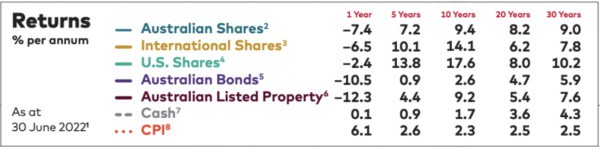
Vanguard’s study of asset class returns over 30 years shows that whilst shares are very volatile, they generally provide higher returns over the long-term.
Source: Vanguard 2022 index chart. Market returns as of 30 June 2022.
Foolish Bottom Line
It should be noted that we fully endorse investors having a well diversified portfolio.
Not only does that mean investing across different businesses within different industries, and with different risk exposures; it also means maintaining some cash and balancing your exposure across different asset classes (e.g. real estate, fixed income, etc.).
However, the point is that each asset class has its own risks and potential benefits. To withdraw everything from the share market in the face of volatility to put it in bonds, for instance, is still likely to leave you exposed to credit or other risks while potentially limiting your upside. Likewise, to move all your capital into real estate could yield you some real assets, although those real assets may come under pressure from rising interest rates and a cooling economy.
The reality is that, in such an uncertain environment, there is no ‘perfect’ place to hide. With shares down considerably from their highs, however, we firmly believe there are attractive opportunities presenting themselves. That is, investors have sold out — possibly out of either necessity or panic — of businesses that are worth more than they are currently trading for. It may take some time to get back to what we consider to be more reasonable values, but we firmly believe that will happen.
In that sense, we strongly encourage investors to sit tight. In fact, we’d go a step further and encourage them to buy while prices are down, and potentially put themselves in a position to outpace the rate of inflation over the coming years.
Motley Fool contributor Ryan Newman has no position in any of the stocks mentioned. The Motley Fool Australia’s parent company Motley Fool Holdings Inc. has no position in any of the stocks mentioned. The Motley Fool Australia has no position in any of the stocks mentioned. The Motley Fool has a disclosure policy. This article contains general investment advice only (under AFSL 400691). Authorised by Scott Phillips.
from The Motley Fool Australia https://ift.tt/2t1Cdis
According to a note out of Morgans, its analysts have retained their add rating on this mining giant’s shares with a trimmed price target of $47.40. Morgans has been looking at the mining sector and named BHP as one of its top two picks. This is due to its strong free cash flow generation, low risk profile, and belief that less can go wrong relative to its peers. The BHP share price ended the week at $40.02.
A note out of Citi reveals that its analysts have retained their buy rating and $8.75 price target on this regional bank’s shares. Although Bank of Queensland’s FY 2022 cash earnings were below consensus estimates, the broker highlights positive commentary on interest rate leverage. It believes the market has been underestimating the extent of rates leverage across the sector. And while disappointed with its cost outlook, it expects this to be offset by higher rates. The Bank of Queensland share price was fetching $7.73 at Friday’s close.
Analysts at JP Morgan have retained their overweight rating and lifted their price target on this airline operator’s shares to $7.50. This follows the release of a trading update for the first half that was well ahead of expectations. And with the domestic market remaining rational and its balance sheet recovering, JP Morgan remains very positive on the company’s outlook. The Qantas share price was trading at $5.80 at the end of last week.
Motley Fool contributor James Mickleboro has no position in any of the stocks mentioned. The Motley Fool Australia’s parent company Motley Fool Holdings Inc. has no position in any of the stocks mentioned. The Motley Fool Australia has no position in any of the stocks mentioned. The Motley Fool has a disclosure policy. This article contains general investment advice only (under AFSL 400691). Authorised by Scott Phillips.
from The Motley Fool Australia https://ift.tt/1WMwZCJ
The first ASX 200 dividend share that could be a top option for income investors next week is Transurban.
It is one of the world’s leading toll road operators with a portfolio of important roads and a pipeline of development projects to drive future growth.
The team at Morgans is positive on the company. So much so, it has Transurban on its best ideas list with a $13.85 price target. The broker likes the company due to regional population, employment growth, urbanisation, and positive exposure to inflation. It explained:
TCL owns a pure play portfolio of toll road concession assets located in Melbourne, Sydney, Brisbane, and North America. This provides exposure to regional population and employment growth and urbanisation. Given very high EBITDA margins, earnings are driven by traffic growth (with recovery from COVID) and toll escalation (roughly 70% by at least CPI and approximately one-quarter at a fixed c.4.25% pa). We think TCL will continue to be attractive to investors given its market cap weighting (important for passive index tracking flows), the high quality of its assets, management team, balance sheet, and growth prospects
In respect to dividends, Morgans expects dividends per share of 53.4 cents in FY 2023 and then 65.8 cents in FY 2024. Based on the current Transurban share price of $12.54, this implies yields of 4.25% and 5.25%, respectively.
Another ASX 200 dividend share to consider is this retail conglomerate.
Woolworths could be a top option thanks to its strong retail brands, entrenched customer base, positive exposure to inflation, and defensive qualities. The latter were on display for all to see during the pandemic and could come in handy if the Australian economy falls into a recession.
In addition, the team at Goldman Sachs highlights the company’s digital and omni-channel advantage. The broker expects this advantage to drive further market share and margin gains in the coming years. Goldman said:
Despite a still volatile year ahead and noise in pcp data, most industry suppliers note that WOW is still firmly in a more advantaged position on omni-channel capabilities. This is largely attributed to the company’s early investments/advantage in digital and its more agile omni-channel supply chain network development.
It is partly for this reason that Goldman currently has a conviction buy rating and $42.70 price target on the company’s shares.
As for dividends, Goldman is forecasting fully franked dividends per share of $1.07 in FY 2023 and $1.16 in FY 2024. Based on the current Woolworths share price of $33.76, this will mean yields of 3.2% and 3.4%, respectively.
Motley Fool contributor James Mickleboro has no position in any of the stocks mentioned. The Motley Fool Australia’s parent company Motley Fool Holdings Inc. has no position in any of the stocks mentioned. The Motley Fool Australia has no position in any of the stocks mentioned. The Motley Fool has a disclosure policy. This article contains general investment advice only (under AFSL 400691). Authorised by Scott Phillips.
from The Motley Fool Australia https://ift.tt/NrT4u1J