
It was a historic day for the S&P/ASX 200 Index (ASX: XJO) yesterday, eclipsing its former record high. The benchmark index trotted upwards to a fresh ceiling of 7,682.30, adding to a smashing three-month stretch for Aussie investors.
The milestone is met with great joy for those who have already jumped aboard the wealth-making equity train. However, the accomplishment might be interpreted differently by people still on the sidelines hoping to take the plunge into stocks.
Like a good pair of R.M. Williams leather boots, waiting for a discount may lead to paying a higher price at a later date.
Unfortunately, the mind can sometimes be bad at understanding value. We tend to only perceive value as a price lower than what we’ve seen before. We assume a new high price represents poor value, even though it might still be a good deal for the product or service.
Let’s make use of history for a more informed interpretation.
ASX 200 at record high, is the market overvalued?
History can be a great teacher. Still, it is important to remember that past performance is not an indicator of future performance. However, it can give us a better picture of what is possible under similar conditions.
Since 1980, the Australian share market has seen its fair share of crashes. But, like clockwork, Australia’s collection of the top 200 listed companies has driven the index to new heights time and time again.
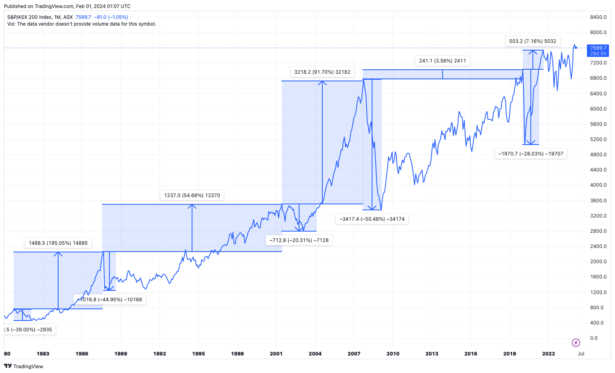
As shown above, once the ASX 200 surpasses its previous record high, the index often marches onwards.
For example, the market tripled in value after clawing back from the damaging 1981 crash. Likewise, Aussie investors relished a 55% gain beyond the freshly set record high that followed the 1987 implosion.
On the flip side, if an investor sold $10,000 worth of shares at the September 1987 high and waited for the index to return to its former high, they’d have missed out on $23,859 in gains to date — excluding the accumulation of dividends.
The reality is that if history repeats itself, there’s rarely a ‘bad time’ to invest, given a long enough time horizon.
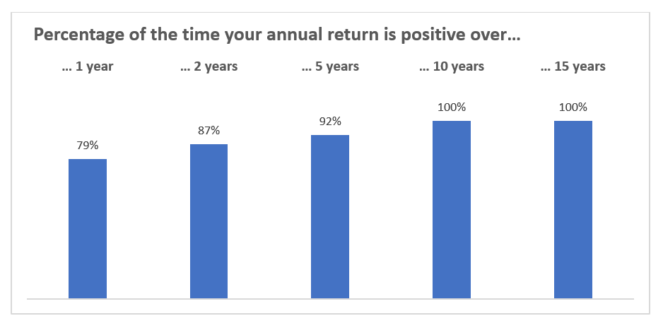
Data from prominent exchange-traded fund (ETF) provider Vanguard Australia demonstrates this well. If you had invested at any point in the last 30-odd years, the chance of making a gain within a year was 79%. If the investment period is expanded to 10 years — suddenly, the chance of making a positive return is 100%.
A tactic to remove the guesswork
Price is only one variable of the value equation. A $500 pair of boots that last 10 years offers better value than a $300 pair of boots that fall apart after five years. In other words, the record high of the ASX 200 is meaningless in terms of value without knowing what you’re getting for the price.
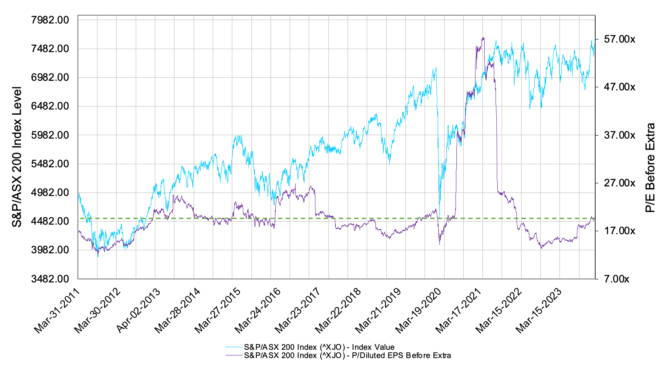
Although the price-to-earnings (P/E) ratio of the ASX 200 is at its highest level in two years, it’s still well below the multiples seen around 2016 and 2017. Furthermore, despite those elevated multiples, the ASX 200 continued to climb amid increasing company earnings, as shown below.
So, how does one know when the right time to plunge into shares is? Run to the antique shop and hope to find a crystal ball with magical powers… I’m joking, of course.
The honest answer is there’s no accurate and reliable way of knowing when to buy to avoid a crash. Here’s the kicker, though — if you’re investing for long enough, you’ll likely encounter it regardless.
My approach is to implement dollar-cost averaging. Not only does it remove the stress of investing at a temporary high, but it also benefits a portfolio during crashes by buying more shares for the same amount of money.
This method of buying on a consistent cadence means less time sweating over what a record high for the ASX 200 means and more time enjoying life.
The post History suggests snubbing the ASX 200 at record highs could be a costly mistake — here’s why appeared first on The Motley Fool Australia.
Wondering where you should invest $1,000 right now?
When investing expert Scott Phillips has a stock tip, it can pay to listen. After all, the flagship Motley Fool Share Advisor newsletter he has run for over ten years has provided thousands of paying members with stock picks that have doubled, tripled or even more.*
Scott just revealed what he believes could be the ‘five best ASX stocks’ for investors to buy right now. These stocks are trading at near dirt-cheap prices and Scott thinks they could be great buys right now…
See The 5 Stocks
*Returns as of 10 November 2023
(function() {
function setButtonColorDefaults(param, property, defaultValue) {
if( !param || !param.includes(‘#’)) {
var button = document.getElementsByClassName(“pitch-snippet”)[0].getElementsByClassName(“pitch-button”)[0];
button.style[property] = defaultValue;
}
}
setButtonColorDefaults(“#0095C8”, ‘background’, ‘#5FA85D’);
setButtonColorDefaults(“#0095C8”, ‘border-color’, ‘#43A24A’);
setButtonColorDefaults(“#fff”, ‘color’, ‘#fff’);
})()
More reading
- After 8 days of gains and a record high why is the ASX 200 tumbling today?
- 5 things to watch on the ASX 200 on Thursday
- These were the best performers on the ASX 200 in January
- Here are the top 10 ASX 200 shares today
- 3 big questions about the Australian stock market in 2024
Motley Fool contributor Mitchell Lawler has no position in any of the stocks mentioned. The Motley Fool Australia’s parent company Motley Fool Holdings Inc. has no position in any of the stocks mentioned. The Motley Fool Australia has no position in any of the stocks mentioned. The Motley Fool has a disclosure policy. This article contains general investment advice only (under AFSL 400691). Authorised by Scott Phillips.
from The Motley Fool Australia https://ift.tt/fHEbJlT
Leave a Reply