
Coles Group Ltd (ASX: COL) shares are down more than 10% in the last six months, and the economic pain for the ASX supermarket share may not be over if shelf prices fall.
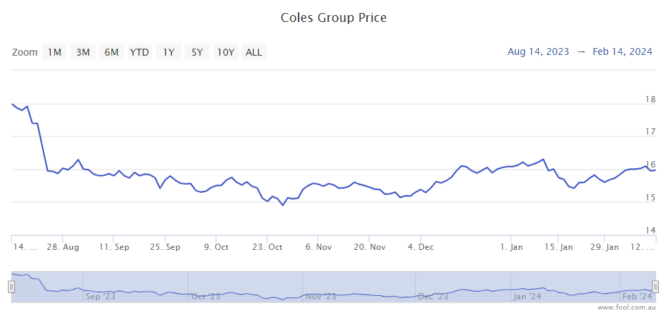
In the last two years, there have been periods of time where the market was excited by Coles’ ability to pass on price rises to consumers. During FY23, we did see the company’s gross profit margin slightly increase, meaning it seemed to have increased prices a little more than what suppliers had charged.
If the company’s earnings before interest tax (EBIT) margin stays the same (or rises), then revenue growth due to inflation is helpful. For example, if Coles’ EBIT margin were 5%, it’d make $5 of EBIT on a $100 basket of goods. If the EBIT margin stays at 5% and the basket price rises to $110, Coles would make $5.50 of EBIT. That’s a stronger bottom line from inflation, even though the margin hasn’t changed. I think this is why Coles shares rose a couple of times during 2022 and 2023.
Food prices to fall?
We’ve already seen Coles reduce lamb prices in supermarkets by a significant amount and there are potentially more cuts for some products under consideration.
Reporting by The Australian this week suggested that supermarkets are wanting to cut prices amid political pressure from a federal Senate inquiry into supermarket prices. Â
Coles has reportedly asked some suppliers for price cuts to reflect a decline in inflation and a reduction of input costs such as logistics and raw materials, which are now cheaper than recent peaks. However, The Australian reported that some suppliers may not give in easily to those price-cut requests because they want to protect their own profits.
In a submission to the Senate inquiry, Coles said its energy, labour logistics and packaging costs had increased by $1.4 billion between 2019 to 2023, with $600 million of that being because of higher employee costs, driven by wage increases. It said:
Significant increases in global commodity prices have flowed through to Australia and impacted Coles and its suppliers, resulting in the pass-through of increasing input costs to fresh and packaged goods.
Lower profits for Coles?
If the company sees lower profit, that could be a headwind for Coles shares.
While some input costs may have reduced, wage and rent costs are increasing for Coles.
Plus, even if its EBIT margin somehow stays the same, Coles’ profit may suffer from deflation if the (above example of) $110 basket of goods heads back towards a cost of $100.
The broker UBS thinks Coles is likely to lose market share over the next six months, with Aldi best-placed to take market share, while Woolworths Group Ltd (ASX: WOW) also has the potential to gain share.
Coles could see increased costs from its new Witron and Ocado automated warehouses.
UBS thinks the Coles EBIT will fall to $1.85 billion and net profit after tax (NPAT) could fall by around 10% to $997 million, leading to an approximate 10% fall in the dividend per share. However, Coles is then expected to see earnings recover to almost FY23 levels in FY25 and eclipse FY23 in FY26.
The post How price cuts on the shelves could hurt Coles shares appeared first on The Motley Fool Australia.
Wondering where you should invest $1,000 right now?
When investing expert Scott Phillips has a stock tip, it can pay to listen. After all, the flagship Motley Fool Share Advisor newsletter he has run for over ten years has provided thousands of paying members with stock picks that have doubled, tripled or even more.*
Scott just revealed what he believes could be the ‘five best ASX stocks’ for investors to buy right now. These stocks are trading at near dirt-cheap prices and Scott thinks they could be great buys right now…
See The 5 Stocks
*Returns as of 10 November 2023
(function() {
function setButtonColorDefaults(param, property, defaultValue) {
if( !param || !param.includes(‘#’)) {
var button = document.getElementsByClassName(“pitch-snippet”)[0].getElementsByClassName(“pitch-button”)[0];
button.style[property] = defaultValue;
}
}
setButtonColorDefaults(“#0095C8”, ‘background’, ‘#5FA85D’);
setButtonColorDefaults(“#0095C8”, ‘border-color’, ‘#43A24A’);
setButtonColorDefaults(“#fff”, ‘color’, ‘#fff’);
})()
More reading
- 3 no-brainer ASX dividend stocks to buy for market-beating returns in 2024
- 7 must-see results this ASX reporting season before buying or selling
- Citi says Coles and these ASX dividend stocks are buys
- Falling yields? I’d buy these ASX dividend beasts for a beefed-up income in 2024
- Brokers say these ASX dividend stocks are buys
Motley Fool contributor Tristan Harrison has no position in any of the stocks mentioned. The Motley Fool Australia’s parent company Motley Fool Holdings Inc. has no position in any of the stocks mentioned. The Motley Fool Australia has positions in and has recommended Coles Group. The Motley Fool has a disclosure policy. This article contains general investment advice only (under AFSL 400691). Authorised by Scott Phillips.
from The Motley Fool Australia https://ift.tt/XBpdsCy
Leave a Reply