
The Global X Fang+ ETF (ASX: FANG) has been one of the best-performing exchange-traded funds (ETFs) on the ASX over the past year. It’s not far off doubling in value, as we can see on the chart below.
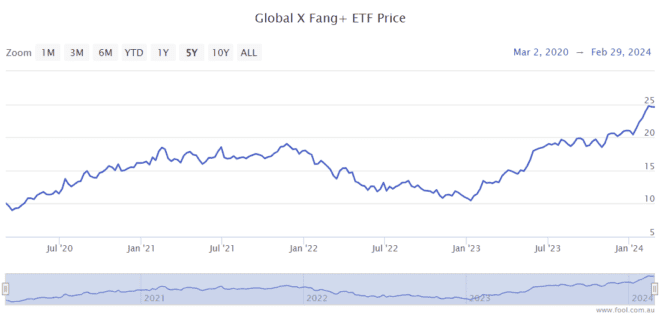
This fund gives significant exposure to large US technology businesses, including Nvidia, Meta Platforms, Netflix, Broadcom, Amazon.com, Microsoft, Alphabet, Snowflake, Apple and Tesla.
Let’s consider the positives and negatives of buying units of the FANG ETF right now.
The positives
This ETF gives investors a concentrated exposure to some of the world’s strongest businesses. The smallest allocation is just over 7% to electric vehicle pioneer Tesla, while its largest position is AI market leader Nvidia, with a 14% weighting.
These businesses have performed very well for investors as they invent and develop new technologies and services. When companies are driving national (or global) change, I think they’re more likely to be able to generate profit growth and drive shareholder returns.
Over the three years to 29 February 2024, the FANG ETF delivered an average return per annum of 19%. Of course, past performance is not necessarily a reliable indicator of future returns.
I think it has a very reasonable management fee of 0.35%, which is cheaper than the 0.48% annual fee charged by Betashares Nasdaq 100 ETF (ASX: NDQ).
Aussies don’t have the option of many large technology businesses on the ASX, so this investment could be a good way of gaining that allocation.
And negatives
If investors are picking this investment for diversification, it doesn’t offer a lot â the FANG ETF only owns 10 names, and they’re all tech businesses or tech-related.
While its share price has lifted significantly in recent times, a sell-off could hit the valuations harder than the overall market. Tech stocks can be very volatile, like we saw in 2022.
According to its provider Global X, the FANG ETF had a price/earnings (P/E) ratio of around 46 on 31 January 2024. That seems high compared to other investments. The price-to-book ratio was 11.7x at the end of January 2024.
Foolish takeaway
There’s a danger of overpaying for the businesses in this portfolio, particularly in the short term. But, I think the long-term looks very promising. I’d call it a long-term buy, but the short-term could be volatile and uncertain.
The post The pros and cons of buying the Global X Fang+ ETF (FANG) right now appeared first on The Motley Fool Australia.
Wondering where you should invest $1,000 right now?
When investing expert Scott Phillips has a stock tip, it can pay to listen. After all, the flagship Motley Fool Share Advisor newsletter he has run for over ten years has provided thousands of paying members with stock picks that have doubled, tripled or even more.*
Scott just revealed what he believes could be the ‘five best ASX stocks’ for investors to buy right now. We believe these stocks are trading at attractive prices and Scott thinks they could be great buys right now…
See The 5 Stocks
*Returns as of 1 February 2024
(function() {
function setButtonColorDefaults(param, property, defaultValue) {
if( !param || !param.includes(‘#’)) {
var button = document.getElementsByClassName(“pitch-snippet”)[0].getElementsByClassName(“pitch-button”)[0];
button.style[property] = defaultValue;
}
}
setButtonColorDefaults(“#0095C8”, ‘background’, ‘#5FA85D’);
setButtonColorDefaults(“#0095C8”, ‘border-color’, ‘#43A24A’);
setButtonColorDefaults(“#fff”, ‘color’, ‘#fff’);
})()
More reading
John Mackey, former CEO of Whole Foods Market, an Amazon subsidiary, is a member of The Motley Foolâs board of directors. Suzanne Frey, an executive at Alphabet, is a member of The Motley Foolâs board of directors. Randi Zuckerberg, a former director of market development and spokeswoman for Facebook and sister to Meta Platforms CEO Mark Zuckerberg, is a member of The Motley Fool’s board of directors. Motley Fool contributor Tristan Harrison has no position in any of the stocks mentioned. The Motley Fool Australia’s parent company Motley Fool Holdings Inc. has positions in and has recommended Alphabet, Amazon, Apple, BetaShares Nasdaq 100 ETF, Meta Platforms, Microsoft, Netflix, Nvidia, Snowflake, and Tesla. The Motley Fool Australia’s parent company Motley Fool Holdings Inc. has recommended the following options: long January 2026 $395 calls on Microsoft and short January 2026 $405 calls on Microsoft. The Motley Fool Australia has positions in and has recommended BetaShares Nasdaq 100 ETF. The Motley Fool Australia has recommended Alphabet, Amazon, Apple, Meta Platforms, Netflix, and Nvidia. The Motley Fool has a disclosure policy. This article contains general investment advice only (under AFSL 400691). Authorised by Scott Phillips.
from The Motley Fool Australia https://ift.tt/IgJWStu
Leave a Reply