• ASX 200 slides as investors head for the exits. Is there more pain to come?

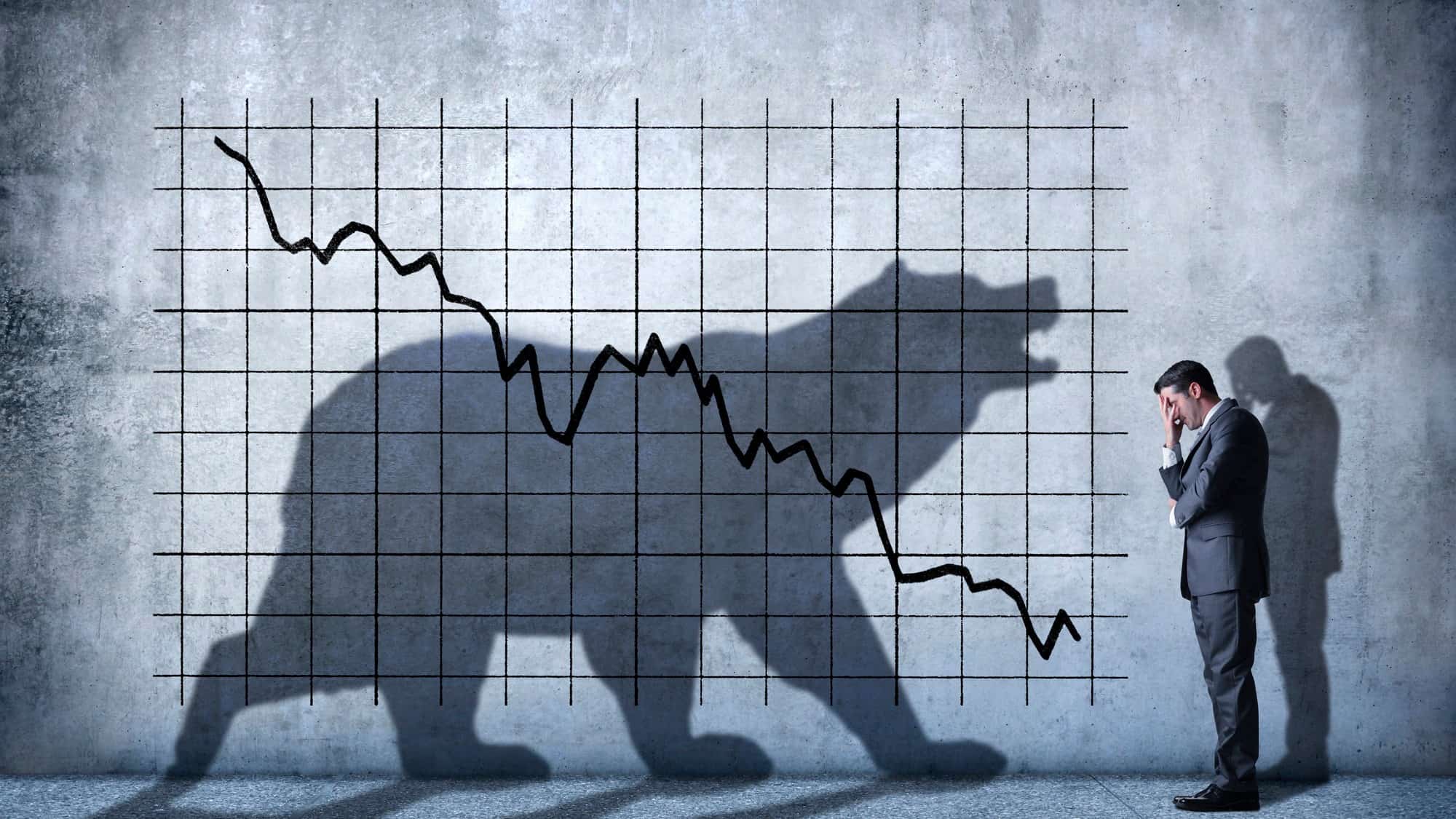
    A shadow bear faces a man against the backdrop of a falling share price.

    The S&P/ASX 200 Index (ASX: XJO) plunged below 8,650 points, shedding almost 120 points from Wednesday’s close.

    Buyers have since returned, but the benchmark remains down 0.69% at approximately 8,705 points in early afternoon trade.

    The selling has reached some of our biggest companies, leaving investors with little relief across several sectors.

    And with another interest rate decision approaching, the next few sessions could prove very important.

    So, is there more pain to come?

    Wall Street gives investors little to cheer about

    Aussie shares followed Wall Street lower after all 3 major US indices finished Wednesday’s session in negative territory.

    The Dow Jones Industrial Average Index (DJX: .DJI) declined 0.68%, while the S&P 500 Index (SP: .INX) slipped 0.75%.

    The tech-heavy Nasdaq Composite Index (NASDAQ: .IXIC) suffered the largest drop, falling 1.13%.

    According to Reuters, rising oil prices and US Treasury yields weighed on sentiment, with the 10-year yield climbing above 5.1%.

    That marked its highest level since 2007, as investors considered the possibility of further interest rate increases.

    Mining heavyweights take a hit

    Closer to home, BHP Group Ltd (ASX: BHP) has fallen 1.61% to $61.07 following an incident at its Escondida copper mine in Chile.

    A worker reportedly died during maintenance work yesterday, prompting BHP to suspend all operational activities at the site.

    The company hasn’t indicated when production will resume at the world’s largest copper mine.

    Rio Tinto Ltd (ASX: RIO), which holds a 30% stake in Escondida, is also trading lower, slipping 0.93% to $166.06.

    Banking shares aren’t providing much relief either.

    Commonwealth Bank of Australia (ASX: CBA) has declined 0.84% to $149.775, and Westpac Banking Corp (ASX: WBC) is down 1.32% to $34.30.

    Jobs data adds another twist

    Today’s employment figures have given investors something else to consider ahead of next week’s RBA meeting.

    The Australian Bureau of Statistics reported that unemployment rose to 4.6% in August, compared with 4.5% in July.

    Employment increased by 39,500 people, although all the growth came from part-time positions.

    Full-time employment declined by 6,300, while the participation rate increased to 67.1%.

    Higher unemployment shows the labour market is easing, which could give the RBA more reason to hold interest rates next week.

    The RBA will announce its next interest rate decision on Tuesday, 29th September.

    Can the ASX 200 hold 8,700 points?

    The immediate test is whether the benchmark can stay above 8,700 heading into today’s close.

    Another break below 8,650 would put this morning’s low back in focus.

    With the RBA’s decision on Tuesday and inflation figures due next Wednesday, I wouldn’t be surprised to see further volatility.

    The post ASX 200 slides as investors head for the exits. Is there more pain to come? appeared first on The Motley Fool Australia.

    Wondering where you should invest $1,000 right now?

    When investing expert Scott Phillips has a stock tip, it can pay to listen. After all, the flagship Motley Fool Share Advisor newsletter he has run for over ten years has provided thousands of paying members with stock picks that have doubled, tripled or even more.*

    Scott just revealed what he believes could be the ‘five best ASX stocks’ for investors to buy right now. We believe these stocks are trading at attractive prices and Scott thinks they could be great buys right now…

    * Returns as of 1 August 2026

    .custom-cta-button p {
    margin-bottom: 0 !important;
    }

    More reading

    Motley Fool contributor Aaron Teboneras has no position in any of the stocks mentioned. The Motley Fool Australia’s parent company Motley Fool Holdings Inc. has no position in any of the stocks mentioned. The Motley Fool Australia has recommended BHP Group. The Motley Fool has a disclosure policy. This article contains general investment advice only (under AFSL 400691). Authorised by Scott Phillips.


  • Boss Energy vs Paladin Energy: Which ASX uranium stock wins?

    A woman wearing a black and white striped t-shirt looks to the sky with her hand to her chin, contemplating buying ASX shares.

    Boss Energy vs Paladin Energy shares

    With the global push for clean, reliable energy accelerating, uranium producers on the ASX have become a focus for Aussie investors. Two names leading the charge are Boss Energy Ltd (ASX: BOE) and Paladin Energy Ltd (ASX: PDN). Both companies aim to supply the growing demand for nuclear fuel, but their business scale, valuations, and recent share price histories diverge in interesting ways. If you’re weighing up Boss Energy shares versus Paladin Energy shares, here’s what stands out.

    The case for Boss Energy

    Boss Energy is an Aussie-based uranium producer with a 100% stake in the Honeymoon uranium project in South Australia, which came online in 2024. It also holds a minority stake in the Alta Mesa project in South Texas, operated by enCore Energy. Boss’s recent transformation from uranium developer to producer puts it in an exciting position as the uranium market heats up.

    A few key metrics jump out:

    • Market cap: $691.27 million – much smaller than Paladin Energy, making Boss a potential growth story if production ramps up successfully.
    • P/E ratio: 263.93 – this reflects minimal reported earnings so far, as the Honeymoon mine is only just coming online.
    • Dividend yield: 0.00% – Boss isn’t paying a dividend at present, which is no surprise for a company focused on ramping up production.
    • Year-to-date (YTD) return: 9.9% – Boss’s share price has delivered a solid gain for investors this year.

    For those who like early-stage producers with room to grow, Boss Energy represents a more agile uranium play compared to its much bigger rival.

    The case for Paladin Energy

    Paladin Energy is a seasoned operator in the global uranium sector, with its flagship Langer Heinrich Mine in Namibia – one of the world’s largest uranium mines. According to its most recent public description, although Paladin put its mine on care and maintenance in recent years (due to softer uranium prices), it’s well-placed to capitalise as global nuclear demand returns.

    Here’s what stands out in the numbers:

    • Market cap: $4.57 billion – Paladin is much larger than Boss, commanding a major presence among global uranium players.
    • P/E ratio: 575.80 – Paladin’s earnings are still slim relative to its price, likely reflecting its transitional state, ramp-up costs, or perhaps adjustments for underlying earnings.
    • Dividend yield: 0.00% – like Boss, Paladin isn’t returning cash to shareholders just yet.
    • YTD return: 2.5% – shares have risen modestly this year, trailing Boss’s performance but reflecting the bigger, steadier nature of the business.

    Paladin’s established global asset base may appeal to those who want scale and operational experience in uranium, albeit at a bigger company valuation.

    Valuation comparison

    Comparing these two uranium producers uncovers stark gaps:

    Metric Boss Energy Ltd Paladin Energy Ltd
    Market Cap $691.27 million $4.57 billion
    P/E Ratio 263.93 575.80
    Earnings per Share (EPS) 0.006 0.012
    Dividend Yield 0.00% 0.00%
    YTD Return 9.9% 2.5%

    Note: Both companies’ reported P/E ratios are extremely high, reflecting the fact that each is in the early stages of commercial production, with limited earnings against their market valuations. Paladin’s P/E is nearly double that of Boss, but in both cases, current earnings are so slim that these multiples should be interpreted with caution. Also, note that the P/E ratios may be based on differing earnings measures, which could explain the disconnect with the corresponding EPS figures.

    Neither company is offering dividends, so for now their investment appeal is about growth and positioning.

    Recent share price performance

    Comparing recent share price momentum:

    • Boss Energy shares rose from $1.42 (31 Aug 2026) to $1.67 (21 Sep 2026), representing a bumpy but upward trend with some sharp swings.
    • Paladin Energy shares fluctuated from $11.61 (31 Aug 2026) to $10.16 (21 Sep 2026), experiencing some big down days, including a -9.59% move on 11 Sept, before stabilising near $10.
    • YTD, Boss is up 9.9%, while Paladin has returned just 2.5% according to the figures supplied.

    Which is the better buy?

    Based on the data discussed, I’d pick Boss Energy. Here’s why: Boss offers a smaller, more nimble uranium pure-play with a recent production start-up, stronger share price momentum this year, and a valuation multiple (while still sky-high!) that is lower than Paladin’s. Both companies currently offer zero yield and trade on lofty earnings multiples due to their early-stage or transitional earnings, but Boss appears to have delivered better recent returns and could have more upside if its Honeymoon ramp-up goes well.

    Paladin, with its mega-market cap and established Namibian asset, offers scale and operational pedigree – and may ultimately prove the steadier uranium bet over time. But given the contrast in YTD returns and relative valuation, I think there’s more excitement and growth potential in Boss Energy at current prices.

    The post Boss Energy vs Paladin Energy: Which ASX uranium stock wins? appeared first on The Motley Fool Australia.

    Should you invest $1,000 in Boss Energy Ltd right now?

    Before you buy Boss Energy Ltd shares, consider this:

    Motley Fool investing expert Scott Phillips just revealed what he believes are the 5 best stocks for investors to buy right now… and Boss Energy Ltd wasn’t one of them.

    The online investing service he’s run for over a decade, Motley Fool Share Advisor, has provided thousands of paying members with stock picks that have doubled, tripled or even more.*

    And right now, Scott thinks there are 5 stocks that may be better buys…

    * Returns as of 1 August 2026

    .custom-cta-button p {
    margin-bottom: 0 !important;
    }

    More reading

    Motley Fool contributor Laura Stewart has no position in any of the stocks mentioned. The Motley Fool Australia’s parent company Motley Fool Holdings Inc. has no position in any of the stocks mentioned. The Motley Fool Australia has no position in any of the stocks mentioned. The Motley Fool has a disclosure policy. This article contains general investment advice only (under AFSL 400691). Authorised by Scott Phillips. This article was prepared with the assistance of Large Language Model (LLM) tools for the initial draft. Any content assisted by AI is subject to our robust human-in-the-loop quality control framework, involving thorough review, substantial editing, and fact-checking by our experienced writers and editors holding appropriate credentials. The Motley Fool Australia stands behind the work of our editorial team and takes ultimate responsibility for the content published by The Motley Fool Australia.

  • Why did Nine Entertainment shares hit a 12-month low today?

    a newsboy wearing historical costume of peaked cap and braces yells into an old fashioned megaphone while holding a newspaper in one hand, a so-called newsboy of previous eras when newsboys sold newspapers on street corners.

    Shares in Nine Entertainment Co Holdings Ltd (ASX: NEC) hit a fresh 12-month low on Thursday, but to discern why, you need to look beyond the company’s announcements.

    Indeed, the company didn’t release any news to the ASX on Thursday, raising the question of what has driven the shares down more than 6%.

    Key personnel jumping ship

    The answer likely lies in the loss of two senior executives across both the company’s broadcast and print journalism divisions.

    Firstly, Amanda Laing, who oversaw the company’s streaming and broadcast division, is leaving just 18 months after taking on the role.

    Ms Laing is a seasoned executive, having worked at Foxtel, ACP Magazines, and formerly as general counsel for Nine.

    The Australian Financial Review (AFR) is reporting that Ms Laing’s role will no longer exist going forward.

    Separately, the Editor-In-Chief of the AFR, James Chessell, has jumped ship to former AFR journalist Joe Aston’s start-up Rampart.

    Rampart said:

    As well as leading Rampart’s growing editorial team, James will write a regular column and co-host Rampart’s new weekly news vodcast with Joe, launching in early 2027.

    Launched by Aston about 18 months ago, Rampart produces regular long-form business articles as well as podcast interviews.

    Aston revealed last month that Rampart had accepted $2.3 million in investment from five partners, including former Nine Chief Executive Officer David Gyngell and Ellerston Capital Executive Chair Ashok Jacob.

    The deal values the company at $28.75 million.

    Aston said further:

    Rampart didn’t need external capital to continue on its already steep trajectory as one of Australia’s fastest growing media brands. The company was profitable in financial 2025, profitable again in financial 2026, even after the rapid growth in our headcount in recent months, and would’ve been profitable in 2027. But with our business model now well-proven, I decided there is no time like the present to turbocharge investment in Rampart’s journalism (which in turn will boost our audience and revenue growth); to establish an external market valuation for the company; and to advance our next phase with an incredibly high-quality group of equity partners.

    Nine forecasting profit growth

    For its part, Nine reported revenue of $2.19 billion in FY26, up 3%, and net profit of $147.2 million, up 11%.

    On the outlook, the company said:

    The change to our portfolio mix, implemented over the past 12 months, has resulted in Nine’s growth assets (Streaming – Stan and 9Now, Outdoor and Digital Publishing) expected to contribute more than 60% of Revenue and c70% of EBITDA in FY27. As a result, Nine expects to report another year of pro forma revenue and EBITDA growth in FY27. Driving this performance, will be further growth from Nine’s subscription businesses of Stan and Digital Publishing, as well as Outdoor (QMS).   

    Nine Entertainment shares on Thursday hit a 12-month low of 66 cents before recovering slightly to be 6.2% lower at 68 cents.

    The company is valued at $1.15 billion.

    The post Why did Nine Entertainment shares hit a 12-month low today? appeared first on The Motley Fool Australia.

    Should you invest $1,000 in Nine Entertainment right now?

    Before you buy Nine Entertainment shares, consider this:

    Motley Fool investing expert Scott Phillips just revealed what he believes are the 5 best stocks for investors to buy right now… and Nine Entertainment wasn’t one of them.

    The online investing service he’s run for over a decade, Motley Fool Share Advisor, has provided thousands of paying members with stock picks that have doubled, tripled or even more.*

    And right now, Scott thinks there are 5 stocks that may be better buys…

    * Returns as of 1 August 2026

    .custom-cta-button p {
    margin-bottom: 0 !important;
    }

    More reading

    Motley Fool contributor Cameron England has no position in any of the stocks mentioned. The Motley Fool Australia’s parent company Motley Fool Holdings Inc. has no position in any of the stocks mentioned. The Motley Fool Australia has recommended Nine Entertainment. The Motley Fool has a disclosure policy. This article contains general investment advice only (under AFSL 400691). Authorised by Scott Phillips.

  • Why Advance Nanotek, Macquarie, Tyro, & Zip Co shares are charging higher

  • Are ASX retail shares undervalued today?

  • Stock market is almost back to where it was before all this coronavirus crap happened! Makes no FUCKING SENSE! How long can the government keep their Brrrrrrrrr infinite fucking money solution going for!?

  • 3 ASX 200 shares to watch this week