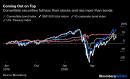
 (Bloomberg Opinion) — It’s growing more likely by the day that we’ve reached peak “bored retail trader” in the financial markets.Bloomberg News, The Wall Street Journal and seemingly every financial news publication has now profiled Dave Portnoy, founder of the website Barstool Sports, who has turned to day-trading stocks with sports on hold because of the coronavirus pandemic. Robinhood Financial’s trading app is all the rage, being credited with the shocking rally in shares of bankrupt Hertz Global Holdings Inc. that almost prompted an unthinkable offering of potentially worthless stock. My Bloomberg Opinion colleague Matt Levine has called this entire phenomenon the “boredom markets hypothesis.” If this trend is close to running its course, more traditional investors might want to consider what happens when the music stops and Portnoy’s No. 1 rule — “stocks only go up” — doesn’t work so flawlessly. The S&P 500 Index’s sharp rally from its March lows is already starting to fizzle, with the index down more than 3% during the past two weeks. While hardly backbreaking, it’s the largest loss over such a sustained period since the worst of the selloff three months ago. Even sideways trading for the summer would violate the day trader’s mantra.Fortunately for sophisticated investors who might side with Warren Buffett and Leon Cooperman over the Robinhood crowd, there’s an intriguing asset class for this crossroads: convertible bonds.The securities, which can be swapped for shares at specified prices, have already been having something of a moment. The Bloomberg Barclays U.S. Convertibles Composite Total Return index jumped to a record on June 8 and remains close to that lofty level. Convertible bonds have gained 7.8% so far in 2020, better than the 5% return on investment-grade corporate bonds and the roughly 3% loss for the S&P 500. I’ve written before about how it seems as if there’s something inherently “cheap” about convertibles that boosts returns above and beyond a mix of stocks and bonds. Part of it might be the types of companies that offer such securities. Within the Bloomberg Barclays index, some of the biggest names include Tesla Inc., Carnival Corp., Southwest Airlines Co., Microchip Technology Inc. and Workday Inc. In other words, a combination of technology companies that have powered the U.S. stock market rally and brand-name businesses particularly harmed by the coronavirus but part of the “recovery trade” strategy. American Airlines Group Inc. is in the market selling convertible notes, too.Some of these individual companies are favorites of the new day-trading crowd. But for those who want to bet on convertible bonds, and specifically to keep trading relatively small sums with zero commission, the $4 trillion exchange-traded fund market is probably their best bet. Yet even the asset class’s sharp rally hasn’t been enough to lure individuals from the thrill of wagering on the trendy stock pick of the day. Consider the $717 million iShares Convertible Bond exchange-traded fund (ticker ICVT), which has soared since March and is up more than 6% this month alone. A few weeks ago, it looked as if it might have been discovered — on June 3, its assets increased by 21% as investors poured a net $108.3 million into the fund, the most since its inception roughly five years ago, according to data compiled by Bloomberg. It gained an additional $69 million on June 9, good for the second-biggest inflow ever. On the flip side, State Street’s $4.47 billion SPDR Bloomberg Barclays Convertible Securities ETF (ticker CWB) suffered an outflow of $107.6 million on June 10, the largest daily withdrawal on record, followed by a $75 million exodus on June 11. That’s a stark contrast to the tens of billions of dollars flowing into credit ETFs.That seeming lack of interest is just fine for investors like Eli Pars, co-chief investment officer and head of alternative strategies at Calamos Advisors. The Naperville, Illinois-based firm is the largest public holder of convertible bonds issued in April by Carnival and Southwest Airlines, according to data compiled by Bloomberg.“It’s a great way to play the stock market in a less volatile way,” he said in a phone interview. While this is the common elevator pitch for investing in convertibles, the securities backed up that claim during March’s turbulence by tumbling less than benchmark equity indexes. That’s because investors can always fall back on interest payments if equity prices fall while capitalizing on a rally because the value of the option to convert to shares increases as well.Pars says convertibles are compelling for those with significant equity holdings who want to dial back their risk a bit after the sharp rebound in the past three months, or for those who sat out the entire rally and want some protection from a reversal. It’s a safer bet than simply taking short positions on the S&P 500; Bloomberg News’s Cameron Crise calculated that speculators have ratcheted up their bets against the index to the most extreme level since 2011.In some ways, the new band of Robinhood traders plays right into the hands of investors like Pars. He manages the $9 billion Calamos Market Neutral Income Fund, which partly employs a strategy known as convertible arbitrage. The trade involves buying and holding the convertible bond while hedging with a short position in the common stock, in theory generating a nearly riskless profit from price discrepancies between the two assets. That’s more likely to happen when there’s added volatility — and especially when the fluctuations seemingly come out of nowhere. “It’s one thing when you have volatility driven by real fundamentals,” Pars says. “When you have more noise volatility, that’s perfect for an arb.”With so much uncertainty surrounding how quickly states can emerge from lockdowns, and just how quickly Americans will travel the way they used to, even modest downside protection, like the 1.25% interest rate on Southwest Airlines’s convertible securities, can be a comfort for investors. That could wind up being a better yield than similar maturity Treasuries over the next five years, given that it’s anyone’s guess whether the Federal Reserve will have raised short-term interest rates from near-zero by then.These are the prudent — albeit less entertaining — calculations that professional investors are paid to think about. There’s still a large divide between the newbie traders who fly in and out of stock and ETF positions on a whim thanks to no-fee trading, and Wall Street denizens who scrutinize market segments mostly out of reach of Robinhood. The former are best thought of like shares of Hertz, surging 682% in the span of days but now sputtering toward zero again.Convertible bonds, by contrast, have delivered average annual returns of 9% or higher over three-, five-, 10- and 15-year horizons. It stands to reason they’ll keep doing so long after the legions of bored traders find a new hobby.This column does not necessarily reflect the opinion of the editorial board or Bloomberg LP and its owners.Brian Chappatta is a Bloomberg Opinion columnist covering debt markets. He previously covered bonds for Bloomberg News. He is also a CFA charterholder.For more articles like this, please visit us at bloomberg.com/opinionSubscribe now to stay ahead with the most trusted business news source.©2020 Bloomberg L.P.
from Yahoo Finance https://ift.tt/37RflLW

