• OPEC+ Meets to Extend Cuts That Trump Says Saved Oil Industry

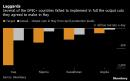
    OPEC+ Meets to Extend Cuts That Trump Says Saved Oil Industry(Bloomberg) — OPEC+ gathers on Saturday to ratify a deal for at least an extra month of record production cuts that U.S. President Donald Trump said saved the American oil industry.After a week of cajoling by Saudi Arabia and Russia, the cartel’s members were ready to prolong almost 10 million barrels a day of output curbs to the end of July, instead of easing them as previously planned.The imminent extension, coupled with a surprisingly good U.S. jobs report, sent crude 5% higher to $42 a barrel on Friday afternoon in London, more than double the price in April.That’s eased pressure on the budgets of oil-rich nations and revived the fortunes of energy companies from Exxon Mobil Corp. to shale drillers such as Parsley Energy Inc.Trump himself hailed the recovery on Friday and thanked the cartel’s leaders for making it possible.“Just a month ago. We had a disaster with respect to energy. It was down to zero, it was worthless,” Trump said at the White House. “We saved that industry in a short period of time. And you know who helped us? Saudi Arabia and Russia.”Bumpy RoadThe unlikely celebration in Washington came at the end of a long road that could still have some unwelcome twists and turns.There’s no guarantee that Trump, who for most of his presidency has been openly hostile to the Organization of Petroleum Exporting Countries, won’t return to accusations of market manipulation and price gouging when it suits him.The partnership at the heart of OPEC+ — between Saudi Arabia and Russia — was only recently patched up after a vicious price war. This week, the unity of the 23-nation coalition has been strained by some nations cheating on their production cuts.Saturday’s meeting only came together after Moscow and Riyadh pushed Angola, Nigeria, Kazakhstan and Iraq to stop shirking their share of cuts and to compensate for past failings. By Friday, delegates said there was a deal in place to resolve these shortcomings, but details were lacking and observers were skeptical.In a tweet just hours before the OPEC meeting Nigeria said it approves that countries who were not able to comply in May and June, to compensate in July, August and September.“Everyone saves face with this agreement,” said Jan Stuart, global energy economist at Cornerstone Macro LLC. “But it begs the question: What is the enforcement mechanism? I’m very curious to see how the organization is going to elicit greater compliance from the cheaters.”OPEC will meet by video conference on Saturday at 1 p.m. London time, followed by a conference with their OPEC+ allies two hours later, delegates said.The agreement, once ratified, will prolong the 9.7 million barrels a day of production curbs for another month until the end of July. Ministers may review later this month whether a further extension into August is warranted, a delegate said.Conditions are now right to achieve the success that Saudi Arabia has hoped, state-run Saudi Press Agency reported on Friday, citing the kingdom’s Energy Minister Prince Abdulaziz bin Salman.Still, OPEC+ is used to dramatic glitches endangering deals at the last minute, so delegates said nothing would be agreed until formal communications take place after Saturday’s meeting.Iraq’s PainThe Oil Ministry in Baghdad said in a statement on Friday that it will comply in full with pledged OPEC+ cuts despite the country’s difficult financial circumstances. But accepting stricter terms risks a backlash from Iraqi parliamentarians and rival political parties for acceding to foreign pressure.Read: Oil’s Fragile Peace Is Threatened by Iraq’s Desperate RealityCutting production is always painful for oil-dependent states. Iraq in particular needs every penny because it’s still rebuilding its economy following decades of war, sanctions and Islamist insurgency.Iraq made less than half of its assigned cutbacks last month, so compensating fully would require it to slash production by a further 24% to about 3.28 million barrels a day, according to Bloomberg calculations. That would be a tall order.Mexico, whose resistance to curbing output delayed the April deal, won’t cause problems this time, the delegate said. Under the terms of that accord, the Latin American country wasn’t expected to make production cuts beyond June.Failure to finalize the agreement could bring a flood of oil back onto the market, undermining a tentative recovery as countries start emerging from coronavirus lockdowns. Instead, OPEC+ hopes a successful deal will force the market to start drawing down the billion barrels of stockpiles that built up during the crisis, further bolstering the price recovery.(Updates with Nigeria comment in 11th paragraph)For more articles like this, please visit us at bloomberg.comSubscribe now to stay ahead with the most trusted business news source.©2020 Bloomberg L.P.

    from Yahoo Finance https://ift.tt/3eVG6B7

  • Hedge Funds Are Selling Unity Biotechnology, Inc. (UBX)

    Hedge Funds Are Selling Unity Biotechnology, Inc. (UBX)The latest 13F reporting period has come and gone, and Insider Monkey is again at the forefront when it comes to making use of this gold mine of data. We at Insider Monkey have plowed through 821 13F filings that hedge funds and well-known value investors are required to file by the SEC. The 13F […]

    from Yahoo Finance https://ift.tt/3eOhUR4

  • Is this ASX small cap the best placed to benefit from the $700m HomeBuilder grant?

    The federal government’s $688 million cash handout to stimulate the home construction sector will benefit several S&P/ASX 200 Index (Index:^AXJO) stocks. But there’s at least one ASX small cap that’s also well placed to cash in.

    This small cap is Beacon Lighting Group Ltd (ASX: BLX) and Citigroup believes the lighting retailer is better placed to outperform its peers in the post COVID-19 world.

    Best small cap retailer?

    “The introduction of the government’s $680 million HomeBuilder scheme, further entrenches Beacon Lighting as our top pick in small cap retail,” said the broker.

    “In our view the HomeBuilder scheme means that Beacon is well placed to continue outperforming the broader discretionary retail sector once JobKeeper ends.”

    That’s a big plus as there are worries about what would happen to discretionary spending in September.

    Not only will the JobKeepter wage supplement come to an end, but other support measures, like JobSeeker and the moratorium on evictions, ends.

    Beyond the HomeBuilder boost

    There are a few other reasons why Citi believes the $235 million small cap ASX stock will outperform most other retailers.

    Beacon’s outlets remained open throughout the coronavirus outbreak when many other retailers shut their doors. This means it faced less competition.

    Another reason is that consumers were actively engaging in home improvement projects during the lockdown, and that bodes well for Beacon.

    “We expect FY21e LFL [like-for-like] sales of 2% to be underpinned by renovation activity, noting that ~60% of Beacon’s customers are home renovators,” added Citi.

    “However, benefits from HomeBuilder may be skewed towards 2H21 given eligible building contracts can be executed up until 31 December 2020 and lighting is typically purchased at the later stages of a renovation.”

    Beacon shares on sale

    The stock is looking cheap too on the broker’s forecasts. Beacon’s shares are trading on an undemanding FY22 price-earnings multiple of 13 times, which is a 15% discount to its Australian housing retail peers.

    Citi is recommending the stock as a “buy” and lifted its price target to $1.24 from $0.95 a share. This implies a 16% plus return over the next 12-months if dividends are included.

    Foolish takeaway

    The way the HomeBuilder program is designed will benefit larger companies more than smaller ones.

    This is one of the criticisms of the stimulus as eligible projects have to be worth between $150,000 to $750,000. Small contractors and sole traders are likely to miss out.

    The same can be said about ASX companies. The grants will disproportionately benefit large cap stocks.

    Some of these companies that I’ve highlighted include building materials supplier James Hardie Industries plc (ASX: JHX), Bunnings owner Wesfarmers Ltd (ASX: WES) and property developer Stockland Corporation Ltd (ASX: SGP).

    NEW! 5 Cheap Stocks With Massive Upside Potential

    Our experts at The Motley Fool have just released a FREE report detailing 5 shares you can buy now to take advantage of the much cheaper share prices on offer.

    One is a diversified conglomerate trading over 30% off it’s all-time high, all while offering a fully franked dividend yield of over 3%…

    Another is a former stock market darling that is one of Australia’s most popular and iconic businesses. Trading at a significant discount to its 52-week high, not only does this stock offer massive upside potential, but it also trades on an attractive fully franked dividend yield of almost 4%.

    Plus, this free report highlights 3 more cheap bets that could position you to profit in 2020 and beyond.

    Simply click here to scoop up your FREE copy and discover the names of all 5 cheap shares.

    But you will have to hurry because the cheap share prices on offer today might not last for long.

    As of 2/6/2020

    More reading

    Motley Fool contributor Brendon Lau owns shares of James Hardie Industries plc. The Motley Fool Australia owns shares of Wesfarmers Limited. We Fools may not all hold the same opinions, but we all believe that considering a diverse range of insights makes us better investors. The Motley Fool has a disclosure policy. This article contains general investment advice only (under AFSL 400691). Authorised by Scott Phillips.

    The post Is this ASX small cap the best placed to benefit from the $700m HomeBuilder grant? appeared first on Motley Fool Australia.

    from Motley Fool Australia https://ift.tt/3cCnOU1

Sorry, but nothing was found. Please try a search with different keywords.