
• How many ANZ shares do you need for $8000 of passive income?

    Different coloured piggy banks on different coloured squares.

    Working out how many ANZ shares you need to generate $8,000 of annual passive income is an important exercise.

    The bank currently yields 4.38% on a share price around $38.

    That sounds modest.

    Once franking credits are included the picture changes considerably, and so does the amount of capital required.

    The maths behind $8,000 from ANZ shares

    ANZ Group Holdings Ltd (ASX: ANZ) has paid 166 cents per share over the past twelve months.

    That comprises an 83 cent final dividend franked at 70%, paid last December, and an 83 cent interim dividend franked at 75%, paid on 1 July.

    Divide $8,000 by $1.66 and you need 4,820 shares.

    At $37.93 each, that is an investment of roughly $182,800.

    What franking credits change

    The calculation looks quite different at tax time.

    At 75% franking and a 30% company tax rate, each dollar of dividend carries about 32 cents of franking credit.

    That lifts the grossed-up dividend to roughly $2.19 per share.

    On that basis you need about 3,650 ANZ shares, or an investment near $138,300.

    The franking credits have saved you more than $44,000 of capital.

    Whether you actually receive that benefit depends on your marginal tax rate, and retirees in pension phase capture the most of it.

    Can ANZ keep paying it?

    This is the important question to ask for long-term investors.

    The half-year result to 31 March delivered cash profit of $3.78 billion, up 14% on the prior half excluding significant items.

    Cash return on tangible equity improved 161 basis points to 11.6%, and the cost-to-income ratio fell from 54.6% to 49.4%.

    Common equity tier one capital was 12.39%.

    On top of this, the August quarterly update was steady rather than spectacular.

    Cash profit was $1.90 billion, up 1% on the first-half quarterly average.

    Net interest margin edged up one basis point to 1.54%, and capital strengthened again to 12.51%.

    The individual credit impairment charge was just $65 million, or three basis points annualised.

    Chief executive Nuno Matos kept the message simple:

    Our balance sheet and capital position remain strong, and we are staying close to our customers should they need support.

    The risk with ANZ shares

    Two risks deserve attention before investors commit $138,000 to a single bank.

    The first is regulatory.

    APRA raised ANZ’s capital add-on to $1 billion in April 2025 alongside a court enforceable undertaking over non-financial risk management, and that overlay has not been removed.

    The bank also booked a NZ$125 million provision for a New Zealand class action in the third quarter.

    The second is concentration.

    Suncorp Bank integration is 57% complete and the single customer front-end is 45% complete, both on schedule, but integrations are where banks tend to find unpleasant surprises.

    Foolish takeaway

    ANZ shares can produce $8,000 a year, and the capital required is either $182,800 or $138,300 depending on whether franking credits count for you.

    I would treat the grossed-up number as the realistic one for most Australian investors.

    What I would not do is build the whole income stream from a single bank on a price-to-earnings ratio above 19.

    Allocating the same capital across three or four payers yields a little less but removes a great deal of risk.

    The post How many ANZ shares do you need for $8000 of passive income? appeared first on The Motley Fool Australia.

    Should you invest $1,000 in Anz Group right now?

    Before you buy Anz Group shares, consider this:

    Motley Fool investing expert Scott Phillips just revealed what he believes are the 5 best stocks for investors to buy right now… and Anz Group wasn’t one of them.

    The online investing service he’s run for over a decade, Motley Fool Share Advisor, has provided thousands of paying members with stock picks that have doubled, tripled or even more.*

    And right now, Scott thinks there are 5 stocks that may be better buys…

    * Returns as of 1 August 2026

    .custom-cta-button p {
    margin-bottom: 0 !important;
    }

    More reading

    Motley Fool contributor Mark Verhoeven has no position in any of the stocks mentioned. The Motley Fool Australia’s parent company Motley Fool Holdings Inc. has no position in any of the stocks mentioned. The Motley Fool Australia has no position in any of the stocks mentioned. The Motley Fool has a disclosure policy. This article contains general investment advice only (under AFSL 400691). Authorised by Scott Phillips.

  • How much is needed in superannuation for $3,000 in weekly passive income?

    Australian dollar notes in the pocket of a man's jeans, symbolising dividends.

    Having a goal in mind for how much income you’d like to receive in retirement can be a very comforting strategy.

    So how much do you need? What most of us aim for is a comfortable retirement, which means something different to everyone.

    But it’s fair to say that an income stream of $3,000 per week would provide a standard of living most people would deem very comfortable.

    How much is needed for a comfortable retirement?

    Indeed, the Association of Superannuation Funds of Australia (ASFA) estimates singles will need $55,923 per year to fund a comfortable retirement. So $3,000 per week, or $156,000 per year, is well above this.

    The ASFA figure does assume a retiree owns their own home and draws a part pension from the age of 67 when they become eligible.

    So, how much superannuation would you need to generate $3,000 per week in passive income?

    For simplicity’s sake, I will assume that a retiree is living off of dividends and not drawing down any capital.

    Naturally, how much you would need in superannuation savings depends on what sort of dividend yield you can regularly rely on.

    If the figure was just 5%, you would need $3.12 million in superannuation savings.

    I would argue that this figure is too low, as retirees who are paying a zero per cent tax rate get the benefit of franking credits – that is, they get paid back the tax already paid by the companies whose shares they own.

    In practice, this means that if a company is paying a 5% dividend yield, what is called the “grossed up” yield comes out at 7.14%.

    If you were able to maintain a 10% dividend yield, you’d only need $1.56 million in superannuation, but I’d argue that somewhere in the middle, let’s call it 7.5%, is realistic.

    At this level you’d need $2.08 million in retirement savings.

    Which shares deliver good dividend yields?

    So, what are some shares you might consider investing in to deliver these sorts of returns?

    Keep in mind that companies with excessively high returns might not be able to sustain them over time.

    A class of shares that tends to offer stability over time is infrastructure. In this sector, gas pipeline operator APA Group Ltd (ASX: APA) pays a 5.29% dividend yield, 31% franked, while toll roads operator Atlas Arteria Ltd (ASX: ALX) pays 8.84% with no franking.

    Among financial services stocks, Regal Partners Ltd (ASX: RPL) is paying 11.15%, fully franked, while among the banks, Westpac Banking Corporation (ASX: WBC) is paying 4.4%.

    Retailer Universal Store Holdings Ltd (ASX: UNI) is paying 5.67% (fully franked), while major retailer Coles Ltd (ASX: COL) is paying 3.29% fully franked.

    There are also a diverse array of exchange traded funds such as the Betashares Australian Dividend Harvester (ASX: HVST) which are focussed on dividend payouts, with this one yielding 5.53%.

    So as you can see, it’s possible to build a portfolio returning a decent yield, which can help hit your income targets.

    The post How much is needed in superannuation for $3,000 in weekly passive income? appeared first on The Motley Fool Australia.

    Should you invest $1,000 in Westpac Banking Corporation right now?

    Before you buy Westpac Banking Corporation shares, consider this:

    Motley Fool investing expert Scott Phillips just revealed what he believes are the 5 best stocks for investors to buy right now… and Westpac Banking Corporation wasn’t one of them.

    The online investing service he’s run for over a decade, Motley Fool Share Advisor, has provided thousands of paying members with stock picks that have doubled, tripled or even more.*

    And right now, Scott thinks there are 5 stocks that may be better buys…

    * Returns as of 1 August 2026

    .custom-cta-button p {
    margin-bottom: 0 !important;
    }

    More reading

    Motley Fool contributor Cameron England has no position in any of the stocks mentioned. The Motley Fool Australia’s parent company Motley Fool Holdings Inc. has no position in any of the stocks mentioned. The Motley Fool Australia has positions in and has recommended Apa Group. The Motley Fool Australia has recommended Universal Store. The Motley Fool has a disclosure policy. This article contains general investment advice only (under AFSL 400691). Authorised by Scott Phillips.

  • Austal shares are surging. Is a bidding war brewing?

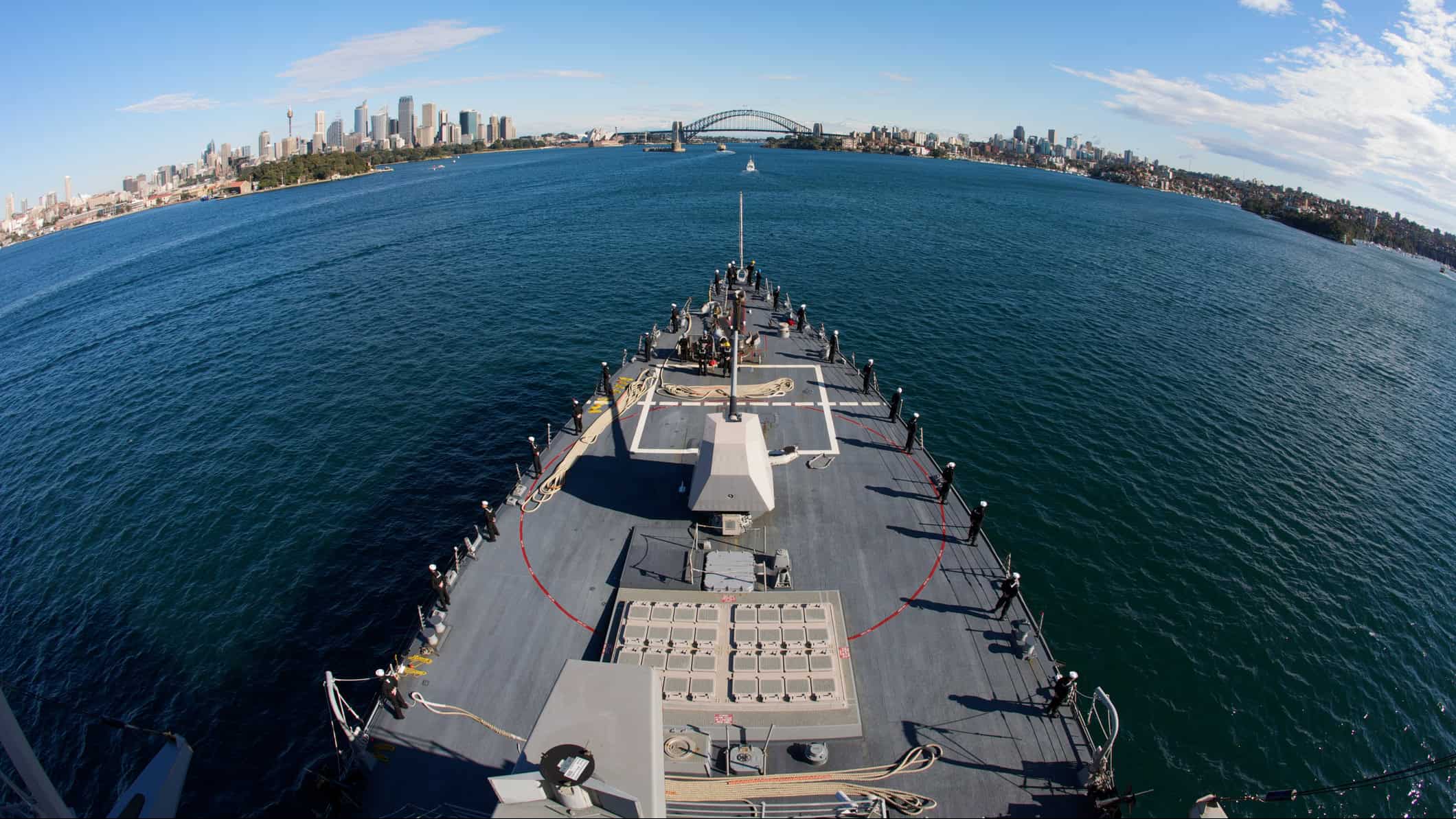
    A U.S. Naval Ship (DDG) enters Sydney harbour.

    Austal shares climbed again this week, extending a run that has now added more than 30% since July.

    The catalyst for this? The possibility that a second buyer has appeared for the company’s American shipyard.

    Why Austal shares are moving

    Austal Ltd (ASX: ASB) confirmed on Monday that it had held an initial discussion with Wildcat Infrastructure, a United States investment firm, after media reports identified it as a potential buyer of Austal USA.

    The company was clear that it had not received a formal offer.

    The reason the market reacted at all is that a bidder already exists.

    Hanwha Defence USA lodged a non-binding, indicative proposal in August, and the board granted it a four-week due diligence window.

    A second interested party changes the negotiating dynamic significantly for Austal.

    What Hanwha has actually offered

    Hanwha’s proposal values Austal USA at between US$1.05 billion and US$1.2 billion on an enterprise value basis, cash and debt free.

    It is an offer for the shares in the Austal USA holding entities only.

    It explicitly excludes the listed shares in Austal Limited, the Australasian operations across Australia, the Philippines and Vietnam, and the Strategic Shipbuilding Agreement with the Commonwealth.

    Completion would require approval from CFIUS, the Defense Counterintelligence and Security Agency, and United States antitrust regulators.

    The board set out its thinking in the announcement.

    The Austal Board and its advisers have carefully assessed the Proposal and determined that it merits further evaluation, approving Hanwha to undertake due diligence related to Austal USA to improve the certainty of any proposal.

    Hanwha is already Austal’s largest shareholder with 19.9% of the register, a stake approved by the Treasurer in December 2025 with conditions attached.

    The FY26 result behind the bid

    Austal’s full-year numbers explain why the American business is the one on the block.

    Revenue rose 11% to $2.03 billion and the order book reached a record $16.5 billion.

    The Australasian division produced record earnings before interest and tax of $85.3 million, up 137%.

    Austal USA went the other way, posting a $202.8 million EBIT loss after provisions on legacy Navy programs, which dragged the group to a statutory loss of $53.6 million.

    Chief executive Paddy Gregg described the Australian side as follows:

    Outside of the US, never before has the Australian business been in such an enviable position, with a long-term order book and a strategic agreement that will provide decades of stability and growth.

    What a sale would mean for Austal shares

    Austal’s whole market capitalisation is roughly $1.8 billion.

    The indicative value placed on Austal USA alone is between A$1.5 billion and A$1.7 billion.

    If a sale completed near that range, shareholders would be left holding a debt-free Australian shipbuilder with record earnings and a decade of committed work, plus a very large pile of cash.

    However, investors should nonetheless adopt a degree of caution.

    Hanwha’s proposal is non-binding, Wildcat has made no offer, and United States regulatory approval is not a formality.

    Foolish takeaway

    Austal shares are still down over twelve months, which tells you how much damage the American contracts did.

    A competitive process for Austal USA would be the fastest available route to recovering some of that.

    Ultimately, the Australian business is performing well enough to justify holding whatever happens, and that is the better reason to own Austal shares today.

    The post Austal shares are surging. Is a bidding war brewing? appeared first on The Motley Fool Australia.

    Should you invest $1,000 in Austal right now?

    Before you buy Austal shares, consider this:

    Motley Fool investing expert Scott Phillips just revealed what he believes are the 5 best stocks for investors to buy right now… and Austal wasn’t one of them.

    The online investing service he’s run for over a decade, Motley Fool Share Advisor, has provided thousands of paying members with stock picks that have doubled, tripled or even more.*

    And right now, Scott thinks there are 5 stocks that may be better buys…

    * Returns as of 1 August 2026

    .custom-cta-button p {
    margin-bottom: 0 !important;
    }

    More reading

    Motley Fool contributor Mark Verhoeven has no position in any of the stocks mentioned. The Motley Fool Australia’s parent company Motley Fool Holdings Inc. has no position in any of the stocks mentioned. The Motley Fool Australia has no position in any of the stocks mentioned. The Motley Fool has a disclosure policy. This article contains general investment advice only (under AFSL 400691). Authorised by Scott Phillips.