Author: therawinformant

  • Telstra hits guidance and declares 16 cents per share FY 2020 dividend

    Telstra share price

    The Telstra Corporation Ltd (ASX: TLS) share price will be in focus on Thursday after the release of its full year results for FY 2020.

    How did Telstra perform in FY 2020?

    For the 12 months ended 30 June 2020, Telstra reported a 5.9% decline in total income to $26.161 billion. This means the telco giant achieved its guidance of $25.3 billion to $27.3 billion.

    The main drag on its performance during FY 2020 was the Consumer and Small Business segment. Telstra’s largest segment reported a 6.7% decline in income to $13.326 billion during the 12 months. It was impacted by an 8.4% decline across fixed products and a 5.2% decline in mobile service revenues. The latter was due to a reduction in its average revenue per user (ARPU), which offset customer additions.

    The company’s Enterprise segment also posted a decline for the year. It recorded income of $7.97 billion, down 3.3% on the prior corresponding period. This was largely due to declines in legacy calling and fixed products.

    Offsetting some of these declines was a solid reduction in operating expenses during the year. Telstra’s operating expenses fell 14.5% to $16.951 billion in FY 2020 thanks to strong progress with its T22 strategy.

    This ultimately led to Telstra posting reported earnings before interest, tax, depreciation, and amortisation (EBITDA) of $8.9 billion and underlying EBITDA of $7.4 billion. The latter was within its guidance range and represents a 9.7% decline on the prior year. However, if you exclude the NBN headwind, Telstra’s underlying EBITDA would have increased by $40 million in FY 2020.

    It is worth noting that the underlying result includes an estimated net negative impact from COVID-19 of approximately $200 million. This relates to lower international roaming, financial support for customers, delays in NAS professional services contracts, and additional bad debt provisions.

    On the bottom line, Telstra’s net profit after tax fell 14.4% to $1.8 billion and its earnings per share dropped 15.5% to 15.3 cents.

    Telstra maintains its dividend.

    Telstra also delivered on its guidance for free cash flow in FY 2020. It reported free cash flow of $3.4 billion, compared to its guidance of $3.3 billion to $3.8 billion.

    In light of this, it was able to maintain its full year dividend of 16 cents per share fully franked. This will see $1.9 billion returned to shareholders for the year. Its final dividend of 8 cents per share will be paid on 24 September.

    Outlook.

    While the company acknowledges that it will not be immune from further disruption and difficulty during the pandemic, it is confident enough in its outlook to provide guidance for FY 2021.

    It expects total income to be in the range of $23.2 billion to $25.1 billion, underlying EBITDA in the range of $6.5 billion to $7 billion, and free cashflow after operating lease payments of $2.8 billion to $3.3 billion.

    Management also expects the in-year NBN headwind for FY 2021 to have a negative impact on underlying EBITDA of approximately $700 million. As a result, to achieve growth in FY 2021 (excluding the in-year NBN headwind), underlying EBITDA will need to be around the mid-point of its guidance range.

    It is also worth noting that this underlying EBITDA guidance assumes an estimated negative impact from the COVID-19 pandemic in FY 2021 of approximately $400 million.

    While it did not mention its dividend, based on this guidance, Telstra appears well-placed to maintain its 16 cents per share payout next year.

    These stocks could rocket in a Post-COVID world (FREE STOCK REPORT)

    When investing expert Scott Phillips has a stock tip, it can pay to listen. After all, the flagship Motley Fool Share Advisor newsletter he has run for more than eight years has provided thousands of paying members with stock picks that have doubled, tripled or even more.*

    In this FREE STOCK REPORT, Scott just revealed what he believes are the 3 ASX stocks for the post COVID world that investors should buy right now while they still can. These stocks are trading at dirt-cheap prices and Scott thinks these could really go gangbusters as we move into ‘the new normal’.

    *Returns as of 6/8/2020

    More reading

    Motley Fool contributor James Mickleboro has no position in any of the stocks mentioned. The Motley Fool Australia owns shares of and has recommended Telstra Limited. We Fools may not all hold the same opinions, but we all believe that considering a diverse range of insights makes us better investors. The Motley Fool has a disclosure policy. This article contains general investment advice only (under AFSL 400691). Authorised by Scott Phillips.

    The post Telstra hits guidance and declares 16 cents per share FY 2020 dividend appeared first on Motley Fool Australia.

    from Motley Fool Australia https://ift.tt/2XULtdS

  • Stock split watch: Could Amazon be next?

    This article was originally published on Fool.com. All figures quoted in US dollars unless otherwise stated.

    This article was originally published on Fool.com. All figures quoted in US dollars unless otherwise stated.

    It’s been a while since e-commerce and cloud-computing giant Amazon.com, Inc (NASDAQ: AMZN) split its stock. We’re talking about the late 1990s when Amazon was a relatively small company with huge dreams.

    Things are different now. A single Amazon share costs more than $3,150 today, and the market cap stands at an enormous $1.58 trillion.

    Other high-priced market darlings have been announcing stock splits recently. Apple (NASDAQ: AAPL) has scheduled a 4-for-1 split at the end of August. That move will drop Apple’s share price from roughly $450 to approximately $113 per stub, assuming that the stock doesn’t make any sudden moves over the next three weeks. Tesla (NASDAQ: TSLA) will run a 5-for-1 split of its own on August 31, dropping the single-stock price tag from $1,550 to approximately $310.

    I wouldn’t be surprised to see a stock split from Amazon, too. Here’s why.

    Amazon’s split history

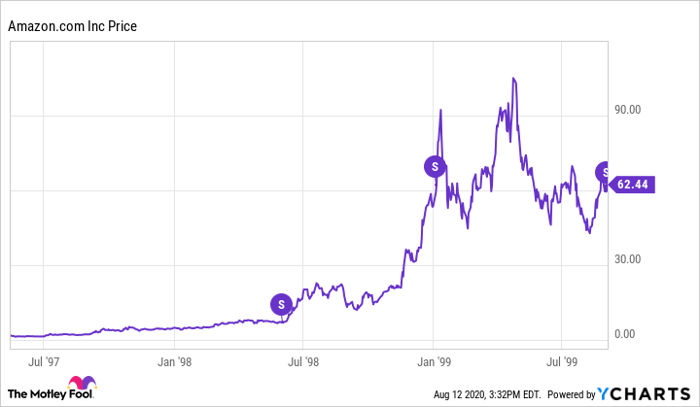
    Amazon closed its first day on the public market at a split-adjusted $23.50 per share. Just 13 months later, share prices had grown 270% higher, and Amazon ran its first 2-for-1 split. The next move followed in January of 1999 after an enormous 755% gain in seven months. This time, Amazon issued two new shares for every original stub in an investor’s possession, which made it a 3-for-1 split.

    Finally, the last 2-for-1 increase followed in September of 1999. There was no crazy price gain to explain this particular accounting move, since the stock had actually dropped 4% lower this time. At this point, each original Amazon share had been transformed into 12 lower-priced tickets.

    AMZN Chart

    AMZN data by YCharts

    Amazon’s split-adjusted price was roughly $86 per share before the first split, $355 per share on the second occasion, and $119 per share the third time. If the company isn’t thinking about another split right now, I don’t know if it ever will.

    What’s the big idea?

    Stock splits are a purely mathematical exercise that divides up ownership of the company into a larger number of lower-priced shares. It’s like cutting your pizza into 12 slices instead of six. Nobody gained or lost anything here, but you can distribute the slices with more granular precision.

    A $3,000 stock can be difficult to afford for an ordinary investor with a limited investment budget. The price tag alone can keep many investors away from high-quality stocks. This is becoming less of an issue these days because some stockbrokers allow you to buy fractional shares of high-priced stocks, and exchange-traded funds (EFT) offer another method for dodging a high single-stub purchase price. Still, you can’t match the simplicity of directly buying full shares of the company you actually want to own. Some people may not even be aware of the more complicated options.

    From Amazon’s point of view, the high stock price might keep the company out of price-weighted indexes such as the Dow Jones Industrial Average . Apple is currently the highest-priced ticker in that closely watched index, and the lofty price gives Cupertino exaggerated power over the Dow’s value. A 10% change in Apple’s stock would move the Dow 1.1% higher or lower, assuming that the other 29 members don’t change at all. After Apple’s split, the same 10% move would nudge the Dow in the same direction by just 0.4%.

    For this reason, the Dow rarely invites stocks with very high share prices. Tesla CEO Elon Musk has publicly floated the idea of adding the electric car maker to the Dow now that its share prices won’t stand in the way. Amazon CEO Jeff Bezos would have to perform a fairly extreme stock split before presenting a similar case. Amazon would still carry land among the five highest share prices on the Dow after a 15-for-1 split.

    If Bezos has any interest in joining the Dow, I would expect an ostentatious stock split very soon. A less dramatic 3-for-1 or 5-for-1 split would also be helpful to small investors. Tesla’s and Apple’s very recent announcements could be the last straw, because Jeff Bezos certainly has a flair for the dramatic.

    This article was originally published on Fool.com. All figures quoted in US dollars unless otherwise stated.

    These 3 stocks could be the next big movers in 2020

    When investing expert Scott Phillips has a stock tip, it can pay to listen. After all, the flagship Motley Fool Share Advisor newsletter he has run for more than eight years has provided thousands of paying members with stock picks that have doubled, tripled or even more.*

    In this FREE STOCK REPORT, Scott just revealed what he believes are the 3 ASX stocks for the post COVID world that investors should buy right now while they still can. These stocks are trading at dirt-cheap prices and Scott thinks these could really go gangbusters as we move into ‘the new normal’.

    *Returns as of 6/8/2020

    More reading

    John Mackey, CEO of Whole Foods Market, an Amazon subsidiary, is a member of The Motley Fool’s board of directors. Anders Bylund owns shares of Amazon and Tesla. The Motley Fool Australia’s parent company Motley Fool Holdings Inc. owns shares of and recommends Amazon, Apple, and Tesla and recommends the following options: short January 2022 $1940 calls on Amazon and long January 2022 $1920 calls on Amazon. The Motley Fool Australia has recommended Amazon and Apple. We Fools may not all hold the same opinions, but we all believe that considering a diverse range of insights makes us better investors. The Motley Fool has a disclosure policy. This article contains general investment advice only (under AFSL 400691). Authorised by Scott Phillips.

    The post Stock split watch: Could Amazon be next? appeared first on Motley Fool Australia.

    This article was originally published on Fool.com. All figures quoted in US dollars unless otherwise stated.

    from Motley Fool Australia https://ift.tt/3kHEgY8

  • Earnings season: 3 ASX shares you may have missed in August

    man sorting through piles of papers with calculators signifying earnings season for asx shares

    The August earnings season is upon us and there are already some ASX shares that are surprising investors.

    Here are a few of my favourites that I’ve been watching in the last week and a half.

    Aurizon and 2 more ASX shares surprising investors

    Right at the top of my list is rail freight operator Aurizon Holdings Ltd (ASX: AZJ).

    Aurizon is responsible for moving coal, iron ore, agricultural freight and more across the country.

    The ASX 200 share surged 3.8% higher on Monday after lifting annual profits. In fact, Aurizon’s underlying net profit after tax (NPAT) climbed 12% higher to $531 million.

    Earnings before interest, tax, depreciation and amortisation (EBITDA) rocketed 102% while statutory NPAT jumped 28% to $605 million.

    On top of that, the Aussie rail freight group is returning funds to shareholders with a $300 million buyback program in FY21.

    Aurizon isn’t the only ASX share that has surprised this month.

    The Charter Hall Social Infrastructure REIT (ASX: CQE) share price surged 4.7% on Tuesday as full-year earnings per unit remained steady.

    The real estate investment trust’s (REIT) weighted average lease expiry (WALE) increased 28.3% to 12.7 years while gross asset values jumped 4.4% to $1.3 billion.

    Positively, gearing was low at 16.4% with a property portfolio yield of 6.2%.

    That was a good result given the coronavirus pandemic is looming over the real estate sector. Investors were quick to buy into the Aussie REIT in early trade following the FY20 result.

    Finally, James Hardie Industries plc (ASX: JHX) was one that you may have missed.

    The James Hardie share price jumped 6.8% higher on Tuesday after the release of its first-quarter earnings.

    James Hardie is a global building materials company and the largest global manufacturer of fibre cement products.

    The ASX share was in high demand yesterday as EBITDA remained flat on Q1 2019 numbers.

    Operating cash flow surged 35% higher to US$89.3 million despite net profit plummeting 89% lower.

    Investors were clearly impressed by the result with the ASX industrials share leading the ASX 200 winners list on Tuesday.

    5 stocks under $5

    We hear it over and over from investors, “I wish I had bought Altium or Afterpay when they were first recommended by The Motley Fool. I’d be sitting on a gold mine!” And it’s true.

    And while Altium and Afterpay have had a good run, we think these 5 other stocks are screaming buys. And you can buy them now for less than $5 a share!

    *Extreme Opportunities returns as of June 5th 2020

    More reading

    Motley Fool contributor Ken Hall has no position in any of the stocks mentioned. The Motley Fool Australia has recommended Aurizon Holdings Limited. We Fools may not all hold the same opinions, but we all believe that considering a diverse range of insights makes us better investors. The Motley Fool has a disclosure policy. This article contains general investment advice only (under AFSL 400691). Authorised by Scott Phillips.

    The post Earnings season: 3 ASX shares you may have missed in August appeared first on Motley Fool Australia.

    from Motley Fool Australia https://ift.tt/2DNYVJt

  • Why the Helios Energy share price is up 15% in August

    man holding petrol pump line which is forming upward trending arrow signifying oil share price increase

    Not yet halfway through August and oil and gas company Helios Energy Ltd‘s (ASX: HE8) share price has already posted a 15.4% gain for the month. That compares to the 3.0% gain for the All Ordinaries (INDEXASX: XAO).

    Like many ASX shares, particularly energy related shares, Helios’ share price was more than cut in half during the COVID-19 induced bear market. The share price fell 53% from 21 February through to 18 March.

    It wasn’t until July that the Helios share price truly began to recover, closing at 15 cents per share on Wednesday, up 88% from 18 March. That gives Helios a market capitalisation of $232 million.

    Year to date, Helios’ share price is down 21%.

    What does Helios Energy do?

    Helios Energy is an oil and gas company with both of its major projects in Texas in the United States. Its predominant focus is the Presidio Oil Project located in Presidio County. To date, Helios has drilled two vertical wells into the Presidio Oil Project.

    Its other project, the Trinity Oil Project, is located along the borders of Trinity, Houston and Walker. Trinity is comprised of 3,128 acres of oil and gas leases.

    Why is Helios Energy’s share price running higher in August?

    With both of its oil projects in Texas, one of the states that’s been hit hardest by the raging pandemic, you might expect Helios’ share price to fall, not gain 15.4% to date in August.

    I see three apparent reasons for Helios’ share price leap.

    First, the price of oil has trended higher this month. West Texas Intermediate (WTI) crude oil has gained 4.4% in August, currently trading for US$42.07 (AU$59.25) per barrel.

    Second, investors are likely betting on higher crude oil prices to come when the world emerges from the coronavirus driven slowdowns. This should see a large increase in the demand for petrol and other products derived from oil.

    Third is Helios’ quarterly report which was released to the ASX on 3 August. While noting the company’s compliance with Texas COVID-19 ordinances, Helios also stated its 2D seismic results had increased its Ojinaga Shale Formation play area by 50% to approximately 300,000 acres.

    The Helios share price gained 7.7% on 4 August, following the release of its quarterly report.

    Where to invest $1,000 right now

    When investing expert Scott Phillips has a stock tip, it can pay to listen. After all, the flagship Motley Fool Share Advisor newsletter he has run for more than eight years has provided thousands of paying members with stock picks that have doubled, tripled or even more.*

    Scott just revealed what he believes are the five best ASX stocks for investors to buy right now. These stocks are trading at dirt-cheap prices and Scott thinks they are great buys right now.

    *Returns as of June 30th

    More reading

    Motley Fool contributor Bernd Struben has no position in any of the stocks mentioned. The Motley Fool Australia has no position in any of the stocks mentioned. We Fools may not all hold the same opinions, but we all believe that considering a diverse range of insights makes us better investors. The Motley Fool has a disclosure policy. This article contains general investment advice only (under AFSL 400691). Authorised by Scott Phillips.

    The post Why the Helios Energy share price is up 15% in August appeared first on Motley Fool Australia.

    from Motley Fool Australia https://ift.tt/2E12g7H

  • Down 37% in 2 days! Is the Mesoblast share price a buy?

    beaten down shares

    Shares in the Aussie biotech company Mesoblast limited (ASX: MSB) continue to fall. In fact, the Mesoblast share price is down 37.0% since Monday’s close to $3.07 per share.

    It’s not unusual to see big valuation swings in the biotech space. But at what point does Mesoblast go from a falling knife to a screaming buy?

    Why is the Mesoblast share price falling?

    A major catalyst for the share price fall has been a report from the United States Food and Drug Administration (FDA).

    The US regulator questioned the effectiveness of Mesoblast’s remestemcel-L as a treatment for paediatric patients with steroid-resistant acute graft versus host disease.

    The FDA noted concerns over the treatment’s clinical performance ahead of Mesoblast’s meeting with the Oncologic Drugs Advisory Committee (ODAC).

    That spooked investors on Tuesday with the Mesoblast share price falling 31.0% lower in one day. That momentum continued on Wednesday as the biotech share slumped a further 8.6% lower.

    That means the Mesoblast share price is now down 37.1% since Monday’s close. It can be a dangerous game to buy a share in freefall, but how does the Mesoblast equation stack up?

    Is Mesoblast in the buy zone yet?

    Investors appear to be pricing in a rejection from the ODAC in tomorrow’s meeting. Given the scepticism expressed by the US FDA, I think that’s probably a fair view to take.

    However, I think Mesoblast still has a portfolio of promising candidates. The company is exploring remestemcel-L as a treatment for coronavirus-induced acute respiratory distress syndrome.

    The company’s Revascor and MPC-06-ID are also Phase 3 candidates for treating advanced chronic heart failure and degenerative back disc disease, respectively.

    I think the Mesoblast share price will continue to be volatile. That’s partly the nature of the game with these make or break, R&D-heavy companies.

    However, I still believe there is long-term potential for Mesoblast. Of course, this setback does lower the short-term intrinsic value.

    With its extensive pipeline and track record of success though, I think the Mesoblast share price could be a buy at $3.07 per share.

    Are there other ASX biotech shares to buy?

    If you’re looking for other ASX biotech shares to buy right now, the Polynovo Ltd (ASX: PNV) share price is another strong candidate.

    Polynovo’s NovoSorb BTM product continues to kick goals and the biotech group is looking to expand its application.

    Man who said buy Kogan shares at $3.63 says buy these 3 ASX stocks now

    When investing expert Scott Phillips has a stock tip, it can pay to listen. After all, the flagship Motley Fool Share Advisor newsletter he has run for more than eight years has provided thousands of paying members with stock picks that have doubled, tripled or even more.*

    In this FREE STOCK REPORT, Scott just revealed what he believes are the 3 ASX stocks for the post COVID world that investors should buy right now while they still can. These stocks are trading at dirt-cheap prices and Scott thinks these could really go gangbusters as we move into ‘the new normal’.

    *Returns as of 6/8/2020

    More reading

    Ken Hall has no position in any of the stocks mentioned. The Motley Fool Australia’s parent company Motley Fool Holdings Inc. owns shares of POLYNOVO FPO. The Motley Fool Australia has no position in any of the stocks mentioned. We Fools may not all hold the same opinions, but we all believe that considering a diverse range of insights makes us better investors. The Motley Fool has a disclosure policy. This article contains general investment advice only (under AFSL 400691). Authorised by Scott Phillips.

    The post Down 37% in 2 days! Is the Mesoblast share price a buy? appeared first on Motley Fool Australia.

    from Motley Fool Australia https://ift.tt/3fR3Qq4

  • 3 excellent ASX dividend shares you can buy right now

    dividend shares

    With low interest rates here to stay for some time to come, I believe the share market remains the best place to earn a passive income.

    But which dividend shares should you buy? Three ASX dividend shares that I think would be great options are listed below:

    BWP Trust (ASX: BWP)

    BWP is a real estate investment trust which I believe is well-positioned to the continue its positive form during the pandemic and beyond it. This is because BWP’s warehouses are predominantly leased to home improvement giant, Bunnings Warehouse. I believe this is a fantastic tenant to have, especially given the way Bunnings continues to grow its sales during the crisis. I believe this means the risk of store closures and rental defaults is extremely low and periodic rental increases remain possible. At present I estimate that its units offer a 4.6% FY 2021 yield.

    National Storage REIT (ASX: NSR)

    I think this storage giant could be a good option for income investors. Although it is inevitable that National Storage will be impacted by the pandemic, I don’t believe this impact will be as negative as some of its real estate peers. This should allow it to continue paying a decent distribution during the crisis and then return to growing it modestly each year once things return to normal. Based on the current National Storage share price, I estimate that it offers a 4.4% FY 2021 distribution yield.

    Rural Funds Group (ASX: RFF)

    A final ASX dividend share to consider buying is Rural Funds. I think the agriculture-focused property trust is is one of the best income options. This is due to the quality and diversity of its assets and its very positive long term growth outlook. I believe Rural Funds strong portfolio puts it in a position to continue growing its distribution during the pandemic and beyond. In FY 2021 it expects to pay shareholders a 11.28 cents per share distribution. Based on the latest Rural Funds share price, this equates to a 5% yield.

    Where to invest $1,000 right now

    When investing expert Scott Phillips has a stock tip, it can pay to listen. After all, the flagship Motley Fool Share Advisor newsletter he has run for more than eight years has provided thousands of paying members with stock picks that have doubled, tripled or even more.*

    Scott just revealed what he believes are the five best ASX stocks for investors to buy right now. These stocks are trading at dirt-cheap prices and Scott thinks they are great buys right now.

    *Returns as of June 30th

    More reading

    Motley Fool contributor James Mickleboro has no position in any of the stocks mentioned. The Motley Fool Australia owns shares of and has recommended RURALFUNDS STAPLED. We Fools may not all hold the same opinions, but we all believe that considering a diverse range of insights makes us better investors. The Motley Fool has a disclosure policy. This article contains general investment advice only (under AFSL 400691). Authorised by Scott Phillips.

    The post 3 excellent ASX dividend shares you can buy right now appeared first on Motley Fool Australia.

    from Motley Fool Australia https://ift.tt/30QZfQD

  • 5 things to watch on the ASX 200 on Thursday

    ASX share

    On Wednesday the S&P/ASX 200 Index (ASX: XJO) ended its winning streak and dropped slightly lower. The benchmark index fell 0.1% to 6,132 points.

    Will the market be able to bounce back from this on Thursday? Here are five things to watch:

    ASX 200 expected to jump.

    The ASX 200 looks set to jump higher on Thursday after a very positive night of trade on Wall Street. According to the latest SPI futures, the ASX 200 is set rise 43 points or 0.7% at the open. In the United States the Dow Jones rose 1.05%, the S&P 500 climbed 1.4%, and the Nasdaq index stormed 2.1% higher.

    Telstra result, dividend on watch.

    The Telstra Corporation Ltd (ASX: TLS) share price will on watch today when it releases one of the most eagerly anticipated results of earnings season. The main focus will of course be on its dividend. Opinion is divided on whether the telco giant will be able to maintain its 16 cents per share fully franked dividend. Goldman Sachs expects this dividend to be maintained. It is also forecasting a 22% decline in net profit after tax to $2.4 billion.

    Oil prices rebound.

    Energy producers such as Beach Energy Ltd (ASX: BPT) and Woodside Petroleum Limited (ASX: WPL) could be on the rise on Thursday after oil prices rebounded. According to Bloomberg, the WTI crude oil price is up 2.2% to US$42.53 a barrel and the Brent crude oil price is 1.8% higher to US$45.31 a barrel. A larger than expected inventory drop in the U.S. supported prices.

    Treasury Wine Estates FY 2020 results.

    Also on watch today will be the Treasury Wine Estates Ltd (ASX: TWE) share price. This morning the wine company is due to release its FY 2020 results. According to a note out of Goldman Sachs, its analysts expect the company to report group sales of $2.65 billion and EBITS of $538.1 million. The latter is down 21% on the prior corresponding period.

    Gold price lower.

    Gold miners Newcrest Mining Limited (ASX: NCM) and Saracen Mineral Holdings Limited (ASX: SAR) will be on watch on Thursday after the gold price failed to rebound from yesterday’s heavy decline. According to CNBC, the spot gold price is down 1% to US$1,926.7 an ounce. Better than expected economic data sent bond yields higher and put pressure on the gold price.

    These 3 stocks could be the next big movers in 2020

    When investing expert Scott Phillips has a stock tip, it can pay to listen. After all, the flagship Motley Fool Share Advisor newsletter he has run for more than eight years has provided thousands of paying members with stock picks that have doubled, tripled or even more.*

    In this FREE STOCK REPORT, Scott just revealed what he believes are the 3 ASX stocks for the post COVID world that investors should buy right now while they still can. These stocks are trading at dirt-cheap prices and Scott thinks these could really go gangbusters as we move into ‘the new normal’.

    *Returns as of 6/8/2020

    More reading

    Motley Fool contributor James Mickleboro has no position in any of the stocks mentioned. The Motley Fool Australia owns shares of and has recommended Telstra Limited and Treasury Wine Estates Limited. We Fools may not all hold the same opinions, but we all believe that considering a diverse range of insights makes us better investors. The Motley Fool has a disclosure policy. This article contains general investment advice only (under AFSL 400691). Authorised by Scott Phillips.

    The post 5 things to watch on the ASX 200 on Thursday appeared first on Motley Fool Australia.

    from Motley Fool Australia https://ift.tt/31MTFxH

  • Cisco Q4 beats expectations, offers weak revenue forecast for Q1

    Cisco Q4 beats expectations, offers weak revenue forecast for Q1Cisco released its fourth quarter earnings report after hours on Wednesday, beating on both its top and bottom lines. The company offered a forecast for its first quarter revenue which fell below investors’ expectations, anticipating a decline between 9% to 11%. Yahoo Finance’s Myles Udland breaks down the company’s earnings report.

    from Yahoo Finance https://ift.tt/3kGmwwk

  • Cisco Gives Weak Revenue Forecast Showing Recession Biting

    Cisco Gives Weak Revenue Forecast Showing Recession Biting(Bloomberg) — Cisco Systems Inc. gave a lackluster sales forecast for the current period, a sign that businesses and government agencies are spending less in the pandemic-driven recession.Revenue will fall 9% to 11% from a year earlier in the fiscal first quarter, which ends in late October, the San Jose, California-based company said Wednesday in a statement. Analysts on average had projected a decline of about 7%. Adjusted profit will be 69 cents to 71 cents a share, lower than Wall Street expectations of 76 cents, according to data compiled by Bloomberg.Cisco shares fell about 4% in extended trading. The stock closed at $48.10 in New York earlier. A large chunk of Cisco’s revenue comes from government agencies and small and medium-sized businesses. Many of these customers have cut spending to adjust to an economic slowdown sparked by Covid-19 lockdowns.Chief Executive Officer Chuck Robbins is trying to reduce Cisco’s reliance on expensive proprietary hardware and increase sales of software and services. After returning to growth in 2018, revenue has started to decline again this year, showing how Cisco’s business is still exposed to economic cycles.For more articles like this, please visit us at bloomberg.comSubscribe now to stay ahead with the most trusted business news source.©2020 Bloomberg L.P.

    from Yahoo Finance https://ift.tt/2E0Zf7K

  • Tesla is the most dangerous stock for 2020: Expert

    Tesla is the most dangerous stock for 2020: ExpertNew Constructs CEO David Trainer joins Yahoo Finance’s Kristin Myers to discuss his outlook on Tesla after the company announced a 5-for-1 stock split.

    from Yahoo Finance https://ift.tt/2XV8jSs