Category: Stock Market

  • How much could a $10,000 investment in Woodside shares be worth in 12 months?

    Woodside Energy Group Ltd (ASX: WDS) shares have been out of form this year.

    So much so, with the energy giant’s shares down 18% since this time last year and currently changing hands for $27.92, they are trading within sight of their two-year low of $27.03.

    While this is disappointing for shareholders, could it prove to be a great time to buy for non-shareholders?

    To find out, let’s see what a $10,000 investment in Woodside shares could become in one year based on what a leading broker is saying about the country’s leading energy producer.

    Investing $10,000 into Woodside shares

    Firstly, with the company’s shares fetching $27.92, you would need to invest $10,023.28 to end up with 359 units.

    According to a note out of Morgans, its analysts believe that Woodside’s shares are extremely undervalued and big returns could be on the cards over the next 12 months.

    The note reveals that the broker has the company on its best ideas list with an add rating and $36.00 price target.

    If its shares were to rise to that level, it would value those 359 units at a sizeable $12,924. That’s almost 30% or $3,000 greater than what you started with.

    Already it is looking like a very fruitful investment. But there’s still more to come according to the broker.

    Morgans is forecasting fully franked dividends of $1.25 per share in FY 2024 and then $1.57 per share in FY 2025. This represents attractive dividend yields of 4.5% and 5.6%, respectively.

    This will add income of $448.75 this year and then $563.63 in 2025. The former boosts the total 12-month return to approximately $3,350, which represents a return on investment of around 33%.

    Why is the broker bullish on Woodside?

    Morgans thinks that recent share price weakness has created a buying opportunity for investors. Especially given the quality of its earnings and an improving outlook for a key growth project. It explains:

    A tier 1 upstream oil and gas operator with high-quality earnings that we see as likely to continue pursuing an opportunistic acquisition strategy. WDS’s share price has been under pressure in recent months from a combination of oil price volatility and approval issues at Scarborough, its key offshore growth project. With both of those factors now having moderated, with the pullback in oil prices moderating and work at Scarborough back underway, we see now as a good time to add to positions. Increasing our conviction in our call is the progress WDS is making through the current capex phase, while maintaining a healthy balance sheet and healthy dividend profile. WDS still has to address long-term issues in its fundamentals (such as declining production from key projects NWS/Pluto), but will still generate substantial high-quality earnings for years to come.

    The post How much could a $10,000 investment in Woodside shares be worth in 12 months? appeared first on The Motley Fool Australia.

    Should you invest $1,000 in Woodside Petroleum Ltd right now?

    Before you buy Woodside Petroleum Ltd shares, consider this:

    Motley Fool investing expert Scott Phillips just revealed what he believes are the 5 best stocks for investors to buy right now… and Woodside Petroleum Ltd wasn’t one of them.

    The online investing service he’s run for over a decade, Motley Fool Share Advisor, has provided thousands of paying members with stock picks that have doubled, tripled or even more.*

    And right now, Scott thinks there are 5 stocks that may be better buys…

    See The 5 Stocks
    *Returns as of 5 May 2024

    More reading

    Motley Fool contributor James Mickleboro has positions in Woodside Energy Group. The Motley Fool Australia’s parent company Motley Fool Holdings Inc. has no position in any of the stocks mentioned. The Motley Fool Australia has no position in any of the stocks mentioned. The Motley Fool has a disclosure policy. This article contains general investment advice only (under AFSL 400691). Authorised by Scott Phillips.

  • What is the dividend yield of Wesfarmers shares?

    Man holding a calculator with Australian dollar notes, symbolising dividends.

    Owning Wesfarmers Ltd (ASX: WES) shares for dividends is a good tactic because of its long-term history of payouts and the board’s commitment to growing the passive income.

    But, there’s more to being a good ASX dividend share than simply paying a dividend. Ideally, it offers a good dividend yield which can also grow thanks to the ability of companies to re-invest their profits into growing their operations.

    Wesfarmers has done a wonderful job of growing Bunnings, Kmart and Officeworks into the businesses they are today. Those retail businesses and other Wesfarmers subsidiaries are responsible for paying some of the biggest dividend payouts in Australia.

    Passive income payout

    To work out what the dividend yield is, we first need to know what the Wesfarmers dividend is.

    The last two dividend payments from the business amount to $1.94 per share. However, that’s the trailing two dividends. How much could the next two dividends be?

    The estimate on Commsec suggests the Wesfarmers dividend per share could be $1.95 for FY24, while the FY25 payout could be $2.16 per share (which would be a year over year increase of 7.7%).

    Wesfarmers dividend yield

    To calculate the dividend yield, we divide the dividend by the Wesfarmers share price. To get to the grossed-up dividend yield, we add the franking credits.

    At the current Wesfarmers share price, the FY24 grossed-up dividend yield could be 4%.

    If we look ahead to FY25, the company could pay a grossed-up dividend yield of 4.4%.

    These aren’t the biggest yields in the world, but it means investors are getting a yield that’s competitive with savings accounts, while also offering organic growth.

    Plus, the business is projected to retain a sizeable amount of profit each year to re-invest for more growth and hopefully grow the dividend in future years.

    In FY24, the business is projected to have a dividend payout ratio of 86% in FY24 and 88% in FY25. If the company paid a 100% dividend payout ratio, it would have a grossed-up dividend yield of 4.6% in FY24 and 5% in FY25.

    Are dividends everything?

    For Wesfarmers, the dividend hasn’t been the key part of the returns. It has been capital growth.

    According to CMC Markets, Wesfarmers shares have generated an average total shareholder return of 14.1% per annum over the past decade, compared to 7.7% for the Vanguard Australian Shares Index ETF (ASX: VAS) over the same period.

    Time will tell what the future Wesfarmers dividends will be, but the future is promising with the strength and value of the consumer offering from the key businesses of Bunnings and Kmart.

    The post What is the dividend yield of Wesfarmers shares? appeared first on The Motley Fool Australia.

    Should you invest $1,000 in Wesfarmers Limited right now?

    Before you buy Wesfarmers Limited shares, consider this:

    Motley Fool investing expert Scott Phillips just revealed what he believes are the 5 best stocks for investors to buy right now… and Wesfarmers Limited wasn’t one of them.

    The online investing service he’s run for over a decade, Motley Fool Share Advisor, has provided thousands of paying members with stock picks that have doubled, tripled or even more.*

    And right now, Scott thinks there are 5 stocks that may be better buys…

    See The 5 Stocks
    *Returns as of 5 May 2024

    More reading

    Motley Fool contributor Tristan Harrison has no position in any of the stocks mentioned. The Motley Fool Australia’s parent company Motley Fool Holdings Inc. has positions in and has recommended Wesfarmers. The Motley Fool Australia has positions in and has recommended Wesfarmers. The Motley Fool has a disclosure policy. This article contains general investment advice only (under AFSL 400691). Authorised by Scott Phillips.

  • These were the 2 best ASX ETFs for price growth in April

    ETF written in gold with dollar signs on coin.

    The two best ASX exchange-traded funds (ETFs) for price growth in April each rose by more than 10%.

    Both of them give ASX investors exposure to one of the great megatrends of the moment.

    That megatrend is the green energy transition.

    Let’s take a look at these 2 top-performing ASX ETFs.

    2 best ASX ETFs for price growth last month

    According to the Australian ETF Review published by leading exchange-traded products (ETPs) provider Betashares, the following two ASX ETFs recorded the best share price growth last month.

    Global X Copper Miners AUD ETF (ASX: WIRE)

    The Global X Copper Miners AUD ETF gained 10.5% in new value over the month of April.

    The ASX ETF closed at $15.08 per unit on Thursday, down 1.70% for the day. Over the past 12 months, the Copper Miners ETF has risen by 31.70%.

    According to provider Global X, the Copper Miners AUD ETF provides access to a global basket of copper miners with exposure to major areas of innovation, including technology, infrastructure, and clean energy.

    Among its top holdings are Canadian miners First Quantum Minerals Ltd (TSE: FM) and Lundin Mining Corp (TSE: LUN), as well as Polish miner KGHM Polska Miedz SA (WSE: KGH).

    ASX copper stocks are also held by this ETF. They include BHP Group Ltd (ASX: BHP), Sandfire Resources Ltd (ASX: SFR), and WA1 Resources Ltd (ASX: WA1) shares.

    Copper is set to play a key role in the green energy transition. An excellent conductor of electricity, it is used in the construction of electric vehicles, wind turbines, solar energy systems, and data centres.

    Right now, global supply is constrained, and this has seen the copper price rise as part of a broader global commodities upswing that is also propelling the prices of other metals like iron ore, gold, tin and zinc.

    At the time of writing, copper is trading at US$4.95. It’s up 32.5% year over year and up 14.6% over the past 30 days alone.

    Betashares Energy Transition Metals ETF (ASX: XMET)

    The Betashares Energy Transition Metals ETF gained 10.4% in new value over the month of April.

    The ASX ETF closed at $8.54 per unit on Thursday, down 1.04% for the day. Over the past 12 months, the Energy Transition Metals ETF has lifted 0.59%.

    According to provider Betashares, the Energy Transition Metals ETF provides investors with exposure to global producers of copper, lithium, nickel, cobalt, graphite, manganese, silver and rare earths.

    First Quantum and Lundin Mining are also among its top holdings. It also holds US miner Freeport-McMoRan Inc (NYSE: FCX) and another Canadian miner, Ivanhoe Mines Ltd (TSE: IVN).

    ASX stocks are also part of this ETF. They include Lynas Rare Earths Ltd (ASX: LYC), Pilbara Minerals Ltd (ASX: PLS), and Nickel Industries Ltd (ASX: NIC).

    The post These were the 2 best ASX ETFs for price growth in April appeared first on The Motley Fool Australia.

    Should you invest $1,000 in Global X Copper Miners Etf right now?

    Before you buy Global X Copper Miners Etf shares, consider this:

    Motley Fool investing expert Scott Phillips just revealed what he believes are the 5 best stocks for investors to buy right now… and Global X Copper Miners Etf wasn’t one of them.

    The online investing service he’s run for over a decade, Motley Fool Share Advisor, has provided thousands of paying members with stock picks that have doubled, tripled or even more.*

    And right now, Scott thinks there are 5 stocks that may be better buys…

    See The 5 Stocks
    *Returns as of 5 May 2024

    More reading

    Motley Fool contributor Bronwyn Allen has positions in BHP Group. The Motley Fool Australia’s parent company Motley Fool Holdings Inc. has no position in any of the stocks mentioned. The Motley Fool Australia has no position in any of the stocks mentioned. The Motley Fool has a disclosure policy. This article contains general investment advice only (under AFSL 400691). Authorised by Scott Phillips.

  • Buying ASX 200 energy shares? Here’s the latest IEA oil forecast

    Oil worker using a smartphone in front of an oil rig.

    Buying S&P/ASX 200 Index (ASX: XJO) energy shares?

    Then I don’t have to tell you how much the oil price can impact the share prices of companies like Woodside Energy Group Ltd (ASX: WDS), Santos Ltd (ASX: STO) and Beach Energy Ltd (ASX: BPT).

    As markets are generally forward-looking, ASX 200 energy shares also tend to rise and fall based on the forecast outlook for global oil prices.

    Now, Woodside, Santos, and Beach Energy also produce gas. While the gas price doesn’t move in lockstep with the oil price, the two tend to trend in the same direction over the medium term.

    With that said, here’s the latest forecast from the International Energy Agency (IEA).

    What’s been happening with the oil price?

    As a quick recap, Brent crude oil prices kicked off 2024, trading for US$76 per barrel. The oil price then marched higher through 5 April amid rising conflict in the Middle East, when Brent crude topped US$91 per barrel.

    Over the past five weeks, the oil price has retraced, with Brent fetching US$83 per barrel at market close on Thursday.

    The net impact has been mixed for ASX 200 energy shares, which have each had their own company specific issues to deal with as well.

    Here’s how they’ve been tracking year to date:

    • Santos shares are flat
    • Woodside shares are down 11.22%
    • Beach Energy shares are up 4.91%

    What can ASX 200 energy shares expect from global oil demand in 2024?

    As for what lies ahead, the IEA has scaled back its 2024 oil demand growth forecast by 140,000 barrels per day since last month’s report. The agency now expects global oil demand to increase by an average of 1.1 million barrels per day over the full year.

    While that may not be great news for investors in ASX 200 energy shares, it’s worth noting that the IEA still forecasts global oil demand will come in at an all-time high of 103.2 million barrels per day in 2024.

    On the supply side, the IEA projects global supplies will ramp up by 580,000 barrels per day to 102.7 million barrels per day, also a new record high.

    Assuming that the Organization of Petroleum Exporting Countries and their allies (OPEC+) extend its voluntary cuts through to the end of the year, the agency expects OPEC+ production to drop by 840,000 barrels per day in 2024. But that will be more than compensated by an expected 1.4 million barrel per day increase from nations outside the cartel.

    One of the wild cards that could see demand higher or lower than forecast remains the path of interest rates, particularly from the US Federal Reserve. Lower rates sooner than forecast, could fuel energy use among households and businesses worldwide.

    “Recent macro data from the US has raised expectations that the Fed could start cutting rates soon, which will be providing some support to oil,” said Warren Patterson (quoted by Bloomberg).

    Looking at what could impact ASX 200 energy shares further down the road, the IEA said, “Our global outlook for 2025 is largely unchanged, with the pace of growth now marginally eclipsing 2024 at 1.2 million barrels per day.”

    The post Buying ASX 200 energy shares? Here’s the latest IEA oil forecast appeared first on The Motley Fool Australia.

    Should you invest $1,000 in Beach Energy Limited right now?

    Before you buy Beach Energy Limited shares, consider this:

    Motley Fool investing expert Scott Phillips just revealed what he believes are the 5 best stocks for investors to buy right now… and Beach Energy Limited wasn’t one of them.

    The online investing service he’s run for over a decade, Motley Fool Share Advisor, has provided thousands of paying members with stock picks that have doubled, tripled or even more.*

    And right now, Scott thinks there are 5 stocks that may be better buys…

    See The 5 Stocks
    *Returns as of 5 May 2024

    More reading

    Motley Fool contributor Bernd Struben has no position in any of the stocks mentioned. The Motley Fool Australia’s parent company Motley Fool Holdings Inc. has no position in any of the stocks mentioned. The Motley Fool Australia has no position in any of the stocks mentioned. The Motley Fool has a disclosure policy. This article contains general investment advice only (under AFSL 400691). Authorised by Scott Phillips.

  • Here are the top 10 ASX 200 shares today

    A neon sign says 'Top Ten'.

    It was another successful session for the S&P/ASX 200 Index (ASX: XJO) this Thursday, building on the momentum ASX shares saw yesterday.

    By the time trading wrapped up, the ASX 200 had enjoyed a 1.65% surge, perhaps buoyed by the latest unemployment figures that we saw today. That leaves the index at 7,881.3 points after we saw it break above 7,900 earlier this afternoon.

    This rampant Thursday for ASX shares follows a stellar night over on the US markets last night and this morning (our time).

    The Dow Jones Industrial Average Index (DJX: .DJI) was on fire, shooting up 0.88% overnight.

    The tech-heavy Nasdaq Composite Index (NASDAQ: .IXIC) did one better again, surging by a healthy 1.4%.

    But let’s return to the ASX now and check out how the different ASX sectors celebrated investors’ good mood today.

    Winners and losers

    Given today’s surging markets, it won’t come as too much of a surprise to see that we only had one sector in the red.

    That unlucky sector was energy stocks. The S&P/ASX 200 Energy Index (ASX: XEJ) was left out in the cold today, suffering a fall of 0.29%.

    But it was all smiles across the rest of the ASX.

    Today’s gains were led by real estate investment trusts (REITs). The S&P/ASX 200 A-REIT Index (ASX: XPJ) was burning hot, rocketing by 3.48%.

    Tech shares also had a day to remember. The S&P/ASX 200 Information Technology Index (ASX: XIJ) enjoyed a 3.32% surge this Thursday.

    Consumer discretionary stocks were high in demand, with the S&P/ASX 200 Consumer Discretionary Index (ASX: XDJ) recording a rise of 2.45%.

    Gold shares joined in the party too, as you can see from the All Ordinaries Gold Index (ASX: XGD)’s 241% gallop higher.

    ASX financial stocks were another bright spot. The S&P/ASX 200 Financials Index (ASX: XFJ) banked a gain of 1.85% today.

    Then we had the healthcare space. The S&P/ASX 200 Healthcare Index (ASX: XHJ) got a 1.5% booster from investors.

    Consumer staples stocks got an invite to the ASX party as well, evident from the S&P/ASX 200 Consumer Staples Index (ASX: XSJ)’s 1.48% bounce.

    Mining shares were just behind that. The S&P/ASX 200 Materials Index (ASX: XMJ) was upgraded by 1.28% by the end of trading.

    Communications shares got some love too. The S&P/ASX 200 Communication Services Index (ASX: XTJ) was given a 0.97% raise by the markets.

    Industrial stocks also had some buyers. The S&P/ASX 200 Industrials Index (ASX: XNJ) was lifted 0.93% higher this session.

    Finally, utilities shares were making their investors happy. The S&P/ASX 200 Utilities Index (ASX: XUJ) managed a 0.61% markup.

    Top 10 ASX 200 shares countdown

    Today’s index winner came in as gaming company Aristocrat Leisure Ltd (ASX: ALL).

    Aristocrat stock ended up rising by a huge 12.3% up to $45.75 today. This leap followed the company releasing its latest half-yearly earnings, which investors clearly loved.

    Here are the rest of today’s winning ASX shares:

    ASX-listed company Share price Price change
    Aristocrat Leisure Ltd (ASX: ALL) $45.75 12.30%
    Charter Hall Group (ASX: CHC) $12.97 6.66%
    Netwealth Group Ltd (ASX: NWL) $20.77 5.49%
    Incitec Pivot Ltd (ASX: IPL) $2.97 5.32%
    A2 Milk Company Ltd (ASX: A2M) $6.55 4.97%
    Silver Lake Resources Ltd (ASX: SLR) $1.60 4.92%
    Xero Ltd (ASX: XRO) $127.54 4.79%
    Perseus Mining Ltd (ASX: PRU) $2.42 4.76%
    Star Entertainment Group Ltd (ASX: SGR) $0.46 4.55%
    Gold Road Resources Ltd (ASX: GOR) $4.45 4.46%

    Our top 10 shares countdown is a recurring end-of-day summary to let you know which companies were making big moves on the day. Check in at Fool.com.au after the weekday market closes to see which stocks make the countdown.

    The post Here are the top 10 ASX 200 shares today appeared first on The Motley Fool Australia.

    Should you invest $1,000 in The A2 Milk Company Limited right now?

    Before you buy The A2 Milk Company Limited shares, consider this:

    Motley Fool investing expert Scott Phillips just revealed what he believes are the 5 best stocks for investors to buy right now… and The A2 Milk Company Limited wasn’t one of them.

    The online investing service he’s run for over a decade, Motley Fool Share Advisor, has provided thousands of paying members with stock picks that have doubled, tripled or even more.*

    And right now, Scott thinks there are 5 stocks that may be better buys…

    See The 5 Stocks
    *Returns as of 5 May 2024

    More reading

    Motley Fool contributor Sebastian Bowen has positions in A2 Milk. The Motley Fool Australia’s parent company Motley Fool Holdings Inc. has positions in and has recommended Netwealth Group and Xero. The Motley Fool Australia has positions in and has recommended Netwealth Group and Xero. The Motley Fool Australia has recommended A2 Milk. The Motley Fool has a disclosure policy. This article contains general investment advice only (under AFSL 400691). Authorised by Scott Phillips.

  • ASX 300 fallen star down 62% in a year hits new 52-week low: Time to buy?

    A man looking at his laptop and thinking.

    There’s an ASX 300 stock on the markets today that one could accurately describe as a fallen star. This particular ASX 300 stock had an incredible runup over the last few months of 2022 and into 2023, rising from around $2 a share to a high of almost $9.

    But ever since, it has been down, down and down for this company. Today, its shares finished trading at $2.43, a drop of 1.25% for the day. That’s after the company hit a new 52-week low of just $2.16 a share this morning. At that price, the ASX 300 stock was down 62% from where it was 12 months ago.

    This fallen star share is none other than ASX 300 tech stock Weebit Nano Ltd (ASX: WBT). Check out its dramatic rises and falls over the past few years below:

    Given where this ASX 300 stock has been in the recent past, and where it is now, many investors might be wondering whether this steep fall from grace represents a buying opportunity for Weebit Nano shares. After all, if the company can get back even close to where it was just a year ago, investors would be in line for some healthy profits.

    Is this fallen star ASX 300 stock a buy today?

    Well, unfortunately for Weebit Nano investors, I can’t say that I think it is. Weebit’s recent share price drop hasn’t come out of nothing. Back in February, the company revealed some pretty dire numbers in its half-year results. For the six months to 31 December, Weebit Nano announced that it pulled in just $153,000 in revenues, which led the company to an overall loss of $25.2 million for the period.

    Bear in mind that this is a company that still has a market capitalisation of $452.66 million today. In a quarterly market update last month, the company stated that it had $67.8 million in cash as of 31 March. If Weebit continues to bleed money at the rate that it did over the six months to 31 December, this implies that it has less than 18 months until it runs out of money.

    Sure, the company is making some interesting inroads in developing its ReRAM chips, which it hopes will have automotive applications.

    However, even though I’m no semiconductor expert, it’s hard to see an investment in Weebit Nano as anything other than a moonshot.

    A lot would have to go right for Weebit to get to a place of financial strength. But not much has to go wrong to make this a potentially money-losing investment from here. So no, I won’t be buying Weebit Nano shares today, despite its steep falls over the past year or two.

    The post ASX 300 fallen star down 62% in a year hits new 52-week low: Time to buy? appeared first on The Motley Fool Australia.

    Should you invest $1,000 in Weebit Nano Limited right now?

    Before you buy Weebit Nano Limited shares, consider this:

    Motley Fool investing expert Scott Phillips just revealed what he believes are the 5 best stocks for investors to buy right now… and Weebit Nano Limited wasn’t one of them.

    The online investing service he’s run for over a decade, Motley Fool Share Advisor, has provided thousands of paying members with stock picks that have doubled, tripled or even more.*

    And right now, Scott thinks there are 5 stocks that may be better buys…

    See The 5 Stocks
    *Returns as of 5 May 2024

    More reading

    Motley Fool contributor Sebastian Bowen has no position in any of the stocks mentioned. The Motley Fool Australia’s parent company Motley Fool Holdings Inc. has no position in any of the stocks mentioned. The Motley Fool Australia has no position in any of the stocks mentioned. The Motley Fool has a disclosure policy. This article contains general investment advice only (under AFSL 400691). Authorised by Scott Phillips.

  • Why is the CBA share price setting a new all-time high today?

    A woman in a bright yellow jumper looks happily at her yellow piggy bank representing bank dividends and in particular the CBA dividend

    The Commonwealth Bank of Australia (ASX: CBA) share price is the only Big Four bank solidifying a fresh all-time high today of $122.55, up 2.1%. That’s despite other banking majors outpacing the return on CommBank shares.

    While many analysts have repeatedly labelled Australia’s largest bank as ‘overvalued‘ or ‘extremely expensive,’ the rally continues — a rally that began in November last year and tracked along a largely uninterrupted trend until last month.

    Undeterred, CBA shares have bounced back, reaching this new price milestone.

    However, the Aussie bank reported a 5% slump in its unaudited statutory net profit after tax only a week ago. So, how does the CBA share price set a record high soon after that dreary news?

    Budget keeps the good times rolling

    The Commonwealth Bank of Australia has not made a price-sensitive announcement since its March quarter trading update. Hence, there is no new information to instigate increased buying of CBA shares today.

    Lacking any company releases, we must broaden our search on what might influence investors’ appetite.

    On Tuesday, the Government released the 2024-25 Australian Federal Budget. How the Federal Government plans to spend its money can have meaningful implications for the economy and Australian businesses.

    Perhaps investors believe some planned budgetary expenditures will benefit CommBank and its peers. After all, banks tend to perform better throughout economic growth than retraction. As such, the $300 energy bill relief for every household might be seen as oil for the economic wheel.

    Likewise, additional tax relief for low and middle-income earners suggests less economic pressure. Less pressure could mean CBA won’t be whacked with a substantial rise in arrears, a common side effect of increased unemployment due to a softening economy.

    In CBA’s trading update last week, cost-of-living pressures were highlighted as a cause of increasing arrears. At that time, management noted its expectation of further worsening arrears during the coming months.

    Post-budget, those fears may be somewhat allayed for shareholders.

    Inflation and the CBA share price

    Nearly everyone wants a well-coordinated ‘soft landing’ as interest rates stifle inflation. The danger for the economy — and banks — is an overly restrictive monetary policy that tightens too far. That’s why investors welcome recent news about inflation in Australia and the United States.

    Last night, US monthly inflation was 3.4%, down from the 3.5% reported for March. Likewise, Australia’s treasurer, Jim Chalmers, forecasts Australia’s inflation rate will fall below 3% before the year ends.

    It paints a rosy picture of the future.

    Bank share investors might be seeing the dark clouds lift. As a result, improved optimism is likely flowing through to the CBA share price.

    Shares in the Aussie bank have risen 25% over the past year. It currently trades at a price-to-earnings (P/E) ratio of 20 times earnings.

    The post Why is the CBA share price setting a new all-time high today? appeared first on The Motley Fool Australia.

    Should you invest $1,000 in Commonwealth Bank Of Australia right now?

    Before you buy Commonwealth Bank Of Australia shares, consider this:

    Motley Fool investing expert Scott Phillips just revealed what he believes are the 5 best stocks for investors to buy right now… and Commonwealth Bank Of Australia wasn’t one of them.

    The online investing service he’s run for over a decade, Motley Fool Share Advisor, has provided thousands of paying members with stock picks that have doubled, tripled or even more.*

    And right now, Scott thinks there are 5 stocks that may be better buys…

    See The 5 Stocks
    *Returns as of 5 May 2024

    More reading

    Motley Fool contributor Mitchell Lawler has positions in Commonwealth Bank Of Australia. The Motley Fool Australia’s parent company Motley Fool Holdings Inc. has no position in any of the stocks mentioned. The Motley Fool Australia has no position in any of the stocks mentioned. The Motley Fool has a disclosure policy. This article contains general investment advice only (under AFSL 400691). Authorised by Scott Phillips.
  • Why is this ASX 200 stock surging despite a $500 million writedown?

    The Incitec Pivot Ltd (ASX: IPL) share price has certainly caught the eye of investors on Thursday.

    In afternoon trade, the ASX 200 stock is up almost 6% to $2.99.

    Why is this ASX 200 stock surging?

    Investors have been bidding the fertiliser and commercial explosives company’s shares higher today following the release of its half year results.

    For the six months ended 31 March, Incitec Pivot posted a net loss after tax including individually material items (IMIs) of $148 million. This is down from a $354 million profit in the prior corresponding period.

    The ASX 200 stock advised that this includes IMIs totalling $312 million after tax. This relates primarily to a $498 million non-cash impairment of the fertilisers business, which was partially offset by a gain on the sale of IPL’s ammonia manufacturing facility in Waggaman, Louisiana.

    However, investors appear to be focusing more on the company’s underlying performance during the half, which was actually very strong despite its loss.

    Incitec Pivot revealed that it delivered underlying EBIT growth of 18% compared to the prior corresponding period after adjusting for re-basing items. Management advised that this reflects growth in all customer-facing businesses, including record first half EBIT for the Dyno Nobel Asia Pacific business and the Fertilisers Distribution business.

    Pleasingly for shareholders, the loss after tax didn’t stop the company from declaring an unfranked interim dividend of 4.3 cents per share.

    Management commentary

    The ASX 200 stock’s CEO and managing director, Mauro Neves, was pleased with the half. He commented:

    Our Dyno Nobel and Incitec Pivot Fertilisers businesses have delivered strong underlying earnings performances across the first half, with record first half results in Dyno Nobel Asia Pacific and our Fertilisers Distribution businesses.

    Our headline result reflects major restructuring in our asset portfolio across both the Dyno Nobel and Incitec Pivot Fertilisers businesses. After re-basing for these items, and movements in commodities and foreign exchange rates, underlying earnings were up 18%, with growth in all customer-facing businesses. This is a testament to the hard work of our teams across our businesses and reflects a solid platform for future growth.

    Outlook

    Management advised that it is focused on delivering continued earnings momentum in its customer-facing businesses in the second half of FY 2024. It is also progressing its strategy of transforming the global explosives business to unlock its full potential and deliver improved returns to shareholders.

    However, no guidance has been provided for the full year with today’s results.

    The post Why is this ASX 200 stock surging despite a $500 million writedown? appeared first on The Motley Fool Australia.

    Should you invest $1,000 in Incitec Pivot Limited right now?

    Before you buy Incitec Pivot Limited shares, consider this:

    Motley Fool investing expert Scott Phillips just revealed what he believes are the 5 best stocks for investors to buy right now… and Incitec Pivot Limited wasn’t one of them.

    The online investing service he’s run for over a decade, Motley Fool Share Advisor, has provided thousands of paying members with stock picks that have doubled, tripled or even more.*

    And right now, Scott thinks there are 5 stocks that may be better buys…

    See The 5 Stocks
    *Returns as of 5 May 2024

    More reading

    Motley Fool contributor James Mickleboro has no position in any of the stocks mentioned. The Motley Fool Australia’s parent company Motley Fool Holdings Inc. has no position in any of the stocks mentioned. The Motley Fool Australia has no position in any of the stocks mentioned. The Motley Fool has a disclosure policy. This article contains general investment advice only (under AFSL 400691). Authorised by Scott Phillips.

  • Macquarie ups the ante on fees with new ASX ETFs

    The conventional wisdom on the ASX exchange-traded fund (ETF) landscape is that index funds offer investors the lowest fees. Amongst all ETFs on the Australian markets, the lowest charging are all index funds that cover either ASX or American indexes.

    Of course, not all ASX ETFs are passive index funds. However, actively managed ETFs that offer exposure to concentrated, thematic portfolios or curated selections of shares tend to charge far higher annual management fees.

    This logically makes sense. After all, all index funds have to do is mirror the benchmark index they happen to track – a process that is now almost entirely automated. Actively managed funds, however, need to employ analysts, portfolio managers and other expensive outlays.

    Well, this week, that conventional wisdom is out the window. That’s thanks to a new suite of ETFs from Macquarie Group Ltd (ASX: MQG).

    Macquarie has just launched two new actively managed ETFs on the Australian share market. However, you wouldn’t know it from the fees these new funds are charging.

    Macquarie introduces new, low-fee ASX ETFs

    First up is the Macquarie Core Australian Equity Active ETF (ASX: MQAE). This new fund draws “around” 200 investments from the S&P/ASX 300 Index (ASX: XKO). These stocks are chosen after all eligible investments are “continually assessed for the most robust and least correlated sources of return”.

    Macquarie uses a mix of data, risk and fundamental analysis to actively “fine-tune” its portfolio of stocks to deliver a return above an ASX index fund ideally.

    Here’s how the company described this approach:

    The Macquarie Systematic Investments machine is constantly scanning the market with one eye on the future, with inputs continuously being updated and the signals utilised fine-tuned to seek potential trades.

    Macquarie’s dedicated in-house quantitative team are continually analysing the market in search of new ways to identify attractive stock characteristics, which are distilled into specific signals. Currently, the signal set is over 60 signals, and all are applied to the 300 ASX stocks and around 1,400 global equities for these active ETFs.

    The centrepiece of these investments is the ultra-low management fee of 0.03% per annum. That’s well below other actively managed ASX ETFs. For example, the BetaShares Australian Quality ETF (ASX: QLTY) charges a management fee of 0.35% per annum.

    It’s even below what most passive ASX index funds charge. The most popular index fund on the ASX is the Vanguard Australian Shares Index ETF (ASX: VAS). It asks investors to pay a fee of 0.07% per annum.

    It’s a similar story with Macquarie’s other new ETF – the Macquarie Core Global Equity Active ETF (ASX: MQEG). This fund works similarly to MQAE but draws 400-500 stocks from the global arena, specifically from the MSCI World ex-Australia ex-Tobacco Index.

    This ETF charges an annual management fee of 0.08%. This fee is lower than that of a comparable fund, the Vanguard MSCI Index International Shares ETF (ASX: VGS), which asks 0.18% per annum.

    A caveat, though: Both of these actively managed ASX ETFs also charge performance fees. If either ETF outperforms its benchmark index in any given period, investors will pay a 20% performance fee on any returns above the index’s return, subject to a high watermark.

    With all of this in mind, it will be interesting to see what kinds of returns these new ETFs generate going forward.

    The post Macquarie ups the ante on fees with new ASX ETFs appeared first on The Motley Fool Australia.

    Should you invest $1,000 in Macquarie Group Limited right now?

    Before you buy Macquarie Group Limited shares, consider this:

    Motley Fool investing expert Scott Phillips just revealed what he believes are the 5 best stocks for investors to buy right now… and Macquarie Group Limited wasn’t one of them.

    The online investing service he’s run for over a decade, Motley Fool Share Advisor, has provided thousands of paying members with stock picks that have doubled, tripled or even more.*

    And right now, Scott thinks there are 5 stocks that may be better buys…

    See The 5 Stocks
    *Returns as of 5 May 2024

    More reading

    Motley Fool contributor Sebastian Bowen has positions in Vanguard Australian Shares Index ETF. The Motley Fool Australia’s parent company Motley Fool Holdings Inc. has positions in and has recommended Macquarie Group. The Motley Fool Australia has positions in and has recommended Macquarie Group. The Motley Fool Australia has recommended Vanguard Msci Index International Shares ETF. The Motley Fool has a disclosure policy. This article contains general investment advice only (under AFSL 400691). Authorised by Scott Phillips.

  • Up 73% in a year, this surging ASX 200 stock just hit another all-time high

    A man and a woman stand on an external balcony in a dense city environment filled with high rise buildings and commercial properties. The man is pointing up at a high rise building and the woman is looking on.

    ASX 200 property stock Goodman Group (ASX: GMG) is trading 4.35% higher on Thursday at $34.82.

    In earlier trading, the industrial real estate giant hit a new 52-week high of $35.09, up 5.15%.

    With no news out of Australia’s biggest real estate investment trust (REIT) today, it is likely Goodman shares are just riding the wave of a buoyant market, with the S&P/ASX 200 Index (ASX: XJO) up 1.64%.

    The industrial property specialist has ripped up the charts over the past 12 months, gaining 73% in new value. This compares to its peers in the S&P/ASX 200 A-REIT Index (ASX: XPJ), which is up 21%.

    What’s got this ASX 200 stock screaming higher?

    Goodman Group is a property development and management behemoth with a $63.37 billion market capitalisation. Last year, it was among the top five most profitable large-cap ASX 200 stocks.

    What’s got the Goodman share price shooting the lights out?

    Well, first of all, the business appears to be in great shape.

    Last week, the company’s third-quarter operational update revealed $800 million of completed developments during the quarter, with 96% of year-to-date completions committed.

    Its total property portfolio is worth $80.5 billion and it’s got 98% occupancy. The 12-month rolling like-for-like net property income (NPI) growth is 4.9%.

    There is $12.9 billion of development work in progress (WIP) across 82 projects, with 59% committed. The yield on cost is 6.8% and 74% of the WIP is either pre-sold or being built for third parties or partners.

    All of this resulted in the company upgrading its guidance for FY24 for a second time. Management now expects operating earnings per share (EPS) growth of 13% in FY24. 

    The ASX 200 property stock dipped 0.26% on the day the update was released.

    What did management say?

    CEO Greg Goodman said:

    Our active asset management continues to optimise returns for our investors as we deliver essential infrastructure for the expanding digital economy.

    The location and quality of our properties enables increased productivity, driving demand as our logistics customers are seeking to improve their supply chain efficiency using automation and offering faster transit times.

    What makes Goodman different to other REITs?

    A second factor likely prompting excited investors to plough more funds into this ASX 200 stock is Goodman’s industrial property specialisation and its exposure to the artificial intelligence (AI) megatrend.

    Goodman is actively positioning itself to take advantage of the AI boom by building the data centres needed to make it all work.

    Currently, data centres under construction represent approximately 40% of Goodman Group’s $12.9 billion WIP pipeline.

    The company said it was progressing its data centre strategy and reviewing additional sites for potential data centre use now.

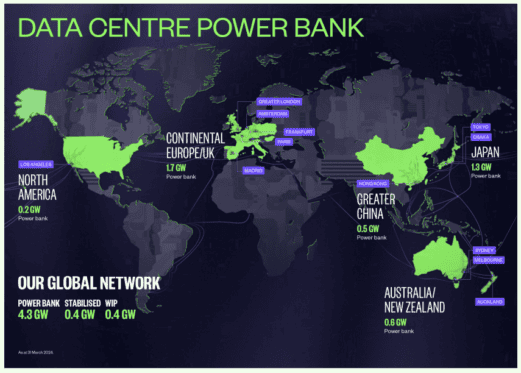
    Goodman’s global power bank totals 4.3GW across 12 major cities, following a 0.3GW addition during the third quarter.

    Source: Goodman Group third quarter update

    The bank comprises 2.1GW of secured power, including 0.4GW that is stabilised and owned, and 0.4GW that is under development, and 2.2GW of power in the advanced stages of procurement.

    Goodman says it has the proven development capabilities and strong balance sheet to continue buying and developing high-tier data centres in popular, supply-constrained locations.

    Goodman said:

    We continue to develop large-scale, high value, data centres, and expand our global power bank to address growing data centre demand as AI usage and cloud computing expands.

    ASX 200 stock price snapshot

    This ASX 200 property stock has gained 153.5% in market cap over the past five years.

    This compares to 9.3% for the S&P/ASX 200 A-REIT Index.

    The post Up 73% in a year, this surging ASX 200 stock just hit another all-time high appeared first on The Motley Fool Australia.

    Should you invest $1,000 in Goodman Group right now?

    Before you buy Goodman Group shares, consider this:

    Motley Fool investing expert Scott Phillips just revealed what he believes are the 5 best stocks for investors to buy right now… and Goodman Group wasn’t one of them.

    The online investing service he’s run for over a decade, Motley Fool Share Advisor, has provided thousands of paying members with stock picks that have doubled, tripled or even more.*

    And right now, Scott thinks there are 5 stocks that may be better buys…

    See The 5 Stocks
    *Returns as of 5 May 2024

    More reading

    Motley Fool contributor Bronwyn Allen has positions in Goodman Group. The Motley Fool Australia’s parent company Motley Fool Holdings Inc. has positions in and has recommended Goodman Group. The Motley Fool Australia has recommended Goodman Group. The Motley Fool has a disclosure policy. This article contains general investment advice only (under AFSL 400691). Authorised by Scott Phillips.