Category: Stock Market

  • Could April be a good month for the AGL share price?

    A woman holds her finger to the side of her lips in contemplation as she looks upwards to an array of graphic images of light bulbs above her head, one of which is on and glowing., indicating the outlook for the AGL share price.

    A woman holds her finger to the side of her lips in contemplation as she looks upwards to an array of graphic images of light bulbs above her head, one of which is on and glowing., indicating the outlook for the AGL share price.

    Despite its reputation as a poor performing ASX 200 share, AGL Energy Limited (ASX: AGL) shares have been on a bit of a tear lately. Investors were badly burned last year when the AGL share price fell by close to 50%. 2019 and 2020 weren’t much better for this energy generator and retailer either. AGL’s last all-time high of close to $28 is still painfully far from the company’s current share price of $8.27 at the time of writing today. 

    But in saying that, AGL has actually been quite the rewarding investment of late. Its shares are now up more than 30% year to date. They are also up around 62% from the company’s last 52-week low of $5.10 that we saw back in November last year. 

    So with these gains under the belt, many investors might be wondering whether AGL shares are still a buy now that we’re in April. Could AGL keep the 2022 momentum going this month and beyond?

    Are AGL shares an April buy today?

    Well, one ASX broker who reckons the company has a good shot is Morgans. As my Fool colleague James covered yesterday, broker Morgans has just upgraded AGL to an ‘add’ rating. That came with a 12-month share price target of $8.83. If that turned out to be the case, investors would be looking at a return of 6.9% on their AGL shares over the next year. That’s on top of any dividends investors may receive too. Morgans reportedly re-rated AGL to the upside in response to improving electricity prices. 

    No doubt investors will be pleased with that assessment. But, as always, we’ll have to wait and see if it proves to be accurate. 

    At the current AGL share price, this ASX 200 share has a market capitalisation of $5.54 billion, with a trailing dividend yield of 6.05%. 

    The post Could April be a good month for the AGL share price? appeared first on The Motley Fool Australia.

    Should you invest $1,000 in AGL Energy right now?

    Before you consider AGL Energy, you’ll want to hear this.

    Motley Fool Investing expert Scott Phillips just revealed what he believes are the 5 best stocks for investors to buy right now… and AGL Energy wasn’t one of them.

    The online investing service he’s run for over a decade, Motley Fool Share Advisor, has provided thousands of paying members with stock picks that have doubled, tripled or even more.* And right now, Scott thinks there are 5 stocks that are better buys.

    *Returns as of January 13th 2022

    More reading

    Motley Fool contributor Sebastian Bowen has no position in any of the stocks mentioned. The Motley Fool Australia’s parent company Motley Fool Holdings Inc. has no position in any of the stocks mentioned. The Motley Fool Australia has no position in any of the stocks mentioned. The Motley Fool has a disclosure policy. This article contains general investment advice only (under AFSL 400691). Authorised by Bruce Jackson.

    from The Motley Fool Australia https://ift.tt/Hixlfv9

  • Is Newcrest Mining considered a defensive ASX share?

    a woman wearing a sparkly strapless dress leans on a neat stack of six gold bars as she smiles and looks to the side as though she is very happy and protective of her stash. She also has gold fingernails and gold glitter pieces affixed to her cheeks.

    a woman wearing a sparkly strapless dress leans on a neat stack of six gold bars as she smiles and looks to the side as though she is very happy and protective of her stash. She also has gold fingernails and gold glitter pieces affixed to her cheeks.

    Is Newcrest Mining Ltd (ASX: NCM) a defensive ASX share? Well, you wouldn’t think so looking at today’s share price movements. At the time of writing, the S&P/ASX 200 Index (ASX: XJO) is down a depressing 0.87% and back under 7,500 points in the ASX’s first major selloff in weeks. But the Newcrest share price is down a nasty 3.12% today to $26.40 a share at the time of writing.

    But one day of underperformance isn’t a lot to go on.

    Newcrest is an ASX 200 gold miner. On the one hand, a gold share can be considered inherently defensive for some for its connection to gold. Gold is still viewed by many investors as the ultimate ‘safe haven’ asset. It often experiences interest during times of economic or geopolitical hardship. We can even see this playing out in 2022. This year has brought some calamitous geopolitical events, none more so than the war in Ukraine.

    Since the start of the year, the price of gold has risen from around US$1,832 an ounce to the US$1,922 we see today.

    Since Newcrest mines and produces gold, and also owns vast reserves of gold ore, it arguably benefits from this reputation for defensiveness by extension. That is tempered by the fact that it, like all gold miners, is a leveraged play on the price of gold. Since it costs Newcrest a relatively fixed sum to extract and produce every ounce of gold it mines, Newcrest’s profitability exponentially increases if the price of gold rises. Conversely, it exponentially falls if gold prices decrease.

    Can Newcrest shares be a defensive ASX investment?

    But let’s see what an expert ASX investor is saying about Newcrest’s defensiveness. James Rutledge of investment manager Perpetual Limited (ASX: PPT) recently sat down for a podcast with Livewire Markets. In this interview, he shared his views on Newcrest shares. Here’s some of what he had to say:

    Newcrest is a buy for us. So, typically when you see real rates move from negative to positive, gold would be a pretty challenging space to invest. But given the freezing of FX reserves from Russia, we think that’ll cause central banks to really revisit their gold holdings and that should support the gold price. Newcrest is also very cheap relative to gold majors. It benefits from a higher copper price with its byproduct. And the market’s concerned about production issues, but we think that’s more than reflected in the price.

    However, his fellow podcast participant, WaveStone Capital’s Raaz Bhuyan, wasn’t as bullish. Here’s some of what Bhuyan said on Newcrest:

    It’s actually a sell for us. I agree with James – the geopolitics has really taken the gold price up, despite the fact that real rates are going up. We think the moment we get some clarity around the Ukraine conflict, given where real rates have moved, the gold price is probably going to be under the pump a little bit.

    So two conflicting views on Newcrest there. As with any gold miner, the fate of this company rides or dies with the price of gold itself. So if you’re keeping an eye on Newcrest for a defensive investment, make sure you consider all sides of the equation.

    At the current Newcrest Mining share price, this ASX 200 gold miner has a market capitalisation of $23.56 billion.

    The post Is Newcrest Mining considered a defensive ASX share? appeared first on The Motley Fool Australia.

    Should you invest $1,000 in Newcrest Mining right now?

    Before you consider Newcrest Mining, you’ll want to hear this.

    Motley Fool Investing expert Scott Phillips just revealed what he believes are the 5 best stocks for investors to buy right now… and Newcrest Mining wasn’t one of them.

    The online investing service he’s run for over a decade, Motley Fool Share Advisor, has provided thousands of paying members with stock picks that have doubled, tripled or even more.* And right now, Scott thinks there are 5 stocks that are better buys.

    *Returns as of January 13th 2022

    More reading

    Motley Fool contributor Sebastian Bowen owns Newcrest Mining Limited. The Motley Fool Australia’s parent company Motley Fool Holdings Inc. has no position in any of the stocks mentioned. The Motley Fool Australia has no position in any of the stocks mentioned. The Motley Fool has a disclosure policy. This article contains general investment advice only (under AFSL 400691). Authorised by Bruce Jackson.

    from The Motley Fool Australia https://ift.tt/wmxI3kv

  • Zip shares sink on the release of its share purchase plan results

    illustration of laptop with down arrow and the word zip representing zip share price going down.illustration of laptop with down arrow and the word zip representing zip share price going down.

    The Zip Co Ltd (ASX: Z1P) share price is heading south today, nearing its 52-week low of $1.40.

    This comes after the buy now, pay later (BNPL) provider announced the results of its recent Share Purchase Plan (SPP).

    At the time of writing, Zip shares are swapping hands for $1.47, down 4.85%.

    What were the results of Zip’s SPP?

    In a statement to the ASX, Zip advised it has completed its SPP.

    In total, the company raised around $23.98 million – a significant shortfall of the $50 million offered to retail investors.

    It appears that concerns the Zip share price could fall further led eligible shareholders to watch from the sidelines.

    And indeed, they were right.

    The final issue price under the SPP is $1.48 per share.

    However, the company’s shares fell to an intraday low of $1.46 today. This means you could have picked them up cheaper than the SPP.

    For those who did participate under the placement, the allotment of the new shares is scheduled for this Friday. Normal trading of the new shares will commence on Monday 11 April.

    Recently, the company successfully completed a $148.7 million institutional placement from a number of institutional, sophisticated and professional investors. The price listed under the placement was $1.90.

    Zip previously noted that the proceeds of its capital raising efforts will go towards strengthening its balance sheet.

    In addition, it is also looking to shore up funds to execute on the potential synergies from the upcoming transaction. This relates to the $491 million all-scrip acquisition of Sezzle Inc (ASX: SZL).

    Zip share price summary

    The Zip share price is down more than 85% since its 52-week high of $10.61 reached in April 2021.

    The company’s share price has continued a downward trajectory, wiping off significant value on investor portfolios.

    On valuation grounds, Zip has a market capitalisation of around $986.85 million, with approximately 669.05 million shares outstanding.

    The post Zip shares sink on the release of its share purchase plan results appeared first on The Motley Fool Australia.

    Should you invest $1,000 in Zip right now?

    Before you consider Zip, you’ll want to hear this.

    Motley Fool Investing expert Scott Phillips just revealed what he believes are the 5 best stocks for investors to buy right now… and Zip wasn’t one of them.

    The online investing service he’s run for over a decade, Motley Fool Share Advisor, has provided thousands of paying members with stock picks that have doubled, tripled or even more.* And right now, Scott thinks there are 5 stocks that are better buys.

    *Returns as of January 13th 2022

    More reading

    Motley Fool contributor Aaron Teboneras has no position in any of the stocks mentioned. The Motley Fool Australia’s parent company Motley Fool Holdings Inc. owns and has recommended ZIPCOLTD FPO. The Motley Fool Australia has no position in any of the stocks mentioned. The Motley Fool has a disclosure policy. This article contains general investment advice only (under AFSL 400691). Authorised by Bruce Jackson.

    from The Motley Fool Australia https://ift.tt/jVxWdoT

  • ASX 200 (ASX:XJO) midday update: Block and Zip sink, Paladin Energy raises $200m

    An ASX200 market analyst holds his hand to his chin and looks closely at his computer screens watching share price movements

    An ASX200 market analyst holds his hand to his chin and looks closely at his computer screens watching share price movements

    At lunch on Wednesday, the S&P/ASX 200 Index (ASX: XJO) has followed Wall Street’s lead and is tumbling lower. The benchmark index is currently down 0.75% to 7,472.3 points.

    Here’s what is happening on the ASX 200 today:

    Zip completes shares purchase plan

    The Zip Co Ltd (ASX: Z1P) share price is trading lower today. This follows weakness in the tech sector and a subdued response to the buy now pay later provider’s share purchase plan. In respect to the latter, Zip raised an additional ~$24 million at $1.48 per new share. This is less than half the $50 million it was seeking from retail shareholders.

    Tech shares slump

    It isn’t just Zip that is tumbling today in the tech sector. A number of ASX 200 tech shares are under pressure and deep in the red. This includes Block Inc (ASX: SQ2) and Xero Limited (ASX: XRO), which are dragging the S&P/ASX All Technology Index down by 2.5% at lunch. This follows a similarly sharp decline by the tech-focused Nasdaq index overnight amid fears that rate rises could slow economic growth.

    Paladin Energy raises $200 million

    The Paladin Energy Ltd (ASX: PDN) share price is falling on Wednesday. This morning the uranium producer announced the completion of a $200 million institutional placement. These funds were raised at an 8.9% discount of 72 cents per new share. Paladin intends to use the cash to support the restart of the globally significant Langer Heinrich Mine.

    Best and worst ASX 200 performers

    The best performer on the ASX 200 on Wednesday has been the PolyNovo Ltd (ASX: PNV) share price with a 5% gain. This follows the release of a third quarter update by the medical device company. Going the other way, the Magellan Financial Group Ltd (ASX: MFG) share price is the worst performer with a 6% decline on no news.

    The post ASX 200 (ASX:XJO) midday update: Block and Zip sink, Paladin Energy raises $200m appeared first on The Motley Fool Australia.

    Wondering where you should invest $1,000 right now?

    When investing expert Scott Phillips has a stock tip, it can pay to listen. After all, the flagship Motley Fool Share Advisor newsletter he has run for over ten years has provided thousands of paying members with stock picks that have doubled, tripled or even more.*

    Scott just revealed what he believes could be the five best ASX stocks for investors to buy right now. These stocks are trading at near dirt-cheap prices and Scott thinks they could be great buys right now.

    *Returns as of January 12th 2022

    More reading

    Motley Fool contributor James Mickleboro has no position in any of the stocks mentioned. The Motley Fool Australia’s parent company Motley Fool Holdings Inc. owns and has recommended Block, Inc., POLYNOVO FPO, Xero, and ZIPCOLTD FPO. The Motley Fool Australia owns and has recommended Block, Inc. and Xero. The Motley Fool has a disclosure policy. This article contains general investment advice only (under AFSL 400691). Authorised by Bruce Jackson.

    from The Motley Fool Australia https://ift.tt/P6UyKJ4

  • Could Amazon help you become a millionaire by 2032?

    This article was originally published on Fool.com. All figures quoted in US dollars unless otherwise stated.

    A young woman sitting atop a superyacht spreads her arms in joy, indictaing a share price rise for marine companies

    This article was originally published on Fool.com. All figures quoted in US dollars unless otherwise stated.

    There’s no denying that Amazon (NASDAQ: AMZN) has been one of the market’s more rewarding stocks in recent years. Up more than 20,000% since the end of the year 2000, the e-commerce giant has arguably been the market’s best large-cap performer for the timeframe in question. It would be easy to be excited about owning it now.

    However, past performance is no guarantee of future results. While many investors have high hopes for Amazon stock over the next 10 years, there’s no assurance that the world is due a repeat performance. Serious competition is starting to take shape, and the company is closer to market saturation than it was a couple of decades ago.

    Still, there are positive signs. While another quintuple-digit surge may not be in the cards, a triple-digit advance by 2032 is hardly out of the question.

    It’s not the Amazon you know

    While the company started as an online book company back in 1995, it didn’t take long for Amazon.com to become an “everything store,” selling pretty much anything anyone might want to buy when they want to buy it. Counting all of its third-party sellers’ inventories, BigCommerce says the company offers at least 350 million products at any given time. No wonder it’s seen as the first place many consumers visit to make an online purchase!

    In light of its existing reach, there’s no reason to think it won’t continue growing. BigCommerce adds that nearly 200 million people shop with Amazon every month. Still, there are nearly 8 billion people on the planet, most of whom are not yet regular Amazon customers.

    The problem is that the company’s consumer-facing online retailing business isn’t exactly what you’d call wildly profitable. Here’s another interesting fact: It doesn’t matter. The graphic below is telling, visually comparing Amazon’s operating income for its North American e-commerce arm, its international e-commerce unit, and its cloud computing division Amazon Web Services (AWS).

    While at one time the company’s online shopping operation carried all the profit weight, since 2018 its cloud computing service’s bottom line has been just as important as its North American retailing business. Indeed, since 2019, AWS has been the biggest moneymaker by far, doing more for the bottom line than North America’s and its overseas e-commerce efforts combined.
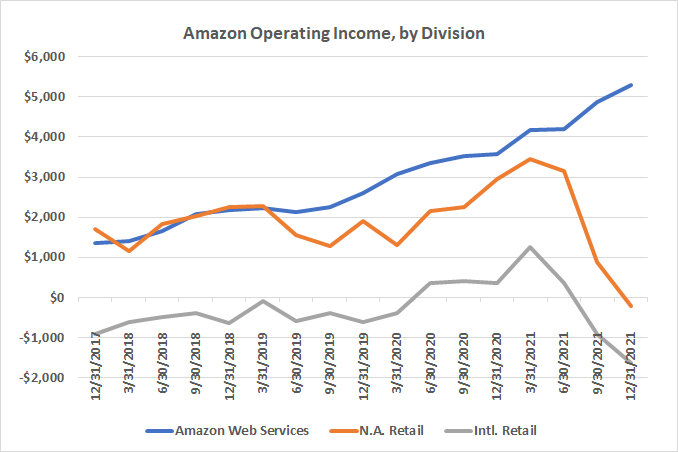
    Amazon's cloud computing arm AWS is significantly more profitable than its e-commerce efforts.


    Data source: Amazon Inc. Chart by author. All dollar figures are in millions.

    As it turns out, the company’s customer acquisition and online shopping expansion is proving very expensive, with inflation only making matters worse. As was already noted, though, it just doesn’t matter. Amazon Web Services has become such a monster of a business that it can keep the rest of the company afloat while nascent CEO Andy Jassy works on reshaping the online shopping marketplace into something sustainable.

    More of the same profit growth on the way

    Yet, Amazon Web Services has only scratched the surface of its potential. Numbers from technology market research outfit Technavio puts things in perspective. Its outlook suggests the worldwide cloud computing industry will grow at an annualized pace of 17% through 2025, ending that period $287 billion bigger than when it started.

    Notably, Technavio believes North America alone — where Amazon has concentrated its cloud computing efforts — will account for 40% of this growth for a business that’s already a major profit engine for the company.

    And that’s still not all of Amazon’s noteworthy growth opportunities outside of conventional e-commerce. While the company has been mostly guarded about providing details of the young business, last year’s full-year report confirmed it generated $31.2 billion worth of advertising revenue, monetizing all the traffic its shopping site draws by helping third-party sellers and advertisers steer people to particular products.

    While 2021 was a banner year in terms of growth, eMarketer is still calling for at least two more years of double-digit increases for the company’s ad business. For perspective, Alphabet‘s (NASDAQ: GOOGL) (NASDAQ: GOOG) Google generated $43.3 billion worth of search-based advertising sales last year. Bear in mind that this is also high-margin revenue as Amazon is only monetizing a website and traffic it already had, tacking on incremental business.

    Millionaire-maker alert

    Bottom line? Yes, Amazon is still one of those stocks that could help your portfolio reach the million-dollar mark. But the same investing advice that applied before still applies now, of course. Namely, keep your portfolio diversified and keep your expectations in check.

    It’s unlikely that Amazon shares will see massive gains again over the coming 10 years since the bulk of the 20,000% return it dished out since the year 2000 was rooted in the fact that Amazon’s growth was so unexpected. Investors see it coming now, but they didn’t then.

    Nevertheless, Amazon certainly has the potential to double or even triple in value throughout the coming decade. The key is simply leaving it alone for that long and letting the stock do its thing.

    John Mackey, CEO of Whole Foods Market, an Amazon subsidiary, is a member of The Motley Fool’s board of directors. Suzanne Frey, an executive at Alphabet, is a member of The Motley Fool’s board of directors. The Motley Fool owns and recommends Alphabet (A shares), Amazon, and BigCommerce Holdings, Inc. The Motley Fool recommends Alphabet (C shares). The Motley Fool has a disclosure policy.

    This article was originally published on Fool.com. All figures quoted in US dollars unless otherwise stated.

    The post Could Amazon help you become a millionaire by 2032? appeared first on The Motley Fool Australia.

    Should you invest $1,000 in Amazon right now?

    Before you consider Amazon, you’ll want to hear this.

    Motley Fool Investing expert Scott Phillips just revealed what he believes are the 5 best stocks for investors to buy right now… and Amazon wasn’t one of them.

    The online investing service he’s run for over a decade, Motley Fool Share Advisor, has provided thousands of paying members with stock picks that have doubled, tripled or even more.* And right now, Scott thinks there are 5 stocks that are better buys.

    *Returns as of January 13th 2022

    More reading

    James Brumley owns Alphabet (A shares). John Mackey, CEO of Whole Foods Market, an Amazon subsidiary, is a member of The Motley Fool’s board of directors. Suzanne Frey, an executive at Alphabet, is a member of The Motley Fool’s board of directors. The Motley Fool Australia’s parent company Motley Fool Holdings Inc. owns and has recommended Alphabet (A shares), Amazon, and BigCommerce Holdings, Inc. The Motley Fool Australia’s parent company Motley Fool Holdings Inc. has recommended Alphabet (C shares). The Motley Fool Australia has recommended Alphabet (A shares), Alphabet (C shares), and Amazon. The Motley Fool has a disclosure policy. This article contains general investment advice only (under AFSL 400691). Authorised by Bruce Jackson.

    This article was originally published on Fool.com. All figures quoted in US dollars unless otherwise stated.


    from The Motley Fool Australia https://ift.tt/ja4QAev

  • Australian Ethical (ASX:AEF) share price in focus on possible Christian Super merger

    two business men sit across from each other at a negotiating table. with a large window in the background.two business men sit across from each other at a negotiating table. with a large window in the background.

    The Australian Ethical Investment Limited (ASX: AEF) share price is down 3.56% amid news of a potential deal with Christian Super.

    Australian Ethical is a fund manager that offers superannuation services.

    Potential Australian Ethical merger with Christian Super?

    Australian Ethical announced today that its superannuation subsidiary, Australian Ethical Superannuation, has signed an exclusive memorandum of understanding with Christian Super to explore a potential merger.

    At this stage, the two parties have entered a non-binding period of due diligence and transition planning. If successfully concluded, Christian Super members will join Australian Ethical Super through a successor fund transfer in late 2022 or early 2023.

    Australian Ethical expects to complete the due diligence process by the end of May 2022. The company plans to release more details once it is complete.

    What’s attractive about a potential deal for Australian Ethical?

    The fund manager said that both parties are confident the opportunity aligns with members’ best financial interests, offering “compelling” member benefits through increased scale, while also significantly amplifying their “combined impact as proven pioneers of ethical and responsible investing.”

    If this merger goes ahead, it could see Australian Ethical manage more than $9 billion. That would be on behalf of 100,000 Australians across its range of superannuation, managed fund and exchange-traded fund (ETF) products.

    According to Christian Super, it has 30,000 members and around $2 billion of funds under management (FUM).

    Why is Christian Super considering this?

    APRA recently imposed additional licence conditions on the trustee of Christian Super, Christian Super Pty Ltd. The conditions are to protect the best financial interests of the fund’s members.

    They address concerns arising from APRA’s investigation into Christian Super’s investment oversight, governance and strategic decision making. The conditions also aim to “rectify[ing] Christian Super’s persistent investment underperformance, which culminated in the fund’s MySuper product failing the first annual performance test” in August 2021.

    Under those terms, Christian Super is required to merge with a larger, better-performing fund by 31 July 2022.

    Christian Super acknowledges that being part of a larger fund with more members and retirement savings is likely to deliver additional financial benefits to Christian Super members.

    Why choose Australian Ethical? According to the Christian Super board, it seemed the most attractive when evaluating various factors.

    Board commentary

    Chair of Australian Ethical Steve Gibbs said:

    We’re delighted to be exploring this opportunity with Christian Super. It is a meaningful endorsement of our purpose and investment philosophy, which remain unchanged and only strengthened by this opportunity.

    Recent research shows that more Australians than ever expect their money to be invested responsibly and ethically. This comes as no surprise to us at Australian Ethical. We’ve seen extraordinary growth as Australians seek to invest in line with their values.

    This opportunity not only accelerates the trajectory we are on through clear stakeholder benefits but also significantly enhances our influence as the leading ethical investment voice in Australia.

    Australian Ethical share price snapshot

    Since the start of the 2022 year, the Australian Ethical share price has dropped 48.8%.

    The post Australian Ethical (ASX:AEF) share price in focus on possible Christian Super merger appeared first on The Motley Fool Australia.

    Should you invest $1,000 in Australian Ethical right now?

    Before you consider Australian Ethical, you’ll want to hear this.

    Motley Fool Investing expert Scott Phillips just revealed what he believes are the 5 best stocks for investors to buy right now… and Australian Ethical wasn’t one of them.

    The online investing service he’s run for over a decade, Motley Fool Share Advisor, has provided thousands of paying members with stock picks that have doubled, tripled or even more.* And right now, Scott thinks there are 5 stocks that are better buys.

    *Returns as of January 13th 2022

    More reading

    Motley Fool contributor Tristan Harrison has no position in any of the stocks mentioned. The Motley Fool Australia’s parent company Motley Fool Holdings Inc. owns and has recommended Australian Ethical Investment Ltd. The Motley Fool Australia has recommended Australian Ethical Investment Ltd. The Motley Fool has a disclosure policy. This article contains general investment advice only (under AFSL 400691). Authorised by Bruce Jackson.

    from The Motley Fool Australia https://ift.tt/g2ICTxi

  • ASX 200 (ASX:XJO) midday update: Block and Zip sink, Paladin Energy raises $200m

    An ASX200 market analyst holds his hand to his chin and looks closely at his computer screens watching share price movements

    An ASX200 market analyst holds his hand to his chin and looks closely at his computer screens watching share price movements

    At lunch on Wednesday, the S&P/ASX 200 Index (ASX: XJO) has followed Wall Street’s lead and is tumbling lower. The benchmark index is currently down 0.75% to 7,472.3 points.

    Here’s what is happening on the ASX 200 today:

    Zip completes shares purchase plan

    The Zip Co Ltd (ASX: Z1P) share price is trading lower today. This follows weakness in the tech sector and a subdued response to the buy now pay later provider’s share purchase plan. In respect to the latter, Zip raised an additional ~$24 million at $1.48 per new share. This is less than half the $50 million it was seeking from retail shareholders.

    Tech shares slump

    It isn’t just Zip that is tumbling today in the tech sector. A number of ASX 200 tech shares are under pressure and deep in the red. This includes Block Inc (ASX: SQ2) and Xero Limited (ASX: XRO), which are dragging the S&P/ASX All Technology Index down by 2.5% at lunch. This follows a similarly sharp decline by the tech-focused Nasdaq index overnight amid fears that rate rises could slow economic growth.

    Paladin Energy raises $200 million

    The Paladin Energy Ltd (ASX: PDN) share price is falling on Wednesday. This morning the uranium producer announced the completion of a $200 million institutional placement. These funds were raised at an 8.9% discount of 72 cents per new share. Paladin intends to use the cash to support the restart of the globally significant Langer Heinrich Mine.

    Best and worst ASX 200 performers

    The best performer on the ASX 200 on Wednesday has been the PolyNovo Ltd (ASX: PNV) share price with a 5% gain. This follows the release of a third quarter update by the medical device company. Going the other way, the Magellan Financial Group Ltd (ASX: MFG) share price is the worst performer with a 6% decline on no news.

    The post ASX 200 (ASX:XJO) midday update: Block and Zip sink, Paladin Energy raises $200m appeared first on The Motley Fool Australia.

    Wondering where you should invest $1,000 right now?

    When investing expert Scott Phillips has a stock tip, it can pay to listen. After all, the flagship Motley Fool Share Advisor newsletter he has run for over ten years has provided thousands of paying members with stock picks that have doubled, tripled or even more.*

    Scott just revealed what he believes could be the five best ASX stocks for investors to buy right now. These stocks are trading at near dirt-cheap prices and Scott thinks they could be great buys right now.

    *Returns as of January 12th 2022

    More reading

    Motley Fool contributor James Mickleboro has no position in any of the stocks mentioned. The Motley Fool Australia’s parent company Motley Fool Holdings Inc. owns and has recommended Block, Inc., POLYNOVO FPO, Xero, and ZIPCOLTD FPO. The Motley Fool Australia owns and has recommended Block, Inc. and Xero. The Motley Fool has a disclosure policy. This article contains general investment advice only (under AFSL 400691). Authorised by Bruce Jackson.

    from The Motley Fool Australia https://ift.tt/P6UyKJ4

  • Could Amazon help you become a millionaire by 2032?

    This article was originally published on Fool.com. All figures quoted in US dollars unless otherwise stated.

    A young woman sitting atop a superyacht spreads her arms in joy, indictaing a share price rise for marine companies

    This article was originally published on Fool.com. All figures quoted in US dollars unless otherwise stated.

    There’s no denying that Amazon (NASDAQ: AMZN) has been one of the market’s more rewarding stocks in recent years. Up more than 20,000% since the end of the year 2000, the e-commerce giant has arguably been the market’s best large-cap performer for the timeframe in question. It would be easy to be excited about owning it now.

    However, past performance is no guarantee of future results. While many investors have high hopes for Amazon stock over the next 10 years, there’s no assurance that the world is due a repeat performance. Serious competition is starting to take shape, and the company is closer to market saturation than it was a couple of decades ago.

    Still, there are positive signs. While another quintuple-digit surge may not be in the cards, a triple-digit advance by 2032 is hardly out of the question.

    It’s not the Amazon you know

    While the company started as an online book company back in 1995, it didn’t take long for Amazon.com to become an “everything store,” selling pretty much anything anyone might want to buy when they want to buy it. Counting all of its third-party sellers’ inventories, BigCommerce says the company offers at least 350 million products at any given time. No wonder it’s seen as the first place many consumers visit to make an online purchase!

    In light of its existing reach, there’s no reason to think it won’t continue growing. BigCommerce adds that nearly 200 million people shop with Amazon every month. Still, there are nearly 8 billion people on the planet, most of whom are not yet regular Amazon customers.

    The problem is that the company’s consumer-facing online retailing business isn’t exactly what you’d call wildly profitable. Here’s another interesting fact: It doesn’t matter. The graphic below is telling, visually comparing Amazon’s operating income for its North American e-commerce arm, its international e-commerce unit, and its cloud computing division Amazon Web Services (AWS).

    While at one time the company’s online shopping operation carried all the profit weight, since 2018 its cloud computing service’s bottom line has been just as important as its North American retailing business. Indeed, since 2019, AWS has been the biggest moneymaker by far, doing more for the bottom line than North America’s and its overseas e-commerce efforts combined.

    Amazon's cloud computing arm AWS is significantly more profitable than its e-commerce efforts.


    Data source: Amazon Inc. Chart by author. All dollar figures are in millions.

    As it turns out, the company’s customer acquisition and online shopping expansion is proving very expensive, with inflation only making matters worse. As was already noted, though, it just doesn’t matter. Amazon Web Services has become such a monster of a business that it can keep the rest of the company afloat while nascent CEO Andy Jassy works on reshaping the online shopping marketplace into something sustainable.

    More of the same profit growth on the way

    Yet, Amazon Web Services has only scratched the surface of its potential. Numbers from technology market research outfit Technavio puts things in perspective. Its outlook suggests the worldwide cloud computing industry will grow at an annualized pace of 17% through 2025, ending that period $287 billion bigger than when it started.

    Notably, Technavio believes North America alone — where Amazon has concentrated its cloud computing efforts — will account for 40% of this growth for a business that’s already a major profit engine for the company.

    And that’s still not all of Amazon’s noteworthy growth opportunities outside of conventional e-commerce. While the company has been mostly guarded about providing details of the young business, last year’s full-year report confirmed it generated $31.2 billion worth of advertising revenue, monetizing all the traffic its shopping site draws by helping third-party sellers and advertisers steer people to particular products.

    While 2021 was a banner year in terms of growth, eMarketer is still calling for at least two more years of double-digit increases for the company’s ad business. For perspective, Alphabet‘s (NASDAQ: GOOGL) (NASDAQ: GOOG) Google generated $43.3 billion worth of search-based advertising sales last year. Bear in mind that this is also high-margin revenue as Amazon is only monetizing a website and traffic it already had, tacking on incremental business.

    Millionaire-maker alert

    Bottom line? Yes, Amazon is still one of those stocks that could help your portfolio reach the million-dollar mark. But the same investing advice that applied before still applies now, of course. Namely, keep your portfolio diversified and keep your expectations in check.

    It’s unlikely that Amazon shares will see massive gains again over the coming 10 years since the bulk of the 20,000% return it dished out since the year 2000 was rooted in the fact that Amazon’s growth was so unexpected. Investors see it coming now, but they didn’t then.

    Nevertheless, Amazon certainly has the potential to double or even triple in value throughout the coming decade. The key is simply leaving it alone for that long and letting the stock do its thing.

    John Mackey, CEO of Whole Foods Market, an Amazon subsidiary, is a member of The Motley Fool’s board of directors. Suzanne Frey, an executive at Alphabet, is a member of The Motley Fool’s board of directors. The Motley Fool owns and recommends Alphabet (A shares), Amazon, and BigCommerce Holdings, Inc. The Motley Fool recommends Alphabet (C shares). The Motley Fool has a disclosure policy.

    This article was originally published on Fool.com. All figures quoted in US dollars unless otherwise stated.

    The post Could Amazon help you become a millionaire by 2032? appeared first on The Motley Fool Australia.

    Should you invest $1,000 in Amazon right now?

    Before you consider Amazon, you’ll want to hear this.

    Motley Fool Investing expert Scott Phillips just revealed what he believes are the 5 best stocks for investors to buy right now… and Amazon wasn’t one of them.

    The online investing service he’s run for over a decade, Motley Fool Share Advisor, has provided thousands of paying members with stock picks that have doubled, tripled or even more.* And right now, Scott thinks there are 5 stocks that are better buys.

    *Returns as of January 13th 2022

    More reading

    James Brumley owns Alphabet (A shares). John Mackey, CEO of Whole Foods Market, an Amazon subsidiary, is a member of The Motley Fool’s board of directors. Suzanne Frey, an executive at Alphabet, is a member of The Motley Fool’s board of directors. The Motley Fool Australia’s parent company Motley Fool Holdings Inc. owns and has recommended Alphabet (A shares), Amazon, and BigCommerce Holdings, Inc. The Motley Fool Australia’s parent company Motley Fool Holdings Inc. has recommended Alphabet (C shares). The Motley Fool Australia has recommended Alphabet (A shares), Alphabet (C shares), and Amazon. The Motley Fool has a disclosure policy. This article contains general investment advice only (under AFSL 400691). Authorised by Bruce Jackson.

    This article was originally published on Fool.com. All figures quoted in US dollars unless otherwise stated.


    from The Motley Fool Australia https://ift.tt/ja4QAev

  • Australian Ethical (ASX:AEF) share price in focus on possible Christian Super merger

    two business men sit across from each other at a negotiating table. with a large window in the background.two business men sit across from each other at a negotiating table. with a large window in the background.

    The Australian Ethical Investment Limited (ASX: AEF) share price is down 3.56% amid news of a potential deal with Christian Super.

    Australian Ethical is a fund manager that offers superannuation services.

    Potential Australian Ethical merger with Christian Super?

    Australian Ethical announced today that its superannuation subsidiary, Australian Ethical Superannuation, has signed an exclusive memorandum of understanding with Christian Super to explore a potential merger.

    At this stage, the two parties have entered a non-binding period of due diligence and transition planning. If successfully concluded, Christian Super members will join Australian Ethical Super through a successor fund transfer in late 2022 or early 2023.

    Australian Ethical expects to complete the due diligence process by the end of May 2022. The company plans to release more details once it is complete.

    What’s attractive about a potential deal for Australian Ethical?

    The fund manager said that both parties are confident the opportunity aligns with members’ best financial interests, offering “compelling” member benefits through increased scale, while also significantly amplifying their “combined impact as proven pioneers of ethical and responsible investing.”

    If this merger goes ahead, it could see Australian Ethical manage more than $9 billion. That would be on behalf of 100,000 Australians across its range of superannuation, managed fund and exchange-traded fund (ETF) products.

    According to Christian Super, it has 30,000 members and around $2 billion of funds under management (FUM).

    Why is Christian Super considering this?

    APRA recently imposed additional licence conditions on the trustee of Christian Super, Christian Super Pty Ltd. The conditions are to protect the best financial interests of the fund’s members.

    They address concerns arising from APRA’s investigation into Christian Super’s investment oversight, governance and strategic decision making. The conditions also aim to “rectify[ing] Christian Super’s persistent investment underperformance, which culminated in the fund’s MySuper product failing the first annual performance test” in August 2021.

    Under those terms, Christian Super is required to merge with a larger, better-performing fund by 31 July 2022.

    Christian Super acknowledges that being part of a larger fund with more members and retirement savings is likely to deliver additional financial benefits to Christian Super members.

    Why choose Australian Ethical? According to the Christian Super board, it seemed the most attractive when evaluating various factors.

    Board commentary

    Chair of Australian Ethical Steve Gibbs said:

    We’re delighted to be exploring this opportunity with Christian Super. It is a meaningful endorsement of our purpose and investment philosophy, which remain unchanged and only strengthened by this opportunity.

    Recent research shows that more Australians than ever expect their money to be invested responsibly and ethically. This comes as no surprise to us at Australian Ethical. We’ve seen extraordinary growth as Australians seek to invest in line with their values.

    This opportunity not only accelerates the trajectory we are on through clear stakeholder benefits but also significantly enhances our influence as the leading ethical investment voice in Australia.

    Australian Ethical share price snapshot

    Since the start of the 2022 year, the Australian Ethical share price has dropped 48.8%.

    The post Australian Ethical (ASX:AEF) share price in focus on possible Christian Super merger appeared first on The Motley Fool Australia.

    Should you invest $1,000 in Australian Ethical right now?

    Before you consider Australian Ethical, you’ll want to hear this.

    Motley Fool Investing expert Scott Phillips just revealed what he believes are the 5 best stocks for investors to buy right now… and Australian Ethical wasn’t one of them.

    The online investing service he’s run for over a decade, Motley Fool Share Advisor, has provided thousands of paying members with stock picks that have doubled, tripled or even more.* And right now, Scott thinks there are 5 stocks that are better buys.

    *Returns as of January 13th 2022

    More reading

    Motley Fool contributor Tristan Harrison has no position in any of the stocks mentioned. The Motley Fool Australia’s parent company Motley Fool Holdings Inc. owns and has recommended Australian Ethical Investment Ltd. The Motley Fool Australia has recommended Australian Ethical Investment Ltd. The Motley Fool has a disclosure policy. This article contains general investment advice only (under AFSL 400691). Authorised by Bruce Jackson.

    from The Motley Fool Australia https://ift.tt/g2ICTxi

  • Could these ASX shares be set to benefit from increasing Russian sanctions?

    man looking at laptop waiting for Pilbara Minerals trading halt to endman looking at laptop waiting for Pilbara Minerals trading halt to end

    Calls for tighter Russian sanctions following alleged war crimes in Bucha could give some ASX shares a second boost.

    Our market has already been outperforming since Russia invaded Ukraine. The conflict is driving up commodity prices and a new round of global sanctions could give commodities another leg up.

    This puts resource-rich ASX shares in the driver’s seat even as inflation and economic growth risks weigh on the broader market.

    ASX coal shares among the sanction winners

    If you are wondering which shares on our bourse are best placed to outperform, Datt Capital’s managing director Emanuel Datt has picked five to watch in an article on Livewire.

    Whitehaven Coal Ltd (ASX: WHC) and New Hope Corporation Limited (ASX: NHC) are on Datt’s list.

    Whitehaven sells thermal coal to Japanese and Korean customers, while New Hope produces thermal coal from its majority-owned Bengalla mine located in NSW.

    ASX shares looking cheap in this climate

    “Whitehaven trades at just over 1x expected [earnings before interest, tax, depreciation and amortisation] EBITDA at current thermal coal spot prices and is currently buying back 10% of its shares on market,” said Datt.

    “New Hope trades at just over 1x expected EBITDA at current thermal coal spot prices and is due to pay an interim fully franked dividend of 30c a share (equating to over 12% yield grossed up).

    “The company has one of the highest franking credit balances of any company on the ASX and we expect the board to release this embedded value to shareholders in a timely manner.”

    Another ASX mining share in the commodities box seat

    Another ASX share to watch is South32 Ltd (ASX: S32). The diversified miner is a significant producer of base metals, aluminium, and coking coal.

    “S32 is highly capital disciplined and has been buying back its shares on-market since 2017 and this continues today,” Datt explained.

    “These repurchases have been highly value-accretive to shareholders and the company trades at approximately 2x EBITDA at current spot prices.”

    Two ASX shares shining bright

    The BlueScope Steel Limited (ASX: BSL) share price also looks cheap in this environment. The steel producer is buying back around 10% of its shares on-market and trades at circa 2x EBITDA. That’s arguably too low given its strong fundamentals and positive outlook for steel prices and demand, added Datt.

    The tailwinds behind the BlueScope share price should also benefit the Vulcan Steel Ltd (ASX: VSL) share price.

    Recently listed on the ASX, Vulcan is a steel distribution business operating in the ANZ region.

    Is this ASX share set to double in price?

    “Vulcan is experiencing excellent tailwinds from these inflationary markets with reported EBITDA per tonne of steel sold doubling in HY22 relative to FY2022,” said Datt.

    “The business has several attractive qualitative factors which make the present value quite compelling and we value the business around 50% higher than present market prices.”

    The post Could these ASX shares be set to benefit from increasing Russian sanctions? appeared first on The Motley Fool Australia.

    Wondering where you should invest $1,000 right now?

    When investing expert Scott Phillips has a stock tip, it can pay to listen. After all, the flagship Motley Fool Share Advisor newsletter he has run for over ten years has provided thousands of paying members with stock picks that have doubled, tripled or even more.*

    Scott just revealed what he believes could be the five best ASX stocks for investors to buy right now. These stocks are trading at near dirt-cheap prices and Scott thinks they could be great buys right now.

    *Returns as of January 12th 2022

    More reading

    Motley Fool contributor Brendon Lau owns BlueScope Steel Limited and South32 Ltd. The Motley Fool Australia’s parent company Motley Fool Holdings Inc. has no position in any of the stocks mentioned. The Motley Fool Australia has no position in any of the stocks mentioned. The Motley Fool has a disclosure policy. This article contains general investment advice only (under AFSL 400691). Authorised by Bruce Jackson.

    from The Motley Fool Australia https://ift.tt/TiLv2sE