Category: Stock Market

  • Will Amazon start paying a dividend?

    This article was originally published on Fool.com. All figures quoted in US dollars unless otherwise stated.

    woman holding a big Amazon gift

    This article was originally published on Fool.com. All figures quoted in US dollars unless otherwise stated.

    Amazon (NASDAQ: AMZN) has been in the headlines the past few weeks as the investor community buzzes with news of the company’s upcoming 20-for-1 stock split. Stock splits don’t change anything fundamental about the company, but they may provide greater access to investing in the stock and make it easier for Amazon employees to manage their equity. 

    This is the company’s fourth stock split since its inception and the first since 1999. While it doesn’t change anything about the company outside of having more shares on the market, does it signal a change in its approach to its business? And does this put it on a path to start paying a dividend? Let’s take a closer look. 

    Why do companies pay dividends?

    Typically, companies begin to issue dividends when growth slows down and the company is loaded with cash. The standard dividend company has high sales figures but low growth figures, and so paying dividends is a way to provide benefits to shareholders. 

    Yet, paying a dividend doesn’t always mean that a stock price doesn’t offer the potential for gains. Very mature companies usually offer a higher yield with fewer opportunities for stock gains, and they often have a high payout ratio — that’s the amount of their cash that they pay out as dividends.

    However, there’s a huge middle ground where companies pay a dividend with a lower yield and payout ratio. A growing company will usually have its payout ratio around 25%, giving shareholders a cut of its success while retaining most of the cash to plow back into the business and generate growth. 

    Amazon fits the model of a company whose growth is slowing but that generates tons of cash. So far, it invests its cash back into the company to fund all of its disruptive businesses, such as its recent acquisition of MGM studios and its investment in Rivian Automotive, which it hopes will provide it a fleet of electric vehicles for its delivery services. 

    Case in point: Apple

    Apple is a good stock with which to compare fellow FAANG stock Amazon. While the company did pay a dividend between 1987 and 1995, founder Steve Jobs wasn’t a fan of doing so since he felt they offer no intrinsic benefit to the company. And under his leadership, Apple did not pay them out.

    But a year after Tim Cook took over the CEO role in 2011, the company began to offer dividends again. Cook felt that paying a dividend would open up the company to new investors, those who actively seek dividend stocks. At the time, Cook said: “Even with … investments [in our business], we can maintain a war chest for strategic opportunities and have plenty of cash to run our business. So we are going to initiate a dividend and share repurchase program.”

    In the past 10 years since Apple started to pay a dividend, its stock has gained more than 1,000%, solidly outperforming the broader market and delivering tremendous value for its shareholders. There was no stock split precipitating the decision to pay a dividend in that case, and the next one was two years later. 
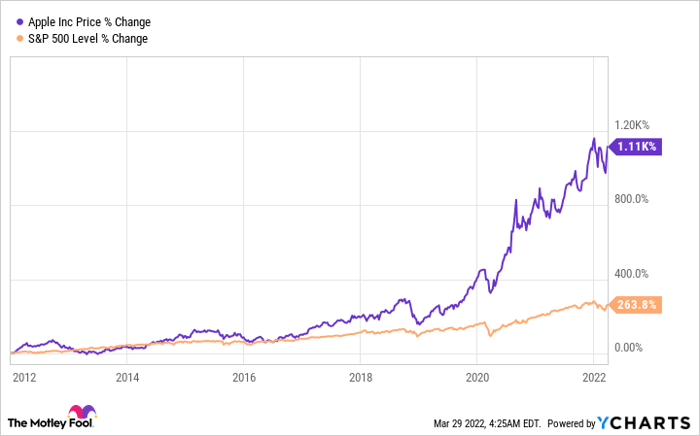
    AAPL Chart

    AAPL data by YCharts

    There are similarities between where Amazon is now and where Apple was when it began issuing a dividend under Cook. There was a new CEO with a different perspective, and the stock price was at a record high. It had generated tons of cash through high sales, which management decided warranted the dividend, still leaving it with excess cash to invest in growth opportunities.

    Are dividend stocks better investments?

    In general, dividend stocks tend to outperform other stocks, even though they’re not usually high-growth stocks. That might seem counter-intuitive, but the point is that dividend-paying stocks are typically quality businesses that generate a lot of cash. And because they’re well-established, they outperform growth stocks as a segment since the category of “growth stocks” includes many initial public offerings that never really get off the ground.

    Whereas individual growth stocks may grow many times the price of slower-growing dividend stocks, the risk associated with the sector means your money grows more safely with dividend stocks in addition to the benefit of passive income.

    Will Amazon stock become a dividend stock?

    Management has said nothing about issuing a dividend, so this is all speculation. In the most recent earnings release, CEO Andy Jassy reiterated that the company is investing in a plethora of growth ventures, from improvements in its core retail segment and other programs to newer initiatives in digital technology and physical storefronts. “There’s a lot to look forward to in the months and years ahead,” he said. 

    Amazon stock has easily outperformed the S&P 500 over the past five years while it plows money back into increasing its growth.
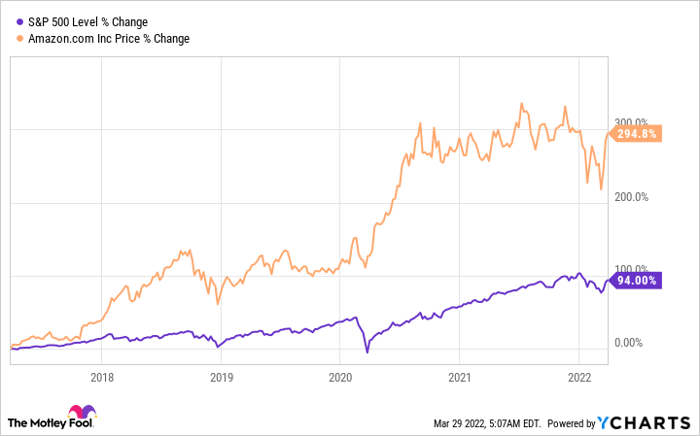
    ^SPX Chart

    ^SPX data by YCharts

    In the current environment, Amazon is also dealing with cost and wage increases, which are affecting its free cash flow and making the present perhaps not an ideal time to start thinking about a dividend.

    In the meantime, Amazon is a great stock to own with plenty of opportunities for growth. There are reasons to consider buying shares before the stock split — and down the line, in the potentially not-so-distant future, a dividend might be in the cards. 

    This article was originally published on Fool.com. All figures quoted in US dollars unless otherwise stated.

    The post Will Amazon start paying a dividend? appeared first on The Motley Fool Australia.

    Wondering where you should invest $1,000 right now?

    When investing expert Scott Phillips has a stock tip, it can pay to listen. After all, the flagship Motley Fool Share Advisor newsletter he has run for over ten years has provided thousands of paying members with stock picks that have doubled, tripled or even more.*

    Scott just revealed what he believes could be the five best ASX stocks for investors to buy right now. These stocks are trading at near dirt-cheap prices and Scott thinks they could be great buys right now.

    *Returns as of January 12th 2022

    More reading

    Jennifer Saibil has no position in any of the stocks mentioned. John Mackey, CEO of Whole Foods Market, an Amazon subsidiary, is a member of The Motley Fool’s board of directors. The Motley Fool Australia’s parent company Motley Fool Holdings Inc. owns and has recommended Amazon and Apple. The Motley Fool Australia’s parent company Motley Fool Holdings Inc. has recommended the following options: long March 2023 $120 calls on Apple and short March 2023 $130 calls on Apple. The Motley Fool Australia has recommended Amazon and Apple. The Motley Fool has a disclosure policy. This article contains general investment advice only (under AFSL 400691). Authorised by Bruce Jackson. 

    This article was originally published on Fool.com. All figures quoted in US dollars unless otherwise stated.

    from The Motley Fool Australia https://ift.tt/xFMzwEI

  • The Telstra dividend is being paid today. Here’s what you need to know

    The Telstra Corporation Ltd (ASX: TLS) share price is edging lower amid the company paying out its latest dividend today.

    The telco provider’s shares are currently down 0.63% to $3.935 apiece.

    In context, the S&P/ASX 200 Index (ASX: XJO) is also hovering in negative territory during Friday morning trade. The benchmark index is down 0.22% to 7,483.3 points.

    Telstra pays out interim dividend

    On 17 February, Telstra reported a relatively sound performance in its half-year results for the 2022 financial year.

    In summary, revenue fell 4.4% to $10.5 billion when compared against the prior corresponding period.

    In addition, statutory earnings before interest, tax, depreciation, and amortisation (EBITDA) backtracked 14.8% to $3.5 billion.

    While both metrics represented a decline, in H1 FY21, the company’s revenue was boosted by a number of one-offs. This included the sale of the Velocity and South Brisbane exchange assets.

    Nonetheless, the board declared a fully franked interim dividend of 8 cents per share to be paid on 1 April (today). This remains unchanged from the previous interim dividend distributed to shareholders last year.

    When calculating against the current share price, Telstra is trailing on a dividend yield of 4.06%.

    Investors who elected for the dividend reinvestment plan (DRP) will see a number of shares added to their portfolio. This was based on the volume weighted average price from 7 to 11 March, which resulted in $3.86 per share.

    No DRP discount rate was offered to shareholders.

    Telstra share price summary

    While moving in circles during recent times, the Telstra share price has lost around 5% in 2022.

    When looking at the last 12 months, its shares have travelled the other way to post a gain of 16%.

    Telstra has a price-to-earnings (P/E) ratio of 26.48 and commands a market capitalisation of roughly $46.38 billion.

    The post The Telstra dividend is being paid today. Here’s what you need to know appeared first on The Motley Fool Australia.

    Should you invest $1,000 in Telstra right now?

    Before you consider Telstra, you’ll want to hear this.

    Motley Fool Investing expert Scott Phillips just revealed what he believes are the 5 best stocks for investors to buy right now… and Telstra wasn’t one of them.

    The online investing service he’s run for over a decade, Motley Fool Share Advisor, has provided thousands of paying members with stock picks that have doubled, tripled or even more.* And right now, Scott thinks there are 5 stocks that are better buys.

    *Returns as of January 13th 2022

    More reading

    Motley Fool contributor Aaron Teboneras owns Telstra Corporation Limited. The Motley Fool Australia’s parent company Motley Fool Holdings Inc. has no position in any of the stocks mentioned. The Motley Fool Australia owns and has recommended Telstra Corporation Limited. The Motley Fool has a disclosure policy. This article contains general investment advice only (under AFSL 400691). Authorised by Bruce Jackson.

    from The Motley Fool Australia https://ift.tt/AImWBl2

  • Why is the Lake Resources (ASX:LKE) share price surging 16% higher to a new record high?

    A man flies into the sky over a city building-scape with a rocket jet pack sketched onto his back.

    A man flies into the sky over a city building-scape with a rocket jet pack sketched onto his back.

    The Lake Resources N.L. (ASX: LKE) share price is ending the week on a very positive note.

    In morning trade, the lithium developer’s shares have jumped 16% to a new record high of $2.31.

    Why is the Lake Resources share price racing higher?

    The Lake Resources share price is storming higher today despite there being no news out of the company.

    However, there has been some very positive industry news that could be getting investors excited.

    This morning lithium giant Allkem Ltd (ASX: AKE) released a lithium carbonate and spodumene concentrate pricing update.

    That update reveals that strong market conditions continue to positively impact the price received for Allkem’s lithium carbonate from the Olaroz Lithium Facility. For the June quarter, the average price received for lithium carbonate is expected to be approximately US$35,000 per tonne FOB.

    This is up from US$27,236 per tonne during the March quarter and is more than tripled the US$11,095 per tonne commanded during the first half.

    It is a similarly story for spodumene, with advanced discussions for spodumene concentrate pricing in the June quarter of approximately US$5,000 per tonne. This is more than double the US$2,218 per tonne received during the March quarter.

    All in all, this paints a very positive picture for the industry right now. Though, it is worth remembering that it will still be a couple of years until Lake Resources is likely to be producing lithium.

    The post Why is the Lake Resources (ASX:LKE) share price surging 16% higher to a new record high? appeared first on The Motley Fool Australia.

    Should you invest $1,000 in Lake Resources right now?

    Before you consider Lake Resources, you’ll want to hear this.

    Motley Fool Investing expert Scott Phillips just revealed what he believes are the 5 best stocks for investors to buy right now… and Lake Resources wasn’t one of them.

    The online investing service he’s run for over a decade, Motley Fool Share Advisor, has provided thousands of paying members with stock picks that have doubled, tripled or even more.* And right now, Scott thinks there are 5 stocks that are better buys.

    *Returns as of January 13th 2022

    More reading

    Motley Fool contributor James Mickleboro owns Allkem Limited. The Motley Fool Australia’s parent company Motley Fool Holdings Inc. has no position in any of the stocks mentioned. The Motley Fool Australia has no position in any of the stocks mentioned. The Motley Fool has a disclosure policy. This article contains general investment advice only (under AFSL 400691). Authorised by Bruce Jackson.

    from The Motley Fool Australia https://ift.tt/49PibNu

  • Another crypto is buying $13 billion of Bitcoin. Here’s why

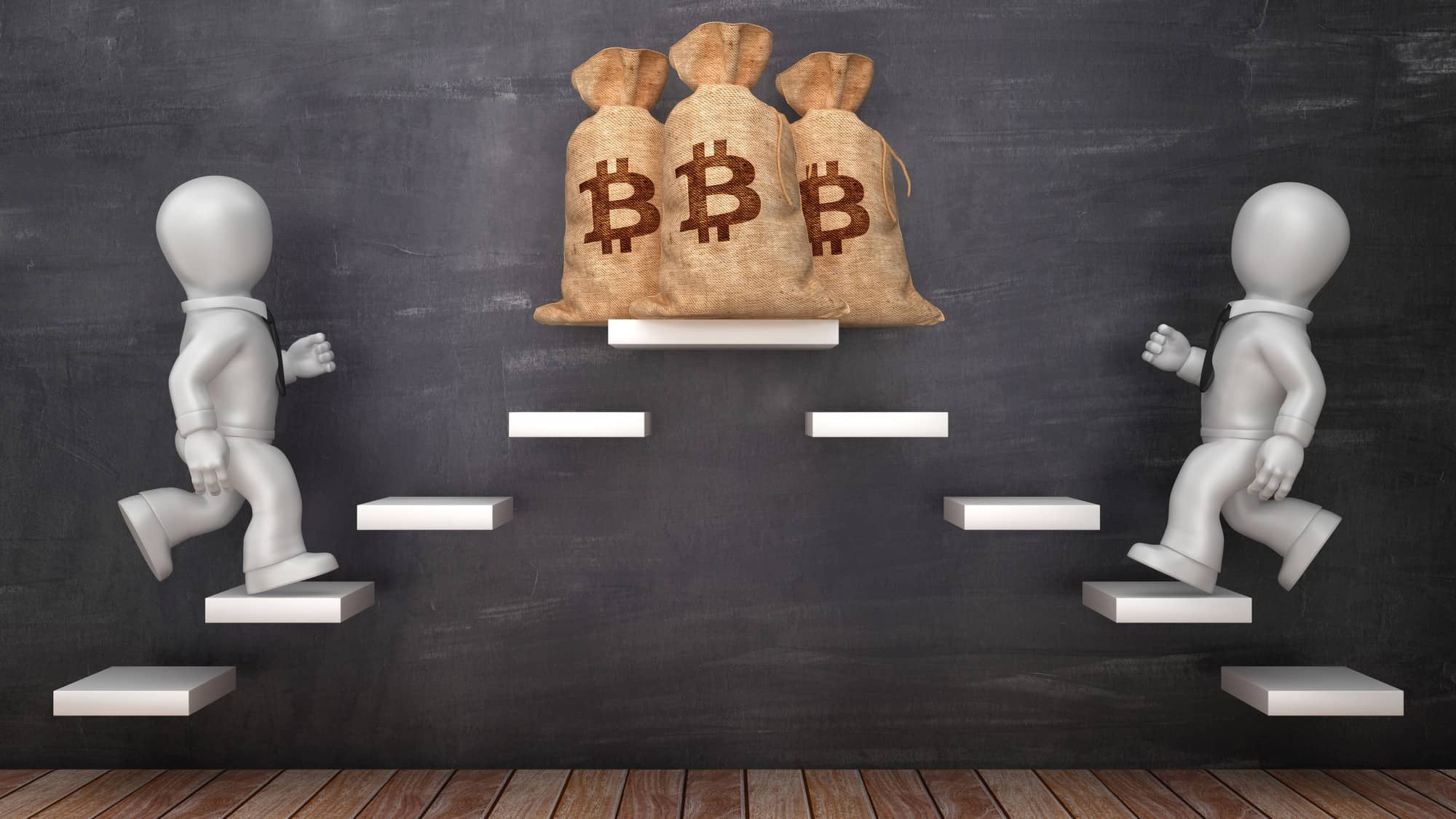
    Two figures run up steps to three bitcoin moneybags at the topTwo figures run up steps to three bitcoin moneybags at the top

    There’s some weird stuff going on in the world of cryptocurrencies at the moment.

    The company that develops Terra (CRYPTO: LUNA) and TerraUSD (CRYPTO: UST) announced that it would buy up US$10 billion ($13 billion) of Bitcoin (CRYPTO: BTC).

    Why is Terraform Labs doing this?

    First we need to dig into the mechanism behind Terra and TerraUSD.

    Creation of TerraUSD pushes up Terra’s value

    According to Coinjar head of content Luke Ryan, investors have been stepping over each other to get their hands on TerraUSD because of a guarantee of 20% returns from the decentralised finance (defi) platform Anchor Protocol.

    A yield of 20% is understandably tempting to investors who can only reap near-zero from bank deposits and maybe 5% from shares if they’re lucky.

    But how do you get your hands on TerraUSD? 

    It needs to be converted from Terra. For each TerraUSD created, one Terra is burned.

    “Right now people are minting a huge amount of UST in order to take advantage of Anchor’s almost definitely unsustainable 20% returns,” Ryan said on the Coinjar blog.

    “The UST supply has gone from US$2bn to almost US$16bn since November, resulting in the destruction of hundreds of millions of LUNA tokens – and a corresponding uptick in the LUNA price.”

    Indeed, Terra has doubled in value since late February.

    “Since November (i.e. the start of the bear market), the amount of UST in circulation has gone up 800% and is still increasing by roughly US$100 million per day. At US$16 billion, UST is almost twice as large as Dai (CRYPTO: DAI), the second largest algorithmic stablecoin.”

    What if this money-making system fails?

    That’s all fantastic for owners of Terra and TerraUSD. But can this party last forever?

    That’s where the massive purchase of Bitcoin comes in.

    “Let’s imagine a mass panic event — say, a large-scale exploit of ANC,” said Ryan.

    “Overnight, billions of UST are redeemed for LUNA. To prevent the wholesale collapse of the ecosystem, Terra sells an equivalent amount of BTC instead.”

    In other words, Terraform Labs co-founder and chief executive Do Kwon is spreading the risk of the Terra-TerraUSD-Anchor relationship.

    “Functionally it’s not that different from the reserve requirement that all banks are subject to,” Ryan said. 

    “The Bitcoin treasury exists to cushion a bank run that could otherwise cause a LUNA-UST death spiral.”

    TerraUSD is currently in hot demand because of its 20% yield. But if the Anchor Protocol ever decides to end or even reduce that return, mass withdrawals are not out of the question.

    That’s where the reserve Bitcoin will come into play, to stabilise the value of Terra.

    The post Another crypto is buying $13 billion of Bitcoin. Here’s why appeared first on The Motley Fool Australia.

    Wondering where you should invest $1,000 right now?

    When investing expert Scott Phillips has a stock tip, it can pay to listen. After all, the flagship Motley Fool Share Advisor newsletter he has run for over ten years has provided thousands of paying members with stock picks that have doubled, tripled or even more.*

    Scott just revealed what he believes could be the five best ASX stocks for investors to buy right now. These stocks are trading at near dirt-cheap prices and Scott thinks they could be great buys right now.

    *Returns as of January 12th 2022

    More reading

    Motley Fool contributor Tony Yoo owns Bitcoin. The Motley Fool Australia’s parent company Motley Fool Holdings Inc. owns and has recommended Bitcoin. The Motley Fool Australia has no position in any of the stocks mentioned. The Motley Fool has a disclosure policy. This article contains general investment advice only (under AFSL 400691). Authorised by Bruce Jackson.

    from The Motley Fool Australia https://ift.tt/MHils0A

  • Own AGL shares? Here’s why today is a momentous day

    A man and woman put hands in the air as they dance in front of a green brick wall.A man and woman put hands in the air as they dance in front of a green brick wall.

    Today marks a big day for AGL Energy Limited (ASX: AGL), but market watchers might not notice the occasion reflected in the company’s share price.

    Though, that doesn’t make it any less significant. Indeed, today might be etched into AGL’s history as the day it took a major step towards shutting down its coal-fired power operations.

    At the time of writing, the AGL share price is $7.74, 0.26% higher than its previous close.

    For context, the S&P/ASX 200 Index (ASX: XJO) is trading in the red this morning, having slipped 0.07%.

    Let’s take a closer look at what’s happening with the iconic energy producer and supplier today.

    AGL takes major step away from coal

    The AGL share price is lower on Friday amid the closure of a unit at the company’s Liddell power station in New South Wales’ Hunter Valley.

    The unit is the first of four to go. The remainder are set to be shut down next April after supporting NSW’s energy grid through the summer months.

    “We announced the retirement of Liddell in 2015 and, seven years later, we are pleased to be in a position to begin the orderly and responsible closure and transition of the power station in line with our climate commitments,” said AGL chief operating officer Markus Brokhof.

    After Liddell’s more than 50-year stint in coal-fired power, the site will become part of AGL’s Hunter Energy Hub.

    “We’re committed to seeing this site continue its legacy as the backbone of the NSW electricity grid as we repurpose the infrastructure to continue delivering energy through the next phase of its life,” said Brokhof.

    “We are excited about our clean energy plans in the Hunter region, including grid-scale battery, solar thermal storage, wind, hydrogen, and pumped hydro projects.”

    The company recently entered an agreement with Fortescue Metals Group Limited (ASX: FMG)’s green energy leg, Fortescue Future Industries, to explore a potential green hydrogen facility for the site.

    AGL was also recently given the thumbs up by the NSW Department of Planning and Environment to put a 500-megawatt, two gigawatt-hour grid-scale battery at the power station.

    Closing the unit will see AGL’s annual greenhouse gas emissions fall by an amount equivalent to removing around 400,000 cars from Australia’s roads.

    The unit’s closure comes weeks after AGL announced it’s planning to shut its other coal-fired operations earlier than previously anticipated. AGL’s Bayswater and Loy Yang A power stations will close in 2033 and 2045 respectively.

    Additionally, AGL is continuing to gear up to split into AGL Australia and Accel Energy.

    Following the demerger, all the company’s thermal sites and future energy hubs will be in the hands of Accel Energy.

    AGL share price snapshot

    The AGL share price has been outperforming the market in 2022 so far.

    It has gained 22% since the start of this year. In that same time, the ASX 200 has slumped by 1%.

    Though, the company’s share price has fallen 20% since this time last year. That leaves it underperforming the benchmark by nearly 30% over the last 12 months.

    The post Own AGL shares? Here’s why today is a momentous day appeared first on The Motley Fool Australia.

    Should you invest $1,000 in AGL Energy right now?

    Before you consider AGL Energy, you’ll want to hear this.

    Motley Fool Investing expert Scott Phillips just revealed what he believes are the 5 best stocks for investors to buy right now… and AGL Energy wasn’t one of them.

    The online investing service he’s run for over a decade, Motley Fool Share Advisor, has provided thousands of paying members with stock picks that have doubled, tripled or even more.* And right now, Scott thinks there are 5 stocks that are better buys.

    *Returns as of January 13th 2022

    More reading

    Motley Fool contributor Brooke Cooper has no position in any of the stocks mentioned. The Motley Fool Australia’s parent company Motley Fool Holdings Inc. has no position in any of the stocks mentioned. The Motley Fool Australia has no position in any of the stocks mentioned. The Motley Fool has a disclosure policy. This article contains general investment advice only (under AFSL 400691). Authorised by Bruce Jackson.

    from The Motley Fool Australia https://ift.tt/3Wp8xnz

  • What is the current dividend yield for Qantas shares?

    a man stands with travel documents in hand with a roller wheel suitcase and extended handle next to him holding his forefinger to his lip as he ponders his next move in a deserted airport. as the Qantas share price fallsa man stands with travel documents in hand with a roller wheel suitcase and extended handle next to him holding his forefinger to his lip as he ponders his next move in a deserted airport. as the Qantas share price falls

    The Qantas Airways Limited (ASX: QAN) share price isn’t having a great time of it so far this Friday. At the time of writing, Qantas shares have opened down by around 0.58% at $5.19. That’s a long way from this company’s COVID lows of 2020 ($2.36 a share), but still well off the airline’s 52-week high of $5.97 a share. Sadly, it’s also a long way from Qantas’ pre-COVID highs of over $7 a share.

    But investors know Qantas, as an ASX 200 travel share, has had a rough trot over the past two years or so. Saying that, it has also been a market beater over 2022 so far, if only just. Qantas remains up by 0.58% over the year to date. In contrast, the S&P/ASX 200 Index (ASX: XJO) remains in the red with a loss of 1.45% over the same period.

    So now that we’re well into 2022, many investors might be wondering what the current dividend yield for Qantas shares is. After all, Qantas used to be known as a solid dividend share before the pandemic.

    Qantas shares: What’s the dividend yield?

    Well, unfortunately, some investors might find the answer to this question is depressingly short. Qantas is not currently an ASX dividend share, since it hasn’t doled out a shareholder payment since September 2019. Thus, Qantas shares do not currently have a dividend yield.

    As we covered earlier this week, Qantas’ books are yet to return to the black following the massive disruption that COVID had on its business model. In fact, during Qantas’ last earnings report – the half-year earnings delivered in February covering the six months to 31 December 2021 – the airline reported an underlying loss before tax of $1.28 billion.

    For a company to fund a dividend, conventional wisdom dictates that it needs to be bringing in healthy profits first. Dividends are funded from profits after all. And Qantas just isn’t back there yet.

    At the current Qantas share price, this ASX 200 travel share has a market capitalisation of $9.83 billion, but with a dividend yield of 0%.

    The post What is the current dividend yield for Qantas shares? appeared first on The Motley Fool Australia.

    Should you invest $1,000 in Qantas right now?

    Before you consider Qantas, you’ll want to hear this.

    Motley Fool Investing expert Scott Phillips just revealed what he believes are the 5 best stocks for investors to buy right now… and Qantas wasn’t one of them.

    The online investing service he’s run for over a decade, Motley Fool Share Advisor, has provided thousands of paying members with stock picks that have doubled, tripled or even more.* And right now, Scott thinks there are 5 stocks that are better buys.

    *Returns as of January 13th 2022

    More reading

    Motley Fool contributor Sebastian Bowen has no position in any of the stocks mentioned. The Motley Fool Australia’s parent company Motley Fool Holdings Inc. has no position in any of the stocks mentioned. The Motley Fool Australia has no position in any of the stocks mentioned. The Motley Fool has a disclosure policy. This article contains general investment advice only (under AFSL 400691). Authorised by Bruce Jackson.

    from The Motley Fool Australia https://ift.tt/DQevYtm

  • Here’s why lithium miner Argosy Minerals’ (ASX:AGY) share price is leaping 9% today

    Happy woman miner with her thumb up signalling Wyloo's commitment to back IGO's takeover of Western Areas nickel

    Happy woman miner with her thumb up signalling Wyloo's commitment to back IGO's takeover of Western Areas nickel

    The Argosy Minerals Ltd (ASX: AGY) share price is leaping higher, up 8.5% in early trade.

    Argosy shares closed yesterday at 47 cents and are currently trading for 51 cents.

    Below we look at the progress update highlights from the ASX lithium miner’s Rincon Lithium Project in Argentina.

    What progress was announced?

    The Argosy Minerals share price is storming higher after the miner reported that 67% of the work has been completed on its modular 2,000 tonnes per annum (tpa) lithium carbonate production operation at Rincon.

    Argosy said it’s on track to commence production of 99.5% battery quality lithium carbonate product from mid-2022.

    The design work for the project has been fully completed, while 70% of the required construction work is finished.

    Most of the onus in moving towards production now falls on plant commissioning works. That includes acquiring the necessary raw materials and getting the right workforce in place and trained. Argosy said this phase is now 13% complete.

    Commenting on the progress, Argosy managing director, Jerko Zuvela said:

    The company’s Puna operations team are making significant progress… as we move closer to commencing the 2,000tpa lithium carbonate production operations.

    The lithium market remains very positive and lithium carbonate prices are maintaining record highs, which is providing great interest in our project and especially our product, noting our Rincon Lithium Project will become the next commercial production operation.

    Argosy’s transformation into a cashflow generator is nearing, whilst also progressing toward the next stage 12,000tpa scale operations. We look forward to a significant near-term growth phase from our operations this year and beyond.

    Argosy Minerals share price snapshot

    The Argosy Minerals share price has been a standout performer on the ASX.

    Over the past 12 months, Argosy shares have gained an eye-popping 439%, tromping the 10% gains posted by the All Ordinaries Index (ASX: XAO) over that same period.

    So far in 2022 the Argosy Minerals share price is up 44%.

    The post Here’s why lithium miner Argosy Minerals’ (ASX:AGY) share price is leaping 9% today appeared first on The Motley Fool Australia.

    Should you invest $1,000 in Argosy Minerals right now?

    Before you consider Argosy Minerals, you’ll want to hear this.

    Motley Fool Investing expert Scott Phillips just revealed what he believes are the 5 best stocks for investors to buy right now… and Argosy Minerals wasn’t one of them.

    The online investing service he’s run for over a decade, Motley Fool Share Advisor, has provided thousands of paying members with stock picks that have doubled, tripled or even more.* And right now, Scott thinks there are 5 stocks that are better buys.

    *Returns as of January 13th 2022

    More reading

    The Motley Fool Australia’s parent company Motley Fool Holdings Inc. has no position in any of the stocks mentioned. The Motley Fool Australia has no position in any of the stocks mentioned. The Motley Fool has a disclosure policy. This article contains general investment advice only (under AFSL 400691). Authorised by Bruce Jackson.

    from The Motley Fool Australia https://ift.tt/b1B3gQu

  • Domain (ASX:DHG) share price halted for $180m equity raising to fund Realbase acquisition

    Couple talking with real estate agent.

    Couple talking with real estate agent.

    The Domain Holdings Australia Ltd (ASX: DHG) share price won’t be going anywhere on Friday.

    This morning the property listings company requested a trading halt.

    Why is the Domain share price in a trading halt?

    The Domain share price was placed in a trading halt this morning so the company could launch an equity raising to fund a major acquisition.

    According to the release, Domain has entered into an agreement to acquire 100% of Realbase for an enterprise value of $180 million, plus contingent consideration of up to $50 million.

    The latter reflects the maximum earn out payments if Realbase delivers a fivefold increase in EBITDA by FY 2026 compared to FY 2022.

    What is Realbase?

    Realbase is a leading campaign management technology platform in the Australia and New Zealand region.

    Management believes it is a highly strategic acquisition which provides complementary Marketplace offerings that progress Domain’s strategy to deliver solutions that help agents and consumers at every stage of the property journey.

    Furthermore, it is expected to significantly accelerate Domain’s Agent Solutions strategy and increase market coverage from ~35% to ~50% of all Australian property transactions.

    Management also sees potential to unlock significant pre-tax EBITDA synergies and scaling efficiencies of up to approximately $18 million per annum by FY 2026.

    Domain’s CEO, Jason Pellegrino, is very positive on the acquisition. He commented:

    “Our mission in Agent Solutions is to build on our track record of trusted partnerships with agents to help them build profitable and sustainable businesses, and deliver value at every stage of the property journey. For some time we have been impressed by Realbase’s technological capabilities and products including innovative campaign management, high growth digital proposals and a rapidly expanding social media marketing offer.

    Each of Realbase’s solutions complements and extends the value proposition Domain can take to agents. The acquisition of Realbase meaningfully increases the scale and impact of Domain’s Agent Solutions unit and strengthens our position as the leading provider of end-to-end agent workflow solutions.”

    Equity raising

    The acquisition of Realbase will be funded via a $180 million underwritten pro-rata accelerated non-renounceable entitlement offer.

    These funds will be raised at $3.80 per new share, which represents a 5.2% discount to the current Domain share price.

    The release notes that the company’s largest shareholder, Nine Entertainment Co Holdings Ltd (ASX: NEC), is supportive of the acquisition and equity raising and has committed to take up 100% of its entitlement. This represents approximately 59% of the equity raising.

    The Domain share price is expected to return to trade on Tuesday of next week.

    The post Domain (ASX:DHG) share price halted for $180m equity raising to fund Realbase acquisition appeared first on The Motley Fool Australia.

    Should you invest $1,000 in Domain right now?

    Before you consider Domain, you’ll want to hear this.

    Motley Fool Investing expert Scott Phillips just revealed what he believes are the 5 best stocks for investors to buy right now… and Domain wasn’t one of them.

    The online investing service he’s run for over a decade, Motley Fool Share Advisor, has provided thousands of paying members with stock picks that have doubled, tripled or even more.* And right now, Scott thinks there are 5 stocks that are better buys.

    *Returns as of January 13th 2022

    More reading

    Motley Fool contributor James Mickleboro has no position in any of the stocks mentioned. The Motley Fool Australia’s parent company Motley Fool Holdings Inc. has no position in any of the stocks mentioned. The Motley Fool Australia has no position in any of the stocks mentioned. The Motley Fool has a disclosure policy. This article contains general investment advice only (under AFSL 400691). Authorised by Bruce Jackson.

    from The Motley Fool Australia https://ift.tt/6wiF9XS

  • 1 red flag for precious metals stocks

    This article was originally published on Fool.com. All figures quoted in US dollars unless otherwise stated.

    Two miners examine things they have taken out the ground.

    This article was originally published on Fool.com. All figures quoted in US dollars unless otherwise stated.

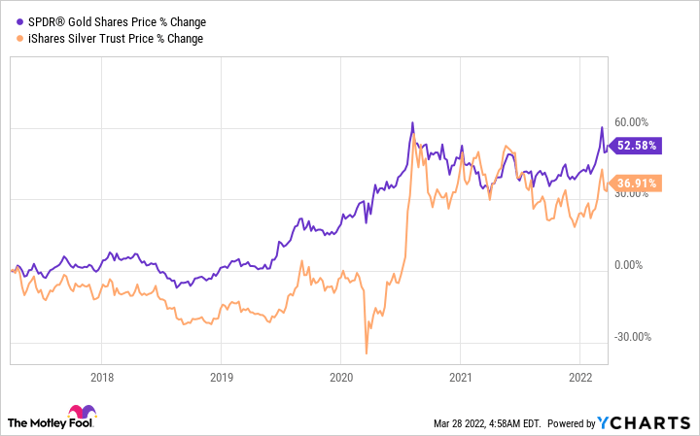
    Geopolitical tensions have gold and silver back in the limelight, as investors often view them as a safe haven. And high levels of inflation fuel the view that precious metals, as hard assets, can help protect against swiftly rising prices.

    That’s the good news, given that gold and silver have been rallying. But there’s another factor to consider when you look at precious metals miners, and if you don’t pay attention to it, you could end up getting hurt.

    The basic model

    Gold and silver mining is a fairly simple business to understand. First, find a place that has material deposits of these precious metals. Then get approval to build a mine. Build the mine. Extract the gold and silver and sell it.

    Conceptually, that’s pretty easy to get your head around. However, building a mine is a long and expensive process with material difficulties possible all along the way.

    Indeed, there are only just so many places with enough of these precious metals to build a mine, and getting approval can be a headache. For example, Barrick Gold (NYSE: GOLD) has been trying to get approval for its Pascua-Lama mine on the Chile/Argentina border for roughly a decade and still doesn’t have the final green light.

    And the cost of building and running a mine is massive. Cleaning up when a company is done with the asset, meanwhile, is also complex and fraught with uncertainty.

    Leverage

    That said, the cost of a mine, once operational, is something of a line in the sand. When gold and silver prices are close to the line, miners can eke out a profit or dip into the red. But when precious metals prices are materially higher than the cost of production, profits flow swiftly to the bottom line.

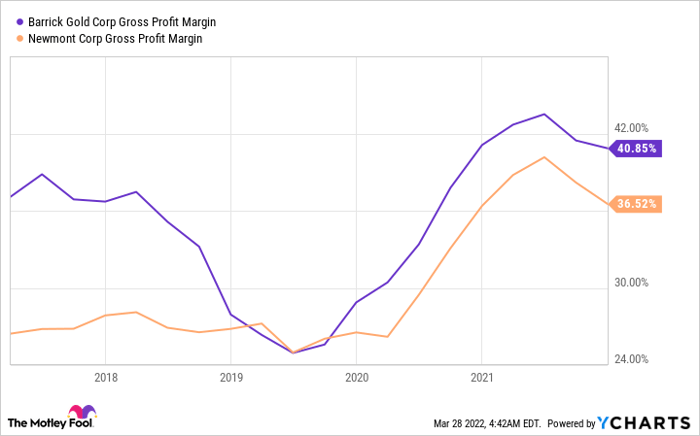
    For example, the gross profit margin for industry giants Barrick and Newmont (NYSE: NEM) has risen dramatically since mid-2019, along with the price of gold. To put some numbers on that, both companies had gross profit margin in the mid-20% range, but Newmont’s is now in the mid-30% area while Barrick’s is touching 40%.

    GOLD Gross Profit Margin Chart

    GOLD Gross Profit Margin data by YCharts

    Smaller miners tend to benefit even more from high prices since many have higher cost structures. And yet, in that statement comes the risk. Gold and silver are commodities subject to supply and demand. Rallies are generally followed by pullbacks.

    When prices fall, the profitability of miners can fall materially, too. That is why investors need to pay close attention to all-in sustaining costs, which is an industry metric that takes into account operating costs and the investment needed to maintain production levels. Lower costs are better because they make it easier to turn a profit.

    GLD Chart

    GLD data by YCharts

    The problem today is that inflation is spreading throughout the world. That means operating costs for miners are likely to be heading higher. For example, all-in sustaining costs for Gold Fields (NYSE: GFI), another large precious metals miner, rose from $977 per ounce in 2020 to $1,063 per ounce in 2021, a nearly 9% year-over-year increase. 

    To be fair, all-in sustaining costs can be impacted by capital spending plans, so investors need to dig in a little to see what’s going on. However, with inflation hitting everything from commodities to labor, price increases are a red flag that investors can’t afford to ignore. In some ways, the rising gold price, which is a major tailwind for miners, is just a sign of this problem. 

    Don’t get carried away

    Wall Street tends to go to extremes, and it is easy to get caught up in the stories that drive the mood swings.

    Right now, gold and silver are being looked at as safe-haven assets, providing protection from geopolitical tensions and inflationary pressures. But, on the inflation side, the companies that mine for precious metals are not immune to the impact.

    If you are investing in gold and silver miners, you need to pay attention to their costs. Not only will rising all-in sustaining costs crimp profitability, but they could also increase the pain when gold and silver prices fall in the future. 

    This article was originally published on Fool.com. All figures quoted in US dollars unless otherwise stated.

    The post 1 red flag for precious metals stocks appeared first on The Motley Fool Australia.

    Wondering where you should invest $1,000 right now?

    When investing expert Scott Phillips has a stock tip, it can pay to listen. After all, the flagship Motley Fool Share Advisor newsletter he has run for over ten years has provided thousands of paying members with stock picks that have doubled, tripled or even more.*

    Scott just revealed what he believes could be the five best ASX stocks for investors to buy right now. These stocks are trading at near dirt-cheap prices and Scott thinks they could be great buys right now.

    *Returns as of January 12th 2022

    More reading

    Reuben Gregg Brewer has no position in any of the stocks mentioned.  The Motley Fool Australia’s parent company Motley Fool Holdings Inc. has no position in any of the stocks mentioned. The Motley Fool Australia has no position in any of the stocks mentioned. The Motley Fool has a disclosure policy. This article contains general investment advice only (under AFSL 400691). Authorised by Bruce Jackson.

    This article was originally published on Fool.com. All figures quoted in US dollars unless otherwise stated.


    from The Motley Fool Australia https://ift.tt/9qa6sQI
  • Why Solana jumped again today

    This article was originally published on Fool.com. All figures quoted in US dollars unless otherwise stated.

    Person pointing at an increasing blue graph which represents a rising share price.

    This article was originally published on Fool.com. All figures quoted in US dollars unless otherwise stated.

    What happened 

    Cryptocurrency Solana (CRYPTO: SOL) jumped double digits in early trading on Thursday following a big gain on Wednesday. As of 11:45 a.m. ET the value of the cryptocurrency was up 4.1% in the last 24 hours and had traded as much as 6.2% higher. 

    Solana is up 25.1% over the last week, so this has been a strong run and the value is rising as other cryptocurrencies fall today. 

    So what 

    Investors continue to pour into Solana as businesses begin to take it more seriously. Cryptocurrency exchange Coinbase Global recently started trading for some Solana-based tokens and yesterday OpenSea said it will start carrying about 50 Solana non-fungible tokens. 

    A lot of investors who primarily trade in Bitcoin or Ethereum may not realize what’s being built on Solana so these moves bring exposure to the ecosystem. In time, that should lead to even more investment and higher values for Solana and its tokens as real businesses are built on the blockchain. 

    Now what 

    Volatility continues to be standard for cryptocurrencies and at times like this, it’s working for Solana investors. But keep in mind that the rise in values could reverse as quickly as it came. 

    What I do like is how much is being built on Solana and I think in time that utility will drive tremendous value for investors. So, long-term this is a cryptocurrency I like, which is why I’m holding and ignoring volatile days like today, even if they are working in my favor. 

    This article was originally published on Fool.com. All figures quoted in US dollars unless otherwise stated.

    The post Why Solana jumped again today appeared first on The Motley Fool Australia.

    Wondering where you should invest $1,000 right now?

    When investing expert Scott Phillips has a stock tip, it can pay to listen. After all, the flagship Motley Fool Share Advisor newsletter he has run for over ten years has provided thousands of paying members with stock picks that have doubled, tripled or even more.*

    Scott just revealed what he believes could be the five best ASX stocks for investors to buy right now. These stocks are trading at near dirt-cheap prices and Scott thinks they could be great buys right now.

    *Returns as of January 12th 2022

    More reading

    Travis Hoium owns Coinbase Global, Inc., Ethereum, and Solana. The Motley Fool Australia’s parent company Motley Fool Holdings Inc. owns and has recommended Bitcoin, Coinbase Global, Inc., Ethereum, and Solana. The Motley Fool Australia owns and has recommended Bitcoin and Ethereum. The Motley Fool has a disclosure policy. This article contains general investment advice only (under AFSL 400691). Authorised by Bruce Jackson. 

    This article was originally published on Fool.com. All figures quoted in US dollars unless otherwise stated.

    from The Motley Fool Australia https://ift.tt/cL0mBte