Category: Stock Market

  • Bitcoin and Ethereum are at 6-month lows. Is now the time to pounce?

    A black cat waiting to pounce on a mouse.

    Bitcoin (CRYPTO: BTC) and Ethereum (CRYPTO: ETH) are both trading right at their levels of 24 hours ago.

    At the time of writing, one Bitcoin is worth US$36,529 (AU$51,382), according to data from CoinMarketCap.

    Bitcoin, the world’s top token by market cap, staged a brief rally over the past 24 hours, reaching as high as US$38,825, but that 6% price gain proved unsustainable. At least for now.

    Ethereum, trading at US$2,443, also saw prices spike over the 24 hours, reaching US$2,706 while most Aussies slept. It’s now down 9% from that level.

    At the current prices, Bitcoin remains down 47% from its 10 November all-time highs of US$68,790. Ethereum is down 50% from its own record high, which it hit on 16 November.

    Is it a good time to buy Bitcoin and Ethereum?

    You have to go back some 6 months to find either token trading significantly lower than today’s prices.

    That, as you’d expect, has many crypto investors wondering if now is the time to buy the dip… or if both Bitcoin and Ethereum could have far further to fall.

    While the jury remains out on the definitive answer to that question, Crypto.com general manager Asia Pacific, Karl Mohan, remains decidedly bullish on the outlook for cryptocurrencies.

    As The Australian reports, Mohan says the year-on-year trendline is up “both in terms of the crypto total market cap, and total number of crypto users”.

    Indeed, go back a year and you’d find Bitcoin trading around US$30,400 and Ethereum in the range of US$1,250 — both well below today’s levels.

    Crypto.com’s own statistics indicate the total number of crypto users increased from 106 million at the beginning of 2021 to end last year at 295 million. And Mohan believes those numbers will continue to charge higher.

    According to Mohan (quoted by The Australian):

    It was a remarkable growth rate, and we’re expecting crypto will reach 1 billion users by the end of the year. We also saw record growth in terms of people working in the crypto industry too. Our staff headcount grew more than 4-times in 2021, and we’re now at over 3,000 employees globally.

    Foolish takeaway

    If Mohan is right and crypto adoption continues to skyrocket, it should provide some strong tailwinds to leading tokens like Ethereum and Bitcoin.

    But you need only look at the past few years’ price charts to know that even if these cryptos return to an upward trend, it’s likely to remain a wild ride.

    Invest with care.

    The post Bitcoin and Ethereum are at 6-month lows. Is now the time to pounce? appeared first on The Motley Fool Australia.

    Should you invest $1,000 in Bitcoin right now?

    Before you consider Bitcoin, you’ll want to hear this.

    Motley Fool Investing expert Scott Phillips just revealed what he believes are the 5 best stocks for investors to buy right now… and Bitcoin wasn’t one of them.

    The online investing service he’s run for over a decade, Motley Fool Share Advisor, has provided thousands of paying members with stock picks that have doubled, tripled or even more.* And right now, Scott thinks there are 5 stocks that are better buys.

    *Returns as of January 13th 2022

    More reading

    The Motley Fool Australia’s parent company Motley Fool Holdings Inc. owns and has recommended Bitcoin and Ethereum. The Motley Fool Australia has no position in any of the stocks mentioned. The Motley Fool has a disclosure policy. This article contains general investment advice only (under AFSL 400691). Authorised by Bruce Jackson.

    from The Motley Fool Australia https://ift.tt/3G68wFQ
  • These 3 ASX 200 shares held up the best in the last market crash

    Concept image of man holding up a falling arrow with a shield.

    Key points

    • The ASX 200 has fallen more than 8% since the beginning of the year
    • Investors might be seeking out investments capable of performing during a market downturn
    • Three Australian companies not only stayed out of the red, but moved higher during the last market crash

    The S&P/ASX 200 Index (ASX: XJO) moved closer towards the official definition of a ‘correction’ on Tuesday. Meaning the benchmark index has fallen almost 10% from its recent high, erasing all of the ground covered since May 2021.

    Unsurprisingly, many investors are seeking out areas of the market that might have a better chance of holding up during more turbulent times. This may include companies with strong balance sheets, existing profitability, and a proven track record during difficult operating environments.

    The COVID-19 crash of 2020 might serve as a good reference point to evaluate which ASX 200 shares have demonstrated their staying power.

    Here are the three ASX 200 shares that handled the last ASX share market crash exceptionally well.

    These ASX 200 shares have held steady in the past

    Before we jump into the list, we need our point of reference. In this case, it is how the ASX 200 performed during the COVID-19 crash in 2020. Between 14 February and 23 March 2020, the benchmark index plummeted an unsettling 36.2%.

    Fisher & Paykel Healthcare Corp Ltd (ASX: FPH)

    One ASX 200 share that was able to avoid the nasty sting of the pandemic was respiratory care product manufacturer, Fisher & Paykel Healthcare. Rather than setting new 52-week lows during this time, the ventilator maker was setting new 52-week highs.

    Fortunately for Fisher & Paykel, the pandemic hinted at the potential for an increase in demand for its medical-grade respiratory products. This was confirmed by the company with an update in March 2022 whereby Fisher & Paykel noted its products were “directly involved in treating patients with coronavirus”. In the same update, the company revised its revenue and earnings expectations higher.

    These factors, when combined, were accompanied by a positive reaction from investors. In contrast to the despair painted in red by the ASX 200, the Fisher & Paykel share price rallied 12.1% throughout the market crash.

    Metcash Limited (ASX: MTS)

    Metcash is another company featured in the ASX 200 that averted losses during the COVID-19 market crash. The grocery, hardware, and liquor conglomerate benefitted from a flight to staples as the economy weakened. However, no official announcements were released by Metcash during the timing of the broader market crash.

    The Metcash share price pushed 19.6% higher during the brief stint of elevated fear for investors. The company has gone on to deliver further gains for its shareholders. This has been fuelled by increased profitability and growing revenue across the business.

    Analysts at Ord Minnett recently tagged Metcash with a buy rating and a $5 price target — suggesting a further 23% upside.

    Chalice Mining Ltd (ASX: CHN)

    The final ASX 200 share on the list was the best performing through the dizzying ride to the downside of 2020. The mineral exploration company, Chalice Mining, flourished for its shareholders while the rest of the market floundered.

    A handful of announcements were published by Chalice during the February to March period of 2020. Perhaps most important were the findings at the Julimar Project in Western Australia. Posted at the peak of the market crash, Chalice Mining pulled back the curtain on its first drill hole at the promising nickel-copper-palladium project. This would mark the first of many positive results to come from Julimar.

    In turn, the Chalice Mining share price soared 26.7% during the five-week stint of market mayhem.

    The post These 3 ASX 200 shares held up the best in the last market crash appeared first on The Motley Fool Australia.

    Wondering where you should invest $1,000 right now?

    When investing expert Scott Phillips has a stock tip, it can pay to listen. After all, the flagship Motley Fool Share Advisor newsletter he has run for over ten years has provided thousands of paying members with stock picks that have doubled, tripled or even more.*

    Scott just revealed what he believes could be the five best ASX stocks for investors to buy right now. These stocks are trading at near dirt-cheap prices and Scott thinks they could be great buys right now.

    *Returns as of January 12th 2022

    More reading

    Motley Fool contributor Mitchell Lawler has no position in any of the stocks mentioned. The Motley Fool Australia’s parent company Motley Fool Holdings Inc. has no position in any of the stocks mentioned. The Motley Fool Australia has no position in any of the stocks mentioned. The Motley Fool has a disclosure policy. This article contains general investment advice only (under AFSL 400691). Authorised by Bruce Jackson.

    from The Motley Fool Australia https://ift.tt/3FYBUhf

  • Here’s why the Kogan (ASX:KGN) share price just sank 15%

    Woman in office sinking in quicksand into the floor

    Key points

    • The Kogan share price fell 15% at market open today to a new 52-week low
    • The drop follows its latest business update
    • The Kogan share price hit its last 52-week-low on Tuesday

    The Kogan.com Ltd (ASX: KGN) share price is sinking lower again this morning, hitting a new 52-week-low just a day after its last.

    At market open, the Kogan share price was down 15%, at $5.96. It has since staged a slight recovery and at the time of writing is down 11.84% at $6.18.

    Today’s drop coincides with the release of the online retailer’s latest business report, which revealed its first-half results.

    So, what did Kogan release?

    Kogan share price slumps on update

    The Kogan share price is falling after the company reported its results for the first half of the 2022 financial year. The key points included:

    Looking closer at its retailing operations, the company reported:

    • More than 4 million active customers reached (more than 10% YoY growth)
    • “Kogan First” loyalty members grew by 176% (at 31 December 2021) and by almost 40% in the period since 30 September 2021
    • A reduction in inventories — $227.9 million (as at 30 June 2021), down to $196.8 million (as at 31 December 2021), comprising of both warehouse and stock in transit.

    What happened in the first half?

    In dissecting its gross sales performance, Kogan believes the boost can be attributed to the “continuously accelerating Kogan Marketplace” — a platform partnering and exposing select brands and distributors to Kogan customers.

    Additionally, it believes its loyalty program “Kogan First” was also a key driver, as well as Kogan Energy (power and gas partnership with part of the Meridian Energy Ltd (ASX: MEZ) group) and Kogan Mobile New Zealand (telecommunications partnership with Vodafone New Zealand).

    The company cited its gross profit decline to coronavirus-related disruptions to its supply chain. However, the company still believes it experienced growth on 1H FY20, with a compound annual growth rate (CAGR) of more than 50%.

    The company was proud of its net cash position as of 31 December, as this was reported after funding the $29.9 million “Tranche 2” payment of its acquisition of Mighty Ape (initially announced back in December 2020).

    Mighty Ape is one of New Zealand’s biggest online gaming and entertainment retailers and had 757,000 active customers as of 31 December.

    Since 31 December, the Kogan share price has declined by 30%.

    Comment from management

    Kogan CEO and founder Ruslan Kogan said:

    Over four million Aussie and Kiwi shoppers have recently experienced the choice, value and delivery benefits of the Kogan.com Group…

    We have continued to re-invest in our customers through the Kogan First loyalty program to offer the best deals on a wide range of products, delivered quickly and efficiently.

    After launching late last year, Kogan Delivery Services is already making an impact with more than 100,000 orders delivered directly to customers since launch.

    As always, we’re obsessed with the long term, and our ever-improving customer experience continues to underpin business success.

    Kogan share price snapshot

    The Kogan share price hasn’t had a great run recently. The company hit a 52-week-low of $7.16 just last week, but that was surpassed on Tuesday by a closing price of just $7.01. Today, Kogan broke its record yet again.

    On Monday, Kogan was reported as one of ASIC’S most shorted ASX shares, with its short interest increasing to 12.2%.

    This represents a 20% drop in the last month, and an overall 66% drop in the past 12 months.

    The company has a market capitalisation of $749.29 million and a price-to-earnings ratio (P/E) of 217.39.

    The post Here’s why the Kogan (ASX:KGN) share price just sank 15% appeared first on The Motley Fool Australia.

    Should you invest $1,000 in Kogan right now?

    Before you consider Kogan, you’ll want to hear this.

    Motley Fool Investing expert Scott Phillips just revealed what he believes are the 5 best stocks for investors to buy right now… and Kogan wasn’t one of them.

    The online investing service he’s run for over a decade, Motley Fool Share Advisor, has provided thousands of paying members with stock picks that have doubled, tripled or even more.* And right now, Scott thinks there are 5 stocks that are better buys.

    *Returns as of January 13th 2022

    More reading

    Motley Fool contributor Alice de Bruin has no position in any of the stocks mentioned. The Motley Fool Australia’s parent company Motley Fool Holdings Inc. owns and has recommended Kogan.com ltd. The Motley Fool Australia owns and has recommended Kogan.com ltd. The Motley Fool has a disclosure policy. This article contains general investment advice only (under AFSL 400691). Authorised by Bruce Jackson.

    from The Motley Fool Australia https://ift.tt/3g0JNrR

  • Why is the BrainChip (ASX:BRN) share price storming 12% higher?

    A male ASX investor sits cross-legged with a laptop computer in his lap with a slightly crazed, happy, excited look on his face while next to him a graphic of a rocket shoots upwards with graphics of stars scattered around it

    Key points

    • BrainChip had handed in its fourth quarter update
    • The artificial intelligence technology company delivered strong sales growth but from a small base
    • Management highlights a number of big developments during the quarter

    The BrainChip Holdings Ltd (ASX: BRN) share price is rebounding strongly on Thursday.

    At the time of writing, the artificial intelligence technology company’s shares are 12% to $1.60.

    Why is the BrainChip share price storming higher?

    Investors have been bidding the BrainChip share price higher today following the release of its fourth quarter update.

    During the three months ended 31 December, the company achieved strong growth in its cash receipts, albeit from a very small base. Cash receipts from customers came in at US$1.1 million, up 83% quarter on quarter.

    This couldn’t stop BrainChip from recording a net operating cash outflow of US$3.4 million for the three months. Though, this is an improvement on the prior period’s cash outflow of US$4 million.

    This left the company with a cash balance of US$19.4 million at the end of December.

    What else did the company say?

    BrainChip provided investors with a breakdown on events during the fourth quarter of FY 2021. This includes the appointment of a new CEO and the receipt of the first batch of the Akida AKD1000 neuromorphic processor chips from Socionext America.

    This has allowed the company to commence taking orders of the Akida development kits from its partners, large enterprises, and OEMs for their own internal testing and validation.

    Management also highlights that during the quarter it licensed its Akida IP to major ASIC manufacturer, MegaChips, to help it enhance and grow its technology positioning for next-generation, Edge-based AI solutions.

    BrainChip also separately provided an update on its top 20 shareholders which include a number of large financial institutions. It also revealed that its former CEO hasn’t sold shares since leaving the company early last year.

    BrainChip’s CEO, Sean Hehir, commented: “The December Quarter was another breakout quarter for BrainChip that included the granting of three additional patents, further strengthening our patent portfolio; the completion of testing for the production version of our Akida technology; and the signing of another major license agreement with a top-tier customer, MegaChips. This was our second IP license agreement and further validates our technology.”

    “Since the conclusion of the quarter, we have welcomed another Non-Executive Director, Pia Turcinov, plus launched our PCIe production board to the market via a low-touch ecommerce model. The Company also received yet another key patent grant related to the Akida technology. In the coming quarter, the Company will be focused on the Akida go-to-market strategy refinement and adding additional resources to our Sales and Marketing teams,” he added.

    A big quarter for BrainChip, but expectations are very high for 2022. Time will tell whether it lives up to the hype.

    The post Why is the BrainChip (ASX:BRN) share price storming 12% higher? appeared first on The Motley Fool Australia.

    Should you invest $1,000 in BrainChip right now?

    Before you consider BrainChip, you’ll want to hear this.

    Motley Fool Investing expert Scott Phillips just revealed what he believes are the 5 best stocks for investors to buy right now… and BrainChip wasn’t one of them.

    The online investing service he’s run for over a decade, Motley Fool Share Advisor, has provided thousands of paying members with stock picks that have doubled, tripled or even more.* And right now, Scott thinks there are 5 stocks that are better buys.

    *Returns as of January 13th 2022

    More reading

    Motley Fool contributor James Mickleboro has no position in any of the stocks mentioned. The Motley Fool Australia’s parent company Motley Fool Holdings Inc. has no position in any of the stocks mentioned. The Motley Fool Australia has no position in any of the stocks mentioned. The Motley Fool has a disclosure policy. This article contains general investment advice only (under AFSL 400691). Authorised by Bruce Jackson.

    from The Motley Fool Australia https://ift.tt/3KFuWRE

  • Cettire (ASX:CTT) share price gains on new $100b potential market

    adore beauty share price

    Key points

    • The Cettire share price is 1.36% higher this morning, trading at $2.99
    • The gain follows news the luxury retailer is expanding into beauty products
    • Its expansion will include a new vertical on its website, set for a soft launch in March

    The Cettire Ltd (ASX: CTT) share price is soaring this morning after the company announced that it’s launching a ‘beautiful’ new vertical.

    The online luxury goods marketplace will soon be offering beauty products – a market said to be worth around $100 billion globally.

    At the time of writing, the Cettire share price is $2.99, 1.36% higher than its previous close.

    However, it opened 5% higher this morning, swapping hands for $3.11 in early morning trade.

    Cettire share price gains on ‘beautiful’ expansion

    The Cettire share price is in the green on news the retailer could soon be selling more than 25,000 beauty products from more than 600 brands.

    Cettire’s beauty vertical will include skincare, haircare, fragrances, and more to appeal to both women and men.

    It’s expected to undergo a soft launch later this quarter.

    Between then and now, the company plans to finalise supply arrangements and its commercial proposition.

    According to the company, the beauty category houses an approximately $100 billion global opportunity within the personal luxury goods market.

    Additionally, it believes expanding its offerings will allow its customers to purchase multiple high value items during their visit to the site.

    Cettire founder and CEO Dean Mintz commented on the company’s extension into the beauty market, saying:

    Beauty represents a large and growing adjacency within the global personal luxury goods market.

    It is a natural extension of our range, particularly as we continue to rapidly scale site traffic and active customers while growing brand awareness globally.

    The scope to integrate fashion and beauty provides excellent potential for cross-promotion and provides a further point of differentiation for Cettire.

    Today’s news has dropped just months after the company announced its expansion into another key vertical – children’s clothing.

    After Cettire announced its move into kid’s clothing on 1 July 2021, its share price launched 4.92%.

    However, the company’s stock hasn’t been trading so well recently.

    Over the last 30 days, it has fallen 18%. Though, it’s still 346% higher than it was this time last year.

    The post Cettire (ASX:CTT) share price gains on new $100b potential market appeared first on The Motley Fool Australia.

    Should you invest $1,000 in Cettire right now?

    Before you consider Cettire, you’ll want to hear this.

    Motley Fool Investing expert Scott Phillips just revealed what he believes are the 5 best stocks for investors to buy right now… and Cettire wasn’t one of them.

    The online investing service he’s run for over a decade, Motley Fool Share Advisor, has provided thousands of paying members with stock picks that have doubled, tripled or even more.* And right now, Scott thinks there are 5 stocks that are better buys.

    *Returns as of January 13th 2022

    More reading

    Motley Fool contributor Brooke Cooper has no position in any of the stocks mentioned. The Motley Fool Australia’s parent company Motley Fool Holdings Inc. owns and has recommended Cettire Limited. The Motley Fool Australia has recommended Cettire Limited. The Motley Fool has a disclosure policy. This article contains general investment advice only (under AFSL 400691). Authorised by Bruce Jackson.

    from The Motley Fool Australia https://ift.tt/3IIKJNE

  • The Nasdaq is down 11% in 2022 — 6 charts suggest what will happen next

    This article was originally published on Fool.com. All figures quoted in US dollars unless otherwise stated.

    Man stands with head on his hands in front of a downward graph.

    This article was originally published on Fool.com. All figures quoted in US dollars unless otherwise stated.

    I don’t know about you, but my portfolio has been bleeding red since the beginning of the year. Multiples have been contracting, and a lot of former high-flyers are amazing bargains right now. On Monday, I started buying my favorite crypto again. (trading disclosure rules prevent me from saying which one.) And happily, that coin was up nicely on Tuesday. So maybe we’ve reached a bottom in crypto. And I’ve noticed a few of my big stock losers, like Smile Direct Club, were up big on Tuesday, too.

    Overall, the Nasdaq is down 11.6% since the beginning of the year (as of Wednesday afternoon). That’s a pretty big hit considering the index is dominated by mega-caps like Apple, Amazon, and Microsoft. Let’s take a look at some prior crashes — September 2001, the Great Recession of 2008-09, and the coronavirus sell-off in 2020 — and see how the stock market responded after these sell-offs. 

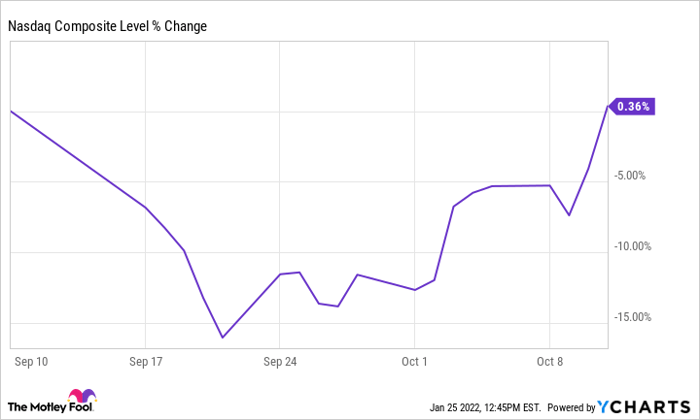
    1. Sept. 20, 2001 — Nasdaq has dropped 13%

    After the terrorist strike against Wall Street, the stock market panicked and there was a quick sell-off. Nine days after the towers fell, the Nasdaq was down 13%. There would be one more ugly day. And then the stock market took off. A month after the terrorist attack, the stock market was back to where it was before.

    ^IXIC Chart

    ^IXIC data by YCharts

    The absolute bottom was about a 16% drop for the Nasdaq. But people who bought when it was down 13% definitely benefitted.

    Of course, the September 2001 crash was caused by a specific event. Today it’s more like a death from a thousand cuts. How does the market respond when bad news comes in waves? Let’s look at the Great Recession in 2008-09, and how that affected the Nasdaq.

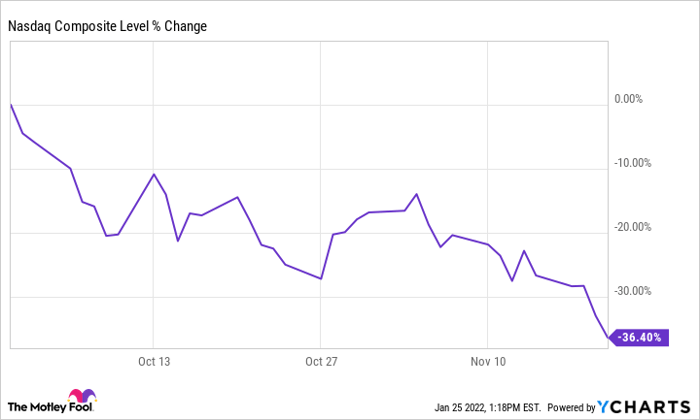
    2. Oct. 1, 2008 — Nasdaq has dropped 13%

    The real estate crash was particularly scary for the markets. A lot of banks imploded, and some went out of business. The government had to rescue others. The crash started in September 2008, and a month later Nasdaq investors were seeing double-digit percentage losses.

    Of course, the Nasdaq is a tech-heavy index. It’s not dominated by real estate companies or banks. And you might think that stocks like Amazon or Microsoft would be immune to this sell-off. But fear is contagious. And those optimistic bulls who figured that “down 13%” might be a buy signal for the Nasdaq, well, they were slaughtered.  If you bought the Nasdaq on Oct. 1, 2008, this is what happened next.

    ^IXIC Chart

    ^IXIC data by YCharts

    Ouch! The Nasdaq continued to plummet. The crash got worse, and worse, and worse. Finding a bottom is always tricky. And there is no “the Nasdaq has dropped 13% and it has to go up now” rule. So lesson No. 2 is that short-term pain today does not mean there will be short-term happiness tomorrow. Bear markets can hurt for a while.

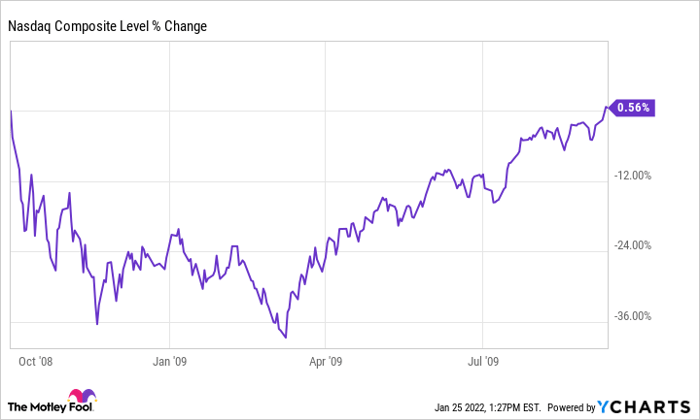
    But will the markets recover? Of course! They always do. In this case, it took almost a year for the Nasdaq to get back to prior levels.

    ^IXIC Chart

    ^IXIC data by YCharts

    Over the next decade, the Nasdaq would almost quadruple! So while it definitely feels scary (and stupid) to buy stocks when the markets are shedding value, over time that’s a great move. The key, of course, is to make sure you’re buying the right stocks. When the market is killing stocks indiscriminately (which is happening right now, in my opinion), it’s always a great time to buy the best stocks in the world. When the panic subsides, those are the ones that will recover quickest, continue to soar, and take the Nasdaq back to positive returns.

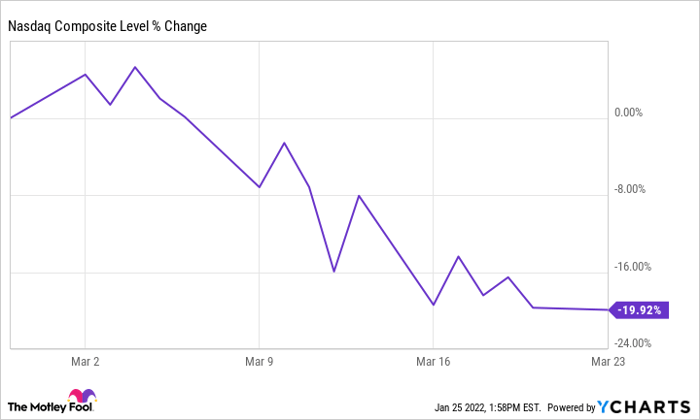
    3. March 1, 2020 — Nasdaq has dropped 13%

    The stock market was doing fine until Feb. 19, 2020. That’s when people started to take alarm at what was happening in Wuhan, China, and at the fast-spreading virus that originated there. The Nasdaq lost 13% of its value in a couple of weeks. So if you bought stocks in an optimistic hope that this viral threat was overhyped, well, you were wrong. March 1, 2020, was a horrible time to buy stocks.

    ^IXIC Chart

    ^IXIC data by YCharts

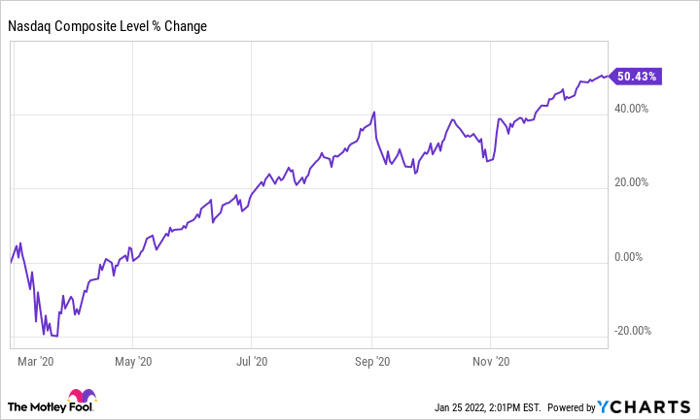
    So the market’s dropped 13%, and you buy, and the market drops another 20% from there. Brutal. But if we expand our time horizon a little, we see that this was actually a great investment. How did that “stupid” investor who bought on March 1 do in 2020? They made a nice 50% gain for the year.

    ^IXIC Chart

    ^IXIC data by YCharts

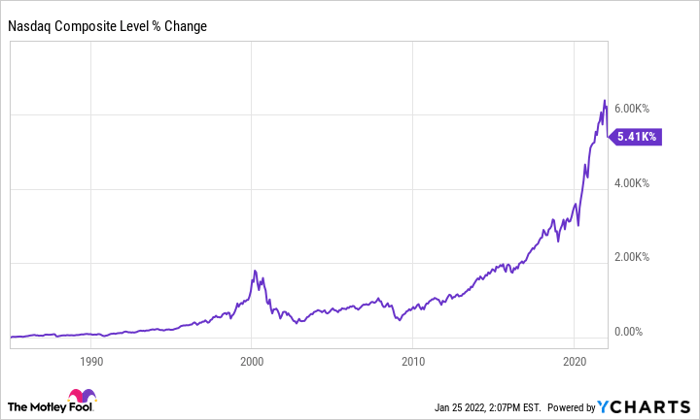
    These charts confirm what we know to be true. Nobody knows what will happen in the short term. Where will the stock market be next week? No idea. But these sharp sell-offs can be wonderful entry points for patient, long-term investors. And some fantastic stocks are on sale right now. We don’t know when stocks will recover. But the future is bullish. Up and to the right is the long-term trend for the stock market, and the Nasdaq.

    ^IXIC Chart

    ^IXIC data by YCharts

    Don’t get caught up in any short-term fright. Stay focused on the long term, continue buying shares of the strongest companies in the world, and you’ll do fine. 

    This article was originally published on Fool.com. All figures quoted in US dollars unless otherwise stated.

    The post The Nasdaq is down 11% in 2022 — 6 charts suggest what will happen next appeared first on The Motley Fool Australia.

    Wondering where you should invest $1,000 right now?

    When investing expert Scott Phillips has a stock tip, it can pay to listen. After all, the flagship Motley Fool Share Advisor newsletter he has run for over ten years has provided thousands of paying members with stock picks that have doubled, tripled or even more.*

    Scott just revealed what he believes could be the five best ASX stocks for investors to buy right now. These stocks are trading at near dirt-cheap prices and Scott thinks they could be great buys right now.

    *Returns as of January 12th 2022

    More reading

    Teresa Kersten, an employee of LinkedIn, a Microsoft subsidiary, is a member of The Motley Fool’s board of directors. The Motley Fool Australia’s parent company Motley Fool Holdings Inc. owns and has recommended Amazon, Apple, and Microsoft. The Motley Fool Australia’s parent company Motley Fool Holdings Inc. recommends Nasdaq and recommends the following options: long March 2023 $120 calls on Apple and short March 2023 $130 calls on Apple. The Motley Fool Australia has recommended Apple. The Motley Fool has a disclosure policy. This article contains general investment advice only (under AFSL 400691). Authorised by Bruce Jackson.

    This article was originally published on Fool.com. All figures quoted in US dollars unless otherwise stated.

    from The Motley Fool Australia https://ift.tt/32yNcLh

  • Premier (ASX:PMV) share price jumps 9% after solid growth despite losing 42,000 trading days

    ASX 200 retail shares a woman smiles over the top of multiple shopping bags she is holding in both hands up near her face.

    Key points

    • Premier Retail had a better half than most retailers despite losing 42,000 trading days
    • Strong performances from Peter Alexander and Smiggle drove modest sales growth
    • Margin expansion underpinned earnings growth

    The Premier Investments Limited (ASX: PMV) share price is on the move on Thursday morning.

    At the time of writing, the retail conglomerate’s shares are up 9% to $28.86.

    Why is the Premier Investments share price jumping?

    Investors have been bidding the Premier Investments share price higher today following the release of a first half trading update for its retail businesses.

    According to the release, the Premier Retail business has navigated the tough operating conditions and the loss of 42,000 trading days to deliver growth during the first half.

    On the top line, the company expects Premier Retail’s sales to come in at $769 million for the six months ending 29 January. This represents a 0.5% increase over the prior corresponding period and was driven largely by strong online sales growth. Online sales are expected to be $195 million for the half, up 27% over the prior corresponding period.

    Pleasingly, unlike what other retailers have reported, Premier Retail’s margins have improved during the six months. So much so, the business expects to report earnings before interest and tax (EBIT) of $209.5 million to $211.5 million. This represents a 4.2% to 5.3% increase over the prior corresponding period.

    Management advised that a key driver of this performance was a rebound in the Smiggle global business as children returned to school and COVID-19 restrictions eased. This was supported by strong performances from its Peter Alexander and Portmans businesses and disciplined cost control. The latter includes rent abatements.

    Premier Retail’s CEO, Richard Murray, commented: “Premier Retail has delivered another strong result despite the volatile trading environment. 1H22 remained challenging as businesses and consumers navigated their way through prolonged government mandated lockdowns.”

    “The Group has weathered the numerous logistical challenges during the half through meticulous planning and by taking full advantage of Premier’s owned Australian Distribution Centre. Reviews of the Group’s distribution centre capabilities in both Australia and New Zealand continue as part of a long-term strategy to meet ongoing demand as customers change their shopping behaviour in the wake of COVID-19,” he added.

    Mr Murray also revealed that the company plans to exit four stores in Mid-City Arcade in the Sydney CBD. Three of these (Peter Alexander, Smiggle and Portmans) will happen in March and one (Just Jeans) will occur no later than July 2023.

    He explained: “These closures demonstrate the Group’s previously announced intention to walk away from stores where landlords seek rents which are unrealistic and which do not reflect the market, particularly in those centres where customer foot traffic has been decimated by the pandemic.”

    Audited half year results will be released in March.

    The post Premier (ASX:PMV) share price jumps 9% after solid growth despite losing 42,000 trading days appeared first on The Motley Fool Australia.

    Should you invest $1,000 in Premier right now?

    Before you consider Premier, you’ll want to hear this.

    Motley Fool Investing expert Scott Phillips just revealed what he believes are the 5 best stocks for investors to buy right now… and Premier wasn’t one of them.

    The online investing service he’s run for over a decade, Motley Fool Share Advisor, has provided thousands of paying members with stock picks that have doubled, tripled or even more.* And right now, Scott thinks there are 5 stocks that are better buys.

    *Returns as of January 13th 2022

    More reading

    Motley Fool contributor James Mickleboro has no position in any of the stocks mentioned. The Motley Fool Australia’s parent company Motley Fool Holdings Inc. has no position in any of the stocks mentioned. The Motley Fool Australia has recommended Premier Investments Limited. The Motley Fool has a disclosure policy. This article contains general investment advice only (under AFSL 400691). Authorised by Bruce Jackson.

    from The Motley Fool Australia https://ift.tt/3IJ1kRQ

  • Life360 (ASX:360) share price pushes higher after reaching 35.5m users in Q4

    Family smile and laugh as they look at a laptop.

    The Life360 Inc (ASX: 360) share price is pushing higher on Thursday morning.

    In early trade, the family-focused technology company’s shares are up 2% to $7.80.

    Life360 share price higher after reporting further Q4 growth

    • Underlying Q4 revenue growth of 46% to US$33.1 million excluding acquisitions and 54% to US$35 million including Jiobit acquisition
    • Full year revenue of US$112.6 million, which is at the top end of its guidance range of US$109 million to US$113 million
    • Global monthly active users (MAU) reached 35.5 million at the end of December and US MAU reached 23.7 million
    • Annualised monthly revenue (AMR) ahead of guidance and up 51% year on year at US$135.7 million
    • Underling earnings before interest, tax, depreciation and amortisation (EBITDA) loss was better than guidance at US$13.1 million

    What happened in the fourth quarter and full year?

    Life360 continued its strong form during the fourth quarter, delivering further top line and user growth.

    For the three months ended 31 December, the company’s revenue grew 51% over the prior corresponding period to US$35 million. This took its full year revenue to US$112.6 million, which compares to its guidance range of US$109 million to US$113 million.

    Things were even better for its annualised monthly revenue (AMR), which came in ahead of guidance. Life360’s AMR grew 51% year on year at US$135.7 million. This compares to its guidance of US$125 million to US$130 million.

    This strong growth was underpinned by a further increase in its global user base, which rose 1.7 million during the fourth quarter to 35.5 million. This represents a year on year increase of 34%.

    The strongest growth was achieved in the US, with user numbers growing 1.5 million or 7% to 23.7 million. International users were 11.8 million at the end of December, which was up 1% quarter on quarter and 24% year on year.

    Another positive is the increasing monetisation of Life360’s user base. Global paying circles grew 11% during the quarter and 39% year on year to 1.2 million. And even better is the fact that the revenue it is generating from these circles is improving on a per circle basis. Average revenue per paying circle grew 3% quarter on quarter and 22% year on year.

    And while this couldn’t stop Life360 from posting an EBITDA loss of US$13.1 million for the year, this was better than its guidance for a loss of US$14 million to US$18 million.

    Life360 finished the year with a cash balance of US$231.3 million.

    Management commentary

    Life360’s Chief Executive Officer, Chris Hulls, said: “This was another milestone quarter for Life360, where we set new records across many key metrics, and made significant progress on our strategic roadmap with the acquisition of Tile. We delivered our third consecutive quarter of record subscriber additions, reaching more than 1.2 million Paying Circles, with underlying revenue growth of 46% year-on-year and underlying Annualised Monthly Revenue growth of 51%. Direct revenue increased 62%, driven by the continued success of our Membership offering, providing a strong leading indicator of our growth momentum.”

    “Monthly Active Users increased 5% from the third quarter to 35.5 million. Life360 is experiencing accelerating growth despite the impact of the Omicron variant in the US and other countries. While Omicron has had some impact on movement – and therefore membership usage – in our primary markets this appears to be much less significant than previous COVID-19 variants. Year-on-year US MAU increased 39% and international MAU grew 24%. In the face of challenging external circumstances, we are seeing continued strengthening of retention and engagement from our users, with the proportion of Returning Monthly Active Users (RMAU) reaching a new record,” he added.

    The post Life360 (ASX:360) share price pushes higher after reaching 35.5m users in Q4 appeared first on The Motley Fool Australia.

    Should you invest $1,000 in Life360 right now?

    Before you consider Life360, you’ll want to hear this.

    Motley Fool Investing expert Scott Phillips just revealed what he believes are the 5 best stocks for investors to buy right now… and Life360 wasn’t one of them.

    The online investing service he’s run for over a decade, Motley Fool Share Advisor, has provided thousands of paying members with stock picks that have doubled, tripled or even more.* And right now, Scott thinks there are 5 stocks that are better buys.

    *Returns as of January 13th 2022

    More reading

    Motley Fool contributor James Mickleboro owns Life360, Inc. The Motley Fool Australia’s parent company Motley Fool Holdings Inc. owns and has recommended Life360, Inc. The Motley Fool Australia has no position in any of the stocks mentioned. The Motley Fool has a disclosure policy. This article contains general investment advice only (under AFSL 400691). Authorised by Bruce Jackson.

    from The Motley Fool Australia https://ift.tt/3u7eHXI

  • Telstra (ASX:TLS) ‘best placed in the Aussie mobile market’ says JP Morgan

    Two male Telstra executives wearing dark coloured suits sit at a table holding their mobile phones discussing the Telstra share price

    The Telstra Corporation Ltd (ASX: TLS) share price closed the session 3% down on Tuesday, and is set to open at $3.93 after a spell on Australia day.

    Shares in the telco giant are a favourite in the coverage universe of investment bank JP Morgan, who are overweight on the stock with a buy rating.

    The broker recently updated its modelling for Telstra following the company’s release on 13 January, although remained firm in its bullish posture in doing so.

    Broker reckons Telstra is a buy

    JP Morgan says that Telstra is the “best placed in the Australian mobile market” to deliver returns in 2022 from a fundamental perspective.

    The company’s “headstart on the rollout of 5G infrastructure should see market share gains of lucrative postpaid subscribers” the broker says.

    “Additionally, product bifurcation through the establishment of sub-brands (such as Telstra’s Belong) should protect higher-quality services from further price degradation”.

    JP Morgan has Telstra as a high conviction name within its telco coverage, noting a strong growth outlook in EBITDA earnings and segment profitability for the company.

    Despite its strong performance over the recent months – where it has rallied from $3.80 in November to trade as high as $4.26 in January – shares have plunged this past week, in sync with a selloff in ASX tech-weighted shares.

    Still, the company has “guided to strong EBITDA growth in the medium term driven by higher profitability in Mobile and productivity gains”.

    “Furthermore, there is the potential for further monetisation of assets through the much larger InfraCo business which we value at 22x or A$32 billion (100% and prior to capital gains tax)”, the broker says.

    Capital inflows from asset sales and good free cash flow could “drive scope for further distributions”, leading analysts to increase the valuation on Telstra to $4.85 per share, signifying a 23% margin of safety at the open today.

    The horizon isn’t risk-free however, with the company still facing challenges in its fixed broadband segment, particularly as the telco could lose market share to lower-cost substitutes.

    “As the NBN rollout continues into metro regions and more well-capitalized operators sign up as NBN resellers” analysts at JP Morgan said, “Telstra could start to lose market share to new entrants that may offer much lower pricing to consumer”.

    “Even if Telstra maintains a steady share of broadband subscribers, pricing pressure from new entrants such as MyRepublic, which is known for its aggressive pricing in Singapore, could lower the potential NBN offset to its ADSL and PSTN revenue losses”.

    Telstra is also relying on “growth from the Mobile, GES and NAS segments as potential offsets” to alleviate pressures on margins, the broker says, which could be difficult to achieve.

    Nevertheless, JP Morgan likes management’s cost reduction efforts and is constructive on the shares given current valuations, and rates it a buy.

    “With the stock price well below our DCF valuation, we are Overweight”.

    Telstra share price snapshot

    The Telstra share price has slipped 6% this year to date amid a heavy selloff in ASX shares, however has still climbed over 25% in the last 12 months.

    The pressure has extended this week and shares are down over 6% in the past 5 days of trading, leading the S&P/ASX 200 Index (ASX: XJO)’s loss of 5%.

    The post Telstra (ASX:TLS) ‘best placed in the Aussie mobile market’ says JP Morgan appeared first on The Motley Fool Australia.

    Should you invest $1,000 in Telstra Corporation right now?

    Before you consider Telstra Corporation, you’ll want to hear this.

    Motley Fool Investing expert Scott Phillips just revealed what he believes are the 5 best stocks for investors to buy right now… and Telstra Corporation wasn’t one of them.

    The online investing service he’s run for over a decade, Motley Fool Share Advisor, has provided thousands of paying members with stock picks that have doubled, tripled or even more.* And right now, Scott thinks there are 5 stocks that are better buys.

    *Returns as of January 13th 2022

    More reading

    Motley Fool contributor Zach Bristow has no position in any of the stocks mentioned. The Motley Fool Australia’s parent company Motley Fool Holdings Inc. has no position in any of the stocks mentioned. The Motley Fool Australia owns and has recommended Telstra Corporation Limited. The Motley Fool has a disclosure policy. This article contains general investment advice only (under AFSL 400691). Authorised by Bruce Jackson.

    from The Motley Fool Australia https://ift.tt/32yLxFx

  • Own Rio Tinto (ASX:RIO) shares? What options does the company have in response to the Serbian government’s decision

    Female worker sitting desk with head in hand and looking fed up

    Key Points

    • Rio Tinto shares withstand market pressure
    • Management looking at legal options to overturn the Serbian Government’s decision
    • Rio Tinto aiming to become a top-tier lithium player

    The Rio Tinto Limited (ASX: RIO) share price has managed to stay in positive territory for 2022, despite the volatility on the ASX.

    In January, the mining heavyweight’s shares have risen by almost 7% in value. In contrast, the S&P/ASX 200 Index (ASX: XJO) has sunken 6.5% over the same time frame.

    At Friday’s closing bell, Rio Tinto shares finished the day down 0.82% to $107.08.

    A quick recap on the Serbian lithium exploration licences fiasco

    Last week, relations between Australia and Serbia hit an all-time low following the ill-treatment and deportation of Novak Djokovic.

    In response to Australia’s handling of the crisis, the Balkan nation decided to revoke Rio Tinto’s lithium exploration licences.

    Serbian environmentalists protested for several weeks against the potential development of the lithium mine by blocking main roads and bridges. If the project went ahead, pollution would run through nearby land and water, affecting valuable farmland.

    Furthermore, with the general election just 3 months away, the Serbian Prime Minister would be looking to shore up support.

    During a televised address to the nation, Serbian Prime Minister Ana Brnabic said:

    We have fulfilled all the requests of the environmental protests and put an end to Rio Tinto in the Republic of Serbia.

    Everything is finished. It’s over.

    A short time after, Rio Tinto stated that it was extremely concerned by the Serbian Prime Minister’s statement, and is reviewing legal options.

    What cards is Rio Tino holding?

    The latest move by the Serbian Government has no doubt put Rio Tinto on the backfoot.

    The Anglo-Australian miner is in unfamiliar territory and doesn’t have many options on the table to overturn the decision.

    One option though could see Rio Tino sue for breach of the fair and equitable treatment provision under the bilateral investment treaty. Both Serbian and the United Kingdom are signatories of this pact along with other European member states.

    The purpose of a bilateral investment treaty is to stimulate foreign investments by reducing political risk.

    Of course, this course of action could only prevail if the Serbian Government formally terminates the license without good cause. Nonetheless, whatever the outcome, this would likely cause permanent damage to relations between Rio Tinto and Serbia.

    Another option would be to hope that pro-mining politicians win the general election and reinstate the exploration licences. Notably, in the last 2020 general election, the Serbian Progressive Party (SNS), lost a large number of its voters. This was because of its strong support of mining in the country.

    Rio Tinto has already spent around $450 million on pre-feasibility and other studies for the Serbian lithium project. In total, the mining giant planned to invest up to $2.4 billion in construction and development activities.

    If approved, it would have become the biggest lithium mine in Europe and one of the largest in the world.

    Experts estimated the mine to have a 40-year life, producing 2.3 million tonnes of lithium carbonate per year.

    Rio Tinto share price snapshot

    Despite travelling 7% higher in 2022, it has been a disappointing 12 months for Rio Tinto shareholders. The company’s shares have lost around 12% in value since this time last year.

    Based on today’s price, Rio Tinto has a market capitalisation of $39.75 billion and approximately 371.22 million shares outstanding.

    The post Own Rio Tinto (ASX:RIO) shares? What options does the company have in response to the Serbian government’s decision appeared first on The Motley Fool Australia.

    Should you invest $1,000 in Rio Tinto right now?

    Before you consider Rio Tinto, you’ll want to hear this.

    Motley Fool Investing expert Scott Phillips just revealed what he believes are the 5 best stocks for investors to buy right now… and Rio Tinto wasn’t one of them.

    The online investing service he’s run for over a decade, Motley Fool Share Advisor, has provided thousands of paying members with stock picks that have doubled, tripled or even more.* And right now, Scott thinks there are 5 stocks that are better buys.

    *Returns as of January 13th 2022

    More reading

    Motley Fool contributor Aaron Teboneras has no position in any of the stocks mentioned. The Motley Fool Australia’s parent company Motley Fool Holdings Inc. has no position in any of the stocks mentioned. The Motley Fool Australia has no position in any of the stocks mentioned. The Motley Fool has a disclosure policy. This article contains general investment advice only (under AFSL 400691). Authorised by Bruce Jackson.

    from The Motley Fool Australia https://ift.tt/3r22cut