Category: Stock Market

  • Wisr (ASX:WZR) share price in hiding after AGM today

    a boy with sad eyes pulls the zip over his mouth and nose while doing up a large jacket where the collar stands up at head height.

    Shares in marketplace lender Wisr Ltd (ASX: WZR) are moving southwards at pace, now fetching an intraday low of 23.5 cents.

    The Wisr share price has lost ground today as the market responds to its AGM. In the presentation, Wisr outlined several investment highlights.

    However, the company hasn’t caught any bids following the release – trading volume today is just 10% of its 4-week average, and shares are 8% down at last check.

    What did Wisr announce?

    Wisr reiterated its latest earnings update, where loan origination was a record $132 million in Q1 FY22. The company has now grown loan originations consecutively for 21 quarters in a row.

    Loan book balance for Wisr Warehouse also surged 239% year on year and reached $451 million. At the time of its Q1 FY22 earnings, total loan originations for Wisr stood at $743 million.

    The release also notes that in June 2021, Wisr’s Financial Wellness Platform was 88% more cost effective as a loan acquisition channel compared to direct and broker channels. Across the second half in total, cost efficiency in this domain improved 33%, lowering Wisr’s customer acquisition cost.

    Over the longer term, revenue growth was up 280% in FY21 at $27 million, and operating expenditures (OPEX) also grew 43%. Note that Wisr already covered these figures in its FY21 earnings up date in August.

    Wisr also had $55.1 million in unrestricted cash and liquid loan assets at the time of its report to ensure it is well capitalised.

    Moving forward, Wisr states that it is set to pass its $1 billion loan book milestone in FY22. New milestones will also be set beyond the $1 billion loan book watermark.

    It also wants to deliver 1 million customers to its proprietary platform, and potentially launch new products, thereby “creating new revenue streams and new market opportunities”.

    Investors have sold Wisr today and the bears have it for now, with shares trending down 25% in the past 3 months.

    The S&P/ASX 200 Financials Index (ASX: XFJ) is also down around 4% this past month, indicating weakness in the broad financial sector.

    Wisr share price snapshot

    The Wisr share price has gained almost 12% in the past 12 months after rallying over 20% this year to date.

    Yet in the past month, it has reversed course and is down 14.5%, and has slipped another 2% in this last week.

    The post Wisr (ASX:WZR) share price in hiding after AGM today appeared first on The Motley Fool Australia.

    Should you invest $1,000 in Wisr right now?

    Before you consider Wisr, you’ll want to hear this.

    Motley Fool Investing expert Scott Phillips just revealed what he believes are the 5 best stocks for investors to buy right now… and Wisr wasn’t one of them.

    The online investing service he’s run for nearly a decade, Motley Fool Share Advisor, has provided thousands of paying members with stock picks that have doubled, tripled or even more.* And right now, Scott thinks there are 5 stocks that are better buys.

    *Returns as of August 16th 2021

    More reading

    The author has no positions in any of the stocks mentioned. The Motley Fool Australia’s parent company Motley Fool Holdings Inc. has no position in any of the stocks mentioned. The Motley Fool Australia has no position in any of the stocks mentioned. The Motley Fool has a disclosure policy. This article contains general investment advice only (under AFSL 400691). Authorised by Bruce Jackson.

    from The Motley Fool Australia https://ift.tt/3l6CaD5

  • Here’s why the Pinnacle (ASX:PNI) share price is falling 6% on Wednesday

    a man stands with arms folded and an unhappy expression on his face looking up from within an iced-up chest freezer in need of defrosting. It's as though the picture has been taken from within the freezer.

    Wednesday is proving to be a rough day for the Pinnacle Investment Management Group Ltd (ASX: PNI) share price after the company defrosted its stock this morning.

    Pinnacle entered a trading halt yesterday as it underwent a $105 million capital raise. The funds were earmarked to go towards a new acquisition.

    Unfortunately, the market reacted poorly to the happenings after the company’s stock was released from its freeze.

    At the time of writing, the Pinnacle share price is $16.35, 6.57% lower than it was as of Monday’s close.

    Let’s take a closer look at this week’s news from the investment management firm.

    Pinnacle share price slides on barrage of news

    The Pinnacle share price is suffering despite news the company is acquiring a 25% stake in venture capital and private equity company Fire V Capital.

    The investment will cost Pinnacle $65 million. A further $10 million is contingent on a successful second fundraising for Five V’s venture capital strategy.

    To cover its cost, the fund has raised $105 million through an institutional placement.

    The $30 million remaining after the acquisition will help replenish its balance sheet following its 2019 purchase of 25% of Coolabah Capital Investments.

    Under the placement, Pinnacle offered institutional investors the option to purchase Pinnacle shares for $16.70 apiece. That was a 4.6% discount on its share price as of Monday’s close. It was also 7.6% less than its 5-day volume-weighted average price.

    Simultaneous to the placement, Pinnacle’s director Adrian Whittingham completed a sell-down of 875,000 Pinnacle shares. The holding was worth approximately $14.6 million at the placement price.

    The fund is also planning to undergo a share purchase plan. During the share purchase plan, eligible shareholders will be able to purchase up to $30,000 worth of new Pinnacle shares.

    Under the share purchase plan, shares will be offered at the placement price or the 5-day volume-weighted average price of Pinnacle shares up to 15 December, whichever is lower. It will open on 30 November.

    As The Motley Fool Australia reported yesterday, Pinnacle also provided the market with an update on its funds under management (FUM) during its trading halt.

    As of 31 October, Pinnacle was managing $90.9 billion of funds. Its aggregate affiliate FUM are also more than 30% higher than its average FUM for financial year 2021.

    Right now, the Pinnacle share price is 130% higher than it was at the start of 2021.

    The post Here’s why the Pinnacle (ASX:PNI) share price is falling 6% on Wednesday appeared first on The Motley Fool Australia.

    Should you invest $1,000 in Pinnacle Investment Management right now?

    Before you consider Pinnacle Investment Management, you’ll want to hear this.

    Motley Fool Investing expert Scott Phillips just revealed what he believes are the 5 best stocks for investors to buy right now… and Pinnacle Investment Management wasn’t one of them.

    The online investing service he’s run for nearly a decade, Motley Fool Share Advisor, has provided thousands of paying members with stock picks that have doubled, tripled or even more.* And right now, Scott thinks there are 5 stocks that are better buys.

    *Returns as of August 16th 2021

    More reading

    Motley Fool contributor Brooke Cooper has no position in any of the stocks mentioned. The Motley Fool Australia’s parent company Motley Fool Holdings Inc. owns shares of and has recommended PINNACLE FPO. The Motley Fool Australia owns shares of and has recommended PINNACLE FPO. The Motley Fool has a disclosure policy. This article contains general investment advice only (under AFSL 400691). Authorised by Bruce Jackson.

    from The Motley Fool Australia https://ift.tt/30SyVYT

  • Macquarie (ASX:MQG) is now a ‘big four’ bank

    A runner hi fives as he cross the finish line in new pole position

    History was made on the ASX recently as the seemingly unbreakable cabal of the big four banks was broken.

    On Wednesday afternoon, Macquarie Group Ltd (ASX: MQG) had a market capitalisation of $77.68 billion, eclipsing Australia and New Zealand Banking Group Ltd (ASX: ANZ)’s $76.87 billion.

    That means ANZ is now the fifth largest bank while Macquarie takes its seat among the big four.

    Australian competition authorities have long held the belief that the four majors — ANZ, Westpac Banking Corp (ASX: WBC), National Australia Bank Ltd (ASX: NAB) and Commonwealth Bank of Australia (ASX: CBA) — had such unassailable leads in the market that they would never be allowed to merge or even cooperate.

    So how did Macquarie sneak in?

    Macquarie shares have skyrocketed this year

    A major contributor is that Macquarie shares have climbed up almost 50% so far this year. The stock started January at $140 but traded for $204.59 on Wednesday afternoon.

    This has much to do with how most of its business is in investment banking rather than retail — and the market thus treats it as a growth stock.

    Meanwhile, it’s been many years since ANZ, Westpac, NAB and CBA shares have been considered anything but value (or income) stocks. This is due to their long-established stranglehold in low-margin consumer banking.

    To demonstrate, the ANZ share price is lower now than its highs before the global financial crisis 14 years ago. It’s the same case for NAB stock.

    Macquarie is having its cake and eating it too

    Ironically for regulators, Marcus Today founder Marcus Padley told Livewire recently Macquarie has relatively little competition in the Australian market.

    “In the US, the competition amongst the investment banks is savage. You have a choice. But not in Australia.”

    But it’s now starting to also eat into the consumer market that the big four have dominated for so long.

    “Their recent foray into the domestic mortgage market, the citadel of the big high-street banks, has grabbed market share and hurt their unimaginative competitors,” Padley said.

    “I have a Macquarie mortgage. They are so much better to deal with. They have something quite unique in my personal banking experience — something called customer service. There is nothing they cannot do.”

    Making the right bets

    According to analysts, Macquarie has also done well to invest in infrastructure and businesses that are on the right side of a world moving to net-zero emissions.

    “Macquarie is a ‘picks and shovels’ play on decarbonisation,” Fidelity International portfolio manager Kate Howitt told The Motley Fool this month.

    “We know that over the next 25 years, the global economy has to spend at least $100 trillion to decarbonise… Macquarie has just been setting itself to be right at the heart of a huge and growing investment pipeline that the world’s got.”

    Macquarie is one of Howitt’s 2 largest holdings.

    “They have been focusing their recruitment… on scientists, engineers — if they understand the real nuance of how these new and emerging technologies work, then they’ll be better placed to assist on the financing of that,” she said. 

    “So that just has a very, very long runway of growth ahead of them.”

    The post Macquarie (ASX:MQG) is now a ‘big four’ bank appeared first on The Motley Fool Australia.

    Wondering where you should invest $1,000 right now?

    When investing expert Scott Phillips has a stock tip, it can pay to listen. After all, the flagship Motley Fool Share Advisor newsletter he has run for more than eight years has provided thousands of paying members with stock picks that have doubled, tripled or even more.*

    Scott just revealed what he believes could be the five best ASX stocks for investors to buy right now. These stocks are trading at near dirt-cheap prices and Scott thinks they could be great buys right now.

    *Returns as of August 16th 2021

    More reading

    Motley Fool contributor Tony Yoo owns shares of Macquarie Group Limited. The Motley Fool Australia’s parent company Motley Fool Holdings Inc. has no position in any of the stocks mentioned. The Motley Fool Australia has recommended Macquarie Group Limited and Westpac Banking Corporation. The Motley Fool has a disclosure policy. This article contains general investment advice only (under AFSL 400691). Authorised by Bruce Jackson.

    from The Motley Fool Australia https://ift.tt/30VciTS

  • Here’s why Macquarie sees 39% upside in the Rio Tinto (ASX:RIO) share price

    happy mining worker fortescue share price

    Shares in resources giant Rio Tinto Limited (ASX: RIO) are struggling to find range today. At the time of writing, the Rio Tinto share price is $94.58, after rallying as high as $95.71 and slipping as low as $94.38 in early trade.

    Zooming out, Rio shares are swimming in a sea of red across all time frames, even if prices have just bounced from 3-month lows.

    Despite this downtrend, analysts are split on the future direction of Rio Tinto’s share price. Let’s take a closer look.

    What’s up with Rio Tinto shares lately?

    Rio shares have been drifting lower these past few months. The trend began after the mining giant released its 3rd quarter results.

    As advised by Rio at the time, it had another difficult quarter after struggles dealing with the pandemic. Ore shipments were barely afloat, growing just 2% for the 12 months. Much of the headwinds came from weakening iron ore prices across 2021.

    As Chinese demand for steel’s main ingredient slowed, the price of iron ore rapidly fell from a high of US$229.50/tonne in May to now trade at US$92.50/tonne – a staggering 60% decline.

    The results meant Rio also lowered its target output across major commodities such as iron ore, titanium dioxide, bauxite, aluminium and mined copper.

    Investors responded poorly to Rio’s quarterly update and sent its share price backtracking where it hit 52-week lows two weeks ago.

    Can the Rio Tinto share price climb to $133?

    The team at Macquarie seem to think so. Analysts at the firm recently retained their valuation of $133/share and retained an outperform rating on Rio’s share price.

    One factor Macquarie highlights in reasoning is Rio’s recent efforts to bump up its ESG framework. This includes a collaboration with US-based nonprofit, Resolve, to re-purpose mining waste from Rio’s legacy mine sites.

    The agreement spawns a company called Regeneration, and Rio has already made an equity investment of $2 million. Macquarie also notes Rio’s $87 million investment to build 16 new posts using AP60 technology in Canada as a positive step towards its ESG credentials.

    Aside from this, the broker likes Rio’s free cash flow generation, that was spurred on by record iron ore prices achieved in early 2021.

    Meanwhile, Citi believes it’s time to revisit the valuations of iron ore shares, especially with Chinese monetary policy and political risks softening. The broker says “with the recent share price corrections, we see value across the Australian iron-ore sector”.

    JP Morgan thinks there is “still plenty of valuation support and free cash flow yield in the space” as well, and forecasts a 10% free cash flow yield in fiscal 2022 for Rio. The broker reckons that other commodities, such as coal and copper, will also jump in to offset iron ore weakness.

    Or could Rio Tinto fall to $87?

    Whilst the teams at these leading brokers are heavily bullish on its direction, others aren’t as optimistic. The team at Jefferies disagree on the valuation front and are cautious on the entire metals/mining space.

    It reckons that ASX iron ore shares still aren’t cheap – even with the large pullbacks of late. As such, it retains a hold rating and a $100 share price target.

    Investment bank Morgan Stanley also cautioned investors on Rio’s situation in a note released to clients today. It reckons that Rio will take a hit if the Mongolian government gets its way from talks on the Oyu Tolgoi project.

    Basically, the Mongolian government wants Rio to cover additional costs and cancel the debt on its 34% share of the Oyu Tolgoi project.

    Oyu Tolgoi, in the South Gobi region of Mongolia, is one of the largest known copper and gold deposits in the world, according to Rio. When the underground is complete, it will be the world’s fourth largest copper mine. Rio owns the remaining 66% of Oyu Tolgoi through a company vehicle, Turquoise Hill Resources.

    The broker estimates the accumulative burden for Rio to be $700 million if Mongolia’s debt is waived and another $700 million to cover the government’s share of costs if it goes ahead.

    Morgan Stanley has a $101 price target on the Rio Tinto share price which it updated yesterday after staying equal weight on its rating.

    The lowest price target on the list of analysts covering Rio Tinto is $87 from RBC Capital Markets, whereas Evans and Partners reckon that shares can hit $146. As such, the spread between all valuations is around 68% or $59 per share.

    In the past 12 months, the Rio Tinto share price has fallen over 8.5% after sliding another 17% this year to date.

    The post Here’s why Macquarie sees 39% upside in the Rio Tinto (ASX:RIO) share price appeared first on The Motley Fool Australia.

    Should you invest $1,000 in Rio Tinto right now?

    Before you consider Rio Tinto, you’ll want to hear this.

    Motley Fool Investing expert Scott Phillips just revealed what he believes are the 5 best stocks for investors to buy right now… and Rio Tinto wasn’t one of them.

    The online investing service he’s run for nearly a decade, Motley Fool Share Advisor, has provided thousands of paying members with stock picks that have doubled, tripled or even more.* And right now, Scott thinks there are 5 stocks that are better buys.

    *Returns as of August 16th 2021

    More reading

    The author Zach Bristow has no positions in any of the stocks mentioned. The Motley Fool Australia’s parent company Motley Fool Holdings Inc. has no position in any of the stocks mentioned. The Motley Fool Australia has no position in any of the stocks mentioned. The Motley Fool has a disclosure policy. This article contains general investment advice only (under AFSL 400691). Authorised by Bruce Jackson.

    from The Motley Fool Australia https://ift.tt/3xfUpea

  • Serko (ASX:SKO) share price halted amid H1 FY22 results and cap raise

    A man hunches over a laptop, covered in frozen icicles.

    The Serko Ltd (ASX: SKO) share price isn’t going anywhere today following the release of the company’s FY22 half-year results.

    The online travel booking and expense management provider’s shares are frozen at $7.42 apiece.

    Serko share price on ice following mixed performance for H1 FY22

    The Serko share price is in a trading halt after the company delivered its half-year FY22 results for the 6 months ending 30 September 2021. Here are some of the key financial highlights for the period:

    What happened to Serko in H1 FY22?

    Serko reported a challenging first half of the year, tempered by the impact of COVID-19 on other markets. In addition, the strict lockdowns experienced during the second quarter affected its performance in New Zealand and Australia.

    Total travel bookings rose on Serko’s platform to 1.3 million, up 157% from the same period a year ago. The segment was more heavily weighted towards the first quarter, lifted by more limited lockdowns in both counties.

    While travel gradually began to recover, the proportion of travel platform versus expense management revenue changed compared to FY21. This resulted in a lower average revenue per booking of $7.38 compared to $8.76 during the full-year FY21.

    EBITDA losses amplified, reflecting a slow return to travel globally, combined with an increase in investment in the Serko platform.

    The company ended the first half with cash and short-term deposits of $62.3 million, down on the $79.9 million at 31 March 2021. The cash burn over the 6-month period averaged $2.9 million per month. Management continued to prudently conserve cash, whilst balancing investing for revenue-generating opportunities.

    What did management say?

    Serko CEO and co-founder Darrin Grafton commented on the result:

    We are poised for growth out of this pandemic and the investment to date has proven our ability to grow from a regional leader to a truly global player. Our focus is now on scaling the business to activate the opportunities we have ahead of us.

    We continue to advance our vision of the ‘connected trip’ with enhancements to our product and the addition of new content. These include tools that allow businesses to deliver on their sustainability commitments and better discharge the duty of care they owe to their travellers, such as informing them of COVID-19 protection measures.

    What’s next for Serko in H2 FY22?

    Looking ahead, Serko is confident that business travel will return over time. It believes that the target of reaching $100 million in revenue in the mid-term remains achievable.

    However, the disruptions to global business travel arising from the pandemic and other factors continue to delay the timing.

    Serko anticipates full-year revenue and other income of between $21 million and $25 million. This outlook assumes a general reduction of domestic travel restrictions within Australia and New Zealand and no significant lockdowns in Europe or North America.

    Serko launches capital raise

    In addition to the results announcement, Serko advised it has launched a NZ$85 million (A$81.47 million) equity raise.

    The company plans to undertake a NZ$75 million (A$71.89 million) fully-underwritten placement, and a NZ$10 million (A$9.59 million) non-underwritten retail offer.

    The offer price is NZ$7.05 (A$6.76) per share, representing a 10.2% discount to the last closing price on 23 November.

    Proceeds from the equity raise will go toward a number of activities. These include investing for growth with Booking.com for Business, developing global marketplace strategy, and accelerating global expansion opportunities.

    Adding to his previous comments, Mr Grafton said:

    Despite the ongoing impacts of the COVID-19 pandemic on the travel industry, Serko has continued to maintain a strong market position in Australasia, invest in the Booking.com for Business global opportunity and increase market presence in North America. Serko is now poised to enter the next phase of growth – to scale up and progress our long-term strategy of becoming a global business travel marketplace.

    The post Serko (ASX:SKO) share price halted amid H1 FY22 results and cap raise appeared first on The Motley Fool Australia.

    Should you invest $1,000 in Serko right now?

    Before you consider Serko, you’ll want to hear this.

    Motley Fool Investing expert Scott Phillips just revealed what he believes are the 5 best stocks for investors to buy right now… and Serko wasn’t one of them.

    The online investing service he’s run for nearly a decade, Motley Fool Share Advisor, has provided thousands of paying members with stock picks that have doubled, tripled or even more.* And right now, Scott thinks there are 5 stocks that are better buys.

    *Returns as of August 16th 2021

    More reading

    Motley Fool contributor Aaron Teboneras has no position in any of the stocks mentioned. The Motley Fool Australia’s parent company Motley Fool Holdings Inc. owns shares of and has recommended Serko Ltd. The Motley Fool Australia has recommended Serko Ltd. The Motley Fool has a disclosure policy. This article contains general investment advice only (under AFSL 400691). Authorised by Bruce Jackson.

    from The Motley Fool Australia https://ift.tt/3DS0Bvp

  • Envirosuite (ASX:EVS) share price jumps 5% on strategic splash with GHD

    a very young girl looks up at a splash of water coming from a hose that she is holding with the sunlight shining through the water drops.

    The Envirosuite Ltd (ASX: EVS) share price is among the green league on Wednesday.

    In afternoon trade, the environmental management software providers’ shares are up 4.65% to 22.5 cents. The company’s share price is now just shy of its 52-week high of 24.5 cents.

    Why is the Envirosuite share price climbing higher today?

    Market participants are bidding up the Envirosuite share price today following the release of a strategic agreement announcement.

    According to its announcement, Envirosuite has entered into two strategic agreements with the consulting group GHD. These agreements with the Australian consulting firm involve the use of Envirosuite’s EVS Water software. Specifically, the agreements with GHD for the water software is to:

    • Implement and scale the solution for water facilities
    • Leverage GHD’s global network to refer EVS Water to prospective clients

    The development marks a new phase in the company’s rollout of its water-focused environmental software solution.

    This software allows clients to create a digital twin of water treatment plants, powered by machine learning and deterministic modelling.

    Through partnering with a large company such as GHD, with 200 offices across five continents, Envirosuite aims to grab a large hold of the water market. The referral program will focus on drinking water, desalination, and industrial water treatment industries. This potential increased market reach appears to be aiding the Envirosuite share price today.

    Currently, the consulting firm uses EVS Water for water treatment and desalination plants across the Asia-Pacific region. Following the agreements, GHD will provide technical support for EVS Water products and offer product improvements. Additionally, the consultant will assist in configuring digital twins for EVS Water projects.

    What does it means for revenue?

    Envirosuite expects that the revenue from these two agreements will not be material to the group FY22 revenue. However, it is anticipated to be material to the revenue of the EVS Water segment. This is possibly due to the relatively small base from which the water product is starting.

    In Q1, the company recorded $0.1 million in annual recurring revenue (ARR) from the water product. For context, this made up only 7% of ARR for the group.

    Finally, the Envirosuite share price is up 24% since the beginning of the year.

    The post Envirosuite (ASX:EVS) share price jumps 5% on strategic splash with GHD appeared first on The Motley Fool Australia.

    Should you invest $1,000 in Envirosuite right now?

    Before you consider Envirosuite, you’ll want to hear this.

    Motley Fool Investing expert Scott Phillips just revealed what he believes are the 5 best stocks for investors to buy right now… and Envirosuite wasn’t one of them.

    The online investing service he’s run for nearly a decade, Motley Fool Share Advisor, has provided thousands of paying members with stock picks that have doubled, tripled or even more.* And right now, Scott thinks there are 5 stocks that are better buys.

    *Returns as of August 16th 2021

    More reading

    Motley Fool contributor Mitchell Lawler has no position in any of the stocks mentioned. The Motley Fool Australia’s parent company Motley Fool Holdings Inc. has no position in any of the stocks mentioned. The Motley Fool Australia has no position in any of the stocks mentioned. The Motley Fool has a disclosure policy. This article contains general investment advice only (under AFSL 400691). Authorised by Bruce Jackson.

    from The Motley Fool Australia https://ift.tt/3xgOV2R

  • 3 reasons to buy Tesla stock, and 1 reason to sell

    This article was originally published on Fool.com. All figures quoted in US dollars unless otherwise stated.

    woman happy while charging her Tesla

    This article was originally published on Fool.com. All figures quoted in US dollars unless otherwise stated.

    The auto industry is clearly shifting toward electricity, with every major automaker pushing hard in the electric vehicle (EV) space. However, it was Tesla (NASDAQ: TSLA) that really got the ball rolling on this front, and investors have clearly noticed.

    Here’s a trio of reasons why investors might want to put some money to work in Tesla’s shares, and one important reason why you might not want to. In fact, if you have profits in the stock, it might even be a good reason to consider locking in at least some of your gains.

    1. Tesla is hyper-focused on the clean energy transition

    Tesla is, basically, the leading pure-play electric vehicle maker. There are others in the niche, but Tesla has long been the name to beat. And at this point, it is actually turning a profit, with positive earnings in each of the last five quarters. For many years the company basically just bled red ink. However, it has turned an important corner even though it only sold 240,000 or so cars in the third quarter. For reference, Ford (NYSE: F) sold more than four times as many cars in the quarter. So Tesla remains a small fry, but that’s just fine if it’s making money.

    The key difference is that Ford and its peers are largely trying to balance the shift from gasoline to electricity. Tesla doesn’t need to do that. In addition to cars, meanwhile, Tesla also has its hand in solar power and battery technology. So there are more avenues for growth as renewable power technology comes to the masses, and it has a very loyal customer base it can sell other products to. So it looks like Tesla could eventually be a much broader play on the clean energy space for those with an ESG bent.

    2. Tesla has visionary leadership

    Tesla is the brainchild of CEO Elon Musk. He’s sometimes compared to Tony Stark from the Iron Man comic series, which is a way to suggest that he’s a wealthy genius do-gooder. That characterization is debatable, since he has a team of experts that help him actually make electric cars and the technology behind them — but what is very clear is that he knows how to promote the company he runs. And what he has created is quite impressive. While he has a habit of pushing the promotional envelope at times, that’s been a net positive so far, and there’s no reason to expect this to change. In fact, many investors own the stock partly because of Elon Musk. 

    3. Tesla has plenty of growth opportunity

    A hyper-focus on a growing industry niche with a visionary leader at the helm. There’s a lot to like in that description. However, what’s really interesting here is that, assuming Tesla can maintain its industry cachet, there’s a lot of room for it to gain ground on older competitors that simply don’t have the same image. Go back to the sales numbers in point No. 1 that noted Tesla’s sales are at less than a quarter of what Ford sold. And Ford is just one of many large global auto companies from which Tesla can steal market share by being cooler and hipper. For example, General Motors (NYSE: GM) sold 1.3 million or so cars in the third quarter. Yes, both are looking to grow their EV businesses, but their dominance of the gasoline-powered vehicle market doesn’t necessarily give them an advantage in the EV space, where Tesla’s brand is often top of mind. Indeed, the EV playing field is much more level, and Tesla has already proven it can compete effectively with the industry’s biggest automakers. 

    TSLA Market Cap Chart

    TSLA Market Cap data by YCharts

    Time to lock in some gains?

    The big problem with Tesla, and one that investors should really think about closely, is valuation. There is a number of ways to look at this, but the one that is probably the most shocking is market cap. Tesla’s market cap is roughly $1.1 trillion, compared to Ford’s $77 billion and General Motors’ $89 billion. That’s shocking because, going back to the sales numbers above, Tesla sold less than a quarter of the cars that Ford or GM sold in the third quarter. How could it possibly be worth more than 10 times as much as each of those two companies? Even with all the opportunities it has for growth in the years ahead, a lot of good news is clearly being priced into Tesla’s stock today. 

    Investors who have ridden the stock up should probably think about taking some money off the table. In fact, in the past year alone the stock price has doubled. And that includes the recent volatility surrounding Elon Musk’s stock sales. This isn’t to suggest that you have to sell every share you own, but prudence hints that locking in some gains makes sense. Perhaps you can use the cash to add some diversification to your portfolio, which may be a little extra heavy on Tesla given its huge 1,200% gain since January of 2020.

    Act before the situation changes

    Nothing lasts forever, and Tesla’s massive market cap relative to its peers is likely to reverse at some point. The company may make great EVs, but it hardly owns the EV market. And that will likely lead to an eventual revaluation of the stock. Since it’s impossible to predict when that will happen, long-term investors should act now while they still have big stock gains. Locking in some of that profit may sting if the stock keeps going up, but it is the logical move for most investors given the very real risk that Wall Street is pricing in way too much good news. And that remains true even with all of the positive attributes Tesla has.

    And if you haven’t bought Tesla yet, well, it might be best to leave it on your wish list for now if you have even the slightest value bias. 

    This article was originally published on Fool.com. All figures quoted in US dollars unless otherwise stated.

    The post 3 reasons to buy Tesla stock, and 1 reason to sell appeared first on The Motley Fool Australia.

    Should you invest $1,000 in Tesla right now?

    Before you consider Tesla, you’ll want to hear this.

    Motley Fool Investing expert Scott Phillips just revealed what he believes are the 5 best stocks for investors to buy right now… and Tesla wasn’t one of them.

    The online investing service he’s run for nearly a decade, Motley Fool Share Advisor, has provided thousands of paying members with stock picks that have doubled, tripled or even more.* And right now, Scott thinks there are 5 stocks that are better buys.

    *Returns as of August 16th 2021

    More reading

    Reuben Gregg Brewer has no position in any of the stocks mentioned. The Motley Fool Australia’s parent company Motley Fool Holdings Inc. has no position in any of the stocks mentioned. The Motley Fool Australia has no position in any of the stocks mentioned. The Motley Fool has a disclosure policy. This article contains general investment advice only (under AFSL 400691). Authorised by Bruce Jackson.

    This article was originally published on Fool.com. All figures quoted in US dollars unless otherwise stated.

    from The Motley Fool Australia https://ift.tt/3CMi8nv

  • 2 fantastic ETFs generating strong returns for ASX investors

    Block letters 'ETF' on yellow/orange background with pink piggy bank

    If you’re wanting to add some diversification to your portfolio in 2022, then you might want to look at exchange traded funds (ETFs).

    ETFs are a great way to achieve this because they give investors easy access to a large and diverse number of different shares through a single investment.

    With that in mind, here are two highly rated ETFs that are generating strong returns for investors:

    BetaShares Global Cybersecurity ETF (ASX: HACK)

    The first ETF to look at is the BetaShares Global Cybersecurity ETF. It aims to track the performance of an index providing investors with exposure to the leading companies in the growing global cybersecurity sector.

    Cyber security companies look well-placed for growth in the coming years thanks to increasing demand for cybersecurity services due to a rise in cybercrime. And given how this side of the market is heavily under-represented on the ASX, this ETF give investors an easy way to invest in the sector.

    Among the ETF’s holdings you’ll find the likes of Accenture, Cisco, Cloudflare, Crowdstrike, and Okta.

    In respect to the latter, Okta provides large enterprises with workforce identity solutions. Its customer identity and access management (CIAM) solutions ensure an organisation’s remote workforce is who they claim to be and that they only have access to the business applications they need to perform their job.

    The fund has generated a return of 23.4% per annum for investors over the last five years. This would have turned a $20,000 investment into ~$57,000.

    VanEck Vectors Morningstar Wide Moat ETF (ASX: MOAT)

    Another ETF to look at is the VanEck Vectors Morningstar Wide Moat ETF. This fund gives investors access to around 50 US-based stocks which are judged to have sustainable competitive advantages.

    Historically, companies with competitive advantages, or moats, have generated strong returns for investors. This is why investing in companies with this quality is a key investment tenet for Warren Buffett.

    Among the ETF’s holdings are the likes of Amazon, Boeing, Coca-Cola, Meta, and Microsoft.

    Over the last five years, the ETF has outperformed the ASX 200 index with an average total return of 19.8% per annum. This would have turned $20,000 into ~$49,350.

    The post 2 fantastic ETFs generating strong returns for ASX investors appeared first on The Motley Fool Australia.

    Wondering where you should invest $1,000 right now?

    When investing expert Scott Phillips has a stock tip, it can pay to listen. After all, the flagship Motley Fool Share Advisor newsletter he has run for more than eight years has provided thousands of paying members with stock picks that have doubled, tripled or even more.*

    Scott just revealed what he believes could be the five best ASX stocks for investors to buy right now. These stocks are trading at near dirt-cheap prices and Scott thinks they could be great buys right now.

    *Returns as of August 16th 2021

    More reading

    Motley Fool contributor James Mickleboro has no position in any of the stocks mentioned. The Motley Fool Australia’s parent company Motley Fool Holdings Inc. owns shares of and has recommended BETA CYBER ETF UNITS. The Motley Fool Australia owns shares of and has recommended BETA CYBER ETF UNITS. The Motley Fool Australia has recommended VanEck Vectors Morningstar Wide Moat ETF. The Motley Fool has a disclosure policy. This article contains general investment advice only (under AFSL 400691). Authorised by Bruce Jackson.

    from The Motley Fool Australia https://ift.tt/3nNKn0Y

  • Here are my top risk-averse cryptocurrencies

    This article was originally published on Fool.com. All figures quoted in US dollars unless otherwise stated.

    a businessman rips open his shirt superman style to reveal the bitcoin logo on a superhero style lycra suit under his clothes.

    This article was originally published on Fool.com. All figures quoted in US dollars unless otherwise stated.

    The cryptocurrency market keeps expanding and that means a lot more choices for investors looking for exposure in digital currencies. Risk is inherent in all types of cryptocurrency, but there are some denominations that should hold up better on a relative basis. 

    Bitcoin (CRYPTO: BTC), Ethereum (CRYPTO: ETH), and USD Coin (CRYPTO: USDC) are my three largest personal investments in the cryptocurrency space. They also happen to be my top choices in terms of limiting the unusually high risks that come with the wild price swings for the market. 

    Bitcoin

    The world’s best known cryptocurrency is Bitcoin, and understandably so. It’s the one that put digital currencies on the map. With a market capitalisation of $1.1 trillion, it is more valuable than the next 40 cryptocurrencies combined. If Bitcoin were a stock there would only be five US publicly traded companies commanding larger market caps.

    Bitcoin is the industry standard. Some companies are converting some of their cash reserves to Bitcoin, and a growing number of financial platforms are allowing their customers to trade in the top dog of digital currencies. 

    There are risks, of course. Bitcoin has been susceptible to sharp spikes and plunges. We’ve seen it happen this year. Bitcoin peaked in April, only to shed more than half of its value by June. It would go on to more than double, hitting fresh all-time highs earlier this month. If this is the kind of volatility that scares you away, you’re not going to want to hear that it has had even bigger crashes in the past. Bitcoin has always bounced back, but that’s obviously not a guarantee of future performance. 

    Bitcoin is also coming under fire this year for the vast amount of energy consumed in mining for the crypto as a proof-of-work platform. It’s also expensive to transfer relative to some more nimble digital currencies. It’s not perfect, but it’s the default crypto as long as it sits atop the market cap throne.

    Ethereum

    The world’s second-most valuable denomination — with a market cap just above $500 million — is Ethereum. Despite commanding less than half of Bitcoin’s value it overtook the top dog as the most traded crypto on Coinbase Global in the last two quarters.

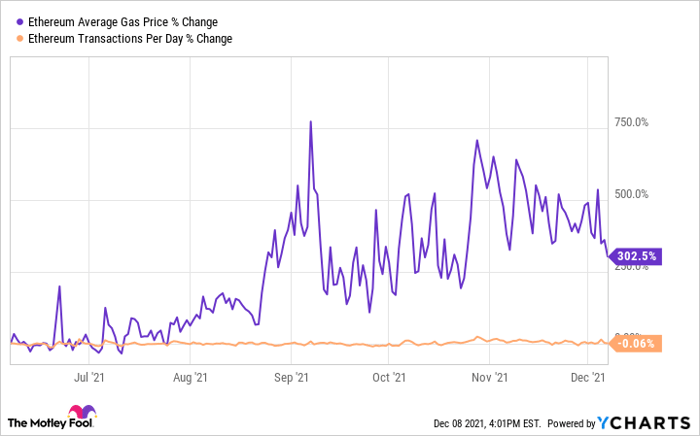
    Ethereum’s blockchain tech has the superior functionality when it comes to use cases beyond being merely a store of capital. Ethereum has become a popular choice for decentralised applications — dApps — for gaming transactions, advertising, and non-fungible token bidding wars. Bitcoin’s recent Taproot update will help it close the gap on some fronts, but Ethereum’s already looking ahead to its next major transformation.

    Ethereum is migrating away from proof-of-work to proof-of-stake, a shift that will make the world’s second-most valuable crypto even more energy efficient when it comes to generating new tokens but also help speed up transactions and related costs. 

    USD Coin

    Picking a stablecoin as my third choice for risk-averse cryptocurrencies may not seem fair, but it certainly makes the cut as a digital currency. Coinbase created USD Coin — more commonly referred to as USDC — and the leading trading exchange stands by it as coin with a price locked at $1 and pegged 1-to-1 with the US dollar. 

    Why would you want to own a crypto locked at $1? Coinbase only offers a 0.15% yield on traders holding the stablecoin, but there are far better alternatives elsewhere if you’re willing to risk it on another app that will lend, stake, or otherwise use your USDC. Platforms like Celsius Network currently pay more than 10% on USDC. Voyager is rolling out a debit card where you can earn 9% interest on your USDC until you use it for purchase. 

    Chasing yield on USDC is riskier than just parking it on Coinbase or in a crypto wallet and even if you’re OK with just earning 0.15% on Coinbase, you are at the mercy of the platform’s financial viability. It’s still a low-risk crypto with a decent $37 billion currently in circulation. 

    This article was originally published on Fool.com. All figures quoted in US dollars unless otherwise stated.

    The post Here are my top risk-averse cryptocurrencies appeared first on The Motley Fool Australia.

    Should you invest $1,000 in cryptocurrency right now?

    Before you consider cryptocurrency, you’ll want to hear this.

    Motley Fool Investing expert Scott Phillips just revealed what he believes are the 5 best stocks for investors to buy right now… and cryptocurrency wasn’t one of them.

    The online investing service he’s run for nearly a decade, Motley Fool Share Advisor, has provided thousands of paying members with stock picks that have doubled, tripled or even more.* And right now, Scott thinks there are 5 stocks that are better buys.

    *Returns as of August 16th 2021

    More reading

    Rick Munarriz owns shares of Bitcoin, Coinbase Global, Inc., and Ethereum. The Motley Fool Australia’s parent company The Motley Fool Holdings Inc. owns shares of and recommends Bitcoin and Ethereum. The Motley Fool Australia has no position in any of the stocks mentioned. The Motley Fool has a disclosure policy. This article contains general investment advice only (under AFSL 400691). Authorised by Bruce Jackson.

    This article was originally published on Fool.com. All figures quoted in US dollars unless otherwise stated.


    from The Motley Fool Australia https://ift.tt/3CKBGss
  • Qantas (ASX:QAN) share price down 5% so far this week despite boss spruiking ‘new opportunities’

    The Qantas Airways Limited (ASX: QAN) share price is struggling through this week despite the company’s CEO Alan Joyce heralding the end of “the most challenging period in Qantas’ history”.

    Joyce made the comment as the first international flights from Victoria took off on Monday.

    On top of the reopening, the travel giant’s boss noted the company is taking advantage of “new opportunities” to broaden its offerings.

    At the time of writing, the Qantas share price is $5.23, 0.57% lower than its previous close. That also represents a 4.6% drop since Friday’s close.

    For context, the S&P/ASX 200 Index (ASX: XJO) has fallen 0.06% today, while the All Ordinaries Index (ASX: XAO) is down 0.14%.

    Here is a breakdown of the opportunities Australia’s iconic airline is taking advantage of as Australia’s borders reopen.

    Qantas share price slumps despite Joyce’s optimisim

    The Qantas share price is struggling this week, but the business is surging into the newly-reopened world.

    As The Motley Fool reported earlier this week, increasing numbers of new COVID-19 cases in parts of Europe and the United States might be weighing on ASX 200 travel shares.

    Still, Qantas is forging ahead with its reopening plans. Additionally, the airline is launching new flights and opening new facilities as many Australians return to international skies.

    The first new offering: Flights between Melbourne and Dehli.

    The new route will take off from 22 December. It comes after the airline announced the launch of flights between Delhi and Sydney last month.

    In more good news for those travelling in style from Melbourne to Delhi – or any other overseas destination ­– Qantas has reopened its international first class lounge in Melbourne.

    Qantas is also opening a new business lounge in Singapore next month.

    Joyce stated the new offerings are in response to “unprecedented pent-up travel demand”. He also said:

    The restart of our international flights is only possible because of the way Victorians and Australians more broadly have rolled up their sleeves to get the jab…

    This is helping us bring more Qantas employees back to work.

    Qantas will also be relaunching flights between Melbourne and London on 27 November. Though, the flying kangaroo won’t be flying between Melbourne and Los Angeles until 19 December.

    Right now, the Qantas share price is 7% higher than it was at the start of 2021.

    The post Qantas (ASX:QAN) share price down 5% so far this week despite boss spruiking ‘new opportunities’ appeared first on The Motley Fool Australia.

    Should you invest $1,000 in Qantas right now?

    Before you consider Qantas , you’ll want to hear this.

    Motley Fool Investing expert Scott Phillips just revealed what he believes are the 5 best stocks for investors to buy right now… and Qantas wasn’t one of them.

    The online investing service he’s run for nearly a decade, Motley Fool Share Advisor, has provided thousands of paying members with stock picks that have doubled, tripled or even more.* And right now, Scott thinks there are 5 stocks that are better buys.

    *Returns as of August 16th 2021

    More reading

    Motley Fool contributor Brooke Cooper has no position in any of the stocks mentioned. The Motley Fool Australia’s parent company Motley Fool Holdings Inc. has no position in any of the stocks mentioned. The Motley Fool Australia has no position in any of the stocks mentioned. The Motley Fool has a disclosure policy. This article contains general investment advice only (under AFSL 400691). Authorised by Bruce Jackson.

    from The Motley Fool Australia https://ift.tt/3CGkjZG