Category: Stock Market

  • The oOh!Media (ASX:OML) share price is falling today. Here’s why

    Woman with frustrated expression sits in front of a laptop

    The oOh!Media Ltd (ASX: OML) share price is having a red day. At the time of writing, shares in the advertising and communications company are swapping hands for $1.65, down 2.37%. The S&P/ASX 200 Index (ASX: XJO), for comparison, is 1.32% lower.

    Despite the company not releasing any market sensitive updates in months, there are a couple of big news items that might be affecting the oOh!Media share price today.

    Let’s take a closer look.

    oOh!Media selling Junkee

    The Sydney Morning Herald (SMH) is reporting the ASX-listed company will sell its online youth publication, Junkee Media, by the end of this year.

    oOh!Media chief executive Cathy O’Connor is quoted in the paper as saying the sale will help the company focus on its core business of outdoor advertising.

    “We’ve been proud owners of Junkee but the online publishing side of it is not core to… us,” Ms O’Connor told SMH.

    “Digital publishing needs to contemplate new things — does it leverage… things like audio, go after video strategies — and as the CEO of oOh!Media, I just feel that those things that Junkee rightly should contemplate are not core to our strategy.”

    oOh!Media bought an 85% interest in Junkee for $11.1 million, back in 2016. Ms O’Connor would not speculate on a potential price she would like to see for the sale. This may be one reason driving the oOh!Media share price today.

    Sydney’s COVID restriction could be extended even further

    In the 24 hours up to 8pm last night, NSW recorded its highest ever daily infections of 44 coronavirus cases – 34 of which were infectious in the community.

    Premier Gladys Berejiklian signalled in her daily press conference that these numbers could mean Sydney’s lockdown could extend beyond its already delayed end date of next Friday.

    Motley Fool Australia has previously reported on how lockdowns may have affected the oOh!Media share price.

    In its most recent half-yearly report, revenue and earnings before interest, taxes, depreciation, and amortisation (EBITDA) fell by 34% and 55% respectively. The company attributed the steep fall to the effect of lockdowns and the pandemic at-large.

    oOh!Media share price snapshot

    Over the past 12 months, the oOh!Media share price has increased 83%. It has, however, still not fully recovered from the March 2020 COVID market crash.

    On the first trading day of january last year, shares in the company closed at $3.07. Today’s share price is still 46% below this level.

    oOh!Media has a market capitalisation of $986 million.

    The post The oOh!Media (ASX:OML) share price is falling today. Here’s why appeared first on The Motley Fool Australia.

    Should you invest $1,000 in right now?

    Before you consider , you’ll want to hear this.

    Motley Fool Investing expert Scott Phillips just revealed what he believes are the 5 best stocks for investors to buy right now… and wasn’t one of them.

    The online investing service he’s run for nearly a decade, Motley Fool Share Advisor, has provided thousands of paying members with stock picks that have doubled, tripled or even more.* And right now, Scott thinks there are 5 stocks that are better buys.

    *Returns as of May 24th 2021

    More reading

    The Motley Fool Australia’s parent company Motley Fool Holdings Inc. has no position in any of the stocks mentioned. The Motley Fool Australia has recommended oOh!Media Ltd. The Motley Fool has a disclosure policy. This article contains general investment advice only (under AFSL 400691). Authorised by Bruce Jackson.

    from The Motley Fool Australia https://ift.tt/2SZQ2Ev

  • Here’s how some of the top ASX SaaS shares performed in FY21

    person touching digital screen featuring array of icons and the word saas

    ASX Software-as-a-Service (SaaS) shares have become an area of intense and red hot interest over the past few years. And fair enough too. Scaling a business through a SaaS earnings model can be a very lucrative exercise indeed. We have seen this in action with some of the performances of the ASX’s most well known SaaS shares.

    Take Xero Limited (ASX: XRO) for instance. Investors can largely thank Xero’s SaaS model, which allows Xero to develop its cloud-based accounting software as almost a ‘one-off cost’ and then on-sell it via a cloud subscription at almost no extra cost per additional customer. It’s this model which has largely allowed the Xero share price to rise from around $17 five years ago to the $132 it’s going for today.

    So even though we now know the potential of a successful SaaS model, it’s worth a look to see how this sub-sector of the ASX fared over the 2021 financial year that has just ended. As your about to see, just having a SaaS model isn’t necessarily a ticket to instant success:

    How some of the most popular ASX SaaS shares have performed in FY21:

    ASX SaaS share FY2021 share price performance Market capitalisation
    Pro Medicus Limited (ASX: PME) 125.7% $5.85 billion
    Xero Limited (ASX: XRO) 65% $19.7 billion
    WiseTech Global Ltd (ASX: WTC) 65% $9.8 billion
    Whispir Ltd (ASX: WSP) 21.4% $319.2 million
    Altium Limited (ASX: ALU) 13.8% $4.88 billion
    TechnologyOne Ltd (ASX: TNE) 5.8% $2.92 billion
    Nearmap Ltd (ASX: NEA) (17.3%) $965.5 million
    Pushpay Holdings Ltd (ASX: PPH) (19.2%) $1.71billion
    ELMO Software Ltd (ASX: ELO) (40.5%) $395.3 million

    As you can see, healthcare SaaS company Pro Medicus was one of the best performing SaaS companies on the ASX over FY21, managing to put on a 125.7% gain over FY2021. Pro Medicus is a company that sells medical diagnostic imaging software. It has benefited from several developments over FY21.

    In mid-May, Pro Medicus announced a The University of Vermont Health Network contract that is scheduled to last for 8 years. This contract will see Pro Medicus’ Visage 7 Enterprise Imaging Platform deployed across 6 hospitals operated by the University, locking in a lucrative revenue stream. Additionally, the company also announced in June that it had signed another long-term contract, this one with the US healthcare provider Mayo Clinic.

    Xero and WiseTech SaaS their way to growth

    The aforementioned Xero is also close to the top of this list, with a FY21 performance of 65%. It was raw growth numbers that seemed to be working in Xero’s favour last financial year.

    Xero gave investors its full-year earnings for the 12 months to 31 March a few months ago. The company reported that revenues grew by 18%, subscriber numbers were up by 20% and earnings before interest, tax, depreciation and amortisation (EBITDA) rose by 39%. As you might expect, investors were clearly impressed by this SaaS company’s model continuing to execute well.

    The same could be said for SaaS logistics solutions company WiseTech Global. WiseTech also managed a 65% gain for FY21. This was spurred by the company’s half-year earnings report for FY21 that WiseTech divulged back in February. This highlighted revenue growth of 16% and EBITDA rising by a very pleasing 43%.

    Communications platform provider Whispir was another SaaS share that had a relatively successful FY21. Again, it was strong growth that seemed to encourage Whispir investors. The company’s April quarterly update was emblematic of this. Whispir reported that annualised recurring revenues grew by 20.3% over the 3 months to 31 March 2021, compared to the previous year’s quarter.

    SaaS doesn’t always equal success

    However, it’s worth noting that not all SaaS shares soared over FY21. Some clear losers are obvious in the table above, namely Nearmap, Pushpay and ELMO Software.

    Pushpay was an interesting case. Even though it delivered seemingly impressive numbers in its annual earnings report back in May, investors have not given it a very nice run at all in FY21. That was despite revenues jumping by 40% and earnings by a whopping 133%.

    Turning to Nearmap, and revelations last month that it would be facing legal proceedings for alleged patent infringement really seemed to derail this company’s share price performance for FY21. It’s worth noting that Nearmap has assured investors that the company’s business remains unaffected and that it is defending these allegations vigorously.

    And finally, let’s take a look at the SaaS FY21 wooden spooner in ELMO Software. ELMO did deliver some impressive numbers with its half-year earnings back in February. The company told investors that its revenues grew by almost 30% in the 6 months to 31 December 2020, helped by user numbers climbing 95.7% over the prior corresponding period.

    However, as my Fool colleague Frank covered last month, ELMO has also been heavily diluting its share count over FY21, with a $90 million capital raise program that was held over May. This might at least be partially behind its poor share price performance over FY21.

    Foolish takeaway

    As we’ve seen with some of these ASX SaaS companies, a software-as-a-Service model can be a very efficient path for companies to grow their revenues and earnings. However, it doesn’t always work out as planned. SaaS companies can succeed, but they usually need more than just the SaaS model to do so.

    The post Here’s how some of the top ASX SaaS shares performed in FY21 appeared first on The Motley Fool Australia.

    Wondering where you should invest $1,000 right now?

    When investing expert Scott Phillips has a stock tip, it can pay to listen. After all, the flagship Motley Fool Share Advisor newsletter he has run for more than eight years has provided thousands of paying members with stock picks that have doubled, tripled or even more.*

    Scott just revealed what he believes could be the five best ASX stocks for investors to buy right now. These stocks are trading at near dirt-cheap prices and Scott thinks they could be great buys right now.

    *Returns as of May 24th 2021

    More reading

    Motley Fool contributor Sebastian Bowen has no position in any of the stocks mentioned. The Motley Fool Australia’s parent company Motley Fool Holdings Inc. owns shares of and has recommended Altium, Elmo Software, Nearmap Ltd., PUSHPAY FPO NZX, Pro Medicus Ltd., Whispir Ltd, WiseTech Global, and Xero. The Motley Fool Australia owns shares of and has recommended Altium, Elmo Software, Nearmap Ltd., PUSHPAY FPO NZX, Pro Medicus Ltd., WiseTech Global, and Xero. The Motley Fool Australia has recommended Whispir Ltd. The Motley Fool has a disclosure policy. This article contains general investment advice only (under AFSL 400691). Authorised by Bruce Jackson.

    from The Motley Fool Australia https://ift.tt/2TQRMAi

  • Worried about another crash? Buy Netflix

    This article was originally published on Fool.com. All figures quoted in US dollars unless otherwise stated.

    couple watching netflix

    This article was originally published on Fool.com. All figures quoted in US dollars unless otherwise stated.

    Stocks keep heading higher, but anyone who’s been in the market for more than just the past few weeks knows that the market doesn’t move upward forever. Sooner or later the downticks will come, and corrections sometimes cascade into outright crashes.

    Where should your money be when the going gets tough? My largest investment is Netflix (NASDAQ: NFLX). It’s held up well in previous market setbacks, and I think the leading premium streaming service has what it takes to weather the storm the next time the market crashes.

    Streaming along

    Netflix probably isn’t on your short list of all-weather stocks, and that’s fair. To hold up in good times and bad times, you want shares of companies like discount department stores, auto-parts retailers, and essential utilities. However, in a way, Netflix is a little bit of all of those things.

    It’s a mass-market discounter in entertainment, offering quality video entertainment at a fraction of cable and satellite television plans. Netflix won’t provide you with wiper blades or motor oil, but its healthy flow of trending content will keep your engine running in social situations. And after the past year and change of sheltering in place…good luck convincing folks that streaming video isn’t an essential utility.

    Even if you don’t buy Netflix as the answer to every question, the math bears out its resiliency. Netflix was one of the handful of stocks to move higher in 2008, climbing 12% that year. Keep in mind that this was during the subprime lending crisis, a global financial calamity that resulted in the S&P 500 cratering 38% the same year.

    Netflix has staying power because no one can spend as much on content as it can, given its global audience of more than 200 million paying subscribers. Netflix also has pricing power. It has increased its monthly rates five times since 2014 — a total 75% increase over that period — and its audience is always larger by the time the next hike rolls around.

    Consistency is what weathers a crash. Netflix shines on that front: It has rattled off 18 consecutive years of double-digit revenue growth.

    Netflix is mortal, of course. It has fallen short of its own guidance, usually about once a year. The stock itself has slipped when new streaming services launch — even if its stellar long-term track record shows that there’s room for more than one ruler in this niche. Remember the Qwikster fiasco? The big takeaway in sizing up the company’s miscues and stock-price drops is that it always finds a way to bounce back.

    The best thing about Netflix is that it might just be scratching the surface. Netflix is still not allowing advertising on its popular streaming platform, a market that one analyst estimates to be a $14 billion opportunity. And it’s just dipping its feet into the infinity pool of merchandising.

    As Netflix transforms itself into a broader media stock than just the basic cable of streaming services, it may become vulnerable. Maybe it won’t be as resilient. However, right now all of those possibilities look like chances to build incremental revenue. If you’re still worried about a market crash coming sooner rather than later, you can do a lot worse than warming up to Netflix.

    This article was originally published on Fool.com. All figures quoted in US dollars unless otherwise stated.

    The post Worried about another crash? Buy Netflix appeared first on The Motley Fool Australia.

    Wondering where you should invest $1,000 right now?

    When investing expert Scott Phillips has a stock tip, it can pay to listen. After all, the flagship Motley Fool Share Advisor newsletter he has run for more than eight years has provided thousands of paying members with stock picks that have doubled, tripled or even more.*

    Scott just revealed what he believes could be the five best ASX stocks for investors to buy right now. These stocks are trading at near dirt-cheap prices and Scott thinks they could be great buys right now.

    *Returns as of May 24th 2021

    More reading

    Rick Munarriz owns shares of Netflix. The Motley Fool Australia’s parent company Motley Fool Holdings Inc. owns shares of and has recommended Netflix. The Motley Fool Australia has recommended Netflix. The Motley Fool has a disclosure policy. This article contains general investment advice only (under AFSL 400691). Authorised by Bruce Jackson.

    This article was originally published on Fool.com. All figures quoted in US dollars unless otherwise stated.

    from The Motley Fool Australia https://ift.tt/3htzYEi

  • Here’s why the Perenti (ASX:PRN) share price is travelling higher today

    happy mining worker fortescue share price

    The Perenti Global Ltd (ASX: PRN) share price is climbing today after the diversified mining company announced a contract update for the Savannah Nickel Project.

    At the time of writing, Perenti shares are up 4.76% trading at 77 cents. It’s worth noting that the company’s share price has accelerated by more than 10% this week.

    What did Perenti announce?

    Investors are driving up the Perenti share price following the company’s latest positive release to the ASX.

    In its statement, Perenti revealed its subsidiary, Barminco has finalised a contract with nickel producer, Panoramic Resources Ltd (ASX: PAN). The deal will see Barminco provide development and production works at the Savannah Nickel Project in the Kimberley region of Western Australia.

    Barminco, wholly-owned by Perenti, is one of the world’s largest hard rock underground mining services companies.

    The finalised contract is valued at around $280 million over a four-year period.

    Under the original initial Letter of Intent in April, Barminco began mobilisation efforts and early mining works ahead of schedule. As a result, the company expects development and production works to increase over the next 6 months. It hopes to achieve the full amount of revenue possible by the third quarter of FY22.

    Perenti managing director and CEO Mark Norwell welcomed the partnership, saying:

    We look forward to working together with the team at Panoramic to develop what we all expect will be Australia’s next long-life nickel producing mine.

    Despite the challenging labour market conditions in Western Australia, we have been successful in mobilising a labour force of approximately 110 highly skilled underground employees. We expect this to increase to 170 as the project ramps-up. Securing this labour force has enabled us to commence early works ahead of schedule. We look forward to providing a safe and efficient service while delivering value and certainty for Panoramic.

    Perenti share price summary

    While the good news has led Perenti shares higher today, over the last 12 months, its shares are down 33%. For this year alone, the company’s share price is down almost 44% following the release of its disappointing business update in May.

    Perenti commands a market capitalisation of about $537 million, with over 704 million shares on its registry.

    The post Here’s why the Perenti (ASX:PRN) share price is travelling higher today appeared first on The Motley Fool Australia.

    Should you invest $1,000 in Perenti right now?

    Before you consider Perenti, you’ll want to hear this.

    Motley Fool Investing expert Scott Phillips just revealed what he believes are the 5 best stocks for investors to buy right now… and Perenti wasn’t one of them.

    The online investing service he’s run for nearly a decade, Motley Fool Share Advisor, has provided thousands of paying members with stock picks that have doubled, tripled or even more.* And right now, Scott thinks there are 5 stocks that are better buys.

    *Returns as of May 24th 2021

    More reading

    Motley Fool contributor Aaron Teboneras has no position in any of the stocks mentioned. The Motley Fool Australia’s parent company Motley Fool Holdings Inc. has no position in any of the stocks mentioned. The Motley Fool Australia has no position in any of the stocks mentioned. The Motley Fool has a disclosure policy. This article contains general investment advice only (under AFSL 400691). Authorised by Bruce Jackson.

    from The Motley Fool Australia https://ift.tt/3yvCjV0

  • It’s been a tough month for the IAG (ASX:IAG) share price so far

    shocked and stressed man looking at his laptop and trying to absorb bad news about the share price falling

    July has not been very kind to the Insurance Australia Group Ltd (ASX: IAG) share price.

    The pain hasn’t stopped today either. At the time of writing, shares in IAG have tumbled more than 2.3% in today’s trading session.

    Despite a weak start to the month, the IAG share price is still around 4% higher since the start of the year.

    Let’s take a look at why the IAG price has come under pressure recently.

    Why has the IAG share price stumbled in July?

    Since the start of July, the IAG share price has tumbled more than 4.5% to date.

    The most recent catalyst that could explain the weakness in the Iag share price can be traced back to earlier this week.

    On Monday IAG announced its aggregate reinsurance cover for FY22.

    IAG noted that the structure of its main catastrophe reinsurance program remains unchanged.

    The FY22 aggregate cover provides protection of $350 million in excess of $400 million. In addition, individual qualifying events will be capped at $200 million in excess of $50 million per event.

    Snapshot of the IAG share price

    IAG is the parent company of a general insurance group with operations in Australia and New Zealand. The Group’s businesses underwrite over $12 billion of premium per annum, selling insurance under many leading brands, including NRMA Insurance, CGU and SGIO.

    As noted previously, the IAG share price remains slightly positive for 2021.

    Shares in the insurance giant came under pressure in mid-June, following flooding events in Victoria. IAG noted that the company received more than 4,300 claims relating to floods in the Gippsland region.

    For FY21, IAG’s net costs for natural disasters are approximately $660 million, having budgeted for only $658 million in natural disaster claims at the beginning of the financial year.

    The floods in Victoria were the third major claim this year following the previous floods in Sydney, and Cyclone Seroja in Western Australia.

    Earlier this year, IAG reported a 33.1% increase in insurance profit of $667 million. The company cited a $100 million benefit from lower motor claim frequency, largely due to COVID-19 induced lockdowns in Victoria.

    Overall the company recorded a loss of $460 million, largely due to claims by businesses under IAG’s business interruption insurance policies.

    IAG was also on the receiving end of a lost landmark court case in NSW last year, which sought to exclude pandemic lockdowns from business interruption policies.

    The post It’s been a tough month for the IAG (ASX:IAG) share price so far appeared first on The Motley Fool Australia.

    Should you invest $1,000 in IAG right now?

    Before you consider IAG, you’ll want to hear this.

    Motley Fool Investing expert Scott Phillips just revealed what he believes are the 5 best stocks for investors to buy right now… and IAG wasn’t one of them.

    The online investing service he’s run for nearly a decade, Motley Fool Share Advisor, has provided thousands of paying members with stock picks that have doubled, tripled or even more.* And right now, Scott thinks there are 5 stocks that are better buys.

    *Returns as of May 24th 2021

    More reading

    Motley Fool contributor Nikhil Gangaram has no position in any of the stocks mentioned. The Motley Fool Australia’s parent company Motley Fool Holdings Inc. has no position in any of the stocks mentioned. The Motley Fool Australia owns shares of and has recommended Insurance Australia Group Limited. The Motley Fool has a disclosure policy. This article contains general investment advice only (under AFSL 400691). Authorised by Bruce Jackson.

    from The Motley Fool Australia https://ift.tt/2TV2xkZ

  • Why the Iluka (ASX:ILU) share price is down today

    sad looking miner holding his head down

    The Iluka Resources Ltd (ASX: ILU) share price has moved through today’s session firmly in the red, slipping further out of the money as the day progresses.

    At the time of writing, Iluka shares are exchanging hands at $8.45, having come off the intraday high of $8.72 soon after the market open.

    With no market sensitive information released on the company today, let’s take a closer look at what could be driving the mineral producer’s price action today.

    Brokers – effects of Rio Tinto’s force majeure

    According to research conducted on 7 July by analysts Chris Perrella and Richard Bourke of Bloomberg LP, titanium oxide producers such as Iluka may “face higher ore input costs in the near term due to Rio Tinto (ASX: RIO)’s force majeure on 30 June“, for its Bay Minerals project.

    This comes as similar reports from investment bank JP Morgan advocating that higher market prices for mineral sands may be needed to offset these input costs.

    The report states:

    …we [JP Morgan] need to run 26% higher [mineral sands] prices versus our base case forecasts over the next 2.5 years to reach the 12% uplift in the ILU share price achieved today.

    Consequently, both reports agree on the point that operations in South Africa actually “represent almost 30% of high-grade titanium oxide feedstock ore outside of China”.

    Therefore, both teams of analysts believe the cost of production in the industry will increase due to the forces of supply and demand, negatively impacting Iluka’s bottom line.

    Iluka shares have slipped 2.2% into the red since the release of this research, having jumped 10% on the day of Rio’s announcement.

    Iluka share price snapshot

    The Iluka share price has spent this year to date well into the green, posting a return of 30% at the time of writing, outpacing the S&P / ASX 200 Index (ASX: XJO)’s return of 10% on the nose.

    The Iluka share price has also outpaced the broad index on a single year basis, posting a return of 82% versus 22% at the time of writing.

    At the current price, Iluka has a market capitalisation of $3.65 billion and trades at a price-to-earnings ratio of 35.

    The post Why the Iluka (ASX:ILU) share price is down today appeared first on The Motley Fool Australia.

    Should you invest $1,000 in Iluka right now?

    Before you consider Iluka, you’ll want to hear this.

    Motley Fool Investing expert Scott Phillips just revealed what he believes are the 5 best stocks for investors to buy right now… and Iluka wasn’t one of them.

    The online investing service he’s run for nearly a decade, Motley Fool Share Advisor, has provided thousands of paying members with stock picks that have doubled, tripled or even more.* And right now, Scott thinks there are 5 stocks that are better buys.

    *Returns as of May 24th 2021

    More reading

    The author Zach Bristow has no positions in any of the stocks mentioned. The Motley Fool Australia’s parent company Motley Fool Holdings Inc. has no position in any of the stocks mentioned. The Motley Fool Australia has no position in any of the stocks mentioned. The Motley Fool has a disclosure policy. This article contains general investment advice only (under AFSL 400691). Authorised by Bruce Jackson.

    from The Motley Fool Australia https://ift.tt/2Voy2V7

  • This is how Alphabet (still) makes most of its money

    This article was originally published on Fool.com. All figures quoted in US dollars unless otherwise stated.

    calculate earnings

    This article was originally published on Fool.com. All figures quoted in US dollars unless otherwise stated.

    Kudos to Alphabet (NASDAQ: GOOG) (NASDAQ: GOOGL) for looking at opportunities beyond search engines and search-based advertising. YouTube and its cloud computing service arm have been smashing successes, driving at least some of the stock’s gains in recent years. These businesses have also smoothed out potential revenue bumps from one quarter to the next.

    Just for the record, though, the company’s biggest revenue-generating business is still search … by far. Both Alphabet and its investors should ensure that this remains the focal point, even as it expands its presence in other areas.

    It’s still all about search

    Don’t misread the message: YouTube and Google Cloud are knocking it out of the park. The former’s ad-based revenue jumped 48% year over year for the quarter ending in March, as the platform became a surprising destination for entertainment-starved consumers during the pandemic. As it turns out, people like access to a universe of short-form video content. Google’s cloud-based revenue improved 46% during the same quarter, as corporations resumed their migration toward the much more flexible storage and computing format. Search ad revenue only improved 30% year over year for that three-month stretch.

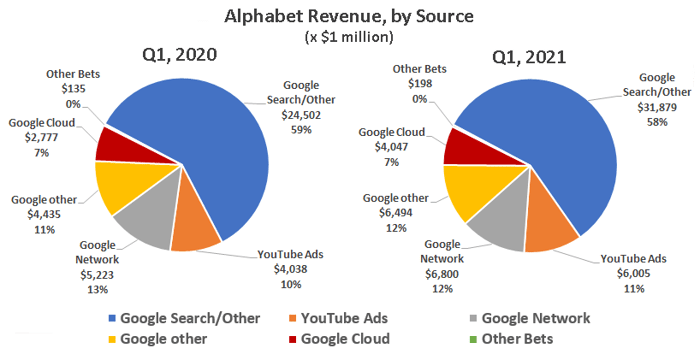
    Keep things in perspective, though. Search still accounts for a little over 58% of Alphabet’s revenue, down only slightly from its proportion in the first quarter of 2020. The pie charts below offer a visual summary of the company’s revenue mix:

    Two pie charts comparing Alphabet revenue in Q1 2020 and Q1 2021 show that search and advertising remains Alphabet's biggest business and revenue source.

    Data source: Alphabet. Charts by author.

    There are some footnotes to add to the discussion.

    Take traffic acquisition costs as an example. They’re incurred by Google to direct people using the web to its affiliated websites, where those users are then monetized in different ways. The company can somewhat throttle ad revenue by spending more or less on web traffic. But traffic acquisition costs (TAC) aren’t completely consistent as a percentage of search and related revenue. Last quarter’s TAC reached $9.7 billion, or 19% of Google Services revenue, versus 22% in the same quarter a year earlier. Sometimes these costs can change for the worse, though.

    Chief among the noteworthy footnotes, however, is the fact that while Alphabet publishes a detailed revenue breakdown, it doesn’t provide the same breakdown for operating income. All we know for sure is that Google Services — which encompasses search, YouTube, Android, and apps — is profitable, while the company’s cloud business and “other bets” continue to lose money. Compare Alphabet’s Q1 operating profit breakdown from this year and last year:

    Two bar charts of operating income in Q1 2020 and Q1 2021 show that the vast majority of Alphabet's profit still comes from search and other services, not Google Cloud or Other Bets.

    Data source: Alphabet. Charts by author.

    The good news is that the company’s cloud loss is clearly shrinking. At its current rate of progress, Google Cloud may even work its way out of the red and into the black within a year or so. The bad news is that while we don’t know for sure whether YouTube is a profitable venture, if it is, it’s not likely to be wildly profitable.

    Analysts and industry insiders are conflicted on the YouTube profitability question, and their collective consensus loosely suggests an operation that’s near breakeven, although the average has a wide standard deviation. Even if YouTube is firmly profitable, its revenue still only accounts for less than 14% of Google Services’ revenue, and less than 11% of Alphabet’s total revenue. Indeed, if every bit of YouTube’s revenue was converted into profit (which it isn’t — not even close), it would still be a minority of Alphabet’s total income.

    In other words, it’s not a game-changer.

    The bullish thesis stands, even if for a different reason

    Many investors are surprised to learn just how minimally YouTube and Google Cloud affect Alphabet’s fiscal results. That’s the point of summarizing this reality in the simple graphics above. And to be fair, while both operating units are relatively small now, they’re both growing nicely, and at a much faster clip than the company’s traditional search advertising business.

    If you’re a shareholder, though, this visual analysis also shows the importance of Alphabet’s core business. The profits made on search and advertising helped fund the expansion of YouTube en route to self-sufficiency, and they are still funding the establishment of Alphabet’s cloud computing operation. Investors will need some further evidence that the time, resources, and innovation put into the cloud segment of its operations is truly helping the bottom line if Alphabet is to remain the cash-cow juggernaut it currently is.

    This is just some food for thought. I believe the stock’s still a buy either way.

    This article was originally published on Fool.com. All figures quoted in US dollars unless otherwise stated.

    The post This is how Alphabet (still) makes most of its money appeared first on The Motley Fool Australia.

    Wondering where you should invest $1,000 right now?

    When investing expert Scott Phillips has a stock tip, it can pay to listen. After all, the flagship Motley Fool Share Advisor newsletter he has run for more than eight years has provided thousands of paying members with stock picks that have doubled, tripled or even more.*

    Scott just revealed what he believes could be the five best ASX stocks for investors to buy right now. These stocks are trading at near dirt-cheap prices and Scott thinks they could be great buys right now.

    *Returns as of May 24th 2021

    More reading

    James Brumley owns shares of Alphabet (A shares). Suzanne Frey, an executive at Alphabet, is a member of The Motley Fool’s board of directors. The Motley Fool Australia’s parent company Motley Fool Holdings Inc. owns shares of and has recommended Alphabet (A shares) and Alphabet (C shares). The Motley Fool Australia has recommended Alphabet (A shares) and Alphabet (C shares). The Motley Fool has a disclosure policy. This article contains general investment advice only (under AFSL 400691). Authorised by Bruce Jackson.

    This article was originally published on Fool.com. All figures quoted in US dollars unless otherwise stated.

    from The Motley Fool Australia https://ift.tt/3AUfxIu

  • Why A2 Milk and Bega shares are looking so tasty now: analyst

    fish eye view of dairy cows in paddock

    Regardless of what COVID-19 and lockdowns do, people still have to eat.

    So if you run with that thesis, Bell Potter this week nominated 2 dairy-related ASX shares as ‘buys’ for investors to consider.

    Senior industrial analyst Jonathan Snape did give a caveat though.

    “Investments in the agricultural and FMCG [fast-moving consumer goods] sector should be considered high risk and come with volatility,” he said in a memo to clients.

    “For this reason, we tend to focus on stocks where we see either: a structural uplift in ROIC [return on invested capital] through the cycle, cyclical growth stories, or counter-seasonal crop exposures.”

    With that in mind, here are the two ASX shares:

    A winning acquisition

    Bega Cheese Ltd (ASX: BGA) won many fans after its acquisition of Lion Dairy & Drinks (LDD), which completed in January.

    “LDD is considered a good strategic fit for Bega, as it diversifies Bega’s dairy exposure, increases scale, and accelerates the shift towards branded products,” said Fairmont Equities managing director Michael Gable last month.

    Snape agreed in his Bell Potter memo.

    “The acquisition of Lion Dairy & Drinks (LDD) and the targeted synergy base is expected to drive a material step change in returns for BGA over the next 3 years.”

    The Bell Potter analyst also thought Bega would be more competitive at the farm gate because of “operational issues” at its rivals.

    Bega shares have only gained 3.84% so far this year, to trade at $5.40 on Friday morning.

    Bell Potter sees a 36% upside, slapping on a price target of $7.35.

    “In the medium term, we see the potential for additional LDD synergies to be realised as seasonal milk flows are better utilised,” said Snape.

    Current earnings don’t reflect future potential

    A2 Milk Company Ltd (ASX: A2M) shareholders have watched in horror as their investment tumbled 63% in the past year.

    An almost overnight elimination of their daigou sales channel into China forced a series of financial downgrades in the past 12 months.

    But with a business that was flying high before the coronavirus struck the globe, Snape reckons A2 Milk could be a recovery bet.

    “While not without near-term risks as supply chains stabilise, at its core we see A2M as a business that, once [margin] is consolidated, has baseline revenue of ~NZ$1.4 to $1.5 billion and EBITDA of ~NZ$300m.”

    If the risks are well-managed, Snape can see the dairy producer reaching NZ$1.7 billion in revenue with NZ$445 million EBITDA.

    “We do not see FY21 earnings as reflective of the returns the business can generate in the medium term, but acknowledge the high level of risk involved in timing the inflection point at which destocking activity concludes.”

    Watermark Funds has recently bought into A2 Milk for similar reasons.

    “The a2 Platinum brand continues to resonate strongly with Chinese mothers,” Watermark portfolio manager Daniel Broeren posted on Livewire.

    “While there are some risks around market size (declining birth rate), and recovery timeline for Chinese travellers (daigou), these are palatable risks when the stock is trading at such a significant discount to prior valuations.” 

    A2 Milk shares were trading at $7.18 on Friday morning. Bell Potter has put on a price target of $8.50, which would be an 18% return from now.

    The post Why A2 Milk and Bega shares are looking so tasty now: analyst appeared first on The Motley Fool Australia.

    Wondering where you should invest $1,000 right now?

    When investing expert Scott Phillips has a stock tip, it can pay to listen. After all, the flagship Motley Fool Share Advisor newsletter he has run for more than eight years has provided thousands of paying members with stock picks that have doubled, tripled or even more.*

    Scott just revealed what he believes could be the five best ASX stocks for investors to buy right now. These stocks are trading at near dirt-cheap prices and Scott thinks they could be great buys right now.

    *Returns as of May 24th 2021

    More reading

    Motley Fool contributor Tony Yoo owns shares of A2 Milk. The Motley Fool Australia’s parent company Motley Fool Holdings Inc. has no position in any of the stocks mentioned. The Motley Fool Australia has recommended A2 Milk. The Motley Fool has a disclosure policy. This article contains general investment advice only (under AFSL 400691). Authorised by Bruce Jackson.

    from The Motley Fool Australia https://ift.tt/3wuWKQi

  • Why Humm, Premier Investments, Western Areas, & Zip shares are sinking

    white arrow pointing down

    The S&P/ASX 200 Index (ASX: XJO) is having a day to forget. In afternoon trade, the benchmark index is down 1.3% to 7,247.2 points.

    Four ASX shares that are falling more than most today are listed below. Here’s why they are sinking:

    Humm Group Ltd (ASX: HUM)

    The Humm share price is down 3% to 98 cents. Investors have been selling the financial services company’s shares after it revealed that it potentially has past exposure to Forum Finance, which is currently embroiled in fraud allegations. Humm’s initial review puts the company’s potential on-sold exposure at $12 million post-tax.

    Premier Investments Limited (ASX: PMV)

    The Premier Investments share price is down 2.5% to $26.84 due to broad market weakness. In other news, the retail conglomerate has revealed that it has instructed its lawyers to immediately request a copy of the Myer Holdings Ltd (ASX: MYR) shareholder register. Premier has commenced consultation with fellow Myer shareholders regarding the quick reconstitution of a majority independent Myer Board with the necessary skills and experience.

    Western Areas Ltd (ASX: WSA)

    The Western Areas share price is down 7% to $2.29. This appears to have been driven by a broker note out of Macquarie this morning. According to the note, Macquarie has downgraded its shares to a neutral rating and cut the price target on them to $2.60. It made the move in response to lower than expected shipments in the June quarter.

    Zip Co Ltd (ASX: Z1P)

    The Zip share price is down 5.5% to $8.29. A number of tech shares have come under pressure today following a poor night of trade on Wall Street’s Nasdaq index. This has led to the S&P/ASX All Technology Index (ASX: XTX) falling a sizeable 3% this afternoon.

    The post Why Humm, Premier Investments, Western Areas, & Zip shares are sinking appeared first on The Motley Fool Australia.

    Wondering where you should invest $1,000 right now?

    When investing expert Scott Phillips has a stock tip, it can pay to listen. After all, the flagship Motley Fool Share Advisor newsletter he has run for more than eight years has provided thousands of paying members with stock picks that have doubled, tripled or even more.*

    Scott just revealed what he believes could be the five best ASX stocks for investors to buy right now. These stocks are trading at near dirt-cheap prices and Scott thinks they could be great buys right now.

    *Returns as of May 24th 2021

    More reading

    from The Motley Fool Australia https://ift.tt/3yH8Mrg

  • Why the QBE (ASX:QBE) share price is down today

    share price plummeting down

    The QBE Insurance Group Ltd (ASX: QBE) share price has started this morning’s session firmly in the red.

    QBE shares have faced downward pressure following announcements on 2 July the company is facing a representative proceeding from Strand Fitness Pty Ltd “and others”.

    At the time of writing, the QBE share price is down 2.67%, after hitting an intraday high of $10.52. It has since pulled back to the current price of $10.40.

    Let’s take a look at what is behind these downside moves on QBE’s share chart.

    Advised of representative proceedings – so what?

    The proceedings mentioned each make allegations against QBE on wrongfully denying cover to various policy-holders during the COVID-19 lockdown(s), for “losses arising from business interruption”.

    According to QBE:

    The issues raised in these proceedings appear to be substantially similar to those currently before the Australian courts in the second industry test case and QIA’s own Federal Court proceeding against Educational World Travel in liquidation and its liquidator.

    The company also mentions that it is satisfied in denying business interruption claims and that it believes its decision to reserve the claims is robust.

    “The allegations will be defended” state QBE in the release.

    The QBE share price has had a volatile 12 months, firstly after former chief executive Pat Regan was dismissed in unclear circumstances back in September last year.

    The Australian Shareholders Association also voted against the company’s remuneration report at its annual general meeting that occurred on May 5.

    Since then, Australia’s second largest international insurer has appointed Andrew Horton as Group chief executive, whilst announcing Sue Houghton to the post of chief executive of its Australia & Pacific (AUSPAC) division.

    QBE shares have climbed from lows of $8.03 to today’s market value, following these 2 events.

    QBE share price snapshot

    The QBE share price has posted a year to date return of around 22%, ahead of the previous 12 months’ return of 11%.

    These gains have slightly outpaced the S&P / ASX 200 Index (ASX: XJO)’s year to date and 12 month return of 9.8% and 21.5% respectively.

    The QBE share price has finished the last 5 trading days 3% in the red, extending the time in the red over the previous 1 month.

    The post Why the QBE (ASX:QBE) share price is down today appeared first on The Motley Fool Australia.

    Should you invest $1,000 in QBE Insurance right now?

    Before you consider QBE Insurance, you’ll want to hear this.

    Motley Fool Investing expert Scott Phillips just revealed what he believes are the 5 best stocks for investors to buy right now… and QBE Insurance wasn’t one of them.

    The online investing service he’s run for nearly a decade, Motley Fool Share Advisor, has provided thousands of paying members with stock picks that have doubled, tripled or even more.* And right now, Scott thinks there are 5 stocks that are better buys.

    *Returns as of May 24th 2021

    More reading

    The author Zach Bristow has no positions in any of the stocks mentioned. The Motley Fool Australia’s parent company Motley Fool Holdings Inc. has no position in any of the stocks mentioned. The Motley Fool Australia has no position in any of the stocks mentioned. The Motley Fool has a disclosure policy. This article contains general investment advice only (under AFSL 400691). Authorised by Bruce Jackson.

    from The Motley Fool Australia https://ift.tt/2TV3Lwy