
Category: Stock Market

  • Better megacap stock: Nvidia vs. Microsoft

    A woman walks along the street holding an oversized box wrapped as a gift.

    This article was originally published on Fool.com. All figures quoted in US dollars unless otherwise stated.

    Let’s face it: 2024 has been all about the megacaps. Nvidia (NASDAQ: NVDA) is up 147% year to date; Meta Platforms is up 44%; Alphabet is up 33%.

    Moreover, Nvidia, Apple, Microsoft, Amazon, Alphabet, and Meta Platforms now boast a combined market cap of $15.6 trillion. That’s roughly equivalent to the size of the Eurozone economy, which has an annual gross domestic product of $15.4 billion, according to the latest estimates from the World Bank.

    So, let’s compare two of the best megacaps, Nvidia and Microsoft (NASDAQ: MSFT), to see which is better positioned to rule the second half of 2024 — and beyond.

    Nvidia

    No company has experienced a more remarkable growth in its market cap over the past two years than Nvidia. The semiconductor giant has added a staggering $2.7 trillion in value, catapulting it to the position of the most valuable company on Earth, if only briefly.

    Its rise is almost entirely thanks to the surge in demand for artificial intelligence (AI) and the hardware behind it. Nvidia designs graphics processing units (GPUs). These powerful devices are often linked together by the thousands — even hundreds of thousands — within data centers to help train the latest and greatest AI models.

    While there are other companies in the GPU design space, Nvidia enjoys several key competitive advantages. The trust and familiarity AI developers have with Nvidia’s GPUs and its software make it challenging for them to switch to another supplier. Moreover, Nvidia’s extensive experience in GPU design prior to the AI boom gives it a unique edge over its competitors.

    Microsoft

    Despite the attention garnered by Nvidia’s rapid ascent, it’s important not to overlook Microsoft’s impressive stock performance. The company once again holds the title of the most valuable company on Earth, a position it regained after briefly being overtaken by Nvidia. To maintain this lead, Microsoft is demonstrating its adaptability to the evolving tech landscape, particularly the AI revolution.

    On that front, Microsoft has already begun integrating AI into its signature software applications. It now offers a generative AI assistant through its Microsoft Copilot add-on, which can analyze data, respond to queries, create images, and generate code.

    What’s more, Microsoft diverse business segments provide a layer of protection, should the AI revolution falter. The company has a massive cloud services unit and a successful gaming division among various other business segments.

    Which stock is a better buy in the second half of 2024?

    Simply put, both Nvidia and Microsoft are outstanding companies. They generate billions in revenue, profits, and free cash flow. They’re also led by some of the top CEOs on the planet: Satya Nadella at Microsoft and Jensen Huang at Nvidia.

    However, there are differences to evaluate.

    For one, Nvidia’s valuation is approaching record highs. Its price-to-sales (P/S) ratio is now 39x more than double its 10-year average of 15x.

    Meanwhile, Microsoft’s P/S ratio is also historically high at 14x. However, that value is less than half of Nvidia’s on an absolute basis.

    MSFT PS Ratio data by YCharts

    In other words, both stocks are historically expensive, but Nvidia is far more costly in a head-to-head comparison.

    At any rate, the rapid growth of the GPU market is what investors are counting on to bring Nvidia’s valuation down. And while those growth estimates are impressive (analysts expect Nvidia’s sales to rise 98% over last year), any signs of slowing growth could lead to a sharp sell-off in Nvidia shares.

    In conclusion, I prefer Microsoft, given the stock’s more reasonable valuation at current levels. That said, long-term Nvidia investors shouldn’t bail on the stock now. Rather, they should remember that one of the keys to successful buy-and-hold investing is to let winners run. 

    This article was originally published on Fool.com. All figures quoted in US dollars unless otherwise stated.

    The post Better megacap stock: Nvidia vs. Microsoft appeared first on The Motley Fool Australia.

    Should you invest $1,000 in Microsoft right now?

    Before you buy Microsoft shares, consider this:

    Motley Fool investing expert Scott Phillips just revealed what he believes are the 5 best stocks for investors to buy right now… and Microsoft wasn’t one of them.

    The online investing service he’s run for over a decade, Motley Fool Share Advisor, has provided thousands of paying members with stock picks that have doubled, tripled or even more.*

    And right now, Scott thinks there are 5 stocks that may be better buys…

    See The 5 Stocks
    *Returns as of 24 June 2024

    More reading

    John Mackey, former CEO of Whole Foods Market, an Amazon subsidiary, is a member of The Motley Fool’s board of directors. Suzanne Frey, an executive at Alphabet, is a member of The Motley Fool’s board of directors. Randi Zuckerberg, a former director of market development and spokeswoman for Facebook and sister to Meta Platforms CEO Mark Zuckerberg, is a member of The Motley Fool’s board of directors. Jake Lerch has positions in Alphabet, Amazon, and Nvidia. The Motley Fool Australia’s parent company Motley Fool Holdings Inc. has positions in and has recommended Alphabet, Amazon, Apple, Meta Platforms, Microsoft, and Nvidia. The Motley Fool Australia’s parent company Motley Fool Holdings Inc. has recommended the following options: long January 2026 $395 calls on Microsoft and short January 2026 $405 calls on Microsoft. The Motley Fool Australia has recommended Alphabet, Amazon, Apple, Meta Platforms, Microsoft, and Nvidia. The Motley Fool has a disclosure policy. This article contains general investment advice only (under AFSL 400691). Authorised by Scott Phillips.


  • Bell Potter says these ASX 200 shares can deliver ~30% returns

    If you’re on the hunt for some big returns for your portfolio, then you may want to check out these ASX 200 shares in this article.

    That’s because Bell Potter has named them as buys and is tipping them to deliver mouth-watering returns over the next 12 months. Here’s what the broker is saying about them:

    Amotiv Ltd (ASX: AOV)

    Bell Potter remains very positive on Amotiv, which was until recently known as GUD Holdings.

    It is a consumer and industrial products company primarily focusing on automotive aftermarket parts and accessories. For automotive aftermarket products, its brands include Ryco, Wesfil, Goss, Brown and Watson. And for 4WD accessories, it operates under the APG brand.

    Bell Potter likes this ASX 200 share due to its undemanding valuation and positive outlook. It explains:

    We are Buy-rated on Amotiv and consider it to be fundamentally a good business and we note upside may exist from APG’s geographic expansion which is not in our earnings forecasts. The legacy auto business has been reasonably strong to date in an environment where there is increased risk around service trade down and deferral. The stock’s valuation is not demanding at 13x FY25 PE. Overall, our Buy rating for AOV is predicated on the relative resilience of the legacy auto business and improving momentum in new car sales, which should be favourable for APG’s earnings.

    The broker currently has a buy rating and $12.80 price target on its shares. This implies potential upside of almost 27% for investors. The total return stretches to 30% including dividends.

    Capricorn Metals Ltd (ASX: CMM)

    Another ASX 200 share that could offer big returns is Capricorn Metals. It is a gold exploration and development company whose primary asset its 100%-owned Karlawinda Gold Project (KGP) in Western Australia.

    Bell Potter has been very impressed with the quality of the KGP operation and management’s strong track record. It explains:

    CMM’s management team has a track record of capital efficient project funding, development, commissioning and operation. In our view, FY25 and FY26 should benefit from higher revenue and EPS increases by 32% and 6% respectively. CMM is a sector leading gold producer with a strong balance sheet, a management team with an excellent track record of delivery and clear organic growth options to lift group production to 270kozpa.

    The broker currently has a buy rating and $6.53 price target on its shares. This suggests that its shares could rise almost 30% from current levels.

    The post Bell Potter says these ASX 200 shares can deliver ~30% returns appeared first on The Motley Fool Australia.

    Should you invest $1,000 in Capricorn Metals Ltd right now?

    Before you buy Capricorn Metals Ltd shares, consider this:

    Motley Fool investing expert Scott Phillips just revealed what he believes are the 5 best stocks for investors to buy right now… and Capricorn Metals Ltd wasn’t one of them.

    The online investing service he’s run for over a decade, Motley Fool Share Advisor, has provided thousands of paying members with stock picks that have doubled, tripled or even more.*

    And right now, Scott thinks there are 5 stocks that may be better buys…

    See The 5 Stocks
    *Returns as of 24 June 2024

    More reading

    Motley Fool contributor James Mickleboro has no position in any of the stocks mentioned. The Motley Fool Australia’s parent company Motley Fool Holdings Inc. has no position in any of the stocks mentioned. The Motley Fool Australia has no position in any of the stocks mentioned. The Motley Fool has a disclosure policy. This article contains general investment advice only (under AFSL 400691). Authorised by Scott Phillips.

  • Up 327% in a year, the Zip share price just smashed new multi-year highs!

    A young man in a retail shop pays for his purchases using a card

    The Zip Co Ltd (ASX: ZIP) share price is at it again.

    And by ‘it’, I mean notching new multi-year highs.

    Shares in the All Ordinaries Index (ASX: XAO) buy now, pay later (BNPL) stock closed yesterday trading for $1.75. Currently, shares are changing hands for $1.76, up 0.7%.

    As you can see on the chart below, this marks a new two-plus year high for the company.

    In fact, you have to go all the way back to February 2022 to find the Zip share price trading at higher levels.

    With another day in the green today, the Zip share price is now up 327% since this time last year. To put that in some perspective, that’s enough to turn a $5,000 investment into $21,350 in just 12 months!

    What’s been driving the Zip share price higher?

    While there’s still a long, long way to go for the Zip share price to potentially reset the $12.35 a share the BNPL stock was trading for on 19 February 2021, the company has clearly turned a corner over the past nine months.

    Part of that comes amid a change in management and strategy, shifting away from an uncompromising growth strategy to one focused on returning the company to profitability. That strategy is proving successful to date, with Zip’s losses continuing to narrow amid rising revenues.

    The company’s most recent quarterly results, Q3 FY 2024, came out on 16 April.

    Highlights included a 14.6% year on year increase in total transaction volumes (TTV). TTV came in at $2.4 billion for the three months.

    While the company’s Australian business hit some headwinds, its Americas business grew strongly, with TTV in the Americas up by 43.6% from Q3 FY 2023.

    And with Apple Inc (NASDAQ: AAPL) announcing in June that it was pulling its United States BNPL service, Apple Pay Later, investors may be optimistic about Zip’s American growth prospects in the year ahead.

    Then there are interest rates.

    BNPL stocks have proven highly sensitive to a higher rate environment, as witnessed by the huge sell-down in the Zip share price when global rates first bottomed and then began to rise from their historic lows in 2022.

    While Aussies may be waiting until 2025 for the first interest rate cut from the Reserve Bank of Australia, markets are increasingly pricing in at least one rate cut from the US Federal Reserve in 2024.

    Any easing by the Fed and other global central banks should come as welcome news to many companies, particularly those in the BNPL space. And it could help the Zip share price continue to outperform.

    The post Up 327% in a year, the Zip share price just smashed new multi-year highs! appeared first on The Motley Fool Australia.

    Should you invest $1,000 in Zip Co right now?

    Before you buy Zip Co shares, consider this:

    Motley Fool investing expert Scott Phillips just revealed what he believes are the 5 best stocks for investors to buy right now… and Zip Co wasn’t one of them.

    The online investing service he’s run for over a decade, Motley Fool Share Advisor, has provided thousands of paying members with stock picks that have doubled, tripled or even more.*

    And right now, Scott thinks there are 5 stocks that may be better buys…

    See The 5 Stocks
    *Returns as of 24 June 2024

    More reading

    Motley Fool contributor Bernd Struben has no position in any of the stocks mentioned. The Motley Fool Australia’s parent company Motley Fool Holdings Inc. has positions in and has recommended Apple and Zip Co. The Motley Fool Australia has recommended Apple. The Motley Fool has a disclosure policy. This article contains general investment advice only (under AFSL 400691). Authorised by Scott Phillips.

  • Are ASX 200 bank shares too expensive to buy right now?

    Man sitting in front of a laptop and analysing an earnings report.

    ASX 200 bank shares have enjoyed robust shareholder returns ranging from 30% to 45% over the past year.

    Commonwealth Bank of Australia (ASX: CBA), Westpac Banking Corp (ASX: WBC) and National Australia Bank Ltd (ASX: NAB) all notched respective gains following a strong show of earnings. Meanwhile, ANZ Group Holdings Ltd (ASX: ANZ) had a similar run.

    Despite this, the big four banks may not have much room to grow into their currently elevated share prices, according to Macquarie analysts.

    And the fact of the matter is the banking majors are all trading at or near six-month highs. So, is now a good time to buy ASX 200 bank shares? Here’s a closer look.

    Macquarie weary on ASX 200 bank growth

    Macquarie analysts caution that ASX 200 bank shares may struggle to grow into their elevated multiples over the next few years.

    According to The Australian, Macquarie says visibility for the sector is low as pressures on earnings mount. According to the reporting, the firm said:

    Looking forward, we do not see a clear path for underlying profitability to improve meaningfully from a top-down and divisional bottom-up perspective.

    We note that banks’ current returns are broadly in the middle of their 10-year average ranges. As a result, we see limited scope for banks to grow into their elevated multiples

    The broker notes that, despite each of the banks delivering double-digit total shareholder returns over the past year, their earnings have declined, while multiples have expanded “to a 15-30% relative premium [in price-to-earnings ratio (P/E)] versus five-year historical averages”.

    Macquarie also observes that banks are currently experiencing one of the lowest bad debt periods on record, which may not support an earnings recovery in the medium term.

    In H1 FY24, the banking majors booked a total of $1.21 billion in impairment charges, a 13% decrease from the prior corresponding period.

    Despite this, bank share prices have continued to rise. But further growth from here could be a challenge, Macquarie says:

    While multiple expansions often precede the earnings growth phase, this is an improbable outcome, in our view. Periods where the earnings subsequently lifted to support rallying share prices were generally characterised by normalising credit losses following an impairment cycle

    Banks were strong in FY24

    ASX 200 banks showed strong returns on the charts, and the fundamentals remained robust throughout the year.

    Commonwealth Bank shares were up 27% in FY24 as the company reported half-yearly profits of $13.7 billion. According to my colleague James, growth softened towards the end of the year, with a 1% decline in earnings reported for its Q3 FY24 numbers.

    Westpac shares gained 30% in FY24, driven by general market strength and positive operating results.

    The bank’s half-year results in May showed a 16% decrease in net profit to $3.3 billion, yet investors welcomed the 7.1% increase in the interim dividend to 75 cents per share, alongside a fully franked special dividend of 15 cents per share.

    Meanwhile, NAB shareholders must have been happy, as the bank delivered a massive return in FY24. According to my colleague Sebastian, NAB shares started the year at $26.37 each and closed at $36.23, a capital gain of 37.39%.

    Including dividends, investors enjoyed a total yield of 6.33%, resulting in a 43.7% total gain.

    Foolish takeaway

    ASX 200 bank shares have delivered impressive returns in the past year, but analysts warn that their current valuations may be too high. Remember to conduct your own research and consider any long-term goals before making any investment decisions.

    The post Are ASX 200 bank shares too expensive to buy right now? appeared first on The Motley Fool Australia.

    Should you invest $1,000 in Australia And New Zealand Banking Group right now?

    Before you buy Australia And New Zealand Banking Group shares, consider this:

    Motley Fool investing expert Scott Phillips just revealed what he believes are the 5 best stocks for investors to buy right now… and Australia And New Zealand Banking Group wasn’t one of them.

    The online investing service he’s run for over a decade, Motley Fool Share Advisor, has provided thousands of paying members with stock picks that have doubled, tripled or even more.*

    And right now, Scott thinks there are 5 stocks that may be better buys…

    See The 5 Stocks
    *Returns as of 24 June 2024

    More reading

    Motley Fool contributor Zach Bristow has no position in any of the stocks mentioned. The Motley Fool Australia’s parent company Motley Fool Holdings Inc. has positions in and has recommended Macquarie Group. The Motley Fool Australia has positions in and has recommended Macquarie Group. The Motley Fool has a disclosure policy. This article contains general investment advice only (under AFSL 400691). Authorised by Scott Phillips.

  • Why DroneShield, GenusPlus, Monadelphous, and Telstra shares are roaring higher today

    In afternoon trade, the S&P/ASX 200 Index (ASX: XJO) is back on form and charging higher. At the time of writing, the benchmark index is up 0.75% to 7,820.8 points.

    Four ASX shares that are rising more than most today are listed below. Here’s why they are racing higher:

    DroneShield Ltd (ASX: DRO)

    The DroneShield share price is up a further 7% to a new record high of $2.15. This is despite there being no news out of the counter drone technology company on Tuesday. In fact, it has been almost three weeks since there was meaningful news out of the market darling. Nevertheless, investors appear to believe that DroneShield is perfectly positioned to continue its explosive growth thanks to industry tailwinds and some major contract wins. Its shares are now up over 450% since the start of the year.

    GenusPlus Group Ltd (ASX: GNP)

    The GenusPlus share price is up 5% to $2.04. Investors have been buying the national essential power and communications infrastructure provider’s shares after it announced a major program of maintenance and upgrade works for Western Power. Genus will provide distribution and transmission overhead maintenance services across Western Power’s network. The five-year agreement is expected to generate revenue of approximately $50 million in its first year.

    Monadelphous Group Ltd (ASX: MND)

    The Monadelphous share price is up 2% to $12.88. This morning, the engineering company announced that it has been awarded a major long-term maintenance and minor construction services contract. The contract is associated with Shell Australia’s Prelude Floating Liquefied Natural Gas (FLNG) facility. The seven year contract will commence in November when the company’s existing contract with Shell ends. Management believes that “renewing this significant contract demonstrates Monadelphous’ leadership position in the Australian energy maintenance market, both onshore and offshore.”

    Telstra Group Ltd (ASX: TLS)

    The Telstra Group share price is up almost 3% to $3.75. Investors have been buying the telco giant’s shares after it announced an increase to its mobile prices. The changes will see prices on most Telstra mobile plans increase by between $2 to $4 per month. Management notes that these changes aimed to balance cost of living pressures “with its need to continue to invest to manage technology evolution and continued strong customer demand on its mobile network.” Judging by its share price performance, the market appears to believe the company has got it just right with these increases.

    The post Why DroneShield, GenusPlus, Monadelphous, and Telstra shares are roaring higher today appeared first on The Motley Fool Australia.

    Should you invest $1,000 in Droneshield Limited right now?

    Before you buy Droneshield Limited shares, consider this:

    Motley Fool investing expert Scott Phillips just revealed what he believes are the 5 best stocks for investors to buy right now… and Droneshield Limited wasn’t one of them.

    The online investing service he’s run for over a decade, Motley Fool Share Advisor, has provided thousands of paying members with stock picks that have doubled, tripled or even more.*

    And right now, Scott thinks there are 5 stocks that may be better buys…

    See The 5 Stocks
    *Returns as of 24 June 2024

    More reading

    Motley Fool contributor James Mickleboro has no position in any of the stocks mentioned. The Motley Fool Australia’s parent company Motley Fool Holdings Inc. has positions in and has recommended DroneShield and GenusPlus Group. The Motley Fool Australia has positions in and has recommended Telstra Group. The Motley Fool has a disclosure policy. This article contains general investment advice only (under AFSL 400691). Authorised by Scott Phillips.
  • Why Clinuvel, Mesoblast, Red Hill, and Resimac shares are sinking today

    The S&P/ASX 200 Index (ASX: XJO) is back on form on Tuesday. In afternoon trade, the benchmark index is up 0.8% to 7,823.6 points.

    Four ASX shares that have failed to follow the market higher today are listed below. Here’s why they are falling:

    Clinuvel Pharmaceuticals Limited (ASX: CUV)

    The Clinuvel Pharmaceuticals share price is down 6.5% to $14.50. This appears to have been driven by a broker note out of Morgans this morning. According to the note, the broker has downgraded the biopharmaceutical company’s shares to a hold rating with a $16.00 price target. Morgans made the move partly on valuation grounds. It also highlights that there are risks around competition that investors should be considering.

    Mesoblast Ltd (ASX: MSB)

    The Mesoblast share price is down 4.5% to $1.07. This is despite the release of a positive announcement this morning from the biotechnology company. Mesoblast revealed that it has now resubmitted its biologic license application (BLA) for the approval of Ryoncil in the treatment of children with steroid-refractory acute graft-versus-host disease (SR-aGVHD). Management expects an answer from the United States Food & Drug Administration (FDA) in two to six months. But with its shares up almost 300% over the past six months, it seems that some investors aren’t sticking around to find out if it will finally be approved.

    Red Hill Minerals Ltd (ASX: RHI)

    The Red Hill Minerals share price is down 21% to $6.19. This has been driven by the iron ore, gold, and base metals explorer’s shares going ex-dividend this morning for a big payout. Last week, the company announced a $1.50 per share fully franked dividend. This was in response to the receipt of $200 million milestone payment from Mineral Resources Ltd (ASX: MIN) relating to the Onslow Iron Project. Eligible shareholders can now look forward to receiving this dividend next week on 19 July. Based on yesterday’s close price, this payout represents a sizeable 19.2% dividend yield.

    Resimac Group Ltd (ASX: RMC)

    The Resimac share price is down 4% to 83 cents. Investors have been selling this non-bank lender’s shares today after it announced the sudden exit of its CEO. According to the release, Scott McWilliam has resigned from his employment with Resimac after 21 years of service. This includes six years as its CEO and three years as its joint CEO following the merger with Homeloans Limited. Mr McWilliam will take a period of leave before his employment contract ends on 1 September 2024.

    The post Why Clinuvel, Mesoblast, Red Hill, and Resimac shares are sinking today appeared first on The Motley Fool Australia.

    Should you invest $1,000 in Clinuvel Pharmaceuticals right now?

    Before you buy Clinuvel Pharmaceuticals shares, consider this:

    Motley Fool investing expert Scott Phillips just revealed what he believes are the 5 best stocks for investors to buy right now… and Clinuvel Pharmaceuticals wasn’t one of them.

    The online investing service he’s run for over a decade, Motley Fool Share Advisor, has provided thousands of paying members with stock picks that have doubled, tripled or even more.*

    And right now, Scott thinks there are 5 stocks that may be better buys…

    See The 5 Stocks
    *Returns as of 24 June 2024

    More reading

    Motley Fool contributor James Mickleboro has no position in any of the stocks mentioned. The Motley Fool Australia’s parent company Motley Fool Holdings Inc. has no position in any of the stocks mentioned. The Motley Fool Australia has no position in any of the stocks mentioned. The Motley Fool has a disclosure policy. This article contains general investment advice only (under AFSL 400691). Authorised by Scott Phillips.

  • 4 reasons to buy Woodside shares today

    An oil worker assesses productivity at an oil rig as ASX 200 energy shares continue to rise

    Woodside Energy Group Ltd (ASX: WDS) shares are in the green today.

    Shares in the S&P/ASX 200 Index (ASX: XJO) oil and gas stock closed yesterday trading for $28.74. In morning trade on Tuesday, shares are changing hands for $28.88 apiece, up 0.5%.

    For some context the ASX 200 is up 0.7% at this same time.

    That’s today’s price action for you.

    Now, here are four reasons BW Equities’ Tom Bleakley is optimistic on the outlook for Woodside shares (courtesy of The Bull).

    Why Woodside shares could run hot into 2025

    The first reason to buy Woodside shares is the strong outlook for global oil demand and prices.

    Bleakley, who has a ‘buy’ rating on the ASX 200 oil and gas company, noted that “This energy giant has been benefiting from increasing crude oil prices.”

    He added, “Electric vehicle sales growth has been slower than expected in the US.”

    Indeed, while EV adoption is still growing in the world’s biggest economy, the growth rate has slowed significantly. That portends a greater reliance, for longer, on petrol cars. A reliance that certainly remains the case across the fast-growing African continent.

    At the time of writing, Brent crude is trading for US$86 per barrel, up from $78 per barrel on 4 June. And with global crude demand forecast to increase to new record highs in 2025, 4 June could well mark the lows for the year ahead.

    Which brings us to the second reason to buy Woodside shares now, some extra passive income.

    “The company was recently trading on an appealing dividend yield above 7%,” Bleakley said.

    Over the past 12 months, Woodside has paid out a total of $2.16 per share in fully franked dividends. At the current share price, that equates to a fully franked trailing yield of 7.5%.

    Moving on to the third reason to buy the ASX 200 oil and gas company today, Bleakley noted that “Woodside recently announced it had achieved first oil from the Sangomar field in Senegal.”

    Woodside reported that first oil on 11 June.

    As we noted about the project growth potential on the day:

    The deepwater Sangomar Field Development Phase 1 project includes a stand-alone floating production storage and offloading (FPSO) facility. The nameplate capacity stands at 100,000 barrels per day. The project includes subsea infrastructure designed to allow further development phases.

    Rounding off the list, the fourth reason to buy Woodside stock today is that shares are in an uptrend yet remain well below their recent highs.

    “Woodside shares have risen from $26.97 on June 24 to trade at $29.22 on July 4. The shares are still trading well below $39 achieved in August 2023,” Bleakley said.

    Those August 2023 levels represent a potential upside of 35% from current prices.

    The post 4 reasons to buy Woodside shares today appeared first on The Motley Fool Australia.

    Should you invest $1,000 in Woodside Petroleum Ltd right now?

    Before you buy Woodside Petroleum Ltd shares, consider this:

    Motley Fool investing expert Scott Phillips just revealed what he believes are the 5 best stocks for investors to buy right now… and Woodside Petroleum Ltd wasn’t one of them.

    The online investing service he’s run for over a decade, Motley Fool Share Advisor, has provided thousands of paying members with stock picks that have doubled, tripled or even more.*

    And right now, Scott thinks there are 5 stocks that may be better buys…

    See The 5 Stocks
    *Returns as of 24 June 2024

    More reading

    Motley Fool contributor Bernd Struben has no position in any of the stocks mentioned. The Motley Fool Australia’s parent company Motley Fool Holdings Inc. has no position in any of the stocks mentioned. The Motley Fool Australia has no position in any of the stocks mentioned. The Motley Fool has a disclosure policy. This article contains general investment advice only (under AFSL 400691). Authorised by Scott Phillips.

  • Why is this ASX mining stock crashing 27% today?

    The market may be pushing higher on Tuesday but the same cannot be said for the Red Hill Minerals Ltd (ASX: RHI) share price.

    The ASX mining stock is the worst performer on the All Ordinaries index today by some distance.

    In fact, at one stage today the Red Hill Minerals share price was down as much as 27% to $5.68.

    It has recovered a touch since then but remains down 22% to $6.19 at the time of writing.

    Why is this ASX mining stock crashing?

    The good news for shareholders of Red Hill Minerals is that this decline isn’t anything to be worried about. Rather, it could be something to get very excited about.

    That’s because the ASX mining stock is crashing today after trading ex-dividend for an upcoming special dividend.

    When a share trades ex-dividend, it means the rights to an upcoming dividend are now settled and new buyers will not be entitled to receive the payout on pay day.

    A dividend forms part of a company’s valuation. And if you’re not going to receive it, then you don’t want to pay for it when buying shares. This means that a share price tends to drop to reflect this.

    But why such a big decline? Well, that’s simply because the company is paying out an extremely large dividend.

    Big dividend

    This West Pilbara-based iron ore, gold, and base metals explorer recently announced the sale of a 40% interest in the Onslow Iron Project via the Red Hill Iron Ore joint venture to Mineral Resources Ltd (ASX: MIN).

    And with the Onslow Iron Project recently reporting its first shipment of ore to China Baowu Steel Group, this triggered the second payment of $200 million to the ASX mining stock from Mineral Resources.

    Last week, the company revealed that it would be returning proceeds from the sale to shareholders. It said:

    The Board of Directors of Red Hill Minerals Limited is pleased to advise that it has resolved to pay a special dividend of $1.50 per ordinary share, fully franked at 25%. The dividend will be sourced from the second of two $200 million payments received from Mineral Resources Limited for the sale of the Company’s 40% interest in the Red Hill Iron Ore Joint Venture.

    Based on its share price at the close of play on Monday, this represents a sizeable 19.2% dividend yield.

    Eligible shareholders can now look forward to receiving this dividend next week on 19 July.

    The post Why is this ASX mining stock crashing 27% today? appeared first on The Motley Fool Australia.

    Should you invest $1,000 in Red Hill Iron Limited right now?

    Before you buy Red Hill Iron Limited shares, consider this:

    Motley Fool investing expert Scott Phillips just revealed what he believes are the 5 best stocks for investors to buy right now… and Red Hill Iron Limited wasn’t one of them.

    The online investing service he’s run for over a decade, Motley Fool Share Advisor, has provided thousands of paying members with stock picks that have doubled, tripled or even more.*

    And right now, Scott thinks there are 5 stocks that may be better buys…

    See The 5 Stocks
    *Returns as of 24 June 2024

    More reading

    Motley Fool contributor James Mickleboro has no position in any of the stocks mentioned. The Motley Fool Australia’s parent company Motley Fool Holdings Inc. has no position in any of the stocks mentioned. The Motley Fool Australia has no position in any of the stocks mentioned. The Motley Fool has a disclosure policy. This article contains general investment advice only (under AFSL 400691). Authorised by Scott Phillips.

  • South32 shares whipsawed in FY24. Here’s the FY25 outlook

    two men in hard hats and high visibility jackets look together at a laptop screen that one of the men in holding at a mine site.

    South32 Ltd (ASX: S32) shares had a cyclical year in FY24.

    The stock began the year trading at $3.76 apiece before consolidating to its yearly low of $2.89 by February.

    Then, as commodity prices began to lift again, so too did South32 shares, reclaiming all of the prior losses from earlier in the year.

    They now trade at $3.71 apiece just after market open on Tuesday, after finishing FY24 at $3.66.

    Given the volatility in commodities – which has seen significant price fluctuations impact the metals and mining sector in the past 12 months – here’s a look at what’s in store for South32 in FY25.

    South32 shares whipsaw in FY24

    Investors saw their South32 shares trade in a range of 87 cents across the last financial year.

    As February rolled around, investors started buying South32 en masse. This can largely be attributed to favourable market conditions for its primary commodities.

    For instance, in the past year, South32 has benefitted from increased demand for materials like aluminium and manganese, which are crucial for green technologies and electric vehicles.

    The aluminium price is up from US$2,170 per tonne in February to US$2,528 per tonne currently.

    This is the highest aluminium price range since 2018, except for 2021-2022, when prices briefly rocketed to US$3,838 per tonne as economies reopened from COVID-19.

    In its quarterly update from April, South32 reported reasonably strong output from its aluminium and manganese operations.

    Aluminium production was up 1% year over year, underscored by record production at its Hillside Aluminium project. Meanwhile, the company’s manganese production in South Africa achieved an 8% growth production, equating to a record production run for the quarter.

    These results, combined with stronger pricing for the underlying metals, saw South32 shares rally from April to their 6-month highs of $3.96 apiece on 4 June.

    What’s in store for South32 in FY25?

    Analysts have reacted positively to South32’s recent developments. UBS, for instance, upgraded the miner to a buy, adjusting its price target to $4.15, which represents a 12% upside potential from the current price.

    The upgrade comes as UBS forecasts a rise in South32’s earnings by 13% to 34% over the next three years, driven by higher expected prices for manganese and alumina.

    Goldman Sachs rates South32 shares a buy, projecting $4.00 per share for the miner in the coming 12 months. The company forecasts up to US$550 million in free cash flow from South32 in its full-year results.

    Macquarie is also on this list of brokers positive on the stock with its $4.25 per share valuation.

    According to CommSec, South32 shares are rated a buy from 9 of the 15 brokers covering the stock. The remainder say it’s a hold.

    Foolish takeaway

    South32 shares whipsawed in a wide range throughout FY24. This is typical for an ASX mining stock, given the sensitivity of sales and earnings to the prices of commodities it mines and produces.

    Brokers nonetheless remain bullish on the company for FY25. Time will tell if their estimates are right. As always, consider current market conditions and perform your own due diligence.

    The post South32 shares whipsawed in FY24. Here’s the FY25 outlook appeared first on The Motley Fool Australia.

    Should you invest $1,000 in South32 Limited right now?

    Before you buy South32 Limited shares, consider this:

    Motley Fool investing expert Scott Phillips just revealed what he believes are the 5 best stocks for investors to buy right now… and South32 Limited wasn’t one of them.

    The online investing service he’s run for over a decade, Motley Fool Share Advisor, has provided thousands of paying members with stock picks that have doubled, tripled or even more.*

    And right now, Scott thinks there are 5 stocks that may be better buys…

    See The 5 Stocks
    *Returns as of 24 June 2024

    More reading

    Motley Fool contributor Zach Bristow has no position in any of the stocks mentioned. The Motley Fool Australia’s parent company Motley Fool Holdings Inc. has positions in and has recommended Goldman Sachs Group and Macquarie Group. The Motley Fool Australia has positions in and has recommended Macquarie Group. The Motley Fool has a disclosure policy. This article contains general investment advice only (under AFSL 400691). Authorised by Scott Phillips.

  • Is Nvidia stock a buy now?

    A man casually dressed looks to the side in a pensive, thoughtful manner with one hand under his chin, holding a mobile phone in his hand while thinking about something.

    This article was originally published on Fool.com. All figures quoted in US dollars unless otherwise stated.

    Rockstar artificial-intelligence (AI) stock Nvidia (NASDAQ: NVDA) likely has many investors tied in knots right now. Those who have thus far avoided shares of the company, which makes computer chips critical in AI’s development, have missed out on 200% returns over the past year alone. Now, shares have fallen a bit from their highs, which may leave investors wondering if the run is over or if this is just a pause before the stock’s next leg higher.

    Unfortunately, nobody can tell you the answer. However, this Fool has done the due diligence to prepare you for what might happen. Is Nvidia a stock to buy now? Here is what you need to know.

    Nvidia stock remains cheap at first glance

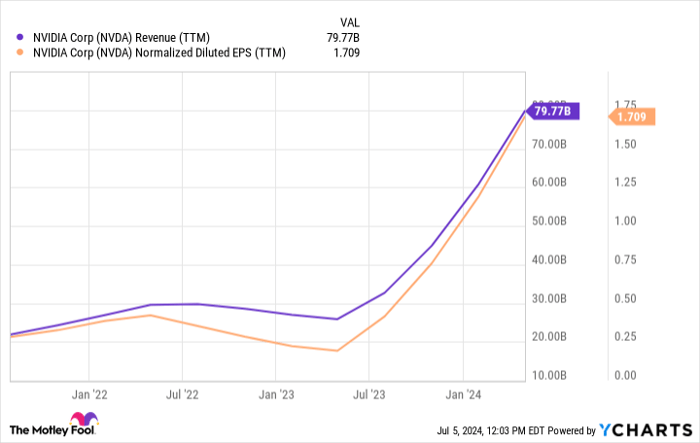
    The investment thesis for Nvidia is straightforward. Technology companies building massive data centers to run powerful artificial intelligence (AI) models are choosing Nvidia’s chips — so much so that experts estimate Nvidia’s market share for AI chips is as high as 90%. Nvidia has won this war with a quality product and proprietary software that helps developers easily configure the chips for AI applications.

    The result has been eye-popping growth that has fueled the stock’s meteoric rise over the past few years:

    NVDA Revenue (TTM) Chart

    NVDA Revenue (TTM) data by YCharts

    Money could continue flowing into AI. Experts predict that America’s data center footprint could double by 2030. Lisa Su, CEO of rival company AMD, expects the AI chip market to grow to over $400 billion over the next few years. Better AI models may require increasingly better chips. CEO Jensen Huang has stated that Nvidia is aiming for annual AI chip releases.

    Analysts believe continued AI chip demand will drive Nvidia’s earnings growth by an average of 38% annually for the next three to five years. The stock’s forward P/E is 48 today. That’s a steep price tag, but it is one that Nvidia could easily grow into if it performed up to analysts’ expectations.

    There are potential risks in this promising tale

    It’s a hopeful story, but things could get ugly if it doesn’t go according to plan. Nvidia has grown remarkably fast; total revenue has more than doubled in short order. Maintaining that revenue (and growing it) requires that AI chip demand lives up to the hype and that Nvidia continues owning the lion’s share of that market.

    There are several realistic scenarios in which this might not happen. Nvidia gets a large chunk of its AI sales from a few large technology companies. What if those companies decide to design custom in-house chips instead? Or, what if these companies reach a point where they’re not getting a good enough return on investment on these chips? This isn’t for fun; AI must make these companies a ton of money to justify spending billions of dollars.

    None of these questions even factor in the reality that AMD, Intel, and others will all be gunning for Nvidia’s market share. Nvidia could retain its market share but face pricing pressure if competitors dramatically undercut its pricing with comparable chips.

    How should investors approach Nvidia stock?

    Everyone buying Nvidia stock now is banking on future growth, not what has already happened. Ultimately, the risk to investors is that Nvidia fails to deliver for whatever reason. And because of how giant Nvidia’s leap has been so far, going backward could be especially painful.

    That doesn’t mean investors should avoid the stock entirely. As shown above, the stock could still perform well if the company’s growth continues. The key is not chasing the stock, and keeping Nvidia to a small percentage of a diversified portfolio.

    Nvidia is the perfect opportunity for dollar-cost averaging, building an investment with small, repeated purchases. Slowly accumulating shares means you won’t be all-in to the stock too soon. You can steadily increase your investment as Nvidia shows it can maintain its growth. Let the company earn your investment dollars. It also would be less costly to pull your investment and move on if Nvidia gets in trouble.

    In this scenario, it’s heads-you-win, tails-you-win. That’s smart investing.

    This article was originally published on Fool.com. All figures quoted in US dollars unless otherwise stated.

    The post Is Nvidia stock a buy now? appeared first on The Motley Fool Australia.

    Should you invest $1,000 in Nvidia right now?

    Before you buy Nvidia shares, consider this:

    Motley Fool investing expert Scott Phillips just revealed what he believes are the 5 best stocks for investors to buy right now… and Nvidia wasn’t one of them.

    The online investing service he’s run for over a decade, Motley Fool Share Advisor, has provided thousands of paying members with stock picks that have doubled, tripled or even more.*

    And right now, Scott thinks there are 5 stocks that may be better buys…

    See The 5 Stocks *Returns as of 24 June 2024

    More reading

    Justin Pope has no position in any of the stocks mentioned. The Motley Fool Australia’s parent company Motley Fool Holdings Inc. has positions in and has recommended Advanced Micro Devices and Nvidia. The Motley Fool Australia’s parent company Motley Fool Holdings Inc. has recommended Intel and has recommended the following options: long January 2025 $45 calls on Intel and short August 2024 $35 calls on Intel. The Motley Fool Australia has recommended Advanced Micro Devices and Nvidia. The Motley Fool has a disclosure policy. This article contains general investment advice only (under AFSL 400691). Authorised by Scott Phillips.