Category: Stock Market

  • Coles and these ASX dividend stocks could offer huge returns

    If you are looking to make some new additions to your income portfolio, then it could be worth looking at the four ASX dividend stocks listed below.

    They have all been named as buys and tipped to provide investors with attractive dividend yields and major upside. Here’s what you need to know about them:

    Aurizon Holdings Ltd (ASX: AZJ)

    Aurizon could be an ASX dividend stock to buy according to analysts at Ord Minnett. It is Australia’s largest rail freight operator. Each year it transports more than 250 million tonnes of Australian commodities.

    The broker currently has an accumulate rating and $4.70 price target on its shares. This implies potential upside of 29% for investors.

    As for dividends, the broker is forecasting partially franked dividends of 17.8 cents per share in FY 2024 and then 24.3 cents per share in FY 2025. Based on the latest Aurizon share price of $3.64, this will mean dividend yields of 4.9% and 6.7%, respectively.

    Coles Group Ltd (ASX: COL)

    Over at Morgans, its analysts think that this supermarket giant would be a top ASX dividend stock to buy now.

    The broker has an add rating and $18.95 price target on its shares. This suggests that upside of 10% is possible from current levels.

    In respect to income, Morgans is forecasting Coles to pay fully franked dividends of 66 cents per share in FY 2024 and 69 cents per share in FY 2025. Based on the current Coles share price of $17.19, this implies yields of approximately 3.8% and 4%, respectively.

    GDI Property Group Ltd (ASX: GDI)

    Analysts at Bell Potter have named this property company as an ASX dividend stock to buy.

    The broker has a buy rating and 75 cents price target on its shares. This implies potential upside of 29% for investors.

    Bell Potter also believes GDI Property is well-positioned to offer some big dividend yields in the coming years. It is forecasting dividends per share of 5 cents in FY 2024, FY 2025, and FY 2026. Based on the current GDI Property share price of 58 cents, this equates to dividend yields of 8.6% each year.

    Woodside Energy Group Ltd (ASX: WDS)

    A final ASX dividend stock that analysts are bullish on is Woodside Energy. It is of course one of the world’s largest energy producers.

    Morgans thinks recently weakness has created a buying opportunity. It has an add rating and $36.00 price target on its shares. This suggests the upside of 27% is possible for investors.

    As for income, the broker is forecasting fully franked dividends of $1.25 per share in FY 2024 and then $1.57 per share in FY 2025. Based on its current share price of $28.31, this represents dividend yields of 4.4% and 5.55%, respectively.

    The post Coles and these ASX dividend stocks could offer huge returns appeared first on The Motley Fool Australia.

    Should you invest $1,000 in Aurizon Holdings Limited right now?

    Before you buy Aurizon Holdings Limited shares, consider this:

    Motley Fool investing expert Scott Phillips just revealed what he believes are the 5 best stocks for investors to buy right now… and Aurizon Holdings Limited wasn’t one of them.

    The online investing service he’s run for over a decade, Motley Fool Share Advisor, has provided thousands of paying members with stock picks that have doubled, tripled or even more.*

    And right now, Scott thinks there are 5 stocks that may be better buys…

    See The 5 Stocks
    *Returns as of 24 June 2024

    More reading

    Motley Fool contributor James Mickleboro has positions in Woodside Energy Group. The Motley Fool Australia’s parent company Motley Fool Holdings Inc. has no position in any of the stocks mentioned. The Motley Fool Australia has positions in and has recommended Coles Group. The Motley Fool Australia has recommended Aurizon. The Motley Fool has a disclosure policy. This article contains general investment advice only (under AFSL 400691). Authorised by Scott Phillips.


  • Here’s when CBA and these ASX 200 bank stocks are paying their dividends

    Man holding a calculator with Australian dollar notes, symbolising dividends.

    It is a good time to be a shareholder of ASX 200 bank stocks.

    Not only have the big four banks been roaring higher recently, but some are about to reward their shareholders with their latest dividend payments.

    Let’s now look and see what is being paid and when.

    Westpac Banking Corp (ASX: WBC)

    Let’s start with Australia’s oldest bank, Westpac. It has already paid its shareholders its interim dividend for FY 2024. That was paid out a couple of days ago on 25 June.

    Westpac shareholders received a fully franked interim dividend of 90 cents per share, which was an increase of 25% on the prior corresponding period.

    The ASX 200 bank stock will declare (or not) its next dividend in November with its full year results. After which, it is usually paid out in December.

    ANZ Group Holdings Ltd (ASX: ANZ)

    ANZ Bank is scheduled to pay its partially franked interim dividend next week on Monday 1 July.

    When the big four bank released its half year results last month, it declared a 65% franked 83 cents per share dividend. Its next dividend is expected to be declared in November and then paid out to shareholders in December.

    Macquarie Group Ltd (ASX: MQG)

    This investment bank will also be paying a dividend next week. The ASX 200 bank stock is scheduled to pay its final dividend for FY 2024 on Tuesday 2 July.

    When Macquarie released its full year results last month, it declared a 40% franked final dividend of $3.85 per share. This was down 14.5% on the prior corresponding period.

    The bank is expected to release its half year results for FY 2025 and announce its interim dividend in November. Based on past dividends, that is likely to then be paid to eligible shareholders in mid to late December.

    National Australia Bank Ltd (ASX: NAB)

    This big four bank is scheduled to pay its latest interim dividend the following day on Wednesday 3 July.

    Last month, the ASX 200 bank stock released its results and declared an 84 cents per share fully franked dividend.

    As with the others, NAB’s final dividend is traditionally declared in November and then paid out in December.

    Commonwealth Bank of Australia (ASX: CBA)

    Australia’s largest bank operates with a financial year that ends 30 June. As a result, it won’t be paying out a dividend next week.

    Traditionally, the bank will release its results and declare its dividends in both August and February, with dividend payments then made in March and September, respectively.

    The post Here’s when CBA and these ASX 200 bank stocks are paying their dividends appeared first on The Motley Fool Australia.

    Should you invest $1,000 in Australia And New Zealand Banking Group right now?

    Before you buy Australia And New Zealand Banking Group shares, consider this:

    Motley Fool investing expert Scott Phillips just revealed what he believes are the 5 best stocks for investors to buy right now… and Australia And New Zealand Banking Group wasn’t one of them.

    The online investing service he’s run for over a decade, Motley Fool Share Advisor, has provided thousands of paying members with stock picks that have doubled, tripled or even more.*

    And right now, Scott thinks there are 5 stocks that may be better buys…

    See The 5 Stocks
    *Returns as of 24 June 2024

    More reading

    Motley Fool contributor James Mickleboro has positions in Westpac Banking Corporation. The Motley Fool Australia’s parent company Motley Fool Holdings Inc. has positions in and has recommended Macquarie Group. The Motley Fool Australia has positions in and has recommended Macquarie Group. The Motley Fool has a disclosure policy. This article contains general investment advice only (under AFSL 400691). Authorised by Scott Phillips.

  • Buy Telstra and these ASX dividend stocks in July

    A woman standing in a blue shirt smiles as she uses her mobile phone to text message someone

    There are plenty of quality ASX dividend shares to choose from on the Australian share market.

    But which ones could be great options for income investors?

    Three that have been tipped as buys are listed below. Here’s why they could be worth a look:

    APA Group (ASX: APA)

    APA Group could be an ASX dividend share to buy according to analysts at Macquarie. It is an energy infrastructure business that owns, manages, and operates a diverse portfolio of gas, electricity, solar and wind assets.

    The broker currently has an outperform rating and $9.40 price target on the company’s shares.

    As for dividends, the broker believes that APA Group is on course to increase its dividend for the 20th year in a row. It is forecasting dividends per share of 56 cents in FY 2024 and then 57.5 cents in FY 2025. Based on the current APA Group share price of $8.32, this equates to 6.7% and 6.9% dividend yields, respectively.

    Rural Funds Group (ASX: RFF)

    Over at Bell Potter, its analysts think that Rural Funds could be an ASX dividend share to buy right now. It is a property company that owns a portfolio of high-quality assets across a number of agricultural industries.

    These properties are predominantly leased to corporate agricultural operators on long-term agreements.

    Bell Potter currently has a buy rating and $2.40 price target on its shares.

    In respect to income, the broker is forecasting dividends per share of 11.7 cents in both FY 2024 and FY 2025. Based on the current Rural Funds share price of $2.04, this will mean dividend yields of 5.7% for investors.

    Telstra Corporation Ltd (ASX: TLS)

    A third ASX dividend share that could be a buy is Telstra.

    That’s the view of analysts at Goldman Sachs, which remain positive on the telco giant despite a recent underwhelming guidance update.

    The broker continues to believe that the “low risk earnings (and dividend) growth that Telstra is delivering across FY22-25, underpinned through its mobile business, is attractive.”

    But the positives don’t end there. Goldman highlights that the company “has a meaningful medium term opportunity to crystallise value through commencing the process to monetize its InfraCo Fixed assets.”

    Its analysts are forecasting fully franked dividends of 18 cents per share in FY 2024 and then 18.5 cents per share in FY 2025. Based on the current Telstra share price of $3.62, this equates to dividend yields of 5% and 5.1%, respectively.

    Goldman currently has a buy rating and $4.25 price target on Telstra’s shares.

    The post Buy Telstra and these ASX dividend stocks in July appeared first on The Motley Fool Australia.

    Should you invest $1,000 in Apa Group right now?

    Before you buy Apa Group shares, consider this:

    Motley Fool investing expert Scott Phillips just revealed what he believes are the 5 best stocks for investors to buy right now… and Apa Group wasn’t one of them.

    The online investing service he’s run for over a decade, Motley Fool Share Advisor, has provided thousands of paying members with stock picks that have doubled, tripled or even more.*

    And right now, Scott thinks there are 5 stocks that may be better buys…

    See The 5 Stocks
    *Returns as of 24 June 2024

    More reading

    Motley Fool contributor James Mickleboro has no position in any of the stocks mentioned. The Motley Fool Australia’s parent company Motley Fool Holdings Inc. has positions in and has recommended Macquarie Group. The Motley Fool Australia has positions in and has recommended Apa Group, Macquarie Group, Rural Funds Group, and Telstra Group. The Motley Fool has a disclosure policy. This article contains general investment advice only (under AFSL 400691). Authorised by Scott Phillips.

  • 3 top ASX ETFs to buy in July

    A group of young ASX investors sitting around a laptop with an older lady standing behind them explaining how investing works.

    If you want to make some investments but aren’t a fan of stock picking, then it could be worth considering exchange-traded funds (ETFs).

    That’s because they allow investors to buy a large collection of shares through a single investment. This makes it an easy way to diversify a portfolio.

    But which ASX ETFs could be great options for investors in July? Let’s take a look at three:

    Betashares Global Cash Flow Kings ETF (ASX: CFLO)

    The first ASX ETF to look at is the Betashares Global Cash Flow Kings ETF

    Analysts at Betashares recently named it as one to consider. They highlight that companies that generate high levels of free cash flow have a tendency to outperform broad global equity benchmarks over the medium to long term.

    This could make the Betashares Global Cash Flow Kings ETF a great long term option for investors. This is because it focuses on global companies that demonstrate strong and consistent free cash flow generation, growth of free cash flow, and relatively low levels of debt.

    Among its holdings are household names such as Alphabet (NASDAQ: GOOG) and Costco (NASDAQ: COST).

    Vanguard Australian Shares Index ETF (ASX: VHY)

    A second ASX ETF to look at is the Vanguard Australian Shares High Yield ETF.

    It could be a good option if you’re looking for income from the share market. That’s because it provides investors with low-cost exposure to a portfolio of 70+ ASX shares that have higher forecast dividends relative to the market average.

    But you’re not just buying the banks and miners. Vanguard highlights that security diversification is achieved by restricting the proportion invested in any one industry to 40% of the total ETF and 10% for any one company. It also points out that Australian Real Estate Investment Trusts (A-REITS) are excluded from the fund.

    Among the dividend-paying shares you will be owning are giants BHP Group and Commonwealth Bank of Australia (ASX: CBA), as well as smaller companies such as Centuria Capital Group (ASX: CNI) and Dicker Data Ltd (ASX: DDR).

    The ETF currently trades with a trailing dividend yield of 4.9%.

    Vanguard MSCI Index International Shares ETF (ASX: VGS)

    A final ASX ETF that could be a great option for investors in July is the Vanguard MSCI Index International Shares ETF.

    It provides investors with access to approximately 1,500 of the world’s largest listed companies from major developed countries.

    Vanguard highlights that investing internationally offers greater access to sectors such as technology and health care that aren’t as well represented on the Australian share market.

    Among the ETF’s holdings are global giants from a range of industries. This includes Apple, Johnson & Johnson, JP Morgan, Nestle, and Visa.

    The post 3 top ASX ETFs to buy in July appeared first on The Motley Fool Australia.

    Should you invest $1,000 in Betashares Global Cash Flow Kings Etf right now?

    Before you buy Betashares Global Cash Flow Kings Etf shares, consider this:

    Motley Fool investing expert Scott Phillips just revealed what he believes are the 5 best stocks for investors to buy right now… and Betashares Global Cash Flow Kings Etf wasn’t one of them.

    The online investing service he’s run for over a decade, Motley Fool Share Advisor, has provided thousands of paying members with stock picks that have doubled, tripled or even more.*

    And right now, Scott thinks there are 5 stocks that may be better buys…

    See The 5 Stocks
    *Returns as of 24 June 2024

    More reading

    Suzanne Frey, an executive at Alphabet, is a member of The Motley Fool’s board of directors. JPMorgan Chase is an advertising partner of The Ascent, a Motley Fool company. Motley Fool contributor James Mickleboro has no position in any of the stocks mentioned. The Motley Fool Australia’s parent company Motley Fool Holdings Inc. has positions in and has recommended Alphabet, Apple, Costco Wholesale, JPMorgan Chase, and Visa. The Motley Fool Australia’s parent company Motley Fool Holdings Inc. has recommended Johnson & Johnson and Nestlé. The Motley Fool Australia has positions in and has recommended Dicker Data. The Motley Fool Australia has recommended Alphabet, Apple, Vanguard Australian Shares High Yield ETF, and Vanguard Msci Index International Shares ETF. The Motley Fool has a disclosure policy. This article contains general investment advice only (under AFSL 400691). Authorised by Scott Phillips.

  • 2 All Ords ASX defence shares ‘poised to thrive’

    defence personnel operating and discussing defence technology

    Two All Ordinaries Index (ASX: XAO) ASX defence shares are among a select basket of stocks “poised to thrive in the coming decade”.

    That’s according to the fund managers at Tamim Asset Management.

    The All Ords ASX defence shares in question are DroneShield Ltd (ASX: DRO) and Codan Ltd (ASX: CDA).

    Now, both stocks have already been shooting the lights out.

    The Codan share price has soared 60% over 12 months and is up 40% so far in 2024.

    The DroneShield share price has rocketed an eye-watering 532% over 12 months and is up 301% year to date.

    To put that in some perspective, the All Ords has gained 10% in 12 months and is up 2% in 2024.

    Looking ahead, both ASX defence shares stand to be among the bigger beneficiaries of the AI revolution.

    But that’s not why Tamim believes they’ll thrive over the next 10 years.

    That investment rationale relates instead to their direct links to the global defence industry.

    Government spending tailwinds

    Successful international and ASX defence shares have some significant advantages over companies operating in other sectors due to the nature of government defence spending.

    As Tamim pointed out, “substantial government spending provides a consistent revenue stream” for these companies.

    Pointing to the defence budgets of the United States and Australia, the fund manager noted, “Government spending on defence remains robust, driven by the need to maintain national security and technological superiority.”

    Atop those big spending packages, international and ASX defence shares also tend to benefit from long-term government contracts, providing investors with some security over next year’s revenue stream.

    “By recognising these dynamics, investors can uncover quality businesses with strong tailwinds poised to thrive in the coming decade,” Tamim said.

    All Ords ASX defence shares well-positioned to capitalise

    Tamim highlights DroneShield, a leading provider of counter-drone and multi-mission unmanned systems solutions, as one of the promising players in the Australian defence sector.

    The All Ords ASX defence share employs AI and machine learning to deliver advanced technologies for military, government, and commercial organisations in more than 70 countries.

    According to Tamim:

    In the most recent quarterly report, DroneShield reported incredible financial results for the first quarter of 2024, with revenue growing 10 times year-over-year and a significant increase in order intake.

    The company has also expanded its global footprint, securing major contracts with military and government agencies, particularly in the US. Over the past 12 months, DroneShield’s share price has rocketed, reflecting the growing demand for counter-drone solutions and the company’s successful execution of its strategic initiatives.

    As the threat of drone-related incidents continues to rise, DroneShield is well-positioned to capitalise on the increasing need for effective counter-drone technologies.

    Tamim is also bullish on the outlook for Codan.

    Codan develops rugged electronics solutions for government, corporate and consumer markets worldwide.

    According to Tamim:

    The company’s communications segment produces equipment used by military, law enforcement, humanitarian, and commercial organisations known for reliability and performance in harsh environments, making them ideal for defence applications.

    Codan’s focus on innovation and quality ensures it remains a trusted supplier in the defence communications market. The company’s technologies also include metal detection…

    On the performance front, the fund manager added:

    The company delivered a strong H1 FY24 result, with group revenue up 26% to $265.9 million and net profit after tax increasing 24% to $38.1 million compared to the prior corresponding period.

    The Communications segment achieved 12.5% revenue growth, while Metal Detection revenues surged 49%.

    Despite higher expenses due to acquisitions and investments, earnings before interest & tax (EBIT) and net profit after tax (NPAT) grew 31% and 24% respectively. Net debt increased to $82.5 million after funding $30.3 million for the Eagle and Wave Central acquisitions.

    Looking ahead, Tamim noted that the ASX defence share expects its Communications revenue growth to exceed the top end of its 10% to 15% target range.

    The post 2 All Ords ASX defence shares ‘poised to thrive’ appeared first on The Motley Fool Australia.

    Should you invest $1,000 in Codan Limited right now?

    Before you buy Codan Limited shares, consider this:

    Motley Fool investing expert Scott Phillips just revealed what he believes are the 5 best stocks for investors to buy right now… and Codan Limited wasn’t one of them.

    The online investing service he’s run for over a decade, Motley Fool Share Advisor, has provided thousands of paying members with stock picks that have doubled, tripled or even more.*

    And right now, Scott thinks there are 5 stocks that may be better buys…

    See The 5 Stocks
    *Returns as of 24 June 2024

    More reading

    Motley Fool contributor Bernd Struben has no position in any of the stocks mentioned. The Motley Fool Australia’s parent company Motley Fool Holdings Inc. has positions in and has recommended DroneShield. The Motley Fool Australia has no position in any of the stocks mentioned. The Motley Fool has a disclosure policy. This article contains general investment advice only (under AFSL 400691). Authorised by Scott Phillips.

  • 5 things to watch on the ASX 200 on Thursday

    A male investor wearing a white shirt and blue suit jacket sits at his desk looking at his laptop with his hands to his chin, waiting in anticipation.

    On Wednesday, the S&P/ASX 200 Index (ASX: XJO) had a difficult session and tumbled lower. The benchmark index fell 0.7% to 7,783 points.

    Will the market be able to bounce back from this on Thursday? Here are five things to watch:

    ASX 200 expected to sink again

    The Australian share market looks set to sink again on Thursday despite the positive night of trade on Wall Street. According to the latest SPI futures, the ASX 200 is expected to open the day 86 points or 1.1% lower this morning. In the United States, the Dow Jones was up 0.05%, the S&P 500 rose 0.15% and the Nasdaq pushed 0.5% higher.

    Oil prices soften

    ASX 200 energy shares including Beach Energy Ltd (ASX: BPT) and Woodside Energy Group Ltd (ASX: WDS) could have a poor session after oil prices softened overnight. According to Bloomberg, the WTI crude oil price is down 0.25% to US$80.64 a barrel and the Brent crude oil price is down 0.1% to US$84.97 a barrel. A surprise increase in US crude inventories weighed on oil prices.

    Buy Paladin Energy shares

    Paladin Energy Ltd (ASX: PDN) shares are good value according to analysts at Bell Potter. In response to recent share price weakness and news of a plan to acquire Fission Uranium, the broker has upgraded the uranium producer’s shares to a buy rating with an improved price target of $16.10. It said: “PDN has sold off since we moved to a Hold in May-24. We see this as a potential buying opportunity irrespective of the transaction.”

    Gold price falls to two-week low

    It could be a poor session for ASX 200 gold shares such as Newmont Corporation (ASX: NEM) and Northern Star Resources Ltd (ASX: NST) today after the gold price dropped overnight. According to CNBC, the spot gold price is down 0.9% to US$2,309.8 an ounce. Stronger bond yields reduced the appeal of the precious metal and sent it to a two-week low.

    Iron ore price rises

    BHP Group Ltd (ASX: BHP) and Rio Tinto Ltd (ASX: RIO) will be on watch on Thursday. That’s because the benchmark iron ore price raced higher overnight and could give these miners a lift ahead of today’s (expected) red session. According to the AFR, the iron ore price is up a sizeable 3.2% today. This appears to have driven by increased buying in China’s spot market amid bets that it will soon unveil more stimulus to boost its struggling property market.

    The post 5 things to watch on the ASX 200 on Thursday appeared first on The Motley Fool Australia.

    Should you invest $1,000 in Bhp Group right now?

    Before you buy Bhp Group shares, consider this:

    Motley Fool investing expert Scott Phillips just revealed what he believes are the 5 best stocks for investors to buy right now… and Bhp Group wasn’t one of them.

    The online investing service he’s run for over a decade, Motley Fool Share Advisor, has provided thousands of paying members with stock picks that have doubled, tripled or even more.*

    And right now, Scott thinks there are 5 stocks that may be better buys…

    See The 5 Stocks
    *Returns as of 24 June 2024

    More reading

    Motley Fool contributor James Mickleboro has positions in Woodside Energy Group. The Motley Fool Australia’s parent company Motley Fool Holdings Inc. has no position in any of the stocks mentioned. The Motley Fool Australia has no position in any of the stocks mentioned. The Motley Fool has a disclosure policy. This article contains general investment advice only (under AFSL 400691). Authorised by Scott Phillips.

  • What is the outlook for Woodside shares in FY25?

    gas and oil worker on pipeline equipment

    The Woodside Energy Group Ltd (ASX: WDS) share price has sunk 25% in ten months, as shown on the chart below. After a difficult period for the ASX oil and gas share, investors may be wondering if the next 12 months could be better.

    The Australian tax year is about to finish, but Woodside’s financial year follows the calendar year. So, while FY25 is about to start for most of us, Woodside still has another six months left of its 2024 financial year.

    We’re going to look at the outlook for the company, encompassing both Woodside’s FY24 and FY25.

    Company’s outlook commentary

    The business has guided that it’s expecting to produce between 185 million barrels of oil equivalent (MMboe) and 195 MMboe in 2024. We won’t learn about its 2024 annual production numbers until January 2025, when it announces its 2024 fourth-quarter update. How much the company produces and the price it gets for that production can be key for Woodside shares.

    It has also guided that it’s expecting capital expenditure of between $5 billion and $5.5 billion in 2024.

    The business continues to work on its three major growth projects. Commissioning activities have been underway at Sangomar in Senegal for the last few months. The company said it was on track for its first oil in the middle of this year.

    Woodside’s Scarborough and Pluto Train 2 projects were 62% complete at the end of the 2024 first quarter. The company says it’s on target for its first LNG cargo in 2026.

    The last update we heard about the sales price for its production was in the first quarter of 2024. Woodside said its average realised price was US$63 per barrel of oil equivalent, which was down 5% quarter over quarter and 25% year over year. There continues to be energy market volatility.

    Analyst forecasts for Woodside shares

    The broker UBS said in a note in April that there is strong demand for LNG in North Asia, though it also sees “a global LNG surplus arising from 2027+”, which it believes is already putting down pressure on fixed slope pricing for new sales and purchase agreements. This “amplifies the need for accelerated LNG marketing activities”, according to UBS.

    Looking at the forecasts for Woodside’s FY24, UBS predicts Woodside can generate US$12.36 billion of revenue, US$4.2 billion of earnings before interest and tax (EBIT), US$2.34 billion of net profit after tax (NPAT) and pay an annual dividend per share of 98 cents. The broker suggested Woodside could finish 2024 with US$2.7 billion of net debt.

    UBS is only expecting a slight improvement in FY25. The broker expects revenue to be US$12.9 billion, EBIT to be US$4.27 billion, net profit to be US$2.48 billion and that the ASX oil and gas share could pay an annual dividend per share of US$1.05.

    Woodside share price snapshot

    The Woodside share price is down around 10% since the start of 2024.

    The post What is the outlook for Woodside shares in FY25? appeared first on The Motley Fool Australia.

    Should you invest $1,000 in Woodside Petroleum Ltd right now?

    Before you buy Woodside Petroleum Ltd shares, consider this:

    Motley Fool investing expert Scott Phillips just revealed what he believes are the 5 best stocks for investors to buy right now… and Woodside Petroleum Ltd wasn’t one of them.

    The online investing service he’s run for over a decade, Motley Fool Share Advisor, has provided thousands of paying members with stock picks that have doubled, tripled or even more.*

    And right now, Scott thinks there are 5 stocks that may be better buys…

    See The 5 Stocks
    *Returns as of 24 June 2024

    More reading

    Motley Fool contributor Tristan Harrison has no position in any of the stocks mentioned. The Motley Fool Australia’s parent company Motley Fool Holdings Inc. has no position in any of the stocks mentioned. The Motley Fool Australia has no position in any of the stocks mentioned. The Motley Fool has a disclosure policy. This article contains general investment advice only (under AFSL 400691). Authorised by Scott Phillips.

  • 1 ASX stock that’s just right for beginner investors

    A view of competitors in a running event, some wearing number bibs, line up together on a starting line looking ahead as if to start a race.

    It can be confusing for a beginner investor to know what ASX stocks to invest in. Should dividends or growth be the focus? What is a good price to pay for this investment?

    There are plenty of interesting companies on the ASX that may be good investments, but there’s one S&P/ASX 200 Index (ASX: XJO) stock that I believe could suit almost every portfolio: Washington H. Soul Pattinson and Co. Ltd (ASX: SOL).

    What Soul Patts does

    Soul Patts is not one of the most famous business names, like BHP Group Ltd (ASX: BHP) or Qantas Airways Limited (ASX: QAN), but it is one of the oldest. It has been listed on the ASX since 1903.

    The company started off as a pharmacy business and eventually started making external investments in names like Brickworks Limited (ASX: BKW) and New Hope Corporation Ltd (ASX: NHC).

    These days, the investment house has exposure to various industries and asset classes, including ASX shares, private equity, credit, and property.

    Some of its larger ASX stock investments include Brickworks, New Hope, TPG Telecom Ltd (ASX: TPG), Tuas Ltd (ASX: TUA), BHP, Macquarie Group Ltd (ASX: MQG), CSL Ltd (ASX: CSL), Goodman Group (ASX: GMG) and Wesfarmers Ltd (ASX: WES).

    Good mixture of returns

    Soul Patts shareholders benefit when the underlying value of its portfolio increases. The company has designed its portfolio to be defensive and resilient to economic shocks, which might be comforting for beginner investors.

    It’s steadily making new investments, such as its acquisition of the entire electrification business Ampcontrol. As these businesses grow in value, they can drive up the value of Soul Patts, leading to capital growth for shareholders.

    The cash flow received from its investment portfolio helps pay for dividends. The ASX stock has paid a dividend every year to shareholders since it was listed in 1903, and it has grown its annual dividend each year since 2000.

    Over the 10 years to 30 April 2024, Soul Patts shares delivered an average return per annum of 11.3%, outperforming the All Ordinaries Accumulation Index (ASX: XAOA) by an average of 3.2% per annum. These figures do not include the benefit of franking credits. However, it must be said that past performance is not a reliable indicator of future performance.

    It currently has a trailing grossed-up dividend yield of close to 4%, which I think is a solid starting yield for beginner investors.

    Foolish takeaway

    Soul Patts is an effective investment for beginners, in my opinion, because it can provide a mixture of dividends and capital growth. Its portfolio investments offer diversification while the growing dividend means we can benefit from owning shares without having to sell.

    This ASX stock is one of the largest positions in my portfolio, and I’m planning to buy more of it over time. I think the current valuation is a good price to start a position.

    The post 1 ASX stock that’s just right for beginner investors appeared first on The Motley Fool Australia.

    Should you invest $1,000 in Washington H. Soul Pattinson And Company Limited right now?

    Before you buy Washington H. Soul Pattinson And Company Limited shares, consider this:

    Motley Fool investing expert Scott Phillips just revealed what he believes are the 5 best stocks for investors to buy right now… and Washington H. Soul Pattinson And Company Limited wasn’t one of them.

    The online investing service he’s run for over a decade, Motley Fool Share Advisor, has provided thousands of paying members with stock picks that have doubled, tripled or even more.*

    And right now, Scott thinks there are 5 stocks that may be better buys…

    See The 5 Stocks
    *Returns as of 24 June 2024

    More reading

    Motley Fool contributor Tristan Harrison has positions in Brickworks and Washington H. Soul Pattinson and Company Limited. The Motley Fool Australia’s parent company Motley Fool Holdings Inc. has positions in and has recommended Brickworks, CSL, Goodman Group, Macquarie Group, Washington H. Soul Pattinson and Company Limited, and Wesfarmers. The Motley Fool Australia has positions in and has recommended Brickworks, Macquarie Group, Washington H. Soul Pattinson and Company Limited, and Wesfarmers. The Motley Fool Australia has recommended CSL and Goodman Group. The Motley Fool has a disclosure policy. This article contains general investment advice only (under AFSL 400691). Authorised by Scott Phillips.

  • 3 reasons I think the CBA share price may crash!

    Friends at an ATM looking sad.

    Over the past few weeks, the Commonwealth Bank of Australia (ASX: CBA) share price has been in the news again, and for all the right reasons. We have seen fresh new record high after record high tumble for this ASX 200 bank stock. No doubt that has made CBA’s veritable army of retail shareholders a very happy bunch.

    The bank’s most recent all-time high came just yesterday. This saw CBA shares hit $128.68 each. Today, the bank is trading just under that, going for $126.90 a share at the close on Wednesday.

    At this share price, CBA stock is up 5.7% over the past month alone. Investors have also enjoyed a year-to-date gain of 11.71% over 2024 so far and a 29.6% lift over the past 12 months.

    Now, I regard CBA as a quality business and probably the best-run bank in Australia. It deserves to keep its place as one of the top stocks in the S&P/ASX 200 Index (ASX: XJO).

    But I also think the CBA share price is highly likely to crash or at least stagnate over the next 12 months.

    Here are three reasons why.

    3 reasons why the CBA share price might crash

    The bank isn’t growing

    You’d think that a stock that has appreciated by almost 30% over the past 12 months would be demonstrating at least some earnings growth. Or even revenue growth. Unfortunately, that isn’t the case when it comes to CommBank.

    CBA’s last earnings report, covering the half-year ended 31 December 2023, showed revenues of $13.58 billion, down 3% on the same period in 2022.

    The bank’s profits from ordinary activities after tax, as well as its net profits, both fell 8% compared to the prior period as well.

    That doesn’t inspire confidence that this CBA share price rally that we’ve seen is built on solid ground.

    The dividend yield is not impressive

    If you ask almost any owner of ASX bank shares why they have a bank in their portfolio, they will probably tell you it’s for the fat, fully-franked dividends. That’s fair enough. Most ASX banks, including CBA, have been responsible for some of the largest and most consistent dividend payouts on the Australian share market over the past two or three decades.

    Unfortunately, CBA’s recent rises have somewhat neutered its dividend yield. While its rivals like Westpac Banking Corp (ASX: WBC) and ANZ Group Holdings Ltd (ASX: ANZ) still offer dividend yields of more than 5% today, CBA’s yield currently sits at a rate unimpressive 3.58%.

    Not only can you get a better yield from any other bank stock right now, but you can also get more cash if you buy Coles Group Ltd (ASX: COL), Telstra Group Ltd (ASX: TLS), Medibank Private Ltd (ASX: MPL) or Transurban Group (ASX: TCL) shares.

    In my view, this reality will eventually hollow out buying pressure for CB shares, at least until its dividend yield returns to something one could consider normal for an ASX bank.

    The CBA share price is insanely expensive

    Finally, let’s talk about valuation. The recent rally in the CBA share price has resulted in this bank having the most expensive valuation out of any of its ASX peers, and by a mile. CBA stock is currently trading on a price-to-earnings (P/E) ratio of 22.23. In contrast, National Australia Bank Ltd (ASX: NAB) is presently on a P/E ratio of 16.7. Westpac is at 15.23 and ANZ at 12.53.

    This means that CBA investors are paying almost double for one dollar of earnings than ANZ investors are right now.

    Commonwealth Bank also currently has a price-to-book (P/B) ratio of 2.96, which is also extremely high for a bank.

    According to Bloomberg, this not only makes CBA the most expensive bank on the ASX, but in the world. Its P/E ratio is even double that of the world-class American bank JP Morgan Chase. Not exactly a title you want in an investment.

    Foolish takeaway

    From where I’m looking, CBA shares are grossly overvalued, period. I’m not saying that this stock is destined to crash in the next 12 months. But for me, the fundamentals point to investor exuberance in this case.

    I can’t see how CBA can continue to climb in value while its earnings fall and its dividend yield drops. All in all, this is one ASX 200 stock I am staying the heck away from at its current price.

    The post 3 reasons I think the CBA share price may crash! appeared first on The Motley Fool Australia.

    Should you invest $1,000 in Commonwealth Bank Of Australia right now?

    Before you buy Commonwealth Bank Of Australia shares, consider this:

    Motley Fool investing expert Scott Phillips just revealed what he believes are the 5 best stocks for investors to buy right now… and Commonwealth Bank Of Australia wasn’t one of them.

    The online investing service he’s run for over a decade, Motley Fool Share Advisor, has provided thousands of paying members with stock picks that have doubled, tripled or even more.*

    And right now, Scott thinks there are 5 stocks that may be better buys…

    See The 5 Stocks
    *Returns as of 24 June 2024

    More reading

    JPMorgan Chase is an advertising partner of The Ascent, a Motley Fool company. Motley Fool contributor Sebastian Bowen has positions in National Australia Bank and Telstra Group. The Motley Fool Australia’s parent company Motley Fool Holdings Inc. has positions in and has recommended JPMorgan Chase and Transurban Group. The Motley Fool Australia has positions in and has recommended Coles Group and Telstra Group. The Motley Fool has a disclosure policy. This article contains general investment advice only (under AFSL 400691). Authorised by Scott Phillips.
  • Superannuation growth funds on track to deliver 9% returns in FY24

    Australian dollar notes in a nest, symbolising a nest egg.

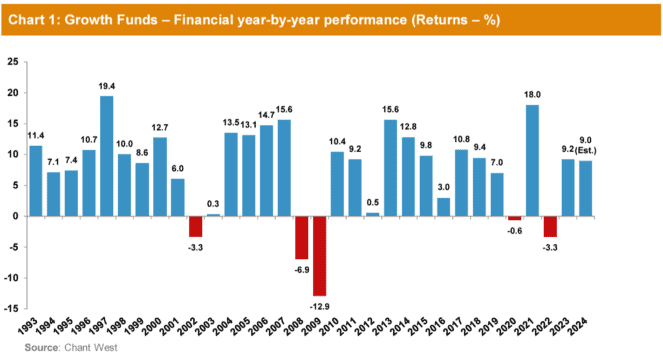
    Superannuation ‘growth’ funds look likely to deliver a median 9% return in FY24, according to Chant West research.

    Growth funds are superannuation funds made up of 61% to 80% growth assets like ASX shares.

    In FY23, growth funds delivered a median 9.2% return.

    Let’s look into the details.

    Resilient share markets drive FY24 superannuation returns

    FY24 is set to become the 13th year of positive superannuation returns out of the past 15 years.

    Chant West Senior Investment Research Manager Mano Mohankumar says resilient share markets have driven the strong FY24 result.

    International shares have been the stand-out category for growth, with the S&P 500 Index (SP: .INX) up 25.85% over the past 12 months compared to a 10.39% gain for the S&P/ASX 200 Index (ASX: XJO).

    Mohankumar commented:

    A final result close to 9% would be an excellent outcome given all of the uncertainty around inflation, expectations of when the Fed will start cutting interest rates and ongoing geopolitical tensions.

    The experience over the past two years is another reminder of the importance of remaining patient and not getting distracted by shorter-term noise.

    If you think back to nearly two years ago, FY22 closed with some sharp losses over the June quarter amid surging inflation and uncertainty as to when interest rate rises might come to an end.

    At that time, very few could have foreseen a return of 19% over the subsequent two years.

    The following chart shows the annual median returns of growth superannuation funds over 30 years.

    Mohankumar commented that since the introduction of the Superannuation Guarantee, the median growth fund has returned 7.9% per annum.

    The annual inflation or consumer price index (CPI) increase over the same period was 2.7%.

    This means a real return of 5.2% per annum to superannuation investors.

    This is well above the typical target of 3.5% per annum.

    He adds:

    On the risk side, there have only been five negative years over the entire period, which translates to about one year in every six.

    Again, funds have done better than their typical long-term risk objective which is one negative return in every five years, on average.

    Some workers prefer higher-risk superannuation funds, such as those with 96% to 100% of monies invested in growth assets (‘super growth’ funds) or those with 81% to 95% in growth assets (‘high growth’ funds).

    Others take a more conservative approach, selecting balanced funds with 41% to 60% of monies invested in growth assets and the rest in defensive assets such as cash and bonds.

    Balanced funds are typically the default option for workers who do not nominate a superannuation strategy themselves.

    Balanced funds and conservative funds (21% to 40% growth assets) are popular with workers close to retirement, given they usually want to preserve their superannuation savings as much as possible.

    The post Superannuation growth funds on track to deliver 9% returns in FY24 appeared first on The Motley Fool Australia.

    Maximise Your Super before June 30: Uncover 5 Strategies Most Aussies Overlook!

    With the end of the financial year almost upon us, there are some strategies that you may be able to take advantage of right now to save some tax and boost your savings…

    Download our latest free report discover 5 super strategies that most Aussies miss today!

    Download Free Report
    *Returns 24 June 2024

    More reading

    Motley Fool contributor Bronwyn Allen has no position in any of the stocks mentioned. The Motley Fool Australia’s parent company Motley Fool Holdings Inc. has no position in any of the stocks mentioned. The Motley Fool Australia has no position in any of the stocks mentioned. The Motley Fool has a disclosure policy. This article contains general investment advice only (under AFSL 400691). Authorised by Scott Phillips.