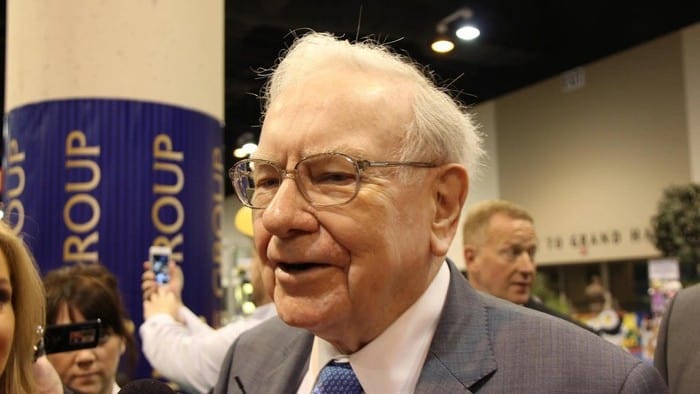
• The world’s best investor turns 96

    Warren Buffett.

    Warren Buffett turns 96 today.

    Many of us have referred to him affectionately as “Uncle Warren” for years. Not because we’re related, sadly (though I continue to hope that Ancestry.com uncovers an as-yet unknown branch of the Phillips/Buffett family tree!) but because he’s probably the closest thing the investing world has to that wise older relative who has been around forever, has seen pretty much everything, and usually has something sensible to say.

    (Before you write in, yes his birthday is August 30… but that’s ‘today’ in the US, where he lives!)

    Yep, I’m an unabashed Buffett fan.

    Not because he’s perfect. He isn’t. Buffett has made plenty of mistakes, and has spent a fair chunk of his annual letters telling us about them.

    But if you were going to choose someone from whom to learn about investing, his record is pretty hard – essentially impossible – to beat.

    So, on his birthday, let’s do that.

    When Buffett took control of Berkshire Hathaway (I own – B class – shares, for the record) in 1965, it was a struggling textile company. What followed was one of the great business and investment stories of all time.

    And the numbers are almost silly.

    Berkshire compounded at roughly 20% a year for decades. The US sharemarket itself did very well over that time, but Berkshire did much, much better.

    The difference between 10% and 20% in any one year doesn’t look life-changing.

    Give it a few decades, though, and you get a very different answer.

    Which, actually, is probably the first Buffett lesson: compounding needs time.

    People spend an enormous amount of effort wondering what the sharemarket will do tomorrow, next month or next year. Buffett built his fortune largely by finding good places to put money and then giving them a very long time to work.

    One of my favourite Buffett lines is:

    “Price is what you pay. Value is what you get.”

    Learning the difference between those two ideas is vital for investors.

    A share price is just the price at which a buyer and seller happen to agree to transact today. It isn’t necessarily what the company is worth.

    Often the two are reasonably close. Sometimes they’re miles apart.

    And yet we tend to let the price tell us how we should feel about the investment.

    A share price rises 30% and suddenly we’re more confident about the company. It falls 30% and we start wondering what we got wrong. (You’re nodding along, aren’t you?)

    Maybe something really has changed. Often, though, it hasn’t. It’s just the market being its usual emotional, short-term, self.

    Buffett has always encouraged investors to turn that thinking around: work out what you think the business is worth, then decide whether the price makes sense.

    Which leads to another Buffett favourite:

    “Be fearful when others are greedy and greedy when others are fearful.”

    That… doesn’t mean it’s easy.

    Being greedy when others are fearful sounds terrific when you’re sitting comfortably at home and the market is behaving itself. It looks even better in hindsight, when you fantasise about buying those shares during the last crash.

    It’s harder when shares have fallen 30%, the headlines are full of doom and gloom, economists are predicting recessions, and your brain is telling you that perhaps you should wait until things become clearer.

    They will become clearer, of course.

    Thing is, shares will probably also be more expensive by then.

    You don’t get bargain prices and blue-sky headlines.

    Buffett also changed as an investor, which I think is an underappreciated part of his story.

    His early investing was heavily influenced by Benjamin Graham: buy something very cheap, ideally for less than the value of its assets, and wait.

    It worked.

    But the late, great, Charlie Munger helped persuade Buffett that there was another way.

    As Buffett later put it, “It’s far better to buy a wonderful company at a fair price than a fair company at a wonderful price.”

    That shift helped produce investments such as Coca-Cola and American Express and, eventually, the purchase of entire high-quality businesses.

    It’s also a useful reminder that even Warren Buffett had to get better at investing.

    He changed his mind.

    He learned.

    He incorporated better ideas when he found them.

    Which brings me to another Buffett idea more investors should take seriously: the circle of competence.

    You don’t have to have a view on everything.

    In fact, you really shouldn’t.

    There are businesses I don’t understand well enough to value with any confidence. There are industries whose futures are too uncertain. And there are plenty of things I might understand reasonably well but where I have no particular insight that the market doesn’t already have.

    That’s okay.

    To use a baseball metaphor that Buffett has invoked, as an investor you get to choose which pitch you swing at.

    There are thousands of listed companies. You don’t need to own all of them. You don’t need to understand all of them. You certainly don’t need to have an opinion on all of them.

    And Buffett’s preferred holding period?

    “Forever.”

    Yes, he’s sold shares, so don’t take that absolutely literally.

    The point is that when you buy shares in a company, you should be thinking about the business you’re becoming a part-owner of, not who might pay you more for the shares next week.

    In fact, that’s the thread that runs through most of Buffett’s best advice.

    Shares are businesses.

    Price and value aren’t the same thing.

    Time is your friend.

    Temperament matters hugely.

    You don’t have to swing at every pitch.

    And avoiding stupidity can be every bit as valuable as trying to be brilliant.

    None of those ideas is particularly complicated.

    Maybe that’s why people keep looking for something more sophisticated.

    But Buffett has spent more than 60 years showing what can happen when some fairly straightforward principles are applied with extraordinary discipline.

    No, you won’t make 20% annual returns. Me either. There is only one Warren Buffett.

    But I reckon we’d all be better investors if we borrowed a little more of his patience, rationality, humility and willingness to think like a business owner.

    It’s Buffett’s birthday, but we get his lifetime of wisdom as our present.

    Happy 96th birthday, Uncle Warren.

    Fool on!

    The post The world’s best investor turns 96 appeared first on The Motley Fool Australia.

    Wondering where you should invest $1,000 right now?

    When investing expert Scott Phillips has a stock tip, it can pay to listen. After all, the flagship Motley Fool Share Advisor newsletter he has run for over ten years has provided thousands of paying members with stock picks that have doubled, tripled or even more.*

    Scott just revealed what he believes could be the ‘five best ASX stocks’ for investors to buy right now. We believe these stocks are trading at attractive prices and Scott thinks they could be great buys right now…

    * Returns as of 1 August 2026

    .custom-cta-button p {
    margin-bottom: 0 !important;
    }

    More reading

    American Express is an advertising partner of Motley Fool Money. Motley Fool contributor Scott Phillips has positions in Berkshire Hathaway. The Motley Fool Australia’s parent company Motley Fool Holdings Inc. has positions in and has recommended American Express and Berkshire Hathaway. The Motley Fool Australia has recommended Berkshire Hathaway. The Motley Fool has a disclosure policy. This article contains general investment advice only (under AFSL 400691). Authorised by Scott Phillips.


  • Qualitas Real Estate Income Fund declares August 2026 distribution

    Australian dollar notes in the pocket of a man's jeans, symbolising dividends.

    The Qualitas Real Estate Income Fund (ASX: QRI) share price is in focus after the fund announced a monthly distribution of 1.0668 cents per unit for August 2026, with payment due on 15 September.

    What did Qualitas Real Estate Income Fund report?

    • Monthly distribution: 1.0668 cents per unit (unfranked)
    • Ex-distribution date: 3 September 2026
    • Record date: 4 September 2026
    • Payment date: 15 September 2026
    • Distribution relates to period ended 31 August 2026
    • Dividend Reinvestment Plan (DRP) available; election deadline 7 September 2026

    What else do investors need to know?

    The August distribution from Qualitas Real Estate Income Fund is unfranked, with the entire payment declared as unfranked income. Unit holders can opt to reinvest their distribution via the DRP, with no discount applied to the reinvestment price.

    The DRP price will be determined as the lesser of the most recent published weekly NTA prior to the record date or the average price of DRP acquisitions during the Board’s set period. If investors do not make a DRP election by 7 September, they will receive their distribution as a cash payment.

    What’s next for Qualitas Real Estate Income Fund?

    Looking ahead, the fund continues its approach of monthly income distributions aimed at delivering regular returns to its unit holders. Qualitas Real Estate Income Fund’s strategy focuses on real estate-backed investments, supporting steady income while navigating changes in property and credit markets.

    Investors should keep watch for future monthly distribution announcements, as well as potential updates to the DRP or investment mandate as market conditions evolve.

    Qualitas Real Estate Income Fund share price snapshot

    Over the past 12 months, Qualitas Real Estate Income Fund shares have declined 6%, trailing the All Ordinaries Index (ASX: XJO), which has risen 1% over the same period.

    View Original Announcement

    The post Qualitas Real Estate Income Fund declares August 2026 distribution appeared first on The Motley Fool Australia.

    Should you invest $1,000 in Qualitas Real Estate Income Fund right now?

    Before you buy Qualitas Real Estate Income Fund shares, consider this:

    Motley Fool investing expert Scott Phillips just revealed what he believes are the 5 best stocks for investors to buy right now… and Qualitas Real Estate Income Fund wasn’t one of them.

    The online investing service he’s run for over a decade, Motley Fool Share Advisor, has provided thousands of paying members with stock picks that have doubled, tripled or even more.*

    And right now, Scott thinks there are 5 stocks that may be better buys…

    * Returns as of 1 August 2026

    .custom-cta-button p {
    margin-bottom: 0 !important;
    }

    More reading

    Motley Fool contributor Laura Stewart has no position in any of the stocks mentioned. The Motley Fool Australia’s parent company Motley Fool Holdings Inc. has no position in any of the stocks mentioned. The Motley Fool Australia has no position in any of the stocks mentioned. The Motley Fool has a disclosure policy. This article contains general investment advice only (under AFSL 400691). Authorised by Scott Phillips. This article was prepared with the assistance of Large Language Model (LLM) tools for the initial summary of the company announcement. Any content assisted by AI is subject to our robust human-in-the-loop quality control framework, involving thorough review, substantial editing, and fact-checking by our experienced writers and editors holding appropriate credentials. The Motley Fool Australia stands behind the work of our editorial team and takes ultimate responsibility for the content published by The Motley Fool Australia.

  • 2 top ASX shares to buy and hold for the next decade

    Hourglass in a hand with white lines and dollar signs.

    There are certain ASX shares that could be excellent investments for the decade ahead, so why not benefit from the power of compounding?

    I think that the businesses which can grow the most over the next 10 years could be the best investments today, even if they don’t seem cheap.

    I believe the following two investments could be excellent buys today.

    L1 Group Ltd (ASX: L1G)

    L1 Group is a fund manager that offers clients exposure to a number of pleasing investment strategies including its long short strategy, a global long short strategy, a gold strategy and a few others.

    There are a few important drivers of a fund management business, including solid fund performance and long-term growth of funds under management (FUM), since that’s what generates the revenue.

    In FY26, the company reported FUM growth of around 17% to $19.1 billion. Revenue rose 49% while expenses declined around 15%, leading to strong positive operating leverage. Underlying net profit grew 97% to $188.8 million.

    Following its merger/takeover of Platinum, it has achieved cost synergies of $31.7 million, with the cost target increased from $35 million to $43 million.

    There are a number of other growth avenues for the business, including two extension strategies, a new PXC Advisors joint venture, offshore distribution build-out in North America, Europe, the Middle East and Africa. L1 has also confirmed an Australian small caps strategy.

    Overall, the outlook for the ASX share seems very positive for the business in the long-term and I think the differentiated strategies with great performance is a promising future.

    VanEck MSCI International Quality ETF (ASX: QUAL)

    Another investment that I’m bullish about for the long-term is this exchange-traded fund (ETF) which aims to buy high-quality global shares.

    There are three factors that a business must rank highly on to be potentially included in this ETF’s holdings.

    First, companies must have a high return on equity (ROE). That means the business makes a lot of profit for how much shareholder money is still retained within the business. Plus, it could be a good indicator of how much profit the business could make on additional retained earnings in the future.

    Second, businesses must have earnings stability. That should mean there is less chance of their earnings going down, which could suggest stronger performance during economically weak times. If earnings are regularly going up, that’s a good sign for capital growth.

    Third, the QUAL ETF holdings must have low debt levels, which is a pleasing sign of the company’s balance sheet strength.

    When you put those elements together, it’s not surprising that the QUAL ETF has returned an average of 15% per year over the last decade. I think it could be a very solid performer over the next decade as well.

    The post 2 top ASX shares to buy and hold for the next decade appeared first on The Motley Fool Australia.

    Should you invest $1,000 in L1 Group right now?

    Before you buy L1 Group shares, consider this:

    Motley Fool investing expert Scott Phillips just revealed what he believes are the 5 best stocks for investors to buy right now… and L1 Group wasn’t one of them.

    The online investing service he’s run for over a decade, Motley Fool Share Advisor, has provided thousands of paying members with stock picks that have doubled, tripled or even more.*

    And right now, Scott thinks there are 5 stocks that may be better buys…

    * Returns as of 1 August 2026

    .custom-cta-button p {
    margin-bottom: 0 !important;
    }

    More reading

    Motley Fool contributor Tristan Harrison has positions in L1 Group and VanEck Msci International Quality ETF. The Motley Fool Australia’s parent company Motley Fool Holdings Inc. has no position in any of the stocks mentioned. The Motley Fool Australia has no position in any of the stocks mentioned. The Motley Fool has a disclosure policy. This article contains general investment advice only (under AFSL 400691). Authorised by Scott Phillips.