• These ASX 200 shares are up over 40% in 2020

    The S&P/ASX 200 Index (ASX: XJO) may have fallen sharply this year because of the pandemic, but not all shares on the index have been dragged lower.

    Some have even managed to carve out exceptionally strong gains this year despite the crisis.

    Three ASX 200 shares that are up more that 40% since the start of the year are listed below. Here’s why they are charging higher:

    Afterpay Ltd (ASX: APT)

    The Afterpay share price has risen 41% since the start of the year. The catalyst for this strong gain has been a particularly strong third quarter update and news of a new substantial shareholder. In respect to its update, Afterpay proved the doubters wrong when it delivered very strong growth in the third quarter despite the pandemic. At the end of March, Afterpay’s underlying sales reached $7.3 billion year to date. This was a 105% increase on the prior corresponding period. Its shares were then given a major boost by news that Chinese tech giant Tencent had become a substantial shareholder with a 5% stake. The market appears to believe the WeChat owner could help Afterpay expand into the Asian market in the future.

    Evolution Mining Ltd (ASX: EVN)

    The Evolution share price has zoomed 50% higher in 2020. The driver of this gold miner’s strong gain has of course been a significant rise in the price of the precious metal. Over the weekend the gold price hit a seven-year high due to a combination of economic concerns, falling interest rates, and government stimulus. The S&P/ASX All Ordinaries Gold index is up over 18% since the start of the year.

    NEXTDC Ltd (ASX: NXT)

    The NEXTDC share price is up over 42% year to date. Investors have been buying this data centre operator’s shares after it revealed increasing demand for its services during the pandemic. Demand was already very strong due to the ongoing shift to the cloud, but the crisis appears to accelerated this shift. NEXTDC has taken advantage of its strong share price and the increased demand to complete a fully underwritten institutional placement to raise $672 million. These funds will be used partly to develop a new Sydney data centre.

    Missed these gains? Then you may regret not buying these top ASX shares while they are still dirt cheap.

    5 cheap stocks that could be the biggest winners of the stock market crash

    Investing expert Scott Phillips has just named what he believes are the 5 cheapest and best stocks to buy right now.

    Courtesy of the crashing stock market, these 5 companies are suddenly trading at significant discounts to their recent highs… creating what could be incredible opportunities for bargain-hungry investors.

    Simply click here to scoop up your FREE copy and discover the names of all 5 cheap shares to buy now… before the next stock market rally.

    See the 5 stocks

    Returns as of 7/4/2020

    More reading

    Motley Fool contributor James Mickleboro owns shares of NEXTDC Limited. The Motley Fool Australia owns shares of AFTERPAY T FPO. We Fools may not all hold the same opinions, but we all believe that considering a diverse range of insights makes us better investors. The Motley Fool has a disclosure policy. This article contains general investment advice only (under AFSL 400691). Authorised by Scott Phillips.

    The post These ASX 200 shares are up over 40% in 2020 appeared first on Motley Fool Australia.

    from Motley Fool Australia https://ift.tt/2Z8q1n4

  • Stock market news live updates: Futures point to higher open on Wall Street as Powell talks recovery

    Stock market news live updates: Futures point to higher open on Wall Street as Powell talks recoveryStocks ended a volatile week on a high note, despite more ugly data.

    from Yahoo Finance https://ift.tt/3dSSRfi

  • Behind Royal Caribbean’s Lifeline, a Shrewd Bond Market Maneuver

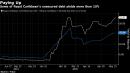
    Behind Royal Caribbean’s Lifeline, a Shrewd Bond Market Maneuver(Bloomberg) — Royal Caribbean Cruises Ltd. was in a quandary.The company needed to raise money while its ships were docked amid the Covid-19 pandemic, and the bond market was open if Royal Caribbean was willing to mortgage ships as collateral. Similar deals had worked for rivals like Viking Cruises and Norwegian Cruise Line Holdings Ltd.Royal Caribbean had plenty of ships to offer. The problem? S&P Global Ratings had slashed its credit grade to junk, and the cruise company was expecting Moody’s Investors Service to follow. With those downgrades came steep restrictions on how much of its assets could be pledged to bondholders. The firm knew it needed more than the $1.66 billion of secured debt it would be permitted to raise to get through the crisis.Miami-based Royal Caribbean ultimately found a new structure that would let it sell more than $3 billion of debt linked to ships without running afoul of restrictions known as covenants embedded in its existing debt documents. It sold half of the debt as a traditional secured offering, and gave investors priority guarantees in the form of ship stock pledges for the rest.“We felt this was a creative way to access liquidity,” Chief Financial Officer Jason Liberty said in an interview with Bloomberg. “Investors knew we were securing with very strong assets, while we kept the flexibility to go back for more liquidity if we need to.” The company plans to regain its investment-grade ratings as soon as it can, he added.A representative for Morgan Stanley, which led the deal, declined to comment.Secured CatchThe Royal Caribbean offering highlights a challenge that an unprecedented number of so-called “fallen angels” may face as they seek funding as high-yield companies after losing investment-grade ratings. Some have especially strict covenants that can make selling secured debt difficult. A record 24 companies have lost high-grade status this year, according to S&P, and another 111 worldwide remain at risk of being junked.“Investor appetite for the Royal Caribbean deal might encourage similar deals like this going forward,” said Alexander Diaz-Matos, an analyst at credit research firm Covenant Review. “I think the lawyers are examining the documents now and seeing what they can do.”When Royal Caribbean began marketing its $3.32 billion offering last Wednesday, it said the deal was secured. But there was a catch laid out to investors as a footnote in deal documents: Only half of the bonds were actually backed by assets including 28 of the cruise liner’s ships worth around $12 billion, according to people with knowledge of the matter who asked not to be named discussing a private transaction. If an investor purchased $10 million of the offering, they would effectively receive $5 million of secured bonds and $5 million of unsecured debt.Read more: When United pawned old jets, bond traders sent a stark warningFew investors would be willing to take on unsecured bonds — which are further back in line for repayment in a bankruptcy or restructuring scenario — linked to an industry in crisis. Money managers have even turned up their noses at collateral they view as less than pristine. United Airlines Holdings Inc. yanked a bond offering earlier this month amid investor concern that the planes backing the debt were too old.Priority GuaranteesTo create more investor protections, Royal Caribbean gave buyers priority guarantees in the form of stock pledges tied to the units that owned each ship. That effectively put investors second in line, behind themselves, to access remaining ship collateral if the company fell into even harder times.If Royal Caribbean recoups its high-grade rating, all $3.32 billion of bonds will become secured in the traditional sense. But in the meantime, investors have what amounts to second-dibs on the ships, and the vessels aren’t pledged to any other piece of debt.The gambit paid off for Royal Caribbean: Investors put in enough orders for the bonds to let the firm trim the coupon it offered to pay on its three-year debt, and it’s using proceeds from the offering to repay a short-term loan and keep additional cash on hand.The new debt did come at a price. The three-year bond priced to yield 11.7%, and its five-year bond an even steeper 12.3%. But the firm would likely pay far more to sell unsecured bonds, if it could find buyers at all. One 5.25% unsecured bond the company sold in 2012 now yields more than 20%.If the coronavirus travel halt continues longer than expected, Royal Caribbean could try to tap the capital markets again for cash, according to the people. Under terms of its debt agreements, the company can raise as much as $3 billion between convertible debt and also bonds using a similar deal structure, one of the people said.Royal Caribbean is burning through $250 million to $275 million of cash per month but has sufficient liquidity to last at least 12 months, according to preliminary earnings released last week.For more articles like this, please visit us at bloomberg.comSubscribe now to stay ahead with the most trusted business news source.©2020 Bloomberg L.P.

    from Yahoo Finance https://ift.tt/3dRXbLK

  • The list of market resources pinned to the top of the sub has been updated!

  • Financial statement inaccuracy

  • PFE | Pfizer and German partner BioNTech SE said Tuesday they’ve begun delivering doses of their coronavirus vaccine to US candidates with trials in Germany already underway.

  • PFE | Pfizer and German Parker BioNTech SE have begun delivering doses of their coronavirus vaccine for human testing US, trials in Germany already underway.