• How much is needed in superannuation for $1,500 in weekly passive income?

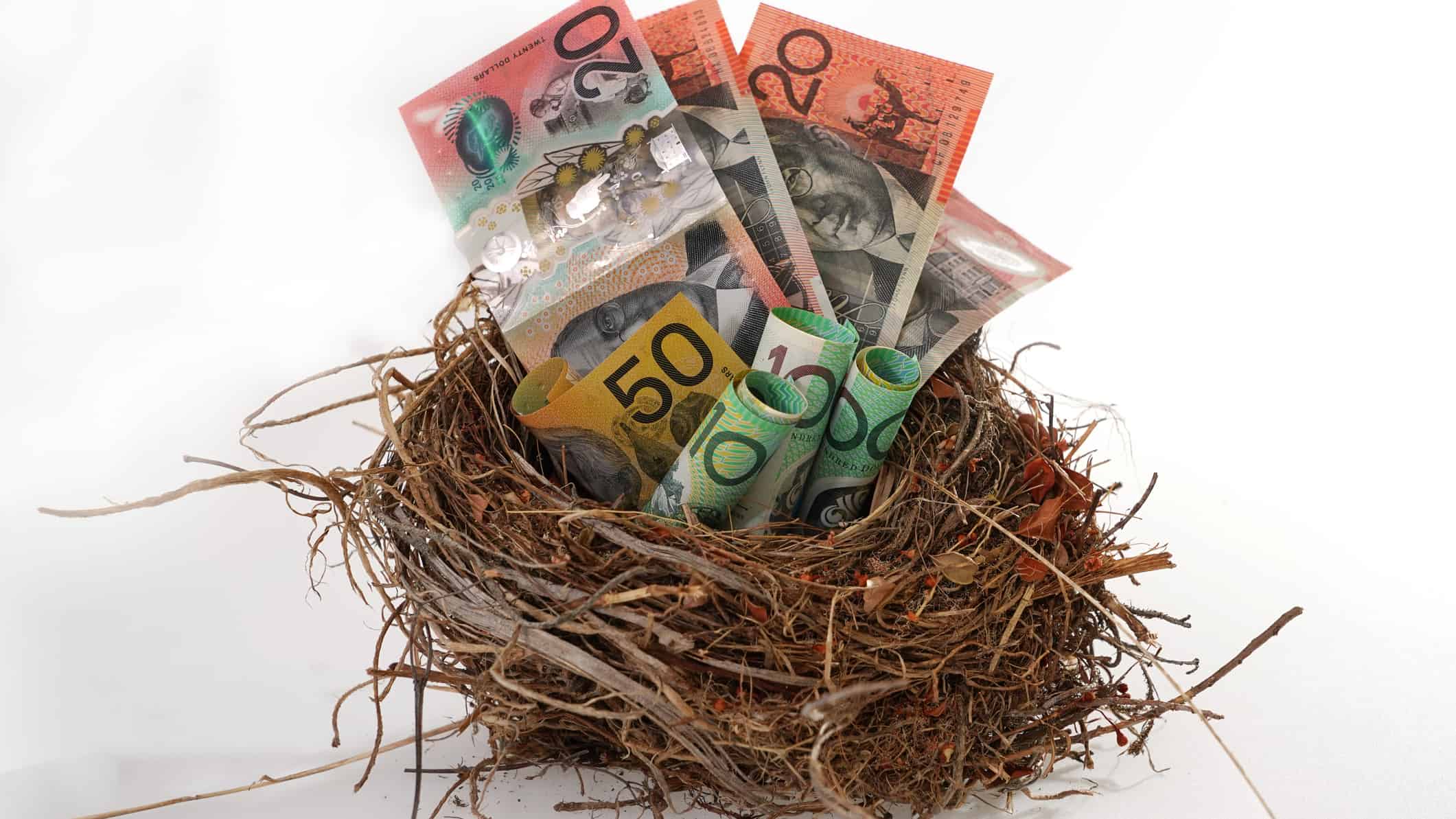
    Australian dollar notes in a nest, symbolising a nest egg.

    Knowing with reasonable certainty how much income you can expect to draw from your superannuation in retirement makes it possible to approach this major life change with confidence.

    Having a goal in mind and planning to hit that goal is essential, and the earlier you start, the better.

    Aiming for $1,500 per week in retirement income will provide a comfortable retirement, at least as measured by the Association of Superannuation Funds of Australia, which estimates that singles will need $55,923 per year to fund a comfortable retirement.

    This so-called retirement standard assumes you own your own home and will draw a part pension when you become eligible at age 67.

    How much do you need in superannuation to hit the $1,500 target?

    But let’s assume for the sake of argument that you are aiming to generate $1500 per week, or $78,000 per year, in retirement income from dividends alone, without drawing down on your invested capital.

    How much you’ll need invested to achieve this target depends on how much you can reliably expect to generate in terms of dividend yield.

    If you are generating 10% a year – a lofty ambition and likely unsustainable – you’d need $780,000 in retirement savings.

    If you were generating just 5% a year, you would need double this amount, or $1.56 million.

    Considering that retirees get the benefit of franking credits on top of the base dividend yield from a share, as long as the share is franked, I’d argue that 5% is very much on the low side.

    A goal of 7.5% is likely quite achievable and would require a superannuation savings amount of $1.04 million.

    Which shares can generate sufficient returns?

    There are a lot of shares you might consider that pay healthy dividends.

    Infrastructure companies such as toll road owner Atlas Arteria Ltd (ASX: ALX) often pay strong dividends, with Atlas forecast by Macquarie to pay a yield of better than 8% out to FY28.

    Rail freight operator Aurizon Holdings Ltd (ASX: AZJ) also pays a good dividend, currently running at 6.28%.

    Real estate investment trusts also often have steady long-term businesses, with Waypoint REIT (ASX: WPR) paying a 7.19% dividend yield and HomeCo Daily Needs REIT (ASX: HDN) paying 7.78%.

    And among the banks, Westpac Banking Corp (ASX: WBC) is paying 4.45% fully franked, while Bank of Queensland Ltd (ASX: BOQ) is paying 6.12% also fully franked.

    How to boost your superannuation balance

    If you’re a bit low on your superannuation at the moment, consider either salary sacrificing into your super or making a concessional contribution.

    This year, the concessional contributions cap has increased to $32,500, meaning you can contribute up to this amount and pay only 15% tax. However, keep in mind that the $32,500 level includes any contributions made by your employer and any salary sacrifice amounts.

    The post How much is needed in superannuation for $1,500 in weekly passive income? appeared first on The Motley Fool Australia.

    Should you invest $1,000 in Atlas Arteria right now?

    Before you buy Atlas Arteria shares, consider this:

    Motley Fool investing expert Scott Phillips just revealed what he believes are the 5 best stocks for investors to buy right now… and Atlas Arteria wasn’t one of them.

    The online investing service he’s run for over a decade, Motley Fool Share Advisor, has provided thousands of paying members with stock picks that have doubled, tripled or even more.*

    And right now, Scott thinks there are 5 stocks that may be better buys…

    * Returns as of 1 August 2026

    .custom-cta-button p {
    margin-bottom: 0 !important;
    }

    More reading

    Motley Fool contributor Cameron England has no position in any of the stocks mentioned. The Motley Fool Australia’s parent company Motley Fool Holdings Inc. has positions in and has recommended Macquarie Group. The Motley Fool Australia has recommended HomeCo Daily Needs REIT and Macquarie Group. The Motley Fool has a disclosure policy. This article contains general investment advice only (under AFSL 400691). Authorised by Scott Phillips.


  • Down 15%: Is it a good time to buy Wesfarmers shares?

    Woman with her kitten on a laptop in her home office.

    Wesfarmers Ltd (ASX: WES) shares have fallen around 15% over the past month.

    At roughly $77.08, they are now much closer to their 52-week low than their recent peak.

    I think the pullback has created a better opportunity to buy one of the ASX’s highest-quality businesses.

    The businesses are still the main attraction

    Wesfarmers owns a collection of market-leading businesses, including Bunnings, Kmart, Officeworks, and Priceline through Wesfarmers Health.

    For me, Bunnings remains the standout. Its scale, store network, brand recognition, and relationships with suppliers have taken decades to build. Home improvement spending can move around with economic conditions, but Australians will continue repairing, renovating, and maintaining their homes over the long term.

    Kmart has also developed a strong position around affordable everyday products. Its ability to source and develop its own ranges gives consumers a clear reason to keep returning.

    I like owning a company with several established businesses capable of producing cash while management continues looking for new areas to invest.

    Wesfarmers shares have pulled back

    Wesfarmers has rarely looked cheap, and it still does not today.

    According to consensus estimates, earnings per share are forecast to rise from $2.72 in FY27 to $2.90 in FY28 and $3.11 in FY29.

    At $77.08, that puts the shares on a PE ratio of roughly 28 times forecast FY27 earnings, falling to around 25 times FY29 earnings.

    That is still a premium valuation. But consider where investors were only recently. At the 52-week high of $94.70, the same FY27 earnings forecast would have put Wesfarmers on almost 35 times earnings.

    I find the current price much easier to justify. Quality businesses rarely spend much time trading at obviously cheap valuations. I am more interested in whether the price gives me a reasonable chance to benefit from years of earnings growth.

    I think it does now.

    There is income along the way

    The dividend outlook also moves in the right direction.

    Consensus forecasts point to dividends per share of $2.34 in FY27, $2.49 in FY28, and $2.71 in FY29.

    At today’s price, that starts with a forecast dividend yield of around 3%, with the potential for income to rise if those estimates are achieved.

    I would not buy Wesfarmers primarily for the dividend, but steadily increasing payments can add to the long-term return.

    Foolish takeaway

    The 15% fall has made Wesfarmers shares considerably more interesting to me.

    I am still paying a premium, so this is not a bargain-hunting exercise. I am paying for strong businesses, capable management, and an earnings outlook that points higher over the next few years.

    At around $77.08, I think the balance between quality and price has improved enough to make Wesfarmers a buy.

    The post Down 15%: Is it a good time to buy Wesfarmers shares? appeared first on The Motley Fool Australia.

    Should you invest $1,000 in Wesfarmers right now?

    Before you buy Wesfarmers shares, consider this:

    Motley Fool investing expert Scott Phillips just revealed what he believes are the 5 best stocks for investors to buy right now… and Wesfarmers wasn’t one of them.

    The online investing service he’s run for over a decade, Motley Fool Share Advisor, has provided thousands of paying members with stock picks that have doubled, tripled or even more.*

    And right now, Scott thinks there are 5 stocks that may be better buys…

    * Returns as of 1 August 2026

    .custom-cta-button p {
    margin-bottom: 0 !important;
    }

    More reading

    Motley Fool contributor Grace Alvino has positions in Wesfarmers. The Motley Fool Australia’s parent company Motley Fool Holdings Inc. has positions in and has recommended Wesfarmers. The Motley Fool Australia has recommended Wesfarmers. The Motley Fool has a disclosure policy. This article contains general investment advice only (under AFSL 400691). Authorised by Scott Phillips.

  • How to earn $10,000 in passive income a month with these ASX dividend shares

    Happy businessman fist pumping while looking at a tablet.

    ASX dividend shares can absolutely produce $10,000 a month, but it does take quite a bit of capital to invest.

    $10,000 per month, or $120,000 per year, is roughly double the median full-time Australian wage.

    Getting there requires a large amount of capital, a reasonable yield, and the patience to leave both alone.

    Here is the actual maths, using three holdings I would happily build that income around.

    Three ASX dividend shares to build the income

    Telstra Group Ltd (ASX: TLS) is the defensive anchor.

    Telstra shares closed Monday at $4.63 and yielded 4.56%, with franking running at roughly 90%.

    FY26 delivered EBITDAaL of $8.2 billion and a fresh $1 billion buyback, alongside a full-year dividend of 21 cents per share.

    The shares have fallen 7.03% over twelve months and now sit close to their 52-week low of $4.56.

    APA Group (ASX: APA) does the heavy lifting on yield.

    The company closed at $10.83 with a 5.39% distribution yield and a market capitalisation of $14.42 billion.

    FY26 underlying EBITDA rose 8.3% to $2,183 million and free cash flow increased 3.2% to $1,118 million.

    The FY26 distribution was 58.0 cents per security, and management has guided to 59.0 cents in FY27.

    The important caveat is that APA’s distributions are only partially franked, at around 31%.

    Vanguard Australian Shares High Yield ETF (ASX: VHY) provides the diversification.

    It holds 92 companies led by the major banks and BHP, and Vanguard forecasts a yield of 4.2%, or 5.5% once franking credits are counted.

    Units closed Monday at $85.61.

    The maths on $10,000 a month

    Spread evenly across the three, the cash yield averages 4.72%.

    To generate $120,000 a year at that rate, you need roughly $2.54 million invested.

    Franking credits change the picture slightly.

    With franking credits taken into account, Telstra’s payout grosses up to about 6.33% and APA’s to roughly 6.11%, while VHY reaches 5.5%.

    The blended grossed-up yield is close to 5.98%, which brings the capital requirement down to about $2.01 million.

    Whether you can actually use those credits depends on your marginal tax rate, and for many retirees in pension phase they are refundable in full.

    Why these ASX dividend shares and not the banks

    The instinct for most income investors is to buy the big four and stop thinking.

    Commonwealth Bank of Australia (ASX: CBA) currently yields 3.21%.

    At that rate, $120,000 a year would require $3.74 million.

    Telstra and APA are not more exciting businesses than the banks, but they pay materially more per dollar invested.

    APA in particular has now raised its distribution for 22 consecutive years, which matters more than any single year’s yield.

    A payment growing at 1.7% a year, as guided for FY27, is not inflation-beating on its own.

    Combined with reinvestment, though, it compounds into something serious across two decades.

    What could go wrong

    Yield is never a promise.

    Telstra shares have fallen 7% over the year, so a stable dividend has still meant a weaker total return.

    APA carries substantial debt, which is the standard trade-off in regulated infrastructure and becomes more expensive if the Reserve Bank raises the cash rate on 29 September.

    Foolish takeaway

    Nobody reaches $10,000 a month in a single step.

    The realistic path is contributing consistently, reinvesting every distribution, and letting two decades do the work.

    A $2 million portfolio sounds impossible until you model it as thirty years of steady contributions inside a growing market.

    These three holdings would form a sensible core for that portfolio.

    For anyone building toward that number, ASX dividend shares remain the most straightforward income engine on the local market.

    The post How to earn $10,000 in passive income a month with these ASX dividend shares appeared first on The Motley Fool Australia.

    Should you invest $1,000 in Commonwealth Bank Of Australia right now?

    Before you buy Commonwealth Bank Of Australia shares, consider this:

    Motley Fool investing expert Scott Phillips just revealed what he believes are the 5 best stocks for investors to buy right now… and Commonwealth Bank Of Australia wasn’t one of them.

    The online investing service he’s run for over a decade, Motley Fool Share Advisor, has provided thousands of paying members with stock picks that have doubled, tripled or even more.*

    And right now, Scott thinks there are 5 stocks that may be better buys…

    * Returns as of 1 August 2026

    .custom-cta-button p {
    margin-bottom: 0 !important;
    }

    More reading

    Motley Fool contributor Mark Verhoeven has no position in any of the stocks mentioned. The Motley Fool Australia’s parent company Motley Fool Holdings Inc. has no position in any of the stocks mentioned. The Motley Fool Australia has positions in and has recommended Apa Group and Telstra Group. The Motley Fool Australia has recommended Vanguard Australian Shares High Yield ETF. The Motley Fool has a disclosure policy. This article contains general investment advice only (under AFSL 400691). Authorised by Scott Phillips.

Sorry, but nothing was found. Please try a search with different keywords.