
Tag: Fool

  • 3 high-quality ASX 200 shares to buy forever

    Business women working from home with stock market chart showing per cent change on her laptop screen.

    One of the best ways to grow your wealth is arguably to invest in high quality companies with a long-term view.

    The latter gives your investment time to compound and supercharge your returns and wealth creation.

    As for the former, they say the cream always rises to the top. And this is usually the case in the share market with the very best companies delivering the best returns over the long term.

    But which ASX 200 shares could be classed as high quality? Let’s look at three that could be buys according to analysts. They are as follows:

    CSL Limited (ASX: CSL)

    CSL could be one of the highest quality companies on the ASX boards. It is one of the world’s leading biotechnology companies with a collection of businesses that are leaders in the respective fields. This includes CSL Behring, CSL Vifor, and Seqirus businesses, which focus on blood plasma products, kidney therapies, and vaccines, respectively.

    But CSL is never one to rest on its laurels. Each year it reinvests in the region of 12% back into its research and development activities. This ensures that it has a pipeline of potentially lucrative treatments.

    Macquarie is a big fan of the company sees scope for its shares to rise to $500 in the coming years. But in the immediate term, the broker has an outperform rating and $330.00 price target on them.

    Goodman Group (ASX: GMG)

    A second high quality ASX 200 share for investors to look at is Goodman Group. It is a leading integrated commercial and industrial property company with a world class portfolio of assets in key locations across the globe.

    Strong demand for these assets has underpinned stellar earnings growth over the last decade. The good news is that Morgan Stanley thinks this positive form can continue. Especially given its belief that Goodman’s exposure to artificial intelligence through its data centre pipeline will be another driver of future growth.

    Morgan Stanley currently has an overweight rating and $36.65 price target on its shares.

    ResMed Inc. (ASX: RMD)

    Bell Potter thinks that this sleep disorder treatment company could be a high quality ASX 200 share to buy.

    The broker likes ResMed due to its significant opportunity as a leader in obstructive sleep apnoea (OSA) and other sleep disorders. It notes that “the market for OSA and chronic obstructive pulmonary disease (COPD) remains under penetrated, and we expect industry volume growth to continue in the 6-8% range for the foreseeable future.”

    This bodes well for its sales and earnings growth over the next decade. Particularly given that one of its key rivals has been battling a major product recall.

    Bell Potter has a buy rating and $36.00 price target on its shares.

    The post 3 high-quality ASX 200 shares to buy forever appeared first on The Motley Fool Australia.

    Should you invest $1,000 in CSL right now?

    Before you buy CSL shares, consider this:

    Motley Fool investing expert Scott Phillips just revealed what he believes are the 5 best stocks for investors to buy right now… and CSL wasn’t one of them.

    The online investing service he’s run for over a decade, Motley Fool Share Advisor, has provided thousands of paying members with stock picks that have doubled, tripled or even more.*

    And right now, Scott thinks there are 5 stocks that may be better buys…

    See The 5 Stocks
    *Returns as of 5 May 2024

    More reading

    Motley Fool contributor James Mickleboro has positions in CSL and ResMed. The Motley Fool Australia’s parent company Motley Fool Holdings Inc. has positions in and has recommended CSL, Goodman Group, Macquarie Group, and ResMed. The Motley Fool Australia has positions in and has recommended Macquarie Group and ResMed. The Motley Fool Australia has recommended CSL and Goodman Group. The Motley Fool has a disclosure policy. This article contains general investment advice only (under AFSL 400691). Authorised by Scott Phillips.


  • If I’d put $5,000 into DroneShield shares just 1 year ago, here’s what I’d have now

    A smiling woman with a handful of $100 notes, indicating strong dividend payments

    If I had invested $5,000 into DroneShield Ltd (ASX: DRO) shares a year ago, I would be laughing all the way to the bank now.

    That’s because during the last 12 months, the counter drone technology company’s shares have been among the very best performers on the Australian share market.

    To demonstrate just how successful an investment in DroneShield has been, let’s take a look and see what a $5,000 investment a year ago would be worth now.

    $5,000 invested in DroneShield shares

    Investors that were savvy enough to invest into the company’s shares in June 2023, would have been able to snap them up for 24 cents a piece.

    This means that with $5,000 to invest, I would have been able to acquire approximately 20,833 shares in the high-flying share.

    As of yesterday’s close, DroneShield shares were changing hands for $1.37 each. This means that those 20,833 units now have a market value of $28,541.21.

    That’s a whopping return on investment of $23,541.21, which is almost five times your original outlay.

    Why has it been such a good investment?

    DroneShield’s rise is not entirely surprising. In fact, I named it as one of my top ten ASX shares to buy in 2024 due to how well-positioned it is to benefit from the increasing demand for counterdrone systems.

    In the company’s annual report, its chairman summarised why demand is surging for its technology. Peter James said:

    Drones and counterdrone systems are now used in every conflict globally, including the Ukraine war, Hamas attacks on Israel, Houthi attacks in the Red Sea, and most recently, the attacks on the U.S. bases in Jordan which killed 3 and injured over 30. Significant non-military use cases for drones continue for the intelligence community, airports, prisons, border security, stadiums, and other facilities. Nefarious use of drones is a global and rapidly rising threat, with DroneShield providing a proven market leading suite of solutions, directly and via its network of 70+ in-country partners globally.

    DroneShield has also let its results do the talking for it. During the first quarter of FY 2024, the company’s revenue increased 10x over the prior corresponding period to $16.4 million.

    Since then, it has been able to raise $100 million from investors through a capital raising.

    The proceeds from this will be used to capitalise on strong momentum experienced in the first quarter and favourable geopolitical environment. Management also noted that it has a sales pipeline of over $500 million, with over 90 qualified projects at different stages with high quality government customers.

    All in all, it’s no wonder that DroneShield shares are the talk of the town right now. Here’s hoping its run can continue.

    The post If I’d put $5,000 into DroneShield shares just 1 year ago, here’s what I’d have now appeared first on The Motley Fool Australia.

    Should you invest $1,000 in Droneshield Limited right now?

    Before you buy Droneshield Limited shares, consider this:

    Motley Fool investing expert Scott Phillips just revealed what he believes are the 5 best stocks for investors to buy right now… and Droneshield Limited wasn’t one of them.

    The online investing service he’s run for over a decade, Motley Fool Share Advisor, has provided thousands of paying members with stock picks that have doubled, tripled or even more.*

    And right now, Scott thinks there are 5 stocks that may be better buys…

    See The 5 Stocks
    *Returns as of 5 May 2024

    More reading

    Motley Fool contributor James Mickleboro has no position in any of the stocks mentioned. The Motley Fool Australia’s parent company Motley Fool Holdings Inc. has positions in and has recommended DroneShield. The Motley Fool Australia has no position in any of the stocks mentioned. The Motley Fool has a disclosure policy. This article contains general investment advice only (under AFSL 400691). Authorised by Scott Phillips.

  • If I buy 1,000 ANZ shares, how much passive income will I receive?

    Man holding a calculator with Australian dollar notes, symbolising dividends.

    ANZ Group Holdings Ltd (ASX: ANZ) shares are traditionally a popular option for passive income investors.

    This isn’t surprising.

    After all, the banking giant regularly shares a good portion of its sizeable profits with its shareholders every six months.

    For example, in FY 2023, ANZ’s solid financial performance allowed the bank to pay an interim dividend of 81 cents per share and then a final dividend of 94 cents per share. The latter comprised an 81 cents per share dividend partially franked at 65% and an additional one-off unfranked dividend of 13 cents per share.

    This brought the total dividends for FY 2023 to 175 cents per share, which represents a dividend payout ratio of 71% of cash profit from continuing operations.

    But those dividends have been and gone. What sort of passive income could be coming next for investors that buy ANZ shares today? Let’s find out.

    Passive income from ANZ shares

    Let’s imagine that you buy 1,000 ANZ shares, let’s see what income you could receive from this sort of investment.

    With the ANZ share price currently trading at $28.78, it would set you back $28,780 to buy 1,000 units. That’s not a small investment but would it be worth it?

    Well, according to a note out of Goldman Sachs, its analysts expect the bank to pay shareholders dividends of $1.66 per share in FY 2024, FY 2025, and FY 2026.

    If Goldman is on the money with its estimates, this will mean passive income of $1,660 for investors over the next 12 months from their 1,000 ANZ shares.

    And given how Goldman expects ANZ to continue paying the same amount for the foreseeable future, you can likely expect to receive the same amount of income from your shares in the following 12 months.

    Should you invest?

    While Goldman Sachs has a buy rating on ANZ’s shares, its price target of $28.15 is actually lower than where they trade today.

    As a result, this could make it worth keeping your powder dry for the time being and waiting for a better entry point.

    Though, it is worth noting that Ord Minnett sees reasonable upside for the bank’s shares. Despite only having a hold rating, its price target of $31.00 implies potential upside of almost 8%.

    In addition, Ord Minnett agrees that a $1.66 per share dividend is coming this year, but expects an increase to $1,70 per share in FY 2025.

    The post If I buy 1,000 ANZ shares, how much passive income will I receive? appeared first on The Motley Fool Australia.

    Should you invest $1,000 in Australia And New Zealand Banking Group right now?

    Before you buy Australia And New Zealand Banking Group shares, consider this:

    Motley Fool investing expert Scott Phillips just revealed what he believes are the 5 best stocks for investors to buy right now… and Australia And New Zealand Banking Group wasn’t one of them.

    The online investing service he’s run for over a decade, Motley Fool Share Advisor, has provided thousands of paying members with stock picks that have doubled, tripled or even more.*

    And right now, Scott thinks there are 5 stocks that may be better buys…

    See The 5 Stocks
    *Returns as of 5 May 2024

    More reading

    Motley Fool contributor James Mickleboro has no position in any of the stocks mentioned. The Motley Fool Australia’s parent company Motley Fool Holdings Inc. has positions in and has recommended Goldman Sachs Group. The Motley Fool Australia has no position in any of the stocks mentioned. The Motley Fool has a disclosure policy. This article contains general investment advice only (under AFSL 400691). Authorised by Scott Phillips.

  • Guess which ASX tech stock could double in value

    Vanadium Resources share price person riding rocket indicating share price increase

    Investors with a high tolerance for risk might want to check out the ASX tech stock in this article.

    That’s because if analysts at Bell Potter are on the money with their recommendation, it could double your money for you over the next 12 months.

    Which ASX tech stock?

    The tech stock in question is environmental technology company Calix Ltd (ASX: CXL).

    It is focused on solving global challenges in industrial decarbonisation and sustainability. This includes CO2 mitigation, sustainable minerals processing, advanced batteries, biotechnology, and water treatment.

    Bell Potter highlights that Calix is commercialising and developing a range of environmentally friendly solutions for industry. These solutions are derived from its patented minerals processing technology, the Calix Flash Calciner (CFC). It notes that the CFC is a patented reinvention of the calcination process that produces very high surface area nano-active materials, without the safety concerns or high production costs of nanoparticles.

    In addition, Bell Potter points out that the technology can be used to separate and capture the CO2 by-product when decomposing carbonates into oxides, such as during the manufacture of cement and lime.

    The broker notes that this CFC technology can be adapted for a broad range of applications based on a variety of minerals. However, the company has prioritised solutions for five target areas with a combined addressable market of $70 billion.

    Big returns but high risk

    Bell Potter is cautiously positive on the company’s long-term outlook and has reaffirmed its speculative buy rating with a $2.40 price target. Based on its current share price of $1.17, this implies potential upside of 105% for this ASX tech stock over the next 12 months.

    To put that into context, a $10,000 investment in this stock today would turn into $20,500 if the broker is proven correct with its recommendation and valuation.

    Though, it is worth highlighting that you could just as easily lose half your money (or more) from a speculative investment like this. So, this is really one for only those with a very high tolerance for risk.

    Bell Potter concludes:

    CXL’s growing suite of CFC applications target global challenges, including decarbonisation of hard-to-abate industrial processes (lime, cement and steel making), and improvement to supply chain efficiency (lithium concentrate value adding). CXL represents a valuable sustainable investing opportunity for ESG-focussed investors. CXL is a development company with prospective operations and cash flows only. Our Speculative risk rating recognises this higher level of risk and volatility of returns.

    The post Guess which ASX tech stock could double in value appeared first on The Motley Fool Australia.

    Should you invest $1,000 in Calix Limited right now?

    Before you buy Calix Limited shares, consider this:

    Motley Fool investing expert Scott Phillips just revealed what he believes are the 5 best stocks for investors to buy right now… and Calix Limited wasn’t one of them.

    The online investing service he’s run for over a decade, Motley Fool Share Advisor, has provided thousands of paying members with stock picks that have doubled, tripled or even more.*

    And right now, Scott thinks there are 5 stocks that may be better buys…

    See The 5 Stocks
    *Returns as of 5 May 2024

    More reading

    Motley Fool contributor James Mickleboro has no position in any of the stocks mentioned. The Motley Fool Australia’s parent company Motley Fool Holdings Inc. has no position in any of the stocks mentioned. The Motley Fool Australia has no position in any of the stocks mentioned. The Motley Fool has a disclosure policy. This article contains general investment advice only (under AFSL 400691). Authorised by Scott Phillips.

  • Big bank bargain: Are this week’s tumbling ASX 200 bank shares a good buy?

    Friends at an ATM looking sad.

    ASX 200 bank shares delivered mixed results in the first half of 2024, and views on the sector’s outlook are also divided.

    The S&P/ASX 200 Banks Index (ASX: XBK) has had a notable year, up almost 13% year-to-date. Not yesterday, though. The banking basket slipped into the red by around 40 basis points at the close of trading on Wednesday.

    The big four banks — National Australia Bank Ltd (ASX: NAB), Australia and New Zealand Banking Group Ltd (ASX: ANZ), Commonwealth Bank of Australia (ASX: CBA), and Westpac Banking Corp (ASX: WBC) — were down less than 1% on Wednesday, but have trended lower generally these past three months.

    With the pullback, are ASX 200 bank shares still a smart investment?

    What’s happening with the big four ASX 200 bank shares?

    All four banking majors trended lower yesterday amid a broader market selloff. The benchmark S&P/ASX 200 Index (ASX: XJO) drifted around 0.5% into the red at Wednesday’s close, similar to the banking index.

    However, over the past year, investors who held ASX 200 bank shares have outperformed the broader market.

    The benchmark index has lifted around 1.5% in the past year. Meanwhile, the banking sector is up 12.5% – an 11% advantage.

    What are experts saying?

    Despite these gains, some analysts are concerned about valuations in the sector. Goldman Sachs is one of those parties. It believes offshore banks might be more attractive to those interested in the space.

    In 2015 for example, the average Australian bank’s return on equity (ROE) was among the highest globally, the broker notes.

    However, from 2015 to 2023, the ROE and return on tangible equity (ROTE) have declined significantly. Now, they rank among the lowest globally.

    Goldman Sachs states, “Australian banks now actually earn the lowest ROTE of global comparable banks.” This decline is due to compressed net interest margins and reduced low capital-intensive non-interest income.

    Goldman Sachs rates Commonwealth Bank and Westpac as sell. It cites valuation concerns and risks in technology disruption for the view on these two ASX 200 bank shares. “We don’t think [Commonwealth Bank] justifies the extent of its valuation premium to peers,” it noted in its sector analysis.

    It has a neutral rating on NAB due to the balance of solid fundamentals but challenging valuations. ANZ meanwhile gets a buy rating for its productivity benefits and improved profitability in its institutional business.

    Meanwhile, Airlie Funds Management has reportedly trimmed its position in CBA, supposedly “the most underweight CBA in the history of [the] fund”, according to The Australian Financial Review.

    This is despite shares in the banking giant climbing 28% in the last 12 months and last week nudging a 52-week closing high of $124.85.

    Citi has some positive comments on CBA — despite rating it a sell. It said the bank’s exposure to, and performance in, retail banking may be enough to “justify continued outperformance versus its peer group”, the AFR reports.

    Citi added ASX 200 banks look to be priced at a premium above “core earnings growth fundamentals”.

    Valuation concerns

    Despite poor ROE and ROTE performance, Australian banks’ price-to-book multiples remain high, making them some of the most expensive banks globally, Goldman Sachs explains.

    Australian banks are currently trading at the 96th percentile versus history on a ROE vs. price-to-book multiples basis. The valuation discrepancy has expanded despite weaker relative profitability.

    Here is the current list of consensus recommendations for each of the banking majors, with the respective number of buys making up that view:

    • ANZ – Hold (7 buys)
    • CBA – Sell (4 buys)
    • WBC – Hold (4 buys)
    • NAB – Hold (2 buys)
    • (All recommendations per CommSec)

    Notably, despite the consensus view, each of the ASX 200 banking shares still shows a drop in positivity.

    Takeout on ASX 200 bank shares

    ASX 200 bank shares have shown strong returns over the past year. However, investors are wise to be cautious, in my view. With concerns about overvaluation and economic headwinds, experts warn it’s essential to consider valuations and profitability in the sector.

    As always, you should consider your own personal financial circumstances before any investment decisions.

    The post Big bank bargain: Are this week’s tumbling ASX 200 bank shares a good buy? appeared first on The Motley Fool Australia.

    Should you invest $1,000 in Australia And New Zealand Banking Group right now?

    Before you buy Australia And New Zealand Banking Group shares, consider this:

    Motley Fool investing expert Scott Phillips just revealed what he believes are the 5 best stocks for investors to buy right now… and Australia And New Zealand Banking Group wasn’t one of them.

    The online investing service he’s run for over a decade, Motley Fool Share Advisor, has provided thousands of paying members with stock picks that have doubled, tripled or even more.*

    And right now, Scott thinks there are 5 stocks that may be better buys…

    See The 5 Stocks
    *Returns as of 5 May 2024

    More reading

    Motley Fool contributor Zach Bristow has no position in any of the stocks mentioned. The Motley Fool Australia’s parent company Motley Fool Holdings Inc. has no position in any of the stocks mentioned. The Motley Fool Australia has no position in any of the stocks mentioned. The Motley Fool has a disclosure policy. This article contains general investment advice only (under AFSL 400691). Authorised by Scott Phillips.

  • Buy and hold these ASX dividend shares until 2034

    Excited woman holding out $100 notes, symbolising dividends.

    If you want to make some buy and hold investments for your income portfolio, then it would be worth looking for ASX dividend shares with strong long-term outlooks.

    But which shares could deliver the goods for investors over the next decade? Let’s take a look at three quality options:

    APA Group (ASX: APA)

    APA Group could be a great buy and hold option for investors. Just ask its long term shareholders.

    They will tell you that the energy infrastructure company is on course to increase its dividend for the 20th consecutive year.

    The good news is that analysts at Macquarie believe this ASX dividend share can then continue this trend for the foreseeable future.

    The broker is forecasting dividends per share of 56 cents in FY 2024 and then 57.5 cents in FY 2025. Based on the current APA Group share price of $8.33, this equates to 6.7% and 6.9% dividend yields, respectively.

    Macquarie has an outperform rating and $9.40 price target on its shares.

    Coles Group Ltd (ASX: COL)

    Another ASX dividend share that could be a good buy and hold investment option is Coles.

    It is one of Australia’s big two supermarket operators. In addition, it has a significant liquor store network and a joint ownership in the Flybuys loyalty program.

    Combined, these businesses appear well-placed to support solid earnings and dividend growth over the long term.

    Morgans appears to believe this is the case and is forecasting fully franked dividends of 66 cents per share in FY 2024 and then 69 cents per share in FY 2025. Based on the current Coles share price of $16.97, this implies yields of approximately 3.9% and 4.1%, respectively.

    The broker has an add rating and $18.95 price target on its shares.

    Endeavour Group Ltd (ASX: EDV)

    A third ASX dividend share that could be a great buy and hold option is Endeavour. It is the liquor giant behind store brands such as BWS and Dan Murphy’s, as well as a large network of hotels.

    Goldman Sachs is very positive on the company due to its market leadership position and attractive valuation. It expects this to support the payment of fully franked dividends of approximately 21 cents per share in FY 2024 and then 22 cents per share in FY 2025. Based on the current Endeavour share price of $5.03, this will mean dividend yields of 4.2% and 4.4% yields, respectively.

    The broker currently has a buy rating and $6.30 price target on its shares.

    The post Buy and hold these ASX dividend shares until 2034 appeared first on The Motley Fool Australia.

    Should you invest $1,000 in Apa Group right now?

    Before you buy Apa Group shares, consider this:

    Motley Fool investing expert Scott Phillips just revealed what he believes are the 5 best stocks for investors to buy right now… and Apa Group wasn’t one of them.

    The online investing service he’s run for over a decade, Motley Fool Share Advisor, has provided thousands of paying members with stock picks that have doubled, tripled or even more.*

    And right now, Scott thinks there are 5 stocks that may be better buys…

    See The 5 Stocks
    *Returns as of 5 May 2024

    More reading

    Motley Fool contributor James Mickleboro has positions in Endeavour Group. The Motley Fool Australia’s parent company Motley Fool Holdings Inc. has positions in and has recommended Goldman Sachs Group and Macquarie Group. The Motley Fool Australia has positions in and has recommended Apa Group, Coles Group, and Macquarie Group. The Motley Fool has a disclosure policy. This article contains general investment advice only (under AFSL 400691). Authorised by Scott Phillips.
  • Guess which ASX 200 stock just boosted its dividend payout ratio

    Man holding Australian dollar notes, symbolising dividends.

    Who doesn’t enjoy a boost to their income? Dividends are a big reason why many choose to invest. That’s why passive income chasers pay attention when an ASX 200 stock lifts its dividend payout ratio — bigger payments could be ahead.

    Yesterday, a $17 billion Australian company highlighted an increase in its payout ratio. The determination, shared in an investor briefing, follows an extended period of debt reduction by one of the country’s steadfast energy providers: Origin Energy Ltd (ASX: ORG).

    So, what does it mean for the back pockets of its shareholders?

    Dividends to take a bigger share of earnings pie

    Operating a utility company can be extremely capital-intensive. Just take a look at the gross margins of Origin and AGL Energy Limited (ASX: AGL). We’re talking respective margins of 20.8% and 28% before removing operating expenses.

    Nonetheless, utility companies can still offer a fountain of dividends. Nearly every household’s needs-based nature of electricity and gas provides a reliable income. For Origin Energy, it means investors can enjoy a dividend yield of 4.8% from this ASX 200 stock.

    But what about the increased dividend payout ratio?

    As per the investor briefing, Origin Energy will target a payout ratio of at least 50% of free cash flow.

    This is slightly different from what a standard dividend payout ratio reflects. Typically, this figure is based on the percentage of net income or net profit after tax (NPAT) paid as a dividend. Free cash flow differs from NPAT, representing the company’s operating cash flow minus its capital expenditures.

    Previously, Origin Energy’s targeted payout ratio was set between 30% and 50%.

    Does it mean more dividends from this ASX 200 stock?

    What really matters to most is whether it means more dollars hitting the account. Unfortunately, the answer to this is not as straightforward.

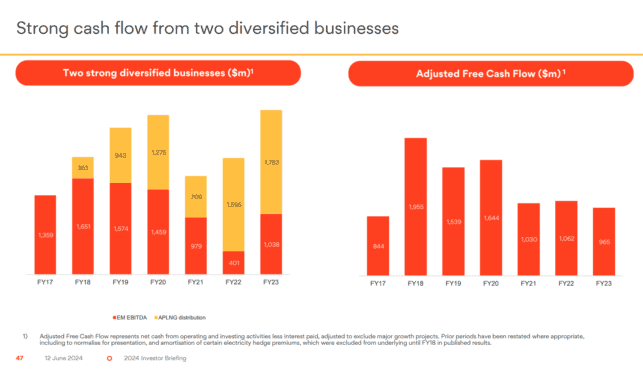
    While Origin’s payout ratio now has a higher minimum, future free cash flows (FCF) will be the deciding factor.

    Source: Origin Energy June Investor Briefing 2024

    As shown on the right-hand side of the image above, the energy company’s adjusted FCF have stagnated across the last three financial years. If Origin’s free cash flow were to fall in FY24, it could mean a bigger slice of a smaller pie.

    The share price of this ASX 200 stock is up 17.8% year-to-date.

    The post Guess which ASX 200 stock just boosted its dividend payout ratio appeared first on The Motley Fool Australia.

    Should you invest $1,000 in Origin Energy Limited right now?

    Before you buy Origin Energy Limited shares, consider this:

    Motley Fool investing expert Scott Phillips just revealed what he believes are the 5 best stocks for investors to buy right now… and Origin Energy Limited wasn’t one of them.

    The online investing service he’s run for over a decade, Motley Fool Share Advisor, has provided thousands of paying members with stock picks that have doubled, tripled or even more.*

    And right now, Scott thinks there are 5 stocks that may be better buys…

    See The 5 Stocks
    *Returns as of 5 May 2024

    More reading

    Motley Fool contributor Mitchell Lawler has no position in any of the stocks mentioned. The Motley Fool Australia’s parent company Motley Fool Holdings Inc. has no position in any of the stocks mentioned. The Motley Fool Australia has no position in any of the stocks mentioned. The Motley Fool has a disclosure policy. This article contains general investment advice only (under AFSL 400691). Authorised by Scott Phillips.

  • Why QBE shares could deliver huge returns for investors that buy them today

    QBE Insurance Group Ltd (ASX: QBE) shares have been in fine form over the last 12 months.

    During this time, the insurance giant’s shares have stormed 22% higher.

    This is almost triple the return of the ASX 200 index over the same period.

    Can QBE shares keep rising?

    The good news for investors is that it isn’t too late to invest according to analysts at Goldman Sachs.

    According to a note, its analysts have retained their buy rating and $20.90 price target on the company’s shares.

    Based on its current share price of $18.32, this implies potential upside of 14% for investors over the next 12 months.

    In addition, the broker is forecasting dividend yields of 5%+ each year through to at least FY 2026. This boosts the total potential 12-month return to approximately 19%.

    If this proves accurate, it would turn a $10,000 investment into approximately $11,900 if you reinvest the dividends.

    Why is the broker bullish?

    Goldman notes that the insurance giant has recently held a number of investor meetings. It was pleased with what management said, highlighting that it is confident in can deliver a combined operating ratio (COR) of 95% in North America by 2025. As a reminder, anything below 100% is profitable for insurers.

    In light of this, the broker believes that there is upside risk to consensus COR estimates. It said:

    In this context, we flag 1) Upside risk to FY25 consensus COR of 92.8% (VA) – we see <92.5% as possible reflecting improvement from North America non core + organic upside. 2) North America non core run off we think could support ~0.7% -1.2% improvement to Group COR alone. 3) Organic trends also suggest possible underlying COR expansion into FY25.

    Goldman also highlights a number of other key items and reasons why it thinks QBE shares could re-rate higher from here. It adds:

    Rate increases earning through FY25 versus moderating claims inflation expected to remain supportive into FY25 – 1Q24 Group rate was 7.3% versus inflation assumption of 5% for FY24. b) Reinsurance markets increasingly more positive with commentary from 1 June renewals suggest lower rates (particularly in upper layers) which are supportive of direct insurer margins and positive read into 2025. c) QBE’s 2024 perils allowance was rebased to an 80% probability of sufficiency (out of the last 10 years) perhaps suggesting less pressure into FY25 and perils growth more in line with book. Perils experience to date has been below expectations. d) All in, there appears to be strong COR tailwinds to offset moderating yield pressures which is supportive of ROE / Valuation into FY25. 4) Valuation comparison versus global peers also suggests upside for QBE across P/E and P/B particularly in context of strong ROE.

    The post Why QBE shares could deliver huge returns for investors that buy them today appeared first on The Motley Fool Australia.

    Should you invest $1,000 in Qbe Insurance right now?

    Before you buy Qbe Insurance shares, consider this:

    Motley Fool investing expert Scott Phillips just revealed what he believes are the 5 best stocks for investors to buy right now… and Qbe Insurance wasn’t one of them.

    The online investing service he’s run for over a decade, Motley Fool Share Advisor, has provided thousands of paying members with stock picks that have doubled, tripled or even more.*

    And right now, Scott thinks there are 5 stocks that may be better buys…

    See The 5 Stocks
    *Returns as of 5 May 2024

    More reading

    Motley Fool contributor James Mickleboro has no position in any of the stocks mentioned. The Motley Fool Australia’s parent company Motley Fool Holdings Inc. has positions in and has recommended Goldman Sachs Group. The Motley Fool Australia has no position in any of the stocks mentioned. The Motley Fool has a disclosure policy. This article contains general investment advice only (under AFSL 400691). Authorised by Scott Phillips.

  • Down 9% in a year, is it time to buy this ASX 200 dividend stock?

    Woman smiling with her hands behind her back on her couch, symbolising passive income.

    The Steadfast Group Ltd (ASX: SDF) share price has dropped 8.9% over the past 12 months to close at $5.41 on Wednesday. The insurance broker’s shares have underperformed the S&P/ASX 200 Index (ASX: XJO), which is up 8% over the past year.

    The following chart shows that the Steadfast share price has exhibited little volatility. Over the last 10 years, the maximum drop from the high price to the low has been 16%, except in March 2020 during the height of the COVID-19 pandemic.

    While past share price movements don’t predict future trends, the resilient performance of the Steadfast share price seems to be supported by its strong fundamentals, in my view.

    So, is this a buying opportunity for this consistent dividend payer?

    Strong business fundamentals

    Steadfast Group is Australia’s largest general insurance broker network, providing businesses and individuals with a broad range of insurance products and services. The company operates through a network of brokerages, offering risk management solutions and support to its members. Steadfast also has interests in underwriting agencies, giving it a diversified presence in the insurance industry.

    Steadfast reported a robust set of numbers in its 1H FY24 results. Underlying revenue rose 19.4% to $790.4 million, and underlying earnings before interest, tax, and amortisation (EBITA) soared by 21.4% to $229 million. While acquisitions supported the growth during the reporting period, the organic growth was also strong at 13.4%.

    Its underlying net profit after tax (NPAT) increased by 17.5% to $106 million, while statutory NPAT rose similarly by 18.5% to $100 million. On a per-share basis, underlying diluted earnings rose 12.2% to 10.2 cents per share (cps).

    Steadfast’s pricing power and volume growth underscored the strong results, while the company attributes its acquisition strategies as key to success. Managing director & CEO Robert Kelly explained:

    Once again, our underlying earnings growth for the half year was driven by sustained organic growth from higher prices from insurers and volume increases in the Group’s insurance broking and underwriting agencies, and continued delivery of our acquisition strategy.

    Consistent with our growth strategy, Steadfast Group acquired Sure Insurance, a business that is complementary to the existing portfolio. This acquisition, together with our Trapped Capital acquisitions made during the half year, further enhances Steadfast Group as the largest general insurance broker network and the largest group of insurance underwriting agencies in Australasia.

    Additionally, we are progressing well with the implementation of our US expansion strategy with the acquisition of ISU Group with its established and trusted network and experienced management team.

    For the full year in FY24, management guides for a 22% growth in its underlying EBITA and 18% in NPAT at the midpoint of its estimated range. Underlying diluted EPS growth is forecast to grow between 11% and 16%.

    Consistent dividend payer

    Among ASX investors, Steadfast is known for its steady increase in dividends.

    Encouraged by a 12.2% growth in its underlying EPS in its half-year FY24 results, the company raised its fully-franked dividend by 12.5% to 6.75 cps.

    Since its initial public offering in 2013, the company has consistently increased its dividend payments from 4.5 cps in FY14 to 15.75 cps in the last 12 months to March 2024. All these years, the company maintained 100% franking on its dividends, offering tax benefits to its shareholders. Its payout ratios have also increased over time, hovering around 60% to 75% in recent years.

    At the current share price, Steadfast shares offer a dividend yield of 2.9%.

    How expensive are Steadfast shares now?

    Steadfast shares are trading at 20x FY24’s estimated earnings, which is near the midpoint of its historical trading range of 13 to 25 times.

    Its smaller competitor, AUB Group Ltd (ASX: AUB), is trading at a similar multiple with a price-to-earnings ratio (PER) of 20 times based on FY24 earnings estimates provided by S&P Capital IQ.

    For comparison, NIB Holdings Limited (ASX: NHF) is trading at a PER of 16 on FY24 earnings estimates, noting nib is an insurance company, which is different from insurance brokers.

    Foolish takeaway

    While the Steadfast share price has been moving sideways, I think its business fundamentals remain strong.

    Based on its historical trading range and compared to its smaller peer, AUB Group, its shares appear to be inexpensive to me. I think it’s a good candidate for any portfolio seeking stable growth.

    The post Down 9% in a year, is it time to buy this ASX 200 dividend stock? appeared first on The Motley Fool Australia.

    Should you invest $1,000 in Steadfast Group Limited right now?

    Before you buy Steadfast Group Limited shares, consider this:

    Motley Fool investing expert Scott Phillips just revealed what he believes are the 5 best stocks for investors to buy right now… and Steadfast Group Limited wasn’t one of them.

    The online investing service he’s run for over a decade, Motley Fool Share Advisor, has provided thousands of paying members with stock picks that have doubled, tripled or even more.*

    And right now, Scott thinks there are 5 stocks that may be better buys…

    See The 5 Stocks
    *Returns as of 5 May 2024

    More reading

    Motley Fool contributor Kate Lee has no position in any of the stocks mentioned. The Motley Fool Australia’s parent company Motley Fool Holdings Inc. has no position in any of the stocks mentioned. The Motley Fool Australia has positions in and has recommended Steadfast Group. The Motley Fool has a disclosure policy. This article contains general investment advice only (under AFSL 400691). Authorised by Scott Phillips.

  • Woodside shares hit a multi-year low this week, should you buy?

    sad looking petroleum worker standing next to oil drill

    The Woodside Energy Group Ltd (ASX: WDS) share price hit a 52-week low this week, dropping to $26.99 on Tuesday. It could be a contrarian buy when resource and cyclical businesses hit lows. The Woodside share price is down around 20% in the past year, as shown on the chart below.

    It’s common for share prices of companies in sectors like iron ore or retail to be volatile over the years as investors react to what’s happening.

    As reported by my colleague Bernd Struben, the Organization of the Petroleum Exporting Countries and its partners (OPEC+) will lift production in October, with current production cuts removed by June 2025. Higher supply could result in lower prices.

    But, Struben also reported earlier this week that energy prices are rebounding, with the Brent crude oil price up to around US$82 per barrel (up from US$79.62 on Friday).  

    Is the Woodside share price a buy?

    Sometimes, the best time to buy a cyclical share is when there are numerous negatives which are expected to stick around the foreseeable future. It’s under those conditions where the share price can reach the most appealing low, making it the best time to invest.

    The company is one of the region’s biggest oil and gas businesses, so its scale provides it with several benefits, including solid profit margins and a sturdy balance sheet.

    I like the moves by the company to improve its balance sheet further. In the last few months, the company has completed the sale of a 10% stake in the Scarborough joint venture to LNG Japan for US$910 million, and it announced the sale of a 15.1% stake in the Scarborough joint venture to JERA for US$1.4 billion.

    We can’t know what energy prices will do in the short term, but unlocking some of the value of its projects is wise, in my opinion. It gives the company more funding for existing projects such as Trion while also giving it a cash pile for future projects, acquisitions and/or shareholder returns.

    Another recent positive for the business was that its Sangomar project achieved ‘first oil’, which will soon generate another stream of earnings for the company.

    My verdict

    With the lower Woodside share price, prospective investors can receive a larger dividend yield. The broker UBS currently projects that Woodside could pay an annual dividend per share of US$1.05, which translates into a grossed-up dividend yield of approximately 8%.

    If investors are interested in Woodside shares, this could be a good time to consider investing because of its lower valuation, the high projected dividend yield and the first oil achievement at Sangomar. But, some investors may not like the company because of the fossil fuel element.

    The post Woodside shares hit a multi-year low this week, should you buy? appeared first on The Motley Fool Australia.

    Should you invest $1,000 in Woodside Petroleum Ltd right now?

    Before you buy Woodside Petroleum Ltd shares, consider this:

    Motley Fool investing expert Scott Phillips just revealed what he believes are the 5 best stocks for investors to buy right now… and Woodside Petroleum Ltd wasn’t one of them.

    The online investing service he’s run for over a decade, Motley Fool Share Advisor, has provided thousands of paying members with stock picks that have doubled, tripled or even more.*

    And right now, Scott thinks there are 5 stocks that may be better buys…

    See The 5 Stocks
    *Returns as of 5 May 2024

    More reading

    Motley Fool contributor Tristan Harrison has no position in any of the stocks mentioned. The Motley Fool Australia’s parent company Motley Fool Holdings Inc. has no position in any of the stocks mentioned. The Motley Fool Australia has no position in any of the stocks mentioned. The Motley Fool has a disclosure policy. This article contains general investment advice only (under AFSL 400691). Authorised by Scott Phillips.