Tag: Fool

  • 3 lessons my seven-bagger ASX 200 stock has taught me

    A grey-haired mature-aged man with glasses stands in front of a blackboard filled with mathematical workings as he holds a pad of paper in one hand and a pen in the other and stands smiling at the camera.

    One of my early investments in an ASX 200 stock is now up 618%, increasing sevenfold. It’s been a five-year journey that has provided a wealth of teachings along the way.

    I’m a huge advocate of learning through doing. Nothing comes closer to the velocity and quality of education than what is gained by a baptism of fire. Hence, diving head-first into investing is, in my opinion, the best way to learn the art.

    Reading is the second-best way. You can save (or make) a lot of money by applying the lessons learned by others. While I won’t claim to be any Warren Buffett, a few educational treasures from my experience might help the next person land a multi-bagger stock pick of their own.

    Teachings from an ASX 200 healthcare stock

    Pro Medicus Limited (ASX: PME) has become one of Australia’s greatest home-grown corporate success stories. The medical imaging software company was listed on the ASX in 2000 for $1.15 per share. Today, shares are worth north of $127.

    I bought roughly $1,000 worth of this ASX 200 stock at a price of $17.75 in 2019.

    Here’s what holding those 58 shares in Pro Medicus for a 600%+ gain has taught me.

    Selling on valuation is a weak reason

    There are many reasons to part ways with an investment — being ‘expensive’ is arguably the worst. Now, there’s a caveat here. Actions that erode the quality of the business can turn it into an overpriced asset. However, a large price tag in isolation shouldn’t make a company too expensive by default.

    Warren Buffett, the world’s eighth richest person, once said, “Price is what you pay. Value is what you get.” Put differently, it matters what you’re getting for your money, not how much it is.

    Amazon share price and price-to-earnings (P/E) ratio. Data by Trading View.

    As shown above, Amazon.com Inc (NASDAQ: AMZN) shares traded on a price-to-earnings (P/E) ratio of about 300 times in late 2017. Yet, if an investor had sold on the premise of it being overvalued, they would have forgone the 217% rally since.

    Quality matters more than price. Selling Pro Medicus shares based on its high P/E multiple — above 200 at times — never crossed my mind because the quality remained intact.

    Don’t underestimate scalability

    I didn’t fully appreciate the value of a scalable business until investing in this ASX 200 stock. Pro Medicus is a perfect example of how valuable a scalable product can be to a company and its shareholders.

    The beauty of software, such as Pro Medicus’ Visage Imaging solution, is its incremental cost, which is oftentimes negligible. Furthermore, there’s no physical limitation to supplying increasing demand. If 50 new healthcare organisations wanted the software tomorrow, it would be nowhere near as difficult as supplying 50 companies with a fleet of Ford Rangers.

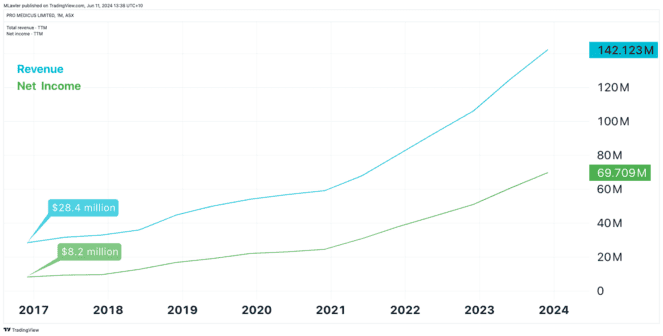
    This is at the core of what makes scalable companies so appealing. Scalable companies can grow from a small business into a big-timer in a short window of time. For example, Pro Medicus’ revenue and net income have increased fivefold and nearly ninefold in less than a decade, as shown below.

    Pro Medicus revenue and net income history. Data by Trading View.

    You don’t need lottery tickets to win big

    I know many aspiring investors who believe ‘taking a punt’ on a no-name company is the only way to achieve large gains in the stock market. Admittedly, I was one of them in my early days.

    Such thinking might lead one to believe that Pro Medicus was an unheard-of, probably unprofitable, company when I first invested in it. Yet, that couldn’t be any further from the truth.

    By March 2019, the ASX 200 stock generated $17.5 million in net profit after tax (NPAT) for the trailing 12 months at a 37.4% margin. It also had $32.3 million in cash (no debt) on its balance sheet. This is hardly reminiscent of a speculative mining explorer or drug developer.

    The lesson here is you don’t need to dumpster dive for tomorrow’s great companies. You can buy the great companies of today and save yourself the added risk of an unproven business.

    The post 3 lessons my seven-bagger ASX 200 stock has taught me appeared first on The Motley Fool Australia.

    Should you invest $1,000 in Pro Medicus Limited right now?

    Before you buy Pro Medicus Limited shares, consider this:

    Motley Fool investing expert Scott Phillips just revealed what he believes are the 5 best stocks for investors to buy right now… and Pro Medicus Limited wasn’t one of them.

    The online investing service he’s run for over a decade, Motley Fool Share Advisor, has provided thousands of paying members with stock picks that have doubled, tripled or even more.*

    And right now, Scott thinks there are 5 stocks that may be better buys…

    See The 5 Stocks
    *Returns as of 5 May 2024

    More reading

    John Mackey, former CEO of Whole Foods Market, an Amazon subsidiary, is a member of The Motley Fool’s board of directors. Motley Fool contributor Mitchell Lawler has positions in Pro Medicus. The Motley Fool Australia’s parent company Motley Fool Holdings Inc. has positions in and has recommended Amazon and Pro Medicus. The Motley Fool Australia has recommended Amazon and Pro Medicus. The Motley Fool has a disclosure policy. This article contains general investment advice only (under AFSL 400691). Authorised by Scott Phillips.

  • iShares S&P 500 ETF (IVV) inks all-time ASX high! Too late to buy?

    ETF spelt out on cube blocks with rising arrows.

    It’s been a disastrous start to the trading week for ASX shares so far this Tuesday. At the time of writing, the S&P/ASX 200 Index (ASX: XJO) has tanked by a horrid 1.56%, leaving the index at just under 7,740 points. But it’s been a very different story for the iShares S&P 500 ETF (ASX: IVV) today.

    Whilst the ASX 200 has been nosediving this Tuesday, the iShares S&P 500 ETF is exploding higher. At present, IVV units have risen by a robust 1.08% up to $54.19 each.

    Just after midday, things were even better for this ASX exchange-traded fund (ETF), with IVV units climbing to a high of $54.21 each.

    Not only is that a new 52-week high for the iShares S&P 500 ETF, but an all-time record high. Yep, since its ASX listing back in 2007, this index fund has never been more expensive than it is today.

    So how can we be seeing a new record high for this ASX ETF on a day that has seen the ASX 200 take such a bath from Australian investors?

    How has the IVV ETF just hit a new ASX record?

    Well, the first thing to note is that the iShares S&P 500 ETF has absolutely no correlation to the ASX or any ASX shares. Rather, it represents an investment in the largest 500 companies listed on the American stock market.

    As such, it’s not really surprising to see this ETF move in the opposite direction to most ASX shares this Tuesday.

    Last night, we saw the US markets rocket higher. The S&P 500 Index (SP: .INX) gained 0.26% to finish up at 5,360.799 points, which is just a tad below its current all-time high of 5,375.08 points.

    So it’s no wonder an S&P 500-tracking ETF is following suit on the ASX today.

    The S&P 500 Index (and thus the iShare S&P 500 ETF) counts the major US tech stocks as its largest holdings. So it was no surprise to see these tech giants grow in value during last night’s trade.

    To illustrate, Microsoft stock rose by 0.95% last night. Amazon shares grew 1.5%, while Alphabet‘s Class A stock was up 0.43%. NVIDIA shares bounced 0.75% higher, and Meta Platforms soared 1.96%.

    These companies are all top ten stocks within the IVV portfolio. So it’s easy to see why this ASX ETF is having such a stunning day on the ASX boards right now.

    Should investors buy?

    Many investors will be taking note of today’s fresh highs and no doubt wonder if it’s too late to buy in. So is it?

    Well, I like to take a long-term view with all investments, but particularly for index funds like IVV. Index funds, both those that cover ASX shares and those that track US shares, have a long history of delivering solid returns over decades. The iShares S&P 500 ETF is no different. As of 31 May, this ASX ETF has returned an average of 16.32% per annum over the past ten years.

    Now one should never assume that an investment’s past returns will dictate future gains. However, with that objectively high rate of return, this ETF would have seen plenty of record highs in years gone by. If an investor had put off deploying more cash into IVV units at any of its last all-time highs, they would probably be rueing that decision today.

    Will today’s new all-time high be different? I don’t know, and neither does anyone else. But if I were personally contemplating whether an investment at today’s all-time highs was prudent, I would remember this simple fact and go ahead. The stock market goes up far more often than it goes down. By that logic, it makes sense to invest as often as we can, as soon as we can.

    The post iShares S&P 500 ETF (IVV) inks all-time ASX high! Too late to buy? appeared first on The Motley Fool Australia.

    Should you invest $1,000 in Ishares S&p 500 Etf right now?

    Before you buy Ishares S&p 500 Etf shares, consider this:

    Motley Fool investing expert Scott Phillips just revealed what he believes are the 5 best stocks for investors to buy right now… and Ishares S&p 500 Etf wasn’t one of them.

    The online investing service he’s run for over a decade, Motley Fool Share Advisor, has provided thousands of paying members with stock picks that have doubled, tripled or even more.*

    And right now, Scott thinks there are 5 stocks that may be better buys…

    See The 5 Stocks
    *Returns as of 5 May 2024

    More reading

    Suzanne Frey, an executive at Alphabet, is a member of The Motley Fool’s board of directors. John Mackey, former CEO of Whole Foods Market, an Amazon subsidiary, is a member of The Motley Fool’s board of directors. Randi Zuckerberg, a former director of market development and spokeswoman for Facebook and sister to Meta Platforms CEO Mark Zuckerberg, is a member of The Motley Fool’s board of directors. Motley Fool contributor Sebastian Bowen has positions in Alphabet, Amazon, Meta Platforms, and Microsoft. The Motley Fool Australia’s parent company Motley Fool Holdings Inc. has positions in and has recommended Alphabet, Amazon, Meta Platforms, Microsoft, Nvidia, and iShares S&P 500 ETF. The Motley Fool Australia’s parent company Motley Fool Holdings Inc. has recommended the following options: long January 2026 $395 calls on Microsoft and short January 2026 $405 calls on Microsoft. The Motley Fool Australia has recommended Alphabet, Amazon, Meta Platforms, Microsoft, Nvidia, and iShares S&P 500 ETF. The Motley Fool has a disclosure policy. This article contains general investment advice only (under AFSL 400691). Authorised by Scott Phillips.
  • 3 overlooked numbers key to the Telstra share price

    A woman sits at her computer with her chin resting on her hand as she contemplates her next potential investment.

    The Telstra Group Ltd (ASX: TLS) share price is down approximately 20% since June 2024, as seen on the chart below. When an ASX blue-chip share has fallen so far, it’s useful to consider whether the market is being too pessimistic.

    The ASX telco share recently talked about troubles it’s experiencing with the enterprise division, though it is embarking on a cost-cutting program which is expected to see thousands of jobs cut.

    Telstra is expecting to achieve $350 million of its T25 cost reduction ambition by the end of FY25, though this comes with one-off restructuring costs of between $200 million to $250 million across FY24 and FY25.

    Amid this restructuring, I think investors shouldn’t forget about the three factors below.

    Revenue is still growing

    The company has a number of divisions, but the crown jewel mobile division continues to deliver for shareholders.

    In the FY24 first-half result, the business made earnings before interest, tax, depreciation and amortisation (EBITDA) of $4 billion, with the mobile division generating $2.5 billion of that overall EBITDA. Growth in this division is an important driver of the overall business.

    HY24 mobile services revenue increased 6% thanks to handheld services in operation (SIO) growth. HY24 mobile SIOs increased 4.6%, or 625,000, year over year.

    In the May update, Telstra revealed its mobile subscriber number growth for the first four months of the FY24 second half was “consistent with the first half of FY24”. In my opinion, that’s positive commentary.

    The fact that the Telstra share price is lower amid this growth suggests to me it’s better value.

    Profit is increasing

    I think the most important thing to keep in mind is a company’s ability to generate net profit after tax (NPAT) and/or cash flow. If the profit is regularly growing then this can support a higher Telstra share price in future years.

    In the HY24 result, Telstra’s NPAT rose 11.4% to $1 billion.

    I’m not expecting Telstra’s profit to grow every result, particularly with its one-off restructuring costs, but investing is about the long-term, and Telstra’s future looks appealing.

    For starters, Telstra recently reaffirmed its commitment to deliver its compound annual growth rate (CAGR) targets for underlying EBITDA, earnings per share (EPS) and return on invested capital (ROIC) growth.

    Telstra said in its May update that the growth of the mobile business has “underpinned” its EBITDA growth in FY24 to date. In FY25, Telstra is expecting underlying EBITDA to grow to between $8.4 billion and $8.7 billion.

    The broker Goldman Sachs thinks Telstra EPS can rise from 17.3 cents in FY24 to 20 cents in FY26. The ASX telco share’s rising profit could also fund a growing dividend if that’s what the board of directors decide to do with the increasing profitability.

    Data demand is rapidly climbing

    National data usage is growing rapidly in Australia (and globally). AI and data centres are driving a significant increase in data use and power demand, and Telstra is one of the main businesses that is helping transmit data into and around Australia.

    Household demand is growing thanks to online video streaming, VR, online gaming and so on.

    I believe there is a growing prospect that 5G (and eventually 6G) developments could help encourage households to use wireless-powered broadband rather than the NBN. This could unlock higher profit margins for telcos, which could help Telstra’s shares. In the FY24 first-half result, Telstra said its fixed wireless offering take-up doubled over 12 months, though that’s starting from a small number.

    The post 3 overlooked numbers key to the Telstra share price appeared first on The Motley Fool Australia.

    Should you invest $1,000 in Telstra Corporation Limited right now?

    Before you buy Telstra Corporation Limited shares, consider this:

    Motley Fool investing expert Scott Phillips just revealed what he believes are the 5 best stocks for investors to buy right now… and Telstra Corporation Limited wasn’t one of them.

    The online investing service he’s run for over a decade, Motley Fool Share Advisor, has provided thousands of paying members with stock picks that have doubled, tripled or even more.*

    And right now, Scott thinks there are 5 stocks that may be better buys…

    See The 5 Stocks
    *Returns as of 5 May 2024

    More reading

    Motley Fool contributor Tristan Harrison has no position in any of the stocks mentioned. The Motley Fool Australia’s parent company Motley Fool Holdings Inc. has positions in and has recommended Goldman Sachs Group. The Motley Fool Australia has positions in and has recommended Telstra Group. The Motley Fool has a disclosure policy. This article contains general investment advice only (under AFSL 400691). Authorised by Scott Phillips.
  • This ridiculously cheap Warren Buffett stock could make you richer

    A man sits thoughtfully on the couch with a laptop on his lap.

    This article was originally published on Fool.com. All figures quoted in US dollars unless otherwise stated.

    Investors tend to follow the companies in which Warren Buffett invests. After all, he’s considered by many to be the greatest investor of all time, so naturally, it’s fascinating to see what he buys and sells. Did you know U.S. e-commerce giant Amazon (NASDAQ: AMZN) is a Buffett stock? 

    It’s a position you don’t hear much about because it’s not very big in Buffett’s portfolio. His holding company, Berkshire Hathaway, allocates just 0.5% of its holdings to Amazon, a position Buffett didn’t add until 2019.

    But don’t let Buffett’s relatively modest stake in Amazon prevent you from capitalizing on an opportunity sitting in plain sight. Amazon is cheap today, even after shares have risen over 50% this past year.

    Here’s how Amazon is poised to make long-term investors richer over the coming years.

    The great pandemic-era investment spree

    Any investor reading this is likely familiar with Amazon’s e-commerce business. Over 200 million households worldwide subscribe to Amazon Prime, and the company has a whopping 38% market share of all online retail sales in the United States.

    Amazon has invested a lot of time and money into building the network of distribution centers, vehicles, planes, and other logistics infrastructure needed to have just about anything in stock and quickly delivered anywhere in the country. Yet, the company was still caught off guard by COVID-19’s boost to online shopping. Amazon responded with a monstrous hike in capital expenditures:

    Data by YCharts.

    These investments helped take Amazon’s logistics business to a new level. Late last year, Amazon surpassed dedicated logistics companies UPS and FedEx to become the country’s largest delivery company. That mind-blowing size and scale illustrate Amazon’s competitive edge against other online retailers.

    Andy Jassy on Amazon’s next potential opportunity

    Retail in America is an ocean of opportunity. It’s such a large market, which has helped explain how Amazon has grown seemingly endlessly over the years and generated such blistering investment returns. But Amazon’s not done growing.

    CEO Andy Jassy hinted at a potential long-term opportunity in his annual shareholder letter in April. Notably, Jassy underlined the potential demand for same-day delivery services. He discussed how Amazon’s 58 same-day fulfillment facilities have cut time-to-ship readiness for its top 100,000 products to as little as 11 minutes. The success has inclined Amazon to invest in growing its same-day facilities.

    Jassy also noted the potential markets that same-day services could help it penetrate, including pharmacy and grocery. Groceries caught my interest because it’s currently a $900 billion-plus opportunity in the U.S. that Amazon has virtually no share in — just about 1%.

    Same-day facilities and the eventual spread of delivery drones (Prime Air) could unlock a whole new segment of U.S. retail for a company that has already invested in logistics like Amazon has.

    Why shares are still cheap while at all-time highs

    Grocery is just one of several needle-moving initiatives Amazon has in the works, meaning earnings growth could continue for years despite Amazon already having a nearly $2 trillion market cap. Shares look pricey, sitting at all-time highs, but I don’t think Amazon is as expensive as some might fear.

    Here is why.

    Few companies continually invest back into their business as much as Amazon does. The company is always planting seeds for future growth. Capital investments can skew earnings and make it hard to get a good read on the stock’s valuation.

    So, consider Amazon’s price versus its operating cash flow instead of looking at earnings. The business generates these cash profits before reinvesting into the company. As you can see below, Amazon’s stock is arguably the cheapest it’s been in years when looking through this lens:

    Data by YCharts.

    Amazon is really good at getting value from the investments it makes in its business. Its return on invested capital is an impressive 10% on average. The company’s ballooning investments in recent years could result in years of strong earnings growth, especially if it once again finds a new industry to dominate in grocery. 

    This article was originally published on Fool.com. All figures quoted in US dollars unless otherwise stated.

    The post This ridiculously cheap Warren Buffett stock could make you richer appeared first on The Motley Fool Australia.

    Should you invest $1,000 in Amazon right now?

    Before you buy Amazon shares, consider this:

    Motley Fool investing expert Scott Phillips just revealed what he believes are the 5 best stocks for investors to buy right now… and Amazon wasn’t one of them.

    The online investing service he’s run for over a decade, Motley Fool Share Advisor, has provided thousands of paying members with stock picks that have doubled, tripled or even more.*

    And right now, Scott thinks there are 5 stocks that may be better buys…

    See The 5 Stocks
    *Returns as of 5 May 2024

    More reading

    John Mackey, former CEO of Whole Foods Market, an Amazon subsidiary, is a member of The Motley Fool’s board of directors. Justin Pope has no position in any of the stocks mentioned. The Motley Fool Australia’s parent company Motley Fool Holdings Inc. has positions in and has recommended Amazon, Berkshire Hathaway, and FedEx. The Motley Fool Australia’s parent company Motley Fool Holdings Inc. has recommended United Parcel Service. The Motley Fool Australia has recommended Amazon and Berkshire Hathaway. The Motley Fool has a disclosure policy. This article contains general investment advice only (under AFSL 400691). Authorised by Scott Phillips.

  • Is Nvidia going to $5 trillion after its 10-for-1 stock split?

    A woman sits at her computer with her hand to her mouth and a contemplative smile on her face as she reads about the performance of Allkem shares on her computer

    This article was originally published on Fool.com. All figures quoted in US dollars unless otherwise stated.

    Nvidia (NASDAQ: NVDA) stock has sustained its stunning rally in 2024 as shares of the chipmaker have already surged an eye-popping 144% so far this year. And the good part is that the company has given investors multiple reasons to be bullish in recent days. 

    The company announced terrific fiscal 2025 first-quarter results that put to rest any doubts about Nvidia’s dominance in the artificial intelligence (AI) chip market. Additionally, it unveiled a new chip architecture that will be launched in 2026, a move that could help ensure that it maintains its technology lead over rivals.

    Also, Nvidia management’s announcement of a 10-for-1 forward stock split seems to have given the stock another big boost, sending the company’s market capitalization to almost $3 trillion as of this writing. Nvidia briefly became the world’s second-most valuable company after Microsoft, overtaking Apple in the charts before falling back to third position.

    But can Nvidia overtake Microsoft and eventually head to a $5 trillion market cap in the wake of its stock split? Let’s find out.

    Nvidia stock has soared big time since its last stock split

    First of all, investors should note that a stock split is nothing but a cosmetic move. It doesn’t alter a company’s fundamentals, market cap, or prospects. In a forward stock split, a company simply increases its outstanding share count while keeping the market cap intact. So, in Nvidia’s case, a 10-for-1 forward stock split that went into effect on June 7 means that if you owned a single share before the split, you would have 10 shares now.

    However, the value of your investment will not change as the price of each Nvidia share will be reduced to reflect the split. This makes it clear that Nvidia’s stock split won’t alter the company’s fundamentals and growth drivers, nor should it affect its performance on the market.

    At the same time, there is a belief that stock splits could increase the demand for a company’s shares. Investors who couldn’t afford to buy Nvidia’s shares earlier will now be able to do so, as the price of each share will come down substantially following the split on account of an increased share count. Of course, many brokerage firms allow investors to purchase fractional shares, so the concept of a split may be redundant for those investors.

    However, if we look at Nvidia’s previous stock split, which was executed in July 2021, it can be seen that its shares have appreciated big time since then. Nvidia management announced a 4-to-1 forward stock split on May 21, 2021, and it started trading on a split-adjusted basis from July 20 of that year.

    Nvidia stock has surged an eye-popping 706% since it announced that 4-to-1 split in May three years ago.

    NVDA data by YCharts.

    Its market cap surged from $373 billion on May 21 to just under $3 trillion today. Now, past performance is not an indicator of a company’s future, and buying Nvidia following its stock split in anticipation that it could repeat its stunning run because of a cosmetic move is illogical.

    However, a closer look at Nvidia’s prospects suggests the company could very well achieve a $5 trillion market cap despite the stock split. Let’s look at the reasons.

    Why a $5 trillion market cap seems attainable

    To understand why Nvidia stock has surged so remarkably in the past three years, let’s examine its financial performance during this period.

    Nvidia’s revenue in fiscal 2021 (which ended in January 2021) stood at $16.7 billion, while its non-GAAP (generally accepted accounting principles) net income was $6.27 billion. Cut to fiscal 2024 (which ended in January this year), Nvidia’s revenue was $60.9 billion, and its non-GAAP net income zoomed to $32.3 billion. That translates into a top-line compound annual growth rate (CAGR) of 54%, while its earnings increased at a CAGR of almost 73%.

    The massive demand for Nvidia’s AI chips has been central to this phenomenal growth. Of the $60.9 billion revenue it generated in fiscal 2024, $47.5 billion came from the data center segment. It is worth noting that Nvidia’s data center revenue in the first quarter of fiscal 2025 (which ended on April 28, 2024) shot up 427% year over year to a record $22.6 billion. So, Nvidia has generated nearly half of its fiscal 2024 data center revenue in just one quarter of the new fiscal year.

    More importantly, the company’s robust data center growth is here to stay, as management points out that the demand for its upcoming Blackwell-based AI chips is so strong that it will have difficulty meeting the same going into 2025. Additionally, Nvidia is looking to keep the heat on its rivals by announcing the Rubin platform for 2026, which will succeed its Blackwell architecture.

    Though Nvidia didn’t offer many details about Rubin, one can expect chips based on this platform to be faster than the Blackwell processors since they could be manufactured on an advanced 3-nanometer (nm) process. The Blackwell chips are manufactured on a 4 nm process and offer a tremendous increase in computing power and efficiency over the previous-generation Hopper architecture.

    All this explains why analysts are upbeat about Nvidia’s data center growth and expect this segment to deliver phenomenal revenue in the coming years. Moreover, as the following chart indicates, Nvidia’s revenue could exceed $182 billion in fiscal 2027.

    NVDA Revenue Estimates for Current Fiscal Year data by YCharts.

    Using fiscal 2024’s revenue of $60.9 billion as the base, the above revenue forecast for fiscal 2027 suggests Nvidia’s top line could clock a CAGR of over 44% for the next three years. Throw in Nvidia’s pricing power in the AI chip market, and its earnings could grow at a faster pace.

    Nvidia stock needs to rise another 68% from current levels to attain a $5 trillion market cap, and the potential growth it could offer over the next three years could help it hit that milestone. 

    This article was originally published on Fool.com. All figures quoted in US dollars unless otherwise stated.

    The post Is Nvidia going to $5 trillion after its 10-for-1 stock split? appeared first on The Motley Fool Australia.

    Should you invest $1,000 in Apple right now?

    Before you buy Apple shares, consider this:

    Motley Fool investing expert Scott Phillips just revealed what he believes are the 5 best stocks for investors to buy right now… and Apple wasn’t one of them.

    The online investing service he’s run for over a decade, Motley Fool Share Advisor, has provided thousands of paying members with stock picks that have doubled, tripled or even more.*

    And right now, Scott thinks there are 5 stocks that may be better buys…

    See The 5 Stocks
    *Returns as of 5 May 2024

    More reading

    Harsh Chauhan has no position in any of the stocks mentioned. The Motley Fool Australia’s parent company Motley Fool Holdings Inc. has positions in and has recommended Apple, Microsoft, and Nvidia. The Motley Fool Australia’s parent company Motley Fool Holdings Inc. has recommended the following options: long January 2026 $395 calls on Microsoft and short January 2026 $405 calls on Microsoft. The Motley Fool Australia has recommended Apple, Microsoft, and Nvidia. The Motley Fool has a disclosure policy. This article contains general investment advice only (under AFSL 400691). Authorised by Scott Phillips.

  • Did you catch the latest rumour about Wesfarmers shares?

    Sad shopper sitting on a sofa with shopping bags.

    Wesfarmers Ltd (ASX: WES) shares are down around 0.5% today, though the stock is noticeably outperforming the market. The S&P/ASX 200 Index (ASX: XJO) has fallen a nasty 1.5% as some investors expect the US Federal Reserve to delay its first interest rate cut.

    The news of the day regarding Wesfarmers stock, albeit only speculation at this stage, is that the company’s Catch business may be headed for the chopping block. Wesfarmers may be best known as the owner of Bunnings, Kmart, and Officeworks, but it also owns some smaller businesses, including e-commerce player Catch.

    The company acquired Catch approximately five years ago for $230 million as it looked to expand its online shopping capabilities.

    Catch to be dropped?

    According to reporting by The Australian, there are “suggestions” Wesfarmers may be considering the future of the e-commerce business.

    The purpose of owning Catch was to assist with its overall digital retail capabilities and help grow earnings.

    The Australian noted the Catch business has been making losses for years, leading to a “view in the market” that Wesfarmers boss Rob Scott may want to call it quits on the online shopping business.

    Recent performance and improvement initiatives

    Whether a divestment is imminent or not, Wesfarmers has been working hard to improve the Catch business.

    In its FY24 first-half result, Wesfarmers reported it had reduced losses made by Catch. Catch’s HY24 earnings improved to a $41 million loss, from a $108 million loss in HY23. However, it also reported Catch’s gross transaction value fell by 29.7% to $317 million which was “driven by [a] planned reduction to [the] in-stock range”.

    Catch has reduced its first-party (1P) range – products it sells directly on behalf of other businesses – by 70% to 28,000 products, focusing on profitable, in-demand demand categories.

    The adjustments improved unit economics, and the online retailer is continuing to reduce the cost base and “develop enhanced marketplace capabilities.” It also reduced its headcount by 50% over the year to 31 December 2023.

    The warehouse cost per order was reduced by around 30% in the first half of FY24, with lower freight costs per order and faster deliveries to customers. Wesfarmers also boasted that Catch has more efficient paid marketing.

    Catch is looking to shift from a 1P business to an asset-light, third-party (3P) business (where sellers are responsible for holding and despatching stock). This can provide greater customer choice and seller competition, while returning to Catch’s “deals heritage”.

    Wesfarmers stated the online retailer can leverage Flybuys and Wesfarmers’ paid service, OnePass, to drive free customer traffic and reduce customer acquisition costs.

    The company also believes it can develop new revenue streams, such as “fulfilled by Catch”, retail media and last-mile fulfilment solutions.

    Wesfarmers share price snapshot

    Since the start of 2024, the Wesfarmers share price has risen by around 16%.

    The post Did you catch the latest rumour about Wesfarmers shares? appeared first on The Motley Fool Australia.

    Should you invest $1,000 in Wesfarmers Limited right now?

    Before you buy Wesfarmers Limited shares, consider this:

    Motley Fool investing expert Scott Phillips just revealed what he believes are the 5 best stocks for investors to buy right now… and Wesfarmers Limited wasn’t one of them.

    The online investing service he’s run for over a decade, Motley Fool Share Advisor, has provided thousands of paying members with stock picks that have doubled, tripled or even more.*

    And right now, Scott thinks there are 5 stocks that may be better buys…

    See The 5 Stocks
    *Returns as of 5 May 2024

    More reading

    Motley Fool contributor Tristan Harrison has no position in any of the stocks mentioned. The Motley Fool Australia’s parent company Motley Fool Holdings Inc. has positions in and has recommended Wesfarmers. The Motley Fool Australia has positions in and has recommended Wesfarmers. The Motley Fool has a disclosure policy. This article contains general investment advice only (under AFSL 400691). Authorised by Scott Phillips.

  • 4 top ASX 200 stocks to buy now for the AI revolution

    Happy woman and man looking at an iPad.

    Looking for some top S&P/ASX 200 Index (ASX: XJO) stocks to tap into the massive growth potential presented by the rapid rise of artificial intelligence (AI)?

    Read on!

    With an eye on that growth potential, shares in generative AI chip maker Nvidia Corporation (NASDAQ: NVDA) have soared 209% over the past 12 months. That gives the US tech giant a market cap of US$3.0 trillion!

    And AI has helped fuel some strong outperformance across the tech sector. Here in Australia, the S&P/ASX All Technology Index (ASX: XTX) is up 28% over 12 months, far outpacing the 9% gains posted by the ASX 200 over this same time.

    But you don’t have to stick to ASX 200 stocks in the tech space to potentially capture outsized gains from the mass adoption of AI.

    Below I look at four top companies outside of the tech space that Bell Direct market analyst Grady Wulff says offer investors attractive exposure to the booming growth of AI.

    ASX 200 stocks tapping into the AI revolution

    First up, we have real estate investment trust (REIT) Goodman Group (ASX: GMG).

    The ASX 200 stock has the potential to capitalise on AI by providing the fast-growing technology with the space it needs to do its thing. Namely data centres.

    Citing Goodman’s latest results, Wulff noted that as at 31 March:

    Goodman has $12.9 billion of development work in progress (WIP) across 82 projects with 40% of the WIP projects representing data centres currently under construction.

    Goodman’s global power bank increased by 0.3GW in Q3 to 4.3GW across 12 major global cities… The global expansion of GMG in the high-demand data centre market makes the industrial property REIT an attractive AI exposure investment opportunity in 2024.

    The Goodman share price is up by around 77% in a year.

    The second ASX 200 stock Wulff flags to benefit from the rollout of AI is biotech company Telix Pharmaceuticals Ltd (ASX: TLX).

    Telix “is leading the way in the use of AI, through its acquisition of Dedicaid in April 2023,” she said.

    According to Wulff:

    Dedicaid’s core asset is a clinical decision support software (CDSS) AI platform capable of rapidly generating indication specific CDSS applications from available data sets for use with specific types of imaging modalities.

    She added that AI could help drive efficiencies and trim Telix’s costs:

    AI has the ability to accelerate Telix’s testing and clinical trial scope by adding predictive AI capabilities to automate the classification of lesions and enhance efficiency in the imaging workflow … to reduce the high costs associated with such processes.

    The Telix share price is up around 55% in a year.

    This brings us to my third ASX 200 stock outside the tech space that could achieve significant benefits from AI; supermarket giant Coles Group Ltd (ASX: COL).

    Wulff said:

    Using AI, Coles has pioneered an AI journey that helps the company to predict the flow of units and even streamline the checkout process by scanning fresh produce that comes up immediately, saving the customer scrolling through pages upon pages of product options to find the correct item.

    She added that Coles is also employing AI technologies “to personalise the delivery of promotions and suggested purchases to customers through its Flybuys customers every week”.

    The Coles share price is down by around 6% in a year.

    Rounding off my list of ASX 200 stocks to buy now for the AI revolution is the biggest company on the index, BHP Group Ltd (ASX: BHP).

    Wulff pointed out that the Aussie mining industry is already employing AI “across a vast array of operations from safety to assay testing and more”.

    As for BHP, she said:

    BHP launched a collaboration with Microsoft to utilise AI and machine learning for improving copper recovery at the world’s largest copper mine, the Escondida Mine in Chile. Given copper’s growing use in the green energy transition globally, declining grades at existing copper mines and fewer new discoveries made, the use of AI and machine learning at the Escondida Mine unlocks greater production and value potential for BHP.

    BHP is also using AI to optimise and increase operation efficiencies in the loading process of iron ore exports from WA by reducing spillage and damages to rail infrastructure during times of unexpected surges in volumes.

    Shares in the ASX 200 mining stock are down around 2% in a year.

    The post 4 top ASX 200 stocks to buy now for the AI revolution appeared first on The Motley Fool Australia.

    Should you invest $1,000 in Bhp Group right now?

    Before you buy Bhp Group shares, consider this:

    Motley Fool investing expert Scott Phillips just revealed what he believes are the 5 best stocks for investors to buy right now… and Bhp Group wasn’t one of them.

    The online investing service he’s run for over a decade, Motley Fool Share Advisor, has provided thousands of paying members with stock picks that have doubled, tripled or even more.*

    And right now, Scott thinks there are 5 stocks that may be better buys…

    See The 5 Stocks
    *Returns as of 5 May 2024

    More reading

    Motley Fool contributor Bernd Struben has no position in any of the stocks mentioned. The Motley Fool Australia’s parent company Motley Fool Holdings Inc. has positions in and has recommended Goodman Group, Nvidia, and Telix Pharmaceuticals. The Motley Fool Australia has positions in and has recommended Coles Group. The Motley Fool Australia has recommended Goodman Group, Nvidia, and Telix Pharmaceuticals. The Motley Fool has a disclosure policy. This article contains general investment advice only (under AFSL 400691). Authorised by Scott Phillips.

  • Here’s the iron ore price forecast through to 2027

    A group of three men in hard hats and high visibility vests stand together at a mine site while one points and the others look on with piles of dirt and mining equipment in the background.

    When it comes to investing in the mining sector, three of the most popular options for investors are BHP Group Ltd (ASX: BHP), Rio Tinto Ltd (ASX: RIO), and Fortescue Ltd (ASX: FMG) shares.

    These miners are popular because they have high quality operations and generate significant amounts of free cash flow when times are good. This free cash flow then allows them to reward their shareholders with big dividends.

    However, all three mining giants are at the mercy of commodity prices. And one particular commodity has a major influence on their profitability and ultimately their dividends – iron ore.

    And while BHP and Rio Tinto are diversifying their operations, the iron ore price still has a significant impact on their performances. For example, US$9.7 billion of BHP’s first half underlying EBITDA of US$13.9 billion was generated from its iron ore operations.

    Whereas for Rio Tinto, iron ore contributed US$20 billion of its US$23.9 billion underlying EBITDA in FY 2023. And of course Fortescue only generates revenue from iron ore at present.

    Clearly, the future direction of the iron ore price will have a major impact on how these miners perform.

    But where is the steel making ingredient heading in the coming years? Let’s take a look at what analysts at Goldman Sachs are forecasting for the base metal.

    Iron ore price forecast through to 2027

    According to a note out of the investment bank this week, its analysts expect the benchmark 62% fines iron ore price to average US$111 a tonne in 2024. This is broadly in line with the current spot price of US$109 a tonne, but down from an average of $120 a tonne in 2023.

    Further weakness is expected in 2025, with Goldman forecasting an average price of US$95 a tonne for the year. This reflects the broker’s belief that global seaborne iron ore demand will increase slightly to 1,573 million tonnes (MT), but for supply to lift 2% to 1,573 MT, leaving supply and demand balanced.

    A smaller decline in the iron ore price is expected in 2026, with Goldman forecasting an average price of US$93 a tonne. This is based on the broker’s forecast for a small reduction in global demand to 1,560 MT, largely due to weaker demand in China. At the same time, Goldman expects global supply to lift 1% to 1,594 MT. This creates a 34 MT surplus.

    Finally, in 2027, the broker is forecasting a further small decline to an average of US$92 a tonne for the iron ore price. This reflects a 2% lift in global seaborne supply to 1,629 MT and smaller 1% lift in demand to 1,580 MT, creating a 49 MT surplus.

    In summary, that is:

    • 2024: US$111 a tonne
    • 2025: US$95 a tonne
    • 2026: US$93 a tonne
    • 2027: US$92 a tonne

    The post Here’s the iron ore price forecast through to 2027 appeared first on The Motley Fool Australia.

    Should you invest $1,000 in Bhp Group right now?

    Before you buy Bhp Group shares, consider this:

    Motley Fool investing expert Scott Phillips just revealed what he believes are the 5 best stocks for investors to buy right now… and Bhp Group wasn’t one of them.

    The online investing service he’s run for over a decade, Motley Fool Share Advisor, has provided thousands of paying members with stock picks that have doubled, tripled or even more.*

    And right now, Scott thinks there are 5 stocks that may be better buys…

    See The 5 Stocks
    *Returns as of 5 May 2024

    More reading

    Motley Fool contributor James Mickleboro has no position in any of the stocks mentioned. The Motley Fool Australia’s parent company Motley Fool Holdings Inc. has positions in and has recommended Goldman Sachs Group. The Motley Fool Australia has no position in any of the stocks mentioned. The Motley Fool has a disclosure policy. This article contains general investment advice only (under AFSL 400691). Authorised by Scott Phillips.

  • Are these beaten-up ASX shares too cheap to ignore?

    a man and a woman kneel in a boxing ring with exaggerated make-up injuries, posing in humorous stance with the woman leaning back on her knees and the man leaning against her bright pink boxing glove as he gasps for air.

    I love looking at opportunities that have been sold off because they offer the potential to buy the dip. Some S&P/ASX 200 Index (ASX: XJO) shares could be a bargain amid recent volatility.

    When businesses have long-term potential but suffer a short-term valuation decline, it could suggest it’s an opportunistic time to buy.

    Some industries, such as ASX retail shares and ASX mining shares, can behave quite cyclically, giving us a chance to buy at a temporarily lower price.

    With that in mind, I think the two ASX shares below are worth scrutinising.

    Super Retail Group Ltd (ASX: SUL)

    Super Retail is one of the largest retailers in Australia with four key brands – Supercheap Auto, Rebel, BCF and Macpac.

    The chart below shows that the Super Retail share price has fallen more than 20% since 20 February 2024.

    Why the negativity? The company said in an update that sales have slowed, with total sales in the second half of FY24 showing a negative year-over-year change. According to Super Retail, in the second half of FY24, total like-for-like sales were down 1%, with Rebel sales down 2% and BCF sales down 5%.

    However, the company revealed some positives – group sales across March and April were up approximately 1% year over year. Supercheap Auto benefited from “strong demand in auto maintenance categories”, Rebel footwear sales improved after introducing new and expanded brand ranges, and Macpac sales growth was “driven by a strong performance in New Zealand.”

    The increase in wages and other costs is a headwind for the business’ profitability, but I don’t believe it will last forever. The company said in its May trading update that store foot traffic and transaction volumes “continue to grow”, which is a positive.

    It has opened 16 net new stores during FY24 to date, with expectations of opening another seven before the end of FY24. I think this bodes well for future revenue growth, once trading conditions improve on a per-store basis.

    According to Commsec, the Super Retail share price is valued at just 12x FY24’s estimated earnings.

    Sandfire Resources Ltd (ASX: SFR)

    Sandfire is one of the larger ASX copper shares, with a market capitalisation of approximately $4 billion. It’s a global miner, with projects in Western Australia, Spain and Botswana.

    Copper is an important decarbonisation resource that’s useful because it conducts electricity well. For example, electric vehicles need more copper than traditional vehicles. Copper is also needed for the expansion of the electrical grid and the manufacture of renewable energy generation like wind.

    McKinsey research suggests there could be a 6.5 million metric ton deficit between supply and demand by 2031, which translates into a 20% deficit in percentage terms. I think this could provide strong support for the copper price and Sandfire’s earnings over the next decade.

    As shown on the chart below, the Sandfire share price is down around 10% since 20 May 2024, following a decline in the copper price over the same time period.

    I think this could be an opportunity to invest in the ASX 200 share at a lower price.  

    The post Are these beaten-up ASX shares too cheap to ignore? appeared first on The Motley Fool Australia.

    Should you invest $1,000 in Sandfire Resources Nl right now?

    Before you buy Sandfire Resources Nl shares, consider this:

    Motley Fool investing expert Scott Phillips just revealed what he believes are the 5 best stocks for investors to buy right now… and Sandfire Resources Nl wasn’t one of them.

    The online investing service he’s run for over a decade, Motley Fool Share Advisor, has provided thousands of paying members with stock picks that have doubled, tripled or even more.*

    And right now, Scott thinks there are 5 stocks that may be better buys…

    See The 5 Stocks
    *Returns as of 5 May 2024

    More reading

    Motley Fool contributor Tristan Harrison has no position in any of the stocks mentioned. The Motley Fool Australia’s parent company Motley Fool Holdings Inc. has positions in and has recommended Super Retail Group. The Motley Fool Australia has positions in and has recommended Super Retail Group. The Motley Fool has a disclosure policy. This article contains general investment advice only (under AFSL 400691). Authorised by Scott Phillips.

  • 25 reasons to buy Nvidia stock now

    A group of people push and shove through the doors of a store, trying to beat the crowd.

    This article was originally published on Fool.com. All figures quoted in US dollars unless otherwise stated.

    Nvidia (NASDAQ: NVDA) stock has been a superb performer over the short and long terms. The artificial intelligence (AI) chip leader held its initial public offering (IPO) in January 1999, six years after the company was founded. In honor of Nvidia stock turning 25 years old earlier this year, below are 25 reasons — in no particular order — to buy it.

    As background, Nvidia has four market platforms: data center, gaming, professional visualization, and auto & robotics. Data center is its largest (accounting for 87% of revenue in its most recent quarter) and fastest growing due to surging adoption of AI, particularly generative AI. Generative AI exploded onto the scene in late 2022 with the release of the ChatGPT chatbot.

    1. Company is run by a founder

    Nvidia CEO Jensen Huang was one of the company’s three co-founders. Studies show that stocks of founder-led companies tend to outperform others over the long term.

    2. Founder-CEO has much skin in the game

    Huang owns about 868 million shares of Nvidia stock following Friday’s 10-for-1 stock split (discussed in No. 6), as of the most recent available data. This stake is worth about $105 billion, as of the stock’s closing price on June 7. Given this massive stake, investors can be sure Huang’s interest is aligned with their interests.

    3. CFO’s huge stock holdings suggest much confidence in Nvidia’s future

    CFO Colette Kress owns 6.43 million shares of Nvidia stock following Friday’s 10-for-1 stock split (discussed in No. 6). These shares were worth about $777 million, as of June 7. A CFO probably has the best handle of everyone in a company — including its CEO — on its financial performance at any given time. So, it seems safe to say that Kress is very optimistic about Nvidia’s growth prospects.

    4. Nvidia stock’s longer-term performance is phenomenal

    Over the last 10 years, Nvidia stock has returned 25,431% through June 7. That’s more than 100 times the S&P 500 index’s return of 230%. Put another way, a $1,000 investment in Nvidia stock a decade ago would now be worth more than $250,000.

    A stock’s past performance is no guarantee of its future performance. However, a stock’s long-term performance often reflects the ability of a company’s top management to establish and implement successful strategies.

    5. AI market is projected to continue to grow briskly

    In 2024, the global AI market is projected to reach revenue of $184 billion, and have a compound annual growth rate (CAGR) of 28.5% through 2030, when it will be worth an estimated $826.7 billion, according to Statista.

    This is a huge positive for Nvidia, whose graphics processing unit (GPU) chips and related products and services are used for training and deploying AI applications.

    6. Nvidia’s 10-for-1 stock split just occured on June 7

    On Friday, June 7, Nvidia stock split 10-for-1. Investors who owned the stock as of the day before received nine additional shares for each share they owned. The stock is scheduled to begin trading on a split-adjusted basis on Monday, June 10.

    On Friday, Nvidia stock’s closing price was $1,208.88, which means that its split-adjusted price was $120.89.

    Potential benefits for investors of Nvidia’s stock split include a boost in price from greater demand for shares, and a higher chance at being included on the Dow Jones Industrial Average index.

    7. The company dominates the data center AI chip market

    It’s widely estimated that Nvidia has more than a 90% share of the market for AI GPU chips for data centers, and more than an 80% share of the overall data center AI chip market.

    8. Data center AI chip market is projected to continue to grow like gangbusters

    In 2023, the global market for chips to accelerate AI processing in data centers was worth about $45 billion, according to an estimate by Advanced Micro Devices (NASDAQ: AMD) CEO Lisa Su. She projects this market will reach $400 billion in revenue by 2027, which equates to a blistering CAGR of 72.7%.

    9. Nvidia’s data center business has strong competitive advantages

    Advanced Micro Devices (AMD) and Intel have recently entered Nvidia’s turf — AI-enabling GPUs for data centers. Investors shouldn’t be overly concerned. Nvidia’s competitive advantages don’t only stem from its GPUs, but also its software, particularly CUDA, which has been used by millions of developers for many years. CUDA enables its GPUs to possess the parallel processing capabilities needed for accelerating general and AI computing.

    10. Its revenue is growing rapidly

    Nvidia’s year-over-year revenue growth over the last four quarters starting with the most recent quarter: 262%, 265%, 206%, and 101%.

    11. Its profits are increasing even faster than revenue

    Nvidia’s adjusted earnings per share (EPS) are growing faster than its revenue, which reflects its expanding profit margins. This dynamic is being driven by its highly profitable data center business growing faster than its other businesses. Here’s the company’s year-over-year adjusted EPS growth over the last four quarters starting with the most recent quarter: 461%, 486%, 593%, and 429%.

    12. Its free cash flow is also growing rapidly

    Nvidia’s year-over-year free cash flow (FCF) growth over the last four quarters starting with the most recent quarter: 465%, 546%, N/A (FCF was negative in year-ago period), and 634%.

    13. Wall Street expects strong profit growth over the next 5 years

    As of June 7, Wall Street projects that Nvidia will grow adjusted EPS at an average annual rate of 46.5% over the next five years.

    14. Nvidia nearly always beats Wall Street’s expectations

    Nvidia nearly always beats Wall Street’s quarterly earnings estimates — and oftentimes, by a lot. In the prior four quarters, the company’s adjusted EPS has exceeded the analyst consensus estimate by percentages ranging from 10% to 29%.

    If this dynamic continues, Nvidia’s CAGR over the next five years will be higher than the 46.5% that analysts now expect.

    15. The stock’s valuation is reasonable

    At Friday’s closing price, Nvidia stock is priced at 44.6 times forward estimated earnings. In a vacuum, this is a high valuation. But it’s reasonable for a company that Wall Street expects to grow adjusted EPS 109% this fiscal year and at an average annual rate of 46.5% over the next five years. Moreover, analysts are likely underestimating its growth potential, as covered above.

    16. It’s much more profitable than its main competitors and peers

    Company GAAP Profit Margin (TTM)
    Nvidia 53.4%
    Advanced Micro Devices 4.9%
    Intel 7.4%
    Qualcomm 23%
    Broadcom 29.9%

    List is not all-inclusive. Data sources: YCharts and finviz.com. GAAP = generally accepted accounting principles. TTM= trailing 12 months.

    17. It’s reportedly forming a custom chip business unit

    Sources have reported and signs suggest that Nvidia is forming a custom chip business unit so that it can capture some of the custom chip development work for big tech companies that currently goes to chipmakers such as Broadcom. The new unit will reportedly help companies design custom chips for AI and other applications.

    18. It’s the largest supplier of graphics cards for gaming

    Gaming is Nvidia’s second largest market platform, accounting for 10% of its revenue in its most recent quarter. The company is the world’s largest supplier of graphics cards for computer gaming. In the first quarter of 2024, it had an 88% share of the desktop discrete GPU market, according to Jon Peddie Research. AMD and Intel had a 12% and less than 1% share, respectively.

    19. PC gaming market is projected to continue its solid growth

    In 2023, the global personal computer (PC) gaming market generated about $80.3 billion in revenue, according to Statista, which projects this market will be worth $141.9 billion in 2028. That equates to a CAGR of about 12.1%.

    20. Nvidia generates some recurring revenue

    Nvidia has relatively recently begun launching software and service offerings that generate recurring revenue. In February, CFO Kress said that in fiscal Q4 the company’s software and services offerings reached an annualized revenue run rate of $1 billion.

    21. Its revenue should get a big boost when driverless vehicles become legal

    Nvidia’s revenue should get a big boost when driverless vehicles become legal across the U.S. and world. Hundreds of vehicle manufacturers, tier 1 suppliers, and others are developing on the company’s autonomous vehicle AI computing platform, DRIVE.

    When Nvidia’s partners use its DRIVE platform in production vehicles, they need to buy a DRIVE AI computer for each vehicle. Its big-name partners include luxury vehicle maker Mercedes-Benz and electric vehicle (EV) giant BYD.

    22. Its sovereign AI business has multibillion-dollar potential

    Nations and other sovereign entities have relatively recently begun using Nvidia’s technology to build their own sovereign AI cloud services. The “sovereign AI infrastructure market represents a multibillion-dollar opportunity over the next few years,” CFO Kress said last November on the company’s fiscal Q3 2024 earnings call.

    23. It just ramped up its robotics initiatives

    In March, Nvidia introduced it Project GR00T (Generalist Robot 00 Technology) AI foundation model for humanoid robots and major updates to its Isaac robotics platform.

    24. Its balance sheet is in solid shape

    At the end of the last quarter, Nvidia had cash and cash equivalents of $7.6 billion and long-term debt of $8.5 billion.

    25. Employes really like working for Nvidia

    On Glassdoor.com, Nvidia employees and former employees give the company an overall rating of 4.6 stars (on a scale of 1 to 5), as of June 7. Employee satisfaction is particularly important for companies in the technology realm, as there is a limited amount of top tech talent. Nvidia’s rating is the highest of all the so-called Big Tech companies.

    This article was originally published on Fool.com. All figures quoted in US dollars unless otherwise stated.

    The post 25 reasons to buy Nvidia stock now appeared first on The Motley Fool Australia.

    Should you invest $1,000 in Nvidia right now?

    Before you buy Nvidia shares, consider this:

    Motley Fool investing expert Scott Phillips just revealed what he believes are the 5 best stocks for investors to buy right now… and Nvidia wasn’t one of them.

    The online investing service he’s run for over a decade, Motley Fool Share Advisor, has provided thousands of paying members with stock picks that have doubled, tripled or even more.*

    And right now, Scott thinks there are 5 stocks that may be better buys…

    See The 5 Stocks
    *Returns as of 5 May 2024

    More reading

    The Motley Fool Australia’s parent company Motley Fool Holdings Inc. has positions in and has recommended Advanced Micro Devices, BYD Company, Nvidia, and Qualcomm. Beth McKenna has positions in Nvidia. The Motley Fool Australia’s parent company Motley Fool Holdings Inc. has recommended Broadcom and Intel and has recommended the following options: long January 2025 $45 calls on Intel and short August 2024 $35 calls on Intel. The Motley Fool Australia has recommended Nvidia. The Motley Fool has a disclosure policy. This article contains general investment advice only (under AFSL 400691). Authorised by Scott Phillips.