
Tag: Fool

  • Buy this dirt cheap ASX 200 mining stock for a 40%+ return

    Happy man in high vis vest and hard hat holds his arms up with fists clenched celebrating the rising Fortescue share price

    When it comes to investing in the mining sector, the obvious choices are BHP Group Ltd (ASX: BHP) and Rio Tinto Ltd (ASX: RIO).

    And while these ASX 200 mining stocks are high quality businesses, it doesn’t necessarily mean that they will generate the biggest returns if buying at current levels.

    Whereas one mining stock that could is Iluka Resources Limited (ASX: ILU).

    In fact, this often overlooked miner could be dirt cheap according to analysts at Goldman Sachs.

    What is the broker saying about this ASX 200 mining stock?

    Firstly, in case you’re not familiar with Iluka, let’s take a look at what it does.

    Iluka is a leading producer of zircon and high-grade titanium dioxide feedstocks (rutile and synthetic rutile). It is also developing Australia’s first fully integrated rare earths refinery at Eneabba in Western Australia. It notes that this will make it a globally significant supplier of separated rare earth oxides.

    Goldman recently attended the annual global Zircon Industry Association (ZIA) conference and was pleased with what it heard. It notes that the premium zircon market is tight and the overall market is balanced after a ~40kt surplus in 2023.

    In light of this, it feels the ASX 200 mining stock is undervalued at current levels. So much so, it thinks that some assets are being ascribed little value. It said:

    Trading at ~0.7x NAV (A$10.2/sh) and pricing in long run zircon of ~US$1,250/t CIF (real) compared to spot (Aus & South Africa) premium zircon at ~US$2,000-2,100/t (CIF) or essentially getting Eneabba & Wimmera Rare Earth projects for a ~50% discount to NPV. We also think ILU is undervalued based on NTM multiples (on ~6x NTM EBITDA) vs. mineral sands/pigment (~8x) industry peers.

    The broker is also positive on the company’s exposure to rare earths. It adds:

    We think ILU’s Eneabba RE refinery is a strategic asset considering it will be only the third significant western world RE refinery. Despite the recent capex increase to A$1.7-1.8bn we continue to think the economics are attractive when including the large Wimmera project (GSe A$0.93bn capex, 30yr life project with heavy rare earths and ~70ktpa of zircon) as feed in the base case with a long run NdPr price of ~US$70/kg (real $, from 2028) required to deliver a ~15% IRR on our estimates.

    Big returns

    Goldman has a buy rating and $9.90 price target on the ASX 200 stock.

    Based on the current Iluka share price of $7.03, this implies potential upside of 41% for investors over the next 12 months.

    In addition, its analysts are forecasting dividend yields of 3% in FY 2024 and 6% in FY 2025.

    The post Buy this dirt cheap ASX 200 mining stock for a 40%+ return appeared first on The Motley Fool Australia.

    Should you invest $1,000 in Iluka Resources Limited right now?

    Before you buy Iluka Resources Limited shares, consider this:

    Motley Fool investing expert Scott Phillips just revealed what he believes are the 5 best stocks for investors to buy right now… and Iluka Resources Limited wasn’t one of them.

    The online investing service he’s run for over a decade, Motley Fool Share Advisor, has provided thousands of paying members with stock picks that have doubled, tripled or even more.*

    And right now, Scott thinks there are 5 stocks that may be better buys…

    See The 5 Stocks
    *Returns as of 5 May 2024

    More reading

    Motley Fool contributor James Mickleboro has no position in any of the stocks mentioned. The Motley Fool Australia’s parent company Motley Fool Holdings Inc. has positions in and has recommended Goldman Sachs Group. The Motley Fool Australia has no position in any of the stocks mentioned. The Motley Fool has a disclosure policy. This article contains general investment advice only (under AFSL 400691). Authorised by Scott Phillips.


  • Buying ASX 200 bank stocks? Here’s why they could keep outperforming

    two magicians wearing dinner suits with bow ties wave their magic wands over a levitating bag with a dollars sign on it.

    You don’t have to search long to find a broker or analyst with a bearish take on S&P/ASX 200 Index (ASX: XJO) bank stocks.

    As one example, in late April, Citi suggested that all of the big four banks were sells.

    It’s not that most of these bearish analysts don’t see the big four banks as high-quality assets with ongoing potential, mind you.

    It’s largely that many analysts believe Australia and New Zealand Banking Group Ltd (ASX: ANZ), National Australia Bank Ltd (ASX: NAB), Westpac Banking Corp (ASX: WBC) and Commonwealth Bank of Australia (ASX: CBA) shares are simply overvalued.

    With a price-to-earnings (P/E) ratio of 20.9 times, CBA shares tend to catch the most flak.

    As you should be aware, various brokers have been calling CBA overvalued relative to its peers for years now. That didn’t stop the ASX 200 bank stock from notching fresh all-time closing highs of $122.26 a share on 16 May.

    For the other big four banks, Westpac stock trades at a P/E ratio of 14.9 times, NAB stock trades at a P/E ratio of 15.6 times, and ANZ stock trades at a P/E ratio of 12.7 times.

    Today’s P/E ratios have increased since this time last year, as the big four banks’ share prices have gained faster than their comparative earnings.

    Over the past 12 months, the ASX 200 has gained 5.8%.

    Here’s how the big ASX 200 bank stocks have performed over that same time (excluding their dividend payouts):

    • CBA shares are up 19.2%
    • NAB shares are up 26.5%
    • Westpac shares are up 23.0%
    • ANZ shares are up 18.8%

    With those kinds of gains already in the bag, can the big banks keep outperforming?

    Why ASX 200 bank stocks could surprise to the upside

    Hugh Dive, chief investment officer at Atlas Funds Management, has ‘overweight’ positions in ANZ, Westpac and Macquarie Group Ltd (ASX: MQG) in the Atlas Australian equity portfolio.

    And as The Australian Financial Review reports, Dive doesn’t think it’s a good idea for investors to be ‘underweight’ in ASX 200 banks stocks right now.

    According to Dive:

    A lot of analysts have called to sell all the banks a month ago, and if you’d followed that advice, you’d be one of the worst performing fund managers.

    You’re fighting against increasing dividends in the banking reporting season and also buybacks which are pushing up share prices…

    Those ‘sell everything’ calls are based purely on valuations, but not understanding what’s going on in the economy and markets.

    As for what’s happening in the economy, the banks have broadly beaten consensus expectations regarding non-performing loans this year, despite households struggling with sticky inflation and elevated interest rates. Net interest margins have also held up better than expected.

    Then there are the juicy, franked dividends the banks are paying out, which look to be drawing the interest of passive income investors.

    And as Dive points out, the billion-plus dollars in share buybacks conducted by all of the big four ASX 200 banks stocks, with more expected, is also helping drive share prices higher.

    With fewer shares in circulation, the remaining shares each offer a larger slice of the banks’ businesses.

    “As a fund manager, I never want to be on the other side of a company when it’s buying back stock, especially when the quantum of the buybacks are quite significant,” Dive said.

    The post Buying ASX 200 bank stocks? Here’s why they could keep outperforming appeared first on The Motley Fool Australia.

    Should you invest $1,000 in Australia And New Zealand Banking Group right now?

    Before you buy Australia And New Zealand Banking Group shares, consider this:

    Motley Fool investing expert Scott Phillips just revealed what he believes are the 5 best stocks for investors to buy right now… and Australia And New Zealand Banking Group wasn’t one of them.

    The online investing service he’s run for over a decade, Motley Fool Share Advisor, has provided thousands of paying members with stock picks that have doubled, tripled or even more.*

    And right now, Scott thinks there are 5 stocks that may be better buys…

    See The 5 Stocks
    *Returns as of 5 May 2024

    More reading

    Motley Fool contributor Bernd Struben has no position in any of the stocks mentioned. The Motley Fool Australia’s parent company Motley Fool Holdings Inc. has positions in and has recommended Macquarie Group. The Motley Fool Australia has positions in and has recommended Macquarie Group. The Motley Fool has a disclosure policy. This article contains general investment advice only (under AFSL 400691). Authorised by Scott Phillips.
  • If you were born in the 1970s or later, your superannuation is delivering the best returns

    A mother and her two adult daughters embrace outdoors.

    Australians born in the 1970s or later who have chosen lifecycle superannuation products have achieved the best annual rates of return over the past decade, according to a new report.

    The KPMG report compared the median annual return of the traditional single-diversified MySuper Growth fund with the returns of different age groups typical of lifecycle superannuation accounts.

    If you have a lifecycle superannuation account, your fund manager will automatically arrange your asset allocations in an age-appropriate way as time goes on.

    The moneysmart.gov.au website explains: “With this option, your fund will typically move your money from growth investments when you’re young to more conservative investments when you’re older.”

    Single diversified MySuper funds are low-fee default funds selected by employers if an employee does not nominate a preferred fund.

    Better returns for those born in the ’70s or later

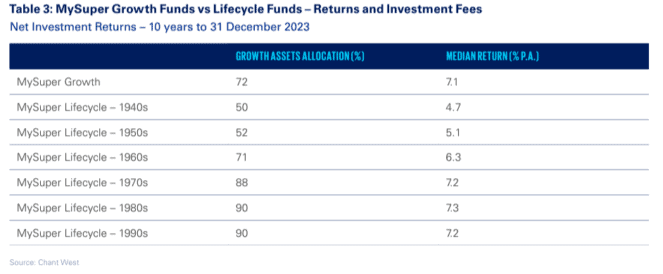
    The following table published in the KPMG report uses Chant West data showing net investment returns per annum over the 10 years to 31 December 2023.

    Source: Super Insights 2024

    As you can see, lifecycle products suited to those born in the 1970s or later performed better. They had higher median returns per annum at either 7.2% or 7.3%.

    KPMG says these higher returns reflected these lifecycle products containing a higher asset allocation in growth investments. This is because account holders were younger.

    Growth investments typically include ASX shares and international equities.

    Older account holders received lower median returns. They ranged from 4.7% among those born in the 1940s to 5.1% for those born in the 1950s and 6.3% for those born in the 1960s.

    The returns were lower because the account holders were older and closer to retirement.

    Therefore, their lifecycle funds allocated more of their money to conservative or defensive assets, such as cash and bonds, to try to achieve more capital preservation.

    KPMG commented:

    The older lifestyle cohorts missed out on some of the performance as they reduced risk over a period where there were generally strong returns, although they did have greater downside protection in the Covid-induced downturn in 2020 – important if they needed access to their super at that time or soon after.

    Your choice of superannuation fund REALLY matters

    The importance of choosing your superannuation fund carefully was apparent in the data.

    Many Australians do not understand that some retail superannuation funds routinely fail to beat the market’s annual benchmark returns (i.e., those of indexes like the S&P/ASX 200 Index (ASX: XJO)).

    This means many super account holders pay hefty management fees in the belief they are benefitting from their fund’s superior stock-picking services when, in fact, many funds fail to outdo or match benchmark returns. And once fees are paid, account holders’ returns are reduced even further.

    KPMG commented that the superior 10-year returns of the 1970s, 1980s, and 1990s lifecycle products barely exceeded the single-option MySuper Growth Fund.

    The 10-year period saw relatively strong returns from growth assets so we would expect the younger lifecycle portfolios with higher growth assets to do much better, but they were only slightly ahead of the median single option MySuper Growth fund.

    This was due to the underlying assets of these lifecycle products (mainly from retail funds) not performing as well as the underlying assets of the single option MySuper products.

    Compare the performance of your current super fund

    Retail funds are usually run by banks or investment firms. The Federal Government provides a comparison tool so you can compare your current super fund’s performance against others.

    This tool is designed to help you select a superannuation fund, with funds forced to disclose their returns.

    At the time of writing, HostPlus MySuper is the top-performing fund among MySuper products with balances over $50,000. It has a 7.96% average annual return net of fees over a 9-year investment period.

    The worst performer was returning 5.25%, with the Federal Government rating it ‘underperforming’.

    KPMG noted that lifecycle superannuation asset allocations today were different from those in the original models dating back to 2014, “some of which were far more conservative at older ages”.

    Superannuation outflows grow amid wave of retiring boomers

    As we recently reported, new figures from the Australian Prudential Regulation Authority (APRA) out this week showed greater growth in superannuation outflows than inflows over the year to 31 March 2024.

    This was largely due to more benefit payments going out as more baby boomers entered retirement.

    Baby Boomers were born between 1945 and 1964, making the youngest Aussies in this cohort 60 years of age this year.

    This means every baby boomer has now reached preservation age. That’s the age at which we can all begin accessing our superannuation savings.

    The data shows $112.9 billion was paid out, up 18.1% annually. Inflows totalled $177 billion, up 11.3%.

    APRA said the increased outflows were directly linked to more lump sum and pension payments:

    This increase was the result of lump sum payments rising by 18.4 per cent to $63.0 billion and pension payments increasing by 17.7 per cent to $49.8 billion.

    The post If you were born in the 1970s or later, your superannuation is delivering the best returns appeared first on The Motley Fool Australia.

    Maximise Your Super before June 30: Uncover 5 Strategies Most Aussies Overlook!

    With the end of the financial year almost upon us, there are some strategies that you may be able to take advantage of right now to save some tax and boost your savings…

    Download our latest free report discover 5 super strategies that most Aussies miss today!

    Download Free Report
    *Returns 28 May 2024

    More reading

    Motley Fool contributor Bronwyn Allen has no position in any of the stocks mentioned. The Motley Fool Australia’s parent company Motley Fool Holdings Inc. has no position in any of the stocks mentioned. The Motley Fool Australia has no position in any of the stocks mentioned. The Motley Fool has a disclosure policy. This article contains general investment advice only (under AFSL 400691). Authorised by Scott Phillips.

  • Is this ASX 200 energy stock a buy at a P/E of 4.5?

    A woman holds her finger to the side of her lips in contemplation as she looks upwards to an array of graphic images of light bulbs above her head, one of which is on and glowing.

    It’s not too often that an ASX share, even an ASX 200 energy stock, trades on a price-to-earnings (P/E) ratio of 4.5. After all, the average P/E ratio on the ASX right now is closer to 20. 

    A company that is asking an earnings multiple of 4.5 is effectively asking investors to pay $4.50 for every $1 of earnings it brings in. That’s a compelling equation for any value investor to contemplate.

    So today, let’s take a look at this ASX 200 energy stock in question and see if there’s anything to like.

    The stock is none other than AGL Energy Ltd (ASX: AGL). AGL is one of the oldest names on the ASX and one of the most famous energy stocks on the market. It has had a rough trot in recent years, falling from over $21 a share in early 2020 to a multi-decade low of under $4 a share in late 2021.

    Today, AGL shares have recovered substantially, but are still trading at half of what they were just four years ago – asking $10.20. Check all of that out for yourself below:

    Yet despite this recovery, this ASX 200 energy stock remains at an arguably cheap share price. For some ASX shares, including some energy stocks, low earnings multiples are the norm. But for others, it could indicate that a company might be trading at a bargain price. So which is it for AGL?

    Is this ASX 200 energy stock a buy at 4.5 times earnings?

    Well, one ASX expert thinks it’s the latter.

    Rafi Lamm is the co-founder of fund manager L1 Capital. Speaking to the Australian Financial Review (AFR) this week, Lamm noted AGL’s quality and future-proof nature, noting that the company was “well positioned to benefit from strong long-term electricity demand with the lowest cost baseload generation in NSW and Victoria”.

    Lamm also views the current AGL share price as cheap, noting that its “multiple of 4.5 times earnings before interest and tax” is “well below its historic multiple of six times”.

    The fund manager argued that AGL is set for “a solid recovery” in terms of earnings from FY2026 onwards thanks to rising wholesale electricity futures pricing:

    Strong medium term free cash flow will enable solid dividends as well as a substantial investment in the energy transition, for example, in high returning battery storage.

    No doubt this opinion will delight shareholders of this ASX 200 energy stock. But let’s see if Lamm’s call proves accurate.

    At the current AGL share price, this ASX 200 energy stock has a market capitalisation of $6.86 billion, with a dividend yield of 4.80%.

    The post Is this ASX 200 energy stock a buy at a P/E of 4.5? appeared first on The Motley Fool Australia.

    Should you invest $1,000 in Agl Energy Limited right now?

    Before you buy Agl Energy Limited shares, consider this:

    Motley Fool investing expert Scott Phillips just revealed what he believes are the 5 best stocks for investors to buy right now… and Agl Energy Limited wasn’t one of them.

    The online investing service he’s run for over a decade, Motley Fool Share Advisor, has provided thousands of paying members with stock picks that have doubled, tripled or even more.*

    And right now, Scott thinks there are 5 stocks that may be better buys…

    See The 5 Stocks
    *Returns as of 5 May 2024

    More reading

    Motley Fool contributor Sebastian Bowen has no position in any of the stocks mentioned. The Motley Fool Australia’s parent company Motley Fool Holdings Inc. has no position in any of the stocks mentioned. The Motley Fool Australia has no position in any of the stocks mentioned. The Motley Fool has a disclosure policy. This article contains general investment advice only (under AFSL 400691). Authorised by Scott Phillips.

  • 5 things to watch on the ASX 200 on Friday

    On Thursday, the S&P/ASX 200 Index (ASX: XJO) had another poor session and dropped into the red. The benchmark index fell 0.5% to 7,628.2 points.

    Will the market be able to bounce back from this on Friday and end the week on a high? Here are five things to watch:

    ASX 200 poised to rebound

    The Australian share market looks set to end the week on a positive note despite a poor session on Wall Street. According to the latest SPI futures, the ASX 200 is expected to open 50 points or 0.65% higher this morning. On Wall Street, the Dow Jones was down 0.85%, the S&P 500 fell 0.6%, and the NASDAQ was 1.1% lower.

    Oil prices fall

    ASX 200 energy shares Beach Energy Ltd (ASX: BPT) and Karoon Energy Ltd (ASX: KAR) could have a tough finish to the week after oil prices tumbled overnight. According to Bloomberg, the WTI crude oil price is down 1.7% to US$77.87 a barrel and the Brent crude oil price is down 2% to US$81.97 a barrel. Traders were selling oil in response to weak gasoline demand.

    Buy Xero shares

    The Xero Ltd (ASX: XRO) share price could be good value according to analysts at Goldman Sachs. In response to price increases in the UK, the broker has reiterated its conviction buy rating and $164.00 price target on the cloud accounting platform provider’s shares. It said: “Although we believe this pricing update was somewhat expected following the Australian plan announcement, we view it as another incremental positive for Xero and very supportive of our FY25/26 revenue forecasts.”

    Gold price softens

    ASX 200 gold shares including Evolution Mining Ltd (ASX: EVN) and Northern Star Resources Ltd (ASX: NST) could have a subdued finish to the week after the gold price edged lower overnight. According to CNBC, the spot gold price is down 0.1% to US$2,362.8 an ounce. The precious metal appears to be in a holding pattern ahead of the release of US inflation data.

    Pro Medicus shares rated hold

    Analysts at Bell Potter have been impressed with the contract wins announced by Pro Medicus Limited (ASX: PME) this week. As a result, the broker has upgraded the health imaging technology company’s shares to a hold rating with an improved price target of $115.00 (from sell and $75.00). It said: “The announcement of recent contract wins provides a heightened degree of certainty for FY25 revenues and earnings, accordingly there is minimal risk of downgrades to consensus for FY25 following the FY24 earnings announcement.”

    The post 5 things to watch on the ASX 200 on Friday appeared first on The Motley Fool Australia.

    Should you invest $1,000 in Beach Energy Limited right now?

    Before you buy Beach Energy Limited shares, consider this:

    Motley Fool investing expert Scott Phillips just revealed what he believes are the 5 best stocks for investors to buy right now… and Beach Energy Limited wasn’t one of them.

    The online investing service he’s run for over a decade, Motley Fool Share Advisor, has provided thousands of paying members with stock picks that have doubled, tripled or even more.*

    And right now, Scott thinks there are 5 stocks that may be better buys…

    See The 5 Stocks
    *Returns as of 5 May 2024

    More reading

    Motley Fool contributor James Mickleboro has positions in Pro Medicus and Xero. The Motley Fool Australia’s parent company Motley Fool Holdings Inc. has positions in and has recommended Goldman Sachs Group, Pro Medicus, and Xero. The Motley Fool Australia has positions in and has recommended Xero. The Motley Fool Australia has recommended Pro Medicus. The Motley Fool has a disclosure policy. This article contains general investment advice only (under AFSL 400691). Authorised by Scott Phillips.

  • These buy-rated ASX dividend stocks offer 6%+ yields (and plenty of upside)

    There are a lot of options for income investors to choose from on the Australian share market.

    To narrow things down, I have picked out three ASX dividend stocks that analysts rate as buys and are forecasting 6%+ dividend yields. Here’s what you need to know about them:

    APA Group (ASX: APA)

    The first ASX dividend stock for income investors to consider buying is APA Group.

    It is an energy infrastructure business that owns and operates a $27 billion portfolio of gas, electricity, solar and wind assets. This includes 15,000 kilometres of natural gas pipelines that connect sources of supply and markets across mainland Australia.

    Analysts at Macquarie are feeling positive about the company’s outlook and expect its long run of dividend increases to continue. The broker is forecasting dividends of 56 cents per share in FY 2024 and then 57.5 cents per share in FY 2025. Based on the current APA Group share price of $8.29, this equates to 6.75% and 6.9% dividend yields, respectively.

    Macquarie has an outperform rating and $9.40 price target on its shares.

    Dalrymple Bay Infrastructure Ltd (ASX: DBI)

    Over at Morgans, its analysts think that Dalrymple Bay Infrastructure could be an ASX dividend stock to buy. It is the long-term operator of the Dalrymple Bay Coal Terminal, which has been Queensland’s premier coal export facility since 1983.

    The broker currently has an add rating and $3.05 price target on its shares.

    As for income, the broker is forecasting dividends per share of 22 cents in FY 2024 and then 23 cents in FY 2025. Based on the latest Dalrymple Bay Infrastructure share price of $2.76, this will mean yields of 8% and 8.3%, respectively.

    HomeCo Daily Needs REIT (ASX: HDN)

    Morgans is also expecting some big dividend yields from HomeCo Daily Needs shares. It is a property company focused on neighbourhood retail and large format retail assets.

    The broker likes the company due to the resilience of its cashflows and its exposure to accelerating click and collect trends. Combined with its development pipeline, Morgans feels the company is well-positioned for growth.

    It expects this to underpin dividends per share of 8 cents in FY 2024 and then 9 cents in FY 2025. Based on the current HomeCo Daily Needs share price of $1.21, this will mean yields of 6.6% and 7.4%, respectively.

    Morgans currently has an add rating and $1.37 price target on the ASX dividend stock.

    The post These buy-rated ASX dividend stocks offer 6%+ yields (and plenty of upside) appeared first on The Motley Fool Australia.

    Should you invest $1,000 in Apa Group right now?

    Before you buy Apa Group shares, consider this:

    Motley Fool investing expert Scott Phillips just revealed what he believes are the 5 best stocks for investors to buy right now… and Apa Group wasn’t one of them.

    The online investing service he’s run for over a decade, Motley Fool Share Advisor, has provided thousands of paying members with stock picks that have doubled, tripled or even more.*

    And right now, Scott thinks there are 5 stocks that may be better buys…

    See The 5 Stocks
    *Returns as of 5 May 2024

    More reading

    Motley Fool contributor James Mickleboro has no position in any of the stocks mentioned. The Motley Fool Australia’s parent company Motley Fool Holdings Inc. has positions in and has recommended Macquarie Group. The Motley Fool Australia has positions in and has recommended Apa Group and Macquarie Group. The Motley Fool Australia has recommended HomeCo Daily Needs REIT. The Motley Fool has a disclosure policy. This article contains general investment advice only (under AFSL 400691). Authorised by Scott Phillips.

  • Do the dividends from Westpac shares still come fully franked?

    Male hands holding Australian dollar banknotes, symbolising dividends.

    When an Australian investor buys an ASX bank stock, they are probably doing so with the expectation of receiving steady, fat and fully franked dividend payments. This reputation naturally applies to Westpac Banking Corp (ASX: WBC) shares.

    Westpac is Australia’s oldest bank and a prominent member of the big four ASX banks. As you would expect, this company has been delighting its investors with hefty dividend payments for decades.

    But do Westpac’s dividends still come with full franking credits attached? This might seem like a silly question. However, we’ve already seen one member of the big four banks club recently drop its commitment to paying fully franked dividends.

    As we discussed last month, the culprit is ANZ Group Holdings Ltd (ASX: ANZ). ANZ shares have transitioned away from paying out fully franked dividends.

    This bank’s first partially franked dividend in decades was announced back in late 2019. Over subsequent years, ANZ’s dividends returned to being fully franked alongside those from Westpac shares and the other banks.. until late 2023. At that time, ANZ revealed that its final dividend for 2023 would only come partially franked at 56%. That payment was doled out on 22 December.

    Its next dividend, the final 83 cents per share payout that shareholders will receive on 1 July, is also set to come partially franked. This time at 65%. So it seems a new norm has been established for ANZ.

    But what about Westpac shares?

    Do the dividends from Westpac shares still come with full franking credits?

    Fortunately for Westpac shareholders, it’s a different story. All of the dividends this bank stock has paid out over the 21st century so far have come with full franking credits attached. Additionally, the bank has made no indication that it is planning on disrupting this status quo.

    Earlier this month, Westpac revealed that its interim dividend for 2024 would come in at a fully franked 75 cents per share. That’s a happy 7.14% increase over 2023’s interim dividend of 70 cents (also fully franked).

    Additionally, Westpac investors are also set to be treated to a supplemental special dividend. That’s to be worth an additional 15 cents per share. This too will come with those full franking credits attached.

    This makes sense because in order for a company like Westpac to pay out fully franked dividends, the profits that the dividends are funded from must be taxed in Australia.

    ANZ, unlike Westpac and the other big four banks, has significant operations outside Australia. As such, these operations make it difficult for ANZ to pay out fully franked dividends.

    But Westpac’s business model is far more domesticated than ANZ’s. As such, this bank probably won’t struggle to keep its dividends fully franked going forward.

    There’s never any certainty in the investing (or dividend) world. But judging by Westpac’s past dividend payouts, as well as its Australia-centric business model, the likelihood of Westpac’s dividends remaining fully franked is arguably high.

    At the current Westpac share price, this ASX 200 bank has a trailing dividend yield of 5.67% on the table. This grosses up to 8.1% with the value of those full franking credits included.

    The post Do the dividends from Westpac shares still come fully franked? appeared first on The Motley Fool Australia.

    Should you invest $1,000 in Westpac Banking Corporation right now?

    Before you buy Westpac Banking Corporation shares, consider this:

    Motley Fool investing expert Scott Phillips just revealed what he believes are the 5 best stocks for investors to buy right now… and Westpac Banking Corporation wasn’t one of them.

    The online investing service he’s run for over a decade, Motley Fool Share Advisor, has provided thousands of paying members with stock picks that have doubled, tripled or even more.*

    And right now, Scott thinks there are 5 stocks that may be better buys…

    See The 5 Stocks
    *Returns as of 5 May 2024

    More reading

    Motley Fool contributor Sebastian Bowen has no position in any of the stocks mentioned. The Motley Fool Australia’s parent company Motley Fool Holdings Inc. has no position in any of the stocks mentioned. The Motley Fool Australia has no position in any of the stocks mentioned. The Motley Fool has a disclosure policy. This article contains general investment advice only (under AFSL 400691). Authorised by Scott Phillips.

  • 2 ASX dividend shares that are coiled springs for a lifetime of passive income

    A couple sit on the deck of a yacht with a beautiful mountain and lake backdrop enjoying the fruits of their long-term ASX shares and dividend income.

    When an investor searches for ASX dividend shares to add to their portfolio, the gold standard is arguably finding those rare stocks that have the potential to fund a lifetime of passive income.

    After all, what could be better than buying a dividend share and never worrying about whether it will be able to scrape together enough cash for its next dividend?

    Buying these lifelong sources of passive income can be thought of as investing in a coiled dividend spring.

    But of course, finding these coiled springs is easier said than done. So today, let’s discuss two ASX dividend shares that I think have the potential to fund a lifetime of passive income.

    2 ASX dividend shares to fund a lifetime of passive income

    Washington H. Soul Pattinson and Co Ltd (ASX: SOL)

    First up is Washington H. Soul Pattinson, or Soul Patts for short. I’ve long touted this stock as one of the best dividend shares on the ASX. This company owns a portfolio of underlying assets, which it manages on behalf of its shareholders, much as a listed investment company (LIC) does.

    In Soul Patts’ case, these assets include major stakes in other ASX stocks, including New Hope Corporation Ltd (ASX: NHC) and TPG Telecom Ltd (ASX: TPG). They also include a huge blue-chip ASX share portfolio and other investments like private credit, venture capital, and unlisted companies.

    My confidence in Soul Patts as a lifetime passive income payer comes from its almost flawless track record of delivering meaningful returns over many decades. For one, the company has a near-25-year streak of providing annual dividend pay rises – a streak unmatched on the ASX. It also hasn’t cut its dividend in more than 120 years.

    Additionally, these fully-franked dividends have not come at the expense of growth. In an ASX release earlier this month, Soul Patts confirmed that its investors have enjoyed an average 12% per annum return over the 20 years to 30 April. That smashes the return of the S&P/ASX 200 Index (ASX: XJO) over the same period.

    All of these factors add up to an ASX dividend share that I think has more than enough potential to be a lifelong passive income payer.

    Coles Group Ltd (ASX: COL)

    When I look for long-term ASX dividend shares, I like to turn to the consumer staples sector. If a company sells us things that we need — rather than want — to buy, I think it inherently makes its business model stronger and more robust than your average ASX share.

    That is arguably true of Coles Group. As the second-largest grocer and supermarket operator in Australia, Coles will always be one of the top places customers head to for food, drinks and household essentials if it offers these products at competitive prices.

    I believe Coles will continue to be able to do this, thanks to its significant investments in its supply chains and automation-driven distribution centres.

    Coles’ rival Woolworths Group Ltd (ASX: WOW) is a larger business with more market share than Coles. However, Coles shares trade with a higher dividend yield right now and have a better history of maintaining consistent, fully-franked payouts.

    For these reasons, I think Coles is another ASX dividend share that has the potential to be a spring of passive income that won’t run dry over a lifetime.

    The post 2 ASX dividend shares that are coiled springs for a lifetime of passive income appeared first on The Motley Fool Australia.

    Should you invest $1,000 in Coles Group Limited right now?

    Before you buy Coles Group Limited shares, consider this:

    Motley Fool investing expert Scott Phillips just revealed what he believes are the 5 best stocks for investors to buy right now… and Coles Group Limited wasn’t one of them.

    The online investing service he’s run for over a decade, Motley Fool Share Advisor, has provided thousands of paying members with stock picks that have doubled, tripled or even more.*

    And right now, Scott thinks there are 5 stocks that may be better buys…

    See The 5 Stocks
    *Returns as of 5 May 2024

    More reading

    Motley Fool contributor Sebastian Bowen has positions in Washington H. Soul Pattinson and Company Limited. The Motley Fool Australia’s parent company Motley Fool Holdings Inc. has positions in and has recommended Washington H. Soul Pattinson and Company Limited. The Motley Fool Australia has positions in and has recommended Coles Group and Washington H. Soul Pattinson and Company Limited. The Motley Fool has a disclosure policy. This article contains general investment advice only (under AFSL 400691). Authorised by Scott Phillips.

  • Buying ASX shares, rentvesting and co-ownership: How young Australians are achieving home ownership

    A couple talks with a real estate agent in a unit, representing the Lifestyle Communities share price today

    Investing in ASX shares to build a deposit, rentvesting, and co-owning with parents or partners are among the inventive ways that young Australians are gaining a foothold on the property ladder.

    Research from Westpac shows that 56% of first-time home buyers are planning to buy with a partner, compared to 40% three years ago.

    Three in four young buyers say they are willing to compromise on location, up 9% from three years ago.

    One in two first-time home buyers is considering rentvesting instead of owner-occupation, whereby they buy an affordable property to lease out and rent a home for themselves wherever they want to live.

    Westpac managing director of mortgages Damien MacRae said first home buyers “are becoming more ruthless with their goals”.

    McRae said:

    They understand it’s a big task, but they are determined to break into the market and are willing to compromise to get there.

    Creative pathways to home ownership

    It’s little wonder young people are compromising or getting creative to help them buy a home sooner.

    For some, it feels like an impossible dream, particularly when it now takes 11.1 years to save a deposit for a typical house and 8.5 years for an apartment, according to an ANZ/CoreLogic affordability report.

    It also takes 52.7% of a person’s income to service an average home loan for houses and 40.5% for apartments, which is well above the mortgage stress threshold of 30%.

    Co-ownership with partners or parents

    In addition to buying with partners, many first home buyers are accepting various kinds of help from the Bank of Mum and Dad, including co-ownership.

    Australian parents are acutely aware of the challenges of housing affordability for their children today.

    In fact, a recent survey showed three in four Australians are planning to leave some of their superannuation behind as an inheritance for their loved ones.

    One of the reasons is to help their kids into home ownership, as one respondent explained:

    The cost of buying a house is beyond reach for younger people now. A little help from me when I die might help pay off their mortgage and allow them to retire at an appropriate age.

    A separate investor survey shows helping their children or other family members financially is a key motivation for 33% of Gen Xers and 25% of baby boomers.

    Investing in ASX shares to save the deposit

    Saving a home deposit is a significant motivation for investing in ASX shares.

    The 2023 ASX Australian Investor Study, which surveyed more than 5,500 Australians, found that buying a home to live in was the main goal of 16% of investors and 31% of intending investors.

    An Australian Housing and Urban Research Institute (AHURI) study confirms the trend:

    Anecdotally, some people have been turning to other strategies to accumulate wealth to achieve home ownership, including share investing and property investing.

    The study found ASX shares were the most popular type of stock among young investors, with ASX exchange-traded funds (ETFs) coming in second.

    By the way, online brokerage platform Selfwealth Ltd (ASX: SWF) reports the most popular ASX shares traded in April were BHP Group Ltd (ASX: BHP) and Woodside Energy Group Ltd (ASX: WDS).

    The top ASX ETFs traded were Vanguard Australian Shares Index ETF (ASX: VAS) and Vanguard MSCI Index International Shares ETF (ASX: VGS).

    Rentvesting

    Rentvestors typically purchase their first property in an affordable suburb on the city outskirts and then lease it out, using the rental income to help them pay the holding costs and mortgage.

    Meanwhile, they rent a home for themselves in a trendy inner-city location that provides the lifestyle they want.

    They hope their investment property will deliver enough capital growth to fund the deposit on a home in a location they want to live in later down the track when they ‘settle down’.

    Rentvesting is a forced choice for some first-time buyers as it’s the only way they can get finance.

    It can be easier to get an investment loan than an owner-occupier loan because the rental income forms part of the banks’ serviceability and income assessments.

    The Australian Bureau of Statistics (ABS) began tracking rentvesting in 2019. Last year, 7,412 first-time buyers took our investment loans, according to ABS lending finance data.

    Buying a first home with government help

    Thousands of first home buyers are also taking up government help to buy their first residence.

    Since May 2022, more than 110,000 Australians have taken advantage of the First Home Guarantee Scheme, which allows them to buy with a 5% deposit and avoid lenders’ mortgage insurance.

    The Federal Government is currently trying to get its new Help to Buy equity scheme through Parliament.

    It says Help to Buy would allow 40,000 buyers to purchase a first home via a shared equity arrangement.

    The government would provide up to 40% of the purchase price of new homes and 30% of the price of established homes.

    The states and territories also offer help for first home buyers, including stamp duty exemptions and concessions and grants.

    In November 2023, Queensland doubled its First Home Owner Grant to $30,000 for people buying or building a new home under $750,000 until 30 June 2025.

    The post Buying ASX shares, rentvesting and co-ownership: How young Australians are achieving home ownership appeared first on The Motley Fool Australia.

    Should you invest $1,000 in Bhp Group right now?

    Before you buy Bhp Group shares, consider this:

    Motley Fool investing expert Scott Phillips just revealed what he believes are the 5 best stocks for investors to buy right now… and Bhp Group wasn’t one of them.

    The online investing service he’s run for over a decade, Motley Fool Share Advisor, has provided thousands of paying members with stock picks that have doubled, tripled or even more.*

    And right now, Scott thinks there are 5 stocks that may be better buys…

    See The 5 Stocks
    *Returns as of 5 May 2024

    More reading

    Motley Fool contributor Bronwyn Allen has positions in Anz Group, BHP Group, Vanguard Australian Shares Index ETF, and Woodside Energy Group. The Motley Fool Australia’s parent company Motley Fool Holdings Inc. has no position in any of the stocks mentioned. The Motley Fool Australia has recommended Vanguard Msci Index International Shares ETF. The Motley Fool has a disclosure policy. This article contains general investment advice only (under AFSL 400691). Authorised by Scott Phillips.

  • 3 key reasons to sell Core Lithium shares

    A man holds his hand under his chin as he concentrates on his laptop screen and reads about the ANZ share price

    Core Lithium Ltd (ASX: CXO) shares have had a very disappointing 12 months.

    During this time, the lithium miner’s shares have lost approximately 87% of their value.

    Unfortunately, despite this material decline, one leading broker believes there’s potential for the lithium stock to fall further.

    Who is bearish on Core Lithium shares?

    Goldman Sachs remains very bearish on Core Lithium.

    According to a recent note, its analysts have a sell rating and 11 cents price target on the company’s shares.

    Based on the latest Core Lithium share price of 13.5 cents, this implies potential downside of approximately 18.5% for investors over the next 12 months.

    What did the broker say?

    Goldman has laid out several reasons why it believes that investors should be avoiding Core Lithium’s shares even after their sharp decline.

    The first reason that Goldman has given to justify its sell rating is the company’s valuation. It notes that it still looks expensive at current levels. The broker said:

    CXO appears relatively expensive trading at a premium on ~1.1x NAV and an implied LT spodumene price of ~US$1,200/t (peer average ~1.05x & ~US$1,250/t (lithium pure-plays ~US$1,140/t)), with the lowest average operating FCF/t LCE on a more moderated/deferred production restart/ramp up.

    Another reason for its bearish view is its belief that that are a lot of risks in respect to the restart of mining operations. It adds:

    In the current pricing environment, a mine restart looks highly unlikely ahead of the next wet season, in our view and, given the Grants open pit has ~12 months of life, likely tied to a development decision on BP33 (with its own funding risks) to support a new processing contract, increasing the risk of a longer gap in production. Following a restart, production risk in a steady state operation remains as the Finniss project moves through ramp ups on project complexity moving between different open pits and underground configurations.

    A third and final reason is its belief that Core Lithium’s resource growth may take longer than expected now. It concludes:

    Though further exploration is underway, and while potential resource expansion could be promising (including revisiting the gold, uranium and base metal exploration projects), with resource extension likely at depth/from new areas, we see limited near-term upside, where further meaningful exploration is now also likely longer dated on falling lithium prices, particularly with a near-term restart of the operation now unlikely in the near-term.

    All in all, Goldman thinks investors should be staying clear of the company for now. It prefers IGO Ltd (ASX: IGO) for lithium exposure and has a buy rating and $8.10 price target on its shares.

    The post 3 key reasons to sell Core Lithium shares appeared first on The Motley Fool Australia.

    Should you invest $1,000 in Core Lithium Ltd right now?

    Before you buy Core Lithium Ltd shares, consider this:

    Motley Fool investing expert Scott Phillips just revealed what he believes are the 5 best stocks for investors to buy right now… and Core Lithium Ltd wasn’t one of them.

    The online investing service he’s run for over a decade, Motley Fool Share Advisor, has provided thousands of paying members with stock picks that have doubled, tripled or even more.*

    And right now, Scott thinks there are 5 stocks that may be better buys…

    See The 5 Stocks
    *Returns as of 5 May 2024

    More reading

    Motley Fool contributor James Mickleboro has no position in any of the stocks mentioned. The Motley Fool Australia’s parent company Motley Fool Holdings Inc. has positions in and has recommended Goldman Sachs Group. The Motley Fool Australia has no position in any of the stocks mentioned. The Motley Fool has a disclosure policy. This article contains general investment advice only (under AFSL 400691). Authorised by Scott Phillips.