
Tag: Fool

  • Why Bellevue Gold, IPH, Life360, and Ramelius Resources shares are racing higher

    Two happy excited friends in euphoria mood after winning in a bet with a smartphone in hand.

    The S&P/ASX 200 Index (ASX: XJO) is on course to start the week with a small decline. In afternoon trade, the benchmark index is down 0.25% to 7,728.9 points.

    Four ASX shares that are not letting that hold them back today are listed below. Here’s why they are rising:

    Bellevue Gold Ltd (ASX: BGL)

    The Bellevue Gold share price is up 4% to $1.83. This appears to have been driven by a broker note out of UBS this morning. According to the note, the broker has upgraded the gold miner’s shares to a buy rating with a $2.05 price target. This implies potential upside of 12% from current levels over the next 12 months. Bellevue Gold recently commenced commercial production at the Bellevue Gold Project in Western Australia and is on track to achieve guidance of 75,000 to 85,000 ounces for the six months to 30 June 2024.

    IPH Ltd (ASX: IPH)

    The IPH share price is up 3.5% to $6.02. This morning, this intellectual property solutions company announced an extension to its share buyback program of up to $40 million. The buyback period will now continue until 30 May 2025, unless the maximum number of shares are bought back or IPH decides to cease the buyback earlier. The company advised that the buyback program will not impact its existing dividend policy. Nor will it prevent IPH from taking advantage of accretive growth opportunities as they occur.

    Life360 Inc (ASX: 360)

    The Life360 share price is up 3.5% to $15.65. Investors have been buying this location technology company’s shares after brokers responded positively to its first quarter update. One of those brokers was Morgan Stanley, which retained its overweight rating and lifted price target to $17.50. Elsewhere, Bell Potter reiterated its buy rating and increased its price target on the market darling’s shares to $17.75. It notes that the company is looking to list in the US very soon, which could be a boost to its valuation given how peers trade on higher multiples.

    Ramelius Resources Ltd (ASX: RMS)

    The Ramelius Resources share price is up 2.5% to $2.05. This has been driven by the release of a mineral reserve estimate for the gold miner’s Eridanus project. The new mineral resource estimate, which now includes the adjacent Lone Pine and Theakston deposits and recent drilling and mining information, is now 21Mt at 1.7g/t for 1,200,000 ounces. This is a 64% increase on last year’s estimate. Managing Director, Mark Zeptner, said: “Given the 64% increase is net of depletion and the current open pit will produce over 300,000 ounces once processed, Eridanus is set to become the third +1Moz mine in the Mt Magnet field, after Hill 50 & Morning Star.”

    The post Why Bellevue Gold, IPH, Life360, and Ramelius Resources shares are racing higher appeared first on The Motley Fool Australia.

    Wondering where you should invest $1,000 right now?

    When investing expert Scott Phillips has a stock tip, it can pay to listen. After all, the flagship Motley Fool Share Advisor newsletter he has run for over ten years has provided thousands of paying members with stock picks that have doubled, tripled or even more.*

    Scott just revealed what he believes could be the ‘five best ASX stocks’ for investors to buy right now. We believe these stocks are trading at attractive prices and Scott thinks they could be great buys right now…

    See The 5 Stocks
    *Returns as of 5 May 2024

    More reading

    Motley Fool contributor James Mickleboro has positions in Life360. The Motley Fool Australia’s parent company Motley Fool Holdings Inc. has positions in and has recommended Life360. The Motley Fool Australia has recommended IPH. The Motley Fool has a disclosure policy. This article contains general investment advice only (under AFSL 400691). Authorised by Scott Phillips.


  • Why ‘Property vs. Shares’ isn’t a fair fight

    set of scales with a house on one side and coins or asx shares on the other

    Asking a shares guy the age-old shares-versus-property question?

    Isn’t that like asking a vegan about whether they’d like the steak or the veges?

    I know… you don’t have to ask if they’re vegan, they’ll tell you! (It’s a joke, Joyce! Relax!)

    And yet, I was asked for a 12-month property forecast the other day.

    Of course, you know my view on forecasts (they’re useless, because you can only assess their accuracy after the event!), and so that’s how I answered.

    I told my inquirer that I had no idea.

    Over the longer term, though? I have some thoughts.

    Not a forecast or a prediction. But rather, the sorts of pressures that come to play on both shares and property over years and decades. And the probabilities that result.

    Let’s go with shares first.

    Over the last 120 years or so, both Australian and US shares have returned somewhere around 9% per annum, before taxes, fees and inflation.

    Now there’s nothing magic about that number. There’s no mathematical reason it must be 9%. It just has been. And over shorter time periods, it’s been about the same (the shorter, the more volatile, of course).

    There are reasons why it might be likely to continue – primarily that investors want to earn a return that’s a decent amount higher than government bonds, in exchange for taking extra risk. And if they’re all rational (unlikely in the short term, far more likely in the long run), something around 9% makes sense (about 4-5% more than bonds).

    But that doesn’t mean it’s a guarantee. And with Western GDP growing at 2-3%, on average, it can’t happen forever (if a subset of a group grows at 9%, but the whole group grows at 3%, that subgroup eventually becomes larger than the whole… clearly not possible!).

    But it is the historical norm for the subset of business that happens to be listed on the US markets and the ASX, so it’s a decent starting point.

    Is it a prediction? A forecast? Nah, just a reference point as we turn to property.

    And here’s where the idea of a ‘subset’ becomes a central point of focus.

    See, when we compare shares and property, we’re looking at around 1,600 ASX businesses (out of maybe 2.6m Aussie businesses in total, as of June 2023, according to the ABS.

    The best 1,600 companies? No. There are probably many higher quality small and large private businesses out there. But some of the best companies in the country? Very likely, yes. And as a group, likely meaningfully higher quality than the average unlisted business.

    And property? Well, the ABS tells us there were 10.9 million dwellings in the country, as at June 2022. There is, for now at least, no subset that is analogous to the ASX.

    So let’s look at those 10.9m dwellings.

    What would it take for them to increase in value?

    Well, a buyer would have to pay more for them, compared to last time they were sold, obviously.

    And how would that happen? There are four main possibilities:

    1. The buyer could earn more, giving them a greater repayment capacity.

    2. The buyer could spend more of his or her (and usually a combined) income on repayments.

    3. Interest rates could be permanently lower, allowing the borrower to spend more for the same level of repayments.

    4. Rents could grow at a higher rate, giving investors a greater repayment capacity.

    Let’s take each in turn.

    I think it’s likely that wages rise, over time. But by how much? Well, once inflation settles, maybe 2-3% per annum is probably most likely. So, the borrower could, assuming all else is equal, increase his or her repayments by 2-3% per year. (Taxes would make that number a little lower if they went into higher tax brackets, and the rate of inflation in other expenses could increase or decrease that number slightly… but neither is material for our purposes here.)

    The buyer(s) could give up spending in other categories to put more money towards repayments, of course. But food is pretty essential. So is transport, energy, clothing and a few other things. Also note that the average Australian borrower is apparently spending somewhere between 41% and 48% of their income on repayments, depending on which source you use. I’m not sure there’s much wiggle room there… and if there is, it’ll be a one-off – it can’t keep increasing every year.

    Of course, interest rates could be permanently lower, and that would mean that, for a given level of repayment, you could borrow more money, pushing prices up. But will rates be permanently lower? I don’t think so. They’ll be lower than the current level at some point in the future. And probably higher at other points. Again, though, that’s cyclical, not structural. Unless the 30 years worth of repayments are done at lower average interest rates than in the past, there’s no upside here.

    Now, if you’re a property investor, you could hope for higher rents. But, like borrowers, renters only have so much income they can devote to putting a roof over their heads. After that, the stock of available renters runs out. Maybe there’s some upside here. Maybe. But if there is, again, it would be a one-off jump, not something that can compound with increases every year.

    So, let’s recap. Rents could rise, maybe, but only by a bit, and can’t increase forever. Rates could fall, but probably not permanently. Like renters, borrowers can only devote so much of their income to repayments before they’re tapped out. And wages will probably rise, but not by much, each year.

    And given that, and given the maths of housing prices, I’ll ask rhetorically: under what circumstances can house prices rise materially above wages growth for any length of time?

    Why rhetorically? Because I’m yet to have someone answer that question with data and/or an argument that holds water.

    Now again, I’m a shares guy, right? Aren’t I biased?

    Maybe. A bit.

    But my wife and I were thinking seriously about buying an investment property recently, our interest piqued by the possibility, raised by some, that COVID and/or higher rates might lead to some bargains.

    I might be a shares guy, but you know what I like more than shares?

    Money.

    If there was a better return to be made in property, I’m not going to knock it back on ideological grounds!

    So I did the numbers. And try as I might, using the above logic, I just couldn’t make them work.

    I can’t conceive of how borrowers or renters can increase their outgoings on property sufficiently – and, importantly, compounded, annually, at a high enough rate over time – to generate a superior return on property, compared to shares.

    Now, a few caveats.

    Neither my property or shares assumptions are cast in stone, because the future is unknowable. Instead, I just used the component parts and some maths to work up some scenarios.

    It’s possible that ASX-listed companies stop outperforming their non-listed counterparts, and profit growth falls to the level of GDP growth. In that scenario, shares would do worse than their historical average.

    It’s possible that wages growth booms – permanently – or that repayments and rent makes up 55%, 60% or 65% of incomes. But think for a minute about what that would do to the rest of the economy.

    It’s possible that rates fall, permanently, and that means borrowers can borrow more. But unless they keep falling, every year, that gain is a one-off.

    So where does that leave us?

    Well, I still don’t have a forecast – for shares or property.

    But if you asked me to look at the probabilities, I know what I feel more comfortable with.

    The hidden (well, not so hidden, but often unremarked-upon) benefit of shares is the ‘subset’ effect I mentioned earlier.

    If you asked me to handicap a race between ‘Australian Property’ and ‘Australian Business’ over the next few decades, I’d struggle to split them.

    But if you asked me to handicap a race between ‘Australian Property’ and ‘The subset of Australian Business that’s listed on the ASX’, I would bet heavily in favour of the latter.

    Now, if you’re paying attention, you might say ‘But if I grabbed just the best properties, they might beat shares!’. And if you did, I would agree with you.

    I’m not saying there aren’t properties out there that can’t do very well from the current price, for reasons of location, scarcity or if the current prices are unreasonably low. In fact, I’d suggest there absolutely are those properties, if you can find them – just as there are shares that’ll beat the average of the ASX, too.

    But I am saying that as an asset class, I don’t see how Australian Property beats the historical return of Australian Shares. So the best chance of Australian Property ‘winning’ might be if shares do relatively poorly from here… and that’d be a pyrrhic victory because it’d mean both asset classes would have had underwhelming results!

    Me? I’m going to keep an eye out for a bargain property, just in case something pops up. But I’m also going to keep looking for attractive shares to buy.

    Given the maths, I think the odds of success in the latter are much better.

    And that’s before we include the tax benefits of franked dividends, and the opportunity to be far more easily diversified with a share portfolio, which is both more liquid and cheaper to buy and sell.

    So… that was a long read. It contains no predictions or forecasts. If you disagree with my logic, you are of course very welcome to make a different decision for your investments. But I hope you’ve found it useful.

    Now, fire at will!

    Fool on!

    The post Why ‘Property vs. Shares’ isn’t a fair fight appeared first on The Motley Fool Australia.

    Should you invest $1,000 in S&P/ASX 200 right now?

    Before you buy S&P/ASX 200 shares, consider this:

    Motley Fool investing expert Scott Phillips just revealed what he believes are the 5 best stocks for investors to buy right now… and S&P/ASX 200 wasn’t one of them.

    The online investing service he’s run for over a decade, Motley Fool Share Advisor, has provided thousands of paying members with stock picks that have doubled, tripled or even more.*

    And right now, Scott thinks there are 5 stocks that may be better buys…

    See The 5 Stocks
    *Returns as of 5 May 2024

    More reading

    Motley Fool contributor Scott Phillips has no position in any of the stocks mentioned. The Motley Fool Australia’s parent company Motley Fool Holdings Inc. has no position in any of the stocks mentioned. The Motley Fool Australia has no position in any of the stocks mentioned. The Motley Fool has a disclosure policy. This article contains general investment advice only (under AFSL 400691). Authorised by Scott Phillips.

  • Why is the Macquarie share price getting hammered on Monday?

    Australian notes and coins symbolising dividends.

    It’s been a fairly bleak start to the trading week so far this Monday. At the time of writing, the S&P/ASX 200 Index (ASX: XJO) has lost 0.22% of its value, pulling the index down to just over 7,730 points. But it’s looking like it’s a lot worse for the Macquarie Group Ltd (ASX: MQG) share price.

    Last Friday, Macquarie shares closed at $193.27 each. But this morning, the ASX 200 financial stock and investment bank opened at $190.09 and is currently trading at $190.38, apparently down a hefty 1.5%.

    So why are Macquarie shares seemingly getting hammered by double the broader market falls this Monday?

    Well, fortunately, investors have nothing to complain about. The Macquarie share price is taking a beating for possibly the best reason a share drops in value – it has just traded ex-dividend for its upcoming shareholder payment.

    It was only at the start of this month that Macquarie investors got a look at their company’s latest full-year earnings, covering the 12 months to 31 March.

    As we went through at the time, these earnings were a little tough for investors to go through. Macquarie reported a 12% drop in operating income at $16.89 billion. The company’s net profits dropped even more, falling 32% to $3.52 billion.

    This led to Macquarie revealing that its final dividend for the period would come in at $3.85 per share, partially franked at 40%.

    Macquarie share price drops as ex-dividend date arrives

    That might also have been a disappointing announcement for investors, considering Macquarie’s final dividend from 2023 was worth $4.50 per share (also 40% franked).

    However, this latest dividend is worth much more than the interim payout of $2.55 that shareholders enjoyed in December.

    But last Friday was the last day that anyone who didn’t already own Macquarie shares could have bought them with the rights to receive this dividend attached. Today, the company has traded-ex-dividend, which means that any new investors who buy shares from today onwards miss out on this round.

    This is why we are seeing such a decisive drop in the Macquarie share price compared to where it was last Friday. There are no free rides on the ASX, so this fall simply reflects the loss of value of this dividend for new investors. It’s the conventional share price reaction for any ASX dividend share that goes ‘ex-div’.

    Eligible Macquarie investors can now look forward to receiving this latest payout from the bank on 2 July later this year.

    This ASX 200 financial stock has a trailing dividend yield of 3.36% at the current Macquarie share price. Despite today’s falls, Macquarie shares remain up a decent 3.06% year to date.

    The post Why is the Macquarie share price getting hammered on Monday? appeared first on The Motley Fool Australia.

    Should you invest $1,000 in Macquarie Group Limited right now?

    Before you buy Macquarie Group Limited shares, consider this:

    Motley Fool investing expert Scott Phillips just revealed what he believes are the 5 best stocks for investors to buy right now… and Macquarie Group Limited wasn’t one of them.

    The online investing service he’s run for over a decade, Motley Fool Share Advisor, has provided thousands of paying members with stock picks that have doubled, tripled or even more.*

    And right now, Scott thinks there are 5 stocks that may be better buys…

    See The 5 Stocks
    *Returns as of 5 May 2024

    More reading

    Motley Fool contributor Sebastian Bowen has no position in any of the stocks mentioned. The Motley Fool Australia’s parent company Motley Fool Holdings Inc. has positions in and has recommended Macquarie Group. The Motley Fool Australia has positions in and has recommended Macquarie Group. The Motley Fool has a disclosure policy. This article contains general investment advice only (under AFSL 400691). Authorised by Scott Phillips.

  • 2 ASX 200 shares to buy at ‘attractive levels’

    A happy couple drinking red wine in a vineyard as the Treasury Wine share price rises today

    S&P/ASX 200 Index (ASX: XJO) shares are often the leader in Australia or the local region – we can find compelling businesses on the ASX. But, we just need to buy them at the right price.

    Banks like Commonwealth Bank of Australia (ASX: CBA) and miners such as BHP Group Ltd (ASX: BHP) often get all of the attention, but every other business is capable of producing good returns. Experts have revealed why the below two ASX 200 shares are buys.

    Worley Ltd (ASX: WOR)

    Worley describes itself as a global professional services company of energy, chemicals and resources experts. It partners with customers to “deliver projects and create value over the life of their assets.” Worley says:

    We’re bridging two worlds, moving towards more sustainable energy sources, while helping to provide the energy, chemicals and resources needed now.

    Writing on The Bull, Toby Grimm from Baker Young said recent Worley share price weakness (see below) presents an opportunity to buy a quality engineering services company at “attractive levels”.

    Grimm pointed out that major shareholder Sidara, formerly Dar Group, recently sold 19% of the ASX 200 share. The underwritten block trade ends an “extensive and potential takeover play”. The expert noted the transaction doesn’t impact Worley’s operations or valuation.

    The ASX 200 share continues to generate growth – the FY24 first-half result saw aggregated revenue increase 22% to $5.6 million and underlying net profit after tax (NPATA) grow 30% to $188 million.

    Treasury Wine Estates Ltd (ASX: TWE)

    Treasury Wine Estates describes itself as one of the world’s largest wine companies, with 11,300 hectares and winemaking facilities in the world’s leading wine regions. Its products are consumed in over 70 countries. It has a number of brands, including Penfolds, Wolf Blass, Blossom Hill, Pepperjack, Squealing Pig and DAOU Vineyards.

    Jed Richards from Shaw and Partners calls Treasury Wine Estates a buy following the removal of Chinese tariffs on imported Australian wine. Richards notes the iconic Penfolds brand “remains prominent in China”. He then said:

    As the world’s second largest economy, China is a most attractive market for TWE, enabling this wine giant to diversify its revenue base moving forward. Share price weakness provides an attractive entry point.

    The ASX 200 share is reallocating a portion of the Penfolds Bin and Icon tiers from other global markets to progressively re-build distribution to China while maintaining the “strong momentum in those other markets where Penfolds has successfully grown in recent years.” It intends to expand its sales, marketing resources and brand investment in China.

    Thanks to the removal of Chinese tariffs, demand for the Penfolds bin and Icon portfolio is expected to exceed availability in the short term, so it will implement price increases, which are expected to be effective from early FY25.

    The post 2 ASX 200 shares to buy at ‘attractive levels’ appeared first on The Motley Fool Australia.

    Wondering where you should invest $1,000 right now?

    When investing expert Scott Phillips has a stock tip, it can pay to listen. After all, the flagship Motley Fool Share Advisor newsletter he has run for over ten years has provided thousands of paying members with stock picks that have doubled, tripled or even more.*

    Scott just revealed what he believes could be the ‘five best ASX stocks’ for investors to buy right now. We believe these stocks are trading at attractive prices and Scott thinks they could be great buys right now…

    See The 5 Stocks
    *Returns as of 5 May 2024

    More reading

    Motley Fool contributor Tristan Harrison has no position in any of the stocks mentioned. The Motley Fool Australia’s parent company Motley Fool Holdings Inc. has no position in any of the stocks mentioned. The Motley Fool Australia has recommended Treasury Wine Estates. The Motley Fool has a disclosure policy. This article contains general investment advice only (under AFSL 400691). Authorised by Scott Phillips.

  • Why these ASX mining shares have ‘got some huge advantages’: Chalmers

    A range of ASX mining shares look set to get further support from the Australian government.

    When Treasurer Jim Chalmers releases the Federal budget tomorrow night, ASX mining shares focused on critical minerals will be flagged to get a fresh boost.

    That would come atop the $566 million the government already tipped into the strategic and critical minerals sector to encourage exploration and spur domestic production.

    The government’s Future Made in Australia program, intended to increase sustainable manufacturing, partly relies on reliable and affordable supplies of critical minerals.

    And ASX mining shares are well-positioned, with the Department of Industry, Science and Resources noting that, “Australia is home to some of the largest recoverable critical minerals deposits on earth.”

    These include high-quality cobalt, lithium, manganese, rare earth elements, tungsten and vanadium.

    Western nations, led by the United States and European Union, are pressing for secure supply chains of critical minerals outside of China. China has long dominated the mining and production of these technology critical metals, vital in EVs, solar panels, batteries, and a wide variety of military applications.

    Chalmers flags support for ASX mining shares

    According to Bloomberg, Chalmers indicated over the weekend that ASX mining shares in the critical mineral space will see more support from the federal government.

    He labelled the sector a “golden opportunity”.

    Chalmers said, “The critical minerals space is one of the reasons why there is so much attention from global and domestic investors, but we need to make sure we can attract and deploy that.”

    He added:

    We’ve got some huge advantages. We’ve been dealt some incredible cards: our resources base, our industrial base, energy, our human capital base, our attractiveness as an investment destination.

    Chalmers said the policy would include “tax incentives, targeted grants, making sure that we’ve got the architecture to attract and absorb and deploy all of this private investment”.

    The Department of Industry, Science and Resources concurs.

    It states, “We are growing our critical minerals sector to make Australia a world-leading producer of raw and processed critical minerals.”

    The government notes that Australia’s critical and strategic minerals “are important for Australia’s modern technologies, economies and national security”.

    Their critical values include:

    • Supporting Australia’s transition to net zero emissions
    • Advanced manufacturing
    • Defence technologies and capabilities
    • Broader strategic applications

    Which miners stand to benefit?

    The list of ASX mining shares that could stand to benefit from further government support measures is lengthy.

    I recommend investors interested in tapping into this “golden opportunity” dig in for some deep research time. Or reach out for some expert advice.

    To get you started, in the lithium space, there are a number of S&P/ASX 200 Index (ASX: XJO) listed miners that remain well down from their highs amid languishing global lithium prices.

    These include Pilbara Minerals Ltd (ASX: PLS), Core Lithium Ltd (ASX: CXO), IGO Ltd (ASX: IGO) and Liontown Resources Ltd (ASX: LTR).

    If you’d prefer to target ASX mining shares with a focus on critical mineral cobalt, you can have a look into beaten down Cobalt Blue Holdings Ltd (ASX: COB), or resurgent Ardea Resources Ltd (ASX: ARL).

    The post Why these ASX mining shares have ‘got some huge advantages’: Chalmers appeared first on The Motley Fool Australia.

    Wondering where you should invest $1,000 right now?

    When investing expert Scott Phillips has a stock tip, it can pay to listen. After all, the flagship Motley Fool Share Advisor newsletter he has run for over ten years has provided thousands of paying members with stock picks that have doubled, tripled or even more.*

    Scott just revealed what he believes could be the ‘five best ASX stocks’ for investors to buy right now. We believe these stocks are trading at attractive prices and Scott thinks they could be great buys right now…

    See The 5 Stocks
    *Returns as of 5 May 2024

    More reading

    Motley Fool contributor Bernd Struben has no position in any of the stocks mentioned. The Motley Fool Australia’s parent company Motley Fool Holdings Inc. has no position in any of the stocks mentioned. The Motley Fool Australia has no position in any of the stocks mentioned. The Motley Fool has a disclosure policy. This article contains general investment advice only (under AFSL 400691). Authorised by Scott Phillips.

  • Buy CSL shares for growing dividends and ‘compelling long-term tailwinds’

    A woman reclines in a comfortable chair while she donates blood holding a pumping toy in one hand and giving the thumbs up in the other as she is attached to a medical machine to collect her blood donation.

    CSL Ltd (ASX: CSL) shares derive their revenue from three operating segments.

    Namely CSL Behring (the company’s blood plasma segment), CSL Vifor, and its Seqirus businesses.

    The S&P/ASX 200 Index (ASX: XJO) biotech stock acquired CSL Vifor, a global leader in iron deficiency therapies, in 2022 for US$11.7 billion. Vifor has been struggling to achieve growth over the past two years.

    However, with the end of the global pandemic, CSL’s Behring division has seen elevated costs come down along with an improving outlook for plasma collections.

    Since 2021, CSL has increased both its interim and final dividend every year.

    At the current share price of $$279.98, CSL shares trade on a fully franked trailing yield of 1.4%.

    Here’s what these experts are saying about the Aussie biotech giant.

    Why now is a good time to buy CSL shares

    Jed Richards, financial advisor at Shaw and Partners, has a ‘buy’ rating on CSL shares.

    According to Richards (courtesy of The Bull), “This well managed blood products company offers compelling long-term tailwinds. CSL is steadily growing its dividend stream.”

    Richards continues:

    The company usually under-promises and over-delivers when it comes to profit. The stock has underperformed on the back of a slower recovery in margins.

    Also behind a weaker share price was a phase 3 study which found its CSL112 drug was unable meet its primary efficacy endpoint of reducing the risk of major adverse cardiovascular events in patients at 90 days following a first heart attack.

    And with CSL shares down 9% over the past 12 months, Richards believes now could be an opportune time to buy.

    “The recent share price presents an attractive entry level for investors,” he said.

    Emma Fisher, portfolio manager at Airlie Funds Management, is also a fan of the ASX 200 biotech company.

    Addressing her investment philosophy more broadly, Fisher said (quoted by The Australian Financial Review):

    Investing is not about having epiphanies. It’s not lightning-bolt moments in the shower where you realise that some secular megatrend is going to make you all this money. It’s about the nuts and bolts – talking to companies, having an open mind, reading widely.

    As for CSL shares, she said these “should be in any Aussie portfolio”.

    How has the ASX 200 biotech stock been tracking?

    CSL shares are bucking the wider market sell-down today to be up 0.3% at the time of writing.

    As mentioned above, the ASX 200 biotech share is down 9% over the past 12 months.

    But in the past months, we have seen a marked uptrend. Since market close on 30 October, shares are up 21%.

    The post Buy CSL shares for growing dividends and ‘compelling long-term tailwinds’ appeared first on The Motley Fool Australia.

    Should you invest $1,000 in CSL right now?

    Before you buy CSL shares, consider this:

    Motley Fool investing expert Scott Phillips just revealed what he believes are the 5 best stocks for investors to buy right now… and CSL wasn’t one of them.

    The online investing service he’s run for over a decade, Motley Fool Share Advisor, has provided thousands of paying members with stock picks that have doubled, tripled or even more.*

    And right now, Scott thinks there are 5 stocks that may be better buys…

    See The 5 Stocks
    *Returns as of 5 May 2024

    More reading

    Motley Fool contributor Bernd Struben has no position in any of the stocks mentioned. The Motley Fool Australia’s parent company Motley Fool Holdings Inc. has positions in and has recommended CSL. The Motley Fool Australia has recommended CSL. The Motley Fool has a disclosure policy. This article contains general investment advice only (under AFSL 400691). Authorised by Scott Phillips.
  • How much money should I put in one ASX ETF?

    Cubes placed on a Notebook with the letters "ETF" which stands for "Exchange traded funds".

    There are a number of excellent ASX-listed exchange-traded funds (ETFs) from which to choose. So how do we pick what to invest in?

    Many share brokers require a minimum (first) investment of $500, which is likely to be what’s needed for a starting position.

    When Aussies start investing, they may put that beginning investment into an individual ASX share like Telstra Group Ltd (ASX: TLS) or Woolworths Group Ltd (ASX: WOW). That wouldn’t be a bad choice, but it would mean all of someone’s portfolio is allocated to just one business.

    It would take multiple investments in individual ASX shares to start being diversified.

    Instead, an ASX ETF can provide instant diversification because you’re getting access to a whole portfolio with just one buy. For example, the iShares S&P 500 ETF (ASX: IVV) is invested in 500 businesses.

    ETFs can enable us to generate portfolio manager-like (or better) returns, for very low costs.

    How much can be invested in one ASX ETF?

    There are no rules saying how much you can invest. If someone wanted to invest $1 million in a particular ASX ETF, they could.

    The important thing, I think, is to attain good returns and solid diversification. That doesn’t mean going out and buying 20 different ETFs – I believe there is power in simplicity. It may be best to just stick to a few names.

    Some funds can seem appealing on the diversification side of things, but they may not be the best choice in the long term if the returns are underwhelming.

    For example, Vanguard Diversified High Growth Index ETF (ASX: VDHG) is highly diversified – it’s invested in ASX shares, large global businesses, smaller global businesses, emerging market shares and bonds.

    In theory, the VDHG ETF could provide all the required diversification, meaning it could be the only investment someone needs. However, it’s invested in so many different things, that its returns have been hampered by the lower-performing assets in the portfolio (such as bonds and the ASX share market). The VDHG ETF has returned an average of 8.7% per annum over the last three years.

    I’d consider putting most of my portfolio into the Vanguard MSCI Index International Shares ETF (ASX: VGS). It invests in the global share market and owns over 1,400 businesses in its portfolio. The VGS ETF has delivered an average return of 14.2% per year over the last five years thanks to the larger allocation to strong, globally growing businesses like Microsoft, Nvidia and Alphabet. It also has a pleasingly low management fee of just 0.18% per annum.

    Ideally, we want to find ETFs that can give diversification, without noticeably hurting our potential long-term returns.

    Of course, people can mix and match ETFs to get exposure to the global share market in different ways. We can decide how much we want allocated to the US share market, the non-US part of the global market, the ASX share market and so on.

    We could have $50,000 invested in the VGS, or spread across a few different funds, such as:

    • The IVV ETF or Vanguard US Total Market Shares Index ETF (ASX: VTS)
    • The Vanguard All-World ex-US Shares Index ETF (ASX: VEU)
    • The Vanguard Australian Shares Index ETF (ASX: VAS) or BetaShares Australia 200 ETF (ASX: A200)

    Investors may also like to include a smaller, tactical allocation to quality-focused ASX ETFs such as VanEck Morningstar Wide Moat ETF (ASX: MOAT) or Betashares Global Quality Leaders ETF (ASX: QLTY), which have outperformed the global benchmark over the longer-term.

    It’s possible to find funds that provide exposure to particular investment themes, but I wouldn’t make these a large part of the portfolio because they’re concentrated on just one area of the economy. Betashares Global Cybersecurity ETF (ASX: HACK) is one example I’d point to with growth potential.

    Should I put all my money in ASX-focused funds?

    Australia is a great country, with plenty of good businesses. The large ASX bank shares and ASX mining shares have become huge players; however, it’s hard for them to ‘move the needle’ and grow profit consistently over a sustained period because of the competitive nature of banking and mining and the price-focused nature of customers.

    On the other hand, the VAS ETF has delivered an average return per year of 8.2% in the past decade. That’s not bad for an ASX ETF, but the global share market has done significantly better over the long term. Past performance is not a guarantee of future performance, of course.

    The US market is where a large number of the strongest global businesses are, and collectively they keep developing new services and products to continue that growth.

    I like the ASX for finding individual stocks, but keep in mind the ASX is only 2%-ish of the global share market. The S&P/ASX 200 Index (ASX: XJO) has plenty of large businesses that are helpful for passive income, but I’d want to have a (large) majority of my ETF money invested in global shares, as well as owning some individual ASX shares.

    The post How much money should I put in one ASX ETF? appeared first on The Motley Fool Australia.

    Wondering where you should invest $1,000 right now?

    When investing expert Scott Phillips has a stock tip, it can pay to listen. After all, the flagship Motley Fool Share Advisor newsletter he has run for over ten years has provided thousands of paying members with stock picks that have doubled, tripled or even more.*

    Scott just revealed what he believes could be the ‘five best ASX stocks’ for investors to buy right now. We believe these stocks are trading at attractive prices and Scott thinks they could be great buys right now…

    See The 5 Stocks
    *Returns as of 5 May 2024

    More reading

    Suzanne Frey, an executive at Alphabet, is a member of The Motley Fool’s board of directors. Motley Fool contributor Tristan Harrison has no position in any of the stocks mentioned. The Motley Fool Australia’s parent company Motley Fool Holdings Inc. has positions in and has recommended Alphabet, BetaShares Global Cybersecurity ETF, Microsoft, Nvidia, and iShares S&P 500 ETF. The Motley Fool Australia’s parent company Motley Fool Holdings Inc. has recommended the following options: long January 2026 $395 calls on Microsoft and short January 2026 $405 calls on Microsoft. The Motley Fool Australia has positions in and has recommended BetaShares Global Cybersecurity ETF and Telstra Group. The Motley Fool Australia has recommended Alphabet, Microsoft, Nvidia, VanEck Morningstar Wide Moat ETF, Vanguard Msci Index International Shares ETF, and iShares S&P 500 ETF. The Motley Fool has a disclosure policy. This article contains general investment advice only (under AFSL 400691). Authorised by Scott Phillips.

  • This ASX 200 stock just slashed its earnings guidance by 17%

    falling down house signifying falling fletcher building share price

    The Australian share market is tipping into the red this morning but nowhere near the extent of one hard-hit ASX 200 stock.

    Fletcher Building Ltd (ASX: FBU) sent out a market update before the market lurched into motion. With shares down 9.6% to $2.91, shareholders are evidently not pleased with the contents. For context, the S&P/ASX 200 Index (ASX: XJO) is starting the week 0.13% lower.

    Let’s look at the negative nudge hurting Fletcher Building today.

    ‘Challenging conditions’ cut down forecast

    Investors are reassessing the home builder as light is shed on the current industry landscape.

    As per the release, Fletcher highlighted ‘weakened’ market conditions in its materials and distribution divisions — think insulation, plasterboard, roofing, and retailing said products — sending the ASX 200 stock into freefall.

    Volumes in New Zealand are down approximately 5% to date in the second half of FY2024 compared to the second quarter. Meanwhile, Australia is the harder hit of the two, with volumes impacted to the tune of 10%.

    Fletcher pointed out a ‘notable slowdown’ in house sales and ‘an end to the house price momentum’ previously witnessed throughout the first half in New Zealand as a cause for the weakness.

    Today’s update lands 11 days after Australian building approvals data published by the Australian Bureau of Statistics.

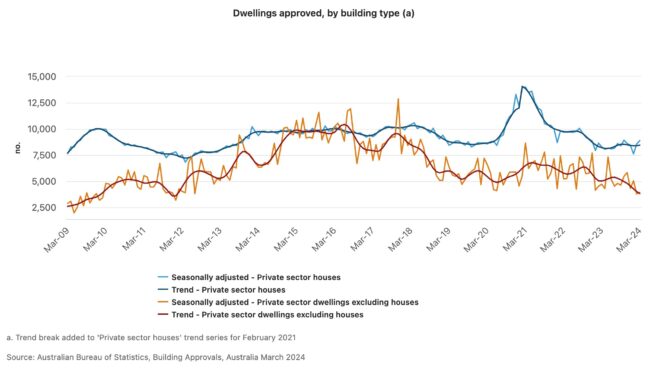
    The March figures show a 2.2% decline in seasonally adjusted total dwelling units approved year-on-year. Meanwhile, the fall for private sector dwellings excluding houses deepens to 16.8%, as depicted below.

    Source: Australian Bureau of Statistics, March 2024 Building Approvals, Australia

    In light of the sector’s softening, the ASX 200 stock has revised its FY2024 earnings before interest and taxes (EBIT) guidance.

    The company’s previous estimate was between $540 million to $640 million. Now, Fletcher expects FY24 EBIT before significant items to land between $500 million and $530 million. It marks a 17% reduction from the top-bound estimate.

    Furthermore, Fletcher highlighted gross margin pressure across Iplex NZ and Steel.

    What could be next for this ASX 200 stock?

    Citi analysts have quickly cast their judgment following Fletcher’s guidance downgrade.

    The team believes there is a risk that the building company may tap investors for money through a capital raise, stating:

    A soft trading update that appears to increase leverage outside the range expected.

    Given the potential quantum of the unknowns, we retain our sell rating and believe it may be prudent for a new CEO to shore up the balance sheet.

    As of 31 December 2023, Fletcher held NZ$2.18 billion of debt on its balance sheet. Whereas the cash pile stood at a relatively meagre NZ$215 million.

    Citi is sticking to its sell rating despite the ASX 200 stock being down 34.5% from a year ago.

    The post This ASX 200 stock just slashed its earnings guidance by 17% appeared first on The Motley Fool Australia.

    Should you invest $1,000 in Fletcher Building Limited right now?

    Before you buy Fletcher Building Limited shares, consider this:

    Motley Fool investing expert Scott Phillips just revealed what he believes are the 5 best stocks for investors to buy right now… and Fletcher Building Limited wasn’t one of them.

    The online investing service he’s run for over a decade, Motley Fool Share Advisor, has provided thousands of paying members with stock picks that have doubled, tripled or even more.*

    And right now, Scott thinks there are 5 stocks that may be better buys…

    See The 5 Stocks
    *Returns as of 5 May 2024

    More reading

    Citigroup is an advertising partner of The Ascent, a Motley Fool company. Motley Fool contributor Mitchell Lawler has no position in any of the stocks mentioned. The Motley Fool Australia’s parent company Motley Fool Holdings Inc. has no position in any of the stocks mentioned. The Motley Fool Australia has no position in any of the stocks mentioned. The Motley Fool has a disclosure policy. This article contains general investment advice only (under AFSL 400691). Authorised by Scott Phillips.

  • What’s happening with the Sayona Mining share price on Monday?

    Miner looking at a tablet.

    The Sayona Mining Ltd (ASX: SYA) share price is starting the week on a bit of a roller coaster.

    Shares in the S&P/ASX 300 Index (ASX: XKO) lithium stock closed on Friday trading for 4.4 cents. In early trade on Monday, shares were changing hands for 4.6 cents apiece, up 4.5%.

    But the embattled miner wasn’t able to hold onto those gains. At the time of writing, in later morning trade, shares are trading for 4.2 cents apiece, down 4.6%.

    For some context, the ASX 300 is down 0.3% at this same time.

    Here’s what’s happening.

    ASX lithium stock drops despite promising discoveries

    The Sayona Mining share price is failing to lift off today despite the company reporting on some promising exploration results at its North American Lithium (NAL) project, located in Quebec, Canada.

    NAL is a joint venture project. Sayona Mining owns 75% of the project, and Piedmont Lithium Inc (ASX: PLL) holds the other 25%.

    According to the release, results from 91 drill holes and wedges totalling 26,605 metres have identified high-grade lithium mineralisation to the northwest, northeast, southeast and below the Mineral Resource Estimate (MRE) pit shell.

    Management said the newly discovered zones will become a focal point for assessing future mining options at NAL.

    The Sayona Mining share price may not be responding positively today, however, as investors await more certainty.

    While the miner said that initial assessments indicated the presence of high-grade lithium mineralisation outside the MRE pit shell, it cannot yet confirm that these will substantially increase NAL’s resource portfolio or contribute to extending the lithium project’s life of mine.

    Investors should gain more certainty on the size of NAL’s resource and its life of mine estimates as more results come in. Assay results are pending for 24 additional drill holes, totalling 4,592 metres, conducted during the 2023 exploratory drilling campaign.

    Commenting on the results that have yet to boost the Sayona Mining share price, interim CEO James Brown said:

    We are very excited by these new discoveries at North American Lithium which highlights the potential of this asset with high-grade mineralisation defined to the north-west, north-east, south-east and below the existing MRE.

    The team at NAL will now be working to update the Mineral Resource incorporating these significant results. We look forward to continue testing the mineralisation at NAL with further drilling underway.

    Sayona Mining share price snapshot

    Despite rocketing 33% last week, the Sayona Mining share price remains deep in the red in 2024, down 40%.

    Pressured in part by weak lithium prices and a tepid medium-term price outlook for the battery-critical metal, shares in the ASX 300 lithium miner are down 82% over 12 months.

    The post What’s happening with the Sayona Mining share price on Monday? appeared first on The Motley Fool Australia.

    Should you invest $1,000 in Sayona Mining Limited right now?

    Before you buy Sayona Mining Limited shares, consider this:

    Motley Fool investing expert Scott Phillips just revealed what he believes are the 5 best stocks for investors to buy right now… and Sayona Mining Limited wasn’t one of them.

    The online investing service he’s run for over a decade, Motley Fool Share Advisor, has provided thousands of paying members with stock picks that have doubled, tripled or even more.*

    And right now, Scott thinks there are 5 stocks that may be better buys…

    See The 5 Stocks
    *Returns as of 5 May 2024

    More reading

    Motley Fool contributor Bernd Struben has no position in any of the stocks mentioned. The Motley Fool Australia’s parent company Motley Fool Holdings Inc. has no position in any of the stocks mentioned. The Motley Fool Australia has no position in any of the stocks mentioned. The Motley Fool has a disclosure policy. This article contains general investment advice only (under AFSL 400691). Authorised by Scott Phillips.

  • Top broker says this beaten-up ASX 200 stock could have further to fall

    falling infrastructure asx share price represented by disheartened looking builder on work site

    The Lendlease Group (ASX: LLC) share price could be in for more misery after the S&P/ASX 200 Index (ASX: XJO) stock’s tax pain. It’s currently down by 3.5% in initial reaction to an ATO tax bill.

    The construction and real estate business has announced a painful amended tax assessment which is likely to hurt earnings.

    Lendlease ATO update

    On 10 May 2024, the ATO issued Lendlease with a ‘statement of audit position’ and an amended income tax assessment relating to the ATO audit of the partial sale of Lendlease’s retirement living business in FY18.

    The amended assessment is for $112.1 million and is made up of three parts.

    First, a $62.4 million capital gains tax is coming from the exit of the retirement living trust, a “one-off event that only applies to the 2018 transaction”.

    Second, there’s $25.2 million of additional tax from the sale of 25% of the units in the joint venture trust.

    Third, the ATO has calculated $24.5 million of interest.

    However, Lendlease is hopeful of being able to avoid paying the interest based on the ATO’s previous written undertaking (in February 2020) that no interest or penalties would be applied to FY18.

    Why has the ATO decided Lendlease owes a lot more tax?

    The ASX 200 stock explained it calculated the gain on the sale by including the liabilities the business took on at the time of the purchase of the assets in its tax cost base. Lendlease considers this to be “in accordance with the lance and consistent with the ATO’s tax ruling on the retirement living industry.”

    The ATO has decided those certain liabilities assumed by Lendlease should be excluded from the tax cost base from the calculated gain. The ATO adjustments don’t relate to deductions claimed by Lendlease.

    The ASX 200 stock said it “proactively contacted the ATO to review the tax treatment applied to the 2018 sale eight months prior to submitting its tax return and also obtained independent advice before lodgement.”

    More tax pain to come?

    Since the initial part sale of the retirement living business in 2018, Lendlease has sold down two more tranches of the units in the joint venture trust in FY21 and FY22, totalling 50%.

    The ATO hasn’t (yet) issued amended assessments about those additional sales.

    If the ATO applies the same treatment to both of those partial sales, the ASX 200 stock has estimated it may mean another $50 million of additional tax, excluding any interest.  

    Broker views on the ASX 200 stock

    According to reporting by The Australian, the broker Citi thinks this could lead to another profit downgrade for the business. News of this tax bill broke before the business announced the news, and Citi commented earlier:

    If confirmed, we believe this could potentially turn into yet another earnings downgrade for FY24, after the downgrade in February 2024.

    The retirement sale profits initially seem to have been taken above the line in FY22, and the treatment of this potential tax bill could also be above the line.

    While investors are looking ahead to the end of May investor day, we believe this announcement could be a further negative and potentially result in negative share price performance.

    The Lendlease share price is already down close to 20% in 2024, as we can see on the chart below.

    The post Top broker says this beaten-up ASX 200 stock could have further to fall appeared first on The Motley Fool Australia.

    Should you invest $1,000 in Lendlease Group right now?

    Before you buy Lendlease Group shares, consider this:

    Motley Fool investing expert Scott Phillips just revealed what he believes are the 5 best stocks for investors to buy right now… and Lendlease Group wasn’t one of them.

    The online investing service he’s run for over a decade, Motley Fool Share Advisor, has provided thousands of paying members with stock picks that have doubled, tripled or even more.*

    And right now, Scott thinks there are 5 stocks that may be better buys…

    See The 5 Stocks
    *Returns as of 5 May 2024

    More reading

    Citigroup is an advertising partner of The Ascent, a Motley Fool company. Motley Fool contributor Tristan Harrison has no position in any of the stocks mentioned. The Motley Fool Australia’s parent company Motley Fool Holdings Inc. has no position in any of the stocks mentioned. The Motley Fool Australia has no position in any of the stocks mentioned. The Motley Fool has a disclosure policy. This article contains general investment advice only (under AFSL 400691). Authorised by Scott Phillips.