Tag: Fool

  • 3 top ASX 200 income stocks to buy now

    Looking for a source of income from the share market? Then take a look at the ASX 200 stocks listed below.

    Brokers have named them as buys and tipped to provide income investors with good dividend yields. Here’s what you need to know about them:

    Inghams Group Ltd (ASX: ING)

    The first ASX 200 income stock to look at is Inghams. It is Australia’s leading poultry producer and supplier.

    The team at Morgans is feeling very positive about the company and has described its shares as “undervalued” at current levels. This is because it believes Inghams deserves to trade on higher multiples due to its market leadership position and favourable consumer eating trends.

    In respect to income, Morgans is forecasting fully franked dividends of 22 cents per share in both FY 2024 and FY 2025. Based on the current Inghams share price of $3.60, this equates to dividend yields of 6.1% for both years.

    Morgans has an add rating and $4.25 price target on its shares.

    Stockland Corporation Ltd (ASX: SGP)

    Another ASX 200 income stock that could be a buy according to brokers is Stockland. It is Australia’s largest community creator. It owns, manages, and develops retail town centres, workplace and logistics assets, residential and land lease communities.

    Morgan Stanley is a fan of the company and believes it is well-placed to reward investors with big dividend yields in the near term.

    It is forecasting Stockland to pay dividends per share of 24.6 cents in FY 2024 and then 25.8 cents in FY 2025. Based on the current Stockland share price of $4.24, this will mean yields of 5.8% and 6.1% yields, respectively.

    Super Retail Group Ltd (ASX: SUL)

    A final ASX 200 income stock that could be in the buy zone right now is Super Retail. It is the retail conglomerate behind popular store brands BCF, Macpac, Rebel, and Super Cheap Auto.

    Goldman Sachs is very positive about the company in the current complex environment. This is largely due to its vast loyalty program. It highlights that Super Retail is “building a competitive advantage through 11.1mn members and 76% sales to members.” Its analysts expect this to “help drive sales in a more complex operating environment.”

    Goldman expects Super Retail to pay fully franked dividends per share of 67 cents in FY 2024 and then 73 cents in FY 2025. Based on the latest Super Retail share price of $13.90, this will mean dividend yields of 4.8% and 5.25%, respectively.

    The broker currently has a buy rating and $17.80 price target on its shares.

    The post 3 top ASX 200 income stocks to buy now appeared first on The Motley Fool Australia.

    Should you invest $1,000 in Inghams Group Limited right now?

    Before you buy Inghams Group Limited shares, consider this:

    Motley Fool investing expert Scott Phillips just revealed what he believes are the 5 best stocks for investors to buy right now… and Inghams Group Limited wasn’t one of them.

    The online investing service he’s run for over a decade, Motley Fool Share Advisor, has provided thousands of paying members with stock picks that have doubled, tripled or even more.*

    And right now, Scott thinks there are 5 stocks that may be better buys…

    See The 5 Stocks
    *Returns as of 10 July 2024

    More reading

    Motley Fool contributor James Mickleboro has no position in any of the stocks mentioned. The Motley Fool Australia’s parent company Motley Fool Holdings Inc. has positions in and has recommended Goldman Sachs Group and Super Retail Group. The Motley Fool Australia has positions in and has recommended Super Retail Group. The Motley Fool has a disclosure policy. This article contains general investment advice only (under AFSL 400691). Authorised by Scott Phillips.


  • 6% dividend yield! I’m buying this ASX share and holding it for decades

    An Australian farmer wearing a beaten-up akubra hat and work shirt leans on a fence with livestock in the background and a blue sky above.

    I’ve owned the ASX dividend share Rural Funds Group (ASX: RFF) for several years now and plan to hold it for a long time.

    It’s a real estate investment trust (REIT) that owns farmland in various states, climactic conditions, and farm types. It’s invested in almonds, macadamias, cropping, vineyards, and cattle.

    I like owning Rural Funds as a way to gain exposure to Australia’s agricultural sector, which is one industry in which Australia is a global leader.

    Here are three key reasons why I think it’s an appealing pick for long-term passive income.

    Long rental contracts

    Rural Funds has a number of high-quality tenants, which is useful for providing reliable rental income. Those tenants include Olam, The Rohatyn Group, JBS, Select Harvests Ltd (ASX: SHV), Treasury Wine Estates Ltd (ASX: TWE), and Australian Agricultural Company Ltd (ASX: AAC).

    The ASX dividend share has a very long weighted average lease expiry (WALE), which means the rental income is locked in for a long time.

    As of the FY24 first-half result, the WALE was 12.8 years, with the almond and macadamia leases on particularly long contracts.

    As Rural Funds put it: “Long-dated WALE provides stability of income and long-term rental growth via a mix of indexation mechanisms.”

    Growing income

    Growing rental income can increase the value of the properties and also unlock higher distributions.

    Most of the ASX dividend share’s rental income grows with either a CPI-inflation-linked increase or a fixed annual increase, with some contracts having market reviews.

    While higher interest rates are currently a headwind for rental profits, rental income growth helps to offset this. It also seems as though interest rates may soon stop rising in Australia.

    Rural Funds has been investing in some of its farms to increase the productivity, and therefore the rental and underlying value, of those properties.

    Farmland has been an important asset for hundreds of years. I think it will be a good asset to own for many more years.

    Strong yield

    The ASX dividend share is currently paying a solid annualised distribution of 11.73 cents per unit. That translates into a distribution yield of close to 6%.

    That’s not the biggest yield around, but it’s more than what someone could get from a savings account, and there’s good potential for distribution growth in the coming years.

    I think Rural Funds is the sort of business that could continue to pay good distributions for decades to come. If farm values keep rising, then shareholders could be on track for fertile passive income.

    The post 6% dividend yield! I’m buying this ASX share and holding it for decades appeared first on The Motley Fool Australia.

    Should you invest $1,000 in Rural Funds Group right now?

    Before you buy Rural Funds Group shares, consider this:

    Motley Fool investing expert Scott Phillips just revealed what he believes are the 5 best stocks for investors to buy right now… and Rural Funds Group wasn’t one of them.

    The online investing service he’s run for over a decade, Motley Fool Share Advisor, has provided thousands of paying members with stock picks that have doubled, tripled or even more.*

    And right now, Scott thinks there are 5 stocks that may be better buys…

    See The 5 Stocks
    *Returns as of 10 July 2024

    More reading

    Motley Fool contributor Tristan Harrison has positions in Rural Funds Group. The Motley Fool Australia’s parent company Motley Fool Holdings Inc. has no position in any of the stocks mentioned. The Motley Fool Australia has positions in and has recommended Rural Funds Group. The Motley Fool Australia has recommended Treasury Wine Estates. The Motley Fool has a disclosure policy. This article contains general investment advice only (under AFSL 400691). Authorised by Scott Phillips.

  • Would I be crazy to buy DroneShield shares now at over $2?

    A woman wearing a black and white striped t-shirt looks to the sky with her hand to her chin contemplating buying ASX shares today as the market rebounds

    DroneShield Ltd (ASX: DRO) shares have been shooting the lights out over the past year.

    Despite a 0.93% retrace yesterday to $2.13, shares in the All Ordinaries Index (ASX: XAO) drone defence company are up an eye-watering 719% over 12 months.

    Yep, that’s no typo.

    To put this blistering performance in perspective, this will have turned a $5,000 investment into $40,962.

    In one year.

    But with DroneShield shares having now leapt from 26 cents to more than $2, would I be crazy to buy?

    Let’s dig in.

    What’s been sending the ASX drone defence stock to the moon?

    ASX investors have been sending DroneShield shares flying higher amid ongoing and rising global tensions.

    As we’ve seen over the last year in hotspots including Ukraine and the Middle East, drones are quickly gaining traction in military conflicts, as well as posing increasing threats to civilian infrastructure, prisons and airports.

    With the AI revolution in full swing, the threats posed by ever-increasing autonomous drones are only likely to grow. And the demand for AI-enabled drone defence capabilities is likely to grow alongside those threats.

    The last 12 months has seen DroneShield tap into that growing defence demand, inking a series of multi-million dollar contracts with government agencies across the globe.

    And this has led to some smashing financial results.

    On 15 April, the company reported record first-quarter revenues of $16.4 million, up a whopping 900% from the $1.6 million reported in the prior corresponding quarter.

    In its quarterly results, the company also reported having a $27 million contracted backlog and a sales pipeline of over $519 million.

    DroneShield shares closed up 11.1% on the day at 95 cents a share.

    And shares have kept charging higher from there.

    Most recently, on 20 June, shares hit another all-time closing high after the company reported on a $4.7 million order from a new non-government Swiss international customer to provide multiple vehicle-based counter-drone (C-UxS) systems.

    So, would I be crazy to buy DroneShield shares at more than $2 apiece?

    I think not.

    Among the tailwinds that could continue to see it grow are the potential threats and accompanying defence capabilities posed by AI technology.

    Commenting on that potential following the $4.7 million C-UxS systems sale on 20 June, DroneShield CEO Oleg Vornik said:

    This order highlights DroneShield expertise not only as a maker of cutting-edge AI-based C-UAS sensor and effector technologies, but also a system integrator, for demanding applications that involve multiple sensor and effector modalities, operating in tough conditions. 

    What are the experts saying about DroneShield shares?

    Turning to what the experts are saying about DroneShield shares, in mid-June, Frazis Capital founder Michael Frazis noted:

    DroneShield recorded revenues of $55 million in 2023, more than triple the $17 million in 2022. And analysts forecast 2024 revenues of over $90 million, with the bulk coming from high margin defence contracts…

    The opportunity is immense. Less than 1% of infantry units, ships, military bases, and civilian targets are protected against low-cost drones.

    The fund managers at Tamim Asset Management are also bullish on the outlook for DroneShield shares, recently stating:

    In the most recent quarterly report, DroneShield reported incredible financial results for the first quarter of 2024, with revenue growing 10 times year-over-year and a significant increase in order intake.

    As the threat of drone-related incidents continues to rise, DroneShield is well-positioned to capitalise on the increasing need for effective counter-drone technologies.

    The post Would I be crazy to buy DroneShield shares now at over $2? appeared first on The Motley Fool Australia.

    Should you invest $1,000 in Droneshield Limited right now?

    Before you buy Droneshield Limited shares, consider this:

    Motley Fool investing expert Scott Phillips just revealed what he believes are the 5 best stocks for investors to buy right now… and Droneshield Limited wasn’t one of them.

    The online investing service he’s run for over a decade, Motley Fool Share Advisor, has provided thousands of paying members with stock picks that have doubled, tripled or even more.*

    And right now, Scott thinks there are 5 stocks that may be better buys…

    See The 5 Stocks
    *Returns as of 10 July 2024

    More reading

    Motley Fool contributor Bernd Struben has no position in any of the stocks mentioned. The Motley Fool Australia’s parent company Motley Fool Holdings Inc. has positions in and has recommended DroneShield. The Motley Fool Australia has no position in any of the stocks mentioned. The Motley Fool has a disclosure policy. This article contains general investment advice only (under AFSL 400691). Authorised by Scott Phillips.

  • Why Macquarie says go overweight on ASX REITs now!

    REIT written with images circling it and a man touching it.

    It was a mixed year for ASX Real Estate Investment Trusts (REITs) in FY24, with some names missing the board, but others like Goodman Group (ASX: GMG) and Scentre Group (ASX: SCG) showing considerable strength.

    According to my colleague Mitch, the outlook for ASX REITs is backed by a strong residential property market. And according to Macquarie, the picture could be even brighter than we think.

    Analysts at the investment bank issued a recommendation for investors to consider overweight positions in ASX REITs this week.

    This comes as part of a strategic shift in response to anticipated changes in the economic cycle and potential interest rate cuts. Let’s take a look at what this means.

    Macquarie bullish on ASX REITs

    Macquarie says ASX REITs could be at a crucial inflection point in the market cycle, noting that global asset managers are also bullish on the sector.

    “This is a key inflection point in the market cycle”, the broker said, according to The Australian Financial Review.

    In the past when sentiment was already very bullish, forward returns were weak and led by defensives. When the cycle shifts to a slowdown, the odds of defensives outperforming likewise start to rise.

    According to Macquarie, this phase typically yields positive but lower returns for stocks. This could warrant a move towards more defensive investments like healthcare and real estate.

    Despite concerns over potential rate hikes from the Reserve Bank of Australia (RBA), global trends suggest that major central banks – including the US Federal Reserve – might soon cut rates.

    This outlook supports a particularly favourable environment for ASX REITs, the broker says. Due to their attractive yields, these assets tend to perform well when interest rates decline.

    Overweight recommendation on ASX REITs

    In light of these insights, Macquarie has upgraded its position on the ASX real estate sector. It recommends investors to be ‘overweight’ with exposure to the domain.

    The recommendation is based on the RBA’s potential moves. But, it says the potential for a stronger Australian dollar could also mitigate the need for additional rate hikes by the RBA.

    We expected a hawkish shift from the RBA, and it has happened. With the shift to slowdown and global banks easing, there is reason to think the RBA will hold so as not to risk pushing the [AUD] up too far.

    Macquarie’s shift towards REITs is part of a broader strategic adjustment. The bank is reducing exposure to sectors more vulnerable to economic downturns, such as banking and mining.

    It has increased its exposure to defensive healthcare stocks like ResMed Ltd (ASX: RMD) and CSL Ltd (ASX: CSL) instead.

    Foolish takeaway

    Macquarie’s recommendation to overweight ASX REITs is driven by its insights into the shifting economic cycle and potential interest rate cuts.

    The performance of REITs like Goodman Group and Scentre Group set the bedrock for FY25. As always, it’s imperative to conduct your own due diligence.

    The post Why Macquarie says go overweight on ASX REITs now! appeared first on The Motley Fool Australia.

    Should you invest $1,000 in Goodman Group right now?

    Before you buy Goodman Group shares, consider this:

    Motley Fool investing expert Scott Phillips just revealed what he believes are the 5 best stocks for investors to buy right now… and Goodman Group wasn’t one of them.

    The online investing service he’s run for over a decade, Motley Fool Share Advisor, has provided thousands of paying members with stock picks that have doubled, tripled or even more.*

    And right now, Scott thinks there are 5 stocks that may be better buys…

    See The 5 Stocks
    *Returns as of 10 July 2024

    More reading

    Motley Fool contributor Zach Bristow has no position in any of the stocks mentioned. The Motley Fool Australia’s parent company Motley Fool Holdings Inc. has positions in and has recommended CSL, Goodman Group, Macquarie Group, and ResMed. The Motley Fool Australia has positions in and has recommended Macquarie Group and ResMed. The Motley Fool Australia has recommended CSL and Goodman Group. The Motley Fool has a disclosure policy. This article contains general investment advice only (under AFSL 400691). Authorised by Scott Phillips.

  • Telstra stock pays a massive 7% dividend, and now could be a great time to buy

    Smiling couple looking at a phone at a bargain opportunity.

    Telstra Group Ltd (ASX: TLS) stock is regularly viewed as an appealing ASX dividend share to own. This could be a compelling time to consider the company for its passive income and dividend potential.

    Businesses that are able to deliver growing earnings can achieve both a rising share price and afford growing dividend payments.

    The latest news from Telstra is exciting for shareholders because of what it could mean for revenue, net profit after tax (NPAT) and the potential payouts.

    The company announced it would increase the prices for most pre-paid and postpaid mobile plans by between $2 and $4 per month. Telstra justified this decision by saying it needs to continue to “invest to manage the technology evolution and continued strong customer demand on its mobile network.”

    The telco noted traffic on Telstra’s mobile network is growing by approximately 20% per annum.

    Why this makes Telstra stock appealing

    The Australian reported that Goldman Sachs analyst Kane Hannan reiterated his buy rating on Telstra stock after seeing the price increase news. The analyst said this, combined with the recent Optus price increase, suggests that the telco market remains “rational”.

    Goldman Sachs reportedly said the Telstra mobile earnings growth “remains strong”, thanks to subscriber and average revenue per user (ARPU) growth.

    Hannan said there are flexibility benefits to the plans no longer being linked to CPI inflation because the core plan prices could experience price rises faster than CPI, while the price-sensitive starter plans can avoid price increases if Telstra decides to do so.

    Goldman Sachs now thinks Telstra will increase its profit guidance range from $8.5 billion to $8.7 billion, up from between $8.4 billion to $8.7 billion.

    Meanwhile, Macquarie decided to increase its dividend forecast for Telstra stock to 9.5 cents for the first half of FY25 thanks to the better-than-expected mobile price rise.

    How big is the dividend yield?

    If Telstra were to pay 9.5 cents per share for the interim and final dividends in FY25, this would translate into an annualised payout of 19 cents per share.

    At the current Telstra stock price, this would translate into a fully franked dividend yield of around 5% and a grossed-up dividend yield of approximately 7%.

    As a starting yield, I think that’s a very good level of income, and there’s potential for ongoing dividend growth if Telstra’s mobile subscriber numbers keep rising. I believe the telco can deliver pleasing shareholder returns in the medium term.

    The post Telstra stock pays a massive 7% dividend, and now could be a great time to buy appeared first on The Motley Fool Australia.

    Should you invest $1,000 in Telstra Corporation Limited right now?

    Before you buy Telstra Corporation Limited shares, consider this:

    Motley Fool investing expert Scott Phillips just revealed what he believes are the 5 best stocks for investors to buy right now… and Telstra Corporation Limited wasn’t one of them.

    The online investing service he’s run for over a decade, Motley Fool Share Advisor, has provided thousands of paying members with stock picks that have doubled, tripled or even more.*

    And right now, Scott thinks there are 5 stocks that may be better buys…

    See The 5 Stocks
    *Returns as of 10 July 2024

    More reading

    Motley Fool contributor Tristan Harrison has no position in any of the stocks mentioned. The Motley Fool Australia’s parent company Motley Fool Holdings Inc. has positions in and has recommended Goldman Sachs Group and Macquarie Group. The Motley Fool Australia has positions in and has recommended Macquarie Group and Telstra Group. The Motley Fool has a disclosure policy. This article contains general investment advice only (under AFSL 400691). Authorised by Scott Phillips.

  • Which US shares are ASX investors buying in 2024?

    A US flag behind a graph, indicating investment in US shares

    Here at the Motley Fool, we normally cover the movements and trends of the Australian share market and those of ASX shares. But in today’s modern world, ASX investors are increasingly looking beyond our shores in the search for the best investments available. And most of the world’s best investments that aren’t ASX shares are arguably found on the US markets.

    The US markets are home to what are indisputably the best companies in the world. Coca-Cola, American Express, Berkshire Hathaway, Netflix, Mastercard, Apple, NVIDIA, Amazon… these world-dominating companies are all US shares, and call the American markets home.

    So it makes sense that ASX investors might want a slice of come of these businesses. After all, while ASX investors are justifiably fond of the likes of Westpac Banking Corp (ASX: WBC), Telstra Group Ltd (ASX: TLS) and Coles Group Ltd (ASX: COL), these ASX shares can’t hold a candle to the names above when it comes to global dominance in their fields.

    But many Australian investors might want to know which US shares are being bought by Australian investors in particular. Luckily, financial services and brokerage company eToro has provided some data on this subject.

    The ten most popular US shares for ASX investors

    Here are the ten most widely-held US shares on eToro’s platform over the quarter ended 30 June 2024:

    1. Tesla Inc (NASDAQ: TSLA)
    2. NVIDIA Corporation (NASDAQ: NVDA)
    3. Apple Inc (NASDAQ: AAPL)
    4. Amazon.com Inc (NASDAQ: AMZN)
    5. Microsoft Corporation (NASDAQ: MSFT)
    6. Meta Platforms Inc (NASDAQ: META)
    7. Nio Inc (NYSE: NIO)
    8. Alphabet Inc (NASDAQ: GOOG)(NASDAQ: GOOGL)
    9. GameStop Corp (NYSE: GME)
    10. Alibaba Group Holding (NYSE: BABA)

    These ten US shares are unchanged from the previous quarter’s figures. However, their positions in this top ten list have changed. Nvidia replaced Apple in the number two spot, while Nio was usurped by Meta in number six. Gamestop also bumped off Alibaba for the ninth position.

    Meme stocks and tech giants

    So it’s not too surprising to see these companies take out the top US share positions for ASX investors. Tesla, Nvidia, Apple, Amazon, Microsoft, Meta and Alphabet (Google and YouTube owner) are all household names with products most of us probably use every day.

    These US shares are well-known for having delivered massive windfalls to their investors in the past, which many ASX investors probably (and reasonably) assume will continue into the future, given their ongoing dominance.

    Gamestop, Nio and Alibaba are more interesting though.

    Both Gamestop and Nio have made names for themselves as ‘meme stocks’. These shares are subject to huge swings in volatility on a regular basis, and have become popular ‘swing trades’.

    Chinese e-commerce giant Alibaba is one of the largest companies in China, but it has lost more than 75% of its value over the past four years or so. Consequently, some ASX investors may be betting on a big recovery.

    But those are the US shares ASX investors have been buying over the past three months. Let’s see if it’s the same names that pop up next quarter.

    The post Which US shares are ASX investors buying in 2024? appeared first on The Motley Fool Australia.

    Should you invest $1,000 in Apple right now?

    Before you buy Apple shares, consider this:

    Motley Fool investing expert Scott Phillips just revealed what he believes are the 5 best stocks for investors to buy right now… and Apple wasn’t one of them.

    The online investing service he’s run for over a decade, Motley Fool Share Advisor, has provided thousands of paying members with stock picks that have doubled, tripled or even more.*

    And right now, Scott thinks there are 5 stocks that may be better buys…

    See The 5 Stocks
    *Returns as of 10 July 2024

    More reading

    Randi Zuckerberg, a former director of market development and spokeswoman for Facebook and sister to Meta Platforms CEO Mark Zuckerberg, is a member of The Motley Fool’s board of directors. Suzanne Frey, an executive at Alphabet, is a member of The Motley Fool’s board of directors. John Mackey, former CEO of Whole Foods Market, an Amazon subsidiary, is a member of The Motley Fool’s board of directors. American Express is an advertising partner of The Ascent, a Motley Fool company. Motley Fool contributor Sebastian Bowen has positions in Alphabet, Amazon, American Express, Apple, Berkshire Hathaway, Coca-Cola, Mastercard, Meta Platforms, Microsoft, Telstra Group, and Tesla. The Motley Fool Australia’s parent company Motley Fool Holdings Inc. has positions in and has recommended Alphabet, Amazon, Apple, Berkshire Hathaway, Mastercard, Meta Platforms, Microsoft, Netflix, Nvidia, and Tesla. The Motley Fool Australia’s parent company Motley Fool Holdings Inc. has recommended Alibaba Group and has recommended the following options: long January 2025 $370 calls on Mastercard, long January 2026 $395 calls on Microsoft, short January 2025 $380 calls on Mastercard, and short January 2026 $405 calls on Microsoft. The Motley Fool Australia has positions in and has recommended Coles Group and Telstra Group. The Motley Fool Australia has recommended Alphabet, Amazon, Apple, Berkshire Hathaway, Mastercard, Meta Platforms, Microsoft, Netflix, and Nvidia. The Motley Fool has a disclosure policy. This article contains general investment advice only (under AFSL 400691). Authorised by Scott Phillips.

  • Here are the top 10 ASX 200 shares today

    A woman's hand draws a stylised 'Top Ten' on a projected surface.

    It was a sobering Wednesday session for the S&P/ASX 200 Index (ASX: XJO) and many ASX shares today.

    After recording a strong gain yesterday, investors appear to have gotten cold feet overnight. By the time trading wrapped up, the ASX 200 had fallen by 0.16% to finish at 7,816.8 points.

    This not-so-happy hump day for ASX shares comes after a mixed night of trading over on the US markets last night.

    The Dow Jones Industrial Average Index (DJX: DJI) had a miserly time of it, dropping 0.13%.

    It was a little better for the Nasdaq Composite Index (NASDAQ: .IXIC) though, which inched 0.14% higher.

    But let’s get back to talking about ASX shares and take a look at what was going on amongst the various ASX sectors today.

    Winners and losers

    Despite the market’s drop, quite a few sectors increased in value this Wednesday.

    But more on those in a moment.

    The worst-performing sector today was mining shares. The S&P/ASX 200 Materials Index (ASX: XMJ) had a shocker, tanking 1.2%.

    Utilities stocks weren’t too far off that, with the S&P/ASX 200 Utilities Index (ASX: XUJ) plunging 1.17%.

    Energy shares were also on the nose. The S&P/ASX 200 Energy Index (ASX: XEJ) cratered by 0.64% today.

    Tech stocks fared a little better, but the S&P/ASX 200 Information Technology Index (ASX: XIJ) still fell 0.17%.

    Healthcare stocks were our last losers of the day. The S&P/ASX 200 Healthcare Index (ASX: XHJ) retreated by a rather unhealthy 0.14%.

    But, believe it or not, that’s it for the losers.

    Leading the winners today were communications shares. The S&P/ASX 200 Communication Services Index (ASX: XTJ) had a great time, rocketing up 1.44%.

    Gold stocks were also running hot, with the All Ordinaries Gold Index (ASX: XGD) recording a rise of 0.33%.

    Consumer staples shares were in demand as well. The S&P/ASX 200 Consumer Staples Index (ASX: XSJ) ended up gaining 0.25%.

    Financial shares proved to be another bright spot, illustrated by the S&P/ASX 200 Financials Index (ASX: XFJ)’s 0.21% lift.

    Real estate investment trusts (REITs) were right behind financials, evidenced by the S&P/ASX 200 A-REIT Index (ASX: XPJ)’s 0.18% improvement.

    Industrial shares also had a pleasant day. The S&P/ASX 200 Industrials Index (ASX: XNJ) ended up enjoying a 0.14% markup.

    Finally, consumer discretionary stocks saw a small increase in value, with the S&P/ASX 200 Consumer Discretionary Index (ASX: XDJ) inching 0.08% higher.

    Top 10 ASX 200 shares countdown

    Today’s best share on the index was none other than gaming stock Star Entertainment Group Ltd (ASX: SGR). Star shares soared by 3.06% today, up to 50.5 cents each.

    That was despite a complete lack of catalysts for such a move out of the company today.

    Here’s how the rest of the top ten pulled up this Wednesday:

    ASX-listed company Share price Price change
    Star Entertainment Group Ltd (ASX: SGR) $0.505 3.06%
    Ingenia Communities Group (ASX: INA) $4.88 2.95%
    Red 5 Ltd (ASX: RED) $0.41 2.50%
    Perseus Mining Ltd (ASX: PRU) $2.51 2.45%
    Telstra Group Ltd (ASX: TLS) $3.82 2.41%
    Steadfast Group Ltd (ASX: SDF) $6.44 2.38%
    JB Hi-Fi Ltd (ASX: JBH) $64.39 2.24%
    Fisher & Paykel Healthcare Corporation Ltd (ASX: FPH) $28.02 2.11%
    Megaport Ltd (ASX: MP1) $11.58 2.03%
    Pinnacle Investment Management Group Ltd (ASX: PNI)
    $15.29 1.87%

    Our top 10 shares countdown is a recurring end-of-day summary to let you know which companies were making big moves on the day. Check in at Fool.com.au after the weekday market closes to see which stocks make the countdown.

    The post Here are the top 10 ASX 200 shares today appeared first on The Motley Fool Australia.

    Should you invest $1,000 in Fisher & Paykel Healthcare Corporation Limited right now?

    Before you buy Fisher & Paykel Healthcare Corporation Limited shares, consider this:

    Motley Fool investing expert Scott Phillips just revealed what he believes are the 5 best stocks for investors to buy right now… and Fisher & Paykel Healthcare Corporation Limited wasn’t one of them.

    The online investing service he’s run for over a decade, Motley Fool Share Advisor, has provided thousands of paying members with stock picks that have doubled, tripled or even more.*

    And right now, Scott thinks there are 5 stocks that may be better buys…

    See The 5 Stocks
    *Returns as of 10 July 2024

    More reading

    Motley Fool contributor Sebastian Bowen has positions in Telstra Group. The Motley Fool Australia’s parent company Motley Fool Holdings Inc. has positions in and has recommended Megaport and Pinnacle Investment Management Group. The Motley Fool Australia has positions in and has recommended Pinnacle Investment Management Group, Steadfast Group, and Telstra Group. The Motley Fool Australia has recommended Jb Hi-Fi and Megaport. The Motley Fool has a disclosure policy. This article contains general investment advice only (under AFSL 400691). Authorised by Scott Phillips.

  • Forget Westpac and buy these ASX dividend stocks

    A woman relaxes on a yellow couch with a book and cuppa, and looks pensively away as she contemplates the joy of earning passive income.

    If you want some income options outside the status quo of Commonwealth Bank of Australia (ASX: CBA) or Westpac Banking Corp (ASX: WBC), then it could be worth looking at the two ASX dividend stocks listed below.

    Here’s why brokers think they could be in the buy zone today:

    South32 Ltd (ASX: S32)

    If you don’t mind investing in the mining sector, then South32 could be an ASX dividend stock to buy right now.

    That’s the view of analysts at Goldman Sachs, which believe that the diversified miner is undervalued. This is due largely to the favourable outlook for copper, aluminium, zinc, and met coal prices. It explains:

    GS are bullish copper, aluminium, zinc and met coal (~65% of S32 NTM EBITDA) in CY24. Together with lower capex, working cap unwind and higher production, we forecast ~US$550mn of FCF in the June H. On our forecasts, S32 is trading on a FCF yield of 9% in FY25 (10% at spot). […] Attractive valuation: although trading at ~1xNAV (A$3.77/sh), on near term multiples S32 is trading on an attractive NTM EV/EBITDA multiple of ~4.5x vs. the global sector average of 5.7x.

    Goldman also believes that the South32 dividend is about to jump. It is forecasting fully franked dividends per share of 4 US cents in FY 2024, then 12 US cents in FY 2025 and 18 US cents in FY 2026. Based on its latest share price of $3.64 and current exchange rates, this will mean dividend yields of 1.7%, 4.9%, and 7.3%, respectively.

    Goldman has a buy rating and $4.30 price target on South32’s shares.

    SRG Global Ltd (ASX: SRG)

    Bell Potter thinks that SRG Global could be a top ASX dividend stock to buy this month. It has a buy rating and $1.30 price target on its shares.

    SRG Global is a diversified industrial services group that provides multidisciplinary construction, maintenance, production drilling and geotechnical services.

    Bell Potter is positive on the company due to its belief that SRG Global will be a big winner from construction activity and accelerating growth in iron ore and gold production volumes. It explains:

    SRG’s short-to-medium term outlook is reinforced by Government-stimulated construction activity in the Infrastructure and Non-Residential sectors and increased development and sustaining capital expenditures in the Resources industry. The resulting expansion in infrastructure bases across these sectors will likely support increased demand for asset care and maintenance in the medium to long-term. We anticipate Mining Services will be a beneficiary of accelerating growth in iron ore and gold production volumes over the next five years.

    In respect to income, Bell Potter is forecasting fully franked dividends of 4.7 cents in FY 2024 and then 6.7 cents in FY 2025. Based on its current share price of 89 cents, this will mean dividend yields of 5.3% and 7.5%, respectively.

    The post Forget Westpac and buy these ASX dividend stocks appeared first on The Motley Fool Australia.

    Should you invest $1,000 in South32 Limited right now?

    Before you buy South32 Limited shares, consider this:

    Motley Fool investing expert Scott Phillips just revealed what he believes are the 5 best stocks for investors to buy right now… and South32 Limited wasn’t one of them.

    The online investing service he’s run for over a decade, Motley Fool Share Advisor, has provided thousands of paying members with stock picks that have doubled, tripled or even more.*

    And right now, Scott thinks there are 5 stocks that may be better buys…

    See The 5 Stocks
    *Returns as of 10 July 2024

    More reading

    Motley Fool contributor James Mickleboro has positions in Westpac Banking Corporation. The Motley Fool Australia’s parent company Motley Fool Holdings Inc. has positions in and has recommended Goldman Sachs Group. The Motley Fool Australia has recommended Srg Global. The Motley Fool has a disclosure policy. This article contains general investment advice only (under AFSL 400691). Authorised by Scott Phillips.

  • Up 45% in FY 2024, can the Yancoal share price keep burning bright in FY 2025?

    A coal miner smiling and holding a coal rock, symbolising a rising share price.

    The Yancoal Australia Ltd (ASX: YAL) share price just closed out a smashing 2024 financial year.

    Shares in the All Ordinaries Index (ASX: XAO) coal stock finished off FY 2023 trading at $4.58. Shares closed on 28 June, the last trading day of FY 2024, changing hands for $6.62 apiece.

    That saw the Yancoal share price up a whopping 44.5% over the 12 months.

    For some context, the All Ords gained 8.3% over this same time.

    And this stellar performance doesn’t even include the outsized dividends the coal miner paid out. In FY 2024 eligible investors will have received a total of 69.5 cents a share in fully franked dividends.

    If we add those back in, the accumulated value of the Yancoal share price leapt 59.7% over the financial year just past.

    Why did the ASX coal stock have such a strong year?

    Yancoal has done a good job keeping a lid on costs while increasing production, even as it focused on its mine recovery plans.

    In fact, Q2 FY 2024 saw the miner achieve its highest rate of quarterly production in three years, offering another boost to the Yancoal share price.

    Over the full calendar year of 2023 (which includes H1 FY 2024), Yancoal reported $7.8 billion in revenue. Operating earnings before interest, taxes, depreciation and amortisation (EBITDA) came in at $3.5 billion. This drove an eye-catching $1.8 billion in after-tax profit.

    As for Q3 FY 2024, the miner continued to generate strong cash flows. Yancoal held $1.66 billion in cash at the end of March. That was before paying out $429 million for the final dividend on 30 April.

    With that picture in mind, what can investors expect from the Yancoal share price in FY 2025?

    What’s ahead for the Yancoal share price in FY 2025?

    Much of the performance of the Yancoal share price will be determined by the price the miner receives for its thermal and coking coal.

    In 2023, the company’s realised price came out to AU$180 per tonne.

    That’s roughly double the cash operating costs of $80 to $97 per tonne that Yancoal is targeting in H1 FY 2025. Cash operating costs were AU$96 per tonne in calendar year 2023.

    Looking to the year ahead, back in April, CEO David Moult said:

    We see Yancoal’s large-scale, low-cost coal production profile as well suited to the current coal market conditions. Having no interest-bearing loans, a large net cash position and robust operating margins provides us with the capacity to act should suitable growth opportunities arise.

    The miner’s 2024 calendar year guidance is for 35 million to 39 million tonnes of attributable saleable production.

    On 30 May, at the annual general meeting, the miner reported:

    Output will vary quarter-to-quarter due to mine plan sequences, longwall moves and planned maintenance, and there will be a second half weighting to the production profile.

    We aim to bring the cash operating costs per tonne down from the full-year 2023 level and are focused on output given the direct relationship between the volumes we produce and the per tonne cash operating costs we report.

    Halfway through week two of FY 2025, the Yancoal share price stands at $7.27. That’s up 9.8% so far in the new financial year.

    The post Up 45% in FY 2024, can the Yancoal share price keep burning bright in FY 2025? appeared first on The Motley Fool Australia.

    Should you invest $1,000 in Yancoal Australia Ltd right now?

    Before you buy Yancoal Australia Ltd shares, consider this:

    Motley Fool investing expert Scott Phillips just revealed what he believes are the 5 best stocks for investors to buy right now… and Yancoal Australia Ltd wasn’t one of them.

    The online investing service he’s run for over a decade, Motley Fool Share Advisor, has provided thousands of paying members with stock picks that have doubled, tripled or even more.*

    And right now, Scott thinks there are 5 stocks that may be better buys…

    See The 5 Stocks
    *Returns as of 10 July 2024

    More reading

    Motley Fool contributor Bernd Struben has no position in any of the stocks mentioned. The Motley Fool Australia’s parent company Motley Fool Holdings Inc. has no position in any of the stocks mentioned. The Motley Fool Australia has no position in any of the stocks mentioned. The Motley Fool has a disclosure policy. This article contains general investment advice only (under AFSL 400691). Authorised by Scott Phillips.

  • This Warren Buffett metric is at a never-before-seen high! What does it mean?

    Woman and man calculating a dividend yield.

    The S&P 500 Index (SP: .INX) and Nasdaq Composite Index (NASDAQ: .IXIC) reached new all-time highs on Wall Street last night. It should be a cause for celebration. If only the record weren’t accompanied by a more sinister number cracking into uncharted territory, too.

    Warren Buffett and I both know investing is for the long term, and history has shown that more record highs follow record highs (eventually). And yet, the greatest of all time (GOAT) investor still takes heed of a market consumed by greed.

    As it turns out, Warren’s own indicator of an overvalued market also reached an all-time high overnight.

    Warren Buffett’s valuation ratio

    Roughly 23 years ago, Warren Buffett explained what he considered to be “the best single measure” of valuations, whether overvalued or undervalued. While the world’s tenth richest person has since walked back the importance of the measure, it remains a popular tool among investors.

    The metric, aptly known as the ‘Buffett Indicator’, measures the total market capitalisation of US stocks divided by the country’s gross domestic product (GDP). Essentially, it’s a ratio of the valuation investors are willing to ascribe to public companies versus the actual size of the country’s economy.

    Source: The Buffett Indicator: Market Cap to GDP, Longtermtrends

    As shown in the chart above, the Warren Buffett Indicator is at a historical high of 195%. Before this rally, the previous high was 194.8%, set in November 2021. The S&P 500 began falling a month later, resulting in a 25% crash over the following nine months.

    Why is it at the highest point in its history?

    There is a dichotomy between the economy and the stock market, especially in the United States.

    On the one hand, the United States economy is softening as interest rates eat into spending. At the same time, there’s a seemingly insatiable demand for all things artificial intelligence (AI).

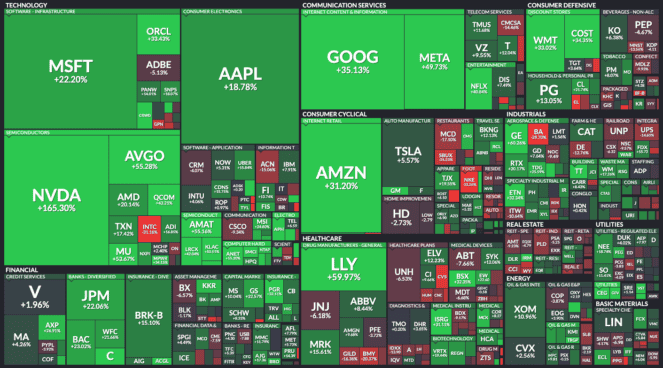
    Source: S&P 500 year-to-date performance map, Finviz

    As a result, stock market indices are being pushed higher by a small handful of beneficiaries of the AI appetite — Nvidia Corp (NASDAQ: NVDA), Microsoft Corp (NASDAQ: MSFT), etc. These same companies constitute a large portion of the entire US stock market, as shown above.

    The narrow concentration of growth could explain the record disconnect between the overall stock market and the United States economy.

    What does it mean for investors?

    As a strong critic of ‘timing the market,’ Warren Buffett doesn’t dump his portfolio when the overall market looks frothy. Rather, he usually moves incoming cash from his investments in Berkshire Hathaway Inc. (NYSE: BRK) into U.S. Treasury Bills until he discovers an opportunity.

    An ‘overvalued’ market hasn’t stopped the Oracle from Omaha from finding stocks to buy. Filings show Buffett bought more shares in oil and gas giant Occidental Petroleum Corp (NYSE: OXY) last month. A company whose shares are only up 1.6% year-to-date.

    It shows that the ‘market’ can be ‘expensive’, but a good investor can keep hunting. Instead of falling victim to FOMO (fear of missing out), Warren Buffett is zigging when others are zagging.

    The post This Warren Buffett metric is at a never-before-seen high! What does it mean? appeared first on The Motley Fool Australia.

    Wondering where you should invest $1,000 right now?

    When investing expert Scott Phillips has a stock tip, it can pay to listen. After all, the flagship Motley Fool Share Advisor newsletter he has run for over ten years has provided thousands of paying members with stock picks that have doubled, tripled or even more.*

    Scott just revealed what he believes could be the ‘five best ASX stocks’ for investors to buy right now. We believe these stocks are trading at attractive prices and Scott thinks they could be great buys right now…

    See The 5 Stocks
    *Returns as of 10 July 2024

    More reading

    Motley Fool contributor Mitchell Lawler has no position in any of the stocks mentioned. The Motley Fool Australia’s parent company Motley Fool Holdings Inc. has positions in and has recommended Microsoft and Nvidia. The Motley Fool Australia’s parent company Motley Fool Holdings Inc. has recommended Occidental Petroleum and has recommended the following options: long January 2026 $395 calls on Microsoft and short January 2026 $405 calls on Microsoft. The Motley Fool Australia has recommended Microsoft and Nvidia. The Motley Fool has a disclosure policy. This article contains general investment advice only (under AFSL 400691). Authorised by Scott Phillips.