
Tag: Fool

  • What you may not know about the Betashares Nasdaq 100 (NDQ) ETF

    a person with an uncomfortable, questioning expression and arms outstretched as if asking why?

    The exchange-traded fund (ETF) Betashares Nasdaq 100 ETF (ASX: NDQ) provides a way for Australian investors to gain exposure to the biggest companies listed on the US-based NASDAQ stock exchange.

    The ETF seeks to track the performance of the largest 100 stocks by market capitalisation. This group is collectively the NASDAQ-100 Index (NASDAQ: NDX).

    When you think of the NASDAQ, the first thing that may come to mind is mega US tech stocks.

    That’s understandable, given that the NASDAQ is home to the Magnificent Seven — six of which are, indeed, mega US tech stocks.

    Just to remind you, the Magnificent Seven stocks are Meta Platforms Inc (NASDAQ: META), Amazon.com, Inc. (NASDAQ: AMZN), Apple Inc (NASDAQ: AAPL), Alphabet Inc (NASDAQ: GOOGL) (NASDAQ: GOOG), Nvidia Corp (NASDAQ: NVDA), Microsoft Corp (NASDAQ: MSFT), and Tesla Inc (NASDAQ: TSLA).

    Tesla is the outlier among the group as it is in the consumer cyclical market sector.

    And it’s not the only non-tech business in the NASDAQ 100, either.

    The first thing you may not know

    While the NASDAQ 100 (and thus, the Betashares Nasdaq 100 ETF) is certainly ‘overweight’ in tech stocks, there are also many stocks from other sectors.

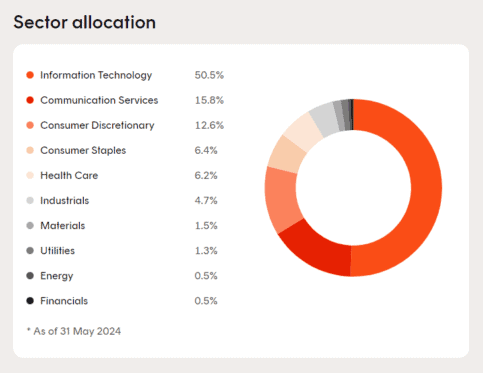
    Here is the latest Betashares Nasdaq 100 ETF sector allocation, as published on betashares.com.au.

    As you can see, only half the NDQ ETF’s allocation is tech stocks.
    At the recent ASX Investor Day held in Sydney, Betashares investment strategist Tom Wickenden pointed out that the Betashares Nasdaq 100 ETF was a particularly complementary holding for ASX 200 investors.

    One reason is their opposite sector weightings.

    The S&P/ASX 200 Index (ASX: XJO) is dominated by banks and major miners, while the NDQ ETF is dominated by tech stocks.

    The ASX 200 comprises 30.6% financial shares, 22.7% materials shares, and only 3.2% tech stocks. In contrast, the NDQ ETF has only 1.5% materials shares, 0.5% financial shares, and 50.5% tech stocks.

    Furthermore, the NDQ ETF complements ASX 200 shares because it offers geographical diversification beyond Australia — and not just to the US economy, either.

    This brings us to the second thing you may not know about the Betashares Nasdaq 100 ETF.

    Only 50% of earnings come from the US

    Although the NASDAQ is a US-based stock exchange and comprises many big-name US-based companies, NASDAQ 100 businesses tend to be global in nature with a globally diverse customer base.

    This means they generate revenue in many different countries and are exposed to many different economies.

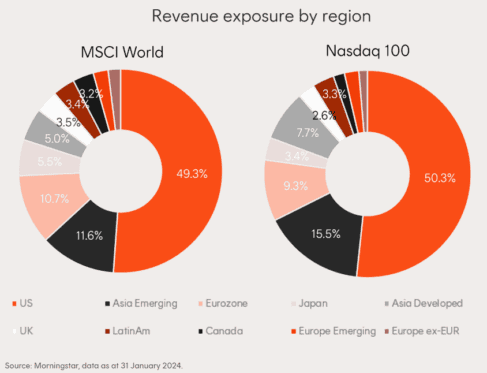
    So, while you may initially associate the NASDAQ with the United States, it’s worth knowing that only 50.3% of revenue generated by the NASDAQ 100 comes from the US.

    The rest comes from various other countries, with a revenue split very similar to the MSCI World Index.

    Take a look.
    Source: Betashares.com.au

    This is notable because investors tend to look to MSCI indexes to attain worldwide diversification for their portfolios.

    The MSCI World Index comprises 1,464 stocks across 23 developed countries. According to msci.com, the index “covers approximately 85% of the free float-adjusted market capitalization in each country”.

    So, it’s interesting to note that the Betashares Nasdaq 100 ETF can offer virtually the same geographical earnings diversification, but your investment is more concentrated with just 100 stocks instead of 1,464.

    Is that a positive or negative? You decide. We’re just letting you know.

    An ‘investment in innovation’

    Wickenden points out that the NASDAQ 100 “is the home of innovation globally” and thereby represents an investment in not just technology but also innovation, which encapsulates so much more than IT.

    And ’tis the era, right?

    Did someone say electric vehicles? Or green steel?

    Wickenden says that of the nine listed companies to ever touch the trillion-dollar mark in market capitalisation, seven have achieved their success through major innovation.

    Of course, those seven stocks are the Magnificent Seven. (Fun fact: The other two stocks that reached US$1 trillion were PetroChina and Saudi Aramco.)

    He also says that innovation requires a serious commitment to research and development (R&D), and the NASDAQ 100 (and thus the Betashares Nasdaq 100 ETF) gives investors exposure to such companies.

    Wickenden said:

    If we look under the hood of the NASDAQ 100, what we find is it’s home to some of the most innovative companies in the world and also some of the biggest R&D spenders in the world.

    We can see … over the past 10 years huge growth of research and development spending has coincided with huge growth of revenue and ultimately earnings growth for that index compared to other companies globally and especially compared to the Australian market.

    Wickenden used Microsoft as a case study.

    He said a huge investment in cloud computing many years ago resulted in Microsoft’s cloud computing division alone delivering more revenue than Australia’s Big Four banks combined last year.

    You can check out the NDQ ETF’s entire portfolio and weightings here.

    The Magnificent Seven’s weightings in the NDQ ETF at the time of writing are Apple 8.6%, Microsoft 8.5%, Nividia 8.4%, Alphabet 5.3%, Amazon 4.9%, Meta 4.5%, and Tesla 2.3%.

    A short price history on Betashares Nasdaq 100 ETF

    The Betashares Nasdaq 100 ETF closed Tuesday’s session at $45.60 per unit, up 0.75% for the day.

    The NDQ ETF has risen 22% in the year to date and 34% over the past 12 months.

    The post What you may not know about the Betashares Nasdaq 100 (NDQ) ETF appeared first on The Motley Fool Australia.

    Wondering where you should invest $1,000 right now?

    When investing expert Scott Phillips has a stock tip, it can pay to listen. After all, the flagship Motley Fool Share Advisor newsletter he has run for over ten years has provided thousands of paying members with stock picks that have doubled, tripled or even more.*

    Scott just revealed what he believes could be the ‘five best ASX stocks’ for investors to buy right now. We believe these stocks are trading at attractive prices and Scott thinks they could be great buys right now…

    See The 5 Stocks
    *Returns as of 5 May 2024

    More reading

    Randi Zuckerberg, a former director of market development and spokeswoman for Facebook and sister to Meta Platforms CEO Mark Zuckerberg, is a member of The Motley Fool’s board of directors. John Mackey, former CEO of Whole Foods Market, an Amazon subsidiary, is a member of The Motley Fool’s board of directors. Suzanne Frey, an executive at Alphabet, is a member of The Motley Fool’s board of directors. Motley Fool contributor Bronwyn Allen has positions in BetaShares Global Sustainability Leaders ETF. The Motley Fool Australia’s parent company Motley Fool Holdings Inc. has positions in and has recommended Alphabet, Amazon.com, Apple, BetaShares Nasdaq 100 ETF, Meta Platforms, Microsoft, Nvidia, and Tesla. The Motley Fool Australia has positions in and has recommended BetaShares Nasdaq 100 ETF. The Motley Fool Australia has recommended Alphabet, Amazon.com, Apple, Meta Platforms, and Nvidia. The Motley Fool has a disclosure policy. This article contains general investment advice only (under AFSL 400691). Authorised by Scott Phillips.


  • Near its 52-week low, this ASX growth stock could be the bargain of the year!

    Man waiting for his flight and looking at his phone.

    The Corporate Travel Management Ltd (ASX: CTD) share price has fallen to a 52-week low, as we can see on the chart below. It’s also down 32% since the start of 2024.

    The ASX travel share has lost investor confidence after the FY24 first-half result wasn’t as strong as some investors were hoping.

    Corporate Travel Management said macro issues beyond the control of the business impacted performance in the second quarter of 2024. That included negative travel sentiment relating to conflict in the Middle East, American client calendar-year travel budgets being fully utilised by the end of the FY24 first quarter due to “unsustainably high ticket prices” and a slower Chinese outbound recovery.

    These issues affected FY24’s second-quarter earnings before interest, tax, depreciation, and amortisation (EBITDA) by approximately $15 million.

    It also said the UK bridging contract is “materially underperforming” compared to the client’s initial expectations because of immigration challenges and timing delays. This is expected to have a $25 million impact to the full-year result.

    But the ASX growth stock could have a very promising outlook for the rest of the decade.

    Why the Corporate Travel Management share price could be undervalued

    For starters, the business said the macro issues in the second quarter “appear to have dissipated, with the group experiencing a strong rebound in January 2024.” These issues are “unlikely to impact 2H24”.

    The company has a five-year growth strategy to double its FY24 profit organically by FY29, which would represent a compound annual growth rate (CAGR) of 15%, with any acquisitions adding to the growth.

    Firstly, the company is aiming to grow its revenue by at least 10% per annum over five years by winning new clients. The new win target starts at $1 billion per annum and will increase to $1.6 billion per annum by FY29.

    Second, the ASX growth stock wants to keep its client retention rate of 97% each year. The company is expecting client activity will grow by 3% per annum, offsetting any client losses.

    Third, it’s hoping that its key projects will achieve revenue gains and savings over time, with a target of costs to only grow by 5% per annum. Revenue per full-time employee improvement will be a key performance measure of progress. Future projects are aimed at both market share growth and automation.

    Fourth, Corporate Travel wants 50% of every new dollar of revenue to fall to the EBITDA profit line as it wins new clients, retains existing clients and implements the above-mentioned cost projects. This can translate into the EBITDA growing at a CAGR of 15% over five years.

    Finally, any acquisitions are in addition to the above plans. Most acquisition targets are “highly leveraged with debt to survive COVID”. The ASX travel share is “actively pursuing” these opportunities, which will add “further growth, shareholder value and economies of scale.”

    If the company executes its plans well and doubles its profit in the next five years, I think it could be a great market-beater, as long as technology and AI don’t negatively disrupt the travel industry.

    ASX growth stock valuation

    According to the estimates on Commsec, the ASX growth stock is valued at 16x FY24’s estimated earnings and just 12x FY26’s estimated earnings.

    The post Near its 52-week low, this ASX growth stock could be the bargain of the year! appeared first on The Motley Fool Australia.

    Wondering where you should invest $1,000 right now?

    When investing expert Scott Phillips has a stock tip, it can pay to listen. After all, the flagship Motley Fool Share Advisor newsletter he has run for over ten years has provided thousands of paying members with stock picks that have doubled, tripled or even more.*

    Scott just revealed what he believes could be the ‘five best ASX stocks’ for investors to buy right now. We believe these stocks are trading at attractive prices and Scott thinks they could be great buys right now…

    See The 5 Stocks
    *Returns as of 5 May 2024

    More reading

    Motley Fool contributor Tristan Harrison has no position in any of the stocks mentioned. The Motley Fool Australia’s parent company Motley Fool Holdings Inc. has positions in and has recommended Corporate Travel Management. The Motley Fool Australia has positions in and has recommended Corporate Travel Management. The Motley Fool has a disclosure policy. This article contains general investment advice only (under AFSL 400691). Authorised by Scott Phillips.

  • 2 ASX ETFs I would happily buy today for my retirement

    An elderly retiree holds her wine glass up while dancing at a party feeling happy about her ASX shares investments especially Brickworks for its dividends

    Legendary investor Warren Buffett said a low-cost index fund is the most sensible equity investment for the great majority of investors.

    Many investors enthusiastically embrace exchange-traded funds (ETFs) as an excellent choice for building a diversified and resilient retirement portfolio, and with good reason.

    Buffett advocates cost-effective investing, highlighting ETFs for their low expense ratios and investors’ ability to keep more money invested. ETFs offer flexibility similar to stocks, allowing for portfolio adjustments in tune with retirement goals and market dynamics.

    With that in mind, here are my two ASX ETF picks for retirement.

    Vanguard Australian Shares Index ETF (ASX: VAS)

    Let’s kick off with the Vanguard Australian Shares Index ETF. This ETF is a prime example of Buffett’s invaluable advice in action. It offers extensive exposure to the Australian equity market, comprising the top 300 companies listed on the ASX.

    This ETF is designed to track the return of the S&P/ASX 300 Index (ASX: XKO), which includes Australia’s major players such as BHP Group Ltd (ASX: BHP), Commonwealth Bank of Australia (ASX: CBA), and CSL Ltd (ASX: CSL).

    Another important consideration is its fees. The VAS ETF is popular due to its low management fee of just 0.1% per annum, making it an even more attractive investment option.

    This ETF is ideal for those seeking regular income, paying quarterly dividends. Over the past 12 months to April 2024, it provided total dividends of $3.741, yielding 3.9% at the current share price, with around 80% franking credits.

    Over the last 10 years, VAS has generated a total return of 7.7% per year, comprising 3.2% capital growth and 4.5% income return.

    The VAS ETF unit price was trading at $96.73 after closing on Tuesday.

    Betashares Nasdaq 100 ETF (ASX: NDQ)

    Now, for those eager to broaden their investment horizons, Betashares Nasdaq 100 ETF stands out as an exceptional choice.

    With Australia accounting for just 2% of the global financial market, it’s crucial to diversify beyond domestic equities when planning for retirement.

    NDQ offers an affordable entry point into the United States market, focusing on tech-heavy and growth-oriented stocks within the NASDAQ-100 Index. Big names include Nvidia, Amazon, Apple and Alphabet. This not only serves as a hedge against domestic market volatility but also adds substantial value by capturing growth opportunities in the global market.

    The ETF’s management fee is 0.48% per annum, which is higher than VAS but reflects its specialised exposure to high-growth tech stocks.

    Since its inception in May 2015, the ETF has generated an average annual return of 19.48%, which is phenomenal.

    The NDQ ETF unit price closed at $45.60 on Tuesday.

    The post 2 ASX ETFs I would happily buy today for my retirement appeared first on The Motley Fool Australia.

    Maximise Your Super before June 30: Uncover 5 Strategies Most Aussies Overlook!

    With the end of the financial year almost upon us, there are some strategies that you may be able to take advantage of right now to save some tax and boost your savings…

    Download our latest free report discover 5 super strategies that most Aussies miss today!

    Download Free Report
    *Returns 28 May 2024

    More reading

    Suzanne Frey, an executive at Alphabet, is a member of The Motley Fool’s board of directors. John Mackey, former CEO of Whole Foods Market, an Amazon subsidiary, is a member of The Motley Fool’s board of directors. Motley Fool contributor Kate Lee has positions in Nvidia. The Motley Fool Australia’s parent company Motley Fool Holdings Inc. has positions in and has recommended Alphabet, Amazon, Apple, BetaShares Nasdaq 100 ETF, CSL, and Nvidia. The Motley Fool Australia has positions in and has recommended BetaShares Nasdaq 100 ETF. The Motley Fool Australia has recommended Alphabet, Amazon, Apple, CSL, and Nvidia. The Motley Fool has a disclosure policy. This article contains general investment advice only (under AFSL 400691). Authorised by Scott Phillips.

  • Could Apple’s latest move boost Zip shares?

    Zip Co Ltd (ASX: ZIP) shares pushed higher on Tuesday.

    The buy now pay later (BNPL) provider’s shares rose 2.5% to $1.44.

    This appears to have been driven by news from across the Pacific.

    What gave Zip shares a boost?

    There were fears last year that tech behemoth Apple Inc (NASDAQ: AAPL) was going to steal market share away from Zip in the United States with the launch of Apple Pay Later.

    However, less than a year after launching its BNPL offering, the iPhone maker has decided to discontinue the service. This means one less player for Zip to compete with in the lucrative US market.

    According to a press release, Apple decided to scrap its Apple Pay Later service after announcing that third-party services would be integrated into its upcoming iOS 18 software. It commented:

    Starting later this year, users across the globe will be able to access installment loans offered through credit and debit cards, as well as lenders, when checking out with Apple Pay. With the introduction of this new global installment loan offering, we will no longer offer Apple Pay Later in the US.

    In addition, it is worth noting that the new service will be made available globally (not just in the US) through the company’s Apple Pay platform with the launch of iOS 18. It adds:

    Our focus continues to be on providing our users with access to easy, secure and private payment options with Apple Pay, and this solution will enable us to bring flexible payments to more users, in more places across the globe, in collaboration with Apple Pay enabled banks and lenders.

    What is unclear, though, is whether Zip will be one of the third-party providers that will be integrated into the software. If it is, it could be a big boost to Zip’s growth in the coming years.

    Conversely, if one of its rivals has the honour of being integrated, it could potentially cause some headwinds for Zip.

    Should you invest?

    With Zip shares up 205% over the last 12 months, analysts believe that potential upside is now becoming somewhat limited.

    For example, both UBS and Ord Minnett currently have buy ratings on the BNPL provider’s shares. However, with price targets of $1.55, this suggests that Zip’s shares could rise a modest 7.6% over the next 12 months.

    This could make it worth waiting for a better entry point and further clarification on Apple Pay’s integrations.

    The post Could Apple’s latest move boost Zip shares? appeared first on The Motley Fool Australia.

    Wondering where you should invest $1,000 right now?

    When investing expert Scott Phillips has a stock tip, it can pay to listen. After all, the flagship Motley Fool Share Advisor newsletter he has run for over ten years has provided thousands of paying members with stock picks that have doubled, tripled or even more.*

    Scott just revealed what he believes could be the ‘five best ASX stocks’ for investors to buy right now. We believe these stocks are trading at attractive prices and Scott thinks they could be great buys right now…

    See The 5 Stocks
    *Returns as of 5 May 2024

    More reading

    Motley Fool contributor James Mickleboro has no position in any of the stocks mentioned. The Motley Fool Australia’s parent company Motley Fool Holdings Inc. has positions in and has recommended Apple and Zip Co. The Motley Fool Australia has recommended Apple. The Motley Fool has a disclosure policy. This article contains general investment advice only (under AFSL 400691). Authorised by Scott Phillips.

  • Is the slashed Sonic Healthcare share price a ‘buying opportunity’?

    Scientist looking at a laptop thinking about the share price performance.

    The Sonic Healthcare Ltd (ASX: SHL) share price has fallen almost 20% this year, while the S&P/ASX 200 Index (ASX: XJO) is up approximately 2% in the same time period.

    One expert thinks this sell-off could be an opportunity.

    As one of the world’s largest providers of pathology services, Sonic is a significant ASX healthcare share player. Healthcare is typically a defensive sector, so some investors may see this heavy decline as uncharacteristic.

    Writing on The Bull, Dylan Evans of Catapult Wealth believes Sonic Healthcare shares could be appealing at this level.

    Expert’s positive view on Sonic Healthcare shares

    Evans points out that the company’s sell-off was triggered by the market’s response to an earnings downgrade.

    Despite that bad news, he believes Sonic Healthcare shares are a buy at the current level, suggesting the company can regain momentum despite the fact it’s taking longer than expected to reduce costs.

    Sonic Healthcare’s earnings dropped in FY23 as COVID testing revenue subsided.

    Earnings recap

    On 21 May, Sonic revealed it’s now expecting FY24 revenue to be $8.9 billion and earnings before interest, tax, depreciation and amortisation (EBITDA) to be $1.6 billion.

    Profit growth was lower than expected, partly because of inflationary pressures impacting the business and worsened by currency exchange headwinds. A number of profit improvement initiatives the company planned to complete in the second half of FY24 have been “slower to deliver than expected” and will instead contribute to earnings growth in FY25. Sonic also expects inflation pressures to ease going forward.

    It guided that EBITDA could be between $1.7 billion to $1.75 billion in FY25 (compared to $1.6 billion for FY24).

    Weakness can be an opportunity

    While short-term profitability is challenged, there are some positives.

    In the four months to 30 April 2024, the company saw organic revenue growth of 6%, which is a solid growth rate.

    Sonic also pointed out that it has made a number of investments which can help earnings growth (and Sonic Healthcare shares) in the future, including Synlab Suisse and Dr Risch in Switzerland and PathologyWatch in the US.

    In the May update, Sonic Healthcare CEO Dr Colin Goldschmidt said:

    Overall, the company remains in a very strong position, both financially and in terms of market positioning.

    We remain well set for growth in revenues and earnings going forward, including realising over the next two years the synergies and enhanced returns from the investments made this year.

    In managing our costs, especially labour costs, we have been mindful to protect our brands and to support our ongoing strong growth and the high quality of essential services we provide.

    According to the forecast on Commsec, the Sonic Healthcare share price is valued at 20x FY26’s estimated earnings.

    The post Is the slashed Sonic Healthcare share price a ‘buying opportunity’? appeared first on The Motley Fool Australia.

    Wondering where you should invest $1,000 right now?

    When investing expert Scott Phillips has a stock tip, it can pay to listen. After all, the flagship Motley Fool Share Advisor newsletter he has run for over ten years has provided thousands of paying members with stock picks that have doubled, tripled or even more.*

    Scott just revealed what he believes could be the ‘five best ASX stocks’ for investors to buy right now. We believe these stocks are trading at attractive prices and Scott thinks they could be great buys right now…

    See The 5 Stocks
    *Returns as of 5 May 2024

    More reading

    Motley Fool contributor Tristan Harrison has positions in Sonic Healthcare. The Motley Fool Australia’s parent company Motley Fool Holdings Inc. has no position in any of the stocks mentioned. The Motley Fool Australia has recommended Sonic Healthcare. The Motley Fool has a disclosure policy. This article contains general investment advice only (under AFSL 400691). Authorised by Scott Phillips.

  • What’s the outlook for the Westpac share price in FY25?

    A man in a suit looks serious while discussing business dealings with a couple as they sit around a computer at a desk in a bank home lending scenario.

    The Westpac Banking Corp (ASX: WBC) share price closed at $27.22 on Tuesday, 0.93% higher for the day and up 17.94% in the year to date.

    As FY24 nears its close, let’s look at what lies ahead for this ASX 200 bank share.

    State of play: Earnings down, but dividends up

    The last round of price-sensitive news we received from Westpac was its mid-year report last month.

    The Westpac share price received a boost on 6 May when the company released its half-year results.

    For the six months ended 31 March, Westpac’s net operating income declined 4% year over year to $10,590 million compared to the prior corresponding period (pcp).

    This reflected a flat net interest income of $9,127 million, a 23% decline in non-interest income to $1,463 million, and an 8% increase in operating expenses to $5,395 million.

    The net interest margin (NIM) came in at 1.89%, down seven basis points.

    Bottom line: Net profit fell 16% pcp to $3,342 million.

    However, ASX investors appeared impressed by the 7.1% increase in the interim dividend to 75 cents per share, plus a fully franked special dividend of 15 cents per share.

    The bank also announced an extra $1 billion for its ongoing share buyback program.

    Looking ahead, CEO Peter King said he was positive about the outlook.

    Amid an increase in loan book stress, King said the bank had a strong balance sheet and was “in a good position to help customers”.

    He said the bank believed the economy was “on track for a soft landing”. However, he noted that inflation was proving sticky and it was “likely interest rates will stay higher for longer”.

    What’s happened to the Westpac share price?

    The Westpac share price is up 28.7% over the past 12 months.

    Like other ASX 200 bank shares, Westpac has had a particularly great run since November 2023. That’s when speculation of interest rate cuts began.

    Valuation is one of the reasons why top broker Goldman Sachs has just downgraded Westpac shares.

    Looking ahead…

    Goldman analysts Andrew Lyons and John Li downgraded Westpac shares from a neutral to a sell rating in May. Their 12-month share price target for Westpac is $24.10.

    In a new note, the analysts gave three main reasons for the downgrade.

    Firstly, Lyons and Li discussed Westpac’s technology simplification plan, dubbed the UNITE program.

    Westpac says UNITE will be a “major driver to close the cost-to-income ratio gap to peers”. It would also improve customer service, make things easier for staff, and lift shareholder returns.

    The plan is expected to cost $1.8 billion in FY24 and about $2 billion per annum from FY25 to FY28. This represents about 30% of the bank’s total investment spend from FY24 to FY28.

    Last month, King said they had started work on 14 initiatives. These include simplifying customer and collections systems.

    Lyons and Li said the plan “comes with a significant degree of execution risk, given historically banks’ large-scale transformation programs have struggled to stay on budget, and we are currently operating in a stickier-than-expected inflationary environment”.

    The Reserve Bank confirmed this yesterday when it announced that interest rates would remain on hold.

    In a statement, the RBA said inflation was falling, “but the pace of decline has slowed” and “the process of returning inflation to target is unlikely to be smooth”.

    Lyons and Li said Westpac’s second challenge for FY25 was that it’s the most exposed to Australian housing.

    In their view, “… the relative outlook for system housing lending is likely to be constrained by an already full[y] indebted household”.

    Australia has the second-highest household debt in the world (behind Switzerland) at 110% of gross domestic product (GDP). This is largely due to expensive home loans, which have resulted from decades of fairly consistent property price growth.

    Property prices have continued to rise in most capital city and regional markets over the past 12 months. Rising prices make finance harder to get. Banks apply an APRA-imposed 3% serviceability buffer to their loan rates when assessing whether applicants can afford the repayments.

    So, on a 6% loan, Westpac and other banks are assessing borrowers at a 9% repayment rate. This is making it tough for Australians to get new home loans, particularly in the more expensive markets.

    It’s little wonder buyers are flocking to the smaller, more affordable capital cities these days.

    Finally, Lyons and Li pointed out that the Westpac share price is trading on a 12-month forward price-to-earnings (P/E) ratio that is one standard deviation above its 15-year historical average.

    Goldman has a 12-month share price target of $24.10 on Westpac. This implies a potential 11.5% downside for investors who buy the ASX 200 bank stock today.

    The post What’s the outlook for the Westpac share price in FY25? appeared first on The Motley Fool Australia.

    Wondering where you should invest $1,000 right now?

    When investing expert Scott Phillips has a stock tip, it can pay to listen. After all, the flagship Motley Fool Share Advisor newsletter he has run for over ten years has provided thousands of paying members with stock picks that have doubled, tripled or even more.*

    Scott just revealed what he believes could be the ‘five best ASX stocks’ for investors to buy right now. We believe these stocks are trading at attractive prices and Scott thinks they could be great buys right now…

    See The 5 Stocks
    *Returns as of 5 May 2024

    More reading

    Motley Fool contributor Bronwyn Allen has no position in any of the stocks mentioned. The Motley Fool Australia’s parent company Motley Fool Holdings Inc. has positions in and has recommended Goldman Sachs Group. The Motley Fool Australia has no position in any of the stocks mentioned. The Motley Fool has a disclosure policy. This article contains general investment advice only (under AFSL 400691). Authorised by Scott Phillips.

  • Invest $10,000 in this ASX dividend stock for $550 per year in passive income

    If you are looking for passive income from ASX dividend stocks, then it could be worth considering Universal Store Holdings Ltd (ASX: UNI).

    That’s the view of analysts at Morgans, which see plenty of value in its shares at current levels.

    In addition, the broker is forecasting dividend yields that are comfortably ahead of market averages.

    Let’s see what a $10,000 investment in Universal Store’s shares could turn into.

    What is Universal Store?

    Firstly, in case you’re not familiar with the company, let’s take a quick look at Universal Store.

    Universal Store owns a portfolio of premium youth fashion brands and omni-channel retail and wholesale businesses.

    Its principal businesses are Universal Store and the Thrills, Worship, and Perfect Stranger brands.

    At present, the company operates 100 physical stores across Australia, in addition to online channels. It notes that its strategy is to grow and develop its premium youth fashion apparel brands and retail formats to deliver a carefully curated selection of on-trend apparel products to a target 16-35 year-old fashion focused customer.

    $10,000 invested in this ASX dividend stock

    If you were to invest $10,000 (and an extra $2.97) into the company’s shares, you would end up owning 2,029 units.

    According to a note out of Morgans, its analysts have an add rating and $6.50 price target on its shares. This implies potential upside of almost 32% for investors and would value your holding at $13,188.50.

    Commenting on its bullish view, Morgans said:

    Our positive view about the fundamental long-term appeal of Universal Store as a retail proposition and investment opportunity is undiminished. The growth opportunities are in place. Universal Store’s women’s banner Perfect Stranger is performing well, justifying an acceleration in its network expansion; the prospect of building out the wholesale distribution channels acquired with CTC is compelling; and customers continue to respond well to the Universal Store banner, rendering its plan to grow this network to more than 100 stores more than reasonable. Although its core youth customers are far from buoyant, they continue to spend.

    And let’s not forget the passive income. Morgans expects the ASX dividend stock to pay fully franked dividends of 26 cents per share in FY 2024 and then 29 cents per share in FY 2025. This represents yields of 5.3% and 5.9%, respectively.

    Let’s imagine that this means fully franked dividends of 27.5 cents per share over the next 12 months (the final dividend of FY 2024 and the interim dividend of FY 2025), this would mean passive income of approximately $558 from your shares.

    Combined, that’s a very healthy 12-month return on investment of approximately $3,750. Not bad if you ask me!

    The post Invest $10,000 in this ASX dividend stock for $550 per year in passive income appeared first on The Motley Fool Australia.

    Wondering where you should invest $1,000 right now?

    When investing expert Scott Phillips has a stock tip, it can pay to listen. After all, the flagship Motley Fool Share Advisor newsletter he has run for over ten years has provided thousands of paying members with stock picks that have doubled, tripled or even more.*

    Scott just revealed what he believes could be the ‘five best ASX stocks’ for investors to buy right now. We believe these stocks are trading at attractive prices and Scott thinks they could be great buys right now…

    See The 5 Stocks
    *Returns as of 5 May 2024

    More reading

    Motley Fool contributor James Mickleboro has positions in Universal Store. The Motley Fool Australia’s parent company Motley Fool Holdings Inc. has no position in any of the stocks mentioned. The Motley Fool Australia has no position in any of the stocks mentioned. The Motley Fool has a disclosure policy. This article contains general investment advice only (under AFSL 400691). Authorised by Scott Phillips.

  • Is it too late to buy Nvidia stock?

    A woman looks nonplussed as she holds up a handful of Australian $50 notes.

    This article was originally published on Fool.com. All figures quoted in US dollars unless otherwise stated.

    Nvidia (NASDAQ: NVDA) shares are riding high on the seas of artificial intelligence (AI). The chip designer took an early lead in the AI hardware race, leading to incredible business results and skyrocketing stock prices.

    The stock traded at a split-adjusted $14 per share when OpenAI released the ChatGPT generative AI engine, powered by thousands of Nvidia AI accelerator chips. Today, Nvidia’s share price has soared to $131. With a $3.2 trillion market cap, it’s one of the three most valuable companies in the stock market.

    Did you miss the boat on Nvidia’s AI-based opportunity, or can the stock continue to rise from this lofty plateau? Let’s find out.

    Nvidia’s upsides

    Nvidia’s financial success is indisputable. Revenues more than tripled year-over-year in the last two earnings reports. Free cash flows are consistently growing by about 500% in the same time frame. Microsoft (NASDAQ: MSFT) and Apple (NASDAQ: AAPL) are still more profitable than Nvidia, but the chip expert is catching up.

    Many market observers like to point out that the generative AI revolution is only getting started. ChatGPT is less than two years old. Only a couple of tech giants have come up with comparably powerful large language models (LLMs) so far, though many are working on their own long-term generative AI plans. Until further notice, Nvidia’s accelerator chips are the gold standard against which other solutions must be measured. If you’re building a strong AI system, Nvidia’s solutions are the default and the industry standard. Others must develop and then prove some sort of unique advantage before winning AI contracts against Nvidia’s killer products.

    Imagine Nvidia maintaining its lead as the generative AI market grows. It’s not hard to see the stock soaring even higher over the next few years.

    Nvidia’s potential downsides

    On the other hand, the good financial news and a whole lot of forward-looking expectations are already priced into Nvidia’s stock. Shares are changing hands at glossy valuation ratios such as 82 times free cash flow and 40 times sales — levels usually reserved for small-cap start-ups with more sizzle than substance.

    At the same time, Nvidia doesn’t stand unchallenged in the AI accelerator market. Arch rival Advanced Micro Devices (NASDAQ: AMD) has its Instinct line of cost-effective AI chips. The Intel (NASDAQ: INTC) Gaudi series boasts impressive performance per watt of electric power. And that’s just the top of a large heap. There’s more than one way to design an AI-crunching system, and rival solutions may offer compelling alternatives for specific use cases. Who’s to say that Nvidia will hang on to its market-defining lead in the long run?

    Separately, the issues of high valuation and strong competition should be enough to give most investors pause before slamming that “buy” button on Nvidia stock. Together, it’s a high-wire act with a long way down. Nvidia’s stock is priced for perfection and any misstep — such as a major AI contract lost to Intel or AMD — will probably result in a quick and painful price drop.

    Should you buy, sell, or hold Nvidia?

    I’m not saying you should sell every Nvidia share right now and never look back. The company could very well stave off the army of rivals and continue to innovate on a hard-to-match level. Indeed, a bit of Nvidia exposure could serve your portfolio well over the years.

    Meanwhile, I highly recommend taking some profits off the table by selling a portion of your long-term Nvidia holdings. The gains are more than substantial and I’m sure you can find more stable and secure ways to invest that money in the AI market.

    So on the scale of buy, sell, or hold, I see Nvidia as a stock to hold for the long run. I’d rather sell a few shares than buy more at these nosebleed-inducing share prices. Your mileage may vary, depending on your appetite for market risk and AI-driven excitement. Feel free to do your own research and reach different conclusions. Just don’t say I didn’t warn you if or when Nvidia’s big price correction comes.

    This article was originally published on Fool.com. All figures quoted in US dollars unless otherwise stated.

    The post Is it too late to buy Nvidia stock? appeared first on The Motley Fool Australia.

    Should you invest $1,000 in Apple right now?

    Before you buy Apple shares, consider this:

    Motley Fool investing expert Scott Phillips just revealed what he believes are the 5 best stocks for investors to buy right now… and Apple wasn’t one of them.

    The online investing service he’s run for over a decade, Motley Fool Share Advisor, has provided thousands of paying members with stock picks that have doubled, tripled or even more.*

    And right now, Scott thinks there are 5 stocks that may be better buys…

    See The 5 Stocks *Returns as of 5 May 2024

    More reading

    The Motley Fool Australia’s parent company Motley Fool Holdings Inc. has positions in and has recommended Apple, Microsoft, and Nvidia. Anders Bylund has positions in Intel and Nvidia. The Motley Fool Australia’s parent company Motley Fool Holdings Inc. has recommended Intel and has recommended the following options: long January 2025 $45 calls on Intel, long January 2026 $395 calls on Microsoft, short August 2024 $35 calls on Intel, and short January 2026 $405 calls on Microsoft. The Motley Fool Australia has recommended Apple, Microsoft, and Nvidia. The Motley Fool has a disclosure policy. This article contains general investment advice only (under AFSL 400691). Authorised by Scott Phillips.

  • Maximising superannuation: Are you losing out due to ‘poor asset allocation’?

    A young woman sits with her hand to her chin staring off to the side thinking about her investments.

    Everyone wants a good retirement, but some of us might be inadvertently self-sabotaging our superannuation.

    When it comes to superannuation, there’s no shortage of comparison tools. We can compare our nest egg to the average for others our age and quickly find which superfunds take the smallest fee. But is enough attention being paid to our allocation?

    Last month, my fellow colleague Bronwyn Allen wrote that 30% of Australians have a ‘vague idea or no idea’ of their superannuation balance. If people don’t know how much they have in their super, there’s a good chance they’re unaware of what it’s invested in.

    It underscores a concern shared by Alex Vynokur, the founder of Betashares, Australia’s second-largest exchange-traded fund (ETF) provider. Everyday Australians could be giving up a wealthier retirement by overlooking a critical element of investing.

    The lowest-cost option isn’t always the best

    Fees can have an enormous impact on any investment portfolio over a long period of time. There is no denying that people should pay attention to the fees charged by a superannuation fund. The problem is that too much emphasis on cost might cloud other important factors.

    In an interview with The Australian Financial Review, Vynokur raised his view on an underrated issue in super, stating:

    It’s all good to ‘compare the pair’ and be proud of the low management fee, but there’s actually a lot you lose via poor asset allocation.

    Vynokur believes too many young Aussies’ super are in a balanced option by default. And not because of risk-averse decision-making. Rather, the Betashares CEO puts it down to a lack of familiarity with the topic or a complete absence of interest.

    Typically, a young investor can afford to take on higher risk with several decades until retirement, allocating more of their assets to stocks. However, a balanced fund can be around 30% invested in fixed-interest and cash, according to MoneySmart.

    Where is your superannuation invested?

    The difference in portfolio allocations could greatly change the outcome for Aussies in retirement.

    In the 11 months to 31 May, Australian Retirement Trust’s balanced option returned 8.8%, while the growth strategy grew by 10.2%. Let’s assume these returns were applied as a per annum performance for a $50,000 superannuation account (with contributions of $5,000 each year) over 10 years; the outcome would be:

    • Balanced option — $191,457
    • Growth option — $212,520

    There is no right or wrong allocation. What is important is knowing how your superannuation is invested. Only then can someone decide whether it is allocated appropriately based on your own individual needs and goals.

    The post Maximising superannuation: Are you losing out due to ‘poor asset allocation’? appeared first on The Motley Fool Australia.

    Maximise Your Super before June 30: Uncover 5 Strategies Most Aussies Overlook!

    With the end of the financial year almost upon us, there are some strategies that you may be able to take advantage of right now to save some tax and boost your savings…

    Download our latest free report discover 5 super strategies that most Aussies miss today!

    Download Free Report
    *Returns 28 May 2024

    More reading

    Motley Fool contributor Mitchell Lawler has no position in any of the stocks mentioned. The Motley Fool Australia’s parent company Motley Fool Holdings Inc. has no position in any of the stocks mentioned. The Motley Fool Australia has no position in any of the stocks mentioned. The Motley Fool has a disclosure policy. This article contains general investment advice only (under AFSL 400691). Authorised by Scott Phillips.

  • Buy this ASX 200 energy stock if you want a big return

    Beach Energy Ltd (ASX: BPT) shares were under pressure on Tuesday.

    The ASX 200 energy stock dropped almost 2.5% to $1.53 after investors responded negatively to its strategic review.

    What did the ASX 200 energy stock announce?

    Yesterday Beach Energy revealed the outcome of its strategic review. It has laid out a plan that it believes will result in operating cost and capital reductions totalling ~$135 million.

    This will come from a 23% headcount reduction, ~$35 million field operating cost savings, and a ~$100 million sustaining capital expenditure reduction.

    Management believes that this will help it deliver leading shareholder returns through the sustainable supply of energy.

    In addition, the ASX 200 energy stock provided its guidance for FY 2025 with the review.

    Its initial FY 2025 guidance is production of 17.5MMboe to 21.5MMboe and capex of $700 million to $800 million. This compares to FY 2024 guidance of ~18MMboe and capex of the top end of $900 million to $1,000 million.

    Broker response

    Although the market wasn’t overly enthralled by Beach Energy’s strategic review, the team at Bell Potter has seen enough to remain positive on the company and its shares.

    And while it has trimmed its earnings estimates to reflect the ASX 200 energy stock’s updated outlook, it continues to see value in its shares. It commented:

    The Strategic Review outcomes are largely as expected; strong on cost out targets and capital discipline. Adjusting for the updated outlook, EPS changes in this report are: FY24 +11%; FY25 -25%; and FY26 -11%.

    Should you invest?

    Bell Potter has responded to the review by retaining its buy rating with a trimmed price target of $1.75. This implies potential upside of 14.4% for investors over the next 12 months.

    In addition, the broker expects a 2.6% dividend yield from its shares, which boosts the potential total return to 17%. Bell Potter concludes:

    FY25 will be a year of consolidation as Waitsia Stage 2 ramps up and new Otway wells offset Western Flank decline. However, capex should now be trending lower and production growth will see free cash flow lift from FY26. BPT has retained a strong balance sheet capable of supporting the group’s dividend policy. BPT’s near-term production growth is a key differentiator when compared with domestic peers. With a positive view on Australian east coast gas and LNG markets, and a strong production and earnings growth outlook, we maintain a Buy recommendation.

    The post Buy this ASX 200 energy stock if you want a big return appeared first on The Motley Fool Australia.

    Should you invest $1,000 in Beach Energy Limited right now?

    Before you buy Beach Energy Limited shares, consider this:

    Motley Fool investing expert Scott Phillips just revealed what he believes are the 5 best stocks for investors to buy right now… and Beach Energy Limited wasn’t one of them.

    The online investing service he’s run for over a decade, Motley Fool Share Advisor, has provided thousands of paying members with stock picks that have doubled, tripled or even more.*

    And right now, Scott thinks there are 5 stocks that may be better buys…

    See The 5 Stocks
    *Returns as of 5 May 2024

    More reading

    Motley Fool contributor James Mickleboro has no position in any of the stocks mentioned. The Motley Fool Australia’s parent company Motley Fool Holdings Inc. has no position in any of the stocks mentioned. The Motley Fool Australia has no position in any of the stocks mentioned. The Motley Fool has a disclosure policy. This article contains general investment advice only (under AFSL 400691). Authorised by Scott Phillips.