Tag: Motley Fool

  • Here’s why the Lovisa share price leapt 8% on Monday

    A woman is excited as she reads the latest rumour on her phone.A woman is excited as she reads the latest rumour on her phone.

    The Lovisa Holdings Ltd (ASX: LOV) share price is one of today’s strong performers. It’s up by 6% at the time of writing, after touching nearly 8.5% in early trade on Monday.

    The affordable jewellery retailer has received a boost thanks to news announced after the market closed on Friday last week.

    Index inclusion

    Every three months, the ASX indices are reviewed by the S&P Dow Jones Indices to see if any changes need to be made.

    A large increase in a company’s market capitalisation can lead to a business being included in an index. Meanwhile, a large decrease in the share price of a business can lead to it being kicked out of an index.

    It’s good news for Lovisa that its share price has gone up so much – over 80% since mid-June. That means it will be included in the S&P/ASX 200 Index (ASX: XJO). It’s not the only company being added. Names like Sayona Mining Ltd (ASX: SYA) and Johns Lyng Group Ltd (ASX: JLG) are also joining the ASX 200.

    Names getting kicked out of the ASX 200 include Life360 Inc (ASX: 360), EML Payments Ltd (ASX: EML) and Zip Co Ltd (ASX: ZIP).

    The changes will happen on 19 September 2022.

    What has driven the Lovisa share price higher?

    Investors had been expecting Lovisa to report a significant increase in profit in FY22. This was proven when it released its report at the end of August.

    Revenue went up by 59.3% to $458.7 million, gross profit increased 63.8% to $361.8 million, and earnings before interest and tax (EBIT) grew 86.6% to $79.7 million, and net profit after tax (NPAT) soared 116.3% to $59.9 million. The company more than doubled its dividend to 37 cents per share.

    Lovisa explained that once stores were able to open, and trading and restrictions were lifted, it was able to deliver “strong growth” across all markets as economic conditions improved. It maintained growth across the financial year.

    Growth has continued strongly in FY23.

    Trading for the first seven weeks of FY23 has seen a continuation of the strong performance of FY22, with comparable store sales growth of 21% compared to FY22. Total sales for the FY23 period were up 66.1%, with the prior year impacted by lockdowns.

    Since the end of FY22, it has opened in two new markets. It has opened two stores in Hong Kong and one store in Namibia. It has opened 22 new stores year to date, reaching a total of 651 stores.

    Lovisa said:

    We continue to focus on opportunities for expanding both our physical and digital store network, with structures in place to drive this growth in existing and new markets and expect rollout momentum to increase going forward. Our balance sheet remains strong with available cash and debt facilities supporting continued investment in growth.

    Lovisa share price snapshot

    Since the beginning of 2022, the Lovisa share price has risen around 17%.

    The post Here’s why the Lovisa share price leapt 8% on Monday appeared first on The Motley Fool Australia.

    Should you invest $1,000 in Lovisa Holdings Limited right now?

    Before you consider Lovisa Holdings Limited, you’ll want to hear this.

    Motley Fool Investing expert Scott Phillips just revealed what he believes are the 5 best stocks for investors to buy right now… and Lovisa Holdings Limited wasn’t one of them.

    The online investing service he’s run for over a decade, Motley Fool Share Advisor, has provided thousands of paying members with stock picks that have doubled, tripled or even more.* And right now, Scott thinks there are 5 stocks that are better buys.

    See The 5 Stocks
    *Returns as of August 4 2022

    (function() {
    function setButtonColorDefaults(param, property, defaultValue) {
    if( !param || !param.includes(‘#’)) {
    var button = document.getElementsByClassName(“pitch-snippet”)[0].getElementsByClassName(“pitch-button”)[0];
    button.style[property] = defaultValue;
    }
    }

    setButtonColorDefaults(“#43B02A”, ‘background’, ‘#5FA85D’);
    setButtonColorDefaults(“#43B02A”, ‘border-color’, ‘#43A24A’);
    setButtonColorDefaults(“#fff”, ‘color’, ‘#fff’);
    })()

    More reading

    Motley Fool contributor Tristan Harrison has no position in any of the stocks mentioned. The Motley Fool Australia’s parent company Motley Fool Holdings Inc. has positions in and has recommended EML Payments, Johns Lyng Group Limited, Life360, Inc., and ZIPCOLTD FPO. The Motley Fool Australia has positions in and has recommended EML Payments. The Motley Fool Australia has recommended Johns Lyng Group Limited and Lovisa Holdings Ltd. The Motley Fool has a disclosure policy. This article contains general investment advice only (under AFSL 400691). Authorised by Scott Phillips.

    from The Motley Fool Australia https://ift.tt/km5KZvT

  • Why are ASX 200 coal shares smashing the market on Monday?

    Three coal miners smiling while underground

    Three coal miners smiling while undergroundS&P/ASX 200 Index (ASX: XJO) coal shares are having another strong run today.

    In morning trade, the Whitehaven Coal Ltd (ASX: WHC) share price is up 7.3% to $8.55 per share.

    Meanwhile, rival ASX 200 coal share New Hope Corp Ltd (ASX: NHC) is surging 6.5% to $5.43 per share.

    That’s well ahead of the 0.2% gain posted by the ASX 200 at the time of writing and also more than twice the 3.4% gains delivered by the S&P/ASX 200 Energy Index (ASX: XEJ) so far today.

    So, what’s stoking ASX investor interest in the coal sector today?

    What’s piquing ASX investor interest?

    If you said surging coal prices, give yourself a gold star.

    The New Castle coal price now stands at US$435 per tonne, up from US$400 per tonne a week earlier.

    That’s just shy of the record high of US$440 per tonne coal was trading for on 2 March, and more than 600% higher than it was trading for two years ago when a tonne of coal was worth US$62.

    Coal prices, alongside the share prices of ASX 200 coal shares, have been rocketing since energy-rich Russia invaded Ukraine on 24 February.

    Hitting back at Western sanctions on its oil and other exports, Russia has been crimping the supplies of gas it sends through its Nord Stream 1 gas pipeline, which pumps gas from Russia directly into northern Germany.

    Now Gazprom, the Russian state-owned company in charge of the pipeline, has shut down the gas indefinitely. Gazprom had been undertaking what it said was unscheduled maintenance on Nord Stream 1 but said due to a “technical fault”, gas may not be flowing again any time soon.

    With many European nations heavily reliant on Russian gas, demand for coal to keep the lights on and heaters working is ramping up as northern winter approaches.

    A difficult and unfortunate situation, to be sure, but certainly one offering some strong tailwinds for ASX 200 coal shares.

    How have these ASX 200 coal shares been tracking longer-term?

    2022 has seen ASX 200 coal shares deliver some stellar returns.

    Since the opening bell on 4 January, the New Hope share price has surged 134% while Whitehaven Coal shares have rocketed 200%.

    For some context, the ASX 200 is down 10% year-to-date.

    The post Why are ASX 200 coal shares smashing the market on Monday? appeared first on The Motley Fool Australia.

    Wondering where you should invest $1,000 right now?

    When investing expert Scott Phillips has a stock tip, it can pay to listen. After all, the flagship Motley Fool Share Advisor newsletter he has run for over ten years has provided thousands of paying members with stock picks that have doubled, tripled or even more.* Scott just revealed what he believes could be the “five best ASX stocks” for investors to buy right now. These stocks are trading at near dirt-cheap prices and Scott thinks they could be great buys right now

    See The 5 Stocks
    *Returns as of August 4 2022

    (function() {
    function setButtonColorDefaults(param, property, defaultValue) {
    if( !param || !param.includes(‘#’)) {
    var button = document.getElementsByClassName(“pitch-snippet”)[0].getElementsByClassName(“pitch-button”)[0];
    button.style[property] = defaultValue;
    }
    }

    setButtonColorDefaults(“#43B02A”, ‘background’, ‘#5FA85D’);
    setButtonColorDefaults(“#43B02A”, ‘border-color’, ‘#43A24A’);
    setButtonColorDefaults(“#fff”, ‘color’, ‘#fff’);
    })()

    More reading

    Motley Fool contributor Bernd Struben has no position in any of the stocks mentioned. The Motley Fool Australia’s parent company Motley Fool Holdings Inc. has no position in any of the stocks mentioned. The Motley Fool Australia has no position in any of the stocks mentioned. The Motley Fool has a disclosure policy. This article contains general investment advice only (under AFSL 400691). Authorised by Scott Phillips.

    from The Motley Fool Australia https://ift.tt/yifUlD1

  • Dreadnought share price pops then drops despite ‘significant’ discoveries

    A sad Carnaby Resources miner holds his head in his handsA sad Carnaby Resources miner holds his head in his hands

    The Dreadnought Resources Ltd (ASX: DRE) share price opened higher at 15 cents this morning after the company came out of its trading halt.

    However, the Dreadnought share price has not maintained its positive momentum, and currently trades a hefty 5.7% lower at 13 cents.

    In contrast, the S&P/ASX 200 Materials Index (ASX: XMJ) is having a good start to the week, up 1.03% at the time of writing.

    Shares in Dreadnought were frozen last Thursday to give the mineral explorer time to prepare a release regarding its exploration results for its Mangaroon project in Western Australia.

    Dreadnought posted two mineral discoveries to the market this morning. Let’s cover what the company announced.

    What’s the drill?

    Dreadnought Resources announced its drilling intersected REE ironstones at its Sabre discovery site. Previous drilling in Sabre uncovered ironstone deposits 10m to 21m thick over an area of approximately 1km.

    These drillings were part of a larger effort of drilling 29 holes in total, of which 19 holes have been completed to date. Checks for mineralisation were completed, and further assays (analysis for composition and quality) are expected in November.

    Dreadnought Resources managing director Dean Tuck commented:

    The significant scale potential of the Mangaroon Rare Earth Project continues to be underscored with thick mineralised REE ironstones at the Sabre discovery (the prospect formally known as Y3).

    With two rare earth discoveries in hand now at the Mangaroon REE Project, we look forward to continuing the discovery drilling program with additional drilling at Sabre, Y8 and then the C1-C5 carbonatite targets all commencing this month.

    Second discovery at Mangaroon

    In a separate announcement, Dreadnought confirmed further ironstone discoveries following preliminary drilling at the Yin site, also part of the Mangaroon project. Ironstone was discovered after drilling 41 out of 120 planned holes, covering an area of approximately 3km.

    The company reported yields of strong rare earth elements such as neodymium and praseodymium, with concentrations ranging from 30% to 38%.

    These elements are highly prized commodities for use in creating strong magnets for motors used in electric vehicles and their drive chains.

    Tuck also commented on the Yin discovery:

    Yin continues to deliver exceptional REE results that exceed expectations for the ironstones of the Gifford Creek Carbonatite Complex. We look forward to receiving the remaining assay results from the 120 RC holes drilled to date which will comprise our initial JORC resource at Yin.

    Importantly this initial JORC resource will only cover ~3km of the ~16km of strike of the Yin Trend. We are also excited to announce in a parallel announcement the discovery at Sabre (formally known as Y3) and look forward to drilling the C1-5 carbonatite targets.

    Dreadnought Resources share price snapshot

    The Dreadnought Resources share price is up 229% year to date. In contrast, the Materials Index is down by around 10.46% over the same period.

    The company’s market capitalisation is $410.5 million based on its share price today.

    The post Dreadnought share price pops then drops despite ‘significant’ discoveries appeared first on The Motley Fool Australia.

    Wondering where you should invest $1,000 right now?

    When investing expert Scott Phillips has a stock tip, it can pay to listen. After all, the flagship Motley Fool Share Advisor newsletter he has run for over ten years has provided thousands of paying members with stock picks that have doubled, tripled or even more.* Scott just revealed what he believes could be the “five best ASX stocks” for investors to buy right now. These stocks are trading at near dirt-cheap prices and Scott thinks they could be great buys right now

    See The 5 Stocks
    *Returns as of August 4 2022

    (function() {
    function setButtonColorDefaults(param, property, defaultValue) {
    if( !param || !param.includes(‘#’)) {
    var button = document.getElementsByClassName(“pitch-snippet”)[0].getElementsByClassName(“pitch-button”)[0];
    button.style[property] = defaultValue;
    }
    }

    setButtonColorDefaults(“#43B02A”, ‘background’, ‘#5FA85D’);
    setButtonColorDefaults(“#43B02A”, ‘border-color’, ‘#43A24A’);
    setButtonColorDefaults(“#fff”, ‘color’, ‘#fff’);
    })()

    More reading

    Motley Fool contributor Matthew Farley has no position in any of the stocks mentioned. The Motley Fool Australia’s parent company Motley Fool Holdings Inc. has no position in any of the stocks mentioned. The Motley Fool Australia has no position in any of the stocks mentioned. The Motley Fool has a disclosure policy. This article contains general investment advice only (under AFSL 400691). Authorised by Scott Phillips.

    from The Motley Fool Australia https://ift.tt/0i6NIwc

  • Why ASX bank shares are more likely to slowly grind lower than crash, despite famed Wall Street bear saying it’s time to short them

    a woman looks down at her phone with a look of concern on her face and her hand held to her chin while she seriously digests the news she is receiving.a woman looks down at her phone with a look of concern on her face and her hand held to her chin while she seriously digests the news she is receiving.

    The widow trade – shorting the shares of Australian banks – is back in the headlines. 

    In an Australian Financial Review article titled “Is it time to short Aussie banks? One Wall St guru says yes”, Bank of America strategist Michael Harnett says that after falls in consumer stocks, the next shoe to drop will be Canadian and Australian banks. 

    With Australian house prices having fallen in August at the fastest pace in 40 years, the AFR article notes:

    “There’s certainly some appealing logic in the idea that where house prices go, the Australian banks – stacked to the gills with mortgages as they are – will follow.”

    Harnett is widely seen as one of the biggest bears on Wall Street and, with the S&P 500 and Nasdaq indices down 18% and 27% respectively so far this year, it’s been a great time to be a bear.

    “Harnett’s view is that persistent inflation will force the Federal Reserve to take rates to 4% and hold them there perhaps until 2024, when inflation finally gets back towards the Fed’s 2%,” the AFR article says.

    Australian banks have long been in the sights of offshore bears, including the occasional short seller. They have traded at premium valuations compared to overseas banks and, coupled with housing affordability in Australia being amongst the worst in the world, logic says the only way is down.

    Is this time different? Rising interest rates are a double-edged sword for banks. Bad debts rise as consumers come under pressure to pay off their loans and mortgages. But net interest profit margins also rise as interest rates increase as banks benefit from a greater spread between funding costs and lending rates.

    I’ve said previously the Commonwealth Bank of Australia (ASX: CBA) looks downright expensive. Even from a dividend yield perspective, CBA shares only trade on a 4% fully franked dividend yield. 

    Australia and New Zealand Banking Group (ASX: ANZ) shares trade on a much more attractive trailing 6.3% fully franked dividend, but a share price that’s fallen 21% over the past five years hardly inspires confidence. 

    It’s mostly the same story with the Westpac Banking Corporation (ASX: WBC) share price; good dividend yield, shares down 31% over the past five years. National Australia Bank (ASX: NAB) shares fare slightly better, being flat over the same period.

    We know Australian investors – particularly retirees and SMSFs – love the Aussie banks for their fully franked dividends. 

    CBA shares apart, what they’ve been missing – during a heady five-year period when interest rates were falling and house prices were rising – is share price appreciation. 

    With inflation high and interest rates on the rise, we’re headed into an altogether different and tougher operating environment for many companies, particularly banks. 

    Looking back, the “short Aussie banks” sentiment has actually been mostly on the money, given the poor share price performance of three out of the four big Australian banks over the past five years.

    Short sellers are unlikely to target Aussie banks – they prefer fads, loss-makers and frauds, and look for quick profits – so I wouldn’t expect sharp falls in the share prices of the big banks. 

    More likely is a slow grind lower as, in the case of the CBA share price, the air comes out of its premium valuation and for the three other banks, they face headwinds from falling house prices and consumers tightening their belts. 

    Given their weighting in the ASX 200 index, investors might also expect the benchmark index to struggle to make meaningful headway in the months ahead.

    The post Why ASX bank shares are more likely to slowly grind lower than crash, despite famed Wall Street bear saying it’s time to short them appeared first on The Motley Fool Australia.

    Wondering where you should invest $1,000 right now?

    When investing expert Scott Phillips has a stock tip, it can pay to listen. After all, the flagship Motley Fool Share Advisor newsletter he has run for over ten years has provided thousands of paying members with stock picks that have doubled, tripled or even more.* Scott just revealed what he believes could be the “five best ASX stocks” for investors to buy right now. These stocks are trading at near dirt-cheap prices and Scott thinks they could be great buys right now

    See The 5 Stocks
    *Returns as of August 4 2022

    (function() {
    function setButtonColorDefaults(param, property, defaultValue) {
    if( !param || !param.includes(‘#’)) {
    var button = document.getElementsByClassName(“pitch-snippet”)[0].getElementsByClassName(“pitch-button”)[0];
    button.style[property] = defaultValue;
    }
    }

    setButtonColorDefaults(“#0095C8”, ‘background’, ‘#5FA85D’);
    setButtonColorDefaults(“#0095C8”, ‘border-color’, ‘#43A24A’);
    setButtonColorDefaults(“#fff”, ‘color’, ‘#fff’);
    })()

    More reading

    Motley Fool contributor Bruce Jackson has no position in any of the stocks mentioned. The Motley Fool Australia’s parent company Motley Fool Holdings Inc. has no position in any of the stocks mentioned. The Motley Fool Australia has recommended Westpac Banking Corporation. The Motley Fool has a disclosure policy. This article contains general investment advice only (under AFSL 400691). Authorised by Scott Phillips.

    from The Motley Fool Australia https://ift.tt/tQEG4f6

  • Where does Tesla get its lithium and do any ASX shares benefit?

    A man sitting at his dining table looks at his laptop and ponders the CSL balance sheet and the value of CSL shares todayA man sitting at his dining table looks at his laptop and ponders the CSL balance sheet and the value of CSL shares today

    When investors look for companies in the electric vehicle (EV) space, they almost inevitably come across tech giant Tesla Inc (NASDAQ: TSLA). The brand has been a cornerstone of the EV revolution so far. And, fortunately for ASX investors, numerous Australian lithium companies are involved with the giant.

    Let’s take a closer look at the ASX lithium shares teaming up with Tesla.

    Where does Tesla get its lithium?

    It hasn’t yet been six months since Tesla co-founder and CEO Elon Musk tweeted the company could be forced to mine and refine lithium itself as prices of the material surged. But that’s yet to happen.

    Instead, the EV giant has continued signing supply deals all around the world. Many of which have been with companies listed on the Aussie bourse.

    Australia has nearly a quarter of the world’s lithium reserves, according to the US Geological Survey Mineral Commodity Summaries 2022.

    Though Lake Resources NL (ASX: LKE) chair Stuart Crow recently told the Financial Times, via the World Economic Forum, “China owns basically 70% [to] 80% of the entire supply chain for electric vehicles and lithium-ion batteries”.

    It mightn’t come as a surprise then that Tesla has supply deals with Chinese heavyweights Sichuan Yahua Industrial Group and Ganfeng Lithium.

    The former signed a five-year deal with the EV giant back in 2020, Reuters reports. Late last year, the latter also entered a deal to supply lithium to Tesla for three years from 2022, the publication reported.

    Tesla also has supply agreements with some Wall Street participants, including Livent.

    And looking to Australia, three notable ASX lithium shares are doing business with the EV icon.

    3 ASX lithium shares boasting deals with Tesla

    Piedmont Lithium Inc (ASX: PLL) got in first. It signed a deal with Tesla way back in 2020.

    The agreement covers a five-year term over which the lithium producer will supply Tesla with a third of its North Carolina deposit’s production.

    Originally, deliveries were to begin sometime between July 2022 and July 2023. However, according to Reuters, that date has been pushed back.

    Two S&P/ASX 200 Index (ASX: XJO) companies have also recently shaken hands with Tesla.

    Core Lithium Ltd (ASX: CXO) entered a four-year agreement to supply the vehicle manufacturer with 110,000 tonnes of spodumene concentrate from its Finniss Lithium Project in the Northern Territory in March.

    Core Lithium and Tesla now have until October to finish negotiating an off-take agreement. The project’s maiden export is on track to occur before the end of this year.

    The final ASX share to have signed on with Tesla is Liontown Resources Limited (ASX: LTR). The company shook on a deal with the tech giant in June.

    It agreed to supply up to 150,000 tonnes of spodumene concentrate annually from its Kathleen Valley Lithium Project in Western Australia. The project’s production is expected to kick off in 2024.

    The post Where does Tesla get its lithium and do any ASX shares benefit? appeared first on The Motley Fool Australia.

    Wondering where you should invest $1,000 right now?

    When investing expert Scott Phillips has a stock tip, it can pay to listen. After all, the flagship Motley Fool Share Advisor newsletter he has run for over ten years has provided thousands of paying members with stock picks that have doubled, tripled or even more.* Scott just revealed what he believes could be the “five best ASX stocks” for investors to buy right now. These stocks are trading at near dirt-cheap prices and Scott thinks they could be great buys right now

    See The 5 Stocks
    *Returns as of August 4 2022

    (function() {
    function setButtonColorDefaults(param, property, defaultValue) {
    if( !param || !param.includes(‘#’)) {
    var button = document.getElementsByClassName(“pitch-snippet”)[0].getElementsByClassName(“pitch-button”)[0];
    button.style[property] = defaultValue;
    }
    }

    setButtonColorDefaults(“#43B02A”, ‘background’, ‘#5FA85D’);
    setButtonColorDefaults(“#43B02A”, ‘border-color’, ‘#43A24A’);
    setButtonColorDefaults(“#fff”, ‘color’, ‘#fff’);
    })()

    More reading

    Motley Fool contributor Brooke Cooper has no position in any of the stocks mentioned. The Motley Fool Australia’s parent company Motley Fool Holdings Inc. has positions in and has recommended Tesla. The Motley Fool Australia has no position in any of the stocks mentioned. The Motley Fool has a disclosure policy. This article contains general investment advice only (under AFSL 400691). Authorised by Scott Phillips.

    from The Motley Fool Australia https://ift.tt/FvDLkJR

  • Where will the bear market bottom? History offers a very clear clue

    This article was originally published on Fool.com. All figures quoted in US dollars unless otherwise stated.

    A baby reaches into the bottom drawer of a chest of drawers.

    This article was originally published on Fool.com. All figures quoted in US dollars unless otherwise stated.

    You probably don’t need me to tell you this, but 2022 has been one of the most challenging years on record for everyone from Wall Street professionals to everyday investors. The first half of the year saw the benchmark S&P 500 (SNPINDEX: ^GSPC), which is the broadest barometer of stock-market health, produce its worst return in 52 years. The growth-dependent Nasdaq Composite (NASDAQINDEX: ^IXIC) fared even worse, with the index losing as much as a third of its value on a peak-to-trough basis.

    With two of Wall Street’s big three indexes falling into bear market territory — the timeless Dow Jones Industrial Average (DJINDICES: ^DJI) maxed out at a peak decline of 19% — and testing the resolve of investors, the critical question has become: “Where will the bear market bottom?”

    While the official answer is that we don’t know with any certainty, history offers a number of very clear clues as to where the S&P 500 could trough. In particular, two indicators provide a range of where we can expect the bear market to bottom.

    Valuation plays a key role during bear markets

    Whereas Wall Street is willing to tolerate higher valuations when the U.S. and global economy are firing on all cylinders, analysts and investors become much more critical of stock valuations when corrections and bear markets arise. That’s why the S&P 500’s forward-year price-to-earnings (P/E) ratio can come in handy.

    The S&P 500’s forward P/E divides the aggregate point value of the S&P 500 Index into the consensus earnings per share forecast for Wall Street in the upcoming year (in this instance, 2023).

    With two exceptions — the Great Recession between 2007 and 2009, where valuations were truly depressed given the uncertain state of the U.S. financial system, and the double-digit percentage pullback for the broader market in 2011 — the S&P 500’s forward P/E has accurately predicted the bottom of every other notable decline since the mid-1990s. Specifically, we’ve witnessed the benchmark index’s forward-year P/E bottom between 13 and 14. This is where the S&P 500 found its bottom following the dot-com bubble in 2002, during the nearly 20% pullback in the fourth quarter of 2018, and following the coronavirus crash.

    As of Aug. 31, the S&P 500’s forward-year P/E stood at 16.8. Based on the noted range of 13 to 14, this would imply further downside to the S&P 500 of 16.7% to 22.6%. In other words, as long as the earnings component of the benchmark index doesn’t drastically change, this indicator would imply a bear-market bottom between 3,061 and 3,296.

    Margin debt tells a grimmer story

    While the S&P 500’s forward-year P/E ratio provides an upper bound of where history would suggest the bear market is headed, outstanding margin debt tells a more worrisome story.

    “Margin debt” describes the amount of money being borrowed, with interest, by investors to purchase or short-sell securities. Although it’s perfectly normal for margin debt to increase over time as the value of U.S. equities grows, it’s anything but normal to see margin debt rise significantly, on a percentage basis, over a short period.

    Since 1995, there have only been three instances where margin debt increased by 60% or more on a trailing-12-month basis. It occurred immediately prior to the dot-com bubble bursting in 2000, just months prior to the financial crisis taking shape in 2007, and once more in 2021. Following the previous two instances where margin debt skyrocketed in excess of 60% in the trailing-12-month period, the S&P 500 lost 49% and 57% of its respective value before finding a bottom.

    If we simplify this to a general loss of 50% of the S&P 500’s value, the bottom range for the index, based on what margin debt history tells us, is 2,409 (half of the 4,818 intra-day high).

    In other words, two leading indicators with a history of successfully calling a number of bear-market bottoms suggest the S&P 500 could fall to 2,409 in a worst-case scenario, or bounce up to 3,296 if corporate earnings hold up better than expected.

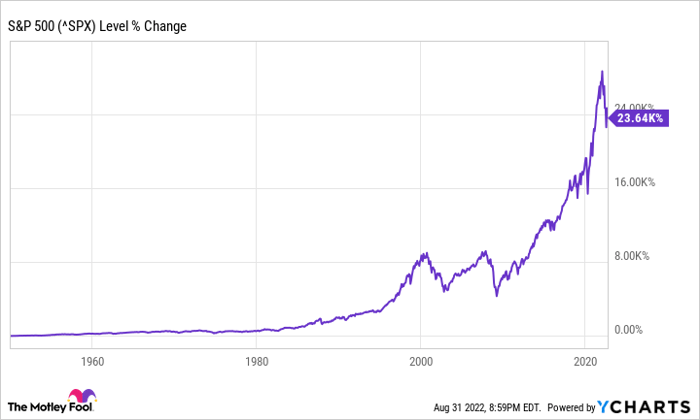
    ^SPX Chart

    ^SPX data by YCharts.

    The one figure more powerful than any bear-market-bottom indicator

    Obviously, these indicators could be wrong, and the June 2022 bear-market low of 3,636 could hold firm for the S&P 500. If there were indicators that were right 100% of the time, every Wall Street professional and retail investor would be using them by now.

    Regardless of whether the S&P 500, Nasdaq Composite, and Dow Jones industrial Average have already found their respective bottoms or still have additional downside, one figure does offer a practical guarantee — and all it requires is your patience.

    Every year, stock-market analytics provider Crestmont Research publishes data highlighting the 20-year rolling total returns (which include dividends paid) for the S&P 500 since 1919. In other words, Crestmont is looking at the average annual total return investors would have made by buying and holding an S&P 500 tracking index for 20 years over each of the past 103 end years (1919-2021). 

    The result? Investors made money 103 out of 103 times if they purchased an S&P 500 tracking index and held it for 20 years. What’s more, approximately 40% of these 103 end years produced an average annual total return of at least 10.9%. Investors weren’t just scraping by holding an S&P 500 index. They were doubling their money about every seven years in roughly 40% of all rolling 20-year periods.

    That means that investors shouldn’t be afraid to put money to work on Wall Street either now or in the future. If you’re a long-term investor, time is a far more powerful ally than any bear-market bottom indicator.

    This article was originally published on Fool.com. All figures quoted in US dollars unless otherwise stated.

    The post Where will the bear market bottom? History offers a very clear clue appeared first on The Motley Fool Australia.

    Wondering where you should invest $1,000 right now?

    When investing expert Scott Phillips has a stock tip, it can pay to listen. After all, the flagship Motley Fool Share Advisor newsletter he has run for over ten years has provided thousands of paying members with stock picks that have doubled, tripled or even more.* Scott just revealed what he believes could be the “five best ASX stocks” for investors to buy right now. These stocks are trading at near dirt-cheap prices and Scott thinks they could be great buys right now

    See The 5 Stocks *Returns as of August 4 2022

    (function() { function setButtonColorDefaults(param, property, defaultValue) { if( !param || !param.includes(‘#’)) { var button = document.getElementsByClassName(“pitch-snippet”)[0].getElementsByClassName(“pitch-button”)[0]; button.style[property] = defaultValue; } } setButtonColorDefaults(“#43B02A”, ‘background’, ‘#5FA85D’); setButtonColorDefaults(“#43B02A”, ‘border-color’, ‘#43A24A’); setButtonColorDefaults(“#fff”, ‘color’, ‘#fff’); })()

    More reading

    Sean Williams has no position in any of the stocks mentioned. The Motley Fool Australia’s parent company Motley Fool Holdings Inc. has no position in any of the stocks mentioned. The Motley Fool Australia has no position in any of the stocks mentioned. The Motley Fool has a disclosure policy. This article contains general investment advice only (under AFSL 400691). Authorised by Scott Phillips.

    This article was originally published on Fool.com. All figures quoted in US dollars unless otherwise stated.


    from The Motley Fool Australia https://ift.tt/SxtLhEZ
  • 3 fundamental lessons on ASX shares following reporting season

    Two female executives looking at a clipboard together.Two female executives looking at a clipboard together.

    This reporting season was pretty momentous for ASX shares. Investors went into it wondering how well FY22 went and what commentary might be given about FY23 and beyond.

    FY22 may well be the last time COVID-19, lockdowns and so on have a sizeable impact on results.

    Inflation and changing economic conditions could be a key impact in FY23.

    But, the reporting season that just finished was very interesting for a number of reasons. I think there are a few lessons to be learned from it.

    Did the market go too negative at the end of FY22?

    As inflation concerns ramped up, and concern over what this might mean for central bank interest rates, investors pushed share prices down going into June.

    For example, from the start to mid-June 2022, the Wesfarmers Ltd (ASX: WES) share price was down 31%, the JB Hi-Fi Limited (ASX: JBH) share price was down 24%, the Goodman Group (ASX: GMG) share price was down 36%, and the Aristocrat Leisure Limited (ASX: ALL) share price had fallen 28%.

    But, the price of many ASX shares rose after that June low.

    What’s the lesson here? I think it’s that the (ASX) share market can swing from being too optimistic to being too pessimistic about the long-term prospects of businesses.

    It can be hard to be positive or brave about investing when share markets are falling – there’s usually a good reason for it (such as a global pandemic or rapidly rising interest rates). But those times when prices go lower could be the most opportunistic time to buy.

    Profits and profit margins increased

    One of the main things we want to see from a business’ result is that it’s growing. Higher revenue is ideal and we probably want to see that a business is making profit and achieving stronger profit margins thanks to operating leverage. Profit isn’t always the goal, as some businesses may be investing heavily for growth over short-term profitability.

    While I won’t cover every business report – you can check out our reporting season centre for an individual result – I can tell you about how the S&P/ASX 200 Index (ASX: XJO) shares performed overall, thanks to some stats from CommSec about (full-year) reporting companies.

    In the year to June 2022, aggregate revenue rose by 10.6%, with 87% of companies achieving revenue growth. The average increase in revenue was 34.5%.

    Total expenses went up 8.6%, with 86% of companies reporting higher expenses, with both of these metrics higher than last reporting season. The average increase in expenses was 21.1% in the last reporting season.

    However, you may have noticed that ASX 200 share revenue did increase faster than expenses.

    CommSec revealed that aggregate statutory net profit after tax (NPAT) lifted by 56.3%, or up 36.5% if excluding BHP Group Ltd (ASX: BHP). Earnings per share (EPS) went up 27.1%, or 23.4% excluding BHP. The average increase in profit across 132 companies was 41.8%. Just under 63% of companies increased profits.

    I think this reporting season showed that companies were successful at continuing to grow and collectively grow their profit margin. This is the type of thing that can help with share price growth and dividends.

    Management taking care of balance sheets

    But, one of the most interesting things was that dividends didn’t increase.

    CommSec reported that aggregate dividends fell by 6.1%, though 84% of companies did issue a dividend. However, only 61% of companies lifted dividends, with 27.4% cutting dividends and 11.5% leaving dividends stable, according to CommSec.

    Both full-year and half-year reporting ASX 200 shares announced dividends totalling $42.3 billion, down 1.7% year over year.

    So, even though collective profits were up, the boards of businesses decided not to grow the dividend.

    CommSec also noted that aggregate cash holdings fell by 9.8%. That’s an interesting revelation as companies enter this period of higher interest rates and perhaps lower growth.

    The lower dividend may indicate that management teams are feeling cautious about the upcoming period.

    The post 3 fundamental lessons on ASX shares following reporting season appeared first on The Motley Fool Australia.

    Wondering where you should invest $1,000 right now?

    When investing expert Scott Phillips has a stock tip, it can pay to listen. After all, the flagship Motley Fool Share Advisor newsletter he has run for over ten years has provided thousands of paying members with stock picks that have doubled, tripled or even more.* Scott just revealed what he believes could be the “five best ASX stocks” for investors to buy right now. These stocks are trading at near dirt-cheap prices and Scott thinks they could be great buys right now

    See The 5 Stocks
    *Returns as of August 4 2022

    (function() {
    function setButtonColorDefaults(param, property, defaultValue) {
    if( !param || !param.includes(‘#’)) {
    var button = document.getElementsByClassName(“pitch-snippet”)[0].getElementsByClassName(“pitch-button”)[0];
    button.style[property] = defaultValue;
    }
    }

    setButtonColorDefaults(“#0095C8”, ‘background’, ‘#5FA85D’);
    setButtonColorDefaults(“#0095C8”, ‘border-color’, ‘#43A24A’);
    setButtonColorDefaults(“#fff”, ‘color’, ‘#fff’);
    })()

    More reading

    Motley Fool contributor Tristan Harrison has no position in any of the stocks mentioned. The Motley Fool Australia’s parent company Motley Fool Holdings Inc. has no position in any of the stocks mentioned. The Motley Fool Australia has positions in and has recommended Wesfarmers Limited. The Motley Fool Australia has recommended JB Hi-Fi Limited. The Motley Fool has a disclosure policy. This article contains general investment advice only (under AFSL 400691). Authorised by Scott Phillips.

    from The Motley Fool Australia https://ift.tt/oEdbR5q

  • How I’d invest $50,000 in ASX dividend shares for retirement, if I had to start from scratch

    Five retirees do a conga line dance on the beach celebrating the special dividend announced by Grange Resources today

    Five retirees do a conga line dance on the beach celebrating the special dividend announced by Grange Resources today

    Investors looking for assets to fund their life in retirement could do well by looking at ASX dividend shares, in my opinion.

    Without a crystal ball, it’s tricky to work out how long your retirement nest egg will need to last – hopefully as long as possible! I think this is where investing in shares can offer that level of dividends and growth to provide income for the long-term, with no end date in mind.

    One strategy that some investors follow is the concept of buying growth assets and selling them as time goes on. That’s certainly a strategy that could work, but I don’t like the idea of having to sell shares during a market crash, which could eat into the nest egg fund, rather than simply living off the dividends.

    So, which ASX dividend shares can provide an attractive source of long-term dividends? I’m going to put together a portfolio worth $50,000 in some of the stocks I’d pick to pay for my income needs in retirement.

    Rural Funds Group (ASX: RFF)

    For investors interested in ASX agricultural shares, Rural Funds could be a solid pick. A real estate investment trust (REIT), it owns various farms across cattle, almonds, macadamias, vineyards and cropping (sugar and cotton).

    Rural Funds aims to boost its total distribution to shareholders by 4% per annum. It has increased the payout every year since listing several years ago.

    The 4% increase in FY23 to 12.2 cents per unit (including franking credits) translates into a distribution yield of 4.75%.

    I’d invest $7,500 here.

    Washington H. Soul Pattinson and Co. Ltd (ASX: SOL)

    I mentioned this business in a recent article about investing in a general portfolio when starting from scratch, but I think it’d be a difficult choice to leave out Soul Pattinson from a retirement-focused portfolio as well.

    It’s one I own in my own portfolio. Soul Pattinson has a diversified portfolio of assets across sectors like building products, property, telecommunications, resources, agriculture and so on.

    The ASX dividend share has grown its dividend every year since 2000. That’s the longest dividend growth streak on the ASX.

    I’d invest $10,000 here.

    APA Group (ASX: APA)

    APA owns a large pipeline network of assets across Australia, transporting half of the country’s national gas usage. The company could benefit from inflation, with its revenue linked to inflation thanks to contracts. It’s also investing in renewable energy and researching how its pipelines can transport hydrogen in a greener future.

    The ASX dividend share has grown its distribution every year for more than a decade and a half. APA’s estimated distribution in FY23 is 55 cents per share, equating to a forward yield of 5.1%.

    I’d invest $6,500 here.

    Charter Hall Long WALE REIT (ASX: CLW)

    This is another REIT, but it’s much more diversified. Its properties are spread across a number of sectors including telco exchanges, agri-logistics, office, Bunnings Warehouses, hotels and Dan Murphy’s, BP service stations, distribution centres and so on.

    But, the common factor across the properties is long-term leases. REIT aims to have all tenants on long-term rental agreements. The weighted average lease expiry (WALE) at 30 June 2022 was 12 years, with an occupancy rate of 99.9%. After a fall in the share price, the FY23 distribution yield is projected to be 6.3%.

    I’d invest $6,000 here.

    Wesfarmers Ltd (ASX: WES)

    Wesfarmers has an impressive portfolio of businesses including Bunnings, Kmart and Officeworks, which are often seen as leaders in their respective retail categories. The start of Wesfarmers Health with the Priceline acquisition opens up another growth avenue. I like the plan to start lithium mining as well. There is plenty of growth potential and diversification on display here.

    It’s a quality ASX dividend share in my view, and it usually pays a solid dividend each year. In FY22, it grew the annual dividend by 1.1% to $1.80 per share. That translates into a grossed-up dividend yield of 5.5%.

    I’d invest $7,500 here.

    Sonic Healthcare Ltd (ASX: SHL)

    Sonic is a global pathology business, though it is also growing in another adjacent healthcare segments. I think this is a defensive business, with growth potential through ageing demographics, new tests, acquisitions and a backlog of testing due to COVID-19. AI is also an interesting area.

    It has a “progressive dividend policy”. In FY22 the ASX dividend share grew the dividend by another 10% to $1 per share. This is a grossed-up dividend yield of 4.25%.

    I’d invest $2,500 here.

    BHP Group Ltd (ASX: BHP)

    BHP is Australia’s biggest resource business, with its portfolio including iron ore, copper, nickel, steel-making (metallurgical) coal and potash (fertiliser). It’s committed to paying at least 50% of its profit as a dividend.

    There will be ups and downs of the dividend, but I think a 30% fall of the BHP share price since the 2022 peak in April offers a good time to buy shares for the long-term. The FY24 grossed-up dividend yield is still expected to be 10.6% (according to CMC Markets), which is based expectations of materially lower profits between now and then.

    I’d invest $6,500 here.

    Duxton Water Ltd (ASX: D2O)

    Duxton Water is a unique business on the ASX. It owns water entitlements and leases them out to farmers who want the security of water access. Water is very important for the agricultural sector and demand could increase due to more permanent crop plantings, such as almonds. Water demand and prices could be largely uncorrelated to economic cycles, according to Duxton.

    The ASX dividend share is expecting to grow its half-yearly dividend from 3.3 cents per share from this reporting season, to 3.4 cents per share at the end of 2022, to 3.5 cents per share for the interim payment in 2023, to 3.6 cents per share at the end of 2023, to 3.7 cents per share for the 2024 interim payment.

    An annual dividend of 7.3 cents per share would be a grossed-up dividend yield of 6.2%.

    I’d invest $3,500 here.

    The post How I’d invest $50,000 in ASX dividend shares for retirement, if I had to start from scratch appeared first on The Motley Fool Australia.

    Wondering where you should invest $1,000 right now?

    When investing expert Scott Phillips has a stock tip, it can pay to listen. After all, the flagship Motley Fool Share Advisor newsletter he has run for over ten years has provided thousands of paying members with stock picks that have doubled, tripled or even more.* Scott just revealed what he believes could be the “five best ASX stocks” for investors to buy right now. These stocks are trading at near dirt-cheap prices and Scott thinks they could be great buys right now

    See The 5 Stocks
    *Returns as of August 4 2022

    (function() {
    function setButtonColorDefaults(param, property, defaultValue) {
    if( !param || !param.includes(‘#’)) {
    var button = document.getElementsByClassName(“pitch-snippet”)[0].getElementsByClassName(“pitch-button”)[0];
    button.style[property] = defaultValue;
    }
    }

    setButtonColorDefaults(“#43B02A”, ‘background’, ‘#5FA85D’);
    setButtonColorDefaults(“#43B02A”, ‘border-color’, ‘#43A24A’);
    setButtonColorDefaults(“#fff”, ‘color’, ‘#fff’);
    })()

    More reading

    Motley Fool contributor Tristan Harrison has positions in DUXTON FPO, RURALFUNDS STAPLED, and Washington H. Soul Pattinson and Company Limited. The Motley Fool Australia’s parent company Motley Fool Holdings Inc. has positions in and has recommended Washington H. Soul Pattinson and Company Limited. The Motley Fool Australia has positions in and has recommended APA Group, RURALFUNDS STAPLED, Washington H. Soul Pattinson and Company Limited, and Wesfarmers Limited. The Motley Fool Australia has recommended Sonic Healthcare Limited. The Motley Fool has a disclosure policy. This article contains general investment advice only (under AFSL 400691). Authorised by Scott Phillips.

    from The Motley Fool Australia https://ift.tt/zfyc2TD

  • What’s dragging the Qantas share price lower today?

    a man stands with a finger to his mouth in a confused pose while his wheeled luggage is next to him with handle extended at a deserted airport.

    a man stands with a finger to his mouth in a confused pose while his wheeled luggage is next to him with handle extended at a deserted airport.

    The Qantas Airways Ltd (ASX: QAN) share price is in the red in morning trade.

    Qantas shares closed on Friday at $5.28 each and are currently trading for $5.13 a share, down 2.84%.

    The fall come despite the S&P/ASX 200 Index (ASX: XJO) holding up better than expected, up 0.17% at this same time.

    So, what’s dragging the Qantas share price lower today?

    What’s happening with the flying kangaroo?

    With some 1,800 trades going through within the first 40 minutes of market open today, valued at just under $6.1 million, there are certainly numerous issues investors are considering today when eyeing Qantas shares.

    But looking at the 1.5% share price fall in Flight Centre Travel Group Ltd (ASX: FLT) and the 1.67% drop in the Webjet Ltd (ASX: WEB) share price, we suspect some of the pressure on the Qantas share price today could be coming from the announced strike by its ground handlers.

    If travellers needed more troubles as airlines and airports struggle to ramp back to pre-COVID levels of traffic, they may well get it next Monday, 12 September.

    That’s the day Dnata ground handlers have voted to go on strike for 24 hours. This will see 350 employees across Brisbane, Sydney, and Adelaide airports take a pause.

    According to the Transport Workers Union (TWU), 96% of the polled workers were in favour of the 24-hour strike which, in turn, could put the Qantas share price under pressure.

    Qantas stirred up ructions last year after the airline, facing huge losses from pandemic-related travel restrictions, outsourced some 2,000 ground handling functions to third-party companies, including Dnata.

    Commenting on the industrial action, the TWU’s national secretary, Michael Kaine said (courtesy of Australian Aviation):

    Ground handling is a highly-skilled job, but thousands of experienced workers have been forced out of the industry by Qantas’ illegal outsourcing and the Morrison Government refusing Dnata workers JobKeeper…

    Workers understand the commercial pressure they’re under from Qantas, but Dnata and [ground services contractor] Menzies must act responsibly and come back to the table to settle a fair deal or risk losing more staff.

    In response to the ongoing wage negotiations that could throw up headwinds for the Qantas share price, Dnata stated:

    We continue to work with our employees and their bargaining representatives and engage with them in good faith to create a sustainable platform for our future operations, including a commitment to exploring opportunities to provide greater full-time employment for our workforce which we have communicated to union representatives

    Qantas share price snapshot

    With today’s losses factored in, the Qantas share price is up a slender 0.4% in 2022. While that may not sound overwhelming, it’s well ahead of the 9.9% year-to-date loss posted by the ASX 200.

    The post What’s dragging the Qantas share price lower today? appeared first on The Motley Fool Australia.

    Wondering where you should invest $1,000 right now?

    When investing expert Scott Phillips has a stock tip, it can pay to listen. After all, the flagship Motley Fool Share Advisor newsletter he has run for over ten years has provided thousands of paying members with stock picks that have doubled, tripled or even more.* Scott just revealed what he believes could be the “five best ASX stocks” for investors to buy right now. These stocks are trading at near dirt-cheap prices and Scott thinks they could be great buys right now

    See The 5 Stocks
    *Returns as of August 4 2022

    (function() {
    function setButtonColorDefaults(param, property, defaultValue) {
    if( !param || !param.includes(‘#’)) {
    var button = document.getElementsByClassName(“pitch-snippet”)[0].getElementsByClassName(“pitch-button”)[0];
    button.style[property] = defaultValue;
    }
    }

    setButtonColorDefaults(“#0095C8”, ‘background’, ‘#5FA85D’);
    setButtonColorDefaults(“#0095C8”, ‘border-color’, ‘#43A24A’);
    setButtonColorDefaults(“#fff”, ‘color’, ‘#fff’);
    })()

    More reading

    Motley Fool contributor Bernd Struben has no position in any of the stocks mentioned. The Motley Fool Australia’s parent company Motley Fool Holdings Inc. has no position in any of the stocks mentioned. The Motley Fool Australia has recommended Flight Centre Travel Group Limited and Webjet Ltd. The Motley Fool has a disclosure policy. This article contains general investment advice only (under AFSL 400691). Authorised by Scott Phillips.

    from The Motley Fool Australia https://ift.tt/65LKg3b

  • Why is the Sayona share price lifting on Monday?

    A boy looks up and points his fingers to the sky in celebration pose.A boy looks up and points his fingers to the sky in celebration pose.

    The Sayona Mining Ltd (ASX: SYA) share price is lifting this morning despite no market-sensitive news on Monday.

    At the time of writing, the Sayona share price is up 2.94% at 26.25 cents.

    In broad market moves, the S&P/ASX 300 Metals and Mining Index (ASX: XMM) is pushing more than 1% higher from the open.

    Sayona added to ASX 200

    Following its quarterly rebalance last Friday, the Standard & Poor’s (S&P) Down Jones Indices released the updated lists for the S&P/ASX indices.

    Various indexes track different portions of the market, from industry/sector, company size, asset class, or even investment theme.

    The S&P/ASX 200 Index (ASX: XJO), for example, is an index that represents the largest 200 ASX-listed companies by market capitalisation, and tracks their performance over time.

    There are numerous other inclusion criteria as well, ranging from stipulated trading volume to volatility in share price.

    Sayona’s market capitalisation nudged past the $2 billion mark at the close last Friday, a gain of almost 100% from January 2022 to date.

    This comes after a wide range in prices from 38 cents in April this year to lows of 11.5 cents on 24 June.

    However, with the June bounce in risk assets such as stocks, Sayona has also caught a bid and is testing three-month highs once more.

    Sayona’s inclusion in the benchmark index also puts it on the radar of various large Australian fund mandates, which are restricted to buying ASX 200 shares only.

    This includes superannuation companies. It, therefore, stands to reason there could be some buying activity in the Sayona share price in the weeks and months to come.

    What that means is that Sayona shares are likely to see routine purchases from these kinds of institutional funds to fulfil their mandates – especially for the super funds.

    What does this mean for the Sayona share price?

    However, what this means for movement of the share price, we won’t know for some time.

    Nonetheless, any further upside would add to an already impressive year for Sayona, with its share price up more than 100% for the year to date, and 22% in the past month.

    That’s well ahead of all benchmarks, and a solid bedrock for the share’s inclusion in the index.

    In the past 12 months, the Sayona share price has gained 69.66%. Its return against the benchmark index over this time is plotted below.

    TradingView Chart

    The post Why is the Sayona share price lifting on Monday? appeared first on The Motley Fool Australia.

    Wondering where you should invest $1,000 right now?

    When investing expert Scott Phillips has a stock tip, it can pay to listen. After all, the flagship Motley Fool Share Advisor newsletter he has run for over ten years has provided thousands of paying members with stock picks that have doubled, tripled or even more.* Scott just revealed what he believes could be the “five best ASX stocks” for investors to buy right now. These stocks are trading at near dirt-cheap prices and Scott thinks they could be great buys right now

    See The 5 Stocks
    *Returns as of August 4 2022

    (function() {
    function setButtonColorDefaults(param, property, defaultValue) {
    if( !param || !param.includes(‘#’)) {
    var button = document.getElementsByClassName(“pitch-snippet”)[0].getElementsByClassName(“pitch-button”)[0];
    button.style[property] = defaultValue;
    }
    }

    setButtonColorDefaults(“#43B02A”, ‘background’, ‘#5FA85D’);
    setButtonColorDefaults(“#43B02A”, ‘border-color’, ‘#43A24A’);
    setButtonColorDefaults(“#fff”, ‘color’, ‘#fff’);
    })()

    More reading

    Motley Fool contributor Zach Bristow has no position in any of the stocks mentioned. The Motley Fool Australia’s parent company Motley Fool Holdings Inc. has no position in any of the stocks mentioned. The Motley Fool Australia has no position in any of the stocks mentioned. The Motley Fool has a disclosure policy. This article contains general investment advice only (under AFSL 400691). Authorised by Scott Phillips.

    from The Motley Fool Australia https://ift.tt/26zhWSj