Tag: Motley Fool

  • Has the Treasury Wines dividend been worthwhile since 2017?

    a wine technician in overalls holds a glass of red wine up to the light and studies is closely with large wine barrels in the background, stored in a brick walled wine cellar.a wine technician in overalls holds a glass of red wine up to the light and studies is closely with large wine barrels in the background, stored in a brick walled wine cellar.

    A difficult past couple of years has led the Treasury Wine Estates Ltd (ASX: TWE) share price to slump 12% since 2017.

    In particular, a 40% drop from January 2020 to April 2020 caused havoc for shareholders amid China introducing tariffs on Australian wines.

    This was in response to the Australian government’s decision to call for an inquiry into the origins of COVID-19.

    Nonetheless, fast-forward to 2022 and the wine distributor’s shares have continued to record wild price swings.

    High inflation levels and rate hikes have sparked concerns about a looming recession in the near future. This has caused volatility across global markets.

    At the time of writing, Treasury Wines shares are down 0.44% to $11.38.

    What about the Treasury Wines dividend?

    Regardless of company’s unstable share price, the Treasury Wines board has continued to pay dividends to shareholders.

    Below, we take a look at the past five years’ worth of dividends that the company has paid out.

    • October 2017 – 13 cents (final)
    • April 2018 – 15 cents (interim)
    • October 2018 – 17 cents (final)
    • April 2019 – 18 cents (interim)
    • October 2019 – 20 cents (final)
    • April 2020 – 20 cents (interim)
    • October 2020 – 8 cents (final)
    • April 2021 – 15 cents (interim)
    • October 2021 – 13 cents (final)
    • April 2022 – 15 cents (interim)

    Calculating Treasury Wines’ dividends since October 2017 gives us a total figure of $1.54 for every share owned.

    And based on the last two dividends distributed to shareholders, Treasury Wines has a dividend yield of 1.6%.

    Treasury Wines share price snapshot

    Over the last 12 months, the Treasury Wines share price has fallen by more than 4% and is down 8% year-to-date.

    The company’s shares strongly rebounded from their 52-week low of $10.37 in February on the back of a surprise half-year result.

    Treasury Wines presides a market capitalisation of roughly $8.22 billion based on today’s price.

    The post Has the Treasury Wines dividend been worthwhile since 2017? appeared first on The Motley Fool Australia.

    Should you invest $1,000 in Treasury Wine Estates Ltd right now?

    Before you consider Treasury Wine Estates Ltd, you’ll want to hear this.

    Motley Fool Investing expert Scott Phillips just revealed what he believes are the 5 best stocks for investors to buy right now… and Treasury Wine Estates Ltd wasn’t one of them.

    The online investing service he’s run for over a decade, Motley Fool Share Advisor, has provided thousands of paying members with stock picks that have doubled, tripled or even more.* And right now, Scott thinks there are 5 stocks that are better buys.

    See The 5 Stocks
    *Returns as of July 7 2022

    (function() {
    function setButtonColorDefaults(param, property, defaultValue) {
    if( !param || !param.includes(‘#’)) {
    var button = document.getElementsByClassName(“pitch-snippet”)[0].getElementsByClassName(“pitch-button”)[0];
    button.style[property] = defaultValue;
    }
    }

    setButtonColorDefaults(“#0095C8”, ‘background’, ‘#5FA85D’);
    setButtonColorDefaults(“#0095C8”, ‘border-color’, ‘#43A24A’);
    setButtonColorDefaults(“#fff”, ‘color’, ‘#fff’);
    })()

    More reading

    Motley Fool contributor Aaron Teboneras has no position in any of the stocks mentioned. The Motley Fool Australia’s parent company Motley Fool Holdings Inc. has no position in any of the stocks mentioned. The Motley Fool Australia has recommended Treasury Wine Estates Limited. The Motley Fool has a disclosure policy. This article contains general investment advice only (under AFSL 400691). Authorised by Scott Phillips.

    from The Motley Fool Australia https://ift.tt/v9iXJYr

  • Here’s why the Coles share price had a volatile FY22

    a woman ponders products on a supermarket shelf while holding a tin in one hand and holding her chin with the other.

    a woman ponders products on a supermarket shelf while holding a tin in one hand and holding her chin with the other.The Coles Group Ltd (ASX: COL) share price had another financial year of ups and downs in FY22.

    As one of Australia’s largest supermarket businesses, investors may not expect that much volatility from the business. But the start of this decade has been momentous with a global pandemic and now elevated inflation.

    Coles Group is the name behind a few different businesses including Coles supermarkets, national liquor brands Liquorland, Vintage Cellars, First Choice Liquor and First Choice Liquor Market, the service station business Coles Express and Coles Financial Services (which offers insurance, credit cards and personal loans).

    There were three distinctive periods of FY22, so let’s look at each of them.

    Lockdowns

    The first half of FY22 saw Australia’s two biggest cities – Sydney and Melbourne – in lockdown. As we saw during the end of FY20 and FY21, lockdowns meant that more people were buying more of their food from supermarkets, so Coles benefited.

    In the first several weeks of FY22, the Coles share price climbed more than 8%.

    When the company released its FY21 result, it noted that in FY22 it would be cycling against the strong sales seen in FY21. In the first seven weeks of FY22, supermarket sales were up approximately 1% year on year and up 12% over two years.

    Liquor sales in those first seven weeks were flat year on year, but up 19% over two years.

    For Coles Express, fuel volumes were impacted by lockdowns.

    The company said that ‘smarter selling’ benefits were expected to be more than $200 million.

    Omicron and normalising sales

    Lockdowns ended in Sydney and Melbourne as vaccination rates rose and restrictions weren’t introduced for the Omicron variant. By mid-January, the Coles share price had fallen more than 13% from the August 2021 high.

    In the FY22 first half, for the 27 weeks to 2 January 2022, sales went up 1% to $20.6 billion and net profit after tax (NPAT) fell 2% to $549 million. It said that it was impacted by higher COVID-19 disruption costs, a hit to Coles Express earnings due to travel restrictions, and transformation project costs.

    The company said that smarter selling benefits achieved in the first half were more than $100 million. It also said it’s on track to deliver over $200 of benefits in FY22.

    While supermarket sales were elevated in the early part of January because of shoppers stocking up amid the Omicron surge, sales “moderated” later in the month.

    Inflation bites

    The last few months have seen inflation jump significantly. The Coles share price rose around 10% to the end of FY22.

    In the third quarter of FY22, total sales rose by 3.9% to $9.3 billion.

    Coles said that cost price inflation is impacting suppliers as a result of “increased raw material, commodity, shopping and fuel costs.”

    It noted that inflation steadily increased throughout the third quarter, with total supermarket price inflation of 3.3%.

    In a trading update talking about the fourth quarter, Coles said it had recorded a solid trading period with no restrictions on traditional family events such as Easter. It said that COVID-19 costs are expected to continue to moderate further.

    However, supplier input cost inflation is expected to continue “in the further quarter and into FY23”.

    Coles share price snapshot

    At the time of writing, the Coles share price has risen by around 7% over the last month.

    The post Here’s why the Coles share price had a volatile FY22 appeared first on The Motley Fool Australia.

    Should you invest $1,000 in Coles Group Ltd right now?

    Before you consider Coles Group Ltd, you’ll want to hear this.

    Motley Fool Investing expert Scott Phillips just revealed what he believes are the 5 best stocks for investors to buy right now… and Coles Group Ltd wasn’t one of them.

    The online investing service he’s run for over a decade, Motley Fool Share Advisor, has provided thousands of paying members with stock picks that have doubled, tripled or even more.* And right now, Scott thinks there are 5 stocks that are better buys.

    See The 5 Stocks
    *Returns as of July 7 2022

    (function() {
    function setButtonColorDefaults(param, property, defaultValue) {
    if( !param || !param.includes(‘#’)) {
    var button = document.getElementsByClassName(“pitch-snippet”)[0].getElementsByClassName(“pitch-button”)[0];
    button.style[property] = defaultValue;
    }
    }

    setButtonColorDefaults(“#43B02A”, ‘background’, ‘#5FA85D’);
    setButtonColorDefaults(“#43B02A”, ‘border-color’, ‘#43A24A’);
    setButtonColorDefaults(“#fff”, ‘color’, ‘#fff’);
    })()

    More reading

    Motley Fool contributor Tristan Harrison has no position in any of the stocks mentioned. The Motley Fool Australia’s parent company Motley Fool Holdings Inc. has no position in any of the stocks mentioned. The Motley Fool Australia has positions in and has recommended COLESGROUP DEF SET. The Motley Fool has a disclosure policy. This article contains general investment advice only (under AFSL 400691). Authorised by Scott Phillips.

    from The Motley Fool Australia https://ift.tt/rpSWDFJ

  • Why is the Galileo Mining share price galloping 17% higher today?

    A man in a horse head mask and suit jumps for joy on a beach.A man in a horse head mask and suit jumps for joy on a beach.

    The Galileo Mining Ltd (ASX: GAL) share price is soaring today, up 17.65% at the time of writing.

    The ASX resource explorer ended Friday’s trade at $1.28 per share and is currently trading for $1.50 per share. However, Galileo shares spiked in earlier trade to $1.575, a 23.5% rise.

    So, what’s piquing ASX investor interest?

    Record intersections boost Galileo share price

    Investors are bidding up the Galileo share price today after the company reported on promising drill assays at its 100% owned Norseman project in Western Australia.

    The results come from the first four reverse circulation (RC) holes at Norseman’s Callisto palladium-platinum-gold-copper-nickel discovery. The current drilling is part of the second RC drill program at the site.

    All four holes returned significant palladium-platinum-gold-copper-nickel assays. The Galileo share price looks to be getting a big boost from one hole in particular, which returned the highest-grade palladium and platinum results the explorer has recorded to date – 8.25 g/t Pd and 1.94 g/t Pt over one metre.

    Samples from all the reported intersections are currently undergoing analysis for rhodium content.

    What did management say?

    Commenting on the strong results helping propel the Galileo share price higher today, managing director Brad Underwood said:

    The latest assays from our Callisto discovery demonstrate the extensive continuity of mineralisation intercepted. We are very pleased to report significant thicknesses over 20 metres at the 1.0 g/t 3E cut-off grade and over 30 metres at the lower 0.5 g/t 3E cut-off.

    Most importantly, the mineralisation is open at the end of the 6,448,000 drill line where it starts to dip east, further onto our granted mine lease.

    Underwood said one RC hole ended with mineralisation. The miner will complete the dig with a diamond drill rig and additional step-out holes.

    There’s more RC drilling to come too.

    “The third round of RC drilling is scheduled to begin in late July with diamond drilling planned to start in August. With over five kilometres of prospective strike length at Callisto we have a lot more drilling to come,” Underwood said.

    Galileo share price snapshot

    The Galileo share price has been a standout performer in 2022, up a whopping 556%. That compares to a year-to-date loss of 14% posted by the All Ordinaries Index (ASX: XAO).

    The post Why is the Galileo Mining share price galloping 17% higher today? appeared first on The Motley Fool Australia.

    Wondering where you should invest $1,000 right now?

    When investing expert Scott Phillips has a stock tip, it can pay to listen. After all, the flagship Motley Fool Share Advisor newsletter he has run for over ten years has provided thousands of paying members with stock picks that have doubled, tripled or even more.* Scott just revealed what he believes could be the “five best ASX stocks” for investors to buy right now. These stocks are trading at near dirt-cheap prices and Scott thinks they could be great buys right now

    See The 5 Stocks
    *Returns as of July 7 2022

    (function() {
    function setButtonColorDefaults(param, property, defaultValue) {
    if( !param || !param.includes(‘#’)) {
    var button = document.getElementsByClassName(“pitch-snippet”)[0].getElementsByClassName(“pitch-button”)[0];
    button.style[property] = defaultValue;
    }
    }

    setButtonColorDefaults(“#43B02A”, ‘background’, ‘#5FA85D’);
    setButtonColorDefaults(“#43B02A”, ‘border-color’, ‘#43A24A’);
    setButtonColorDefaults(“#fff”, ‘color’, ‘#fff’);
    })()

    More reading

    Motley Fool contributor Bernd Struben has no position in any of the stocks mentioned. The Motley Fool Australia’s parent company Motley Fool Holdings Inc. has no position in any of the stocks mentioned. The Motley Fool Australia has no position in any of the stocks mentioned. The Motley Fool has a disclosure policy. This article contains general investment advice only (under AFSL 400691). Authorised by Scott Phillips.

    from The Motley Fool Australia https://ift.tt/mqlBFcb

  • Anteotech share price surges 20% after passing first lithium battery hurdle

    Pilbara Minerals share price ASX lithium shares A stylised clean energy battery flexes its muscles, indicating a strong lift in share price for ASX energy companies

    Pilbara Minerals share price ASX lithium shares A stylised clean energy battery flexes its muscles, indicating a strong lift in share price for ASX energy companies

    The AnteoTech Ltd (ASX: ADO) share price has started the week strongly.

    In morning trade, the surface chemistry company’s shares were up as much as 20% to 9.6 cents.

    The AnteoTech share price has pulled back since then but remains up 7.5% to 8.6 cents.

    Why is the AnteoTech share price racing higher?

    Investors have been bidding the AnteoTech share price higher this morning following the release of an announcement.

    While AnteoTech may be best known as a company focused on COVID rapid antigen testing, today’s update has nothing to do with that.

    According to the release, the company has received the latest test results from “two respected and recognised global companies operating in the lithium-ion battery (LIB) value chain” for its drop-in cross-linker additive for LIB anodes, AnteoX.

    The results reveal that a high performance lithium-ion battery developer found an uplift in electrochemical performance using AnteoX, whereas a global battery manufacturer also demonstrated an uplift in electrochemical performance testing with three different binder chemistries.

    AnteoTech believes that the results provide further validation and confirmation of AnteoX’s performance enhancing properties, particularly in silicon-rich and high energy anode designs.

    The company also notes that AnteoX has now passed a first-stage evaluation and validation by a battery manufacturer. In light of this, the manufacturer has expressed interest in conducting further testing on full cells and combining AnteoX with more commercial anode formulations.

    ‘An important development milestone’

    AnteoTech’s Head of Energy, Manuel Wieser, was excited with the news. He said:

    Having proven AnteoX in our laboratories it is exciting to see the independent validation of AnteoX from two respected battery companies, this marks an important development milestone for AnteoTech.

    Whilst there is further development and validation work to be done with both companies, the energy team is very pleased with the results to date. These collaborations are ongoing, and we would like to thank both parties for their roles in our technology development to this point. We will continue to provide further updates as the collaborations advance to the next stage.

    The post Anteotech share price surges 20% after passing first lithium battery hurdle appeared first on The Motley Fool Australia.

    Should you invest $1,000 in Anteotech Ltd right now?

    Before you consider Anteotech Ltd, you’ll want to hear this.

    Motley Fool Investing expert Scott Phillips just revealed what he believes are the 5 best stocks for investors to buy right now… and Anteotech Ltd wasn’t one of them.

    The online investing service he’s run for over a decade, Motley Fool Share Advisor, has provided thousands of paying members with stock picks that have doubled, tripled or even more.* And right now, Scott thinks there are 5 stocks that are better buys.

    See The 5 Stocks
    *Returns as of July 7 2022

    (function() {
    function setButtonColorDefaults(param, property, defaultValue) {
    if( !param || !param.includes(‘#’)) {
    var button = document.getElementsByClassName(“pitch-snippet”)[0].getElementsByClassName(“pitch-button”)[0];
    button.style[property] = defaultValue;
    }
    }

    setButtonColorDefaults(“#0095C8”, ‘background’, ‘#5FA85D’);
    setButtonColorDefaults(“#0095C8”, ‘border-color’, ‘#43A24A’);
    setButtonColorDefaults(“#fff”, ‘color’, ‘#fff’);
    })()

    More reading

    Motley Fool contributor James Mickleboro has no position in any of the stocks mentioned. The Motley Fool Australia’s parent company Motley Fool Holdings Inc. has no position in any of the stocks mentioned. The Motley Fool Australia has no position in any of the stocks mentioned. The Motley Fool has a disclosure policy. This article contains general investment advice only (under AFSL 400691). Authorised by Scott Phillips.

    from The Motley Fool Australia https://ift.tt/YNLfcwb

  • GameStop finally announced its stock split. The MOASS still isn’t coming

    This article was originally published on Fool.com. All figures quoted in US dollars unless otherwise stated.

    A boy holds on tight as his gaming console nearly blows him away.

    This article was originally published on Fool.com. All figures quoted in US dollars unless otherwise stated.

    GameStop‘s (NYSE: GME) stock split announcement finally dropped. Investors have been waiting since March for the move after the video game retailer dramatically increased the number of shares outstanding from 300 million to one billion with the goal of splitting the stock.

    The shares will split by a four-to-one ratio, meaning for every share you own, you get three more, but each one will be worth one-fourth the price they previously traded at. So, with GameStop recently closing around $135 per share, an investor with 10 shares will now own 40 stubs instead, but each will be worth only $33.75.

    Unfortunately, the “mother of all short squeezes,” or MOASS, that meme stock traders have been waiting for still will not happen. Just because GameStop’s split will be in the form of a ‘dividend‘ doesn’t mean there will be any special impact on short-sellers. Yes, they’ll have to buy back four times as many shares, but they’ll be priced lower, just like investors who are long on the stock.

    Gaming the system

    GameStop, of course, is one of the premiere meme stocks on the market, often trading more on how much chatter is generated on social media and internet stock discussion boards than on the fundamentals of the business. In those circles, the self-described ‘apes’ have encouraged each other to hold firm and not sell their shares because a short squeeze, or fast and notable run-up, in GameStop’s share price was imminent.

    The video game retailer remains a heavily shorted stock — over one-fifth of its shares are sold short. So, when GameStop said it would be splitting its stock as a dividend, that was seen as the catalyst to set the MOASS in motion. But that’s not how it works.

    A special kind of dividend

    Most people are familiar with a cash dividend, where a company pays you a portion of its profits each month, quarter, or some other interval. As I explained once before, GameStop deeming its stock split a dividend is more a type of boilerplate language than some incantation with special powers.

    Another heavily shorted stock, Tesla, has also said it will split its stock as a dividend, as do many companies. Alphabet‘s 20-for-1 stock split on July 15 will be in the form of a special dividend.

    By declaring the split a dividend, a company is really only changing its accounting, essentially how much it keeps in its retained earnings account, and not much else. GameStop’s stock dividend won’t affect its cash balances as it would if it issued a cash dividend (which could cost short-sellers a lot of money), and the split won’t trigger a new ‘gamma squeeze’ on its shares.

    More important matters to address

    While GameStop’s stock typically doesn’t trade on its fundamentals, that doesn’t mean it never does. After announcing its stock split, the video game retailer also said it had fired its CFO and was laying off employees. After jumping 15% on the split announcement, the stock tumbled again in the aftermath of the firing and layoffs.

    Meme stock traders like to claim the game is rigged against them and that the Securities and Exchange Commission is allowing illegal or improper activities. These traders are also basking in the camaraderie that develops in the chat rooms. Yet, they also tend to reinforce the notion that if they hold on just a little longer, they could wait out the monied interests better against their stock and realize significant riches when the MOASS occurs.

    There may very well be a triggering event at some point, but GameStop’s stock split isn’t it.

    This article was originally published on Fool.com. All figures quoted in US dollars unless otherwise stated.

    The post GameStop finally announced its stock split. The MOASS still isn’t coming appeared first on The Motley Fool Australia.

    Wondering where you should invest $1,000 right now?

    When investing expert Scott Phillips has a stock tip, it can pay to listen. After all, the flagship Motley Fool Share Advisor newsletter he has run for over ten years has provided thousands of paying members with stock picks that have doubled, tripled or even more.* Scott just revealed what he believes could be the “five best ASX stocks” for investors to buy right now. These stocks are trading at near dirt-cheap prices and Scott thinks they could be great buys right now

    See The 5 Stocks *Returns as of July 7 2022

    (function() { function setButtonColorDefaults(param, property, defaultValue) { if( !param || !param.includes(‘#’)) { var button = document.getElementsByClassName(“pitch-snippet”)[0].getElementsByClassName(“pitch-button”)[0]; button.style[property] = defaultValue; } } setButtonColorDefaults(“#0095C8”, ‘background’, ‘#5FA85D’); setButtonColorDefaults(“#0095C8”, ‘border-color’, ‘#43A24A’); setButtonColorDefaults(“#fff”, ‘color’, ‘#fff’); })()

    More reading

    Suzanne Frey, an executive at Alphabet, is a member of The Motley Fool’s board of directors. Rich Duprey has no position in any of the stocks mentioned. The Motley Fool Australia’s parent company Motley Fool Holdings Inc. has positions in and has recommended Alphabet (A shares), Alphabet (C shares), and Tesla. The Motley Fool Australia has recommended Alphabet (A shares) and Alphabet (C shares). The Motley Fool has a disclosure policy. This article contains general investment advice only (under AFSL 400691). Authorised by Scott Phillips.

    This article was originally published on Fool.com. All figures quoted in US dollars unless otherwise stated.


    from The Motley Fool Australia https://ift.tt/Pguah81
  • EML share price sinks 18% amid CEO’s unexplained departure

    a man with a moustache sits at his computer with his hands over his eyes making a gap between his fingers so he can peek through to his computer screen.a man with a moustache sits at his computer with his hands over his eyes making a gap between his fingers so he can peek through to his computer screen.

    The EML Payments Ltd (ASX: EML) share price is one of the worst performers on the ASX today.

    This comes as the company announced the departure of its managing director and CEO Tom Cregan with no reason given.

    At the time of writing, the payments company’s shares are trading at a multi-year low of $1.045, down 18.36%.

    EML Payments shares freefall

    EML Payments advised that it has appointed Emma Shand as its managing director and CEO, effective immediately.

    This sudden news over the quick change in leadership has evidently shocked investors.

    The company stated that Shand brings 25 years of global experience in technology, capital markets, and diversified financial services.

    Most notably, she spent more than 16 years in senior management roles with US-based index, Nasdaq.

    EML Payments chair Peter Martin touched on the appointment saying:

    This is an exciting time of opportunity for EML, and Emma has an ideal set of attributes to lead the company into the future. Emma will provide highly professional leadership through a period of very rapid change.

    Emma has served as a member of the EML Board of Directors since September 2021. She brings a deep appreciation of the exciting growth opportunities ahead for EML in a world rapidly transitioning to digital payments. Importantly, she has a very impressive track record initiating and overseeing complex, transformational change.

    Due to of EML Payment’s significant European business, Shand will mostly spend her time and run operations from there.

    EML Payments noted that Cregan will receive his contractual entitlements but no termination benefits will be provided.

    About the EML Payments share price

    The latest share price slump won’t bode well for EML Payments shareholders.

    Its shares are down more than 72% since this time last year and continue to be dragged lower by tough trading conditions.

    EML Payments has a market capitalisation of roughly $394 million.

    The post EML share price sinks 18% amid CEO’s unexplained departure appeared first on The Motley Fool Australia.

    Should you invest $1,000 in Eml Payments Ltd right now?

    Before you consider Eml Payments Ltd, you’ll want to hear this.

    Motley Fool Investing expert Scott Phillips just revealed what he believes are the 5 best stocks for investors to buy right now… and Eml Payments Ltd wasn’t one of them.

    The online investing service he’s run for over a decade, Motley Fool Share Advisor, has provided thousands of paying members with stock picks that have doubled, tripled or even more.* And right now, Scott thinks there are 5 stocks that are better buys.

    See The 5 Stocks
    *Returns as of July 7 2022

    (function() {
    function setButtonColorDefaults(param, property, defaultValue) {
    if( !param || !param.includes(‘#’)) {
    var button = document.getElementsByClassName(“pitch-snippet”)[0].getElementsByClassName(“pitch-button”)[0];
    button.style[property] = defaultValue;
    }
    }

    setButtonColorDefaults(“#43B02A”, ‘background’, ‘#5FA85D’);
    setButtonColorDefaults(“#43B02A”, ‘border-color’, ‘#43A24A’);
    setButtonColorDefaults(“#fff”, ‘color’, ‘#fff’);
    })()

    More reading

    Motley Fool contributor Aaron Teboneras has no position in any of the stocks mentioned. The Motley Fool Australia’s parent company Motley Fool Holdings Inc. has positions in and has recommended EML Payments. The Motley Fool Australia has positions in and has recommended EML Payments. The Motley Fool has a disclosure policy. This article contains general investment advice only (under AFSL 400691). Authorised by Scott Phillips.

    from The Motley Fool Australia https://ift.tt/f7skrMQ

  • How does the CBA dividend stack up against its ASX 200 peers?

    A businesswoman weighs up the stack of cash she receives, with the pile in one hand significantly more than the other hand.A businesswoman weighs up the stack of cash she receives, with the pile in one hand significantly more than the other hand.

    Commonwealth Bank of Australia (ASX: CBA) is the S&P/ASX 200 Index (ASX: XJO)’s biggest banking share, boasting a market capitalisation of around $157 billion. But how do CBA’s dividends stack up against those offered by its peers?

    Interestingly, despite posting a seemingly healthy dividend yield, it doesn’t compare well to most of its ASX 200 bank peers. In fact, the banking giant’s 4% dividend yield is the smallest of the big four.

    CBA shares offer 4% dividend yield

    Over the past 12 months, each CBA share has offered $3.75 in dividends.

    This is made up of a $2 final dividend for financial year 2021, announced in August. The bank’s final dividend reflected a 104% increase on that of the prior comparable period.

    It was followed by a $1.75 interim dividend announced in February, representing a 17% increase.

    On top of that, CBA shares have paid out fully-franked dividends since the early 90s. That means they could offer some shareholders a better deal on their tax.

    Considering CBA’s current share price – $93.15 – the bank’s stock is trading with a 4.02% dividend yield. That’s notably lower than the yield offered by the bank’s big four peers.

    Here’s how that compares to fellow ASX 200 banking giants at Friday’s close:

    • National Australia Bank Ltd (ASX: NAB) offered a dividend yield of nearly 5%
    • Westpac Banking Corp (ASX: WBC) boasted a dividend yield of around 6%
    • Australia and New Zealand Banking Group Ltd (ASX: ANZ) offered a dividend yield of around 6.3%
    • Macquarie Group Ltd (ASX: MQG) offered a dividend yield of around 3.6%

    Of course, it’s also worth considering the performance posted by CBA shares.

    Over the last 12 months, the CBA share price has fallen around 6%.

    That means it’s outperformed most of its ASX 200 peers. It’s only been bested by shares in Westpac and Macquarie, which posted gains of around 7% and 10%, respectively.

    The post How does the CBA dividend stack up against its ASX 200 peers? appeared first on The Motley Fool Australia.

    Wondering where you should invest $1,000 right now?

    When investing expert Scott Phillips has a stock tip, it can pay to listen. After all, the flagship Motley Fool Share Advisor newsletter he has run for over ten years has provided thousands of paying members with stock picks that have doubled, tripled or even more.* Scott just revealed what he believes could be the “five best ASX stocks” for investors to buy right now. These stocks are trading at near dirt-cheap prices and Scott thinks they could be great buys right now

    See The 5 Stocks
    *Returns as of July 7 2022

    (function() {
    function setButtonColorDefaults(param, property, defaultValue) {
    if( !param || !param.includes(‘#’)) {
    var button = document.getElementsByClassName(“pitch-snippet”)[0].getElementsByClassName(“pitch-button”)[0];
    button.style[property] = defaultValue;
    }
    }

    setButtonColorDefaults(“#0095C8”, ‘background’, ‘#5FA85D’);
    setButtonColorDefaults(“#0095C8”, ‘border-color’, ‘#43A24A’);
    setButtonColorDefaults(“#fff”, ‘color’, ‘#fff’);
    })()

    More reading

    Motley Fool contributor Brooke Cooper has no position in any of the stocks mentioned. The Motley Fool Australia’s parent company Motley Fool Holdings Inc. has no position in any of the stocks mentioned. The Motley Fool Australia has recommended Macquarie Group Limited and Westpac Banking Corporation. The Motley Fool has a disclosure policy. This article contains general investment advice only (under AFSL 400691). Authorised by Scott Phillips.

    from The Motley Fool Australia https://ift.tt/vlG2VfC

  • What is Stonehouse and why is Warren Buffett’s right-hand man investing?

    A man in his 30s holds his computer underneath and operates it with his other hand as he has a look of pleasant surprise on his face as though he is learning something new or finding hidden value in something on the screen.A man in his 30s holds his computer underneath and operates it with his other hand as he has a look of pleasant surprise on his face as though he is learning something new or finding hidden value in something on the screen.

    Warren Buffett’s right-hand man, Charlie Munger, has invested in a limited partnership with Australian investment holding company Stonehouse.

    If you haven’t heard of Stonehouse, the company explains, “We invest our committed equity capital into businesses that wish to benefit from our permanent ownership approach.”

    Stonehouse seeks to acquire quality businesses for the long haul, valued from $20 million to $150 million. The business model is in line with Warren Buffett’s Berkshire Hathaway, where Munger has long served as vice chairman.

    Why is Warren Buffett’s right-hand man investing in Stonehouse?

    Munger is well-known for his long-term value investing approach. And Warren Buffett’s Berkshire, with a market cap north of US$620 billion, has made its mark by investing in quality companies at fair value and holding them for many years.

    Addressing how Stonehouse popped up on his radar, Munger said (quoted by The Australian Financial Review):

    I got interested in one Australian because I think he’s very much like the kind of people that are in Berkshire. Berkshire and Jennings are quite similar. He’s picky and manages things well. He has a mindset very much like ours. Business fundamentalism and relentless rationality and doing business in a very high-grade way.

    Munger sees Australia as offering more potential acquisition opportunities than the US, where he says buyout competition is more intense. And he sees Stonehouse’s kindred philosophy as one that could pay off down under.

    According to Munger:

    Berkshire often buys something because the seller wants a good home and knows that Berkshire will be a good place for his employees who are transferred with the business will be fairly treated.

    Jennings is operating the same way. He’s seeking a good home for these Australian businesses. It’s the Berkshire playbook all over again. You can see where I recognise the kindred spirit.

    As the AFR reported, Stonehouse’s focused investment approach has seen the company own only three businesses since it launched in 2012: Goldners Horse Transport, EvaKool and Prestige Plants.

    Munger noted the similarity, though on a smaller scale, with the company he co-chairs with Warren Buffett:

    He owns radically different businesses, which is a Berkshire-type thing. He’s got just three big businesses in 12 years. Berkshire’s top 40 deals in its whole history amount for most of our achievement. Life is a game where you work very hard and deal only occasionally.

    It’s very hard to acquire unrelated companies, earn a higher return on capital and pay market prices for them. Most people who try and do that, fail. And the only reason that Berkshire and Stonehouse succeed is that we don’t do it very often, and we’re pretty careful.

    “We’re simply looking for great businesses to acquire,” Jennings added. “We want business owners to know there is a good, credible, long-term buyer available to them.”

    Working with his investment idol

    Like Munger and Warren Buffett, Stonehouse founder Jennings was educated in the United States, though he’s now an Aussie.

    He said as a teenager in the 1990s he attended Berkshire’s annual shareholder meetings in Omaha, Munger’s and Buffett’s hometown.

    According to Jennings, “Having Charlie become involved in our business has been surreal. I’ve admired him my whole life, and he’s now become a business partner.”

    The post What is Stonehouse and why is Warren Buffett’s right-hand man investing? appeared first on The Motley Fool Australia.

    Wondering where you should invest $1,000 right now?

    When investing expert Scott Phillips has a stock tip, it can pay to listen. After all, the flagship Motley Fool Share Advisor newsletter he has run for over ten years has provided thousands of paying members with stock picks that have doubled, tripled or even more.* Scott just revealed what he believes could be the “five best ASX stocks” for investors to buy right now. These stocks are trading at near dirt-cheap prices and Scott thinks they could be great buys right now

    See The 5 Stocks
    *Returns as of July 7 2022

    (function() {
    function setButtonColorDefaults(param, property, defaultValue) {
    if( !param || !param.includes(‘#’)) {
    var button = document.getElementsByClassName(“pitch-snippet”)[0].getElementsByClassName(“pitch-button”)[0];
    button.style[property] = defaultValue;
    }
    }

    setButtonColorDefaults(“#0095C8”, ‘background’, ‘#5FA85D’);
    setButtonColorDefaults(“#0095C8”, ‘border-color’, ‘#43A24A’);
    setButtonColorDefaults(“#fff”, ‘color’, ‘#fff’);
    })()

    More reading

    Motley Fool contributor Bernd Struben has no position in any of the stocks mentioned. The Motley Fool Australia’s parent company Motley Fool Holdings Inc. has no position in any of the stocks mentioned. The Motley Fool Australia has no position in any of the stocks mentioned. The Motley Fool has a disclosure policy. This article contains general investment advice only (under AFSL 400691). Authorised by Scott Phillips.

    from The Motley Fool Australia https://ift.tt/0QJm4xE

  • Link share price higher amid takeover and guidance update

    A male sharemarket analyst sits at his desk looking intently at his laptop with two other monitors next to him showing stock price movements

    A male sharemarket analyst sits at his desk looking intently at his laptop with two other monitors next to him showing stock price movements

    The Link Administration Holdings Ltd (ASX: LNK) share price is edging higher on Monday.

    In morning trade, the administration services company’s shares are up 1% to $4.07.

    Why is the Link share price rising today?

    The Link share price is rising on Monday despite the release of an update on the Dye & Durham takeover approach.

    Last week Dye & Durham sweetened its revised proposal by increasing it from $4.30 per share to $4.57 per share. However, this was still a long way from its original offer of $5.50 per share.

    Upon receipt of the latest offer, Link revealed that it would consider Dye & Durham’s revised offer, including obtaining advice from its advisers.

    According to today’s update, the Link board has decided that it is unable to recommend a $4.57 per share transaction.

    It advised that this decision was based on factors such as feedback from a wide range of stakeholders, the range which the Independent Expert has determined to be the full underlying value of its shares, changes in market valuations of PEXA Group Ltd (ASX: PXA), and alternatives available to Link if a transaction with Dye & Durham does not proceed.

    Link is continuing to engage with Dye & Durham. But if a deal is not reached, the company plans to evaluate alternatives for the business. This includes an in specie distribution of a minimum of 80% of Link’s shareholding in PEXA, in order to maximise value for shareholders.

    Earnings update and guidance

    Offsetting this news and helping to boost the Link share price higher is news that the company expects to outperform its guidance in FY 2022.

    The release reveals that the company is expecting to report revenue of $1,175 million, operating EBITDA of $250 million, and operating EBIT of $152 million in FY 2022. This is slightly ahead of guidance.

    Looking ahead, in FY 2023 Link expects revenue to increase by a low single digit percentage, operating EBITDA is currently projected to be around 8-10% higher, and operating EBIT is currently projected to be around 10-12% higher.

    The post Link share price higher amid takeover and guidance update appeared first on The Motley Fool Australia.

    Should you invest $1,000 in Link Administration Holdings Ltd right now?

    Before you consider Link Administration Holdings Ltd, you’ll want to hear this.

    Motley Fool Investing expert Scott Phillips just revealed what he believes are the 5 best stocks for investors to buy right now… and Link Administration Holdings Ltd wasn’t one of them.

    The online investing service he’s run for over a decade, Motley Fool Share Advisor, has provided thousands of paying members with stock picks that have doubled, tripled or even more.* And right now, Scott thinks there are 5 stocks that are better buys.

    See The 5 Stocks
    *Returns as of July 7 2022

    (function() {
    function setButtonColorDefaults(param, property, defaultValue) {
    if( !param || !param.includes(‘#’)) {
    var button = document.getElementsByClassName(“pitch-snippet”)[0].getElementsByClassName(“pitch-button”)[0];
    button.style[property] = defaultValue;
    }
    }

    setButtonColorDefaults(“#43B02A”, ‘background’, ‘#5FA85D’);
    setButtonColorDefaults(“#43B02A”, ‘border-color’, ‘#43A24A’);
    setButtonColorDefaults(“#fff”, ‘color’, ‘#fff’);
    })()

    More reading

    Motley Fool contributor James Mickleboro has no position in any of the stocks mentioned. The Motley Fool Australia’s parent company Motley Fool Holdings Inc. has positions in and has recommended Link Administration Holdings Ltd. The Motley Fool Australia has no position in any of the stocks mentioned. The Motley Fool has a disclosure policy. This article contains general investment advice only (under AFSL 400691). Authorised by Scott Phillips.

    from The Motley Fool Australia https://ift.tt/bkLIBFc

  • Better bear market buy: Netflix vs Amazon

    This article was originally published on Fool.com. All figures quoted in US dollars unless otherwise stated.

    A man sits in deep thought with a pen held to his lips as he ponders his computer screen with a laptop open next to him on his desk in a home office environment.

    This article was originally published on Fool.com. All figures quoted in US dollars unless otherwise stated.

    In today’s volatile market, it’s not hard to find growth stocks that trade at huge discounts compared to their highs. Amazon (NASDAQ: AMZN) and Netflix (NASDAQ: NFLX) are two FAANG stocks trading far below peak levels, and investors might be wondering which former highflier is the better buy. Read on to see where two Motley Fool contributors come down on this tech stock valuation debate. 

    Netflix is the streaming content trailblazer

    Parkev Tatevosian: Netflix has pioneered a new form of content consumption through streaming. The company boasted 222 million subscribers as of March 31. Much has been made about its slowdown in subscriber growth. Netflix shed 200,000 subscriptions in its most recently completed quarter and is forecasting a loss of two million more in the current quarter. The market didn’t respond well to these latest numbers and accelerated the stock sell-off. However, investors have arguably overreacted to the bad news.

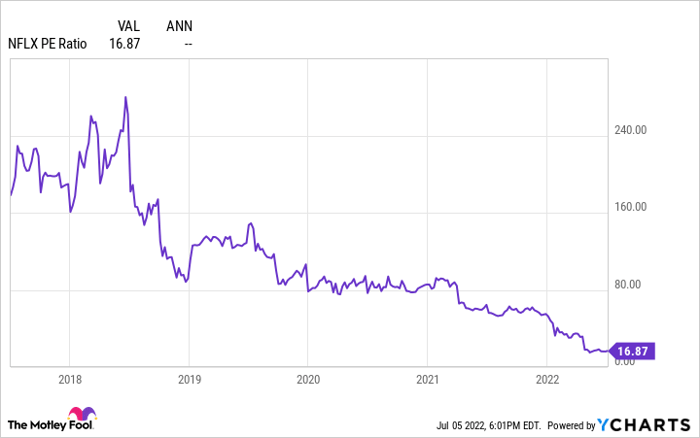
    NFLX PE Ratio Chart

    NFLX PE Ratio data by YCharts.

    Netflix stock is trading at a price-to-earnings (P/E) ratio of 16.9, which is the lowest in the last five years. Meanwhile, it was expected that growth would slow following the surge in subscriber additions at the onset of the pandemic that pulled a lot of growth forward. The economic reopening has created more options for what people can do with their time, and after being cooped up at home for more than a year, it’s understandable that they want to get out of the house and use less Netflix. 

    That change of pace by users should not be mistaken for a structural decrease in demand for Netflix’s services. For less than $20 per month, a family can get entertainment that can be accessed anywhere they can take a mobile device or have internet access. That excellent customer value proposition will likely fuel growth for several more years. 

    At Netflix’s scale, it was already good enough to deliver revenue of $29.7 billion and operating income of $6.2 billion in 2021. It has foundational economies of scale that rapidly expand profits with incremental revenue growth. That’s because it will cost Netflix roughly the same to show its content to 500 million subscribers as it does to 200 million.

    Amazon is built for growth thanks to strong moats 

    Keith Noonan: Amazon stock has fallen roughly 30% year to date and 39% from its lifetime high. With the company valued at roughly 2.3 times this year’s expected sales and 143 times expected earnings, it still has a much more growth-dependent valuation than Netflix. However, I also think it stands out as a better buy for long-term investors.

    With fuel and other shipping and logistics costs rising, Amazon’s e-commerce business is facing some major headwinds at the moment. Coupled with big investments in online-retail infrastructure and technology spending, current conditions are creating significant setbacks for profitability right now.

    However, Amazon Web Services continues to account for a greater portion of the company’s overall sales profile, and the business has a strong industry position and a fantastic net income margin. Despite rising expenses, Amazon’s e-commerce and cloud infrastructure segments look incredibly well-positioned for long-term growth, and competitors will have great difficulty disrupting the company’s dominant positions in these spheres. 

    Meanwhile, Netflix carries a lot of debt, and it looks like the business model that was formerly so successful for the company is no longer capable of delivering the kind of performance investors are looking for. While the streaming leader has undeniably created some big hits, it also seems to have pursued a quantity-over-quality approach to building out its library, and its content has lost some luster now that competitors are rapidly finding their footing in the streaming space. I wouldn’t be shocked to see Netflix stock bounce back from recent pricing lows, but the business doesn’t strike me as special anymore.

    So which is the better buy?

    When it comes to deciding between Amazon and Netflix, investors should probably start by deciding which business they think looks stronger and then balancing that assessment against growth expectations and valuation levels. If you’re looking for a more value-oriented stock with a less growth-dependent valuation, Netflix may prove to be the better buy. However, if you’re more concerned about long-term moats and market positioning, Amazon might be a better fit.

    This article was originally published on Fool.com. All figures quoted in US dollars unless otherwise stated.

    The post Better bear market buy: Netflix vs Amazon appeared first on The Motley Fool Australia.

    Wondering where you should invest $1,000 right now?

    When investing expert Scott Phillips has a stock tip, it can pay to listen. After all, the flagship Motley Fool Share Advisor newsletter he has run for over ten years has provided thousands of paying members with stock picks that have doubled, tripled or even more.* Scott just revealed what he believes could be the “five best ASX stocks” for investors to buy right now. These stocks are trading at near dirt-cheap prices and Scott thinks they could be great buys right now

    See The 5 Stocks *Returns as of July 7 2022

    (function() { function setButtonColorDefaults(param, property, defaultValue) { if( !param || !param.includes(‘#’)) { var button = document.getElementsByClassName(“pitch-snippet”)[0].getElementsByClassName(“pitch-button”)[0]; button.style[property] = defaultValue; } } setButtonColorDefaults(“#0095C8”, ‘background’, ‘#5FA85D’); setButtonColorDefaults(“#0095C8”, ‘border-color’, ‘#43A24A’); setButtonColorDefaults(“#fff”, ‘color’, ‘#fff’); })()

    More reading

    John Mackey, CEO of Whole Foods Market, an Amazon subsidiary, is a member of The Motley Fool’s board of directors. . Keith Noonan has no position in any of the stocks mentioned. Parkev Tatevosian has positions in Netflix. The Motley Fool Australia’s parent company Motley Fool Holdings Inc. has positions in and has recommended Amazon and Netflix. The Motley Fool Australia has recommended Amazon and Netflix. The Motley Fool has a disclosure policy. This article contains general investment advice only (under AFSL 400691). Authorised by Scott Phillips.

    This article was originally published on Fool.com. All figures quoted in US dollars unless otherwise stated.


    from The Motley Fool Australia https://ift.tt/fX20HiY