Tag: Motley Fool

  • Should investors dig the BHP share price in July?

    a sad looking engineer or miner wearing a high visibility jacket and a hard hat stands alone with his head bowed and hand to his forehead as he speaks on a mobile telephone out front of what appears to be an on site work shed.

    a sad looking engineer or miner wearing a high visibility jacket and a hard hat stands alone with his head bowed and hand to his forehead as he speaks on a mobile telephone out front of what appears to be an on site work shed.The BHP Group Ltd (ASX: BHP) share price closed 5.6% lower today and it’s down 8.5% in July so far. Is it time to be looking at BHP, and what’s the outlook for the company in July?

    As one of the world’s biggest resource businesses, changes in commodity prices can have a big impact on the company’s shorter-term profit prospects and investor sentiment.

    BHP’s commodity portfolio is a bit smaller after the company divested its oil and gas segment to Woodside Energy Group Ltd (ASX: WDS). As such, it’s not suffering from the collapse of the oil price right now amid concerns of the world entering into a recession.

    After that divestment, BHP has a portfolio comprising iron ore, copper, coal, and potash.

    But, some of these commodities aren’t doing so well either. The copper price is at a 19-month low while the iron ore price has fallen by more than US$20 per tonne since the start of June.

    Why do commodity prices matter for the BHP share price?

    BHP is a price-taker business. In other words, whatever price iron ore or copper are currently trading at is generally the price that BHP can sell its resources for.

    It typically costs BHP the same amount of money to extract the resource out of the ground, whether the commodity is priced $50 per tonne higher or $50 per tonne lower.

    If the costs are largely fixed, higher revenue can largely go straight to BHP’s net profit after tax (NPAT) in its financial accounts (except for things like company tax, which would rise too).

    Larger profits can also lead to big dividend payments as well.

    However, the reverse is true when resource prices fall. When commodity prices fall, it largely gets wiped off the NPAT. Dividends can quickly get reduced as well.

    So, getting back to the situation for the iron ore price – which is the key profit generator for BHP – the iron ore price has reduced 15% since the beginning of June to the mid-US$110s per tonne.

    What do brokers think of the BHP share price?

    While Macquarie’s pick of the major miners is BHP, it has just cut its profit expectations because of the lower commodity prices. Even so, Macquarie’s price target is $50, suggesting a possible rise of around 30% in the next year.

    Other brokers are less optimistic.

    For example, Morgan Stanley is ‘equal-weight’ on the business, which is similar to a ‘hold’ rating. Its price target is $40.05, suggesting a mid-single-digit rise.

    The broker Ord Minnett rates the business as ‘hold’ with a price target of $44. That implies a mid-teen rise for the ASX mining share. It notes the lower resource prices, which is why it reduced its price target slightly.

    The post Should investors dig the BHP share price in July? appeared first on The Motley Fool Australia.

    Should you invest $1,000 in Bhp Group Ltd right now?

    Before you consider Bhp Group Ltd, you’ll want to hear this.

    Motley Fool Investing expert Scott Phillips just revealed what he believes are the 5 best stocks for investors to buy right now… and Bhp Group Ltd wasn’t one of them.

    The online investing service he’s run for over a decade, Motley Fool Share Advisor, has provided thousands of paying members with stock picks that have doubled, tripled or even more.* And right now, Scott thinks there are 5 stocks that are better buys.

    See The 5 Stocks
    *Returns as of June 1 2022

    (function() {
    function setButtonColorDefaults(param, property, defaultValue) {
    if( !param || !param.includes(‘#’)) {
    var button = document.getElementsByClassName(“pitch-snippet”)[0].getElementsByClassName(“pitch-button”)[0];
    button.style[property] = defaultValue;
    }
    }

    setButtonColorDefaults(“#0095C8”, ‘background’, ‘#5FA85D’);
    setButtonColorDefaults(“#0095C8”, ‘border-color’, ‘#43A24A’);
    setButtonColorDefaults(“#fff”, ‘color’, ‘#fff’);
    })()

    More reading

    JPMorgan Chase is an advertising partner of The Ascent, a Motley Fool company. Motley Fool contributor Tristan Harrison has no position in any of the stocks mentioned. The Motley Fool Australia’s parent company Motley Fool Holdings Inc. has no position in any of the stocks mentioned. The Motley Fool Australia has recommended Macquarie Group Limited. The Motley Fool has a disclosure policy. This article contains general investment advice only (under AFSL 400691). Authorised by Scott Phillips.

    from The Motley Fool Australia https://ift.tt/Tcdhsji

  • Here’s why ASX renewable shares slipped in June

    A boy holds up a lamp shining dimly in the dark.A boy holds up a lamp shining dimly in the dark.

    ASX renewable energy shares incorporate a range of companies involved in producing clean energy sources.

    They span several sectors including resources, materials, and energy. Think lithium explorers, battery producers, electric vehicle manufacturers, clean energy providers… arguably, they’re all in the renewables space. But for now, let’s just focus on clean power producers.

    Power has been a hot topic in the Australian economy of late. Electricity prices have skyrocketed and are contributing significantly to rising inflation, which is currently running at 5.1% per annum.

    This problem highlights the urgent need for more renewable energy sources. Not only to lower power costs for consumers but also to support a lurching grid at risk of more frequent blackouts and outages.

    So, why did several ASX renewable energy shares fall in June?

    ASX renewable energy shares dip in June

    Well, let’s remember that ASX renewable shares are a relatively young and growing part of the market. And like any growth sector, it will have its ups and downs — and that’s what we saw in June.

    Mind you, June was a volatile month for ASX shares in general. The S&P/ASX 200 Index (ASX: XJO) lost 8.9% and the S&P/ASX All Ordinaries Index (ASX: XAO) lost 9.5% over the month.

    First up, let’s look at the broad picture.

    Clean energy shares generally form part of the utilities segment of the ASX energy sector. The S&P/ASX 200 Energy Index (ASX: XEJ) fell 0.3% in June and is up 16.9% over the year to date.

    There’s no index for ASX renewable shares, however, we can look to the VanEck Global Clean Energy ETF (ASX: CLNE) for guidance. It’s an exchange-traded fund trading on the ASX and it’s chock-a-block full of global renewable energy companies. So it serves as a good proxy for ASX renewable energy shares.

    The VanEck Global Clean Energy ETF share price dipped 2.5% in June. Year to date, it’s down 9.6%.

    Here’s how some of the big players performed

    Let’s look at the performance of the bigger players among ASX renewable energy shares in June.

    The Meridian Energy Ltd (ASX: MEZ) share price dropped 3% in June. Year to date, Meridian shares are down 6.5%.

    Meridian is New Zealand’s largest energy producer and uses 100% renewables. It owns five wind farms, scores of commercial solar arrays, and seven hydropower stations, including the country’s largest.

    The Mercury General Corporation (ASX: MCY) share price dropped 9.5% in June. Year to date, Mercury shares are down 16.5%.

    Mercury is another New Zealand-based green energy provider that uses 100% renewables. The company owns nine hydro stations that supply 10% of the country’s electricity annually. It owns five geothermal plants and four wind farms. It’s currently building what will be New Zealand’s largest wind farm.

    The Infratil Ltd (ASX: IFT) share price rose by 0.6% in June. Year to date, Infratil shares are down 7.7%.

    Infratil is a different kind of ASX renewable energy share. It’s an infrastructure investment company that owns several green energy assets in New Zealand.

    Genesis Energy Ltd (ASX: GNE) shares lost 0.15% in value in June. Year to date, Genesis shares are down 6.9%.

    Genesis is a leading New Zealand electricity and gas retailer that owns a bunch of thermal and renewable generation assets.

    Some ASX renewable shares had a shocker

    The Genex Power Ltd (ASX: GNX) share price dropped 14% in June. Year to date, Genex shares are down 32.5%.

    Genex is an Australian power generation company specialising in the generation and storage of renewable energy.

    Ongoing challenges for ASX renewable energy shares

    As my Fool colleague Bernd Struben reported in March, the renewables sector has experienced years of underinvestment, so it’s difficult to ramp up production rapidly to meet today’s soaring demand.

    Plus, many clean energy companies are spending a lot — as you do when you’re in growth mode — which is narrowing profit margins.

    And it appears ASX investors don’t like that, especially when a booming commodities cycle is delivering massive profits to the big resources companies digging fossil fuels out of the ground.

    The post Here’s why ASX renewable shares slipped in June appeared first on The Motley Fool Australia.

    Wondering where you should invest $1,000 right now?

    When investing expert Scott Phillips has a stock tip, it can pay to listen. After all, the flagship Motley Fool Share Advisor newsletter he has run for over ten years has provided thousands of paying members with stock picks that have doubled, tripled or even more.* Scott just revealed what he believes could be the “five best ASX stocks” for investors to buy right now. These stocks are trading at near dirt-cheap prices and Scott thinks they could be great buys right now

    See The 5 Stocks
    *Returns as of June 1 2022

    (function() {
    function setButtonColorDefaults(param, property, defaultValue) {
    if( !param || !param.includes(‘#’)) {
    var button = document.getElementsByClassName(“pitch-snippet”)[0].getElementsByClassName(“pitch-button”)[0];
    button.style[property] = defaultValue;
    }
    }

    setButtonColorDefaults(“#43B02A”, ‘background’, ‘#5FA85D’);
    setButtonColorDefaults(“#43B02A”, ‘border-color’, ‘#43A24A’);
    setButtonColorDefaults(“#fff”, ‘color’, ‘#fff’);
    })()

    More reading

    Motley Fool contributor Bronwyn Allen has no position in any of the stocks mentioned. The Motley Fool Australia’s parent company Motley Fool Holdings Inc. has no position in any of the stocks mentioned. The Motley Fool Australia has no position in any of the stocks mentioned. The Motley Fool has a disclosure policy. This article contains general investment advice only (under AFSL 400691). Authorised by Scott Phillips.

    from The Motley Fool Australia https://ift.tt/UjG6IpK

  • Why did the Lynas Rare Earths share price tumble in June?

    a man wearing a hard hat and a high visibility vest stands with his arms crossed in front of heavy equipment at a mine site.a man wearing a hard hat and a high visibility vest stands with his arms crossed in front of heavy equipment at a mine site.

    The Lynas Rare Earths Ltd (ASX: LYC) share price struggled in June, but it was not alone among S&P/ASX 200 Materials Index (ASX: XMJ) shares.

    Lynas shares shed more than 11% in June. At the close of trade on Wednesday, they have dropped another 5.12%, finishing the day at $8.53 each.

    So how did the Lynas Rare Earths share price perform in June?

    What happened in June?

    Lynas Rare Earths shares fell in June, but they were not alone within the sector. For perspective, the ASX 200 Materials Index slid more than 12% during the month.

    Lynas is mining the Mt Weld mine in Western Australia. The company touts it as one of the “world’s premier rare earths deposits”. Lynas also drives rare earths processing from the “world’s largest” processing plant in Malaysia.

    Investors appeared to sell down Lynas shares amid a wider market selloff in June, despite the company releasing some positive news.

    Multiple shares involved in battery technology for the electric vehicle (EV) market fell during the month. Lithium share Pilbara Minerals Ltd (ASX: PLS) descended 22% in June while metals miner IGO Ltd (ASX: IGO) lost 21%.

    In mid-June, Lynas USA, a subsidiary of the company, signed a US$120 million contract for a commercial rare earths separation facility.

    The contract provides an opportunity for Lynas to operate in the United States. The deal will complement the company’s light rare earth separation facility. It also involves working with the United States Department of Defense (DOD).

    And this agreement appears to be attracting attention from China. According to recent reports, Lynas has recently been subject to a pro-China social media campaign. It calls for protests against the company’s facility in Texas. The US DOD responded to this campaign, saying:

    The Department of Defense is aware of the recent disinformation campaign, first reported by Mandiant, against Lynas Rare Earth Ltd…the department has engaged the relevant interagency stakeholders and partner nations to assist in reviewing the matter.

    Lynas Rare Earths share price snapshot

    Lynas Rare Earth shares have gained around 50% in the past year, but they have dived 16% year to date.

    For perspective, the S&P/ASX 200 Index (ASX: XJO) has shed about 9% in a year.

    Lynas has a market capitalisation of about $7.7 billion based on today’s share price.

    The post Why did the Lynas Rare Earths share price tumble in June? appeared first on The Motley Fool Australia.

    Should you invest $1,000 in Lynas Rare Earths Ltd right now?

    Before you consider Lynas Rare Earths Ltd, you’ll want to hear this.

    Motley Fool Investing expert Scott Phillips just revealed what he believes are the 5 best stocks for investors to buy right now… and Lynas Rare Earths Ltd wasn’t one of them.

    The online investing service he’s run for over a decade, Motley Fool Share Advisor, has provided thousands of paying members with stock picks that have doubled, tripled or even more.* And right now, Scott thinks there are 5 stocks that are better buys.

    See The 5 Stocks
    *Returns as of June 1 2022

    (function() {
    function setButtonColorDefaults(param, property, defaultValue) {
    if( !param || !param.includes(‘#’)) {
    var button = document.getElementsByClassName(“pitch-snippet”)[0].getElementsByClassName(“pitch-button”)[0];
    button.style[property] = defaultValue;
    }
    }

    setButtonColorDefaults(“#43B02A”, ‘background’, ‘#5FA85D’);
    setButtonColorDefaults(“#43B02A”, ‘border-color’, ‘#43A24A’);
    setButtonColorDefaults(“#fff”, ‘color’, ‘#fff’);
    })()

    More reading

    Motley Fool contributor Monica O’Shea has no position in any of the stocks mentioned. The Motley Fool Australia’s parent company Motley Fool Holdings Inc. has no position in any of the stocks mentioned. The Motley Fool Australia has no position in any of the stocks mentioned. The Motley Fool has a disclosure policy. This article contains general investment advice only (under AFSL 400691). Authorised by Scott Phillips.

    from The Motley Fool Australia https://ift.tt/jF1DKAH

  • Telstra share price rises as Optus folds to inflation

    A female executive smiles as she carries out business on her mobile phone.

    A female executive smiles as she carries out business on her mobile phone.

    The Telstra Corporation Ltd (ASX: TLS) share price is on form on Wednesday.

    In afternoon trade, the telco giant’s shares are up 1.5% to $3.95.

    Why is the Telstra share price rising?

    The catalyst for the rise in the Telstra share price today appears to be news that Optus is lifting the prices of its legacy mobile plans.

    Optus has informed customers on its legacy $39/$49/$59 plans that pricing will increase $4 per month from 8 August to $43/$53/$63, respectively. The telco explained that the higher pricing was justified because of ongoing network investment and cost inflation.

    Why is this good news?

    Goldman Sachs highlights that this is good news for Telstra, which also announced price increases recently, because it “is another positive sign supporting a rational mobile market.”

    And while Optus has yet to increase its in-market pricing, the broker expects this to happen before the end of the year.

    Furthermore, although TPG Telecom Ltd (ASX: TPG) has not followed suit yet, Goldman isn’t overly surprised. This is because the ACCC is currently looking at its proposed Multi-Operator Core Network (MOCN) deal with Telstra.

    Goldman explained:

    We expect TPG will wait until early 2023 before making a decision. At this point its proposed MOCN deal with Telstra will have been implemented if successful (ACCC ruling due by 17th October), and the company will face the choice of targeting ARPU growth or market share. Commentary at its recent Investor Day was non-committal on this, which we see as unsurprising given the ongoing ACCC review.

    Are Telstra’s shares a buy?

    Goldman Sachs currently has a neutral rating on Telstra’s shares. However, with a price target of $4.30, this still implies potential upside of 9% for investors.

    And if you include dividends, the potential total return stretches to approximately 13% over the next 12 months.

    The post Telstra share price rises as Optus folds to inflation appeared first on The Motley Fool Australia.

    Wondering where you should invest $1,000 right now?

    When investing expert Scott Phillips has a stock tip, it can pay to listen. After all, the flagship Motley Fool Share Advisor newsletter he has run for over ten years has provided thousands of paying members with stock picks that have doubled, tripled or even more.* Scott just revealed what he believes could be the “five best ASX stocks” for investors to buy right now. These stocks are trading at near dirt-cheap prices and Scott thinks they could be great buys right now

    See The 5 Stocks
    *Returns as of June 1 2022

    (function() {
    function setButtonColorDefaults(param, property, defaultValue) {
    if( !param || !param.includes(‘#’)) {
    var button = document.getElementsByClassName(“pitch-snippet”)[0].getElementsByClassName(“pitch-button”)[0];
    button.style[property] = defaultValue;
    }
    }

    setButtonColorDefaults(“#0095C8”, ‘background’, ‘#5FA85D’);
    setButtonColorDefaults(“#0095C8”, ‘border-color’, ‘#43A24A’);
    setButtonColorDefaults(“#fff”, ‘color’, ‘#fff’);
    })()

    More reading

    Motley Fool contributor James Mickleboro has no position in any of the stocks mentioned. The Motley Fool Australia’s parent company Motley Fool Holdings Inc. has no position in any of the stocks mentioned. The Motley Fool Australia has positions in and has recommended Telstra Corporation Limited. The Motley Fool Australia has recommended TPG Telecom Limited. The Motley Fool has a disclosure policy. This article contains general investment advice only (under AFSL 400691). Authorised by Scott Phillips.

    from The Motley Fool Australia https://ift.tt/x1FD9UM

  • What Tesla’s production slowdown could mean for its stock

    This article was originally published on Fool.com. All figures quoted in US dollars unless otherwise stated.

    A family drives along the road with smiles on their faces.

    This article was originally published on Fool.com. All figures quoted in US dollars unless otherwise stated.

    Tesla (NASDAQ: TSLA) has grown to become the largest producer of electric vehicles (EVs) worldwide. It has always been a trailblazer, leading this new industry with its innovation not just inside each car but also in the manufacturing process.

    But 2022 has been challenging. The automotive industry is facing supply chain disruptions that have slowed production, and a brutal sell-off in the stock market has sent company valuations in the tech sector plunging. 

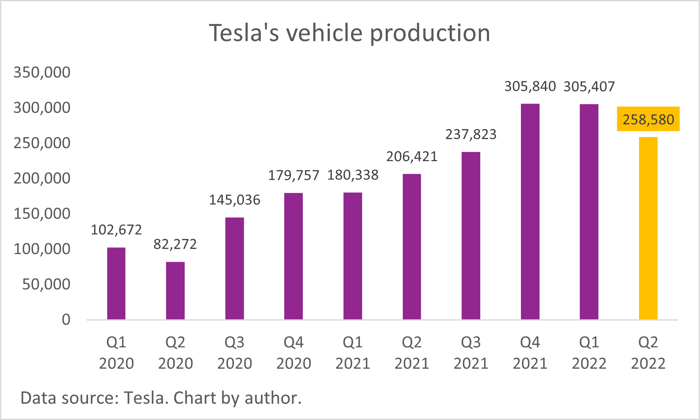
    Tesla just reported its production figures for the second quarter of 2022, and it revealed the largest sequential drop in two years. While this is a short-term speed bump, it shouldn’t alter the company’s long-term trajectory. 

    Tesla management is navigating tough times

    The automotive industry has grappled with shortages of key vehicle components like semiconductors since the pandemic began, as lockdowns across Europe and Asia caused production to grind to a halt. Semiconductors are advanced computer chips that power the digital features inside new cars, but in Tesla’s electric vehicles, they do far more.

    The infotainment system inside a Tesla is responsible for controlling many of the car’s core functions like charging and comfort, in addition to enabling the user to browse the internet and play games. It’s a step above the processing power required in a traditional combustion engine car, to the point that semiconductor giant Micron Technology has described electric vehicles as data centers on wheels.

    Tesla has navigated the chip shortage well, generating quarterly production growth for most of the past two years. But it was hit with a further challenge when its production facility in Shanghai, China, was shut down for the majority of April as part of COVID-related temporary closings. The facility has an annual manufacturing capacity of 450,000 vehicles, which is almost half of the company’s total capacity (until new factories in Texas, Berlin and Germany ramp up), so the downtime heavily impacted second-quarter output. 

    The slowdown at Tesla might be temporary

    When all was said and done, Tesla produced 258,580 vehicles in Q2, which was a 15% drop compared to Q1. But it was still 25% higher than the number of cars produced a year ago, in Q2 2021. 

    A chart of Tesla's quarterly vehicle production.


    In the commentary that accompanied the Q2 numbers, Tesla informed investors that June was actually its highest production month in the company’s history. It suggests two things: The Shanghai plant is nearly back in full swing, and supply chain issues (like chip shortages) are beginning to resolve.

    But it’s also attributable to the fact that Tesla’s two brand new gigafactories in the U.S. and Germany have begun to manufacture vehicles. Once they ramp up to full capacity, it’s expected that Tesla could produce 2 million cars every year, which is almost double the number it could make with its existing factories. 

    That’s a sign that the Q2 production slump might be a mere speed bump on the road to much, much higher numbers in the near future. Given Tesla stock is currently down 45% from its all-time high, this might be an opportunity for investors to build a position. For those deploying smaller amounts of capital, keep an eye out for the company’s stock split later this year.

    This article was originally published on Fool.com. All figures quoted in US dollars unless otherwise stated.

    The post What Tesla’s production slowdown could mean for its stock appeared first on The Motley Fool Australia.

    Should you invest $1,000 in Tesla Motors right now?

    Before you consider Tesla Motors, you’ll want to hear this. Motley Fool Investing expert Scott Phillips just revealed what he believes are the 5 best stocks for investors to buy right now… and Tesla Motors wasn’t one of them. The online investing service he’s run for over a decade, Motley Fool Share Advisor, has provided thousands of paying members with stock picks that have doubled, tripled or even more.* And right now, Scott thinks there are 5 stocks that are better buys.

    See The 5 Stocks *Returns as of June 1 2022

    (function() { function setButtonColorDefaults(param, property, defaultValue) { if( !param || !param.includes(‘#’)) { var button = document.getElementsByClassName(“pitch-snippet”)[0].getElementsByClassName(“pitch-button”)[0]; button.style[property] = defaultValue; } } setButtonColorDefaults(“#43B02A”, ‘background’, ‘#5FA85D’); setButtonColorDefaults(“#43B02A”, ‘border-color’, ‘#43A24A’); setButtonColorDefaults(“#fff”, ‘color’, ‘#fff’); })()

    More reading

    Anthony Di Pizio has no position in any of the stocks mentioned. The Motley Fool Australia’s parent company Motley Fool Holdings Inc. has positions in and has recommended Tesla. The Motley Fool Australia has no position in any of the stocks mentioned. The Motley Fool has a disclosure policy. This article contains general investment advice only (under AFSL 400691). Authorised by Scott Phillips.

    This article was originally published on Fool.com. All figures quoted in US dollars unless otherwise stated.


    from The Motley Fool Australia https://ift.tt/0aXHdfg
  • Why are ASX 200 bank shares responding positively to higher interest rates?

    Bank building with word Bank on it.Bank building with word Bank on it.

    Australian markets are rangebound today with tech and financial leading into afternoon trade.

    ASX 200 bank shares have been net-winners today, following news that the Reserve Bank (RBA) hiked the cash rate by 50 basis points to 1.35% on Tuesday.

    Investors have rallied the sector amid speculation the hikes may be passed immediately through to consumers.

    In broad market moves, the S&P/ASX 200 Index (ASX: XJO) is rangebound today.

    Tackling macroeconomic worries

    The rate increases are also hoped to compress the level of inflation, a common theme currently plaguing equity markets.

    “Global inflation is high,” the RBA said.

    “Monetary policy globally is responding to this higher inflation, although it will be some time yet before inflation returns to target in most countries,” it added.

    The size and timing of future interest rate increases will be guided by the incoming data and the Board’s assessment of the outlook for inflation and the labour market. The Board is committed to doing what is necessary to ensure that inflation in Australia returns to target over time.

    ASX 200 bank shares rise amid rate hikes

    In an effort to uphold net interest income (NII) and net interest margins (NIMs), the big Australian banks have folded the cash rate hikes into their lending rates.

    It wasn’t long after the RBA’s decision that the Commonwealth Bank of Australia (ASX: CBA) passed on the full 50 basis point increase to its standard variable mortgage rates.

    Macquarie Group Ltd (ASX: MQG) and Australia New Zealand Banking Group Ltd (ASX: ANZ) each passed through the 0.5% raise as well.

    CBA, Macquarie and ANZ are each up around 1% on the day at the time of writing.

    However, CBA and Macquarie have also passed on rate increases to their deposit rates. For example, CBA also fed the 50 basis point jump through to its GoalSaver and YouthSaver accounts.

    ANZ also followed suit and now offers a 2.5% rate of interest on an “advance notice” term deposit with an 11-month maturity.

    As a result of the shift in rates, investors have rallied ASX bank shares amid speculation the interest rate rises could be a net positive to NII and NIMs.

    Should that be the case, it would address the NIM issue that’s been festering amongst ASX bank shares for some time.

    The post Why are ASX 200 bank shares responding positively to higher interest rates? appeared first on The Motley Fool Australia.

    Wondering where you should invest $1,000 right now?

    When investing expert Scott Phillips has a stock tip, it can pay to listen. After all, the flagship Motley Fool Share Advisor newsletter he has run for over ten years has provided thousands of paying members with stock picks that have doubled, tripled or even more.* Scott just revealed what he believes could be the “five best ASX stocks” for investors to buy right now. These stocks are trading at near dirt-cheap prices and Scott thinks they could be great buys right now

    See The 5 Stocks
    *Returns as of June 1 2022

    (function() {
    function setButtonColorDefaults(param, property, defaultValue) {
    if( !param || !param.includes(‘#’)) {
    var button = document.getElementsByClassName(“pitch-snippet”)[0].getElementsByClassName(“pitch-button”)[0];
    button.style[property] = defaultValue;
    }
    }

    setButtonColorDefaults(“#43B02A”, ‘background’, ‘#5FA85D’);
    setButtonColorDefaults(“#43B02A”, ‘border-color’, ‘#43A24A’);
    setButtonColorDefaults(“#fff”, ‘color’, ‘#fff’);
    })()

    More reading

    Motley Fool contributor Zach Bristow has no position in any of the stocks mentioned. The Motley Fool Australia’s parent company Motley Fool Holdings Inc. has no position in any of the stocks mentioned. The Motley Fool Australia has recommended Macquarie Group Limited. The Motley Fool has a disclosure policy. This article contains general investment advice only (under AFSL 400691). Authorised by Scott Phillips.

    from The Motley Fool Australia https://ift.tt/CWKRvmx

  • How did the Santos share price perform in FY22?

    oil and gas worker in hard hard in front of oil and gas equipmentoil and gas worker in hard hard in front of oil and gas equipment

    The Santos Ltd (ASX: STO) share price had a turbulent year in FY22 and managed to finish in the green.

    Investors rallied behind commodity giants like Santos, particularly as the new year rolled around. On the last trading day of June, Santos shares were trading at $7.42 apiece.

    The company’s share price has taken a tumble since then. It’s down 5.88% so far today at $7.04.

    In broader market moves today, the S&P/ASX 300 Metals and Mining Index (ASX: XMM) is also down 5.42% on the back of falling commodity prices.

    Santos compounds upward in FY22

    The big story behind moves in the Santos share price is the tremendous rally in oil and gas markets that have ensued since the pandemic.

    In the 12 months of FY22, Brent Crude oil surged more than 45% to trade at US$109 per barrel on June 30.

    It nudged past US$123 per barrel back in March 2022, its highest level since 2014.

    Meanwhile, natural gas posted triple-digit returns in FY22 amid extreme volatility, particularly in European gas contracts.

    These moves are plotted against the Santos share price below.

    TradingView Chart

    The oil and gas trade was certainly active this past financial year with momentum picking up from February amid tensions in Europe.

    The bullish momentum in these commodity markets provided the perfect underlying conditions for the Santos share price to rally back near its pre-pandemic high.

    It topped $8.53 before entering a consolidation phase and levelling off toward the end of June.

    As such, the Santos share price had a successful FY22, rewarding shareholders in the process. It gained around 4% in that time.

    The post How did the Santos share price perform in FY22? appeared first on The Motley Fool Australia.

    Wondering where you should invest $1,000 right now?

    When investing expert Scott Phillips has a stock tip, it can pay to listen. After all, the flagship Motley Fool Share Advisor newsletter he has run for over ten years has provided thousands of paying members with stock picks that have doubled, tripled or even more.* Scott just revealed what he believes could be the “five best ASX stocks” for investors to buy right now. These stocks are trading at near dirt-cheap prices and Scott thinks they could be great buys right now

    See The 5 Stocks
    *Returns as of June 1 2022

    (function() {
    function setButtonColorDefaults(param, property, defaultValue) {
    if( !param || !param.includes(‘#’)) {
    var button = document.getElementsByClassName(“pitch-snippet”)[0].getElementsByClassName(“pitch-button”)[0];
    button.style[property] = defaultValue;
    }
    }

    setButtonColorDefaults(“#0095C8”, ‘background’, ‘#5FA85D’);
    setButtonColorDefaults(“#0095C8”, ‘border-color’, ‘#43A24A’);
    setButtonColorDefaults(“#fff”, ‘color’, ‘#fff’);
    })()

    More reading

    Motley Fool contributor Zach Bristow has no position in any of the stocks mentioned. The Motley Fool Australia’s parent company Motley Fool Holdings Inc. has no position in any of the stocks mentioned. The Motley Fool Australia has no position in any of the stocks mentioned. The Motley Fool has a disclosure policy. This article contains general investment advice only (under AFSL 400691). Authorised by Scott Phillips.

    from The Motley Fool Australia https://ift.tt/Hdsjq6I

  • Why did the AGL share price have a volatile FY22?

    A woman holds her finger to the side of her lips in contemplation as she looks upwards to an array of graphic images of light bulbs above her head, one of which is on and glowing., indicating the outlook for the AGL share price.A woman holds her finger to the side of her lips in contemplation as she looks upwards to an array of graphic images of light bulbs above her head, one of which is on and glowing., indicating the outlook for the AGL share price.

    The AGL Energy Limited (ASX: AGL) share price went on a rollercoaster ride during the 2022 financial year.

    The energy company’s shares finished at $8.20 on 30 June 2021 and closed at $8.25 the same time this year. However, there were steep declines in between, trading as low as $5.10 during November 2021.

    In contrast, the S&P/ASX 200 Index (ASX: XJO) crashed around 10% over the same period.

    Share prices of AGL’s competitors, Meridian Energy Ltd (ASX: MEZ) and Infratil Ltd (ASX: IFT) backtracked 16% and 2%, respectively.

    What happened to AGL shares throughout FY22?

    Australia’s largest electricity provider had a busy year in FY22 with the proposed demerger that was eventually scrapped in May.

    After reaching around the $8 mark in July 2021, AGL shares came under severe selling pressure in the following months. This came from difficult conditions of the national electricity market as well as unstable electricity prices.

    Management noted the disappointing AGL share price performance as the demand for decarbonisation increased.

    It’s worth noting that the company is one of the largest carbon emitters in Australia.

    Furthermore, the Liddell coal-fired power station caused a financial strain on AGL’s books. It plans to transform the site with a hydro and solar energy facility after Liddell’s shutdown in 2023.

    Fast forward to March 2022, AGL shares made a stunning turnaround after receiving an improved takeover offer from the Brookfield Consortium.

    Although, this was soon rejected by the board as it believed the $8.25 per share offer undervalued the company.

    Nonetheless, AGL shares continued to surge as investors closed their short positions following an uptick in energy prices.

    More recently, the company ditched its demerger plans on the likelihood of being rejected for splitting into two separate businesses.

    This led AGL shares to trade sideways before retracing due to fears regarding a potential recession in 2023.

    AGL share price snapshot

    A challenging year brought many twists and turns for the AGL share price.

    While relatively unchanged since this time last year, in 2022, its shares have produced strong returns, up 35%.

    At the time of writing, AGL shares are swapping hands at $8.26, down 1.08% for the day.

    The company has a price-to-earnings (P/E) ratio of 6.78 and commands a market capitalisation of roughly $5.62 billion.

    The post Why did the AGL share price have a volatile FY22? appeared first on The Motley Fool Australia.

    Wondering where you should invest $1,000 right now?

    When investing expert Scott Phillips has a stock tip, it can pay to listen. After all, the flagship Motley Fool Share Advisor newsletter he has run for over ten years has provided thousands of paying members with stock picks that have doubled, tripled or even more.* Scott just revealed what he believes could be the “five best ASX stocks” for investors to buy right now. These stocks are trading at near dirt-cheap prices and Scott thinks they could be great buys right now

    See The 5 Stocks
    *Returns as of June 1 2022

    (function() {
    function setButtonColorDefaults(param, property, defaultValue) {
    if( !param || !param.includes(‘#’)) {
    var button = document.getElementsByClassName(“pitch-snippet”)[0].getElementsByClassName(“pitch-button”)[0];
    button.style[property] = defaultValue;
    }
    }

    setButtonColorDefaults(“#0095C8”, ‘background’, ‘#5FA85D’);
    setButtonColorDefaults(“#0095C8”, ‘border-color’, ‘#43A24A’);
    setButtonColorDefaults(“#fff”, ‘color’, ‘#fff’);
    })()

    More reading

    Motley Fool contributor Aaron Teboneras has no position in any of the stocks mentioned. The Motley Fool Australia’s parent company Motley Fool Holdings Inc. has no position in any of the stocks mentioned. The Motley Fool Australia has no position in any of the stocks mentioned. The Motley Fool has a disclosure policy. This article contains general investment advice only (under AFSL 400691). Authorised by Scott Phillips.

    from The Motley Fool Australia https://ift.tt/efULTD0

  • Why did the Nearmap share price tumble 17% in June?

    A paper plane crashed in sand.A paper plane crashed in sand.

    The Nearmap Ltd (ASX: NEA) share price struggled in June, closing the month down 16.9%.

    Nearmap shares finished May trading at $1.24 per share and had slid to $1.03 by 30 June.

    The decline was significantly more than the 9.5% losses posted by the All Ordinaries Index (ASX: XAO) in June and the 10.4% loss on the S&P/ASX All Technology Index (ASX: XTX).

    Why was the aerial mapping company sold off in June?

    Though the Nearmap share price fell harder than many tech shares, it’s worth noting that the NASDAQ also slipped 8.7% in June.

    Nearmap certainly will have felt the same pressures that saw the broader technology sector sell off last month, namely soaring inflation figures and fast-rising interest rates. With the markets pricing in a series of sharp rate hikes ahead yet.

    That’s put particular pressure on companies like Nearmap, which are priced with future growth in mind. As the present cost of money goes up, awaiting those future earnings gets pricier.

    The Nearmap share price also looks to have gotten some continuing headwinds from a lawsuit in the United States. Eagle View Technologies and Pictometry International Corp allege the Aussie company has infringed on their patents. While Nearmap is defending its position, analysts have taken note.

    Speaking to The Motley Fool’s Tony Yoo in June, U Ethical chief investment officer Jon Fernie cited the lawsuit along with increased competition as likely to drag on Nearmap:

    We think the company’s small, but also I think it’s facing increased competition in that aerial mapping space. It continues to be a loss-making business. It’s going to require a lot of ongoing investment, and they’re also facing some legal action from a competitor.

    Nearmap share price snapshot

    The Nearmap share price is down 21% year to date, compared to a loss of 14% posted by the All Ordinaries.

    Longer-term, Nearmap shares remain up 82% over five years and up 1,639% since the beginning of 2013.

    The post Why did the Nearmap share price tumble 17% in June? appeared first on The Motley Fool Australia.

    Wondering where you should invest $1,000 right now?

    When investing expert Scott Phillips has a stock tip, it can pay to listen. After all, the flagship Motley Fool Share Advisor newsletter he has run for over ten years has provided thousands of paying members with stock picks that have doubled, tripled or even more.* Scott just revealed what he believes could be the “five best ASX stocks” for investors to buy right now. These stocks are trading at near dirt-cheap prices and Scott thinks they could be great buys right now

    See The 5 Stocks
    *Returns as of June 1 2022

    (function() {
    function setButtonColorDefaults(param, property, defaultValue) {
    if( !param || !param.includes(‘#’)) {
    var button = document.getElementsByClassName(“pitch-snippet”)[0].getElementsByClassName(“pitch-button”)[0];
    button.style[property] = defaultValue;
    }
    }

    setButtonColorDefaults(“#43B02A”, ‘background’, ‘#5FA85D’);
    setButtonColorDefaults(“#43B02A”, ‘border-color’, ‘#43A24A’);
    setButtonColorDefaults(“#fff”, ‘color’, ‘#fff’);
    })()

    More reading

    Motley Fool contributor Bernd Struben has no position in any of the stocks mentioned. The Motley Fool Australia’s parent company Motley Fool Holdings Inc. has positions in and has recommended Nearmap Ltd. The Motley Fool Australia has positions in and has recommended Nearmap Ltd. The Motley Fool has a disclosure policy. This article contains general investment advice only (under AFSL 400691). Authorised by Scott Phillips.

    from The Motley Fool Australia https://ift.tt/uJfEj19

  • Why is the Nanosonics share price jumping 10% on Wednesday?

    Three businesspeople leap high with the CBD in the background.

    Three businesspeople leap high with the CBD in the background.The Nanosonics Ltd (ASX: NAN) share price is having a very strong day on Wednesday.

    In afternoon trade, the infection prevention company’s shares are up over 10% to $3.96.

    What’s going on with the Nanosonics share price?

    Investors have been bidding the Nanosonics share price higher today despite there being no news out of the company.

    However, it is worth highlighting that the healthcare sector is performing strongly today, as are a range of beaten down shares.

    In respect to the former, in afternoon trade the S&P/ASX 200 Health Care index is up a sizeable 2%. That’s despite the ASX 200 index trading 0.5% at the time of writing.

    As for the latter, a number of beaten down ASX shares are recording double digit gains on Wednesday. This includes the likes of Life360 Inc (ASX: 360), Megaport Ltd (ASX: MP1), Mesoblast limited (ASX: MSB), and Zip Co Ltd (ASX: ZIP).

    Some investors appear to believe that the selling has been overdone and now is the time to pounce.

    Anything else?

    Nanosonics is one of the most shorted shares on the Australian share market. At the last count, the company had over 12% of its shares in the hands of short sellers.

    If some short sellers have decided to close positions, then they could be boosting the buy side by buying shares today.

    Whatever the reason, with the Nanosonics share price still down ~40% in 2022, shareholders will no doubt be hoping there are more strong gains to come.

    The post Why is the Nanosonics share price jumping 10% on Wednesday? appeared first on The Motley Fool Australia.

    Should you invest $1,000 in Nanosonics Ltd. right now?

    Before you consider Nanosonics Ltd., you’ll want to hear this.

    Motley Fool Investing expert Scott Phillips just revealed what he believes are the 5 best stocks for investors to buy right now… and Nanosonics Ltd. wasn’t one of them.

    The online investing service he’s run for over a decade, Motley Fool Share Advisor, has provided thousands of paying members with stock picks that have doubled, tripled or even more.* And right now, Scott thinks there are 5 stocks that are better buys.

    See The 5 Stocks
    *Returns as of June 1 2022

    (function() {
    function setButtonColorDefaults(param, property, defaultValue) {
    if( !param || !param.includes(‘#’)) {
    var button = document.getElementsByClassName(“pitch-snippet”)[0].getElementsByClassName(“pitch-button”)[0];
    button.style[property] = defaultValue;
    }
    }

    setButtonColorDefaults(“#43B02A”, ‘background’, ‘#5FA85D’);
    setButtonColorDefaults(“#43B02A”, ‘border-color’, ‘#43A24A’);
    setButtonColorDefaults(“#fff”, ‘color’, ‘#fff’);
    })()

    More reading

    Motley Fool contributor James Mickleboro has positions in Life360, Inc. The Motley Fool Australia’s parent company Motley Fool Holdings Inc. has positions in and has recommended Life360, Inc., MEGAPORT FPO, Nanosonics Limited, and ZIPCOLTD FPO. The Motley Fool Australia has positions in and has recommended Nanosonics Limited. The Motley Fool Australia has recommended MEGAPORT FPO. The Motley Fool has a disclosure policy. This article contains general investment advice only (under AFSL 400691). Authorised by Scott Phillips.

    from The Motley Fool Australia https://ift.tt/14U9Kfh