Tag: Motley Fool

  • What did the SEC just say about Bitcoin?

    A young woman lifts her glasses with one hand as she takes a closer look at the news that the US SEC is ready to label Bitcoin a commodityA young woman lifts her glasses with one hand as she takes a closer look at the news that the US SEC is ready to label Bitcoin a commodity

    Bitcoin (CRYTPO: BTC), the world’s top crypto by market cap, hasn’t exactly joined the commodity super cycle in 2022.

    While most soft and hard commodities have soared this calendar year, this virtual commodity is down 56% since 1 January, currently trading for US$20,716.

    Bitcoin is a commodity?

    You may not have heard the world’s top crypto referred to as a commodity before.

    But that’s how the United States Securities and Exchange Commission (SEC) chairman Gary Gensler labelled the token last night.

    Speaking on CNBC’s Squawk Box, Gensler said that Bitcoin was the only crypto the SEC was ready to label a commodity as opposed to a security.

    That’s a crucial distinction.

    Under US regulations, the SEC oversees securities and companies must observe strict disclosure regimes. Issuers must register with the SEC before any securities can be sold.

    Commodities trading is also regulated, but under a different regime overseen by the Commodity Futures Trading Commission (CFTC).

    Gensler reiterated the need for more regulatory oversight and clarity in crypto trading. He said, “There’s a lot of risk in crypto, but there’s also risk in classic securities markets.”

    He said that many cryptos display the same attributes as securities.

    Gensler noted:

    The investing public is hoping for a return just like when they invest in other financial assets we call securities. Many of these … crypto financial assets have the key attributes of a security.

    Gensler wouldn’t be drawn into extending the commodity label to other tokens beyond Bitcoin. “That’s the only one I’m going to say,” he told CNBC.

    He added that the SEC and CFTC are “two great market regulators in this country”. He said they can cooperate to increase transparency and protect investors in cryptocurrencies.

    Why have cryptos come under pressure?

    Bitcoin and almost every major altcoin are deep in the red in 2022.

    While there have been a few headwinds, the biggest driver impacting crypto prices has been the new environment of high inflation and fast-rising interest rates.

    Bitcoin has been trading much like other risk assets, such as high-growth ASX tech shares.

    The same forces impacting crypto prices have seen the tech-heavy NASDAQ fall 27% year to date as investors reweight their holdings.

    The post What did the SEC just say about Bitcoin? appeared first on The Motley Fool Australia.

    Wondering where you should invest $1,000 right now?

    When investing expert Scott Phillips has a stock tip, it can pay to listen. After all, the flagship Motley Fool Share Advisor newsletter he has run for over ten years has provided thousands of paying members with stock picks that have doubled, tripled or even more.* Scott just revealed what he believes could be the “five best ASX stocks” for investors to buy right now. These stocks are trading at near dirt-cheap prices and Scott thinks they could be great buys right now

    See The 5 Stocks
    *Returns as of June 1 2022

    (function() {
    function setButtonColorDefaults(param, property, defaultValue) {
    if( !param || !param.includes(‘#’)) {
    var button = document.getElementsByClassName(“pitch-snippet”)[0].getElementsByClassName(“pitch-button”)[0];
    button.style[property] = defaultValue;
    }
    }

    setButtonColorDefaults(“#0095C8”, ‘background’, ‘#5FA85D’);
    setButtonColorDefaults(“#0095C8”, ‘border-color’, ‘#43A24A’);
    setButtonColorDefaults(“#fff”, ‘color’, ‘#fff’);
    })()

    More reading

    Motley Fool contributor Bernd Struben has no position in any of the stocks mentioned. The Motley Fool Australia’s parent company Motley Fool Holdings Inc. has positions in and has recommended Bitcoin. The Motley Fool Australia has positions in and has recommended Bitcoin. The Motley Fool has a disclosure policy. This article contains general investment advice only (under AFSL 400691). Authorised by Scott Phillips.

    from The Motley Fool Australia https://ift.tt/ej1RBK9

  • 2 monster Warren Buffett stock-split stocks to buy right now

    This article was originally published on Fool.com. All figures quoted in US dollars unless otherwise stated.

    warren buffett

    This article was originally published on Fool.com. All figures quoted in US dollars unless otherwise stated.

    Legendary investor Warren Buffett may not be a fan of stock splits when it comes to some stock classes of his own company, Berkshire Hathaway, but several notable names have been going down this route recently.

    A split reduces the dollar value of a company’s stock and leads to an increase in the number of outstanding shares — a purely cosmetic move as it doesn’t do anything to boost the intrinsic value of a company. However, companies sometimes turn to stock splits to make the shares more attractive to a larger pool of retail investors. It is believed that the increased accessibility following a split can boost the retail demand for a company’s shares, and thereby lead to an increase in the stock price.

    Warren Buffett’s top holding, Apple (NASDAQ: AAPL), executed a stock split in August 2020. Amazon (NASDAQ: AMZN) is another Warren Buffett holding whose stock split went into effect on June 6. Investors can still buy these stock-split plays from Warren Buffett’s portfolio at attractive valuations right now. Let’s see why that could turn out to be a smart long-term move.

    1. Apple

    Apple’s 4-for-1 stock split was executed on Aug. 28, 2020. Shares of the tech giant have gained only 12% since then, barely outperforming the S&P 500.

    AAPL Chart

    AAPL data by YCharts

    Apple’s weak returns can be attributed to the broader stock market sell-off this year. However, this also means that investors who missed buying the stock after its split can still buy it at an attractive valuation following its pullback. Apple currently sports a price-to-earnings (P/E) ratio of 22.4. For comparison, it was trading at over 40 times trailing earnings at the end of 2020.

    Buying Apple at this valuation looks like a no-brainer, as the company has multiple catalysts that could send the stock higher in the long run. These growth drivers include the iPhone, the services business, and Apple’s potential entry into emerging technologies such as headsets and self-driving cars.

    The iPhone, for instance, is dominating the fast-growing 5G smartphone market. Strategy Analytics estimates that Apple cornered a 31% share of the 5G smartphone market last year. More importantly, Apple is also enjoying robust pricing power thanks to the adoption of 5G smartphones.

    That’s evident from the 14% increase in the average selling price (ASP) of the iPhone last year to $825. This was well ahead of the global smartphone ASP of $322. What’s more, Apple managed to boost its iPhone ASP despite increasing its share in price-sensitive emerging markets such as India, Brazil, Vietnam, and Thailand.

    According to a third-party estimate, the global 5G smartphone market could clock annual growth of 123% through 2027. So it wouldn’t be surprising to see the iPhone drive impressive growth for Apple in the long run thanks to a mix of higher volumes and healthy pricing driven by the rapid growth of the 5G smartphone market.

    Additionally, Apple’s rumored entry into potentially lucrative markets such as autonomous cars could substantially boost the company’s revenue and stock price. So investors who haven’t bought Apple following its split still have an opportunity to do so — it is cheap right now and is sitting on solid catalysts that could supercharge this tech stock in the long run.

    2. Amazon

    Amazon stock has headed south since splitting earlier this month. It is now trading at 54 times trailing earnings, which, though expensive, is lower than its five-year average multiple of 121.

    Amazon stock’s decline following the split is a blessing in disguise for investors looking to buy a growth stock. After all, the company is expected to clock annual earnings growth of 40% for the next five years, which isn’t surprising given the opportunities in the e-commerce and cloud computing markets.

    Amazon is expected to generate $525 billion in revenue this year, which would be a 12% jump over 2021. The company’s growth rate is expected to pick up the pace in 2023, with revenue expected to jump an estimated 17% to $613 billion and adjusted earnings anticipated to more than triple to $2.71 per share. Even better, Amazon is expected to sustain its growth trajectory in 2024 as well, as evident from the chart below.

    AMZN Revenue Estimates for 2 Fiscal Years Ahead Chart

    AMZN Revenue Estimates for 2 Fiscal Years Ahead data by YCharts

    Amazon could sustain its impressive growth for a much longer time. E-commerce, which is Amazon’s biggest business with 84% of its top line, is set for secular long-term growth. According to a third-party estimate, global e-commerce sales could more than quadruple by 2030 to $17.5 trillion, compared to $4.2 trillion in 2020.

    Amazon is a key player in several e-commerce hotspots around the globe, so the company is in a nice position to capitalize on this market’s expansion. Meanwhile, Amazon built a solid position for itself in the cloud computing market, pulling well ahead of competitors with a market share of 33%. This points toward yet another enticing opportunity for Amazon to clock incremental revenue growth, as the global cloud computing market is expected to more than double in revenue by 2026 compared to last year’s levels according to third-party estimates.

    So even though Amazon’s stock may not have taken off following its split, investors shouldn’t miss the bigger picture, as its two big growth drivers could lead to healthy upside in the long run.

    This article was originally published on Fool.com. All figures quoted in US dollars unless otherwise stated.

    The post 2 monster Warren Buffett stock-split stocks to buy right now appeared first on The Motley Fool Australia.

    Wondering where you should invest $1,000 right now?

    When investing expert Scott Phillips has a stock tip, it can pay to listen. After all, the flagship Motley Fool Share Advisor newsletter he has run for over ten years has provided thousands of paying members with stock picks that have doubled, tripled or even more.* Scott just revealed what he believes could be the “five best ASX stocks” for investors to buy right now. These stocks are trading at near dirt-cheap prices and Scott thinks they could be great buys right now

    See The 5 Stocks *Returns as of June 1 2022

    (function() { function setButtonColorDefaults(param, property, defaultValue) { if( !param || !param.includes(‘#’)) { var button = document.getElementsByClassName(“pitch-snippet”)[0].getElementsByClassName(“pitch-button”)[0]; button.style[property] = defaultValue; } } setButtonColorDefaults(“#43B02A”, ‘background’, ‘#5FA85D’); setButtonColorDefaults(“#43B02A”, ‘border-color’, ‘#43A24A’); setButtonColorDefaults(“#fff”, ‘color’, ‘#fff’); })()

    More reading

    John Mackey, CEO of Whole Foods Market, an Amazon subsidiary, is a member of The Motley Fool’s board of directors. Harsh Chauhan has no position in any of the stocks mentioned. The Motley Fool Australia’s parent company Motley Fool Holdings Inc. has positions in and has recommended Amazon, Apple, and Berkshire Hathaway (B shares). The Motley Fool Australia’s parent company Motley Fool Holdings Inc. has recommended the following options: long January 2023 $200 calls on Berkshire Hathaway (B shares), long March 2023 $120 calls on Apple, short January 2023 $200 puts on Berkshire Hathaway (B shares), short January 2023 $265 calls on Berkshire Hathaway (B shares), and short March 2023 $130 calls on Apple. The Motley Fool Australia has recommended Amazon, Apple, and Berkshire Hathaway (B shares). The Motley Fool has a disclosure policy. This article contains general investment advice only (under AFSL 400691). Authorised by Scott Phillips.

    This article was originally published on Fool.com. All figures quoted in US dollars unless otherwise stated.


    from The Motley Fool Australia https://ift.tt/a5EpNwR
  • Macquarie share price slips amid move to fortify war chest by $400 million

    A man thinks very carefully about his money and investments.

    A man thinks very carefully about his money and investments.The Macquarie Group Ltd (ASX: MQG) share price has edged into the red this morning.

    At the time of writing, the investment bank’s shares are down almost 0.5% to $165.63.

    What’s happening with the Macquarie share price today?

    Today’s pullback in the Macquarie share price appears to be largely due to weakness in the banking sector this morning.

    All the big four banks are trading lower currently following a soft night for financials on Wall Street.

    Capital notes offer

    Also potentially weighing on the Macquarie share price today is news that the investment bank is raising funds.

    According to an announcement, the company intends to raise $400 million, with the ability to raise more or less, through the offer of capital notes.

    These are being issued at $100 per note and will pay distributions on a quarterly basis in arrears commencing on 12 September. The distribution rate is based on a reference rate plus the margin, adjusted for franking. The margin will be determined under a bookbuild but is expected to be between 3.7% and 3.9%.

    Management advised that the offer is consistent with Macquarie’s strategy to actively manage its capital mix and maintain diverse sources of funding. The net proceeds of the offer will be used for general corporate purposes.

    Are Macquarie’s shares in the buy zone?

    Analysts at Morgans see a lot of value in the Macquarie share price at the current level.

    The broker currently has an add rating and $215.00 price target on the company’s shares. This implies potential upside of almost 30% for investors over the next 12 months.

    It commented:

    We continue to like MQG’s exposure to long-term structural growth areas such as infrastructure and renewables. The company also stands to benefit from recent market volatility through its trading businesses, while the company continues to gain market share in Australian mortgages.

    The post Macquarie share price slips amid move to fortify war chest by $400 million appeared first on The Motley Fool Australia.

    Wondering where you should invest $1,000 right now?

    When investing expert Scott Phillips has a stock tip, it can pay to listen. After all, the flagship Motley Fool Share Advisor newsletter he has run for over ten years has provided thousands of paying members with stock picks that have doubled, tripled or even more.* Scott just revealed what he believes could be the “five best ASX stocks” for investors to buy right now. These stocks are trading at near dirt-cheap prices and Scott thinks they could be great buys right now

    See The 5 Stocks
    *Returns as of June 1 2022

    (function() {
    function setButtonColorDefaults(param, property, defaultValue) {
    if( !param || !param.includes(‘#’)) {
    var button = document.getElementsByClassName(“pitch-snippet”)[0].getElementsByClassName(“pitch-button”)[0];
    button.style[property] = defaultValue;
    }
    }

    setButtonColorDefaults(“#43B02A”, ‘background’, ‘#5FA85D’);
    setButtonColorDefaults(“#43B02A”, ‘border-color’, ‘#43A24A’);
    setButtonColorDefaults(“#fff”, ‘color’, ‘#fff’);
    })()

    More reading

    Motley Fool contributor James Mickleboro has no position in any of the stocks mentioned. The Motley Fool Australia’s parent company Motley Fool Holdings Inc. has no position in any of the stocks mentioned. The Motley Fool Australia has recommended Macquarie Group Limited. The Motley Fool has a disclosure policy. This article contains general investment advice only (under AFSL 400691). Authorised by Scott Phillips.

    from The Motley Fool Australia https://ift.tt/d4iIEHp

  • BWX share price sinks 38% following capital raising at dizzying discount

    man bending over to look at red arrow crashing down through the groundman bending over to look at red arrow crashing down through the ground

    The BWX Ltd (ASX: BWX) share price has come out of a trading halt to plummet during mid-morning trade.

    This comes after the company announced an FY22 trading update as well as a capital raise to reduce its debt.

    At the time of writing, the personal care products company’s shares are fetching for 72.5 cents, down 38.03%.

    What’s driving the BWX share price lower?

    Investors are scrambling to sell BWX shares after an impending share dilution from the company.

    According to the release, BWX advised it has launched a fully underwritten $23.2 million capital raise.

    The details consist of a $13.5 million placement to sophisticated and professional investors and a $9.7 million non-renounceable entitlement offer.

    Listed at a price of 60 cents apiece, this represents a 48.7% discount to last closing price of $1.17 on 23 June 2022.

    Approximately 38.6 million new fully paid ordinary shares in BWX are set to be issued under the offer. This accounts for around 24% of the company’s existing ordinary shares on issue.

    The proceeds will support BWX’s business operations as well as accelerate its “debt reduction towards more conservative leverage ratios.”

    Pro-forma net debt as at 30 June 2022 is expected to be between $58-62 million (following the net proceeds received).

    FY22 trading update

    Furthermore, BWX provided a FY22 trading update in regards to its revenue and earnings guidance.

    Management is forecasting underlying revenue to tip $212 million, up 9% from the $194.3 million achieved in FY21.

    However, underlying EBITDA is expected to come in the range of $12-$16 million, down 59% from $34.5 million in FY21.

    Looking further ahead, BWX’s financial metrics is predicted to greatly change in FY23.

    The business is forecasting revenue to be roughly $260-$270 million, and EBITDA to come in between $45-$49 million.

    The BWX share price has fallen by more than 86% over the past 12 months, and is down 84% year-to-date.

    The post BWX share price sinks 38% following capital raising at dizzying discount appeared first on The Motley Fool Australia.

    Wondering where you should invest $1,000 right now?

    When investing expert Scott Phillips has a stock tip, it can pay to listen. After all, the flagship Motley Fool Share Advisor newsletter he has run for over ten years has provided thousands of paying members with stock picks that have doubled, tripled or even more.* Scott just revealed what he believes could be the “five best ASX stocks” for investors to buy right now. These stocks are trading at near dirt-cheap prices and Scott thinks they could be great buys right now

    See The 5 Stocks
    *Returns as of June 1 2022

    (function() {
    function setButtonColorDefaults(param, property, defaultValue) {
    if( !param || !param.includes(‘#’)) {
    var button = document.getElementsByClassName(“pitch-snippet”)[0].getElementsByClassName(“pitch-button”)[0];
    button.style[property] = defaultValue;
    }
    }

    setButtonColorDefaults(“#0095C8”, ‘background’, ‘#5FA85D’);
    setButtonColorDefaults(“#0095C8”, ‘border-color’, ‘#43A24A’);
    setButtonColorDefaults(“#fff”, ‘color’, ‘#fff’);
    })()

    More reading

    Motley Fool contributor Aaron Teboneras has no position in any of the stocks mentioned. The Motley Fool Australia’s parent company Motley Fool Holdings Inc. has no position in any of the stocks mentioned. The Motley Fool Australia has recommended BWX Limited. The Motley Fool has a disclosure policy. This article contains general investment advice only (under AFSL 400691). Authorised by Scott Phillips.

    from The Motley Fool Australia https://ift.tt/0Vkjxfa

  • Sniffing out an opportunity: Why I think the Dusk share price could be a buy

    Two pink pillar candles lit and shown with a pink background indicating rosy news for the Dusk share priceTwo pink pillar candles lit and shown with a pink background indicating rosy news for the Dusk share price

    The Dusk Group Ltd (ASX: DSK) share price has dropped heavily in 2022 — it’s down almost 50%.

    Investors should certainly take the potential impacts of inflation and higher interest rates into account. But I believe the Dusk share price has fallen too far and could be an opportunity.

    If you haven’t heard of Dusk before, let me outline what it does.

    Dusk describes itself as a specialty retailer of home fragrance products. It offers a range of Dusk-branded “quality products at competitive prices” from its physical stores and online store.

    The company claims to be Australia’s leading home fragrance, omni-channel retailer.

    Some of the things it sells include candles, ultrasonic diffusers, reed diffusers, and essential oils, as well as fragrance-related homewares.

    What’s attractive about the Dusk share price?

    For starters, Dusk shares are now a lot cheaper than they were before. A 50% drop is very large. Is its current and future value really worth 50% less than it was at the start of the year?

    Using the estimates on CMC, the business is projected to generate earnings per share (EPS) of 27 cents in FY22 (which has nearly finished), 19.7 cents in FY23, and 22.4 cents in FY24.

    That means it’s valued at less than seven times FY22 estimated earnings, less than nine times FY23 estimated earnings, and less than eight times FY23 estimated earnings.

    A low price/earnings (P/E) ratio doesn’t automatically mean great value. But I think when combined with some of the other things I’m going to write about, it will explain why I see Dusk as attractive.

    The company’s cash level is an important part of the valuation, in my opinion.

    According to the ASX, Dusk has a market capitalisation of $107 million. At the end of the FY22 first half, it had $33.3 million of net cash. So, almost a third of the Dusk valuation is backed by cash. The P/E looks even cheaper when taking the cash into account.

    What is Dusk doing to grow its earnings?

    While sales may move up and down over shorter-term periods, I think the company is doing the right things to try to grow earnings in the future, which will hopefully help the Dusk share price.

    For example, it’s growing its store network. At HY22, it finished with 128 stores, which was an increase of six stores.

    It’s also trying to grow its Dusk rewards active members, who pay to join. These members generated 62% of total company sales in the FY22 first half.

    Online sales continue to grow, which could be important to connect with customers as more shopping is done online.

    In the first eight weeks of the second half of FY22, online sales were up 19.4% year over year. They were also up 121.8% over a two-year period.

    Dividends of 12.5% for FY23 and 14.4% for FY24

    The Dusk share price is cheap in relation to its earnings. That means any dividends paid come at a higher dividend yield right now.

    CMC forecasts a dividend per share of 15.2 cents in FY23 and 17.6 cents in FY24.

    With Dusk’s dividend being fully franked, that translates into forward grossed-up dividend yields of 12.5% in FY23 and 14.4% in FY24.

    Foolish takeaway

    I’m not suggesting that Dusk is an extremely high-quality business, or that it will be very resilient during an economic downturn – it’s already seeing sales decline in FY22.

    But I think it’s now so cheap that it looks good value for the long term if it continues to grow its store network, pay big dividends, and increase online sales.

    The post Sniffing out an opportunity: Why I think the Dusk share price could be a buy appeared first on The Motley Fool Australia.

    Wondering where you should invest $1,000 right now?

    When investing expert Scott Phillips has a stock tip, it can pay to listen. After all, the flagship Motley Fool Share Advisor newsletter he has run for over ten years has provided thousands of paying members with stock picks that have doubled, tripled or even more.* Scott just revealed what he believes could be the “five best ASX stocks” for investors to buy right now. These stocks are trading at near dirt-cheap prices and Scott thinks they could be great buys right now

    See The 5 Stocks
    *Returns as of June 1 2022

    (function() {
    function setButtonColorDefaults(param, property, defaultValue) {
    if( !param || !param.includes(‘#’)) {
    var button = document.getElementsByClassName(“pitch-snippet”)[0].getElementsByClassName(“pitch-button”)[0];
    button.style[property] = defaultValue;
    }
    }

    setButtonColorDefaults(“#43B02A”, ‘background’, ‘#5FA85D’);
    setButtonColorDefaults(“#43B02A”, ‘border-color’, ‘#43A24A’);
    setButtonColorDefaults(“#fff”, ‘color’, ‘#fff’);
    })()

    More reading

    Motley Fool contributor Tristan Harrison has no position in any of the stocks mentioned. The Motley Fool Australia’s parent company Motley Fool Holdings Inc. has no position in any of the stocks mentioned. The Motley Fool Australia has recommended Dusk Group Limited. The Motley Fool has a disclosure policy. This article contains general investment advice only (under AFSL 400691). Authorised by Scott Phillips.

    from The Motley Fool Australia https://ift.tt/GVSjweK

  • Own Qantas shares? Here’s why the $5K staff bonus could be up in the air

    An airport ground staff worker holds two red beacons in either hand crossed above his head on a vast airport tarmac.An airport ground staff worker holds two red beacons in either hand crossed above his head on a vast airport tarmac.

    Qantas Airways Limited (ASX: QAN) has put staff on alert regarding an upcoming $5,000 bonus for employees.

    Qantas shares are currently trading at $4.585, a 1.19% fall. For perspective, the  S&P/ASX 200 Index (ASX: XJO) is up 0.22% so far on Tuesday morning.

    Fellow travel shares are also not flying well. The Flight Centre Travel Group Ltd (ASX: FLT) share price is down 2.77% today, while Webjet Ltd (ASX: WEB) shares are 2.79% lower.

    What’s happening at Qantas?

    Qantas recently revealed it will offer up to 19,000 staff covered by its Enterprise Bargaining Agreement a $5,000 bonus. This is set to follow a two-year wage freeze.

    But it has emerged this payment could be at risk if staff are involved in any action that “harms Qantas”.

    In a question and answer document for employees, cited by the Australian Financial Review, Qantas said:

    The workgroup covered by the Wage Freeze Enterprise Agreement must not have engaged in any action that harms Qantas or any Qantas Group company between the announcement date and the payment date

    In a market update on Friday, Qantas informed shareholders the total cost of these payments will be $87 million in FY22.

    Staff will be paid once new enterprise agreements are finalised. Nine agreements covering 4,000 staff are already complete, with these staff to be paid imminently.

    Qantas highlighted travel demand “remains strong” and the company expects to lower net debt to about $4 billion in FY22.

    The airline will cut domestic capacity between July 2022 and March 2023 due to rising fuel prices.

    Qantas share price snapshot

    The Qantas share price has shed nearly 3% in the past 12 months while it has slid more than 8% year to date.

    In contrast, the benchmark S&P/ASX 200 Index (ASX: XJO) has lost nearly 10% in a year.

    The airline has a market capitalisation of about $8.7 based on today’s share price.

    The post Own Qantas shares? Here’s why the $5K staff bonus could be up in the air appeared first on The Motley Fool Australia.

    Wondering where you should invest $1,000 right now?

    When investing expert Scott Phillips has a stock tip, it can pay to listen. After all, the flagship Motley Fool Share Advisor newsletter he has run for over ten years has provided thousands of paying members with stock picks that have doubled, tripled or even more.* Scott just revealed what he believes could be the “five best ASX stocks” for investors to buy right now. These stocks are trading at near dirt-cheap prices and Scott thinks they could be great buys right now

    See The 5 Stocks
    *Returns as of June 1 2022

    (function() {
    function setButtonColorDefaults(param, property, defaultValue) {
    if( !param || !param.includes(‘#’)) {
    var button = document.getElementsByClassName(“pitch-snippet”)[0].getElementsByClassName(“pitch-button”)[0];
    button.style[property] = defaultValue;
    }
    }

    setButtonColorDefaults(“#43B02A”, ‘background’, ‘#5FA85D’);
    setButtonColorDefaults(“#43B02A”, ‘border-color’, ‘#43A24A’);
    setButtonColorDefaults(“#fff”, ‘color’, ‘#fff’);
    })()

    More reading

    Motley Fool contributor Monica O’Shea has no position in any of the stocks mentioned. The Motley Fool Australia’s parent company Motley Fool Holdings Inc. has no position in any of the stocks mentioned. The Motley Fool Australia has no position in any of the stocks mentioned. The Motley Fool has a disclosure policy. This article contains general investment advice only (under AFSL 400691). Authorised by Scott Phillips.

    from The Motley Fool Australia https://ift.tt/pUFKBPm

  • What was the Sonic Healthcare share price when it first listed on the ASX?

    Two medical researchers in white coats collaborate over a computer screen of data in a medical research laboratory

    Two medical researchers in white coats collaborate over a computer screen of data in a medical research laboratory

    After being listed on the Australian share market for over three decades, the Sonic Healthcare Limited (ASX: SHL) share price reached an all-time high of $46.95 around the turn of the year.

    And while the pathology services company’s shares have pulled back meaningfully since then and are currently fetching $32.82, they are still a long way from where they started.

    Where did the Sonic Healthcare share price start life?

    Finding information on the Sonic Healthcare IPO from 1987 is a lot harder than you would think. But there’s a very good reason for that.

    That reason is that Sonic Healthcare actually started life as a (failed) mining company named Gunnersen Nosworthy and then Sonic Technology Australia. Yes, you read that correctly. The world’s third largest pathology/laboratory medicine company originally was aiming to be a miner.

    But sensing an opportunity, the company purchased its first pathology practice during the year of its IPO. That purchase was the Sydney-based Douglass Laboratories.

    After this acquisition, the company continued to operate primarily as a mining focused company with little success. In fact, the Sonic share price soon reached a record low of just 3 cents in 1990.

    Things would ultimately change for the better in 1992 when a new management team came in and made sweeping changes. By 1995, the company changed its name to Sonic Healthcare and its share price was trading at 55 cents. The rest, as they say, is history.

    What if you’d invested early?

    If you had invested in the IPO you would have no doubt done incredibly well. However, I wouldn’t really count that as the company’s true beginnings as it wasn’t a healthcare company at that point.

    So, for the purpose of this exercise, I’m going to count 55 cents as the first real Sonic Healthcare share price.

    Based on this, if you had invested $10,000 into Sonic’s shares back in 1995, you would have ended up with 18,181 shares. So, with the Sonic share price currently fetching $32.82 and no share-splits evident, your parcel of shares would be valued at a mouth-watering $596,700 today.

    Not a bad return!

    The post What was the Sonic Healthcare share price when it first listed on the ASX? appeared first on The Motley Fool Australia.

    Should you invest $1,000 in Sonic Healthcare Limited right now?

    Before you consider Sonic Healthcare Limited, you’ll want to hear this.

    Motley Fool Investing expert Scott Phillips just revealed what he believes are the 5 best stocks for investors to buy right now… and Sonic Healthcare Limited wasn’t one of them.

    The online investing service he’s run for over a decade, Motley Fool Share Advisor, has provided thousands of paying members with stock picks that have doubled, tripled or even more.* And right now, Scott thinks there are 5 stocks that are better buys.

    See The 5 Stocks
    *Returns as of June 1 2022

    (function() {
    function setButtonColorDefaults(param, property, defaultValue) {
    if( !param || !param.includes(‘#’)) {
    var button = document.getElementsByClassName(“pitch-snippet”)[0].getElementsByClassName(“pitch-button”)[0];
    button.style[property] = defaultValue;
    }
    }

    setButtonColorDefaults(“#43B02A”, ‘background’, ‘#5FA85D’);
    setButtonColorDefaults(“#43B02A”, ‘border-color’, ‘#43A24A’);
    setButtonColorDefaults(“#fff”, ‘color’, ‘#fff’);
    })()

    More reading

    Motley Fool contributor James Mickleboro has no position in any of the stocks mentioned. The Motley Fool Australia’s parent company Motley Fool Holdings Inc. has no position in any of the stocks mentioned. The Motley Fool Australia has recommended Sonic Healthcare Limited. The Motley Fool has a disclosure policy. This article contains general investment advice only (under AFSL 400691). Authorised by Scott Phillips.

    from The Motley Fool Australia https://ift.tt/ForWhX1

  • Why is the Electro Optic Systems share price frozen today?

    a man peers out from a high collared jacket with just his eyes and nose visible amid a swirling snowstorm.a man peers out from a high collared jacket with just his eyes and nose visible amid a swirling snowstorm.

    The Electro Optic Systems Holdings Ltd (ASX: EOS) share price has been put in the freezer this morning amid news of a proposed capital raise.

    The Electro Optic Systems’ shares will remain halted at $1.54 until the market hears more from the company.

    Let’s take a closer look at what the market might expect to hear from the space, defence, and communications stock.

    Why is the Electro Optic Systems share price frozen?

    Electro Optic Systems stock has been put on ice as the company looks to bolster its coffers.

    It’s said to be embarking on capital raising activities. The proposed capital raise is to incorporate an institutional placement and a share purchase plan.

    The company believes its stock will return to trade upon the announcement of the placement’s outcome.

    However, if such an announcement isn’t released by Thursday’s open, the stock is expected to return to trade as normal.

    The company has announced plenty of news this year. Its directed energy drone defence system was qualified, it received finance support from Export Finance Australia, and its subsidiary SpaceLink achieved notable breakthroughs in its communication satellite design.

    Despite these developments, the Electro Optic Systems share price has tumbled 35% since the start of 2022. It’s also currently 65% lower than it was this time last year.

    The post Why is the Electro Optic Systems share price frozen today? appeared first on The Motley Fool Australia.

    Wondering where you should invest $1,000 right now?

    When investing expert Scott Phillips has a stock tip, it can pay to listen. After all, the flagship Motley Fool Share Advisor newsletter he has run for over ten years has provided thousands of paying members with stock picks that have doubled, tripled or even more.* Scott just revealed what he believes could be the “five best ASX stocks” for investors to buy right now. These stocks are trading at near dirt-cheap prices and Scott thinks they could be great buys right now

    See The 5 Stocks
    *Returns as of June 1 2022

    (function() {
    function setButtonColorDefaults(param, property, defaultValue) {
    if( !param || !param.includes(‘#’)) {
    var button = document.getElementsByClassName(“pitch-snippet”)[0].getElementsByClassName(“pitch-button”)[0];
    button.style[property] = defaultValue;
    }
    }

    setButtonColorDefaults(“#0095C8”, ‘background’, ‘#5FA85D’);
    setButtonColorDefaults(“#0095C8”, ‘border-color’, ‘#43A24A’);
    setButtonColorDefaults(“#fff”, ‘color’, ‘#fff’);
    })()

    More reading

    Motley Fool contributor Brooke Cooper has no position in any of the stocks mentioned. The Motley Fool Australia’s parent company Motley Fool Holdings Inc. has positions in and has recommended Electro Optic Systems Holdings Limited. The Motley Fool Australia has recommended Electro Optic Systems Holdings Limited. The Motley Fool has a disclosure policy. This article contains general investment advice only (under AFSL 400691). Authorised by Scott Phillips.

    from The Motley Fool Australia https://ift.tt/E16Ihl5

  • Tassal share price rockets 14% on $1 billion takeover bid

    A bearded man holds both arms up diagonally and points with his index fingers to the sky with a thrilled look on his face over these rising Tassal share priceA bearded man holds both arms up diagonally and points with his index fingers to the sky with a thrilled look on his face over these rising Tassal share price

    The Tassal Group Limited (ASX: TGR) share price is rocketing higher, up 13.85% in early trade.

    Tassal closed yesterday at $3.97 per share and is currently trading for $4.57.

    This comes after the Tasmanian-based salmon farming company reported a takeover proposal.

    What takeover bid was announced?

    The Tassal share price is surging after the company revealed it has received a “non-binding, indicative, incomplete and conditional” takeover proposal from Cooke Inc.

    Cooke, a large, privately-held, Canadian-based seafood company, proposes to acquire 100% of the company’s shares in cash for $4.85 per Tassal share. That’s 22% higher than the Tassal share price at yesterday’s close.

    With 214.82 million shares outstanding, the bid values the Aussie salmon farmer at just north of $1.04 billion.

    Cooke disclosed it had acquired 5.4% of Tassal shares after the market close yesterday. The Canadian-headquartered company reported it has obtained Foreign Investment Review Board (FIRB) approval.

    This isn’t the first time Cooke has attempted to reel in Tassal. Its offered two prior indicative non-binding confidential proposals, the first for $4.67 per Tassal share and the second for $4.80 per Tassal share.

    After evaluating the earlier proposals, the Tassal Board opted not to pursue them.

    As for the latest proposal, the board says it believes “Tassal has an attractive independent future and is well positioned to deliver growth in shareholder value.”

    As such:

    [The Board] has determined that the Indicative Proposal does not reflect the fundamental value of the business and is not in the best interests of shareholders. Accordingly, the Company’s Board has determined not to engage with Cooke regarding the Indicative Proposal. Shareholders are advised that they do not need to take any action.

    Goldman Sachs is acting as Tassal’s financial advisor.

    Tassal share price snapshot

    The Tassal share price has been a strong outperformer in 2022, up 30%.

    That compares to a year-to-date loss of 13% posted by the All Ordinaries Index (ASX: XAO).

    The post Tassal share price rockets 14% on $1 billion takeover bid appeared first on The Motley Fool Australia.

    Wondering where you should invest $1,000 right now?

    When investing expert Scott Phillips has a stock tip, it can pay to listen. After all, the flagship Motley Fool Share Advisor newsletter he has run for over ten years has provided thousands of paying members with stock picks that have doubled, tripled or even more.* Scott just revealed what he believes could be the “five best ASX stocks” for investors to buy right now. These stocks are trading at near dirt-cheap prices and Scott thinks they could be great buys right now

    See The 5 Stocks
    *Returns as of June 1 2022

    (function() {
    function setButtonColorDefaults(param, property, defaultValue) {
    if( !param || !param.includes(‘#’)) {
    var button = document.getElementsByClassName(“pitch-snippet”)[0].getElementsByClassName(“pitch-button”)[0];
    button.style[property] = defaultValue;
    }
    }

    setButtonColorDefaults(“#0095C8”, ‘background’, ‘#5FA85D’);
    setButtonColorDefaults(“#0095C8”, ‘border-color’, ‘#43A24A’);
    setButtonColorDefaults(“#fff”, ‘color’, ‘#fff’);
    })()

    More reading

    Motley Fool contributor Bernd Struben has no position in any of the stocks mentioned. The Motley Fool Australia’s parent company Motley Fool Holdings Inc. has positions in and has recommended Goldman Sachs. The Motley Fool Australia has no position in any of the stocks mentioned. The Motley Fool has a disclosure policy. This article contains general investment advice only (under AFSL 400691). Authorised by Scott Phillips.

    from The Motley Fool Australia https://ift.tt/KBkhodV

  • Better stock-split buy: Alphabet or Tesla?

    This article was originally published on Fool.com. All figures quoted in US dollars unless otherwise stated.

    man looking at his phone and comparing investments

    This article was originally published on Fool.com. All figures quoted in US dollars unless otherwise stated.

    Stock splits generate a ton of excitement among investors. A stock split does not directly affect the value of an investor’s holdings but opens up other opportunities. There is often a lot of stock-price movement around the announcement and split dates. But what about afterward? Once the excitement dies down, the stock will start trading on economics again. With this in mind, which of these juggernauts is the better long-term play? 

    Alphabet (NASDAQ: GOOG) (NASDAQ: GOOGL), the parent company of Google, and Tesla (NASDAQ: TSLA) are on the clock, with Alphabet’s 20-for-1 split coming up on July 1 and Tesla’s date still to be determined. Tesla will hold its shareholder meeting on August 4th when it is expected a 3-for-1 split will be approved. The execution of the split will likely follow shortly after. Based on recent prices, Alphabet will trade in the range of $115 per share and Tesla around $240 per share post-split. This could change drastically in today’s topsy turvy market, of course.

    What is the outlook for Alphabet?

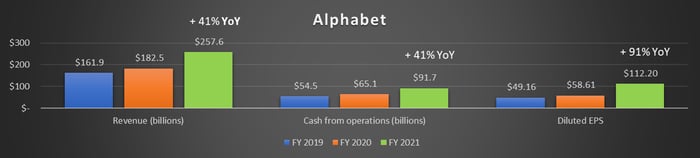
    Alphabet had a tremendous 2021 by nearly any measure. As shown below, sales and cash from operations rose 41% to $257.6 billion and $91.7 billion, respectively. And the company’s diluted earnings per share (EPS) reached $112.20 on over 90% growth. 

    Alphabet selected results  2019 - 2021

    Data source: Alphabet. Chart by author.

    The company followed up this performance with a strong first-quarter 2022 in which sales, cash from operations, and EPS increased year over year. But what about the future? With a potential recession around the corner, investors are rightly concerned that ad budgets will be cut, which could hurt Alphabet’s results. 

    Alphabet has a few aces up its sleeve to weather an economic slowdown. First, Google Search currently holds a market share of over 85%, according to Statista. The Federal Trade Commission (FTC) believes it is a monopoly, but unless Congress passes comprehensive legislation, Alphabet will continue to dominate. This gives the company tremendous pricing power, which is critical to maintaining profitability. 

    Alphabet also has two other fast-growing revenue streams in YouTube and the Google Cloud. YouTube revenues spiked 46% in 2021 partly due to people staying in more due to COVID-19. The growth slowed to 14% year over year in Q1 2022 as the pandemic waned, but the upward trend remains.

    Google Cloud may be the most important segment to watch moving forward. This segment competes with Amazon‘s Amazon Web Services (AWS) and Microsoft‘s Azure. Cloud computing is expected to continue its explosive growth in the foreseeable future. Sales for Google Cloud grew 47% in 2021 to $19.2 billion. The rub is that this segment isn’t profitable, while AWS produces enormous operating profits for Amazon. If Alphabet can scale to profitability, it will be a giant boon for profits and shareholders.

    On the valuation front, Alphabet trades for its lowest price-to-earnings (P/E) ratio since the beginning of 2019, as shown below. 

    GOOG PE Ratio data by YCharts.

    Even if the company experiences short-term headwinds, this price looks enticing for long-term investors. 

    What is the outlook for Tesla?

    Let’s face it, whatever we think of Tesla’s valuation (it’s high!) or outspoken CEO Elon Musk (he’s polarizing!), the company’s rise has been absolutely phenomenal. And shareholders have been richly rewarded. An investment of $10,000 in Tesla stock 10 years ago would be worth over $1 million today, while the same investment five years ago would be worth more than $95,000. 

    There are positive and negative factors on the horizon for Tesla. Gas prices are shocking Americans at the pump. This could lead many to consider an electric vehicle maybe for the first time. Tesla is experiencing massive demand already, with many cars sold out until 2023.

    The big question is whether this demand can continue in a potential recession.

    Consumer sentiment is generally a leading indicator of upcoming consumer spending. As shown below, sentiment is not only lower than in March 2020, but it is far lower than even during the Great Recession. This is disturbing for any company that relies upon consumer spending. 

    US Index of Consumer Sentiment data by YCharts.

    Competition is heating up. For years, Tesla has enjoyed an incredible first-mover advantage. Tesla was laser-focused on electric vehicles while other automakers scuffled along. That’s changing quickly as traditional automakers invest billions in electrifying large parts of their fleets in the coming years.

    The final concern is the valuation. Tesla has a larger market cap than the following seven largest automakers combined. Tesla crushes most of these on growth and profitability, and investors have been willing to pay a premium on the stock for years. Still, caution is warranted with an economic storm on the horizon. Companies with high valuations may fare worse than others. 

    Which has the stronger bull case?

    Alphabet has a few advantages over Tesla in an inflationary environment and with an economic slowdown likely. Alphabet relies on business spending while Tesla relies on consumers. Business spending may prove more durable because advertisers must continue to invest to grab limited consumer dollars. Due to inflation, Tesla also has to contend with rising costs for raw materials. One of Tesla’s draws is its profitability, and its margins could be crimped. A manufacturing company will be more affected by this than a tech company.

    This all adds up to Alphabet stock being the better bet currently. That said, Tesla likely has a higher long-term ceiling but much more risk. Long-term investors could consider both stocks and weigh them according to their risk tolerance.  

    This article was originally published on Fool.com. All figures quoted in US dollars unless otherwise stated.

    The post Better stock-split buy: Alphabet or Tesla? appeared first on The Motley Fool Australia.

    Wondering where you should invest $1,000 right now?

    When investing expert Scott Phillips has a stock tip, it can pay to listen. After all, the flagship Motley Fool Share Advisor newsletter he has run for over ten years has provided thousands of paying members with stock picks that have doubled, tripled or even more.* Scott just revealed what he believes could be the “five best ASX stocks” for investors to buy right now. These stocks are trading at near dirt-cheap prices and Scott thinks they could be great buys right now

    See The 5 Stocks
    *Returns as of June 1 2022

    (function() {
    function setButtonColorDefaults(param, property, defaultValue) {
    if( !param || !param.includes(‘#’)) {
    var button = document.getElementsByClassName(“pitch-snippet”)[0].getElementsByClassName(“pitch-button”)[0];
    button.style[property] = defaultValue;
    }
    }

    setButtonColorDefaults(“#43B02A”, ‘background’, ‘#5FA85D’);
    setButtonColorDefaults(“#43B02A”, ‘border-color’, ‘#43A24A’);
    setButtonColorDefaults(“#fff”, ‘color’, ‘#fff’);
    })()

    More reading

    Bradley Guichard has positions in Alphabet (C shares). Suzanne Frey, an executive at Alphabet, is a member of The Motley Fool’s board of directors. John Mackey, CEO of Whole Foods Market, an Amazon subsidiary, is a member of The Motley Fool’s board of directors. The Motley Fool Australia’s parent company Motley Fool Holdings Inc. has positions in and has recommended Alphabet (A shares), Alphabet (C shares), Amazon, Microsoft, and Tesla. The Motley Fool Australia has recommended Alphabet (A shares), Alphabet (C shares), and Amazon. The Motley Fool has a disclosure policy. This article contains general investment advice only (under AFSL 400691). Authorised by Scott Phillips.

    This article was originally published on Fool.com. All figures quoted in US dollars unless otherwise stated.

    from The Motley Fool Australia https://ift.tt/SiVTxE6