Tag: Motley Fool

  • Why are these 3 ASX 200 shares tumbling 6% to 15% today?

    A man holds his head in his hands, despairing at the bad result he's reading on his computer.

    A man holds his head in his hands, despairing at the bad result he's reading on his computer.

    The ASX 200 index is falling hard today after a selloff on Wall Street overnight.

    But three ASX 200 shares that are catching the eye with particularly big declines are listed below.

    Let’s see what is making investors hit the sell button:

    Domain Holdings Australia Ltd (ASX: DHG)

    This property listings company’s shares are down 6% to $3.25 at the time of writing.

    Investors have been selling down the ASX 200 share despite it posting strong revenue and earnings growth during the first half.

    Domain posted an 11% increase in revenue to $202.2 million, a 32.1% lift in EBITDA to $68.4 million, and a 48.7% jump in net profit to $25.8 million.

    As strong as this is on paper, the market was expecting Domain’s EBITDA to be approximately 4% higher than what was delivered.

    Graincorp Ltd (ASX: GNC)

    This grain exporter’s shares are down 15% to $6.98. This follows the release of its guidance for FY 2024 at its annual general meeting.

    Graincorp advised that it expects to report FY 2024 underlying EBITDA in the range of $270 million to $310 million and underlying net profit after tax of $65 million to $95 million.

    This will be down sharply from the $565 million and $250 million it reported in FY 2023. Management advised that this reflects the normalisation of East Coast Australia (ECA) growing conditions.

    GUD Holdings Limited (ASX: GUD)

    This diversified products company’s shares are down 11% to $10.65. This follows the release of its half-year results.

    GUD reported an 11.6% increase in underlying EBITA to $98.0 million for the half. This was thanks to strong growth from the APG business and the ongoing resilience of the Automotive business.

    In addition, underlying NPATA and earnings per share both increased 10.5%, which allowed the ASX 200 share to increase its interim dividend by 8.8% to 18.5 cents per share.

    The share price weakness may have been driven by commentary around the outlook of APG. It said:

    Still expecting strong revenue and EBITA growth in FY24 but short-term deferrals of replenishment orders (Toyota) means that H2 EBITA is expected to be slightly below H1.

    The post Why are these 3 ASX 200 shares tumbling 6% to 15% today? appeared first on The Motley Fool Australia.

    Wondering where you should invest $1,000 right now?

    When investing expert Scott Phillips has a stock tip, it can pay to listen. After all, the flagship Motley Fool Share Advisor newsletter he has run for over ten years has provided thousands of paying members with stock picks that have doubled, tripled or even more.*

    Scott just revealed what he believes could be the ‘five best ASX stocks’ for investors to buy right now. These stocks are trading at near dirt-cheap prices and Scott thinks they could be great buys right now…

    See The 5 Stocks
    *Returns as of 10 November 2023

    (function() {
    function setButtonColorDefaults(param, property, defaultValue) {
    if( !param || !param.includes(‘#’)) {
    var button = document.getElementsByClassName(“pitch-snippet”)[0].getElementsByClassName(“pitch-button”)[0];
    button.style[property] = defaultValue;
    }
    }

    setButtonColorDefaults(“#0095C8”, ‘background’, ‘#5FA85D’);
    setButtonColorDefaults(“#0095C8”, ‘border-color’, ‘#43A24A’);
    setButtonColorDefaults(“#fff”, ‘color’, ‘#fff’);
    })()

    More reading

    Motley Fool contributor James Mickleboro has no position in any of the stocks mentioned. The Motley Fool Australia’s parent company Motley Fool Holdings Inc. has no position in any of the stocks mentioned. The Motley Fool Australia has no position in any of the stocks mentioned. The Motley Fool has a disclosure policy. This article contains general investment advice only (under AFSL 400691). Authorised by Scott Phillips.

    from The Motley Fool Australia https://ift.tt/gYW6HTB

  • This ASX 200 stock is surging 10% following a return to profit

    A businessman looking at his digital tablet or strategy planning in hotel conference lobby. He is happy at achieving financial goals.

    A businessman looking at his digital tablet or strategy planning in hotel conference lobby. He is happy at achieving financial goals.

    Downer EDI Ltd (ASX: DOW) shares are catching the eye on Wednesday morning.

    At the time of writing, the ASX 200 stock is up 10% to $4.74.

    Investors have been scrambling to buy the integrated services provider’s shares following the release of its half-year results.

    What did the ASX 200 stock report?

    • Total revenue down 1.9% to $6 billion
    • Underlying EBITA up 12.6% to $150.5 million
    • Underlying NPATA up 11.9% to 76.1 million
    • Statutory profit after tax up 5.9% to $72.1 million
    • Interim dividend up 20% to 6 cents per share

    What happened during the half?

    For the six months ended 31 December, the ASX 200 stock returned to profit with a 5.9% increase in statutory profit after tax to $72.1 million. That was despite Downer reporting a 1.9% decline in revenue for the period.

    Management advised that this was primarily driven by a recovery in earnings from the Utilities business compared to a loss in the prior year. In addition, an improved performance in the Projects business in New Zealand also helped.

    In light of this profit rebound, the Downer board was able to increase its dividend by 20% to 6 cents per share. This represents a 58% payout ratio.

    The ASX 200 stock’s CEO, Peter Tompkins, was pleased with the half. He said:

    We said that FY24 would be an important transition year for Downer as we address areas of underperformance, stabilise, and reposition the business for future profitable growth.

    Delivering double digit underlying EBITA and NPATA growth alongside solid underlying cash conversion during the half highlights the momentum we are building as we address underperformance and execute on our transformation agenda.

    Outlook

    No guidance was given for the full year but management has reiterated “that FY24 is an important year in the company’s turnaround program.”

    Though, one positive is that “Downer anticipates continued EBITA margin percentage improvement in H2 through a combination of cost out and improving operational performance towards its management target of >4.5% in FY25.”

    Downer shares are now up 21% over the last 12 months.

    The post This ASX 200 stock is surging 10% following a return to profit appeared first on The Motley Fool Australia.

    Wondering where you should invest $1,000 right now?

    When investing expert Scott Phillips has a stock tip, it can pay to listen. After all, the flagship Motley Fool Share Advisor newsletter he has run for over ten years has provided thousands of paying members with stock picks that have doubled, tripled or even more.*

    Scott just revealed what he believes could be the ‘five best ASX stocks’ for investors to buy right now. These stocks are trading at near dirt-cheap prices and Scott thinks they could be great buys right now…

    See The 5 Stocks
    *Returns as of 10 November 2023

    (function() {
    function setButtonColorDefaults(param, property, defaultValue) {
    if( !param || !param.includes(‘#’)) {
    var button = document.getElementsByClassName(“pitch-snippet”)[0].getElementsByClassName(“pitch-button”)[0];
    button.style[property] = defaultValue;
    }
    }

    setButtonColorDefaults(“#0095C8”, ‘background’, ‘#5FA85D’);
    setButtonColorDefaults(“#0095C8”, ‘border-color’, ‘#43A24A’);
    setButtonColorDefaults(“#fff”, ‘color’, ‘#fff’);
    })()

    More reading

    Motley Fool contributor James Mickleboro has no position in any of the stocks mentioned. The Motley Fool Australia’s parent company Motley Fool Holdings Inc. has no position in any of the stocks mentioned. The Motley Fool Australia has no position in any of the stocks mentioned. The Motley Fool has a disclosure policy. This article contains general investment advice only (under AFSL 400691). Authorised by Scott Phillips.

    from The Motley Fool Australia https://ift.tt/Yqj89cP

  • AMP share price rockets 10% amid 2023 earnings boost

    Emotional euphoric young woman giving high five to male partner, celebrating family achievement, getting bank loan approval, or financial or investing success.Emotional euphoric young woman giving high five to male partner, celebrating family achievement, getting bank loan approval, or financial or investing success.

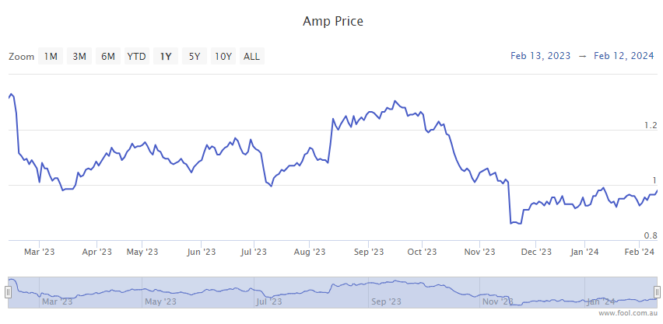
    The AMP Ltd (ASX: AMP) share price is soaring today.

    Shares in the S&P/ASX 200 Index (ASX: XJO) financial stock closed yesterday trading for 97 cents. At the time of writing on Wednesday morning, shares are swapping hands for $1.07 apiece, up 10.3%.

    For some context, the ASX 200 is down 1.4% at this same time.

    This comes following the release of AMP’s full-year results for 2023.

    Read on for the highlights.

    AMP share price soars on earnings beat

    • Underlying net profit after tax (NPAT) of $196 million, up 6.5% from $184 million in 2022
    • Statutory NPAT of $265 million, down from $387 million year on year
    • Net debt reduced by $337 million
    • Underlying earnings per share of 6.8 cents, up 19.3% from the prior year
    • Final dividend of 2.0 cents 20% franked, down from 2.5 cents per share in 2022

    What else happened with AMP during the year?

    The AMP share price is flying higher today, spurred in part by AMP’s Platforms segment, where NPAT jumped 38.5% year on year to $90 million. The company said this was driven by positive North Guarantee movement from favourable market conditions.

    Its AMP Bank segment went the other way, with NPAT falling to 9.7% from 2022 to $93 million in 2023. This reflected net interest margin (NIM) compression and growth moderation, which the company has previously addressed.

    The Advice segment booked an underlying NPAT loss of $47 million, an improvement of 30.9% year on year.

    And the group underlying NPAT loss of $27 million compared to a loss of $1 million in 2022. This was partly due to lower strategic partnership earnings and regulatory changes impacting its China partnership earnings.

    Another core metric that could be boosting the AMP share price was the return of $750 million of capital to shareholders since August 2022, with more capital returns on the horizon.

    The year also saw the sale of AMP Capital and SuperConcepts, as well as the resolution of legacy legal issues, including the shareholder class action and the agreement to settle an adviser class action.

    What did management say?

    Commenting on the results sending the AMP share price soaring today, CEO Alexis George said:

    2023 was a year of progress for AMP. We have repositioned the portfolio with the completion of the AMP Capital sales, built momentum in our cost-out program, and resolved a number of significant legacy legal matters.

    In addition, we have continued to reduce net debt, implemented further business simplification initiatives, invested in sustainable growth and returned surplus capital to shareholders.

    George added:

    The simplification program and investment we’ve undertaken across the portfolio is delivering positive outcomes for our customers and provides a foundation for sustainable growth…

    We have a strong balance sheet and remain focused on optimising capital – including returning surplus capital to shareholders where possible.

    What’s next for AMP?

    Looking at what might impact the AMP share price in the year ahead, the company flagged momentum in its cost reduction program targeting a $120 million reduction in AMP’s cost base by the end of 2025.

    There’s also the $350 million tranche 3 capital return. Management said this will progress with a combination of the final dividend (totalling $55 million) alongside further dividends and/or an on-market share buyback of up to $295 million.

    The company also noted it was “well-positioned to benefit from the long-term trends in banking and wealth in Australia”. Those trends include the super guarantee increase to 12% in July 2025.

    AMP share price snapshot

    Despite today’s big lift, the AMP share price remains down 19% since this time last year.

    Shares are up 26% since 22 November.

    The post AMP share price rockets 10% amid 2023 earnings boost appeared first on The Motley Fool Australia.

    Wondering where you should invest $1,000 right now?

    When investing expert Scott Phillips has a stock tip, it can pay to listen. After all, the flagship Motley Fool Share Advisor newsletter he has run for over ten years has provided thousands of paying members with stock picks that have doubled, tripled or even more.*

    Scott just revealed what he believes could be the ‘five best ASX stocks’ for investors to buy right now. These stocks are trading at near dirt-cheap prices and Scott thinks they could be great buys right now…

    See The 5 Stocks
    *Returns as of 10 November 2023

    (function() {
    function setButtonColorDefaults(param, property, defaultValue) {
    if( !param || !param.includes(‘#’)) {
    var button = document.getElementsByClassName(“pitch-snippet”)[0].getElementsByClassName(“pitch-button”)[0];
    button.style[property] = defaultValue;
    }
    }

    setButtonColorDefaults(“#0095C8”, ‘background’, ‘#5FA85D’);
    setButtonColorDefaults(“#0095C8”, ‘border-color’, ‘#43A24A’);
    setButtonColorDefaults(“#fff”, ‘color’, ‘#fff’);
    })()

    More reading

    Motley Fool contributor Bernd Struben has no position in any of the stocks mentioned. The Motley Fool Australia’s parent company Motley Fool Holdings Inc. has no position in any of the stocks mentioned. The Motley Fool Australia has no position in any of the stocks mentioned. The Motley Fool has a disclosure policy. This article contains general investment advice only (under AFSL 400691). Authorised by Scott Phillips.

    from The Motley Fool Australia https://ift.tt/diCeRvW

  • CBA shares tumble 3% on half-year profit decline and margin pain

    A businesswoman gets angry, shaking her fist at her computer.

    A businesswoman gets angry, shaking her fist at her computer.

    Commonwealth Bank of Australia (ASX: CBA) shares are under pressure on Wednesday morning.

    In early trade, the banking giant’s shares dropped 3% to $112.65.

    This follows a broad market selloff on inflation concerns and the release of its half year results.

    CBA shares under pressure

    As we covered here earlier, CBA reported a modest 0.2% increase in operating income to $13,649 million but a 3% decline in cash net profit after tax to $5,019 million.

    Management advised that its operating income reflects volume growth and higher volume-based fee income, offset by margin compression. CBA’s net interest margin was down 6 basis points since the end of FY 2023 to 1.99%. This was driven by increased deposit price competition and deposit switching.

    Australia’s largest bank’s cash profits were down 3% to $5,019 million after operating expenses increased 4% to $6,011 million. Management advised that this was due to inflationary pressures and additional spending on technology to support the delivery of strategic priorities.

    One positive that is failing to lift the CBA share price today was its dividend. The CBA board decided to increase its fully franked dividend by 2.4% to $2.15 per share despite the profit decline.

    What are analysts saying?

    Analysts at Goldman Sachs have responded relatively positively to the bank’s results. They said:

    CBA’s 1H24 cash earnings (company basis) from continued operations grew by 2.6% hoh to A$5,019 mn, and was -0.8%/+1.6% versus GSe / Visible Alpha consensus expectations (VAe). The quality of the result was good, with PPOP +1.6/+1.3% vs. GSe/VAe, largely on account of expenses. Versus GSe, the higher-than-expected BDD charge was entirely on account of our expectations of provisions releases, which CBA has remained conservative on this half. […] The interim ordinary DPS of A215¢ was higher than GSe (A210¢), and implies a 1H24 payout ratio of 72% GSe: 70%).

    Goldman currently has a sell rating and $82.37 price target on CBA’s shares.

    The post CBA shares tumble 3% on half-year profit decline and margin pain appeared first on The Motley Fool Australia.

    Wondering where you should invest $1,000 right now?

    When investing expert Scott Phillips has a stock tip, it can pay to listen. After all, the flagship Motley Fool Share Advisor newsletter he has run for over ten years has provided thousands of paying members with stock picks that have doubled, tripled or even more.*

    Scott just revealed what he believes could be the ‘five best ASX stocks’ for investors to buy right now. These stocks are trading at near dirt-cheap prices and Scott thinks they could be great buys right now…

    See The 5 Stocks
    *Returns as of 10 November 2023

    (function() {
    function setButtonColorDefaults(param, property, defaultValue) {
    if( !param || !param.includes(‘#’)) {
    var button = document.getElementsByClassName(“pitch-snippet”)[0].getElementsByClassName(“pitch-button”)[0];
    button.style[property] = defaultValue;
    }
    }

    setButtonColorDefaults(“#0095C8”, ‘background’, ‘#5FA85D’);
    setButtonColorDefaults(“#0095C8”, ‘border-color’, ‘#43A24A’);
    setButtonColorDefaults(“#fff”, ‘color’, ‘#fff’);
    })()

    More reading

    Motley Fool contributor James Mickleboro has no position in any of the stocks mentioned. The Motley Fool Australia’s parent company Motley Fool Holdings Inc. has positions in and has recommended Goldman Sachs Group. The Motley Fool Australia has no position in any of the stocks mentioned. The Motley Fool has a disclosure policy. This article contains general investment advice only (under AFSL 400691). Authorised by Scott Phillips.

    from The Motley Fool Australia https://ift.tt/BqxkPd2

  • Why is the ASX 200 index crashing 1.5% on Wednesday?

    a trader on the stock exchange holds his head in his hands, indicating a share price drop

    a trader on the stock exchange holds his head in his hands, indicating a share price drop

    The S&P/ASX 200 Index (ASX: XJO) is breaking hearts on Valentine’s Day and is a sea of red in early trade.

    At the time of writing, the benchmark index is down 1.5% to 7,491 points.

    Almost all sectors are deep in the red, with investors selling shares indiscriminately.

    Here’s a quick summary of how a number of popular ASX 200 shares are performing:

    • BHP Group Ltd (ASX: BHP) shares have dropped 1.5%
    • JB Hi-Fi Limited (ASX: JBH) shares are down 3%
    • Pilbara Minerals Ltd (ASX: PLS) shares have fallen 3%
    • Westpac Banking Corp (ASX: WBC) shares are down 1.5%
    • Xero Ltd (ASX: XRO) shares are 2% lower

    Why is the ASX 200 sinking?

    Investors have been hitting the sell button in a panic today following a selloff on Wall Street which saw the Dow Jones drop 1.35%, the S&P 500 index fall 1.4%, and the Nasdaq index crash 1.8%.

    This was driven by the release of inflation data that was much hotter than expected, sparking fears that interest rate cuts are still some way off.

    According to CNBC, the US consumer price index rose 0.3% in January from December and 3.1% on an annual basis. Whereas economists were expecting CPI to have increased by 0.2% month over month in January and 2.9% from a year earlier.

    Furthermore, excluding volatile food and energy prices, core CPI accelerated 0.4% in January and was up 3.9% from a year ago.

    Quincy Krosby, chief global strategist at LPL Financial, commented:

    The much-anticipated CPI report is a disappointment for those who expected inflation to edge lower allowing the Fed to begin easing rates sooner rather than later. Across the board numbers were hotter than expected making certain that the Fed will need more data before initiating a rate cutting cycle.

    The post Why is the ASX 200 index crashing 1.5% on Wednesday? appeared first on The Motley Fool Australia.

    Wondering where you should invest $1,000 right now?

    When investing expert Scott Phillips has a stock tip, it can pay to listen. After all, the flagship Motley Fool Share Advisor newsletter he has run for over ten years has provided thousands of paying members with stock picks that have doubled, tripled or even more.*

    Scott just revealed what he believes could be the ‘five best ASX stocks’ for investors to buy right now. These stocks are trading at near dirt-cheap prices and Scott thinks they could be great buys right now…

    See The 5 Stocks
    *Returns as of 10 November 2023

    (function() {
    function setButtonColorDefaults(param, property, defaultValue) {
    if( !param || !param.includes(‘#’)) {
    var button = document.getElementsByClassName(“pitch-snippet”)[0].getElementsByClassName(“pitch-button”)[0];
    button.style[property] = defaultValue;
    }
    }

    setButtonColorDefaults(“#0095C8”, ‘background’, ‘#5FA85D’);
    setButtonColorDefaults(“#0095C8”, ‘border-color’, ‘#43A24A’);
    setButtonColorDefaults(“#fff”, ‘color’, ‘#fff’);
    })()

    More reading

    Motley Fool contributor James Mickleboro has positions in Westpac Banking Corporation and Xero. The Motley Fool Australia’s parent company Motley Fool Holdings Inc. has positions in and has recommended Xero. The Motley Fool Australia has positions in and has recommended Xero. The Motley Fool has a disclosure policy. This article contains general investment advice only (under AFSL 400691). Authorised by Scott Phillips.

    from The Motley Fool Australia https://ift.tt/kjB5JFR

  • How does investing in a term deposit compare with buying ASX shares?

    Two people comparing and analysing material.Two people comparing and analysing material.

    Soaring interest rates have made the return from term deposits much more attractive. However, ASX shares should also be considered for the long term.

    The Reserve Bank of Australia (RBA) cash rate has gone from almost 0% to 4.35%. Aussies can now get good term deposit rates compared to two years ago.

    According to Canstar, there are some term deposits that offer an interest rate of at least 5% for 12 months.

    I’d always recommend that some people should always keep some cash aside as an emergency fund. I think cash, deposited in a government-guaranteed savings account with a safe bank, is the safest and most flexible in the short term.

    But, over the long term, it could make a lot of sense to invest in ASX shares. Let’s compare term deposits to ASX shares.

    Term deposit return

    If we put $10,000 into a term deposit for a 12-month period which pays annually, we typically have to wait until the end of the term to get the interest and for the bank to return the money.

    A $10,000 investment would generate $500 of annual interest and the capital amount would still be worth $10,000 at the end of the period. If they spent that $500 and did another 12-month term with the remaining $10,000, it’d make another $500 (if the interest rate was still 5%).

    The term deposit holder could decide to re-invest the $500 instead and it’d be $10,500 making interest, but they wouldn’t be able to spend any of that money. If $10,500 earned 5%, they’d get $525 of interest at the end of the period.

    What about ASX shares?

    ASX shares have the ability to pay dividends and deliver growth.

    Investing in the stock market does come with volatility – share prices can go down, but they can also go up over time.

    Let’s think about an ASX blue-chip share like Telstra Group Ltd (ASX: TLS), which has an enviable market position in the mobile market. Steady growth of subscribers and other revenue is helping drive the company’s profit higher.

    I don’t have a crystal ball, but Telstra has been steadily growing its dividend in the last few results and it could keep growing. Analyst estimates on Commsec suggest Telstra could pay a fully franked dividend yield of 4.5%, or a grossed-up dividend yield of 6.5%, in FY24.

    If someone invested $10,000 into Telstra shares, they’re projected to get $650 of grossed-up income for FY24. That person could spend all of that money and could still get a bigger dividend in FY25. The Commsec projection suggests a fully franked dividend yield of 4.8% or a grossed-up dividend yield of 6.8% for FY25 at the current Telstra share price. That would be grossed-up income of $680.

    Good ASX shares can pay appealing dividends and also deliver dividend growth.

    That’s not even mentioning the potential to supercharge compounding by re-investing the dividends into more shares. An investor can decide to receive the dividends and invest in different ASX shares, or activate the dividend reinvestment plan (DRP) of a company (if it has one) and receive more shares (brokerage free) instead of cash.

    In my mind, if people are looking for their money to make a return, I’d choose ASX shares because of that long-term growth element. One of my favourite blue chips for potential long-term dividends and growth is Wesfarmers Ltd (ASX: WES) – the owner of Bunnings and Kmart – which I recently wrote about here.

    The post How does investing in a term deposit compare with buying ASX shares? appeared first on The Motley Fool Australia.

    Wondering where you should invest $1,000 right now?

    When investing expert Scott Phillips has a stock tip, it can pay to listen. After all, the flagship Motley Fool Share Advisor newsletter he has run for over ten years has provided thousands of paying members with stock picks that have doubled, tripled or even more.*

    Scott just revealed what he believes could be the ‘five best ASX stocks’ for investors to buy right now. These stocks are trading at near dirt-cheap prices and Scott thinks they could be great buys right now…

    See The 5 Stocks
    *Returns as of 10 November 2023

    (function() {
    function setButtonColorDefaults(param, property, defaultValue) {
    if( !param || !param.includes(‘#’)) {
    var button = document.getElementsByClassName(“pitch-snippet”)[0].getElementsByClassName(“pitch-button”)[0];
    button.style[property] = defaultValue;
    }
    }

    setButtonColorDefaults(“#0095C8”, ‘background’, ‘#5FA85D’);
    setButtonColorDefaults(“#0095C8”, ‘border-color’, ‘#43A24A’);
    setButtonColorDefaults(“#fff”, ‘color’, ‘#fff’);
    })()

    More reading

    Motley Fool contributor Tristan Harrison has no position in any of the stocks mentioned. The Motley Fool Australia’s parent company Motley Fool Holdings Inc. has positions in and has recommended Wesfarmers. The Motley Fool Australia has positions in and has recommended Telstra Group and Wesfarmers. The Motley Fool has a disclosure policy. This article contains general investment advice only (under AFSL 400691). Authorised by Scott Phillips.

    from The Motley Fool Australia https://ift.tt/0tlbmWg

  • IDP Education share price jumps 15% after crushing first-half expectations

    Two happy excited friends in euphoria mood after winning in a bet with a smartphone in hand.

    Two happy excited friends in euphoria mood after winning in a bet with a smartphone in hand.

    The IDP Education Ltd (ASX: IEL) share price is avoiding the market selloff on Wednesday.

    In morning trade, the language testing and student placement company’s shares are up 15% to $23.33.

    This follows the release of a stronger than expected half-year result.

    IDP Education share price jumps on strong result

    • Revenue up 15% to a record of $579.1 million
    • Adjusted earnings before interest and tax (EBIT) up 25% to $159 million
    • Adjusted net profit after tax up 23% to $107 million
    • Interim dividend of 25 cents share

    What happened during the half?

    For the six months ended 31 December, IDP Education reported a 15% increase in revenue to $579.1 million. This was driven almost entirely by its Student Placement business, which offset softer revenue from English Language Testing.

    IDP Education’s Student Placement business reported a 44% increase in revenue to $287.5 million thanks to strong growth across both its Australia and Other Destinations segments. This reflects a 33% increase in student placement volumes to a record of 57,300 and price increases.

    The English Language Testing business reported a 5% decline in revenue after testing (IELTS) volumes fell 12% to 902,000. This was due largely to weakness in the key India market.

    How does this compare to expectations?

    The company’s half-year results has come in ahead of expectations. This may explain why the IDP Education share price is charging higher today. Goldman Sachs commented:

    IEL has reported a strong 1H24 result, with revenue/EBIT/NPAT in line with our above-consensus estimates, and +3%/+11%/+13% vs Visible Alpha Consensus Data expectations.

    Management commentary

    IDP Education’s CEO and managing director, Tennealle O’Shannessy, was pleased with the half. She said:

    IDP’s performance was highlighted by our student placement business which grew total revenue by 44 per cent. This exceptional growth was partially offset by a weaker period for English Language Testing where revenues fell five per cent.

    Outlook

    While no guidance was given, O’Shannessy spoke about recent policy changes that have been weighing on the IDP Education share price. The good news is that she believes the company is well-placed to navigate these changes. Ms O’Shannessy said:

    IDP is the leading player, operating in a large market, with global scale diversified across business lines and geographies. We have a relentless focus on quality and have been building our strategic position as the trusted provider for more than 50 years. While policy settings in our main destination markets for international students and migrants are entering a more restrictive period, IDP remains very well placed to strengthen its industry leadership and help students and institutions navigate these changing market conditions.

    The IDP Education share price remains down 25% over the last 12 months.

    The post IDP Education share price jumps 15% after crushing first-half expectations appeared first on The Motley Fool Australia.

    Wondering where you should invest $1,000 right now?

    When investing expert Scott Phillips has a stock tip, it can pay to listen. After all, the flagship Motley Fool Share Advisor newsletter he has run for over ten years has provided thousands of paying members with stock picks that have doubled, tripled or even more.*

    Scott just revealed what he believes could be the ‘five best ASX stocks’ for investors to buy right now. These stocks are trading at near dirt-cheap prices and Scott thinks they could be great buys right now…

    See The 5 Stocks
    *Returns as of 10 November 2023

    (function() {
    function setButtonColorDefaults(param, property, defaultValue) {
    if( !param || !param.includes(‘#’)) {
    var button = document.getElementsByClassName(“pitch-snippet”)[0].getElementsByClassName(“pitch-button”)[0];
    button.style[property] = defaultValue;
    }
    }

    setButtonColorDefaults(“#0095C8”, ‘background’, ‘#5FA85D’);
    setButtonColorDefaults(“#0095C8”, ‘border-color’, ‘#43A24A’);
    setButtonColorDefaults(“#fff”, ‘color’, ‘#fff’);
    })()

    More reading

    Motley Fool contributor James Mickleboro has no position in any of the stocks mentioned. The Motley Fool Australia’s parent company Motley Fool Holdings Inc. has positions in and has recommended Idp Education. The Motley Fool Australia has recommended Idp Education. The Motley Fool has a disclosure policy. This article contains general investment advice only (under AFSL 400691). Authorised by Scott Phillips.

    from The Motley Fool Australia https://ift.tt/UXYq7v5

  • Forget Westpac and buy these top ASX dividend stocks

    A woman sits at a table with notebook on lap and pen in hand as she gazes off to the side with the pen resting on the side of her face as though she is thinking and contemplating while a glass of orange juice and a pair of red sunglasses rests on the table beside her.

    A woman sits at a table with notebook on lap and pen in hand as she gazes off to the side with the pen resting on the side of her face as though she is thinking and contemplating while a glass of orange juice and a pair of red sunglasses rests on the table beside her.

    While Westpac Banking Corp (ASX: WBC) is a popular option for income investors, its shares are currently trading at a 52-week high.

    In addition, they are trading beyond the valuations of almost all brokers. This makes them a riskier than usual proposition for investors.

    In the absence of a decent pullback that creates a better entry point, income investors might find more value from the ASX dividend stocks listed below.

    Here’s what analysts are saying about them:

    Telstra Corporation Ltd (ASX: TLS)

    Goldman Sachs thinks that telco giant Telstra could be a great option for income investors.

    The broker rates the company highly due to its low risk earnings and dividends growth over FY 2023 to FY 2025.

    It is expecting this to lead to Telstra paying fully franked dividends of 18 cents per share in FY 2024, 19 cents per share in FY 2025, and then 20 cents per share in FY 2026. Based on the current Telstra share price of $3.97, this equates to yields of 4.5%, 4.8%, and 5%, respectively.

    Goldman has a buy rating and $4.65 price target on Telstra’s shares.

    Transurban Group (ASX: TCL)

    Another ASX dividend stock that analysts think could be in the buy zone at current levels is toll road operator Transurban.

    Citi remains positive on the company following its first half results release last week. So much so, it continues to expect Transurban to pay dividends ahead of guidance in FY 2024.

    The broker is forecasting dividends per share of 63 cents in FY 2024, 65 cents in FY 2025, and 68 cents in FY 2026. Based on the current Transurban share price of $12.90, this will mean yields of 4.9%, 5%, and 5.3%, respectively.

    Citi has a buy rating and $15.60 price target on the company’s shares.

    Finally, in case you were wondering, Goldman and Citi have neutral ratings and $22.85 and $22.25 price targets on Westpac’s shares.

    The post Forget Westpac and buy these top ASX dividend stocks appeared first on The Motley Fool Australia.

    Wondering where you should invest $1,000 right now?

    When investing expert Scott Phillips has a stock tip, it can pay to listen. After all, the flagship Motley Fool Share Advisor newsletter he has run for over ten years has provided thousands of paying members with stock picks that have doubled, tripled or even more.*

    Scott just revealed what he believes could be the ‘five best ASX stocks’ for investors to buy right now. These stocks are trading at near dirt-cheap prices and Scott thinks they could be great buys right now…

    See The 5 Stocks
    *Returns as of 10 November 2023

    (function() {
    function setButtonColorDefaults(param, property, defaultValue) {
    if( !param || !param.includes(‘#’)) {
    var button = document.getElementsByClassName(“pitch-snippet”)[0].getElementsByClassName(“pitch-button”)[0];
    button.style[property] = defaultValue;
    }
    }

    setButtonColorDefaults(“#0095C8”, ‘background’, ‘#5FA85D’);
    setButtonColorDefaults(“#0095C8”, ‘border-color’, ‘#43A24A’);
    setButtonColorDefaults(“#fff”, ‘color’, ‘#fff’);
    })()

    More reading

    Citigroup is an advertising partner of The Ascent, a Motley Fool company. Motley Fool contributor James Mickleboro has positions in Westpac Banking Corporation. The Motley Fool Australia’s parent company Motley Fool Holdings Inc. has positions in and has recommended Goldman Sachs Group and Transurban Group. The Motley Fool Australia has positions in and has recommended Telstra Group. The Motley Fool has a disclosure policy. This article contains general investment advice only (under AFSL 400691). Authorised by Scott Phillips.

    from The Motley Fool Australia https://ift.tt/Q7ktm1H

  • Is buying investment property in regional areas like buying ASX small-cap shares?

    A cute young girl wearing gumboots and play clothes holds open the door of her wooden cubby house as she sits and smiles in a backyard outdoor setting.A cute young girl wearing gumboots and play clothes holds open the door of her wooden cubby house as she sits and smiles in a backyard outdoor setting.

    On the face of it, buying investment property in Australia’s regions may seem like the inferior choice.

    Historically, regional properties have been a cheaper option for investors, delivering superior rental returns but less capital growth than the cities. And it was harder to find a good long-term tenant.

    What’s the equivalent in shares?

    Are ASX small-cap shares seen as the inferior choice to ASX 200 blue-chip shares?

    Depends on your point of view. Small-caps are riskier investments but the good ones can deliver more share price growth than the large-caps over the long term. But they typically don’t pay dividends, so there’s no yield for their investors, and they can struggle to perform in poor economic conditions.

    But are times changing? Are regional properties and ASX small-caps looking more attractive these days?

    Over the past three years, regional properties have actually grown at a faster rate than city properties.

    They’ve still delivered superior rental returns, and it’s become much easier to find a tenant with the average regional vacancy rate currently as low as the cities at 0.8%, according to Domain data.

    And what about ASX small-cap shares?

    Some experts are saying they’re looking more attractive, given they were sold off as interest rates rose, and now that rates are expected to fall, their prospects for share price gains look better.

    Let’s investigate further.

    Buying investment property in regional areas

    A key reason why capital cities have historically delivered better capital gains is population density and growth.

    Migration is the primary driver of our population growth, and we don’t build enough new homes. That means housing demand goes up at a rapid rate every year, with all those new arrivals needing homes immediately. Natural increase (births minus deaths) raises housing demand much more slowly.

    On top of that, Australia only has eight capital cities, and almost 70% of us choose to live in one of them.

    But Australia has just undergone a dramatic population shift.

    During the pandemic, working from home enabled thousands of city dwellers to relocate to the regions for more affordable housing and arguably a better lifestyle.

    In 2020, interstate migration reached its highest level since the Australian Bureau of Statistics began keeping records in 2001.

    This trend continued for a while, leading to massive property price growth. So much so that the 10-year rate of capital growth is now higher in the regions, as this chart shows.

    This has changed the game when it comes to buying investment property.

    While that COVID surge in interstate migration has tapered back, remote work is a permanent change.

    This means future generations will have far more choices as to where to live. This may create permanent changes in our population movement, especially given the housing affordability challenges in our cities.

    The Regional Australia Institute (RAI) estimates that 3.5 million Australians are interested in relocating to regional areas today.

    Difficulty finding employment was previously a deterrent to regional living. Now, people can take their jobs with them, or find one pretty easily locally.

    The Federal Government’s newly released State of Australia’s Regions 2024 report says three years of record agricultural production and expanded tourism have contributed to strong regional economic growth and a more than doubling of regional job ads over the four years to October 2023.

    Put all that together, and regional property markets seem to have stronger economic fundamentals to support better capital gains in the future.

    Plus, most of them are still cheaper than city markets and still deliver better rental yields.

    Will this see more people buying investment property in regional areas?

    It seems so, with research by MCG Quantity Surveyors revealing the average distance between landlords’ primary residences and their property investments soared to 1,502km in the year to November 2023.

    It was just 293km before COVID.

    For the record, regional South Australia delivered the best capital gains of the regions in 2023 at 9.4%.

    Buying ASX small-caps for investment

    ASX small-cap shares are those with a market capitalisation of between a few hundred thousand and $2 billion.

    They are typically young and growing companies that have yet to establish strong, consistent earnings. They often don’t do well when interest rates are rising because they’re carrying debt to enable expansion.

    Their share prices are volatile, and their trading liquidity is often constrained.

    However, for investors with medium to high risk tolerance, ASX small caps can be more attractive. This is mainly because their prospects for long-term capital growth can be better.

    Andy Gracey, portfolio manager of the Emerging Companies and the Australian Shares Fund at Australian Ethical Investment, says ASX small-cap shares may do better this year.

    In an interview with my colleague Bernd last month, Gracey said:

    Small companies and particularly microcap companies have underperformed their Australia blue-chip peers over the last few years, so there certainly is rationale to anticipate some form of catchup for these emerging companies.

    Gracey has some tips for investors interested in buying ASX small-cap stocks this year.

    Morgans analysts also think ASX small-cap shares may be in for a good year, commenting:

    Small-caps have historically bounced hardest upon confirmation of a flattening-out in the rates cycle. Several ingredients remain in place supporting a rebound in this space (rates, trading/fundamentals, sentiment/positioning). We think the tide is turning for small-caps, and now is an opportune time to build exposure to forgotten small-caps.

    Morgans says their favourite seven forgotten small-caps include ASX biotech Clinuvel Pharmaceuticals Limited (ASX: CUV) and debt collector Credit Corp Group Limited (ASX: CCP).

    Broker Bell Potter says luxury retailer Cettire Ltd (ASX: CTT) and electrical infrastructure products group IPD Group Ltd (ASX: IPG) are small-caps worth buying.

    LSN Emerging Companies Fund likes financial services provider EQT Holdings Ltd (ASX: EQT) and MMA Offshore Ltd (ASX: MRM).

    Joe Wright of Airlie Funds Management says ASX small-cap stock selection is crucial. He recommends avoiding ‘concept’ companies and those with excessive gearing.

    The post Is buying investment property in regional areas like buying ASX small-cap shares? appeared first on The Motley Fool Australia.

    Wondering where you should invest $1,000 right now?

    When investing expert Scott Phillips has a stock tip, it can pay to listen. After all, the flagship Motley Fool Share Advisor newsletter he has run for over ten years has provided thousands of paying members with stock picks that have doubled, tripled or even more.*

    Scott just revealed what he believes could be the ‘five best ASX stocks’ for investors to buy right now. These stocks are trading at near dirt-cheap prices and Scott thinks they could be great buys right now…

    See The 5 Stocks
    *Returns as of 10 November 2023

    (function() {
    function setButtonColorDefaults(param, property, defaultValue) {
    if( !param || !param.includes(‘#’)) {
    var button = document.getElementsByClassName(“pitch-snippet”)[0].getElementsByClassName(“pitch-button”)[0];
    button.style[property] = defaultValue;
    }
    }

    setButtonColorDefaults(“#0095C8”, ‘background’, ‘#5FA85D’);
    setButtonColorDefaults(“#0095C8”, ‘border-color’, ‘#43A24A’);
    setButtonColorDefaults(“#fff”, ‘color’, ‘#fff’);
    })()

    More reading

    Motley Fool contributor Bronwyn Allen has no position in any of the stocks mentioned. The Motley Fool Australia’s parent company Motley Fool Holdings Inc. has positions in and has recommended Ipd Group. The Motley Fool Australia has recommended Cettire, Ipd Group, and Mma Offshore. The Motley Fool has a disclosure policy. This article contains general investment advice only (under AFSL 400691). Authorised by Scott Phillips.

    from The Motley Fool Australia https://ift.tt/xcbHNnO

  • Invest $833 in this ASX share each month to create passive income of $840 in 2024!

    Man jumping in water with a floatable flamingo, symbolising passive income.Man jumping in water with a floatable flamingo, symbolising passive income.

    You don’t need to be a millionaire to start earning a meaningful annual passive income stream.

    In fact, by investing just $833 a month in ASX shares, you could create a passive income of $845 a year, or more, in only 12 months’ time.

    Now, there are a wide number of quality S&P/ASX 200 Index (ASX: XJO) dividend stocks that could help you achieve this goal. But, keeping in mind the importance of diversification, you wouldn’t want to invest all of your money into a single, high-yielding company.

    Even quality companies with a good track record of annual dividend payouts can run into short-term troubles that could slash the passive income you were expecting to bank.

    However, as you may have noticed in the title, I did mention one particular ASX share.

    Here’s why.

    This ASX ETF is a passive income leader

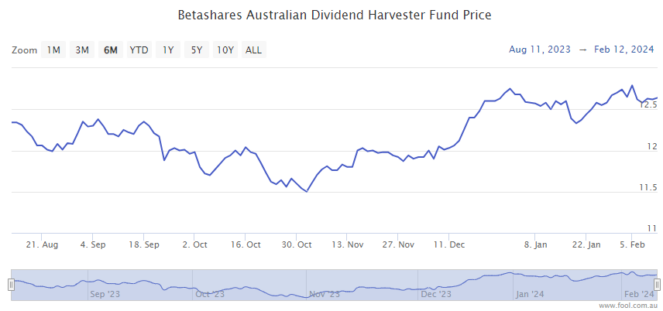
    The ASX share in question is the BetaShares Australian Dividend Harvester Fund (ASX: HVST).

    The appealing thing for passive income hunters is that this exchange-traded fund (ETF) gives investors instant diversity through its portfolio of 40 to 60 high-yielding, blue-chip ASX shares.

    As of the end of December, the ETF’s top three holdings are Commonwealth Bank of Australia (ASX: CBA) BHP Group Ltd (ASX: BHP) and CSL Limited (ASX: CSL).

    And HVST pays out dividends on a monthly basis, meaning your next passive income payout is never too far away.

    Because the ETF’s holdings are actively managed and rebalanced every three months to target higher-yielding ASX dividend stocks, the annual management fee is 0.72%.

    If you’re looking to capture the magic of compounding so you can watch your annual income soar over the years, HVST offers a partial or full dividend reinvestment plan.

    As at 31 January, the ETF had a 12-month trailing yield of 5.94%, 79.5% franked. Those franking credits bring the grossed-up yield to 8.45%.

    Based on this grossed-up dividend yield alone, investing $833 a month (or $10,000 over a year) should deliver $845 in annual passive income.

    Of course, we’re also hoping to see the ETF deliver some share price gains in 2024.

    The HVST share price is down 2% since this time last year. But the ETF has gained 10% since 31 October.

    If that upward trend continues, it could see this ASX ETF deliver significantly more than $845 in passive income from those 12 monthly $833 investments.

    The post Invest $833 in this ASX share each month to create passive income of $840 in 2024! appeared first on The Motley Fool Australia.

    Wondering where you should invest $1,000 right now?

    When investing expert Scott Phillips has a stock tip, it can pay to listen. After all, the flagship Motley Fool Share Advisor newsletter he has run for over ten years has provided thousands of paying members with stock picks that have doubled, tripled or even more.*

    Scott just revealed what he believes could be the ‘five best ASX stocks’ for investors to buy right now. These stocks are trading at near dirt-cheap prices and Scott thinks they could be great buys right now…

    See The 5 Stocks
    *Returns as of 10 November 2023

    (function() {
    function setButtonColorDefaults(param, property, defaultValue) {
    if( !param || !param.includes(‘#’)) {
    var button = document.getElementsByClassName(“pitch-snippet”)[0].getElementsByClassName(“pitch-button”)[0];
    button.style[property] = defaultValue;
    }
    }

    setButtonColorDefaults(“#0095C8”, ‘background’, ‘#5FA85D’);
    setButtonColorDefaults(“#0095C8”, ‘border-color’, ‘#43A24A’);
    setButtonColorDefaults(“#fff”, ‘color’, ‘#fff’);
    })()

    More reading

    Motley Fool contributor Bernd Struben has no position in any of the stocks mentioned. The Motley Fool Australia’s parent company Motley Fool Holdings Inc. has positions in and has recommended CSL. The Motley Fool Australia has recommended CSL. The Motley Fool has a disclosure policy. This article contains general investment advice only (under AFSL 400691). Authorised by Scott Phillips.

    from The Motley Fool Australia https://ift.tt/Yxo1Z5F