Tag: Motley Fool

  • Here are the best ASX renewables shares of the year so far

    A group of businesspeople hold green balloons outdoors.A group of businesspeople hold green balloons outdoors.

    Commodity markets are booming in 2022 amid a wave of catalysts. Turns out, that’s been equally as harsh for ESG and ethically focused share baskets.

    As a sector – which is still poorly defined on Australian public markets, mind you – renewables have lagged other segments such as financials, utilities and materials this year.

    How can we tell? Whilst there’s no specific ASX renewables index, EFTs tracking the segment have crept downwards this year, as is shown further below.

    Evidently, as markets have endured volatility in 2022, that’s translated to a fairly strong headwind for ASX renewables shares, and at the end of the day, the sector is in the red in 2022.

    Nonetheless, scaling back to the start of the year, some names have absorbed losses better than others. Let’s take a look at those.

    ‘Green’ shares aren’t in the green

    Unfortunately, on an individual stock level, what we define as a ‘renewables’ share is quite narrow. Actually, there are no real winners per se, but some shares absorbed selling pressures better than others.

    Let’s talk in terms of energy first and, with that, results aren’t good.

    Renewables investor Infratil Ltd (ASX: IFT) is down 2.45% year to date but has whipsawed higher over the past three months. Although, its price chart looks like a 9.0 scale reading on the Richter scale.

    Meanwhile, Genesis Energy Ltd (ASX: GNE), owner of a diverse portfolio of thermal and renewable generation assets located in different parts of New Zealand, has slipped 3.3%.

    Trends are similar across the board and it appears any capital that’s left the sector has been shipped straight across to the adjacent resources, traditional energy, and wider commodities segments.

    Alas, it’s no better for the exchange-traded funds (ETFs), with the Vanguard Ethically Conscious International Shares INDEX ETF (ASX: VESG) creeping down by 13%.

    Meantime, the VanEck MSCI Australian Sustainable Equity ETF (ASX: GRNV) has fallen by more than 5% and is in a similar vein to the product above.

    Finally, the Russell Investments Australian Responsible Investment ETF (ASX: RARI) has crept up hard in 2022 and is 4 basis points higher in that time.

    TradingView Chart

    It’s important to zoom out

    Longer term – since last January to be specific – the picture’s a bit different. Three of the four securities have remained buoyant over that time, albeit Genesis Energy, which slipped more than 21% into the red.

    The VESG ETF seems to have outperformed this bunch and was the star player until volatility crept in this year and it has since consolidated returns.

    It has now levelled off and is rangebound alongside the fellow MSCI Australian Sustainability ETF from VanEck.

    That’s something to think about.

    TradingView Chart

    The post Here are the best ASX renewables shares of the year so far appeared first on The Motley Fool Australia.

    Wondering where you should invest $1,000 right now?

    When investing expert Scott Phillips has a stock tip, it can pay to listen. After all, the flagship Motley Fool Share Advisor newsletter he has run for over ten years has provided thousands of paying members with stock picks that have doubled, tripled or even more.*

    Scott just revealed what he believes could be the five best ASX stocks for investors to buy right now. These stocks are trading at near dirt-cheap prices and Scott thinks they could be great buys right now.

    *Returns as of January 12th 2022

    More reading

    Motley Fool contributor Zach Bristow has no position in any of the stocks mentioned. The Motley Fool Australia’s parent company Motley Fool Holdings Inc. has no position in any of the stocks mentioned. The Motley Fool Australia has no position in any of the stocks mentioned. The Motley Fool has a disclosure policy. This article contains general investment advice only (under AFSL 400691). Authorised by Bruce Jackson.

    from The Motley Fool Australia https://ift.tt/Ed7nTxF

  • Why Netflix stock crashed and burned Wednesday

    This article was originally published on Fool.com. All figures quoted in US dollars unless otherwise stated.

    kids and dad watching movie

    This article was originally published on Fool.com. All figures quoted in US dollars unless otherwise stated.

    What happened

    Shares of Netflix (NASDAQ: NFLX) were going down in flames on Wednesday, plunging by as much as 39% in morning trading. As of 11:50 a.m. ET, the stock was still down by 36.9%.

    The catalyst that sent the streaming pioneer lower was news that its subscriber count actually declined last quarter, the first time that’s happened in more than a decade. 

    So what

    In the first quarter, Netflix generated revenue of $7.9 billion, up 9.8% year over year, while its earnings per share (EPS) declined by roughly 5.9% to $3.53. 

    To put those numbers in context, analysts’ consensus estimates had called for revenue of $7.9 billion and EPS of $2.90. 

    The big story, however, was that Netflix shed roughly 200,000 subscribers during the quarter and expects to lose another 2 million in Q2. Netflix cited a number of factors as contributing to the subscriber loss, including inflation, the war in Ukraine (which has slowed adoption of the service in Eastern Europe), growing competition, and password sharing.

    Now what

    The news certainly isn’t good, but it also isn’t as bad as it might appear at first glance. In the fine print of its investor letter, management provided details of the suspension of its operations in Russia, which played a pivotal role in the quarter’s subscriber decline (italics mine):

    The suspension of our service in Russia and winding-down of all Russian paid memberships resulted in a -0.7 million impact on paid net adds; excluding this impact, paid net additions totaled +0.5 million. 

    Netflix’s management acknowledged the ongoing challenges and is exploring various measures to reignite its subscriber growth. The primary focus will be on increasing the quality of its programming and recommendations, but the company is also investigating ways to combat password sharing and working to continue its expansion in international markets.

    Given its dramatic slowdown in subscriber growth, investors are certainly justified in wondering whether Netflix’s growth story is winding down. Management said it expects to return to — and sustain — double-digit percentage revenue growth and remain free-cash-flow positive in 2022 and beyond.

    I, for one, don’t think the sky is falling. The sell-off might represent a compelling opportunity for investors, because this isn’t fade to black for Netflix. 

    This article was originally published on Fool.com. All figures quoted in US dollars unless otherwise stated.

    The post Why Netflix stock crashed and burned Wednesday appeared first on The Motley Fool Australia.

    Should you invest $1,000 in Netflix right now?

    Before you consider Netflix, you’ll want to hear this.

    Motley Fool Investing expert Scott Phillips just revealed what he believes are the 5 best stocks for investors to buy right now… and Netflix wasn’t one of them.

    The online investing service he’s run for over a decade, Motley Fool Share Advisor, has provided thousands of paying members with stock picks that have doubled, tripled or even more.* And right now, Scott thinks there are 5 stocks that are better buys.

    *Returns as of January 13th 2022

    More reading

    Daniel Vena owns Netflix. The Motley Fool Australia’s parent company Motley Fool Holdings Inc. owns and has recommended Netflix. The Motley Fool Australia has recommended Netflix. The Motley Fool has a disclosure policy. This article contains general investment advice only (under AFSL 400691). Authorised by Bruce Jackson.

    This article was originally published on Fool.com. All figures quoted in US dollars unless otherwise stated.

    from The Motley Fool Australia https://ift.tt/SGiep9x

  • Megaport’s quarterly update sends its share price crashing 18%

    a woman looks distressed as she stares dramatically at her phone watching the Megaport share price crashing todaya woman looks distressed as she stares dramatically at her phone watching the Megaport share price crashing today

    Shares in Megaport Ltd (ASX: MP1) are crashing this morning after the company released its quarterly key performance indicators for March.

    At the time of writing, the Megaport share price is $10.75, down 15.75%. In the first 30 minutes of trading today, it hit a new 52-week low of $10.42 — an 18.3% drop.

    Megaport grows revenue 6% this quarter

    The company covered its monthly revenue statistics for 3Q FY22, including:

    • Monthly recurring revenue (MRR) for the month of March was $9.5 million, an increase of $300,000 or 3% quarter-on-quarter (QoQ)
    • Revenue for the quarter was $27.9 million, an increase of $1.4 million or 5% QoQ
    • Customer numbers at the end of the quarter were 2,541, an increase of 86, or 4% QoQ
    • Total ports at the end of the quarter were 9,012, an increase of 489, or 6% QoQ
    • Total virtual cross connections (VXCs) at the end of the quarter were 14,706, an increase of 993, or 7% QoQ
    • Total Megaport Cloud Router (MCRs) at the end of the quarter were 670, an increase of 67, or 11% QoQ
    • Total Megaport Virtual Edge (MVEs) at the end of the quarter were 59, an increase of 19, or 48% QoQ.

    What else happened this quarter for Megaport?

    The company launched its full suite of products and services in Mexico. It says this is the “2nd largest IT spending market in Latin America and the 25th country enabled on Megaport’s global platform”.

    It also launched the Megaport ONE platform in January 2022 and named Jim Brinksma as Chief Technology Officer last month.

    Cash outflows were up for network operations, with a 21% increase from last quarter, whilst the company also realised an increase in gross profit of $1 million.

    Cash receipts came in at $29 million versus revenue of $28 million. Megaport had a cash position of $88.8 million at the end of March.

    Management commentary

    Speaking on the results, Megaport’s CEO, Vincent English, said:

    The momentum of our channel program, Megaport PartnerVantage, continues to accelerate since the launch of our partner portal in November, 2021. The team has been highly-focused on partner recruitment and enablement in the past two quarters. As our channel investments are yielding greater
    results, we are strengthening our pipeline and increasingly converting more deals from partners across the board. Additionally, our larger strategic partnerships with Arrow Electronics and Cisco contributed to deals in the third quarter. Operationalising these larger partnerships requires commercial, marketing, and development investments to bring our combined capabilities to market and we are very excited to see the impact with these initial deals.

    What’s next for Megaport?

    Regarding the company’s outlook, English added some additional colour:

    Coming into the close of Fiscal Year 2022, we will remain focused on our channel and innovation strategies. Our commercial team will continue to recruit and onboard partners within our PartnerVantage program to sell our Network as a Service offering as part of holistic IT solutions including bundles with cloud service offers. With our recent agreement with Arrow Electronics beginning to produce deals, we are also focusing on operationalising our most recent partnership with TD Synnex, announced in January.

    The Megaport team is energized and focused on delivering a solid fourth quarter performance and setting our business up for great momentum heading into Fiscal year 2023.

    Megaport share price snapshot

    Over the past 12 months, the Megaport share price is down 7%. The new year has been rough with the shares collapsing in value by 43% year to date.

    The post Megaport’s quarterly update sends its share price crashing 18% appeared first on The Motley Fool Australia.

    Should you invest $1,000 in Megaport right now?

    Before you consider Megaport, you’ll want to hear this.

    Motley Fool Investing expert Scott Phillips just revealed what he believes are the 5 best stocks for investors to buy right now… and Megaport wasn’t one of them.

    The online investing service he’s run for over a decade, Motley Fool Share Advisor, has provided thousands of paying members with stock picks that have doubled, tripled or even more.* And right now, Scott thinks there are 5 stocks that are better buys.

    *Returns as of January 13th 2022

    More reading

    Motley Fool contributor Zach Bristow has no position in any of the stocks mentioned. The Motley Fool Australia’s parent company Motley Fool Holdings Inc. owns and has recommended MEGAPORT FPO. The Motley Fool Australia has recommended MEGAPORT FPO. The Motley Fool has a disclosure policy. This article contains general investment advice only (under AFSL 400691). Authorised by Bruce Jackson.

    from The Motley Fool Australia https://ift.tt/KjUSBWa

  • ‘Another period of volatility’: What’s going on with the Endeavour share price today?

    Couple look at a bottle of wine while trying to decide what to buy.Couple look at a bottle of wine while trying to decide what to buy.

    The Endeavour Group Ltd (ASX: EDV) share price is in the red after the company released a trading update for the quarter just been.

    The drinks and hotels business saw its sales slip 2.1% over the 13 weeks between 3 January and 3 April, on those of the same period of last year, led by its retail division.

    Though, the S&P/ASX 200 Index (ASX: XJO) company notes the dip was partly due to the timing of the Easter holidays, which fell in the third quarter of financial year 2021. Its performance was also impacted by COVID-19 and extreme weather events.

    In fact, major flood events in NSW and Queensland cost the company approximately $9 million during the period.

    At the time of writing, the Endeavour share price is $7.77, 1.27% lower than its previous close.

    Let’s take a closer look at today’s update from the Woolworths Group Ltd (ASX: WOW) spin off.

    Endeavour share price down as sales slip

    The Endeavour share price is down after the company announced its group sales for the March quarter slumped to $2,728 million.

    Most of that fall is attributed to the company’s retail business ­– the home of Dan Murphy’s and BWS. Its sales fell 3% to $2,323 million last quarter.

    Though, adjusting for the Easter holidays, which fell in the fourth quarter of financial year 2022, the segment’s sales slipped 0.7%.

    Also adjusting for Easter, the segment’s online sales rose 16.8% to $222 million last quarter. That saw it surpassing $1 billion of annual online sales.

    The ASX 200 company believes the drop in retail sales was partly born from relaxing COVID-19 restrictions, as Australians returned to pubs and hotels.

    Meanwhile, Endeavour’s hotels segment brought in $405 million of sales – a 3.8% improvement. Or, a 2.5% improvement if adjusting for Easter.

    The improvement was also driven by easing COVID-19 restrictions in Victoria and NSW, where improving sales offset a decline in Western Australia. Restrictions tightened in the western state during the period.

    Though, the spread of COVID-19 caused customer hesitancy and impacted staff availability early in the quarter.

    Endeavour managing director and CEO, Steve Donohue said the company’s “sustained strength” was “encouraging”, particularly during a challenging quarter.

    These results are once again delivered within the context of an uncertain operating environment with extreme weather events, ongoing supply chain disruptions, and growing inflationary pressures creating new challenges.

    Flood events take their toll

    Damages to the company’s stores and bottom line caused by major flooding in parts of NSW and Queensland might also be hampering the Endeavour share price this morning.

    Dan Murphy’s Lismore store was submerged in floodwater in early March. 10 BWS stores were also impacted by the flood event.

    Additionally, Endeavour’s Breakfast Creek Hotel – located in Brisbane – and its Westower Tavern – in Ballina – were affected.

    Endeavour expects the event dinted its earnings before interest and tax (EBIT) by $9 million last quarter.

    That figure includes the direct costs of the floods, such as clean-up costs and asset write offs. It also includes the estimated profits lost due to some stores and hotels being unable to open.

    Endeavour is processing an insurance claim for the event. It hasn’t recognised an insurance recovery yet.

    As of the end of the quarter, 5 stores and a hotel remained fully or partially closed.

    Endeavour share price snapshot

    This year so far has been good for the Endeavour share price.

    Right now, it’s 14% higher year to date.

    It has also gained 29% since it split from Woolworths in June 2021.

    The post ‘Another period of volatility’: What’s going on with the Endeavour share price today? appeared first on The Motley Fool Australia.

    Should you invest $1,000 in Endeavour right now?

    Before you consider Endeavour, you’ll want to hear this.

    Motley Fool Investing expert Scott Phillips just revealed what he believes are the 5 best stocks for investors to buy right now… and Endeavour wasn’t one of them.

    The online investing service he’s run for over a decade, Motley Fool Share Advisor, has provided thousands of paying members with stock picks that have doubled, tripled or even more.* And right now, Scott thinks there are 5 stocks that are better buys.

    *Returns as of January 13th 2022

    More reading

    Motley Fool contributor Brooke Cooper has no position in any of the stocks mentioned. The Motley Fool Australia’s parent company Motley Fool Holdings Inc. has no position in any of the stocks mentioned. The Motley Fool Australia has no position in any of the stocks mentioned. The Motley Fool has a disclosure policy. This article contains general investment advice only (under AFSL 400691). Authorised by Bruce Jackson.

    from The Motley Fool Australia https://ift.tt/zYxPDcN

  • Zip share price edges higher amid third quarter update

    Zip share price man hitting digital screen saying buy now pay later

    Zip share price man hitting digital screen saying buy now pay laterThe Zip Co Ltd (ASX: ZIP) share price is having a subdued but positive start to the day.

    This follows the release of the buy now pay later (BNPL) provider’s third quarter update under the new ticker code ZIP.

    At the time of writing, the Zip share price is up slightly at $1.22.

    Zip share price edges higher following quarterly update

    • Quarterly transaction volume up 27% year on year to $2.1 billion
    • Group quarterly revenue up 39% year on year to $159.2 million
    • Active customers up 78% to 11.4 million
    • Merchants up 90% to 86,200
    • Cash transaction margin improved to 2.3%
    • Credit losses worsen

    What happened during the third quarter?

    For the three months ended 31 March, Zip reported a 27% increase in quarterly transaction volume to $2.1 billion. This reflects transaction growth of 28% in the US, 7% in the ANZ region, and the inclusion of Rest of the World transaction volume of $154.8 million.

    Zip’s revenue came in 39% higher year on year at $159.2 million thanks to an improvement in its cash transaction margin to 2.3%.

    While this top line growth was solid on paper, it is a slowdown on what the company recorded during the first half. During the six months, Zip reported transaction volume growth of 93% and revenue growth of 89%.

    Also potentially holding back the Zip share price today could be its credit losses. Management advised that due to a combination of both internal and external factors, credit losses increased outside the company’s target range during the quarter.

    Zip is addressing this by executing on adjustments to its risk settings to drive down credit losses towards target levels, while still maintaining top line growth. This includes through the rollout of new machine learning models and comprehensive diagnostic analysis.

    Positively, these adjustments have seen an immediate improvement in February and March cohorts in the United States. Though, it is worth noting that even these cohorts are still outside Zip’s target range at this stage.

    As for costs, the company is taking steps to reduce its operating costs by trimming its workforce. This is expected to reduce staff costs by $30 million+ in FY 2023. Additional initiatives across procurement and automation are also underway, and these will be realised in the coming quarters

    Management commentary

    Zip’s Co-Founder and Global CEO, Larry Diamond, appears to be pleased with the progress the company made during the quarter. He said:

    “In the half year results we acknowledged a change in external factors and announced several adjustments to our strategy – with a refined focus on sustainable growth, strong unit economics and fast tracking profitability.

    The quarter saw us continue to deliver top line growth and strong revenue margins, while beginning to implement this refreshed strategy. The Sezzle acquisition remains on track and will deliver significant scale and synergies, directly supporting our objective of accelerating and winning in our core US market, and building a profitable business at scale. Our merchant pipeline is exceptionally healthy and we look forward to welcoming game changing merchants to the platform in Q4.

    The underlying business remains strong, we are well funded and positioned to execute on the significant market opportunity as we aim to take control of our future. We are well on our way to disrupting the unfair and broken credit card, with a better and fairer digital alternative for the customer of tomorrow.”

    The post Zip share price edges higher amid third quarter update appeared first on The Motley Fool Australia.

    Should you invest $1,000 in Zip right now?

    Before you consider Zip, you’ll want to hear this.

    Motley Fool Investing expert Scott Phillips just revealed what he believes are the 5 best stocks for investors to buy right now… and Zip wasn’t one of them.

    The online investing service he’s run for over a decade, Motley Fool Share Advisor, has provided thousands of paying members with stock picks that have doubled, tripled or even more.* And right now, Scott thinks there are 5 stocks that are better buys.

    *Returns as of January 13th 2022

    More reading

    Motley Fool contributor James Mickleboro has no position in any of the stocks mentioned. The Motley Fool Australia’s parent company Motley Fool Holdings Inc. owns and has recommended ZIPCOLTD FPO. The Motley Fool Australia has no position in any of the stocks mentioned. The Motley Fool has a disclosure policy. This article contains general investment advice only (under AFSL 400691). Authorised by Bruce Jackson.

    from The Motley Fool Australia https://ift.tt/f1NKWHA

  • What is the Betashares Geared Australian Equity Fund and is it worth buying?

    The letters ETF sit in orange on top of a chart with a magnifying glass held over the top of itThe letters ETF sit in orange on top of a chart with a magnifying glass held over the top of it

    Capital flows in and out of ASX exchange-traded funds (ETFs) have remained buoyant this year. The iShares MSCI Australia ETF (LON: IAUS) has realised $230 million in net inflows so far in April, in line with last month’s result.

    One such ETF is the Betashares Geared Australian Equity Fund (ASX: GEAR) which gives investors a cost-effective way to access geared exposure to the returns of the ASX. What that means is it uses leverage — or borrowed funds — to magnify the returns.

    Leverage is a strategy that uses borrowed funds from a broker in order to magnify investment returns. The ETF currently has a 2.06 times leverage, meaning it seeks a return of 2.06 times its benchmark index on a daily basis. According to Bloomberg data, this is the S&P/ASX 200 Index (ASX: XJO).

    Before we go any further, we need to recognise that the equation works both ways. Whilst leverage magnifies returns, it also magnifies losses in the same multitude. Often the saying with leverage is that it can provide ‘an elevator to the ceiling — and the basement’.

    So, is this ASX ETF worth buying?

    Depending on who you ask — as well as your personal financial situation — it certainly could be. For Ben Nash of Pivot Wealth, it’s a no-brainer for every investor to include this ETF in their ASX portfolio.

    “I love index investing generally and I think that this one is certainly not for the faint of heart, but by introducing borrowing to amplify returns you pick up all of the companies as they increase in size,” he recently said to Livewire.

    “Like with any index investment, the costs are reasonable and the performance is quite strong, with the focus on dividend yield. I think it’s a good one for growth investors.”

    Nash would be right, too, in his comment on amplifying returns, as shown on the chart below. The GEAR ETF has outpaced the benchmark over the past 12 months to date.

    TradingView Chart

    However, it’s a question of risk tolerance and just how much volatility you’re willing to accept in your portfolio.

    Can you handle the volatility?

    There’s actually a quick way in which we can examine how ‘worth it’ the GEAR ETF has been compared to the ASX 200.

    To do that, we need to check in on each product’s ‘risk-adjusted’ return, in other words – just how much return did we get for the amount of volatility we had to endure?

    Let’s pretend we invested in both ‘indices’ on 1 April 2021. On face value, we’ve recognised a 23.8% gain in GEAR, and a circa 8% gain in the ASX 200. Thanks, leverage.

    However, as we can see on the chart above, GEAR was far more volatile over that time. Checking its risk-adjusted return via a measure called the Sharpe Ratio we see it scores 1.11, whereas the ASX 200 has a score of 1.17.

    GEAR also has historical downside risk – the amount of ‘down’ moves in its share price – of 16.25% versus just 7.10% for the ASX 200 benchmark.

    However, payoffs matter – we don’t want to lose money, right? So, the benchmark has had 55.77% of the time in the green, and 44.23% in the red.

    The GEAR ETF, on the other hand, has had more up periods at 57.69%, with just 42.3% of time spent in the red — more than two percentage points less than the ASX 200 benchmark.

    Recent research from Man Group PLC (LON: EMG), the world’s oldest hedge fund, noted the following:

    There is a clear positive correlation between return and payoff: in other words, it matters less that a portfolio manager is right or wrong, rather that they know when they are right and wrong, and in both cases act with conviction by running winners and cutting losers.

    With GEAR in the green almost 58% of the time this past year, that’s something worth thinking about.

    The post What is the Betashares Geared Australian Equity Fund and is it worth buying? appeared first on The Motley Fool Australia.

    Should you invest $1,000 in Betashares Geared Australian Equity Fund right now?

    Before you consider Betashares Geared Australian Equity Fund, you’ll want to hear this.

    Motley Fool Investing expert Scott Phillips just revealed what he believes are the 5 best stocks for investors to buy right now… and Betashares Geared Australian Equity Fund wasn’t one of them.

    The online investing service he’s run for over a decade, Motley Fool Share Advisor, has provided thousands of paying members with stock picks that have doubled, tripled or even more.* And right now, Scott thinks there are 5 stocks that are better buys.

    *Returns as of January 13th 2022

    More reading

    Motley Fool contributor Zach Bristow has no position in any of the stocks mentioned. The Motley Fool Australia’s parent company Motley Fool Holdings Inc. has no position in any of the stocks mentioned. The Motley Fool Australia has no position in any of the stocks mentioned. The Motley Fool has a disclosure policy. This article contains general investment advice only (under AFSL 400691). Authorised by Bruce Jackson.

    from The Motley Fool Australia https://ift.tt/k851no7

  • What’s the outlook for the Woodside share price this quarter?

    A miner in visibility gear and hard hat looks seriously at an iPad device in a field where oil mining equipment is visible in the background.A miner in visibility gear and hard hat looks seriously at an iPad device in a field where oil mining equipment is visible in the background.

    Shares in Woodside Petroleum Limited (ASX: WPL) have struck a green chord in 2022 and are now up 49% this year to date.

    Whilst energy and commodity markets continue to boom, ASX resources shares are front and centre with names like Woodside leading the pack.

    It is now up 40% in the last 12 months and has locked in a 2% gain this past week.

    TradingView Chart

    What’s the Woodside share price in for in Q3?

    According to analysts, it’s all about the price of oil and gas for Woodside over the coming weeks and months.

    Brent Crude oil now trades above US$108 per barrel after whipsawing between US$96–$117 over the past few weeks.

    Natural gas has been on a different trajectory in that time – up, with all gas and no brakes (pun intended).

    “[A]s traders weighed in the outlook for global energy demand…oil prices have also been supported by protest-driven supply disruptions in Libya and the potential for an EU ban on Russian oil,” according to analysis from Trading Economics.

    “A full and immediate ban could displace more than 4 million barrels a day and propel Brent prices to a record $185,” according to a forecast from JPMorgan cited by Trading Economics.

    It now rests at US$7.19 MMBtu after stepping down from 52-week highs in recent days.

    In a separate note from late week, JP Morgan upped its forecasts on forward oil and electricity prices, based on the market’s pricing of each in the forward markets.

    “We have increased our Brent price forecast based on the current forward curve,” the broker wrote to clients. Continuing on the same lines, it added:

    We now estimate average Brent prices of US$101/bbl in CY2022 (+30%), US$90/bbl in CY2023 (+20%) and US$90/bbl in CY2024 (+27). Similarly, we have marked-to-market our electricity price forecasts to US$108/bbl in CY2022 (+15%), US$93/bbl in CY2023 (+11%) and US$80/bbl in CY2024 (+9%).

    While we believe energy commodity prices are unsustainably high and will likely prompt a supply response, the factors driving tight markets are challenging to immediately address.

    We believe this will likely result in prices remaining above our long-run forecasts for some time.

    Analysts Henik Fung and Joyce Ho of Bloomberg Intelligence reckon these upward revisions to oil and gas markets should inflect positively on Woodside’s share price.

    “Woodside Petroleum’s financial performance could get a boost from elevated LNG prices amid Asia’s rising gas demand and its reliance on Australia as a supplier,” the pair said in a recent note.

    “Woodside’s merger with BHP’s petroleum business may further spur revenue and profit growth on volume gains once the deal is final before June 2022,” they added.

    Both Fung and Ho also agree that Woodside’s decision to sell its stake in the Pluto Train 2 asset “may yield sufficient liquidity to power other growth projects”.

    Woodside is rated as a buy from two-thirds of analysts covering it according to Bloomberg data, whilst around 27% say its a hold right now.

    Each of Jarden, Barrenjoey, Bernstein, Credit Suisse and Morgans each have it as a buy, whilst the consensus price target is $32.88 per share.

    The post What’s the outlook for the Woodside share price this quarter? appeared first on The Motley Fool Australia.

    Should you invest $1,000 in Woodside Petroleum right now?

    Before you consider Woodside Petroleum, you’ll want to hear this.

    Motley Fool Investing expert Scott Phillips just revealed what he believes are the 5 best stocks for investors to buy right now… and Woodside Petroleum wasn’t one of them.

    The online investing service he’s run for over a decade, Motley Fool Share Advisor, has provided thousands of paying members with stock picks that have doubled, tripled or even more.* And right now, Scott thinks there are 5 stocks that are better buys.

    *Returns as of January 13th 2022

    More reading

    Motley Fool contributor Zach Bristow has no position in any of the stocks mentioned. The Motley Fool Australia’s parent company Motley Fool Holdings Inc. has no position in any of the stocks mentioned. The Motley Fool Australia has no position in any of the stocks mentioned. The Motley Fool has a disclosure policy. This article contains general investment advice only (under AFSL 400691). Authorised by Bruce Jackson.

    from The Motley Fool Australia https://ift.tt/xqNOIuB

  • Top fund manager reveals 2 undervalued ASX shares to buy

    A white and black clock face is shown with three hands saying Time to Buy reflecting Wilson Asset Management's two ASX share picks in its WAM Research portfolioA white and black clock face is shown with three hands saying Time to Buy reflecting Wilson Asset Management's two ASX share picks in its WAM Research portfolio

    Leading fund manager Wilson Asset Management (WAM) has revealed two ASX shares that it rates as buys within its WAM Research Limited (ASX: WAX) portfolio.

    WAM operates a few different listed investment companies (LICs).

    One of the LICs is called WAM Research, which looks at smaller businesses on the ASX.

    WAM describes WAM Research as an LIC that “invests in the most compelling undervalued growth opportunities in the Australian market”.

    The WAM Research portfolio has delivered gross returns (that’s before fees, expenses, and taxes) of 15.3% per annum since the investment strategy changed in July 2010. This has been better than the All Ordinaries Total Accumulation Index (ASX: XAOA) return of 9.6% per annum.

    These are the two undervalued ASX shares that WAM outlined in its most recent monthly update for WAM Research.

    Brickworks Limited (ASX: BKW)

    WAM explained that Brickworks manufactures a diverse range of building products across Australia and North America. It has 2,500 staff around the world.

    The fund manager noted that in March, Brickworks announced a record half-year statutory net profit after tax (NPAT) of $581 million. This represented a 720% increase from the previous corresponding period, which beat market expectations.

    The ASX share’s building material manufacturing division in Australia delivered a significant increase in earnings before interest and tax (EBIT) in the first half of FY22. It rose by 66% to $27 million. WAM said that sales momentum increased after COVID-19 lockdowns.

    Wilson Asset Management believes the joint venture industrial property trust between Brickworks and Goodman Group (ASX: GMG) continues to be undervalued by the market “despite its sustained growth which has been fuelled by the accelerated industry trend towards e-commerce.”

    The fund manager is positive on Brickworks, with expectations that further sales of land into the property trust will lead to a significant uplift in rental income, which “will continue to support double-digit earnings growth in this division”.

    Johns Lyng Group Ltd (ASX: JLG)

    The other ASX share that WAM named was the integrated building services business Johns Lyng, which has operations in Australia and the US. Its main businesses are based on rebuilding and restoring a variety of properties and contents after damage.

    Last month, the business announced that it had been chosen to lead the New South Wales Government’s $142 million recovery response to the February and March flood events across the Eastern seaboard.

    WAM believes this contract win will provide a tailwind of future earnings growth in Australia for the company, which has already been underpinned by a better-than-expected FY22 interim result.

    The fund manager is still positive on Johns Lyng as it continues to grow with acquisitions that add to earnings in both Australia and the US.

    The post Top fund manager reveals 2 undervalued ASX shares to buy appeared first on The Motley Fool Australia.

    Wondering where you should invest $1,000 right now?

    When investing expert Scott Phillips has a stock tip, it can pay to listen. After all, the flagship Motley Fool Share Advisor newsletter he has run for over ten years has provided thousands of paying members with stock picks that have doubled, tripled or even more.*

    Scott just revealed what he believes could be the five best ASX stocks for investors to buy right now. These stocks are trading at near dirt-cheap prices and Scott thinks they could be great buys right now.

    *Returns as of January 12th 2022

    More reading

    Motley Fool contributor Tristan Harrison has no position in any of the stocks mentioned. The Motley Fool Australia’s parent company Motley Fool Holdings Inc. owns and has recommended Brickworks. The Motley Fool Australia owns and has recommended Brickworks. The Motley Fool has a disclosure policy. This article contains general investment advice only (under AFSL 400691). Authorised by Bruce Jackson.

    from The Motley Fool Australia https://ift.tt/4rUhmMj

  • Why this broker tips the Macquarie share price to clip $227 this year

    Two brokers analysing stocks.Two brokers analysing stocks.

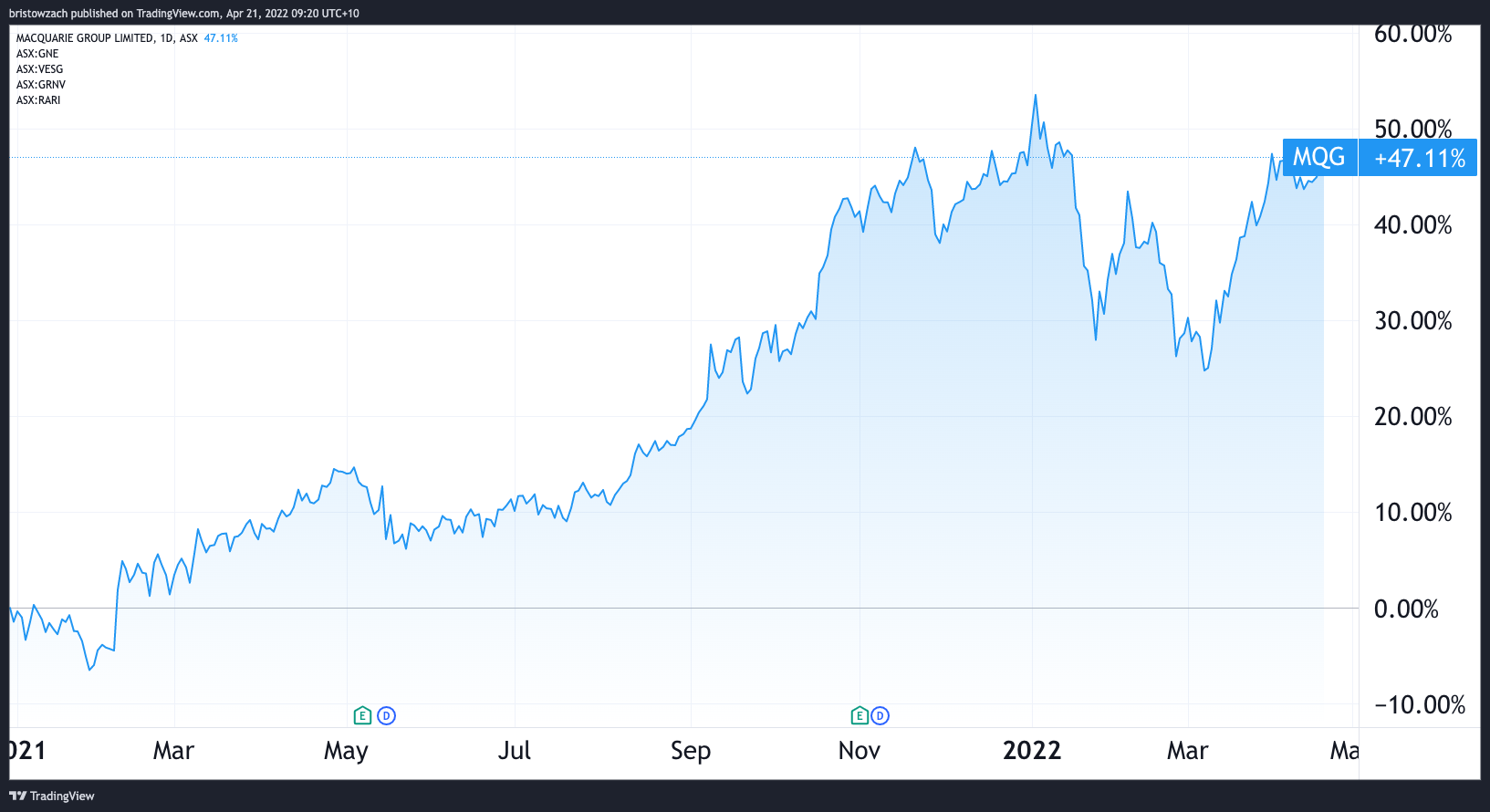
    Shares in Macquarie Group Ltd (ASX: MQG) have leapt higher in recent weeks to trade at $206.67 before the open on Thursday.

    After a rough period of volatility, the investment bank has clawed back gains and is now tracking towards its 52-week high of $215.

    TradingView Chart

    Can Macquarie’s share price run higher?

    One broker has priced in roughly 10% more upside for Macquarie shares this year. JP Morgan values the bank at $227 per share, after revising its price target up from $223/share in a recent note.

    “[Macquarie’s] guidance for commodities income to be “significantly up on FY21” was given prior to the recent spike in energy prices,” the broker shared.

    “Since then, international events have contributed to much higher natural gas price volatility, which should provide strong support to trading income.”

    As such it now projects the bank’s commodities income to spike 27% in FY22 to $3.4 billion, with a slight drop to $2.6 billion the following year.

    All-in-all, the broker tips FY22 to be a bolster year for Macquarie, locking in tidy profits if all goes according to plan.

    Recent acquisitions and structural demand for alternative investments are also catalysts for Macquarie’s various operating segments, it says.

    “Growth should be supported by significant deployment of capital into all operating divisions given a healthy capital surplus,” analysts added.

    “We still see modest upside to our valuation, particularly given our forecast of >15% Return on Equity (ROE) in FY22-24′”.

    At $227 per share JP Morgan’s valuation rests above the consensus price target for Macquarie of $220.54, but Jefferies and Morgan Stanley both value the bank at $245 per share, according to Bloomberg data.

    In the last 12 months the Macquarie share price has climbed 32% and is up 6% this past month.

    The post Why this broker tips the Macquarie share price to clip $227 this year appeared first on The Motley Fool Australia.

    Should you invest $1,000 in Macquarie Group right now?

    Before you consider Macquarie Group, you’ll want to hear this.

    Motley Fool Investing expert Scott Phillips just revealed what he believes are the 5 best stocks for investors to buy right now… and Macquarie Group wasn’t one of them.

    The online investing service he’s run for over a decade, Motley Fool Share Advisor, has provided thousands of paying members with stock picks that have doubled, tripled or even more.* And right now, Scott thinks there are 5 stocks that are better buys.

    *Returns as of January 13th 2022

    More reading

    Motley Fool contributor Zach Bristow has no position in any of the stocks mentioned. The Motley Fool Australia’s parent company Motley Fool Holdings Inc. has no position in any of the stocks mentioned. The Motley Fool Australia has recommended Macquarie Group Limited. The Motley Fool has a disclosure policy. This article contains general investment advice only (under AFSL 400691). Authorised by Bruce Jackson.

    from The Motley Fool Australia https://ift.tt/3MVuQSX

  • Why are EML shares attracting so much short interest in April?

    A short boy wearing big glasses stands next to a measuring stick with his hand on his head wondering if he'll ever stop being short, similar to the Polynovo share price which is among the most shorted shares on the ASX right nowA short boy wearing big glasses stands next to a measuring stick with his hand on his head wondering if he'll ever stop being short, similar to the Polynovo share price which is among the most shorted shares on the ASX right now

    Shares in EML Payments Ltd (ASX: EML) have levelled off after a short-lived recovery in March. From the beginning of last month, EML shares thrust off a low of $2.20 per share and raced north to touch the ceiling at $3.01 apiece.

    Since, prices have taken a step backward and rest at $2.80 per share before the open of trade on Thursday.

    The shortened week has done nothing to save EML’s stock either, with the share price sliding more than 13% since trading restated in January.

    EML also leads the list of companies with the largest amount of short interest as a percentage of free float, and its been embroiled in a takeover drama with private equity giant Bain Capital.

    Before the open on Thursday, EML has a short interest ratio of 15.2 with more than 34.5 million shares in the hands of short sellers. It hit a high of 33.5 two weeks ago. As such, 9.2% of its shares are under short interest.

    TradingView Chart

    Why are investors bearish on EML?

    Interestingly, bearish wagers on ASX names has increased over the past few weeks, and again week-on-week to Wednesday.

    “Total Australian short interest [was] A$21.5 billion vs. A$21.3 billion last week; [whilst] bearish bets [were] equivalent to approximately 1.08% of equity float,” according to Bloomberg Intelligence, from internal calculations.

    Of the entire market, consumer discretionary and information technology sectors are most shorted, with 2.4% of short interest in each segment, Bloomberg data shows.

    Arguably, both of these industries have spillover into EML, considering its a technology-based payments company that relies on customer transactions to generate operating income.

    In fact a quick check sees that these 3 ‘instruments’, let’s call them, have moved in almost unison since October last year.

    TradingView Chart

    Last week, EML released a statement advising it had been in talks with Bain Capital last year for a purported buyout.

    As TMF reported at the time, Bain walked away “because of the high price tag after looking at the due diligence numbers.”

    “The board of EML said that it would always consider proposals presented to the company and that it’s fully committed to acting in the best interests of shareholders. The goal of EML’s board is to maximise value for shareholders,” it was reported.

    Investors weren’t galvanised by the outcome and refused to allocate more capital to EML shares, meaning the stock remains in the lurch for 2022.

    Ron Shamgar of Tamim Asset Management appeared to see the reasoning behind Bain’s decision, in a post last week.

    “If ASX investors won’t value businesses properly, then others will take them off their hands and reap the rewards over time!” he wrote.

    The EML share price is down more than 49% in the last 12 months despite a 14% surge over the past single month.

    The post Why are EML shares attracting so much short interest in April? appeared first on The Motley Fool Australia.

    These 5 Cheap Shares Could Be Set For Huge Gains (FREE REPORT)

    We hear it over and over from investors, “I wish I had bought Altium or Afterpay when they were first recommended by The Motley Fool. I’d be sitting on a gold mine!” And it’s true.

    And while Altium and Afterpay have had a good run, we think these 5 other stocks are screaming buys. And you can find out the names of these stocks in the FREE stock report.

    *Extreme Opportunities returns as of February 15th 2021

    More reading

    Motley Fool contributor Zach Bristow has no position in any of the stocks mentioned. The Motley Fool Australia’s parent company Motley Fool Holdings Inc. owns and has recommended EML Payments. The Motley Fool Australia owns and has recommended EML Payments. The Motley Fool has a disclosure policy. This article contains general investment advice only (under AFSL 400691). Authorised by Bruce Jackson.

    from The Motley Fool Australia https://ift.tt/SDk6IO5