Tag: Motley Fool

  • Jumbo (ASX:JIN) share price edges lower following $12.7m founder share sale

    jumbo share pricejumbo share price

    The Jumbo Interactive Ltd (ASX: JIN) share price is in reverse despite the S&P/ASX 200 Index (ASX: XJO) lifting today.

    At the time of writing, the lottery ticket seller’s shares are swapping hands for $18.77, down 0.79%.

    In contrast, the benchmark index is trading at 7,524.9 points, up 0.42%.

    Jumbo shares retreat

    Investors appear uneased by the company’s latest announcement, sending the Jumbo share price into negative territory.

    According to the release, Jumbo CEO and founder, Mike Veverka sold $12.7 million of his Jumbo shares between 28 March and 1 April.

    In total, 688,455 Jumbo shares were offloaded in an on-market trade for an average price of $18.42 per share.

    Whilst this isn’t uncommon as CEOs sell for various reasons, the company noted the sale was driven by “diversification purposes”.

    The transaction represents roughly 1.1% of Jumbo’s share registry and reduced Mr Veverka’s entire holding to around 8.85 million shares. This equates to 14.1% of the total issued capital.

    Furthermore, the company noted that Mr Veverka intends to remain a substantial and long-term shareholder of Jumbo.

    In addition, the CEO noted he has no plans to sell any more of his Jumbo shares within the next 12 months.

    Mr Veverka commented:

    I remain fully committed to leading Jumbo through the exciting future ahead.

    The global lottery industry continues to grow, underpinned by the ongoing structural shift to digital and Jumbo is uniquely placed to help our lottery partners and clients through this change by providing our best-in-class lottery software and our continuously improving player experience.

    It’s worth noting that Mr Veverka spent almost $100,000 on 23 February, buying 5,680 Jumbo shares through an on-market trade. This was a day after the company’s shares slumped to $17.04 following its 52-week high of $19.94 on 9 February.

    Jumbo share price snapshot

    Despite today’s slight drop, the Jumbo share price is up 43% over the last 12 months.

    Although the same can’t be said when looking at year to date, with the company’s shares down 2%.

    Based on today’s price, Jumbo commands a market capitalisation of approximately $1.18 billion, with about 62.76 million shares on hand.

    The post Jumbo (ASX:JIN) share price edges lower following $12.7m founder share sale appeared first on The Motley Fool Australia.

    Should you invest $1,000 in Jumbo right now?

    Before you consider Jumbo, you’ll want to hear this.

    Motley Fool Investing expert Scott Phillips just revealed what he believes are the 5 best stocks for investors to buy right now… and Jumbo wasn’t one of them.

    The online investing service he’s run for over a decade, Motley Fool Share Advisor, has provided thousands of paying members with stock picks that have doubled, tripled or even more.* And right now, Scott thinks there are 5 stocks that are better buys.

    *Returns as of January 13th 2022

    More reading

    Motley Fool contributor Aaron Teboneras has no position in any of the stocks mentioned. The Motley Fool Australia’s parent company Motley Fool Holdings Inc. owns and has recommended Jumbo Interactive Limited. The Motley Fool Australia has recommended Jumbo Interactive Limited. The Motley Fool has a disclosure policy. This article contains general investment advice only (under AFSL 400691). Authorised by Bruce Jackson.

    from The Motley Fool Australia https://ift.tt/jK32AJc

  • The Santos share price has gained 26% this year. Is it too late to buy?

    a group of four engineers stand together smiling widely wearing hard hats, overalls and protective eye glasses with the setting of a refinery plant in the background.a group of four engineers stand together smiling widely wearing hard hats, overalls and protective eye glasses with the setting of a refinery plant in the background.

    The Santos (ASX: STO) share price has had a brilliant start to the year, but could it still be a buying opportunity?

    Santos shares have gained 25.52% since the start of 2022 and are currently trading at $7.93, a 0.38% gain on Friday’s close.

    Let’s take a look at how experts rate the Santos share price.

    Could the Santos share price still gain more?

    Analysts at Morgan Stanley have retained their overweight rating on the share with a $10.40 price target. That’s 31% more than the current share price. Following the release of Santos’s climate report on Wednesday, Morgan Stanley highlighted the company’s carbon credit plans could help it create new revenue streams.

    Meanwhile, Wavestone Capital principal and portfolio manager Raaz Bhuyan marked Santos as a company with a management team that stands out, in a Livewire episode of Buy Hold Sell. Bhuyan noted Santos is trying to bring down its carbon footprint while growing production. He added:

    We’ve owned Santos and Kevin Gallagher who’s the CEO – and has been the CEO since 2016 – has done an exceptional job. He obviously bought Oil Search right before the oil price took off. He’s got a diversified business. He’s done an exceptional job with the way he’s taking the business forward.

    Perpetual portfolio manager James Rutledge agrees. He said Gallagher has done a great job taking out costs in the business since 2016. He also added the following assessment:

    He has ‘high-graded’ the portfolio through the acquisition of the Oil Search assets. He needs to divest some assets and improve the free cash flow over the medium term, but we will back him to do it.

    Santos share price snapshot

    The Santos share price has climbed 11.24% in the past 12 months while it has gained 1% in a month.

    In comparison, S&P/ASX 200 Index (ASX: XJO) has returned 10% in the past year.

    In the last week, Santos shares have slid marginally — down by 0.25%.

    Santos has a market capitalisation of about $26.8 billion based on the current share price.

    The post The Santos share price has gained 26% this year. Is it too late to buy? appeared first on The Motley Fool Australia.

    Wondering where you should invest $1,000 right now?

    When investing expert Scott Phillips has a stock tip, it can pay to listen. After all, the flagship Motley Fool Share Advisor newsletter he has run for over ten years has provided thousands of paying members with stock picks that have doubled, tripled or even more.*

    Scott just revealed what he believes could be the five best ASX stocks for investors to buy right now. These stocks are trading at near dirt-cheap prices and Scott thinks they could be great buys right now.

    *Returns as of January 12th 2022

    More reading

    The Motley Fool Australia’s parent company Motley Fool Holdings Inc. has no position in any of the stocks mentioned. The Motley Fool Australia has no position in any of the stocks mentioned. The Motley Fool has a disclosure policy. This article contains general investment advice only (under AFSL 400691). Authorised by Bruce Jackson.

    from The Motley Fool Australia https://ift.tt/7m8nCa0

  • Why dividend stocks with low payout ratios can be better than those with high yields

    This article was originally published on Fool.com. All figures quoted in US dollars unless otherwise stated.

    a man sits in a home environment on a sofa while writing in a book with a pen, a plant on the table nearby and curtains open in the background.

    This article was originally published on Fool.com. All figures quoted in US dollars unless otherwise stated.

    Dividend-paying stocks in the S&P 500 have historically outperformed their non-dividend-paying index peers. Dividend-growing companies in the index have performed even better. 

    So should we buy the highest-yielding dividend-growth stocks in the S&P 500 and call it a day?

    Maybe, but there is one last (and less popular) metric that has historically led to outperformance — the payout ratio. Specifically, dividend-growing stocks that maintain a payout ratio below 50% help create the exact type of stocked pond people like to fish in, offering investors a healthy balance between returning cash to shareholders and funding company growth.

    As a result, it’s not the top quintile of highest-yield stocks (and their 74% average payout ratio) that outperform at the highest rate, but the second quintile (and its 41% average payout ratio), according to data from Wellington Management.

    Let’s find out what this means for investors interested in optimizing their dividend strategy.

    High-yield dividends, low growth prospects

    While high-yield dividend stocks may be alluring at first glance, many tend to have higher payout ratios. The payout ratio is a stock’s dividend payout as a percentage of its net income, and it can quickly tell investors how much of a company’s profits are going directly back to shareholders.

    When these high-yield stocks continue to increase their dividend payments over time, they eventually begin to test the limits of their financial security, paying out bigger portions of their earnings.

    High payout ratios typically mean two things.

    First, the company will have less money to reinvest back into the business, spending which could have fueled future sales growth, eventually growing the bottom line. Sales growth is a strong indicator of a stock’s long-term performance, putting companies with high payout ratios at a disadvantage thanks to their hampered growth prospects.

    Furthermore, if a company has a high payout ratio, its dividend growth potential is similarly restricted — or worse yet, it may need to cut its payout to maintain financial security. While dividend cuts are far from death knells (sometimes even wise decisions), they generally lead to a sell-off in the stock as income-focused investors flee.

    S&P 500 companies that cut their dividend not only underperformed their peers over a 48-year period but produced a negative annual return overall, reinforcing the importance of a well-funded dividend.

    Low payout ratios, long-term growth potential

    On the flip side, stocks with low payout ratios offer a balanced approach between returning cash to shareholders and funding future growth. Thanks to this extra cash available to reinvest in the business, a flywheel effect can take hold.

    First, a portion of the excess profits go back into the business, creating new sales that flow through to the bottom line. With this rising net income, the company can increase its dividend, often without raising its payout ratio as profits and dividends paid out rise at a similar rate.

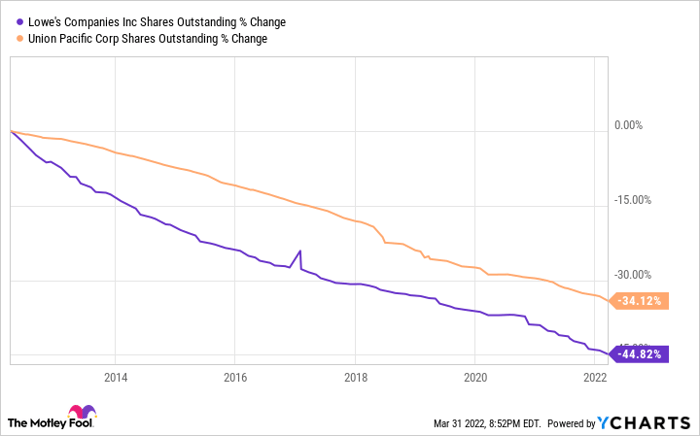
    Additionally, if the company still has earnings to spare, management can also consider lowering its share count through share repurchase programs. For example, consider the declining share counts for two great low payout ratio stocks, Lowe’s and Union Pacific.

    LOW Shares Outstanding Chart

    Data by YCharts.

    Despite the capital required to maintain their respective operations, these two have not only funded many years of annual dividend increases but rapidly lowered their total shares outstanding over the last decade. Fewer shares make the dividends cheaper to maintain while boosting earnings per share (EPS) — furthering the flywheel effect.

    Because of these benefits, looking for low payout ratios over high yields is akin to choosing longer-term cash flow potential over higher near-term income. 

    The best of both worlds

    Best yet for investors, a handful of stocks offer relatively high dividend yields and low payout ratios. Let’s look at three here:

    MetricCumminsIntelTarget
    Dividend yield2.9%3.0%1.7%
    Payout ratio38.3%28.6%22.4%
    Maximum dividend potential7.6%10.5%7.6%
    Consecutive years of dividend increases81953

    Source: Yahoo! Finance. Maximum dividend potential = dividend yield/payout ratio. 

    Notice that despite not having the highest dividend yield, Intel has the highest maximum dividend potential based on its dividend yield divided by its payout ratio. Similarly, Target has a dividend yield about one percentage point lower than Cummins, but they have comparable maximums.

    I bring these three companies up to illuminate the power of a low payout ratio. Yes, you may be sacrificing some near-term dividend income by forgoing high-yield stocks, but your long-term dividend potential should one day dwarf that high initial income if you hold for the long haul.

    This article was originally published on Fool.com. All figures quoted in US dollars unless otherwise stated.

    The post Why dividend stocks with low payout ratios can be better than those with high yields appeared first on The Motley Fool Australia.

    Wondering where you should invest $1,000 right now?

    When investing expert Scott Phillips has a stock tip, it can pay to listen. After all, the flagship Motley Fool Share Advisor newsletter he has run for over ten years has provided thousands of paying members with stock picks that have doubled, tripled or even more.*

    Scott just revealed what he believes could be the five best ASX stocks for investors to buy right now. These stocks are trading at near dirt-cheap prices and Scott thinks they could be great buys right now.

    *Returns as of January 12th 2022

    More reading

    Josh Kohn-Lindquist has no position in any of the stocks mentioned. The Motley Fool owns and recommends Intel. The Motley Fool recommends Cummins, Lowe’s, and Union Pacific and recommends the following options: long January 2023 $57.50 calls on Intel and short January 2023 $57.50 puts on Intel. The Motley Fool has a disclosure policy.

    This article was originally published on Fool.com. All figures quoted in US dollars unless otherwise stated.


    from The Motley Fool Australia https://ift.tt/P3zfcJX
  • Here’s why the Sayona (ASX:SYA) share price is surging 34% on Monday

    A group of people in suits and hard hats celebrate the rising BHP share price with champagne.A group of people in suits and hard hats celebrate the rising BHP share price with champagne.

    The Sayona Mining Ltd (ASX: SYA) share price is rocketing higher on more positive spodumene testing results.

    Lithium hydroxide made from the company’s Authier spodumene product has been found to be of the same quality as commercial battery-grade material.

    At the time of writing, the Sayona share price is 33.5 cents, 34% higher than its previous close.

    However, that’s fallen from its intraday – and new 52-week — high of 34 cents. That represented a 36% increase.

    Let’s take a closer look at today’s news from the emerging lithium producer.

    Positive test results send Sayona shares soaring 34%

    The Sayona share price is launching upwards after testing conducted by lithium-ion battery technology giant Novonix Ltd (ASX: NVX) confirmed the quality of the company’s spodumene product.

    Scientists at Novonix have found the discharge capacity of cathode cells made using lithium hydroxide from Sayona’s spodumene concentrates was the same as benchmark cathode cells.

    The spodumene concentrate was produced at the company’s Authier Lithium Project – located in Québec, Canada.

    The company states the results show its Authier product performs as well as commercially available battery-grade lithium hydroxide.

    Additionally, when combined with Québec’s hydroelectric power, the company’s product comes with environmental competitive advantages.

    The positive results from Novonix’s testing follow analysis completed at CSIRO’s Mineral Resources Laboratories in Perth.

    There, Authier spodumene was found to be able to be processed into high purity, 99.99% lithium hydroxide.

    Sayona managing director Brett Lynch said the results further verify that Authier spodumene is suitable to be converted into highly demanded lithium hydroxide.

    “Sayona has committed to downstream processing in Québec, including lithium carbonate or hydroxide,” Lynch continued.

    “These results by an industry-leading battery tester have further increased confidence in our strategy.”

    Also potentially boosting the Sayona share price today, the company has updated the market on its recent activities.

    Drilling at its Moblan Lithium Project is ongoing and expected to finish in the middle of this month. The results are predicted to expand Sayona’s lithium resource base.

    Additionally, Sayona was recently added to the S&P/ASX 300 Index (ASX: XKO). The company said its inclusion followed significant growth in its market value, which is expected to increase institutional investments in Sayona.

    “Sayona has made an extremely bright start to 2022, despite significant geopolitical and market instability, amid a continued focus on the electrification of transport to curb emissions,” said Lynch. 

    Sayona share price snapshot

    Today’s gains have boosted the Sayona share price even higher into the ASX green.

    Right now, the company’s stock is trading for 157% more than it was at the start of 2022. It has also gained 807% over the last 12 months.

    The post Here’s why the Sayona (ASX:SYA) share price is surging 34% on Monday appeared first on The Motley Fool Australia.

    Should you invest $1,000 in Sayona right now?

    Before you consider Sayona, you’ll want to hear this.

    Motley Fool Investing expert Scott Phillips just revealed what he believes are the 5 best stocks for investors to buy right now… and Sayona wasn’t one of them.

    The online investing service he’s run for over a decade, Motley Fool Share Advisor, has provided thousands of paying members with stock picks that have doubled, tripled or even more.* And right now, Scott thinks there are 5 stocks that are better buys.

    *Returns as of January 13th 2022

    More reading

    Motley Fool contributor Brooke Cooper has no position in any of the stocks mentioned. The Motley Fool Australia’s parent company Motley Fool Holdings Inc. has no position in any of the stocks mentioned. The Motley Fool Australia has no position in any of the stocks mentioned. The Motley Fool has a disclosure policy. This article contains general investment advice only (under AFSL 400691). Authorised by Bruce Jackson.

    from The Motley Fool Australia https://ift.tt/H0iVUEB

  • Perpetual (ASX:PPT) share price halted amid Pendal takeover bid

    a woman wearing a dark business suit holds her hand up in a stop gesture while sitting at a desk. She has a sombre look on her face.a woman wearing a dark business suit holds her hand up in a stop gesture while sitting at a desk. She has a sombre look on her face.

    The Perpetual Ltd (ASX: PPT) share price is frozen during Monday morning following the company’s $2.4 billion takeover offer.

    At the time of writing, the fund manager’s shares are halted from Friday’s closing price of $34.23.

    What’s going on with Perpetual shares?

    Investors will have to wait for a pending announcement by the company before Perpetual shares open up for trading.

    Earlier today, Pendal Group Ltd (ASX: PDL) advised that it received a conditional, non-binding indicative proposal from Perpetual.

    The latter is hoping to acquire 100% of Pendal shares by way of a scheme of arrangement.

    According to the details, the indicative proposal has valued $6.23 per Pendal share based on its closing price on Friday. This represents a 35.4% premium to its 30-day volume weighted average price prior to 1 April.

    The consideration is for 1 Perpetual share for every 7.5 Pendal shares, along with a $1.67 cash offer for each Pendal share owned.

    While the Pendal board is assessing the offer, Perpetual is preparing to release its own statement to the ASX.

    It’s worth noting that the proposal from Perpetual is subject to a number of conditions that need to be met. This includes due diligence, negotiation and execution of transaction documentation, regulatory approvals and no material adverse change to Pendal.

    Perpetual share price snapshot

    A rollercoaster 12 months has led the Perpetual share price to register a 3% gain for the period.

    However, after touching a 52-week low of $31.96 in late January, the company’s shares are down 5% year to date.

    Perpetual has a price-to-earnings (P/E) ratio of 28.84 and commands a market capitalisation of roughly $1.94 billion.

    The post Perpetual (ASX:PPT) share price halted amid Pendal takeover bid appeared first on The Motley Fool Australia.

    Should you invest $1,000 in Perpetual right now?

    Before you consider Perpetual, you’ll want to hear this.

    Motley Fool Investing expert Scott Phillips just revealed what he believes are the 5 best stocks for investors to buy right now… and Perpetual wasn’t one of them.

    The online investing service he’s run for over a decade, Motley Fool Share Advisor, has provided thousands of paying members with stock picks that have doubled, tripled or even more.* And right now, Scott thinks there are 5 stocks that are better buys.

    *Returns as of January 13th 2022

    More reading

    Motley Fool contributor Aaron Teboneras has no position in any of the stocks mentioned. The Motley Fool Australia’s parent company Motley Fool Holdings Inc. has no position in any of the stocks mentioned. The Motley Fool Australia has no position in any of the stocks mentioned. The Motley Fool has a disclosure policy. This article contains general investment advice only (under AFSL 400691). Authorised by Bruce Jackson.

    from The Motley Fool Australia https://ift.tt/E0mltuI

  • These were the best and worst performing ASX sectors in March

    A woman wearing green flexes her bicep.A woman wearing green flexes her bicep.

    The S&P/ASX 200 Index (ASX: XJO) rallied strongly in March, but some ASX sectors did particularly well.

    ASX shares gained nearly 7% in the month, which was around 320 basis points ahead of the S&P 500 Index, according to Macquarie Group.

    The outperformance was even starker compared to the 7.7% crash in the MSCI China Index.

    Best performing ASX sector in March

    ASX technology shares were the best performing sector in March as the group gained over 13%. Bargain hunting was a key driver for tech shares, as many had tumbled hard in the first two months of 2022.

    For instance, the Block Inc CDI (ASX: SQ2) share price surged over 19%, while the WiseTech Global Ltd (ASX: WTC) share price added 17%.

    The Computershare Limited (ASX: CPU) share price was another standout last month.

    “CPU (+14%) was also an outperformer in March, supported by the rise in bond yields,” said Macquarie.

    “While strong, the returns from Technology have less impact on the overall market return as the sector accounts for <4% of the index (vs ~28% for the S&P 500).”

    ASX sectors contributing the most index points last month

    This means it was up to ASX mining shares and ASX bank shares to do the heavy lifting. Both of these ASX sectors were the largest contributors to the rise in the ASX 200 and All Ordinaries Index (ASX: XAO).

    “We think Banks and Resources are benefiting from increased global interest, and that an increased allocation to Australian equities could come at the expense of markets with higher geopolitical risk (e.g. China) and/or net importers of commodities (e.g. Europe),” added Macquarie.

    The ASX energy sector also contributed to the outperformance of our market. Russia’s invasion of Ukraine has turned the energy market on its head. Russia is one of the largest oil and gas suppliers, and global sanctions threaten to cut off this major supply source.

    Big earnings upgrades

    The big run-up in energy and other commodities prompted Macquarie to double its ASX FY22 earnings per share growth estimate to 26%. This is due to upgrades for ASX resources shares.

    On the flip side, the worst-performing ASX sector in March is real estate, noted Macquarie. This is due mainly to rising bond yields, although it may be too early to throw in the towel.

    Don’t count the worst-performing ASX sector out yet

    “We note 2021 also saw a sharp bond yield spike early in the year, but that rebalancing of portfolios at the start of 2Q21 led to a decline in bond yields,” said Macquarie.

    “We think this could occur again, especially if we are right that there is a growth scare over the next 3-6 months, as global policy tightening, and high commodity prices are US growth headwinds.”

    While this ASX sector may have been out of favour last month, at least it still managed a 1% plus gain.

    The post These were the best and worst performing ASX sectors in March appeared first on The Motley Fool Australia.

    Wondering where you should invest $1,000 right now?

    When investing expert Scott Phillips has a stock tip, it can pay to listen. After all, the flagship Motley Fool Share Advisor newsletter he has run for over ten years has provided thousands of paying members with stock picks that have doubled, tripled or even more.*

    Scott just revealed what he believes could be the five best ASX stocks for investors to buy right now. These stocks are trading at near dirt-cheap prices and Scott thinks they could be great buys right now.

    *Returns as of January 12th 2022

    More reading

    Motley Fool contributor Brendon Lau owns Block, Inc. and Macquarie Group Limited. The Motley Fool Australia’s parent company Motley Fool Holdings Inc. owns and has recommended Block, Inc. and WiseTech Global. The Motley Fool Australia owns and has recommended Block, Inc. and WiseTech Global. The Motley Fool Australia has recommended Macquarie Group Limited. The Motley Fool has a disclosure policy. This article contains general investment advice only (under AFSL 400691). Authorised by Bruce Jackson.

    from The Motley Fool Australia https://ift.tt/s4SfGWk

  • Own AMP shares? Here’s how this ASX company did in March

    a man holds his hand under his chin as he concentrates on his laptop screen and makes a concerned face.

    a man holds his hand under his chin as he concentrates on his laptop screen and makes a concerned face.

    The AMP Limited (ASX: AMP) share price hasn’t exactly made a name for itself as a strong ASX performer. The financial services company is up a robust 1.57% at 97 cents a share at the time of writing.

    But over the past five years, the picture is shockingly bleak. Since April 2017, AMP shares have lost more than 81% of their value. Although AMP has been dealing with a number of issues over a number of years, most of these losses came in the wake of the company’s exposed misconduct during the 2018 banking royal commission.

    But let’s not get too bogged down in the past and instead examine how this ASX 200 share fared over March, the month that has just passed.

    So AMP shares began March at a price of 95 cents. Last Thursday, the company finished the trading day at 97 cents per share. That translates into a March gain of 2.11% for AMP. In contrast, the S&P/ASX 200 Index (ASX: XJO) had a very successful month, rising by a pleasing 6.4%.

    So what might have prompted this more muted gain from AMP?

    AMP shares rise in March but lose to the ASX 200

    Well, we didn’t get a lot of news out of the company over March. Back in February, AMP seemingly disappointed investors when its half-year earnings came without a dividend. So that might have played a role last month too.

    Perhaps the biggest piece of March news came just last week. Last Monday, AMP announced that it had successfully finalised the sale of its Global Equities and Fixed Income division to Macquarie Group Ltd (ASX: MQG).

    Although this sale was first gazetted last year, it represents a milestone for the company as it helps set up AMP for the planned demerger of its Collimate Capital division. The sale to Macquarie Asset Management will see roughly $47 billion in assets under management transferred to Macquarie. In return, AMP will receive $63 million in cash, with the possibility of another $75 million down the road, depending on some conditions.

    Still, this news had little impact on AMP shares at the time, although the company’s share price has risen since this announcement was released. But even so, shareholders will no doubt welcome the gain AMP shares saw over March.

    At the current AMP share price, this ASX 200 financials share has a market capitalisation of $3.16 billion.

    The post Own AMP shares? Here’s how this ASX company did in March appeared first on The Motley Fool Australia.

    Should you invest $1,000 in AMP right now?

    Before you consider AMP, you’ll want to hear this.

    Motley Fool Investing expert Scott Phillips just revealed what he believes are the 5 best stocks for investors to buy right now… and AMP wasn’t one of them.

    The online investing service he’s run for over a decade, Motley Fool Share Advisor, has provided thousands of paying members with stock picks that have doubled, tripled or even more.* And right now, Scott thinks there are 5 stocks that are better buys.

    *Returns as of January 13th 2022

    More reading

    Motley Fool contributor Sebastian Bowen has no position in any of the stocks mentioned. The Motley Fool Australia’s parent company Motley Fool Holdings Inc. has no position in any of the stocks mentioned. The Motley Fool Australia has recommended Macquarie Group Limited. The Motley Fool has a disclosure policy. This article contains general investment advice only (under AFSL 400691). Authorised by Bruce Jackson.

    from The Motley Fool Australia https://ift.tt/8n3ACcw

  • ASX 200 (ASX:XJO): Perpetual makes Pendal offer, Iluka hits record high

    A male sharemarket analyst sits at his desk looking intently at his laptop with two other monitors next to him showing stock price movements

    A male sharemarket analyst sits at his desk looking intently at his laptop with two other monitors next to him showing stock price movements

    At lunch on Monday, the S&P/ASX 200 Index (ASX: XJO) is on course to start the week on a positive note. The benchmark index is currently up 0.45% to 7,528 points.

    Here’s what is happening on the ASX 200 today:

    Perpetual makes Pendal takeover offer

    The Pendal Group Ltd (ASX: PDL) share price is shooting higher today after Perpetual Limited (ASX: PPT) made a takeover offer. According to the release, Perpetual has tabled the equivalent of a $6.23 per share scrip and cash takeover proposal to acquire its fellow fund manager. This values Pendal at $2.4 billion, which is actually greater than Perpetual’s own market capitalisation of ~$2 billion.

    Domain shares return

    The Domain Holdings Australia Ltd (ASX: DHG) share price has returned from its trading halt after completing the institutional component of its entitlement offer. Domain raised $162 million from institutional investors and will now seek a further $18 million from retail shareholders. These funds are being used to acquire Realbase. It is a leading campaign management technology platform in the Australia and New Zealand region.

    Iluka shares

    The Iluka Resources Limited (ASX: ILU) share price hit a record high this morning. This was driven by the mineral sands and rare earths company announcing a final investment decision on phase three of the Eneabba Rare Earths Refinery. Iluka will push ahead with phase three after its feasibility study demonstrated solid economics and significant potential for growth.

    Best and worst ASX 200 performers

    The best performer on the ASX 200 on Monday has been the Pendal share price with a 20% gain following the aforementioned takeover approach. The worst performer on the index has been the Bank of Queensland Limited (ASX: BOQ) share price with a 3% decline. This is despite there being no news out of the regional bank. Though, it is worth noting that Macquarie downgraded its shares to a neutral rating on Friday.

    The post ASX 200 (ASX:XJO): Perpetual makes Pendal offer, Iluka hits record high appeared first on The Motley Fool Australia.

    Wondering where you should invest $1,000 right now?

    When investing expert Scott Phillips has a stock tip, it can pay to listen. After all, the flagship Motley Fool Share Advisor newsletter he has run for over ten years has provided thousands of paying members with stock picks that have doubled, tripled or even more.*

    Scott just revealed what he believes could be the five best ASX stocks for investors to buy right now. These stocks are trading at near dirt-cheap prices and Scott thinks they could be great buys right now.

    *Returns as of January 12th 2022

    More reading

    Motley Fool contributor James Mickleboro has no position in any of the stocks mentioned. The Motley Fool Australia’s parent company Motley Fool Holdings Inc. has no position in any of the stocks mentioned. The Motley Fool Australia has no position in any of the stocks mentioned. The Motley Fool has a disclosure policy. This article contains general investment advice only (under AFSL 400691). Authorised by Bruce Jackson.

    from The Motley Fool Australia https://ift.tt/nyJqMRh

  • Wesfarmers share price in the green amid overhaul news

    three businessmen stand in silhouette against a window of an office with papers displaying graphs and office documents on a desk in the foreground.three businessmen stand in silhouette against a window of an office with papers displaying graphs and office documents on a desk in the foreground.

    The Wesfarmers Ltd (ASX: WES) share price is higher this morning as the company shakes up the management of its Catch business.

    The underperforming online marketplace is set to move from the company’s retail segment to its shiny new digital and data division.

    The change has spurred Catch managing director, Pete Sauerborn, to walk away from the business.

    At the time of writing, the Wesfarmers share price is $49.60, 0.02% higher than its previous close.

    For context, the S&P/ASX 200 Index (ASX: XJO) is currently up 0.42%. Meanwhile, the S&P/ASX Consumer Discretionary Index (ASX: XDJ) has slipped 0.37%.

    Let’s take a closer look at the future of Wesfarmers’ online marketplace.

    Wesfarmers’ OneDigital bags a new Catch

    The Wesfarmers share price is in the green on Monday amid news the company is reshuffling its Catch business as part of a transformative divisional shakeup.

    Wesfarmers has been alluding to a new digital and data division led by Nicole Sheffield for some time now.

    Now, more details on the division – to be named OneDigital ­– have been released. They include Catch’s move from Wesfarmers’ Kmart Group to OneDigital from 1 July.

    OneDigital is already home to Catch’s recently rebranded subscription program, OnePass, as well as Wesfarmers’ Advanced Analytics Centre.

    Following the announcement of the move, Sauerborn has decided to leave the business. His position will be filled in the coming months.

    Wesfarmers managing director, Rob Scott said the shakeup will see all the company’s digital pure plays housed under one roof. He continued:

    Each of our divisions is developing significant capabilities in data analytics and digital services to meet the specific needs of their customers.

    Wesfarmers OneDigital will complement these divisional capabilities … The Catch marketplace, together with the OnePass subscription program and the Advanced Analytics Centre, provide a strong foundation for Wesfarmers OneDigital.

    This will support the growth and performance of our retail divisions while providing new growth opportunities for the group.

    The move comes as the online marketplace struggles following a pandemic-related boom.

    Catch brought in $315 million of revenue over the first half of financial year 2022 – 4.3% less than it did in the prior comparable period.

    Its earnings before interest, tax, depreciation, and amortisation (EBITDA) loss also deepened last half. It fell from a $4 million loss to a $30 million loss.

    Meanwhile, Catch’s gross transaction value increased 1%.

    The market will hear more of Wesfarmers’ OneDigital division during the company’s strategy briefing day in June.

    Wesfarmers share price snapshot

    The Wesfarmers share price has been struggling through 2022 so far.

    It has slipped 17% year to date. It’s also nearly 7% lower than it was this time last year.

    For comparison, the ASX 200 has fallen 0.8% year to date and has gained 9% over the last 12 months.

    The post Wesfarmers share price in the green amid overhaul news appeared first on The Motley Fool Australia.

    Should you invest $1,000 in Wesfarmers right now?

    Before you consider Wesfarmers, you’ll want to hear this.

    Motley Fool Investing expert Scott Phillips just revealed what he believes are the 5 best stocks for investors to buy right now… and Wesfarmers wasn’t one of them.

    The online investing service he’s run for over a decade, Motley Fool Share Advisor, has provided thousands of paying members with stock picks that have doubled, tripled or even more.* And right now, Scott thinks there are 5 stocks that are better buys.

    *Returns as of January 13th 2022

    More reading

    Motley Fool contributor Brooke Cooper has no position in any of the stocks mentioned. The Motley Fool Australia’s parent company Motley Fool Holdings Inc. has no position in any of the stocks mentioned. The Motley Fool Australia owns and has recommended Wesfarmers Limited. The Motley Fool has a disclosure policy. This article contains general investment advice only (under AFSL 400691). Authorised by Bruce Jackson.

    from The Motley Fool Australia https://ift.tt/AekFB9s

  • Pendal (ASX:PDL) share price rockets 23% on $2.4b takeover approach

    An executive in a suit smooths his hair and laughs as he looks at his laptop feeling surprised and delighted by the VAS ETF share price gains on the ASXAn executive in a suit smooths his hair and laughs as he looks at his laptop feeling surprised and delighted by the VAS ETF share price gains on the ASX

    The Pendal Group Ltd (ASX: PDL) share price is rocketing on Monday after the company received a $2.4 billion takeover offer.

    At the time of writing, the fund manager’s shares are up 23.44% to $5.53 apiece.

    What the details of the Pendal takeover?

    Pendal shares have opened up with a bang as investors digest the company’s latest announcement.

    In its statement, Pendal advised that it has received a conditional, non-binding indicative proposal from Perpetual Ltd (ASX: PPT).

    The latter is seeking to acquire 100% of Pendal shares by way of a scheme of arrangement.

    According to the details, the indicative proposal is for a consideration of one Perpetual share for every 7.5 Pendal shares.

    Furthermore, each Pendal shareholder will receive $1.67 for every Pendal share owned prior to the takeover. This represents an indicative value of $6.23 per Pendal share based on the closing price of Perpetual shares last Friday.

    Should the proposed component of the scrip consideration follow through, Pendal shareholders would own approximately 48% of the merged entity.

    The indicative value of $6.23 also reflects a 35.4% premium to Pendal’s 30-day volume weighted average price up until 1 April.

    It’s worth noting that the proposal from Perpetual is subject to a number of conditions. These include due diligence, negotiation and execution of transaction documentation, receipt of all regulatory approvals (including ACCC and FIRB), and no adverse material change to Pendal’s operations.

    However, the Pendal board did note that the indicative proposal has been offered at a time where broader market volatility has disrupted global markets. This relates to recent geopolitical instability and the economic impacts of the ongoing COVID-19 pandemic.

    Nonetheless, the board has commenced an assessment of the indicative proposal, taking into account the strategic value of Pendal.

    While shareholders don’t need to do anything for now, Pendal advised it will update the market as developments occur.

    Pendal share price review

    Despite surging today, it has been a disappointing 12 months for Pendal shares, falling by almost 15%.

    Early last month, the company’s shares reached a 52-week low of $4.04 before staging a small rebound of late.

    Based on valuation grounds, Pendal commands a market capitalisation of roughly $2.12 billion, with approximately 383 million shares on hand.

    The post Pendal (ASX:PDL) share price rockets 23% on $2.4b takeover approach appeared first on The Motley Fool Australia.

    Should you invest $1,000 in Pendal right now?

    Before you consider Pendal, you’ll want to hear this.

    Motley Fool Investing expert Scott Phillips just revealed what he believes are the 5 best stocks for investors to buy right now… and Pendal wasn’t one of them.

    The online investing service he’s run for over a decade, Motley Fool Share Advisor, has provided thousands of paying members with stock picks that have doubled, tripled or even more.* And right now, Scott thinks there are 5 stocks that are better buys.

    *Returns as of January 13th 2022

    More reading

    Motley Fool contributor Aaron Teboneras has no position in any of the stocks mentioned. The Motley Fool Australia’s parent company Motley Fool Holdings Inc. has no position in any of the stocks mentioned. The Motley Fool Australia has no position in any of the stocks mentioned. The Motley Fool has a disclosure policy. This article contains general investment advice only (under AFSL 400691). Authorised by Bruce Jackson.

    from The Motley Fool Australia https://ift.tt/50MknmQ