Tag: Motley Fool

  • How the changed interest rate outlook is turbocharging shares vs. property

    Interest rates written on top of pictures of houses on a computer.Interest rates written on top of pictures of houses on a computer.

    As expected, the Reserve Bank (RBA) left interest rates on hold at 4.35% today, further stoking optimism that the rate hiking cycle may be over following a significant fall in inflation in the December quarter.

    Market optimism on rates was a primary driver of the Santa Rally in ASX shares and US shares at the end of 2023 after the US Federal Reserve hinted that it expected to start cutting rates in the new year.

    We then saw a new record high for the ASX 200 last Wednesday, which was superseded on Friday, as speculation grew that interest rates in Australia would also be cut in 2024, but later in the year.

    And we’ve just seen an amazing start to the 2024 auction season, with the second-highest number of homes going to auction since 2008 and an astounding preliminary national clearance rate of 74%.

    CoreLogic economist Kaytlin Ezzy says the possibility of rate cuts likely contributed to this very strong start.

    Why did the Reserve Bank keep interest rates on hold?

    In a statement released at 2.30pm, the Reserve Bank said higher interest rates were working to bring down economic demand, and household consumption growth was now weak.

    However, it left the door open to another rate hike, warning that inflation was still too high and it “needs to be confident that inflation is moving sustainably towards the target range” of 2% to 3%.

    This appears to have spooked investors today, with ASX 200 shares falling after the news and closing the session 0.58% lower.

    The Reserve Bank said:

    Inflation is still high, but we are making progress towards a better balance between supply and demand in the economy. While there are encouraging signs, the economic outlook is uncertain and the Board expects it will be some time before inflation is sustainably low and stable.

    The Board’s decision today balances the objectives of bringing inflation down while also preserving the gains in employment. The Board’s future decisions will depend upon the data and evolving risks, and a further increase in interest rates cannot be ruled out.

    However, NAB chief economist Alan Oster reckons the RBA is “pretty much done” with interest rate rises, according to news.com.au. Oster said the cash rate would now remain “on hold for quite a while”.

    Oster is not alone in his outlook on interest rates.

    In a recent note, CBA head economist Gareth Aird said he expects the next move on rates to be down, but the RBA may choose to keep a tightening bias in its communication strategy for a while.

    Aird explained:

    The Governor and Deputy Governor do not just communicate with market participants. They communicate with households, businesses and policymakers (i.e. government).

    Maintaining a tightening bias will signal to the fiscal authorities that it’s too early to declare the inflation fight over. The RBA would not wish to see fiscal settings loosened until further progress on inflation has been made towards the target band.

    CBA is tipping that the RBA will start cutting interest rates in September. NAB is tipping November.

    Aird said he expects total cuts of 75 basis points this year and another 75 points in the first half of 2025.

    The size of the annual inflation rate decline — from 5.4% in the September quarter to 4.1% in the December quarter — seems to have supercharged analysts’ confidence that rates will be cut.

    There are also expectations that the US Fed Reserve will cut rates in the US aggressively this year.

    How rates optimism is turbocharging shares vs. property

    ASX 200 shares beat their August 2021 high of 7,632.8 points last Wednesday when the index reached an intraday peak of 7,682.3 points.

    The ASX 200 index went even higher on Friday, clocking 7,703.6 at the intraday peak.

    As my Fool colleague Seb explained, investors are feeling confident due to falling inflation, continuing low unemployment, expectations of rate cuts later in the year, and surging US stocks.

    Meantime, Australian home values are continuing to rise in 2024, and the official auction season began with a bang on Saturday.

    CoreLogic data shows 1,671 homes went to auction across Australia’s combined capital cities on Saturday, which was the second-biggest auction season start since CoreLogic began tracking auctions in 2008.

    The high volume of auctions indicates greater confidence among sellers. This follows an extraordinary year in 2023 when we saw surprisingly strong rises in home values while interest rates were going up.

    Not only was it a big day in terms of auction numbers, but we also saw extraordinary clearance rates across the capital cities and in regional areas, too.

    A balanced market typically delivers an auction clearance rate of 60%. Anything higher indicates there is more demand than supply, and 80% or thereabouts is considered boom-time conditions.

    On Saturday, the national preliminary clearance rate came in at an impressive 73.9% across the cities.

    The individual clearance rates were Canberra 80%, Adelaide 77.6%, Sydney 76.3%, Melbourne 71.9%, and Brisbane 68.5%. Regional results included Newcastle and Lake Macquarie 77.8%, and the Gold Coast at 65.3%.  

    CoreLogic economist Kaytlin Ezzy said optimism about interest rates was potentially contributing to some early-year market exuberance.

    Ezzy said:

    Overall, it looks like auction markets are starting the year on a strong footing.

    Potentially, the news of low inflation and the possibility of early rate cuts is already boosting sentiment. The next few weeks should provide further guidance on whether this strong result is simply some early-year exuberance or a trend that can persist.

    The post How the changed interest rate outlook is turbocharging shares vs. property appeared first on The Motley Fool Australia.

    Wondering where you should invest $1,000 right now?

    When investing expert Scott Phillips has a stock tip, it can pay to listen. After all, the flagship Motley Fool Share Advisor newsletter he has run for over ten years has provided thousands of paying members with stock picks that have doubled, tripled or even more.*

    Scott just revealed what he believes could be the ‘five best ASX stocks’ for investors to buy right now. These stocks are trading at near dirt-cheap prices and Scott thinks they could be great buys right now…

    See The 5 Stocks
    *Returns as of 10 November 2023

    (function() {
    function setButtonColorDefaults(param, property, defaultValue) {
    if( !param || !param.includes(‘#’)) {
    var button = document.getElementsByClassName(“pitch-snippet”)[0].getElementsByClassName(“pitch-button”)[0];
    button.style[property] = defaultValue;
    }
    }

    setButtonColorDefaults(“#0095C8”, ‘background’, ‘#5FA85D’);
    setButtonColorDefaults(“#0095C8”, ‘border-color’, ‘#43A24A’);
    setButtonColorDefaults(“#fff”, ‘color’, ‘#fff’);
    })()

    More reading

    Motley Fool contributor Bronwyn Allen has positions in Commonwealth Bank Of Australia. The Motley Fool Australia’s parent company Motley Fool Holdings Inc. has no position in any of the stocks mentioned. The Motley Fool Australia has no position in any of the stocks mentioned. The Motley Fool has a disclosure policy. This article contains general investment advice only (under AFSL 400691). Authorised by Scott Phillips.

    from The Motley Fool Australia https://ift.tt/Zd032Ec

  • Unpacking some big economic changes

    Woman and man calculating a dividend yield.

    Woman and man calculating a dividend yield.

    For a time of year when not much usually happens, economically or politically, January was pretty busy.

    And, for investors, too. January is usually ‘confession season’, where companies do a quick sum of their last six months and, if the numbers have come in light, share the bad news with the market in advance of the release of their formal earnings announcements, in February.

    Then, of course, the RBA starts its new meeting regime this month.

    Rather than a half-day meeting, on the first Tuesday of every month (bar January) as has been the tradition, they’ll now meet for two half-days at a time, but only eight times a year.

    That’s yesterday and today, with an announcement on rates due at 2.30pm AEDT this afternoon.

    Me? I like that they’re spending more time discussing each rates decision. But I’d far prefer they met 11 (or even 12) times a year. During occasional times of particular economic uncertainty or change, having fewer meetings could tend to mean the RBA is less agile in responding, has to wait longer to respond, and/or has to make bigger movements, when it does.

    Turns out neither the Treasurer or the RBA Governor asked me, of course, so they’re going with eight!

    But back to January.

    We got some important economic data, notably retail sales (down 2.7% for December, but off an unusually big November) and inflation (down to a still-too-high 4.1%, from 5.4% the previous quarter).

    We are, it seems, potentially at an inflection point (which is why many think the RBA will keep rates on hold this month, and that the first cuts in this cycle are now likely to be sooner than previously expected). I’ll return to predictions in a minute.

    A couple of economic thoughts, first, if I may.

    The government’s decision to change the legislated Stage 3 tax cuts – which they voted for, in opposition – took up a lot of airtime over the last few weeks.

    I tweeted about it, at the time. Here are my thoughts:

    First, let’s review the state of play. I’ve repeatedly said that Stage 3, as legislated, was

    – Irresponsible, because it was unfunded
    – Inflationary, by adding to demand when the RBA is trying to cool the economy; and
    – Unfair

    Based on the changes, where are we?

    First, the good. The government has resisted the urge (and urgings of some) to increase the cost of the tax cuts by any significant amount. That’s very good news, economically-speaking. More cash splashed would have made debt and inflation worse, and locked in a higher structural deficit.

    The better: Given the current cost of living pressures, it is axiomatic (based on the maths) that lower and middle income earners need support more than high(er) income earners. I think the reported reallocation across the tax brackets is fairer.

    (A parenthesis here: I would have benefited more from Stage 3 as legislated than from the planned changes. On a personal level, this new proposal makes me worse off than I would otherwise have been. I don’t love that. But it’s the right policy, fairness-wise).

    The bad: My issues with Stage 3 were and are three-fold, per the above. The government has taken steps to address ‘fairness’ (though everyone will have their take on what fairness means, and might disagree with my assessment), but has ducked the economically important issues of debt/deficit and the inflationary impacts.

    And that’s very bad. ANZ reportedly thinks Stage 3 is worth about 0.5% of rate cuts (in other words, the RBA could likely reduce rates by that much, if Stage 3 was cancelled). Plus, it locks in an irresponsible Budget position and does nothing for national debt.

    So if you’re going to do Stage 3, and spend $20b this year, this is better than the original proposal, but it’s like choosing between economic illnesses, rather than trying to return to health. So it’s decently better than the original plan, but nowhere near good enough.

    The inflationary impacts are probably worse than planned, despite reports that Treasury advice says they won’t be. I trust the boffins, but if you give Twiggy $1, he probably won’t spend it. If you give it to someone on welfare, they absolutely will.

    That’s not a bad thing – the lower income earner will spend it because they need to – but it absolutely lays bare the economic impact of these unfunded tax cuts and directly works against the RBA’s efforts. The cuts should be funded or cancelled. At least reduced.

    They won’t be, of course. Because of politics. But that doesn’t change the economics.

    Speaking of politics, there’s been a lot of angst about lies and broken promises.

    For what it’s worth, I don’t think the government lied. My strong sense is that they were scared of the political implications of a ‘broken promise’, which is why they waited so long to finally decide to change the mix of the Stage 3 tax cuts.

    But it’s also clearly a broken promise.

    Now, it’s better to break a bad promise than to stay with bad policy, in my view. (We can argue about whether Stage 3 is bad policy – as mentioned above, but that’s a different discussion.)

    As I tweeted this week:

    “If you think a promise is more important than good policy, you’re partisan or bloody-minded.

    And if you think breaking a promise doesn’t matter, you’re partisan or unprincipled.”

    So, what implications does all of this have for investing?

    Well, as I said above, Stage 3 is bad for inflation, and that’ll have an impact on interest rates. That matters if you’re borrowing money to invest, if the companies you own have significant amounts of debt, and interest rates matter for share prices, too.

    (Also, a reminder that many companies have fixed rate loans, many of which still haven’t rolled over. So keep an eye out for that.)

    The changes to Stage 3 are probably good for spending, particularly for discretionary retailers. As long term investors, it’ll likely not be a particularly important boost, measured over years, but it will put some extra air in the tyres of those companies over the next 6 or 12 months.

    And the ‘promises’ thing has some import, too. Not the political implications themselves, but as a reminder of the way things can change, and the folly of promises or expectations based on predictions.

    We’ve already heard from some companies who over-egged their profit guidance, and have had to walk it back. I’d bet we haven’t heard the last of it, yet.

    As I tweeted in relation to the political machinations, an Opposition Leader (and, frankly, a PM), should, when asked for a promise, reply:

    “I understand why you’re asking. But I’m not going to play the game of ruling things in or out. Australia deserves a competent government that will do what’s required, when it’s required… not a government that plays political games.”

    Which is exactly the same sentiment a CEO should express when asked to give profit guidance. Will that make her unpopular for a while? Maybe. Will it lead to headlines and criticism? Probably. For a bit.

    That doesn’t mean it’s the wrong thing to do, either for our pollies or the managers of our companies.

    It also applies to economics, too. I’ve lost count of the number of times I’ve been asked to make a prediction on interest rates, economic growth, or the level of the ASX.

    Each time, I simply say ‘I don’t do predictions, because no-one knows’. I do then go on to outline some of the risks and opportunities, and ranges of outcomes, to help inform my audience, but I flatly refuse to predict. It’s a parlour game that owes far, far more to luck than skill, and so is all-but useless.

    We should prepare, not predict (or promise). It’s an approach that I’m convinced is far, far more useful – and profitable – for investors, economists and politicians alike!

    Fool on!

    The post Unpacking some big economic changes appeared first on The Motley Fool Australia.

    Wondering where you should invest $1,000 right now?

    When investing expert Scott Phillips has a stock tip, it can pay to listen. After all, the flagship Motley Fool Share Advisor newsletter he has run for over ten years has provided thousands of paying members with stock picks that have doubled, tripled or even more.*

    Scott just revealed what he believes could be the ‘five best ASX stocks’ for investors to buy right now. These stocks are trading at near dirt-cheap prices and Scott thinks they could be great buys right now…

    See The 5 Stocks
    *Returns as of 10 November 2023

    (function() {
    function setButtonColorDefaults(param, property, defaultValue) {
    if( !param || !param.includes(‘#’)) {
    var button = document.getElementsByClassName(“pitch-snippet”)[0].getElementsByClassName(“pitch-button”)[0];
    button.style[property] = defaultValue;
    }
    }

    setButtonColorDefaults(“#0095C8”, ‘background’, ‘#5FA85D’);
    setButtonColorDefaults(“#0095C8”, ‘border-color’, ‘#43A24A’);
    setButtonColorDefaults(“#fff”, ‘color’, ‘#fff’);
    })()

    More reading

    Motley Fool contributor Scott Phillips has no position in any of the stocks mentioned. The Motley Fool Australia’s parent company Motley Fool Holdings Inc. has no position in any of the stocks mentioned. The Motley Fool Australia has no position in any of the stocks mentioned. The Motley Fool has a disclosure policy. This article contains general investment advice only (under AFSL 400691). Authorised by Scott Phillips.

    from The Motley Fool Australia https://ift.tt/JxF1gS7

  • These ASX tech shares could rise 18% to 30% this year

    Woman on her phone with diagrams of tech sector related elements linking with each other.

    Woman on her phone with diagrams of tech sector related elements linking with each other.

    The technology sector has been having a prosperous time of late.

    For example, over the last 12 months, the S&P ASX All Technology index is up approximately 21%.

    This compares extremely favourably to a gain of almost 1% by the benchmark ASX 200 index over the same period.

    But if you thought all the gains were gone now, think again.

    That’s because Goldman Sachs is tipping the following ASX tech shares as buys with considerable upside potential. Here’s what the broker is saying:

    Macquarie Technology Group Ltd (ASX: MAQ)

    The first ASX tech share that could be a buy according to Goldman Sachs is Macquarie Technology.

    It is a leading cloud, data centre, cyber security, and telecommunications company with a focus on the corporate and government sectors.

    According to a recent note, the broker has a buy rating and $82.10 price target on its shares. This implies potential upside of 18% for investors over the next 12 months. It commented:

    Data centre demand has reached an inflection point, both in the near-term (cloud) and long-term (AI), in our view driving an improvement in MAQ’s growth, earnings mix and ultimately valuation multiple over time. Backed by management’s track record of execution, and trading at a discount to other DC and Cloud Services peers, we maintain Buy.

    Xero Limited (ASX: XRO)

    Another ASX tech share that could generate big returns according to the broker is Xero.

    It is a leading cloud accounting platform provider to small and medium-sized businesses (SMBs) globally.

    Goldman has a buy rating and $141.00 price target on its shares, which suggests potential upside of 30% for investors from current levels. It commented:

    We see Xero as very well-placed to take advantage of the digitisation of SMBs globally, driven by compelling efficiency benefits and regulatory tailwinds, with >100mn SMBs worldwide representing a >NZ$76bn TAM. Given the company’s pivot to profitable growth and corresponding faster earnings ramp, we see an attractive entry point into a global growth story with Xero our preferred large-cap technology name in ANZ – we are Buy rated.

    The post These ASX tech shares could rise 18% to 30% this year appeared first on The Motley Fool Australia.

    Wondering where you should invest $1,000 right now?

    When investing expert Scott Phillips has a stock tip, it can pay to listen. After all, the flagship Motley Fool Share Advisor newsletter he has run for over ten years has provided thousands of paying members with stock picks that have doubled, tripled or even more.*

    Scott just revealed what he believes could be the ‘five best ASX stocks’ for investors to buy right now. These stocks are trading at near dirt-cheap prices and Scott thinks they could be great buys right now…

    See The 5 Stocks
    *Returns as of 10 November 2023

    (function() {
    function setButtonColorDefaults(param, property, defaultValue) {
    if( !param || !param.includes(‘#’)) {
    var button = document.getElementsByClassName(“pitch-snippet”)[0].getElementsByClassName(“pitch-button”)[0];
    button.style[property] = defaultValue;
    }
    }

    setButtonColorDefaults(“#0095C8”, ‘background’, ‘#5FA85D’);
    setButtonColorDefaults(“#0095C8”, ‘border-color’, ‘#43A24A’);
    setButtonColorDefaults(“#fff”, ‘color’, ‘#fff’);
    })()

    More reading

    Motley Fool contributor James Mickleboro has positions in Xero. The Motley Fool Australia’s parent company Motley Fool Holdings Inc. has positions in and has recommended Goldman Sachs Group and Xero. The Motley Fool Australia has positions in and has recommended Xero. The Motley Fool has a disclosure policy. This article contains general investment advice only (under AFSL 400691). Authorised by Scott Phillips.

    from The Motley Fool Australia https://ift.tt/qkTbAKH

  • ASX 200 drops as RBA leaves interest rates unchanged at 4.35%

    A blockchain investor sits at his desk with a laptop computer open and a phone checking information from a booklet in a home office setting.

    A blockchain investor sits at his desk with a laptop computer open and a phone checking information from a booklet in a home office setting.

    Things have gone from bad to worse for the S&P/ASX 200 Index (ASX: XJO) this Tuesday following the latest decision on interest rates from the Reserve Bank of Australia (RBA).

    The ASX 200 was already having a pretty lacklustre time of it this session. By 2:30 pm, the index had dropped around 0.5%.

    But when the RBA’s latest interest rate move became public, investors started selling again. At present, the ASX 200 is nursing a 0.6% loss and is down to 7,580 points.

    ASX 200 drops as RBA leaves interest rates at 4.35%

    In a move most commentators expected, the RBA has left the cash rate unchanged at 4.35% at its February meeting – its first for the 2024 calendar year. It’s the second month in a row that the RBA has left rates unchanged, following December’s pause. That pause followed the last hike that Australians were subjected to. This occurred following the RBA’s November meeting.

    Some ASX 200 investors might have been hoping that today’s RBA meeting would result in an interest rate cut. After all, we did see better-than-expected inflation numbers in December.

    But in its statement today, the Bank arguably poured some old water on that sentiment. Here’s some of what the Bank had to say on its decision today:

    Inflation continued to ease in the December quarter. Despite this progress, inflation remains high at 4.1 per cent. Goods price inflation was lower than the RBA’s November forecasts… Services price inflation, however, declined at a more gradual pace in line with the RBA’s earlier forecasts and remains high. This is consistent with continuing excess demand in the economy and strong domestic cost pressures, both for labour and non-labour inputs.

    Higher interest rates are working to establish a more sustainable balance between aggregate demand and supply in the economy. Accordingly, conditions in the labour market continue to ease gradually, although they remain tighter than is consistent with sustained full employment and inflation at target…

    While there are encouraging signs, the economic outlook is uncertain and the Board remains highly attentive to inflation risks. The central forecasts are for inflation to return to the target range of 2–3 per cent in 2025, and to the midpoint in 2026…

    While recent data indicate that inflation is easing, it remains high. The Board expects that it will be some time yet before inflation is sustainably in the target range. The path of interest rates that will best ensure that inflation returns to target in a reasonable timeframe will depend upon the data and the evolving assessment of risks, and a further increase in interest rates cannot be ruled out…

    The Board remains resolute in its determination to return inflation to target and will do what is necessary to achieve that outcome.

    So if you’ve picked up a definite bias towards the notion that the next interest rate move could be higher rather than lower in this statement, you’re probably not alone. This statement is arguably more hawkish than the one that followed the RBA’s last decision in December.

    This is probably what has spooked ASX 200 investors today. As we touched on earlier, the decision to leave rates at 4.35% was expected. But it’s likely that the market wasn’t expecting such a cautious tone from the RBA regarding its assessment of its next move.

    It was only last week that we saw ASX 200 shares making new all-time highs, possibly due to euphoria over possible interest rate cuts in 2024. Today, that euphoria is nowhere to be seen.

    The post ASX 200 drops as RBA leaves interest rates unchanged at 4.35% appeared first on The Motley Fool Australia.

    Wondering where you should invest $1,000 right now?

    When investing expert Scott Phillips has a stock tip, it can pay to listen. After all, the flagship Motley Fool Share Advisor newsletter he has run for over ten years has provided thousands of paying members with stock picks that have doubled, tripled or even more.*

    Scott just revealed what he believes could be the ‘five best ASX stocks’ for investors to buy right now. These stocks are trading at near dirt-cheap prices and Scott thinks they could be great buys right now…

    See The 5 Stocks
    *Returns as of 10 November 2023

    (function() {
    function setButtonColorDefaults(param, property, defaultValue) {
    if( !param || !param.includes(‘#’)) {
    var button = document.getElementsByClassName(“pitch-snippet”)[0].getElementsByClassName(“pitch-button”)[0];
    button.style[property] = defaultValue;
    }
    }

    setButtonColorDefaults(“#0095C8”, ‘background’, ‘#5FA85D’);
    setButtonColorDefaults(“#0095C8”, ‘border-color’, ‘#43A24A’);
    setButtonColorDefaults(“#fff”, ‘color’, ‘#fff’);
    })()

    More reading

    Motley Fool contributor Sebastian Bowen has no position in any of the stocks mentioned. The Motley Fool Australia’s parent company Motley Fool Holdings Inc. has no position in any of the stocks mentioned. The Motley Fool Australia has no position in any of the stocks mentioned. The Motley Fool has a disclosure policy. This article contains general investment advice only (under AFSL 400691). Authorised by Scott Phillips.

    from The Motley Fool Australia https://ift.tt/Xf5bzxG

  • ASX IPO alert: Blockbuster copper listing coming soon

    A female miner wearing a high vis vest and hard hard smiles and holds a clipboard while inspecting a mine site with a colleague.

    A female miner wearing a high vis vest and hard hard smiles and holds a clipboard while inspecting a mine site with a colleague.

    Last year, the Australian stock exchange lost one of its copper miners when OZ Minerals was taken over by BHP Group Ltd (ASX: BHP) for $9.6 billion.

    This left investors with slim pickings when it comes to direct exposure to the base metal.

    But fear not, a blockbuster ASX IPO is on the horizon that promises to give investors access to a high-quality copper operation.

    Upcoming ASX IPO

    The company in question is Metals Acquisition, which is due to hit the ASX boards later this month under the ticker code MAC.

    In connection with the listing, the company is seeking to raise A$300 million (US$197 million) before costs through the issue of between 17,647,059 – 18,750,000 CDIs in the range of A$16.00 to A$17.00 each.

    What is Metals Acquisition?

    Metals Acquisition is an NYSE-listed copper miner that owns the CSA Mine at Cobar in regional New South Wales.

    At 1.9 kilometres deep, it is one of Australia’s deepest underground mines. The mine, which was previously owned by Glencore PLC (LON: GLEN), is also one of Australia’s highest grade copper mines, producing approximately 40,000 tonnes of copper each year.

    The company is currently listed on the New York Stock Exchange, which means that this ASX IPO will be for a secondary listing.

    As of yesterday’s close, its NYSE listed shares were trading close to a 52-week high at US$12.84. This equates to A$19.76 in Australian dollar, which appears to indicate that its indicative ASX IPO price is at an attractive discount for local investors.

    Metals Acquisition shares are scheduled to commence trading on the ASX on 20 February if all goes to plan.

    The post ASX IPO alert: Blockbuster copper listing coming soon appeared first on The Motley Fool Australia.

    Wondering where you should invest $1,000 right now?

    When investing expert Scott Phillips has a stock tip, it can pay to listen. After all, the flagship Motley Fool Share Advisor newsletter he has run for over ten years has provided thousands of paying members with stock picks that have doubled, tripled or even more.*

    Scott just revealed what he believes could be the ‘five best ASX stocks’ for investors to buy right now. These stocks are trading at near dirt-cheap prices and Scott thinks they could be great buys right now…

    See The 5 Stocks
    *Returns as of 10 November 2023

    (function() {
    function setButtonColorDefaults(param, property, defaultValue) {
    if( !param || !param.includes(‘#’)) {
    var button = document.getElementsByClassName(“pitch-snippet”)[0].getElementsByClassName(“pitch-button”)[0];
    button.style[property] = defaultValue;
    }
    }

    setButtonColorDefaults(“#0095C8”, ‘background’, ‘#5FA85D’);
    setButtonColorDefaults(“#0095C8”, ‘border-color’, ‘#43A24A’);
    setButtonColorDefaults(“#fff”, ‘color’, ‘#fff’);
    })()

    More reading

    Motley Fool contributor James Mickleboro has no position in any of the stocks mentioned. The Motley Fool Australia’s parent company Motley Fool Holdings Inc. has no position in any of the stocks mentioned. The Motley Fool Australia has no position in any of the stocks mentioned. The Motley Fool has a disclosure policy. This article contains general investment advice only (under AFSL 400691). Authorised by Scott Phillips.

    from The Motley Fool Australia https://ift.tt/Vs05glz

  • Chair says his $2.8 billion Domino’s stock meltdown ‘doesn’t matter’

    Young couple having pizza on lunch break at workplace.Young couple having pizza on lunch break at workplace.

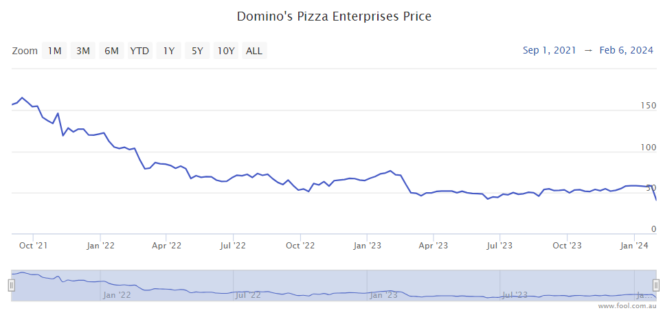
    Domino’s Pizza Enterprises Ltd (ASX: DMP) stock has been through a terrible plunge, it is currently 30% lower than its level on 15 January 2024.

    The sell-off was sparked by a trading update. You can read the coverage of that from my colleague James Mickleboro here.

    While the company saw good sales growth in ANZ and Germany, it suffered from negative same-store sales performance in Japan, Taiwan, Malaysia and France.

    In the FY24 first half, Domino’s is expecting to report net profit before tax (NPBT) of between $87 million to $90 million, which is lower than what it generated in the FY23 first half, and above the FY23 second half.

    Management said improvements are required in the FY24 second half to grow order volumes and it withdrew its guidance and commentary about its FY24 performance.

    Is this a big worry for Domino’s stock?

    The market usually judges a profitable business on how much profit it’s making and the direction of the profit. Clearly, investors were not impressed.

    But, one of the leadership figures of Domino’s – chair Jack Cowin – is not concerned by the fall of around 75% of the Domino’s share price since 2021 which has seen his current shareholding fall in value by roughly $2.8 billion – it’s now ‘only’ worth around $950 million.

    The Australian Financial Review reported that Cowin said:

    If you’re not buying or selling it doesn’t matter. The last couple of years the ball hasn’t bounced the right way.

    The board is supportive of the direction the company is taking. The company is supportive of Don.

    Cowin noted pain in Malaysia for American-related fast food brands because of a boycott relating to the Gaza war, with Malaysia reportedly supporting Palestine.

    The Domino’s chair said the company is working on reinventing overseas markets where a disappointing performance could eventually be turned around.

    What now?

    It could take Domino’s stock a bit of time to regain investor confidence – this is not the first time that the Domino’s share price has sold off.

    If the business can regain momentum in some of these underperforming markets, particularly Japan and France, then it could send the profit and perhaps the share price back in the right direction.

    The estimates on Commsec currently suggest the business could achieve a similar earnings per share (EPS) and pay a similar dividend in FY24 as FY23. EPS could be $1.44 and the dividend per share could be $1.10, which would put the business at 29 times FY24’s estimated earnings and a dividend yield of 2.7%, excluding any possible franking credits.

    The post Chair says his $2.8 billion Domino’s stock meltdown ‘doesn’t matter’ appeared first on The Motley Fool Australia.

    Wondering where you should invest $1,000 right now?

    When investing expert Scott Phillips has a stock tip, it can pay to listen. After all, the flagship Motley Fool Share Advisor newsletter he has run for over ten years has provided thousands of paying members with stock picks that have doubled, tripled or even more.*

    Scott just revealed what he believes could be the ‘five best ASX stocks’ for investors to buy right now. These stocks are trading at near dirt-cheap prices and Scott thinks they could be great buys right now…

    See The 5 Stocks
    *Returns as of 10 November 2023

    (function() {
    function setButtonColorDefaults(param, property, defaultValue) {
    if( !param || !param.includes(‘#’)) {
    var button = document.getElementsByClassName(“pitch-snippet”)[0].getElementsByClassName(“pitch-button”)[0];
    button.style[property] = defaultValue;
    }
    }

    setButtonColorDefaults(“#0095C8”, ‘background’, ‘#5FA85D’);
    setButtonColorDefaults(“#0095C8”, ‘border-color’, ‘#43A24A’);
    setButtonColorDefaults(“#fff”, ‘color’, ‘#fff’);
    })()

    More reading

    Motley Fool contributor Tristan Harrison has no position in any of the stocks mentioned. The Motley Fool Australia’s parent company Motley Fool Holdings Inc. has positions in and has recommended Domino’s Pizza Enterprises. The Motley Fool Australia has recommended Domino’s Pizza Enterprises. The Motley Fool has a disclosure policy. This article contains general investment advice only (under AFSL 400691). Authorised by Scott Phillips.

    from The Motley Fool Australia https://ift.tt/UdVFtTY

  • Why is the Cochlear share price tumbling 5% on Tuesday?

    a woman puts her fingers in her ears with a pained expression on her face with her eyes closed as though trying to block hearing bad news or an unpleasant loud noise.

    a woman puts her fingers in her ears with a pained expression on her face with her eyes closed as though trying to block hearing bad news or an unpleasant loud noise.

    It’s been a pretty awful day for the S&P/ASX 200 Index (ASX: JXO) and most ASX 200 shares so far this Tuesday. At present, the ASX 200 has slid by 0.52% and is back to around 7,585 points. But it’s been far worse for the Cochlear Limited (ASX: COH) share price.

    Cochlear shares are having a horrid day. This ASX 200 healthcare stock and medical device manufacturer closed at $308.45 a share yesterday. But this morning, Cochlear shares opened at $301.74 and are currently down a significant 5.55% to just $291.33 a share.

    So what’s going on with Cochlear shares this Tuesday that has elicited such a dramatic, and market-trailing, loss for investors?

    Why has this ASX 200 healthcare stock just tanked 5%?

    Well, unfortunately, we can’t know for sure. There has been no news or announcements out of Cochlear itself today that might explain this sizeable share price drop. Indeed, we haven’t seen any fresh news out of the company since 12 January.

    However, there has been some other news out today that might be playing a role here.

    According to reporting in The Australian, an ASX broker has dramatically downgraded its opinions on Cochlear shares.

    As reported, broker UBS has lowered its rating on Cochlear from neutral to sell. The broker has also reduced its share price target for the company by 7.7% to $240 a share. If realised, this would see the Cochlear share price lose another 17.7% from where the company is currently trading at.

    Here’s what UBS analyst Laura Sutcliffe was quoted as saying to explain this move:

    The market seems to be ignoring the possible impact to Cochlear’s implant sales from a potential vaccine against CMV [cytomegalovirus], a virus transmitted in utero that accounts for an estimated 20 per cent of childhood deafness… Our work with experts suggests a good chance of success, meaning 5-6 per cent of our prior Cochlear revenue estimates could be at risk.

    This could well be what has spooked investors today. A long-term threat to Cochlear’s business model is obviously not something that shareholders relish. Even if this vaccine news leads to better outcomes for humanity, investors have to value Cochlear’s financials above everything else.

    Cochlear share price snapshot

    Despite today’s chunky sell-off, the Chochlear share price has remained a fairly lucrative investment for anyone who has held the company for longer than a few months. At today’s pricing, Cochlear remains up a healthy 32.3% over the past 12 months, and up 46.5% over the past five years.

    At the current share price, Cochlear is trading with a market capitalisation of $19.96 billion and a dividend yield of 1.13%.

    The post Why is the Cochlear share price tumbling 5% on Tuesday? appeared first on The Motley Fool Australia.

    Wondering where you should invest $1,000 right now?

    When investing expert Scott Phillips has a stock tip, it can pay to listen. After all, the flagship Motley Fool Share Advisor newsletter he has run for over ten years has provided thousands of paying members with stock picks that have doubled, tripled or even more.*

    Scott just revealed what he believes could be the ‘five best ASX stocks’ for investors to buy right now. These stocks are trading at near dirt-cheap prices and Scott thinks they could be great buys right now…

    See The 5 Stocks
    *Returns as of 10 November 2023

    (function() {
    function setButtonColorDefaults(param, property, defaultValue) {
    if( !param || !param.includes(‘#’)) {
    var button = document.getElementsByClassName(“pitch-snippet”)[0].getElementsByClassName(“pitch-button”)[0];
    button.style[property] = defaultValue;
    }
    }

    setButtonColorDefaults(“#0095C8”, ‘background’, ‘#5FA85D’);
    setButtonColorDefaults(“#0095C8”, ‘border-color’, ‘#43A24A’);
    setButtonColorDefaults(“#fff”, ‘color’, ‘#fff’);
    })()

    More reading

    Motley Fool contributor Sebastian Bowen has no position in any of the stocks mentioned. The Motley Fool Australia’s parent company Motley Fool Holdings Inc. has positions in and has recommended Cochlear. The Motley Fool Australia has recommended Cochlear. The Motley Fool has a disclosure policy. This article contains general investment advice only (under AFSL 400691). Authorised by Scott Phillips.

    from The Motley Fool Australia https://ift.tt/X6geMu5

  • Down 70%: An insider just loaded up on this ASX 300 lithium share

    Hand with Australian dollar notes handing the money to another hand symbolising ex-dividend date.

    Hand with Australian dollar notes handing the money to another hand symbolising ex-dividend date.

    Vulcan Energy Resources Ltd (ASX: VUL) shares have managed to avoid another lithium selloff on Tuesday.

    In afternoon trade, the ASX 300 lithium share is up 1% to $2.03.

    As a comparison, Arcadium Lithium (ASX: LTM) shares are down 5%, Pilbara Minerals Ltd (ASX: PLS) shares are down 2%, and Core Lithium Ltd (ASX: CXO) shares are down 3%.

    Why is this ASX 300 share rising?

    Investors appear to have been buying the Germany-based lithium developer’s shares today in response to news of some insider buying.

    Insider buying is often seen as a bullish indicator as few should know the intrinsic value of a company than its directors.

    According to the change of director’s interest notice, the company’s non-executive director Josephine Bush has added to her holding.

    The notice reveals that Ms Bush picked up 14,200 Vulcan shares through an on-market trade on Monday. This boosted the non-executive director’s holding by 54% to 40,367 units.

    In addition, it was revealed that Ms Bush paid a slightly higher price that where the ASX 300 share trade today. She paid an average of $2.045 per Vulcan share, which equates to a total consideration of $29,039.

    Is this good news?

    While this isn’t the largest insider buying you will see, it is still likely to be interpreted as a positive by the market.

    And there haven’t been many of them in recent times.

    Due largely to the falling lithium price, this ASX 300 share is down by a whopping 71% over the last 12 months.

    Investors appear concerned what prices the company’s Zero Carbon Lithium project will be dealing with when it finally commences operations in 2025.

    Though, with its costs estimated by management to be “one of the lowest on the industry cost curve and despite inflation,” it may be better placed than most.

    The post Down 70%: An insider just loaded up on this ASX 300 lithium share appeared first on The Motley Fool Australia.

    Wondering where you should invest $1,000 right now?

    When investing expert Scott Phillips has a stock tip, it can pay to listen. After all, the flagship Motley Fool Share Advisor newsletter he has run for over ten years has provided thousands of paying members with stock picks that have doubled, tripled or even more.*

    Scott just revealed what he believes could be the ‘five best ASX stocks’ for investors to buy right now. These stocks are trading at near dirt-cheap prices and Scott thinks they could be great buys right now…

    See The 5 Stocks
    *Returns as of 10 November 2023

    (function() {
    function setButtonColorDefaults(param, property, defaultValue) {
    if( !param || !param.includes(‘#’)) {
    var button = document.getElementsByClassName(“pitch-snippet”)[0].getElementsByClassName(“pitch-button”)[0];
    button.style[property] = defaultValue;
    }
    }

    setButtonColorDefaults(“#0095C8”, ‘background’, ‘#5FA85D’);
    setButtonColorDefaults(“#0095C8”, ‘border-color’, ‘#43A24A’);
    setButtonColorDefaults(“#fff”, ‘color’, ‘#fff’);
    })()

    More reading

    Motley Fool contributor James Mickleboro has positions in Arcadium Lithium. The Motley Fool Australia’s parent company Motley Fool Holdings Inc. has no position in any of the stocks mentioned. The Motley Fool Australia has no position in any of the stocks mentioned. The Motley Fool has a disclosure policy. This article contains general investment advice only (under AFSL 400691). Authorised by Scott Phillips.

    from The Motley Fool Australia https://ift.tt/UNDkn1j

  • Guess which ASX 200 mining stock is sinking on strike fears

    a mine worker holds his phone in one hand and a tablet in the other as he stands in front of heavy machinery at a mine site.

    a mine worker holds his phone in one hand and a tablet in the other as he stands in front of heavy machinery at a mine site.

    Champion Iron Ltd (ASX: CIA) shares are having a tough time on Tuesday.

    In afternoon trade, the ASX 200 mining stock is down 6% to $6.22.

    Why is this ASX 200 mining stock sinking?

    While the mining sector is admittedly struggling today, there’s more to this decline than just that.

    This morning, the Canadian iron ore miner revealed that unionised employees have voted against the company’s proposed terms towards a new collective bargaining agreement (CBA).

    Instead, they have voted in favour of a strike action mandate. This mandate means that these workers can initiate a strike if the ongoing discussions do not conclude in a new agreement.

    And given that unionised employees represent 63% of its workforce at the Bloom Lake mine, this could have a major impact on its production during the quarter.

    The ASX 200 mining stock advised that it believes it has proposed fair and equitable terms for a new CBA. It highlights that its offer carefully balances the needs of its employees to protect their individual buying power, considering inflationary pressures, and reflects industry competitive dynamics.

    Clearly the unionised employees don’t agree with this. And it’s not like Champion Iron is struggling for cash right now.

    Last week, the ASX 200 mining stock reported third quarter revenue of C$507 million and EBITDA of C$247 million. The latter was up 109% year on year.

    One positive, though, is that the company advised that it has significant liquidity and stockpiled iron ore concentrate. As a result, it believes it is well positioned to mitigate the impacts of a potential strike on its operations and financial position.

    Champion Iron’s CEO, David Cataford, commented:

    We are disappointed that we could not reach an agreement with the union following recent discussions and a mediation process. We always have the well-being of our employees at heart, whether unionized or not. As such, we aim to create the best possible work conditions to retain, attract and develop the best talent, while ensuring our Company can navigate volatile economic environments.

    Our latest global offer submitted to the Metallos [union] meets this objective in every aspect. We have shown a great deal of transparency with the Metallos since the beginning of negotiations and we are confident that its members recognize our significant efforts in offering a healthy work environment and competitive terms towards a new CBA.

    The post Guess which ASX 200 mining stock is sinking on strike fears appeared first on The Motley Fool Australia.

    Wondering where you should invest $1,000 right now?

    When investing expert Scott Phillips has a stock tip, it can pay to listen. After all, the flagship Motley Fool Share Advisor newsletter he has run for over ten years has provided thousands of paying members with stock picks that have doubled, tripled or even more.*

    Scott just revealed what he believes could be the ‘five best ASX stocks’ for investors to buy right now. These stocks are trading at near dirt-cheap prices and Scott thinks they could be great buys right now…

    See The 5 Stocks
    *Returns as of 10 November 2023

    (function() {
    function setButtonColorDefaults(param, property, defaultValue) {
    if( !param || !param.includes(‘#’)) {
    var button = document.getElementsByClassName(“pitch-snippet”)[0].getElementsByClassName(“pitch-button”)[0];
    button.style[property] = defaultValue;
    }
    }

    setButtonColorDefaults(“#0095C8”, ‘background’, ‘#5FA85D’);
    setButtonColorDefaults(“#0095C8”, ‘border-color’, ‘#43A24A’);
    setButtonColorDefaults(“#fff”, ‘color’, ‘#fff’);
    })()

    More reading

    Motley Fool contributor James Mickleboro has no position in any of the stocks mentioned. The Motley Fool Australia’s parent company Motley Fool Holdings Inc. has no position in any of the stocks mentioned. The Motley Fool Australia has no position in any of the stocks mentioned. The Motley Fool has a disclosure policy. This article contains general investment advice only (under AFSL 400691). Authorised by Scott Phillips.

    from The Motley Fool Australia https://ift.tt/lUHLi2b

  • 7 must-see results this ASX reporting season before buying or selling

    a small boy dressed in a bow tie and britches looks up from a pile of books with a book laid in front of him on a desk and an abacus on the other side, as though he is an accountant scouring books of figures.

    a small boy dressed in a bow tie and britches looks up from a pile of books with a book laid in front of him on a desk and an abacus on the other side, as though he is an accountant scouring books of figures.

    We’re (somehow) now in early February of 2024. That means that ASX reporting season is upon us. Every six months, most ASX shares show investors their report card for (usually) the preceding six-month period. This means that over the rest of this month, and into next, we’ll get a look at how the six months to 31 December 2023 treated the companies on the ASX.

    Reporting season is one of the biggest ASX events of the year. It usually sets the trend for most stocks’ share prices over the following months and can make or break a company’s share price fortunes.

    So it goes without saying that most investors will be paying attention to what their companies have to say over the coming weeks.

    But today, I want to discuss seven ASX shares that I’ll personally be watching this reporting season. I think their results will be must-sees this month and will dictate the mood of the markets over the coming six months.

    7 ASX 200 shares I’m watching this reporting season

    First up is the big one, Commonwealth Bank of Australia (ASX: CBA). As the largest ASX 200 bank stock on the market, CBA often leads the ASX pack during reporting season, announcing its results relatively early. As one of the largest companies on the market, as well as one of the most widely-held stocks in Australia, CBA’s earnings often set the mood for the entire season.

    If CBA bears good news, ideally a dividend hike, it can indicate a humming Australian economy, which is obviously good news for all ASX shares. CBA’s results also give us a good indication of what might come out of the other ASX 200 banks.

    CBA is actually the only member of the big four that conforms to the normal ASX reporting season schedule. But I’ll also be watching out for the trading updates that we’ll likely see from the other banks like Westpac Banking Corp (ASX: WBC).

    Next, I’ll be watching the big mining stocks‘ reports, particularly that of BHP Group Ltd (ASX: BHP). Behind the banks, the big miners like BHP are responsible for a vast chunk of the dividends available to investors on our share market. The miners are also good harbingers of the health of both the global and Australian economies – not to mention the Federal Government’s budget.

    So again, if we see good earnings and generous dividends from the likes of BHP, it’s going to help set the tone of the entire market.

    It’s a similar story with Woodside Energy Group Ltd (ASX: WDS). BHP might be the largest miner on the ASX, but Woodside is the largest ASX 200 energy stock. It’s another strong source of dividend income, and its earnings should give some additional insight into the global and local economies.

    Barometers of inflation and the economy

    Next, I’ll be paying attention to what both Woolworths Group Ltd (ASX: WOW) and Coles Group Ltd (ASX: COL) have to say this ASX reporting season.

    As the largest grocers and consumer staples providers in the country, both Coles and Woolies can offer some unique insights into economic factors like inflation. These companies’ results can tell us a great deal about whether Australians are absorbing cost of living pressures or whether they are hitting hard. I’ll be watching Coles’ and Woolies’ earnings and dividends with great interest this month.

    My final stock on the ASX reporting season watchlist is Telstra Group Ltd (ASX: TLS). Telstra delighted investors with another dividend hike last year. As one of the most widely-held dividend payers on the ASX (including by yours truly), Telstra’s dividend decisions every reporting season are closely watched.

    If the company delivers another dividend hike later this month, it will go a long way in setting the tone for the ASX’s 2024 in my view.

    The post 7 must-see results this ASX reporting season before buying or selling appeared first on The Motley Fool Australia.

    Wondering where you should invest $1,000 right now?

    When investing expert Scott Phillips has a stock tip, it can pay to listen. After all, the flagship Motley Fool Share Advisor newsletter he has run for over ten years has provided thousands of paying members with stock picks that have doubled, tripled or even more.*

    Scott just revealed what he believes could be the ‘five best ASX stocks’ for investors to buy right now. These stocks are trading at near dirt-cheap prices and Scott thinks they could be great buys right now…

    See The 5 Stocks
    *Returns as of 10 November 2023

    (function() {
    function setButtonColorDefaults(param, property, defaultValue) {
    if( !param || !param.includes(‘#’)) {
    var button = document.getElementsByClassName(“pitch-snippet”)[0].getElementsByClassName(“pitch-button”)[0];
    button.style[property] = defaultValue;
    }
    }

    setButtonColorDefaults(“#0095C8”, ‘background’, ‘#5FA85D’);
    setButtonColorDefaults(“#0095C8”, ‘border-color’, ‘#43A24A’);
    setButtonColorDefaults(“#fff”, ‘color’, ‘#fff’);
    })()

    More reading

    Motley Fool contributor Sebastian Bowen has positions in Telstra Group. The Motley Fool Australia’s parent company Motley Fool Holdings Inc. has no position in any of the stocks mentioned. The Motley Fool Australia has positions in and has recommended Coles Group and Telstra Group. The Motley Fool has a disclosure policy. This article contains general investment advice only (under AFSL 400691). Authorised by Scott Phillips.

    from The Motley Fool Australia https://ift.tt/cjihowm