Tag: Motley Fool

  • Newcrest (ASX:NCM) shares rise following Pretivm takeover update

    happy mining worker fortescue share pricehappy mining worker fortescue share pricehappy mining worker fortescue share price

    The Newcrest Mining Ltd (ASX: NCM) share price is edging higher today following an update from the company.

    At the time of writing, the gold miner’s shares are swapping hands for $25.22 apiece, up 1.61%.

    Newcrest expands gold mine portfolio

    In today’s release, Newcrest advised it has received the final approval to acquire the remaining stake in Canadian metals and mining company, Pretivm Resources.

    The transaction received final approval under the Investment Canada Act, meaning that all regulatory approvals have now been obtained.

    As a result, the Pretivm acquisition is expected to complete on or about 9 March 2022.

    Currently, Newcrest currently holds a 4.8% stake in its Canadian counterpart.

    Last month, Pretivm shareholders and option holders voted overwhelmingly in favour of the transaction. In total, 95.48% of the votes cast approved the special resolution.

    Under the agreement, Pretium shareholders who elected to receive maximum cash consideration will receive approximately C$10.81 (A$11.79) in cash and 0.3357 Newcrest shares per Pretivm share.

    For Pretivm shareholders who elected to receive the maximum share consideration, they will be allocated 0.8084 Newcrest shares per Pretivm share.

    Pretivm shareholders who did not elect cash or Newcrest shares will receive the default consideration of 50% cash and 50% Newcrest shares. This will be C$9.25 (A$10.09) in cash and 0.4042 Newcrest shares per Pretivm share.

    Quick take on Pretivm Resources

    Pretivm is the owner of the Brucejack gold mine in British Columbia, Canada — one of the highest-grade operating gold mines in the world. It has an estimated gold production of 311koz (thousand ounces) per annum at an all-in sustaining cost (AISC) of $743 per ounce. The projected mine life is around 13 years.

    Furthermore, Brucejack is conveniently located about 140 kilometres from Newcrest’s majority-owned and operated Red Chris mine. This allows the company to strengthen the region by having close access to critical infrastructure.

    The combination of Newcrest and Pretivm will create the largest gold miner in the Tier 1 area of British Columbia.

    Newcrest share price summary

    Over the past 12 months, the Newcrest share price has been on a rollercoaster ride, posting a gain of around 2.7%. Year-to-date, its shares are up around 3.4% for investors.

    The company holds the title of owning and operating some of Australia’s largest gold and copper mines. While the company appears solid on paper, its shares have not been immune to volatile market conditions.

    Based on today’s price, Newcrest commands a market capitalisation of roughly $20.7 billion, with approximately 818 million shares outstanding.

    The post Newcrest (ASX:NCM) shares rise following Pretivm takeover update appeared first on The Motley Fool Australia.

    Should you invest $1,000 in Newcrest right now?

    Before you consider Newcrest, you’ll want to hear this.

    Motley Fool Investing expert Scott Phillips just revealed what he believes are the 5 best stocks for investors to buy right now… and Newcrest wasn’t one of them.

    The online investing service he’s run for over a decade, Motley Fool Share Advisor, has provided thousands of paying members with stock picks that have doubled, tripled or even more.* And right now, Scott thinks there are 5 stocks that are better buys.

    *Returns as of January 13th 2022

    More reading

    Motley Fool contributor Aaron Teboneras has no position in any of the stocks mentioned. The Motley Fool Australia’s parent company Motley Fool Holdings Inc. has no position in any of the stocks mentioned. The Motley Fool Australia has no position in any of the stocks mentioned. The Motley Fool has a disclosure policy. This article contains general investment advice only (under AFSL 400691). Authorised by Bruce Jackson.

    from The Motley Fool Australia https://ift.tt/ZcxuU0p

  • ‘Impressive and consistent’: Sandfire Resources (ASX:SFR) share price gains on half-year earnings

    Female South32 miner smiling with mining machinery in the background.Female South32 miner smiling with mining machinery in the background.Female South32 miner smiling with mining machinery in the background.

    The Sandfire Resources Ltd (ASX: SFR) share price is gaining after the company released its earnings for the first half of financial year 2022.

    At the time of writing, the Sandfire share price is $7.14, 2% higher than its previous close.

    Sandfire Resources share price rises on strong half

    Over the first half, Sandfire’s EPS was impacted by the issuing of equity due to the company’s acquisition of the MATSA Mining Complex in Spain.

    Though, a strong copper price and production at its DeGrussa operations delivered the company record half-year revenue.

    It sold 34,946 tonnes of contained copper and 16,161 ounces of contained gold last half.

    For comparison, those figures came to 35,790 and 21,343 respectively in the prior comparable period.

    The copper price was consistently between US$9,000 and US$10,600 in the first half.

    Sandfire recorded cash flow from operating activities of US$101.1 million – up from US$89.2 million.

    At the end of the period, the company boasted US$321.4 million of cash.

    What else happened in the half?

    Sandfire announced its US$1.86 billion acquisition of the MATSA Mining Complex in September, undergoing a $1.248 billion capital raise to fund it.

    The Sandfire share price plummeted 6.8% when it returned to trade following the announcement of the acquisition and capital raise.

    The following month, Sandfire announced the sale of its holding in Adriatic Metals Plc (ASX: ADT).

    Sandfire’s 16% holding in Adriatic Metals brought it a $97 million payday.

    What did management say?

    Sandfire’s managing director, Karl Simich commented on the company’s first half results, saying:

    With the completion of [the MATSA acquisition] in February, Sandfire is on the way to completing our transition from a single-mine company into a diversified and sustainable international miner – and we are doing so against the backdrop of one of the best commodity market environments seen in over a decade.

    The combination of surging demand from the renewable energy and EV sectors, together with declining metal stockpiles and supply side tightness exacerbated by global supply chain instability, has seen the copper price surge to new highs – with further upside expected.

    As well as expanding through acquisition, Sandfire also grew organically during the first half of [financial year 2022], with construction of our new Motheo Copper Mine in Botswana really stepping up a gear.

    Our strong financial results for the first half reflected another impressive and consistent performance by the DeGrussa Operations in Australia. This led to record sales revenue, strong operational cashflows and a 24% increase in NPAT.

    What’s next?

    According to Simich, Sandfire’s first half production is in line with its financial year 2022 guidance.

    It’s expecting to produce between 64 kilotons and 68 kilotons of contained copper for the period.

    Additionally, the company is predicting contained gold production of between 30 kilotons and 34 kilotons.

    Its full year results will also include 5 months of contribution from the MATSA operation.

    Over that time, Sandfire expects it will produce around 26,000 tonnes of copper, 37,000 tonnes of zinc, 1,000 tonnes of palladium, and 820,000 ounces of silver.

     Delving deeper into the company’s outlook, Simich commented:

    [Financial year 2022] and [financial year 2023] will be transitional years for Sandfire, underpinned by a strong and growing production base at MATSA. DeGrussa production will phase out post the first quarter of [financial year 2023], to be replaced towards the end of [financial year 2023] by new production from the Motheo Copper Mine in Botswana, where we expect to scale up in [financial year 2024] with the development of the satellite A4 Deposit.

    We are also looking to progress the development of our Black Butte Copper Project in the US, and with further organic growth opportunities, support our aspirational vision to more than double production towards 300,000 tonnes of copper equivalent by the end of this decade.

    Sandfire Resources share price snapshot

    The Sandfire share price has been outperforming the market in 2022.

    It has gained 5% since the start of this year. Meanwhile, the S&P/ASX 200 Index (ASX: XJO) has slipped 7%.

    Additionally, Sandfire’s stock has gained 23% since this time last year.

    The post ‘Impressive and consistent’: Sandfire Resources (ASX:SFR) share price gains on half-year earnings appeared first on The Motley Fool Australia.

    Should you invest $1,000 in Sandfire Resources right now?

    Before you consider Sandfire Resources, you’ll want to hear this.

    Motley Fool Investing expert Scott Phillips just revealed what he believes are the 5 best stocks for investors to buy right now… and Sandfire Resources wasn’t one of them.

    The online investing service he’s run for over a decade, Motley Fool Share Advisor, has provided thousands of paying members with stock picks that have doubled, tripled or even more.* And right now, Scott thinks there are 5 stocks that are better buys.

    *Returns as of January 13th 2022

    More reading

    Motley Fool contributor Brooke Cooper has no position in any of the stocks mentioned. The Motley Fool Australia’s parent company Motley Fool Holdings Inc. has no position in any of the stocks mentioned. The Motley Fool Australia has no position in any of the stocks mentioned. The Motley Fool has a disclosure policy. This article contains general investment advice only (under AFSL 400691). Authorised by Bruce Jackson.

    from The Motley Fool Australia https://ift.tt/lo68ILk

  • Allkem (ASX:AKE) share price higher amid results and ‘surging demand for lithium’

    A brightly coloured graphic with a silver square showing the abbreviation Li and the word Lithium to represent lithium ASX shares such as Core Lithium with small coloured battery graphics surrounding

    A brightly coloured graphic with a silver square showing the abbreviation Li and the word Lithium to represent lithium ASX shares such as Core Lithium with small coloured battery graphics surroundingA brightly coloured graphic with a silver square showing the abbreviation Li and the word Lithium to represent lithium ASX shares such as Core Lithium with small coloured battery graphics surrounding

    The Allkem Ltd (ASX: AKE) share price is pushing higher on Monday morning.

    At the time of writing, the lithium miner’s shares are up 2% to $9.30.

    This follows the release of the company’s first set of results since the merger of Galaxy Resources and Orocobre.

    Allkem share price jumps after strong half year result

    • Revenue of US$192.3 million
    • Gross profit of US$118.45 million
    • Earnings before tax of US$42.1 million
    • Net profit after tax of US$13 million
    • Cash and cash equivalents of US$449.8 million

    What happened during the first half?

    For the six months ended 31 December, Allkem delivered revenue of US$192.3 million.

    This result includes a four-month contribution from the Mt Cattlin business following the Galaxy-Orocobre merger. This makes comparing the result to the prior corresponding period difficult. However, a good example of its excellent performance can be seen with the Olaroz operation, which was part of the old Orocobre business. It reported a 142% increase in revenue to US$65.6 million.

    Olaroz’s strong revenue was driven by the sale of 5,915 tonnes of lithium carbonate and a 218% jump average FOB pricing to US$11,095 per tonne. It also recorded a gross profit margin of 68% for the period.

    Over at Mt Cattlin, for the period 25 August to 31 December, it reported sales of 96,871 dry metrics tonnes (dmt) of spodumene concentrate, grading 5.7% Li2O, at an average price of US$1,186/tonne CIF. This underpinned revenue of US$114.9 million and a gross profit margin of 62%.

    As for its earnings, Allkem reported gross profit of US$118 million, group EBITDAIX of US$97.9 million, and a consolidated net profit after tax of US$13 million. The latter compares to a loss of US$29.1 million a year earlier. Management advised that this reflects improved product prices and comprehensive cost management mitigating inflationary pressures.

    Management commentary

    Allkem’s Managing Director and CEO, Martin Perez de Solay, was pleased with the company’s post-merger performance.

    He said: “Post-merger we achieved record revenue for the Group, not only from strengthened pricing but from successfully and safely producing high-quality lithium products from our global operations that continue to meet the requirements and specifications of our long-term customers.”

    “Amidst surging demand for lithium products and continued challenges arising from the COVID-19 pandemic, our team also achieved significant advancements at all our development assets across the globe with both Olaroz Stage 2 and Naraha on the cusp of commissioning this calendar year. With two revenue generating operations and a healthy balance sheet, we are in a strong financial position to continue to advance Sal de Vida and the development of James Bay.”

    Outlook

    Also likely supporting the Allkem share price today is management’s commentary on the outlook for lithium prices.

    It confirmed that upwards pricing momentum for lithium products continues. In fact, its March quarter indicative pricing for 43.5kt of spodumene concentrate shipments is US$2,500 per tonne CIF for 6.0% Li2O.

    Furthermore, lithium carbonate prices for the second half are expected to be ~US$25,000 per tonne FOB. This is up ~125% on the first half and 25% ahead of its previous guidance.

    The post Allkem (ASX:AKE) share price higher amid results and ‘surging demand for lithium’ appeared first on The Motley Fool Australia.

    Should you invest $1,000 in Allkem right now?

    Before you consider Allkem, you’ll want to hear this.

    Motley Fool Investing expert Scott Phillips just revealed what he believes are the 5 best stocks for investors to buy right now… and Allkem wasn’t one of them.

    The online investing service he’s run for over a decade, Motley Fool Share Advisor, has provided thousands of paying members with stock picks that have doubled, tripled or even more.* And right now, Scott thinks there are 5 stocks that are better buys.

    *Returns as of January 13th 2022

    More reading

    Motley Fool contributor James Mickleboro owns Allkem. The Motley Fool Australia’s parent company Motley Fool Holdings Inc. has no position in any of the stocks mentioned. The Motley Fool Australia has no position in any of the stocks mentioned. The Motley Fool has a disclosure policy. This article contains general investment advice only (under AFSL 400691). Authorised by Bruce Jackson.

    from The Motley Fool Australia https://ift.tt/X5deltm

  • 4 ways to win in the stock market

    This article was originally published on Fool.com. All figures quoted in US dollars unless otherwise stated.

    a man holds his hands to his head as he looks to a jagged red line trending sharply downward on the wall behind him with graphic images of figures superimposed. It is a back view of the man's head.

    This article was originally published on Fool.com. All figures quoted in US dollars unless otherwise stated.

    Investing is a very serious business. If you buy the right stocks, they can pay for your house, your retirement, or your child’s education. Investing can make you a millionaire. But thinking about money can cause stress. And, ironically, if you worry about your investments a lot, you might well turn out to be an underperforming stock investor.

    What I’ve discovered is that if you can reduce your stress level with stock investing, it makes it less scary — especially as your stocks increase in value dramatically over time. Here are four tips about how to put the odds of the stock market in your favor.

    1. Stay in the market and give your investments time to grow

    Many investors get very competitive, wanting to make money fast. One mistake many make early on is actively managing their portfolios, buying and selling stocks. Most day traders find their performance turns out to be mediocre at best.

    It’s counterintuitive, but if you stop paying as much attention to the stock market, it can be more effective in doing its work in building up your wealth. Your stocks don’t need you to micro-manage them. More often than not, your stocks just needed you to leave them alone.

    2. Forget about the money

    Amazing investments can be highly volatile in the short term. When you buy a high-flying stock, your portfolio might drop thousands of dollars in a day. Overcome by fear, you might remove your money from the market at the worst possible time. And that’s how people lose money in the stock market.

    Think about it: On bad days in the market, billionaires lose billions of dollars. Those losses happen all the time. In the short term, stocks can do anything. Those whose wealth is tied to the market feel the impact of those movements constantly.

    So many people succumb to greed and cash out when they’ve made some short-term money. Or they succumb to fear and cash out when they’ve lost some short-term money.

    If you give in to these impulses, though, you’ll almost certainly underperform the stock market dramatically. You’ll miss out on the gains you could have made by holding onto winning stocks over time.

    3. Winners might look like losers in the short term

    Aggressive investors swing for the fences and try to find the best winners in the stock market. I love the high flyers. But doing so means getting a lot of calls wrong.

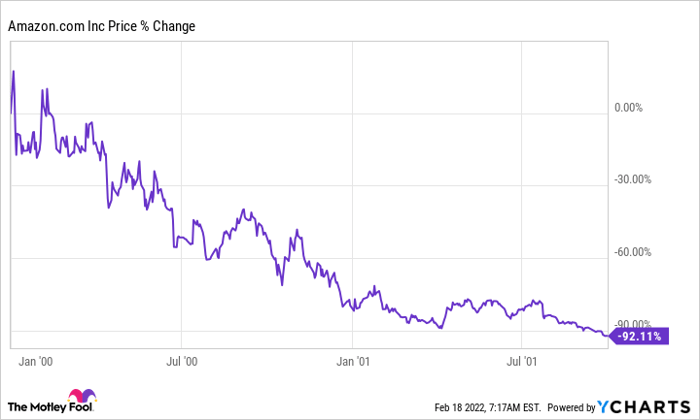
    The experience is especially humbling because companies often mount comebacks from seemingly impossible challenges. Those who’ve held winners like Amazon (NASDAQ: AMZN), and hold them through all the volatility, are rich. But that’s easier said than done. Amazon had several 50% drops and one scary 90% drop.

    AMZN Chart

    AMZN data by YCharts

    Imagine sitting on that 92% loss. Indeed, Amazon wasn’t the only stock seeing losses of that magnitude. There were lots of internet stocks that cratered. Many of them never came back.

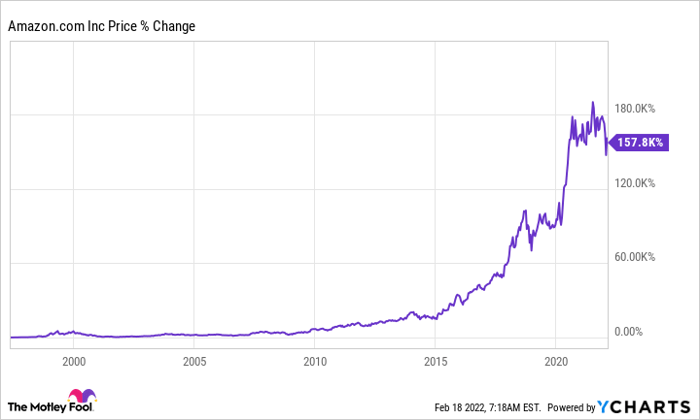
    But in Amazon’s case, the dramatic ups and downs would fade in importance over time and yield huge gains. Now, all you see is that magnificent chart, up and to the right.

    AMZN Chart

    AMZN data by YCharts

    4. One or two massive winners could make you rich

    What’s strange about stock picking is that you don’t know which picks will turn out to be massive winners and which ones will produce complete losses. You might have some good (or bad) feelings in the short term. But the real game of amassing riches is what your stock does over a decade or two.

    To be a successful investor, you need to take smart risks. Indeed, every stock investment is a risk, because you might lose your money. And then you have to be patient and let the story play out. Risk-taking and patience aren’t two character traits that usually go together. One of them will probably come naturally to you, and the other one you might have to work on.

    Yet it doesn’t take many stocks producing returns of 10,000%, 25,000%, or even 100,000% or more to make up for a whole bunch of 100% declines. Find those one or two winners, and they’ll define your success as an investor.

    The lesson here is obvious: If you find an amazing stock, keep it.

    Investing is a very serious business

    The toughest challenge in investing is understanding that paying too much attention to your stocks’ performance can be just as damaging as not paying enough attention. If you focus on your companies and how their businesses are doing, you will be rewarded over time.

    This article was originally published on Fool.com. All figures quoted in US dollars unless otherwise stated.

    The post 4 ways to win in the stock market appeared first on The Motley Fool Australia.

    Wondering where you should invest $1,000 right now?

    When investing expert Scott Phillips has a stock tip, it can pay to listen. After all, the flagship Motley Fool Share Advisor newsletter he has run for over ten years has provided thousands of paying members with stock picks that have doubled, tripled or even more.*

    Scott just revealed what he believes could be the five best ASX stocks for investors to buy right now. These stocks are trading at near dirt-cheap prices and Scott thinks they could be great buys right now.

    *Returns as of January 12th 2022

    More reading

    John Mackey, CEO of Whole Foods Market, an Amazon subsidiary, is a member of The Motley Fool’s board of directors. Taylor Carmichael owns Amazon. The Motley Fool owns and recommends Amazon. The Motley Fool has a disclosure policy.

    This article was originally published on Fool.com. All figures quoted in US dollars unless otherwise stated.


    from The Motley Fool Australia https://ift.tt/LgZowAB
  • Is this the most underrated chart for building your investment portfolio?

    This article was originally published on Fool.com. All figures quoted in US dollars unless otherwise stated.

    man on an iPad looking at chart of an increasing share price

    This article was originally published on Fool.com. All figures quoted in US dollars unless otherwise stated.

    Most investors make an important mistake when they’re building their investment portfolio, and it can be a costly one. Luckily, we can all take valuable insights from an important chart that’s used by professional asset managers. This chart won’t create the perfect portfolio for you, but it provides essential guidelines for building an investment allocation.

    The efficient frontier

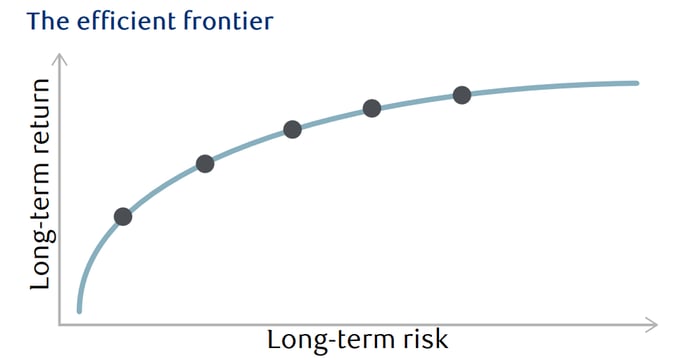
    The efficient frontier is a chart that plots portfolio returns against portfolio risk. 

    Chart showing the relationship between portfolio risk and return.


    Source: RBC Wealth Management — “Why does asset allocation matter?”

    The chart is well-known among asset managers and financial advisors, but it’s rarely mentioned by individual investors. Professionals have to focus more on risk management — losses tend to shake a client’s confidence in an asset manager. Meanwhile, financial media overwhelmingly covers market indexes and the performance of individual stocks.

    Returns are intuitive. If you invest a certain amount of capital, the value of that investment grows or falls by a certain percentage. Over the long term, those returns are based on the fundamental performance of the asset. Companies that grow and produce profits tend to have stocks that appreciate. The stocks of unsuccessful companies generally lose value. That’s all pretty straightforward. 

    Risk is a bit more complicated, and there are whole fields of study dedicated to understanding it to a high degree. Risk is defined in different ways, but portfolio risk usually refers to volatility. Volatility is generally calculated as the standard deviation of returns over a given period, and beta is a popular metric for measuring relative volatility. Portfolio returns tend to follow long-term trend lines, but they fluctuate over the short term around that trend. The bigger the swings in a portfolio’s value, the higher a risk it’s considered to be. 

    This chart suggests that there’s a trade-off between investment risk and return over the long term. In an efficient capital market, investors are forced to accept more risk in exchange for higher expected returns. Equities are more volatile than bonds, but they produce larger gains in the long term. Growth stocks have higher upside than value stocks, but they’re also prone to steeper losses due to high valuation ratios.

    How the efficient frontier works

    The efficient frontier is theoretical — the exact numbers aren’t really known or universally established. Instead, it represents the highest theoretical return that can be achieved at a given level of volatility. The curve is the collection of potential returns across the spectrum of risk, from low volatility to high.

    From a portfolio composition perspective, any point along the frontier is just as valid as any other. It might seem odd to suggest that a strategy with a 6% average rate of return could be just as good as one with a 10% average return, but it’s true in the context of asset management. Not everyone is in the position to assume the risk that’s required to achieve higher rates of return, and the frontier illustrates a balance between the two. Investors with low risk tolerance can’t achieve the same long-term growth as those with high risk tolerance.

    Any point below the frontier is inferior to any point that’s on the frontier. If a portfolio’s long-term combination of volatility and returns places it below the frontier on a graph, then that portfolio is not compensating investors enough for the risk that’s being taken. In that case, there are better allocations that could deliver more growth without adding any additional volatility.

    Using the frontier

    The key to portfolio management is to identify your optimal spot along the efficient frontier, then ensure that your investment strategy gets as close to the theoretical limit as possible. That’s how the best allocations are defined, rather than simply the biggest gains over a small window.

    The first step is to quantify risk tolerance, which should reflect time horizon and personality. Risk tolerance questionnaires are popular tools to accomplish this, and they allow investors to set a volatility target for a portfolio.

    Once that volatility cap has been determined, it’s important to maximize the potential growth within those boundaries. Obviously, that’s easier said than done, and there are tons of variables and unknowns that dictate gains and losses moving forward. Fill your allocation with high-conviction stocks that will deliver growth, but make sure that it’s governed by risk tolerance. That’s the best way to place yourself on the right part of the efficient frontier curve.

    People who have long time horizons and can stomach volatility are able to take more risks in favor of growth. Those portfolios should contain more growth stocks, small caps, and emerging markets. On the other end of the spectrum, some investors need to sacrifice growth to limit volatility. Those portfolios tend to have more bonds, dividend stocks, and stable value stocks

    A 30-year-old should generally focus on growth in their 401(k) or IRA. Investors nearing retirement have to pull back on the reins to ensure that they aren’t forced to sell stocks at the bottom of a market cycle.

    We’re seeing this in action with the current stock market correction. Any retiree whose well-being is seriously jeopardized by this pullback has mismanaged their volatility exposure and ignored the efficient frontier. 

    This article was originally published on Fool.com. All figures quoted in US dollars unless otherwise stated.

    The post Is this the most underrated chart for building your investment portfolio? appeared first on The Motley Fool Australia.

    Wondering where you should invest $1,000 right now?

    When investing expert Scott Phillips has a stock tip, it can pay to listen. After all, the flagship Motley Fool Share Advisor newsletter he has run for over ten years has provided thousands of paying members with stock picks that have doubled, tripled or even more.*

    Scott just revealed what he believes could be the five best ASX stocks for investors to buy right now. These stocks are trading at near dirt-cheap prices and Scott thinks they could be great buys right now.

    *Returns as of January 12th 2022

    More reading

    The Motley Fool Australia’s parent company Motley Fool Holdings Inc. has no position in any of the stocks mentioned. The Motley Fool Australia has no position in any of the stocks mentioned. The Motley Fool has a disclosure policy. This article contains general investment advice only (under AFSL 400691). Authorised by Bruce Jackson.

    This article was originally published on Fool.com. All figures quoted in US dollars unless otherwise stated.

    from The Motley Fool Australia https://ift.tt/ZBTXbcC

  • Top broker says Harvey Norman (ASX:HVN) share price is cheap

    The Harvey Norman Holdings Limited (ASX: HVN) share price could be in the buy zone.

    That’s the view of the team at Goldman Sachs, which has responded positively to the retail giant’s half year results.

    What did Goldman say?

    According to the note, Harvey Norman delivered a half year result ahead of the broker’s expectations.

    It commented: “HVN delivered 1H22 sales growth of +1.7% to A$2.34bn, +5.2% vs. GSe and group EBIT at +13.6% vs. GSe on an underlying basis, after adjusting for property revaluation and interest income. The results were a broad based retail beat across Australia, NZ as well as key international regions, largely driven by strong margin execution.”

    Pleasingly, the broker notes that this strong form has continued into the second half, which has led to its analysts upgrading their estimates.

    Goldman explained: “Trading into early 2H22 remained positive vs. GSe, reporting strong double digit growths on a 2 year basis across all regions excl. Asia and Slovenia and Croatia on a comparable basis. In Australia, the underlying 2 year trend improved to 23% comparable growth vs. 15.9% into mid November and +17.1% in December.”

    “We revise earnings forecasts for HVN to factor in the 1H22 results. Regionally, we revise FY22 Australia earnings the most, by +13.6%, as the 1H22 EBIT was significantly ahead of GSe, largely due to the continued absence of tactical support, in our view, given the strong trading environment,” it added.

    Is the Harvey Norman share price good value?

    Goldman believes the Harvey Norman share price is good value at the current level, particularly in comparison with rival JB Hi-Fi Limited (ASX: JBH). In addition, it notes that its shares offer a generous yield at current levels, boosting the total potential return.

    The broker said: “HVN continues to trade at P/E 1.5x lower than JBH. On a property adjusted basis, HVN currently trades at 6.5x FY22e P/E vs. JBH at 12.4x. Our 12m Target Price for HVN remains unchanged at A$6.00, implying an upside of 16.5% and total return of 24.6% [including dividends]. We maintain our Buy rating on HVN.”

    The post Top broker says Harvey Norman (ASX:HVN) share price is cheap appeared first on The Motley Fool Australia.

    Should you invest $1,000 in Harvey Norman right now?

    Before you consider Harvey Norman, you’ll want to hear this.

    Motley Fool Investing expert Scott Phillips just revealed what he believes are the 5 best stocks for investors to buy right now… and Harvey Norman wasn’t one of them.

    The online investing service he’s run for over a decade, Motley Fool Share Advisor, has provided thousands of paying members with stock picks that have doubled, tripled or even more.* And right now, Scott thinks there are 5 stocks that are better buys.

    *Returns as of January 13th 2022

    More reading

    Motley Fool contributor James Mickleboro has no position in any of the stocks mentioned. The Motley Fool Australia’s parent company Motley Fool Holdings Inc. has no position in any of the stocks mentioned. The Motley Fool Australia owns and has recommended Harvey Norman Holdings Ltd. The Motley Fool has a disclosure policy. This article contains general investment advice only (under AFSL 400691). Authorised by Bruce Jackson.

    from The Motley Fool Australia https://ift.tt/WaHtUd4

  • Own Medibank (ASX:MPL) shares? Here’s all you need to know about the latest dividend

    a woman looks down at her phone with a look of concern on her face and her hand held to her chin while she seriously digests the news she is receiving.a woman looks down at her phone with a look of concern on her face and her hand held to her chin while she seriously digests the news she is receiving.a woman looks down at her phone with a look of concern on her face and her hand held to her chin while she seriously digests the news she is receiving.

    Medibank Private Ltd (ASX: MPL) shareholders might be feeling frustrated after the company’s share price tumbled 6% over the last week.

    The private health insurer released its half-year results for the 2022 financial year, reporting single-digit increases across key metrics.

    Nonetheless, the board opted to increase its upcoming interim dividend to eligible investors.

    Let’s take a look below at what you need to know.

    What’s the deal with Medibank interim dividend?

    The Medibank share price backtracked late last week, which appears to have been caused by an underwhelming performance.

    In total, the company will be paying out 6.1 cents per share for the 6 months ended 31 December 2021. That’s 5% higher than last year’s interim dividend for financial year 2021.

    Furthermore, the payout ratio for the latest dividend is at 78.5% (in line with the target range of 75% – 85%).

    Management noted that the full-year dividend for FY22 is expected to be towards the top end of the above target range.

    The higher dividend came despite Medibank’s net profit after tax (NPAT) falling 2.7% to $220.2 million over the first half. It noted that a $40.9 million, or 57% decrease, in net investment income dragged down the company’s bottom line.

    When can shareholders expect to be paid?

    Medibank will pay the interim dividend to eligible shareholders next month on 24 March.

    However, to be eligible you’ll need to own Medibank shares before the ex-dividend date on Friday 4 March. This means if you want to secure the dividend, you will need to purchase Medibank shares by Thursday 3 March at the latest.

    It is worth noting that on the ex-dividend day, the share price traditionally falls in proportion to the dividend amount.

    In addition, the dividend is fully-franked which means that investors will receive tax credits when tax time comes along.

    Currently, Medibank has a dividend trailing yield of 4.16% and a market capitalisation of roughly $8.4 billion.

    The post Own Medibank (ASX:MPL) shares? Here’s all you need to know about the latest dividend appeared first on The Motley Fool Australia.

    Should you invest $1,000 in Medibank right now?

    Before you consider Medibank, you’ll want to hear this.

    Motley Fool Investing expert Scott Phillips just revealed what he believes are the 5 best stocks for investors to buy right now… and Medibank wasn’t one of them.

    The online investing service he’s run for over a decade, Motley Fool Share Advisor, has provided thousands of paying members with stock picks that have doubled, tripled or even more.* And right now, Scott thinks there are 5 stocks that are better buys.

    *Returns as of January 13th 2022

    More reading

    Motley Fool contributor Aaron Teboneras has no position in any of the stocks mentioned. The Motley Fool Australia’s parent company Motley Fool Holdings Inc. has no position in any of the stocks mentioned. The Motley Fool Australia has no position in any of the stocks mentioned. The Motley Fool has a disclosure policy. This article contains general investment advice only (under AFSL 400691). Authorised by Bruce Jackson.

    from The Motley Fool Australia https://ift.tt/TKGdM3E

  • 4 ASX shares that love rising interest rates: report

    Percentage symbol in white with a black rising arrow.Percentage symbol in white with a black rising arrow.Percentage symbol in white with a black rising arrow.

    The S&P/ASX 200 Index (ASX: XJO) tumbled in January due to fears of rising interest rates.

    After a mini-revival to start February, the index has again headed down as the Russian military started a war in Ukraine.

    However, the primary force that’s putting downward pressure on ASX shares is actually the same as a month ago.

    It’s all about inflation.

    The fear in January was that inflation arising from COVID-19 issues such as supply chain and economic recovery would become persistent.

    This time a war involving Russia and Ukraine could result in a surge in prices for anything from gas, oil, wheat and corn.

    And of course, rising and persistent inflation will result in higher interest rates.

    “Forward-looking rate markets are now starting to factor in much higher rates,” read the Inflation Beneficiaries: What is Currently Priced In? memo from Wilsons.

    “The pivot from the [US] Federal Reserve in January 2022 and the RBA earlier this month has only heightened the markets’ expectations of rate increases.”

    In this report, the analysts at Wilsons examined which ASX shares might fare the best in such an environment:

    40% boost if interest rates rise one percent

    Wilsons reported that “cyclical sectors” typically outperform during times of rising interest rates.

    “The performance so far in this cycle looks very similar to what we have seen in prior cycles.”

    Stock transfer provider Computershare Limited (ASX: CPU) is a direct beneficiary of any rate rises.

    This is because the company holds investors’ unclaimed dividends as a cash balance that’s invested.

    According to management, incredibly, a 1 percentage point increase in interest rates will result in a 40% boost to Computershare’s profitability. 

    “Interest earning cash balances CPU holds across key business lines are expected to average ~$40 billion this half. 

    “The recent acquisition of the Wells Fargo Corporate Trust has doubled Computershare’s exposure to interest rates.”

    Insurance is a lovely business in 2022

    QBE Insurance Group Ltd (ASX: QBE) is another stock that Wilsons analysts would target.

    “Insurance companies typically provide outperformance opportunities in periods of rising inflation/interest rates,” the report read.

    “They benefit from higher premiums due to the rising inflation environment and higher interest income on policyholders’ funds.”

    While QBE itself hasn’t indicated how much it would benefit from rising rates, the Wilsons team made its own calculations.

    “We estimate QBE would see a benefit of 10-20% to earnings if rates were to rise by 1.0%,” stated the report.

    “This assumes that higher premiums are not offset by higher claims inflation; the capital base is unchanged while profit margins expand marginally.”

    Similarly, Wilsons saw Insurance Australia Group Ltd (ASX: IAG) as a beneficiary, but not as convincing as QBE.

    “We see IAG as offering mild positive exposure to higher inflation/interest rates. Premium growth of 6.2% in 1H22 reflects IAG pricing power in a duopoly market,” the report read.

    “So far, higher claim costs are not enough to detract from the premium benefits.”

    How would a payments company benefit?

    One stock that might be so obvious as a rate-rise beneficiary is payments company EML Payments Ltd (ASX: EML).

    “As a payments business, EML earns a return on client funds held in its accounts,” read the Wilsons report.

    “The guidance provided by EML equates to a 15% to 20% uplift in earnings for a +1.0% move in rates.”

    This possible boost is not reflected in financial year 2023 market estimates, according to Wilsons analysts.

    “If rates move through 2%, the leverage becomes even greater given EML’s rate structures in the US,” stated the memo.

    “With rate rises already in place in the UK, and all but given in the US, higher rates should assist in EML meeting guidance.”

    The post 4 ASX shares that love rising interest rates: report appeared first on The Motley Fool Australia.

    Wondering where you should invest $1,000 right now?

    When investing expert Scott Phillips has a stock tip, it can pay to listen. After all, the flagship Motley Fool Share Advisor newsletter he has run for over ten years has provided thousands of paying members with stock picks that have doubled, tripled or even more.*

    Scott just revealed what he believes could be the five best ASX stocks for investors to buy right now. These stocks are trading at near dirt-cheap prices and Scott thinks they could be great buys right now.

    *Returns as of January 12th 2022

    More reading

    Motley Fool contributor Tony Yoo has no position in any of the stocks mentioned. The Motley Fool Australia’s parent company Motley Fool Holdings Inc. owns and has recommended EML Payments. The Motley Fool Australia owns and has recommended EML Payments and Insurance Australia Group Limited. The Motley Fool has a disclosure policy. This article contains general investment advice only (under AFSL 400691). Authorised by Bruce Jackson.

    from The Motley Fool Australia https://ift.tt/LHOdsg8

  • These are the 10 most shorted ASX shares

    Once a week I like to look at ASIC’s short position report to find out which shares are being targeted by short sellers.

    This is because I believe it is well worth keeping a close eye on short interest levels as high levels can sometimes be a sign that something isn’t quite right with a company.

    With that in mind, here are the 10 most shorted shares on the ASX this week according to ASIC:

    • Flight Centre Travel Group Ltd (ASX: FLT) remains the most shorted share despite its short interest easing to 14.9%. Last week the travel agent’s shares came under pressure after it posted another large half year loss.
    • Betmakers Technology Group Ltd (ASX: BET) has seen its short interest rise again to 11.8%. The betting sector has come under significant pressure in recent months and short sellers don’t appear to expect that to change any time soon.
    • Zip Co Ltd (ASX: Z1P) has seen its short interest rise week on week to 11.3%. This buy now pay later provider recently released its half year update and revealed a greater than expected loss. This has led to speculation that a capital raising is coming soon.
    • Kogan.com Ltd (ASX: KGN) has seen its short interest rise to 10.5%. This ecommerce company’s shares came under pressure last week after it swung to a loss during the first half. The company also revealed a sharp pullback in its core Kogan revenues despite a rise in customers.
    • Nanosonics Ltd (ASX: NAN) has short interest of 9.8%, which is up again week on week. This infection prevention company’s shares have been falling heavily this year following the announcement of a change in its sales model in the United States.
    • Mesoblast limited (ASX: MSB) has short interest of 9.7%, which is up slightly week on week. Short sellers have been going after this biotech amid poor trial results, significant cash burn, and the loss of a major deal with Novartis.
    • Webjet Limited (ASX: WEB) has short interest of 9.7%, which is down slightly week on week for a second week in a row. Some short sellers may have been closing positions now international borders are reopening.
    • Polynovo Ltd (ASX: PNV) has seen its short interest rise again to 9.3%. This medical device company’s mixed performance appears to be attracting short sellers.
    • Tyro Payments Ltd (ASX: TYR) is back in the top ten with short interest of 8.4%. Last week this payments company’s shares were sold off after its EBITDA tumbled 67% to just $2.8 million.
    • Temple & Webster Group Ltd (ASX: TPW) has seen its short interest rise to 8.3%. Like many online retailers, Temple & Webster’s shares have come under pressure in recent months amid concerns over valuations, increasing marketing costs, and slowing growth.

    The post These are the 10 most shorted ASX shares appeared first on The Motley Fool Australia.

    Wondering where you should invest $1,000 right now?

    When investing expert Scott Phillips has a stock tip, it can pay to listen. After all, the flagship Motley Fool Share Advisor newsletter he has run for over ten years has provided thousands of paying members with stock picks that have doubled, tripled or even more.*

    Scott just revealed what he believes could be the five best ASX stocks for investors to buy right now. These stocks are trading at near dirt-cheap prices and Scott thinks they could be great buys right now.

    *Returns as of January 12th 2022

    More reading

    Motley Fool contributor James Mickleboro has no position in any of the stocks mentioned. The Motley Fool Australia’s parent company Motley Fool Holdings Inc. owns and has recommended Betmakers Technology Group Ltd, Kogan.com ltd, Nanosonics Limited, POLYNOVO FPO, Temple & Webster Group Ltd, Tyro Payments, and ZIPCOLTD FPO. The Motley Fool Australia owns and has recommended Kogan.com ltd and Nanosonics Limited. The Motley Fool Australia has recommended Betmakers Technology Group Ltd, Flight Centre Travel Group Limited, Temple & Webster Group Ltd, Tyro Payments, and Webjet Ltd. The Motley Fool has a disclosure policy. This article contains general investment advice only (under AFSL 400691). Authorised by Bruce Jackson.

    from The Motley Fool Australia https://ift.tt/VFRD6Wp

  • Buy these 2 impressive ASX shares in March 2022: experts

    A stopwatch ticking close to the 12 where the words on the face say 'Time to Buy' indicating its the bottom of the falling market and time to buy ASX shares

    A stopwatch ticking close to the 12 where the words on the face say 'Time to Buy' indicating its the bottom of the falling market and time to buy ASX sharesA stopwatch ticking close to the 12 where the words on the face say 'Time to Buy' indicating its the bottom of the falling market and time to buy ASX shares

    Experts have rated some ASX shares as impressive opportunities in March 2022.

    These are businesses with long-term growth plans and a management team that is motivated to achieve those goals.

    Whilst brokers don’t always get everything right, they like to keep a keen eye on business valuation to find ideas.

    These are two ASX shares that experts like right now:

    Bubs Australia Ltd (ASX: BUB)

    Bubs is one of the leading Australian infant formula companies, which is currently seeing a lot of growth with plans for a lot more.

    Citi rates Bubs as a buy with a price target of $0.73 – that’s around 70% higher than where it is today.

    The broker pointed to several positives from the Bubs half-year result, including US distribution expansion and the potential for Australia’s international borders opening up providing a tailwind to sales.

    In the first six months of FY22, Bubs reported positive underlying earnings before interest, tax, depreciation and amortisation (EBITDA) of $1.2 million, after 84% year-on-year growth of group revenue to $33.6 million. There was also a “significant improvement” in the gross profit margin to 38%.

    One of the key highlights was that the ASX share’s corporate daigou gross revenue was at a record high, exceeding pre-COVID levels, rising by 276%. There was also 53% growth of Chinese cross-border e-commerce gross revenue.

    Bubs revealed that it’s now listed with the three largest US national food distributors. It has also secured ranging at Southern California’s largest food retailer.

    Citi thinks that Bubs could start making a positive net profit after tax (NPAT) in FY23.

    ELMO Software Ltd (ASX: ELO)

    ELMO is a provider of HR and payroll software to small and medium businesses in Australia and the UK.

    It’s currently rated as a buy by the broker Morgan Stanley with a price target of $7.80. That suggests a possible upside of around 110% over the next year, if the broker ends up being right.

    The first half of FY22 showed a lot of growth for the business and it increased its FY22 guidance, but that seemingly wasn’t enough for the market to be positive about the result.

    ELMO said that annualised recurring revenue (ARR) of $98.3 million was an increase of 35% compared to 30 June 2021. Revenue rose by 41% to $43.1 million.

    The ASX share generated a positive EBITDA. Half-year EBITDA rose by $0.9 million to $0.3 million. ARR guidance was increased to a range of $107 million to $113 million for FY22.

    ELMO revealed that operating leverage continues to improve with a reduction in key spending ratios across the business which has driven the positive EBITDA result and reduced the monthly operating cash burn by 36%.

    The company launches new modules to make itself more useful for clients and increase the possible value of each client to ELMO, if they sign up. This can make the client even more sticky as well.

    Management also noted that the UK acquisitions are performing “exceptionally well” and provide a solid foundation to increase its market share in the region.

    The post Buy these 2 impressive ASX shares in March 2022: experts appeared first on The Motley Fool Australia.

    Should you invest $1,000 in ELMO right now?

    Before you consider ELMO, you’ll want to hear this.

    Motley Fool Investing expert Scott Phillips just revealed what he believes are the 5 best stocks for investors to buy right now… and ELMO wasn’t one of them.

    The online investing service he’s run for over a decade, Motley Fool Share Advisor, has provided thousands of paying members with stock picks that have doubled, tripled or even more.* And right now, Scott thinks there are 5 stocks that are better buys.

    *Returns as of January 13th 2022

    More reading

    Motley Fool contributor Tristan Harrison has no position in any of the stocks mentioned. The Motley Fool Australia’s parent company Motley Fool Holdings Inc. owns and has recommended Elmo Software. The Motley Fool Australia owns and has recommended Elmo Software. The Motley Fool Australia has recommended BUBS AUST FPO. The Motley Fool has a disclosure policy. This article contains general investment advice only (under AFSL 400691). Authorised by Bruce Jackson.

    from The Motley Fool Australia https://ift.tt/XObt8iI