Tag: Motley Fool

  • Up 18% in a month, is it too late to buy Flight Centre (ASX:FLT) shares?

    A couple are running late for their flight as they rush to the gate.A couple are running late for their flight as they rush to the gate.A couple are running late for their flight as they rush to the gate.

    The Flight Centre Travel Group Ltd (ASX: FLT) share price has roared higher over the last 30 days, likely leaving the travel agent’s investors excited for its future.

    But the stock’s surge may have left market watchers wondering if it’s too late to jump on the bandwagon.

    At market open on Wednesday, the Flight Centre share price is $19.53 – 17.9% higher than it was this time last month. That’s despite the stock taking a 5.4% tumble yesterday.

    So, with its half-year earnings set to be released tomorrow, could the travel stock take off again? Let’s take a look.

    Will Flight Centre shares continue their up-and-up trajectory?

    After a turbulent January, the Flight Centre share price has rebounded to serve investors an 18% gain.

    The boost came amid the complete reopening of Australia’s international border this week, as well as news Western Australia’s hard border is set to lift on 3 March.

    Though, while the grass is certainly looking greener, it might not be blue skies ahead for Flight Centre.

    As The Motley Fool’s Bernd Struben reported earlier this week, it could be years before the travel industry fully returns to its pre-pandemic self.

    Additionally, the travel agent’s stock remains the most shorted on the ASX.

    Flight Centres shares had a short interest of 15.45% in The Motley Fool’s most recent weekly short-selling breakdown.

    Of course, that suggests there’s significantly bearish sentiment regarding the Flight Centre share price among short-sellers.

    Such sentiment might be explained by the company’s valuation.

    As Airlie Funds Management portfolio manager Matt Williams told the Australian Financial Review, the company’s enterprise value is already higher than it was prior to the pandemic.

    That means its recovery looks to be already priced into its shares.

    Not to mention, the company underwent a $700 million capital raise in April 2020, handing out 97.2 million new shares. That represents a 96.1% increase on the number of outstanding shares in the company.

    It later issued $400 million of convertible notes, due in 2027.

    That also helped boost its market capitalisation to higher than it was pre-pandemic.

    All in all, Williams warned investors to be wary of buying into the company at its current price. Particularly, as there could be a way to go before the Australian travel industry returns to its pre-pandemic self.

    The post Up 18% in a month, is it too late to buy Flight Centre (ASX:FLT) shares? appeared first on The Motley Fool Australia.

    Should you invest $1,000 in Flight Centre right now?

    Before you consider Flight Centre, you’ll want to hear this.

    Motley Fool Investing expert Scott Phillips just revealed what he believes are the 5 best stocks for investors to buy right now… and Flight Centre wasn’t one of them.

    The online investing service he’s run for over a decade, Motley Fool Share Advisor, has provided thousands of paying members with stock picks that have doubled, tripled or even more.* And right now, Scott thinks there are 5 stocks that are better buys.

    *Returns as of January 13th 2022

    More reading

    Motley Fool contributor Brooke Cooper has no position in any of the stocks mentioned. The Motley Fool Australia’s parent company Motley Fool Holdings Inc. has no position in any of the stocks mentioned. The Motley Fool Australia has recommended Flight Centre Travel Group Limited. The Motley Fool has a disclosure policy. This article contains general investment advice only (under AFSL 400691). Authorised by Bruce Jackson.

    from The Motley Fool Australia https://ift.tt/ZiMKz1h

  • Pilbara Mineral (ASX:PLS) share price sinks 7% amid half year results and CEO exit

    a woman holds her hands to her temples as she sits in front of a computer screen with a concerned look on her face.a woman holds her hands to her temples as she sits in front of a computer screen with a concerned look on her face.

    a woman holds her hands to her temples as she sits in front of a computer screen with a concerned look on her face.The Pilbara Minerals Ltd (ASX: PLS) share price has taken a tumble on Wednesday morning. This follows the release of the lithium miner’s half year results.

    At the time of writing, the Pilbara Minerals share price is down 7.5% to $2.58.

    Pilbara Minerals share price lower on results and shock announcement

    • Shipments up 49% to 170,228 dry metric tonnes (dmt) of spodumene concentrate
    • Half year sales revenue up 394% to a record of $291.7 million
    • EBITDA of $151.1 million, up from $3.2 million a year earlier
    • Cash balance of $191.2 million
    • Underlying profit after tax of $84.2 million
    • CEO Ken Brinsden to step down by the end of 2022

    What happened during the first half?

    For the six months ended 31 December, the lithium giant reported a 394% increase in revenue to a record of $291.7 million. Management advised that this result reflects continued improvement in lithium market conditions over the period, which has continued its strong momentum into the current half.

    During the half, Pilbara Minerals achieved an average selling price of ~US$1,250/dmt (~A$1,700/dmt). However, since the end of the half, the company notes that reporting agencies are currently indicating spot spodumene concentrate prices in the range of ~US$3,750-US$4,500/dmt.

    This bodes well for its performance in the second half, particularly given its unit operating costs. While these costs have increased due to higher royalties and sea freight costs, lower spodumene rates, and the tight labour market, at US$486/dmt (A$666dmt) Pilbara Minerals is operating with huge profit margins.

    CEO exit

    Taking some of the shine off the strong result is news that Pilbara Minerals’ CEO, Ken Brinsden, plans to step down by the end of 2022.

    Mr Brinsden revealed that he believed it was the right time for him to step back after what will be approximately seven years in the role. The decision is motivated by his desire to be able to spend more time with his family and to pursue personal interests after a lengthy career at senior executive levels.

    Pilbara Minerals has commenced an executive search process for its next CEO.

    Management commentary

    The outgoing CEO was pleased with the company’s performance during the half.

    Mr Brinsden said: “We are very pleased to announce an outstanding inaugural profit for the half-year to 31 December, which marks a significant milestone for Pilbara Minerals in our journey to become one of the world’s leading suppliers of lithium raw materials.”

    “Our financial performance for the period is a direct reflection of the incredible turnaround which has been experienced in the lithium raw materials supply chain over the past year or so. The combination of strong underlying demand growth and Pilbara Mineral’s ability to create a transparent spot price outcome via the Battery Material Exchange has driven very strong increases in prices for our product,” he added.

    Outlook

    Mr Brinsden is confident on the company’s outlook despite the widespread labour shortage issues and cost inflation being experienced in the Western Australian resource sector.

    He commented: “Despite these challenges, the outlook for Pilbara Minerals in the second half of FY2022 and beyond remains extremely bright. The current momentum in lithium markets continues to demonstrate higher price outcomes and we are very well placed to participate in this as production and sales volumes from the combined Pilgangoora Operation continue to increase. I am confident that a combination of hard work, innovation and focus on production growth will continue to drive our success.”

    The post Pilbara Mineral (ASX:PLS) share price sinks 7% amid half year results and CEO exit appeared first on The Motley Fool Australia.

    Should you invest $1,000 in Pilbara Minerals right now?

    Before you consider Pilbara Minerals, you’ll want to hear this.

    Motley Fool Investing expert Scott Phillips just revealed what he believes are the 5 best stocks for investors to buy right now… and Pilbara Minerals wasn’t one of them.

    The online investing service he’s run for over a decade, Motley Fool Share Advisor, has provided thousands of paying members with stock picks that have doubled, tripled or even more.* And right now, Scott thinks there are 5 stocks that are better buys.

    *Returns as of January 13th 2022

    More reading

    Motley Fool contributor James Mickleboro has no position in any of the stocks mentioned. The Motley Fool Australia’s parent company Motley Fool Holdings Inc. has no position in any of the stocks mentioned. The Motley Fool Australia has no position in any of the stocks mentioned. The Motley Fool has a disclosure policy. This article contains general investment advice only (under AFSL 400691). Authorised by Bruce Jackson.

    from The Motley Fool Australia https://ift.tt/Ebwtrzh

  • Is inflation a threat for pharma stocks?

    This article was originally published on Fool.com. All figures quoted in US dollars unless otherwise stated.

    Woman serving customer in pharmacy

    This article was originally published on Fool.com. All figures quoted in US dollars unless otherwise stated.

    Unless you’ve been living under a rock, you’ve already heard that, per the latest economic data hot off the presses, U.S. inflation rose by 7.5% in the past year. As intimidating as that figure may be, I have some good news for you. It just might be possible to protect your hard-earned cash from the detrimental impact of inflation by parking it in the right pharmaceutical stock.

    Of course, many other types of stocks could also be a better move than holding your wealth in cash. But I’m of the opinion that pharmas have at least one edge against inflation that makes them a decent choice, at least in some cases. Let’s investigate why inflation isn’t likely to cause too much damage to the companies responsible for developing and commercializing new medicines. 

    Input costs aren’t exactly a problem

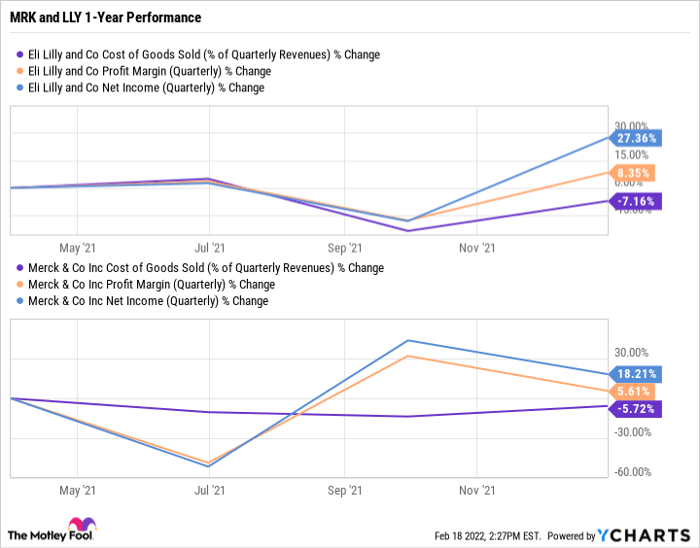
    The biggest thing to realize about pharma stocks is that the prices of the materials they need to manufacture and sell drugs aren’t necessarily tightly linked to inflation. Consider the two pharma giants, Eli Lilly (NYSE: LLY) and Merck (NYSE: MRK). Flying in the face of inflationary pressure, the quarterly cost of goods sold (COGS) as a percentage of revenue actually dropped for both companies over the past year.

    LLY Cost of Goods Sold (% of Quarterly Revenues) Chart

    LLY Cost of Goods Sold (% of Quarterly Revenues) data by YCharts

    As a result, their profit margins and net income actually both increased by a bit in the same period. If inflation were a serious threat to their bottom line, the costs of their inputs would have risen and forced their margin down accordingly. There’s no guarantee that further increases in the pace of inflation won’t start to make life more difficult for these companies, but they also have a powerful trick up their sleeve: pricing. 

    If you’re skeptical that pricing is the ultimate solution to inflationary cost increases in pharma, consider the following: 

    Eli Lilly makes an insulin analog called Humalog, which helps patients to control diabetes. Most people who need the drug require consistent infusions of it, and they can’t go without it, as doing so is a risk to their health. Furthermore, most patients are somewhat insulated from the cost of their prescriptions for the medicine via their insurance or public healthcare scheme. 

    Thus, if inflation causes Eli Lilly’s costs to produce Humalog to increase, it can count on being able to hike the price per dose without losing many customers. And that’s one more reason why inflation is unlikely to cause much of a dent in its profits. 

    Keep an eye on the total return

    The other issue with inflation is that it can erode the effective return that investors get from their holdings — unless the value of your shares can grow by as much as inflation. Take Eli Lilly, for example. Over the past year, it had a total return of 18.4%, which is derived from its share price appreciation and dividend yield of around 1.4%. Happily, the stock appreciated in value more than the inflation rate, which is a good sign. But that’s not the whole story.

    Assuming inflation remains at 7.5% year over year, Eli Lilly’s dividend payment needs to increase by at least the same rate in order for its contribution to the total return to remain constant in terms of its real value. Luckily, the company’s dividend grew by 15.3% in the past 12 months. So it rose by significantly more than the rate of inflation, meaning that investors did actually get a positive return from holding their shares on the basis of the dividend as well as the total return. 

    The same set of facts won’t necessarily be true for every pharma stock. Over the past year, the total return of Merck’s shares was roughly 7.5%, and its dividend increased by only 6.2%. That means the payout lost ground against inflation, and the total return barely broke even. In other words, inflation was indeed a threat to the value of investors’ shares of Merck because it killed their real returns. 

    In short, inflation may not be a threat to the actual operations of pharmaceutical companies, but it can be a significant concern for investors because the returns of slower-growing pharmas might not keep pace. So it may be wise to invest at least a portion of your investment portfolio in smaller and faster-growing companies, which are more likely to be able to outgrow inflation’s detrimental impact on returns. 

    This article was originally published on Fool.com. All figures quoted in US dollars unless otherwise stated.

    The post Is inflation a threat for pharma stocks? appeared first on The Motley Fool Australia.

    Wondering where you should invest $1,000 right now?

    When investing expert Scott Phillips has a stock tip, it can pay to listen. After all, the flagship Motley Fool Share Advisor newsletter he has run for over ten years has provided thousands of paying members with stock picks that have doubled, tripled or even more.*

    Scott just revealed what he believes could be the five best ASX stocks for investors to buy right now. These stocks are trading at near dirt-cheap prices and Scott thinks they could be great buys right now.

    *Returns as of January 12th 2022

    More reading

    Alex Carchidi has no position in any of the stocks mentioned. The Motley Fool Australia’s parent company Motley Fool Holdings Inc. has no position in any of the stocks mentioned. The Motley Fool Australia has no position in any of the stocks mentioned. The Motley Fool has a disclosure policy. This article contains general investment advice only (under AFSL 400691). Authorised by Bruce Jackson.

    This article was originally published on Fool.com. All figures quoted in US dollars unless otherwise stated.

    from The Motley Fool Australia https://ift.tt/qUJYCr3

  • Domino’s Pizza (ASX:DMP) profit nosedives: how will market digest result?

    a man looks sadly away from his computer screen as he holds a slice of pizza in his hand with an open pizza box in front of him on his desk.a man looks sadly away from his computer screen as he holds a slice of pizza in his hand with an open pizza box in front of him on his desk.a man looks sadly away from his computer screen as he holds a slice of pizza in his hand with an open pizza box in front of him on his desk.

    Domino’s Pizza Enterprises Ltd (ASX: DMP) has reported lower profit but higher sales for the half ending December, as it looks to open 500 new stores this financial year.

    What did the company report?

    What else happened in the first half?

    Domino’s also reported that it had opened more than 285 new stores during the first half, with 129 coming organically and 156 landing by acquisition in Taiwan.

    The pizza franchisor is on track to expand by about 500 stores over the current financial year.

    Despite the impact of successive waves of COVID-19, Domino’s is sticking by its long-term annual growth goals of 9% to 12% new store openings and 3% to 6% same-store sales. 

    The company admitted same-store sales growth this financial year would fall below this target range.

    What did Domino’s management say?

    Domino’s chief executive Don Meij stated that his team would deliver “another strong year of profit” after accelerating its long-term investments during the pandemic.

    “While there may be uncertainty about what it means for society to be ‘living with COVID’, we are certain we have the essential ingredients for long-term future success, and plan to deliver significant continued growth,” he said.

    “COVID-19 has brought unanticipated challenges, including the closure of a market, temporary store closures, and staff shortages as they self-isolate as patients or close contacts.”

    Meij added that Domino’s “avoided the temptation” to bunker down and get defensive when the coronavirus pandemic hit.

    “As a result we have built a materially stronger and more resilient business in all markets – in partnership with our people – and we will continue to do so.” 

    What’s next?

    Meij admitted forecasting same-store sales growth for the second half was “challenging”, especially because the prior first half had very strong sales.

    Supply chain issues, like in most industries, have struck Domino’s.

    “Our teams in each region are working with our supply chain partners to ensure our customers continue to enjoy their favourite meals,” he said. 

    “It is worth noting their efforts so far have avoided any menu unavailability, which reflects positively on our team and our partners.” 

    Domino’s Pizza share price snapshot

    The Domino’s share price has fallen brutally the past few months.

    The stock has plummeted more than 39% since its September high, or almost 30% since its November peak.

    Domino’s started Wednesday at $100.18, while it was flying high in the mid-$160s less than six months ago.

    Goldman Sachs this week rated Dominos shares as a buy with a target of $136.20, which is a 36% upside from the current level.

    The post Domino’s Pizza (ASX:DMP) profit nosedives: how will market digest result? appeared first on The Motley Fool Australia.

    Wondering where you should invest $1,000 right now?

    When investing expert Scott Phillips has a stock tip, it can pay to listen. After all, the flagship Motley Fool Share Advisor newsletter he has run for over ten years has provided thousands of paying members with stock picks that have doubled, tripled or even more.*

    Scott just revealed what he believes could be the five best ASX stocks for investors to buy right now. These stocks are trading at near dirt-cheap prices and Scott thinks they could be great buys right now.

    *Returns as of January 12th 2022

    More reading

    Motley Fool contributor Tony Yoo has no position in any of the stocks mentioned. The Motley Fool Australia’s parent company Motley Fool Holdings Inc. has no position in any of the stocks mentioned. The Motley Fool Australia has recommended Dominos Pizza Enterprises Limited. The Motley Fool has a disclosure policy. This article contains general investment advice only (under AFSL 400691). Authorised by Bruce Jackson.

    from The Motley Fool Australia https://ift.tt/y8haKTB

  • 3 reasons to treat a market correction like a cup of burnt coffee

    This article was originally published on Fool.com. All figures quoted in US dollars unless otherwise stated.

    Womann holding a coffee mug and smiling.

    This article was originally published on Fool.com. All figures quoted in US dollars unless otherwise stated.

    Stock market corrections are a part of investing. The emotions of fear and greed rule Wall Street on a daily basis, and the tug of war between them creates a roller coaster of gains and losses that make the occasional correction inevitable.

    Smart investors recognize that reality and prepare for it. If you have a solid end-to-end plan in place, a market correction might still be painful, but you could very well emerge in a better spot on the other side of one. With that in mind, here are three reasons to treat a market correction like a cup of burnt coffee. 

    No. 1: It’s an unpleasant experience, and you’re out some money

    If you buy a cup of burnt coffee, the taste can be nasty, and you’re out the money you spent. In addition, especially if you’re on the run, there might not be much you can do about it except choke it down and move on with your life.

    Similarly, when the stock market corrects, it can leave a dent in your wallet and a bad taste in your mouth. In addition, there’s a good chance that once the correction takes place, there’s little you can do aside from accept it and figure out what to do next.

    The common thread is the need to accept the situation, and figure out what to do next. Just like you can’t really go back in time and undo the coffee, you can’t really go back in time to undo a market correction. Still, if you recognize the possibility of a market correction in advance, you can prepare yourself so that the long-term impact to your finances is not much worse than a bad cup of coffee.

    The key is to recognize that money you need to spend within the next five years or so does not belong in stocks. With that long-term horizon, you give the market time to stage a recovery, and you give yourself a chance to adjust your spending should it appear that a recovery may take longer to happen.

    No. 2: This, too, shall pass

    One of the nicer things about burnt coffee is that the experience passes. Once it does, you can move on with your life, largely no worse off for the experience. Similarly, every market correction that we’ve had so far has been temporary, with the market ultimately coming back stronger. Unless there’s a complete breakdown in society or a socialist economic takeover, there is every reason to believe that the trend of recoveries will continue.

    Consider, for instance, the dot-com bust, when all sorts of high-flying internet-first companies completely vanished after the market collapsed. That didn’t mark the end of the internet, but rather the emergence of a much stronger breed of businesses that learned from the mistakes and built upon the successes of their predecessors.

    In a healthy market, that’s exactly the sort of thing that market corrections enable. Indeed, one of the biggest problems our economy currently faces is that there’s a slew of zombie companies out there, surviving only because of cheap debt. Those zombie companies are consuming resources and brainpower that could otherwise be used more productively. As painful as the near-term disruption might be, history shows that the eventual recovery makes the survivors and new entrants that much stronger.

    No. 3: There could be some good to come of it after all

    If there’s an upside to burnt coffee, it’s that it still tends to have about the same amount of caffeine as the unburnt variety. So if you’re into coffee more for the pick-me-up than for the taste, even the burnt kind can serve that purpose.

    Taking that perspective to the stock market, if there’s an upside to a market correction, it’s that corrections often open up some of the few opportunities to buy strong businesses at value-stock prices. This is because when fear is actively winning the market’s battle of emotions, even great companies tend to see their share prices drop.

    The lower the per-share price of a company, the more shares you can pick up for any given dollar amount invested. That can serve you well in any subsequent market recovery, as you can keep those shares, even if their prices do go back up. After all, fortunes aren’t made in bull markets — that’s just when they get revealed. Value investors like Warren Buffett, who are able to buy strong companies at cheap prices during market corrections, show just how powerful that process can be.

    Get yourself ready for the market’s next correction

    Like the occasional burnt cup of coffee, market corrections are inevitable. The better prepared you are for a correction, the easier it is for you to handle it when it happens. Make today the day you start preparing for the next correction, and you’ll improve your chances of being able to make it through intact. 

    This article was originally published on Fool.com. All figures quoted in US dollars unless otherwise stated.

    The post 3 reasons to treat a market correction like a cup of burnt coffee appeared first on The Motley Fool Australia.

    Wondering where you should invest $1,000 right now?

    When investing expert Scott Phillips has a stock tip, it can pay to listen. After all, the flagship Motley Fool Share Advisor newsletter he has run for over ten years has provided thousands of paying members with stock picks that have doubled, tripled or even more.*

    Scott just revealed what he believes could be the five best ASX stocks for investors to buy right now. These stocks are trading at near dirt-cheap prices and Scott thinks they could be great buys right now.

    *Returns as of January 12th 2022

    More reading

    Chuck Saletta has no position in any of the stocks mentioned. The Motley Fool Australia’s parent company Motley Fool Holdings Inc. has no position in any of the stocks mentioned. The Motley Fool Australia has no position in any of the stocks mentioned. The Motley Fool has a disclosure policy. This article contains general investment advice only (under AFSL 400691). Authorised by Bruce Jackson.

    This article was originally published on Fool.com. All figures quoted in US dollars unless otherwise stated.

    from The Motley Fool Australia https://ift.tt/tsJ0NmB

  • Why is the Appen (ASX:APX) share price having such a dire start to 2022?

    a woman wearing a close-sitting hat featuring wires and thick computer screen glasses clutches her computer monitor and looks shocked and disturbed as she reads old-fashioned computer text from the screen.a woman wearing a close-sitting hat featuring wires and thick computer screen glasses clutches her computer monitor and looks shocked and disturbed as she reads old-fashioned computer text from the screen.a woman wearing a close-sitting hat featuring wires and thick computer screen glasses clutches her computer monitor and looks shocked and disturbed as she reads old-fashioned computer text from the screen.

    The Appen (ASX: APX) share price has been struggling this year amid a tough time for ASX tech shares.

    Appen shares have fallen 27% since market open on 4 January. Appen shares finished Tuesday’s session at $8.14.

    Let’s take a look at what might be impacting this artificial intelligence (AI) data service company.

    Why has the Appen share price fallen?

    The Appen share price has been descending since the start of the year, shedding nearly 22% since market close on 1 February.

    Appen shares took a major hit in early February amid an earnings release from global tech giant Meta Platforms Inc (NASDAQ: FB). Meta is the parent company of Facebook, Instagram, and WhatsApp.

    Meta reported Facebook had experienced weaker advertising demand and revenue. As my Foolish colleague James reported, Facebook uses Appen services to support its advertising operations.

    Analysts at RBC Capital Markets also alluded to the impact of Meta’s earnings on Appen in a broker note in February.

    The broker stated Appen’s AI-powered search relevance accounts for more than 80% of domestic revenue, as my colleague Zach reported.

    Broader technology sector weakness also may have impacted the Appen share price. Since market open on 4 January, Megaport Ltd (ASX: MP1) shares have dropped nearly 35%, Altium Limited (ASX:ALU) has slipped 29% and Xero Limited (ASX: XRO) is down nearly 33%.

    For perspective, the S&P ASX All Technology Index (ASX: XTX) has plunged 24% in the same time frame.

    Nasdaq-100 Technology Sector Index (NASDAQ: NDXT) in the United States has also fallen nearly 17% in the year to date. ASX tech shares often follow in the footsteps of their US counterparts. Rising interest rate speculation is among the reasons for the tech share fall.

    Appen share price snapshot

    The Appen share price has plunged 60% in the past year. In the past month alone, Appen shares have fallen almost 20%.

    For perspective, the benchmark S&P/ASX 200 Index (ASX: XJO) has returned around 6% over the past year.

    Appen has a market capitalisation of about $1 billion, based on its current share price.

    The post Why is the Appen (ASX:APX) share price having such a dire start to 2022? appeared first on The Motley Fool Australia.

    Should you invest $1,000 in Appen right now?

    Before you consider Appen, you’ll want to hear this.

    Motley Fool Investing expert Scott Phillips just revealed what he believes are the 5 best stocks for investors to buy right now… and Appen wasn’t one of them.

    The online investing service he’s run for over a decade, Motley Fool Share Advisor, has provided thousands of paying members with stock picks that have doubled, tripled or even more.* And right now, Scott thinks there are 5 stocks that are better buys.

    *Returns as of January 13th 2022

    More reading

    Randi Zuckerberg, a former director of market development and spokeswoman for Facebook and sister to Meta Platforms CEO Mark Zuckerberg, is a member of The Motley Fool’s board of directors. The Motley Fool Australia’s parent company Motley Fool Holdings Inc. owns and has recommended Altium, Appen Ltd, MEGAPORT FPO, Meta Platforms, Inc., and Xero. The Motley Fool Australia owns and has recommended Appen Ltd and Xero. The Motley Fool Australia has recommended MEGAPORT FPO and Meta Platforms, Inc. The Motley Fool has a disclosure policy. This article contains general investment advice only (under AFSL 400691). Authorised by Bruce Jackson.

    from The Motley Fool Australia https://ift.tt/sU1iE4C

  • Here’s everything you need to know about the latest Altium (ASX:ALU) dividend

    A florist gets some good news on his laptop and tablet, a big smile on his face as he is surrounded by flowers.A florist gets some good news on his laptop and tablet, a big smile on his face as he is surrounded by flowers.A florist gets some good news on his laptop and tablet, a big smile on his face as he is surrounded by flowers.

    The Altium Ltd (ASX: ALU) share price has plunged since announcing its FY22 half-year results on Monday.

    The electronic design software company delivered strong earnings growth along with a bumper dividend. However, it was management’s outlook on achieving the low end of its margin guidance range that spooked investors.

    At yesterday’s market close, Altium shares finished the day 2.77% lower to $31.54. This means that this week alone, its shares have lost around 8.7%.

    Below, we look at the details regarding Altium’s latest dividend.

    What’s the go with the Altium dividend?

    In the half-year report for the 2022 financial year, Altium reported strong performance across key metrics.

    In summary, revenue surged by 28% to US$102 million in H1 FY22. The company benefitted from its core board and systems business which lifted by 16% to US$79.17 million. Double-digit growth was achieved across all regions, except for China. The Europe, Middle East, and Africa segment (EMEA) rose by 25% to US$23 million.

    The group also reported operating cash flow of US$33.28 million, up 33% on the prior corresponding period. 

    Overall, the company finished the first half with a net cash balance of US$195 million. This represents an increase of 120% from the prior year (H1 FY21 US$88.49 million). It’s also worth noting that the company remains debt free.

    The board declared a fully-franked (30%) interim dividend of 21 cents per share, up 11% on the previous comparable period. The latest dividend amounts to US$19.9 million based on the total number of shares outstanding.

    Altium was able to fully frank the interim dividend as a result of tax paid on the successful sale of the tasking business.

    When can Altium shareholders expect payment?

    Altium will pay the interim dividend to eligible shareholders on 22 March.

    To be eligible for the latest dividend, you’ll need to own Altium shares before the ex-dividend date of 7 March. This means if you want to secure the dividend, you will need to purchase Altium shares on or before Friday 4 March.

    In case you are wondering, the company is not offering a dividend reinvestment plan (DRP) to shareholders.

    The post Here’s everything you need to know about the latest Altium (ASX:ALU) dividend appeared first on The Motley Fool Australia.

    Should you invest $1,000 in Altium right now?

    Before you consider Altium, you’ll want to hear this.

    Motley Fool Investing expert Scott Phillips just revealed what he believes are the 5 best stocks for investors to buy right now… and Altium wasn’t one of them.

    The online investing service he’s run for over a decade, Motley Fool Share Advisor, has provided thousands of paying members with stock picks that have doubled, tripled or even more.* And right now, Scott thinks there are 5 stocks that are better buys.

    *Returns as of January 13th 2022

    More reading

    Motley Fool contributor Aaron Teboneras owns Altium. The Motley Fool Australia’s parent company Motley Fool Holdings Inc. owns and has recommended Altium. The Motley Fool Australia has no position in any of the stocks mentioned. The Motley Fool has a disclosure policy. This article contains general investment advice only (under AFSL 400691). Authorised by Bruce Jackson.

    from The Motley Fool Australia https://ift.tt/5Bs6kCU

  • WiseTech (ASX:WTC) share price on watch after strong half and FY22 earnings guidance upgrade

    three businessmen high five each other outside an office building with graphic images of graphs and metrics superimposed on the shot.

    three businessmen high five each other outside an office building with graphic images of graphs and metrics superimposed on the shot.three businessmen high five each other outside an office building with graphic images of graphs and metrics superimposed on the shot.

    The WiseTech Global Ltd (ASX: WTC) share price will be on watch on Wednesday.

    This follows the release of the logistics solutions company’s half year results.

    WiseTech share price on watch after upgrading guidance

    • Revenue up 18% over the prior corresponding period to $281 million
    • Recurring on-demand revenue up 25.4% to $225 million
    • EBITDA up 54% to $137.7 million
    • Underlying net profit after tax up 77% to $77.3 million
    • Fully franked interim dividend of 4.75 cents per share
    • FY 2022 EBITDA guidance upgraded

    What happened during the first half?

    For the six months ended 31 December, WiseTech was on form again and delivered an 18% increase in revenue over the prior corresponding period to $281 million.

    This was driven by increased market penetration, customer usage and adoption of its technology, as well a price change to CargoWise reflecting increased investment in product research and development (R&D), data centre hardware, and cyber security. Management notes that it has also made considerable progress with its cost reduction initiatives to drive operational efficiencies and acquisition synergies across the business.

    Supporting its strong performance has been the stickiness of its CargoWise product. Management notes that its attrition rate for the CargoWise platform remains below 1%. In fact, this is a level its attrition rate has been at for almost 10 years. Management notes that its customers are staying and growing their transaction usage due to the productivity and deep capabilities of the platform.

    Management commentary

    CEO Richard White commented: “The ongoing growth of eCommerce and strong demand for goods, coupled with the challenges posed by outbreaks of new COVID variants, has resulted in continued capacity constraints, port congestion, supply chain labor shortages and higher freight rates.”

    “From WiseTech’s perspective, whilst higher freight rates do not result in immediate revenue growth, we are benefitting from the acceleration of the longer-term structural changes they are driving. In particular, we are seeing increased investment by logistics companies in replacing legacy systems with integrated global technology, such as CargoWise, to drive productivity, and facilitate planning, visualization and control of global operations.”

    “We are also seeing continued consolidation within the logistics sector. Over the past two years Top 25 Global Freight Forwarders such as DHL, DSV6 , CEVA Logistics, Kuehne + Nagel and JAS Worldwide have embarked on acquisitions with consolidation activity intensifying in the second half of calendar 2021, ” he concluded.

    Outlook

    The good news for shareholders and the WiseTech share price today is that management appears confident that its strong form can continue.

    On the basis that market conditions do not materially change, the company has reaffirmed its revenue growth guidance of 18% to 25% in FY 2022. This will represent revenue of $600 million to $635 million.

    In respect to its earnings, management has now upgraded its EBITDA growth guidance to 33% to 43%, which represents EBITDA of $275 million to $295 million. This compares to its prior guidance of 26% to 38%, which implied EBITDA of $260 million to $285 million.

    The post WiseTech (ASX:WTC) share price on watch after strong half and FY22 earnings guidance upgrade appeared first on The Motley Fool Australia.

    Should you invest $1,000 in WiseTech right now?

    Before you consider WiseTech, you’ll want to hear this.

    Motley Fool Investing expert Scott Phillips just revealed what he believes are the 5 best stocks for investors to buy right now… and WiseTech wasn’t one of them.

    The online investing service he’s run for over a decade, Motley Fool Share Advisor, has provided thousands of paying members with stock picks that have doubled, tripled or even more.* And right now, Scott thinks there are 5 stocks that are better buys.

    *Returns as of January 13th 2022

    More reading

    Motley Fool contributor James Mickleboro has no position in any of the stocks mentioned. The Motley Fool Australia’s parent company Motley Fool Holdings Inc. owns and has recommended WiseTech Global. The Motley Fool Australia owns and has recommended WiseTech Global. The Motley Fool has a disclosure policy. This article contains general investment advice only (under AFSL 400691). Authorised by Bruce Jackson.

    from The Motley Fool Australia https://ift.tt/csOC2So

  • The iron ore price outlook could be darkening amid China’s latest plans

    The yellow stars of China's flag painted on a red wall next to a padlock, indicating the risk of trading with China

    The yellow stars of China's flag painted on a red wall next to a padlock, indicating the risk of trading with ChinaThe yellow stars of China's flag painted on a red wall next to a padlock, indicating the risk of trading with China

    The iron ore price outlook may be darkening with China’s latest plans for the commodity.

    It has already been a tricky couple of weeks for iron ore as the price has dropped over US$10 per tonne over the last 10 or so days.

    The Australian Financial Review reported that “China’s state planner and the market regulator told some iron ore traders to release excess inventory and reduce stocks to reasonable levels following a joint investigation in Qingdao, one of the country’s largest iron ore ports.”

    But there’s more potential change on the cards.

    China’s platform plans to control the iron ore price

    According to reporting by Bloomberg Quint, China wants to regain control of iron ore prices with a platform where all transactions have to be done through a single state-backed platform that is being worked on.

    The current laws are that Chinese businesses, such as the steel producers, can make their purchases independently.

    This platform aims to increase China’s ability to influence the price of commodities.

    It was reported by Bloomberg Quint that Chinese officials want to ensure limited inflation with possible upcoming stimulus measures that may lead to higher steel demand.

    It wouldn’t be unique

    Iron ore wouldn’t be the only commodity that centralised negotiations happen with, if this went ahead. There is reportedly a group of leading copper smelters in China that already do this for their annual supplies. This method could be tricky for how many buyers may be involved.

    Other tactics to control the iron ore price

    Bloomberg Quint also referred to some other strategies that China may pursue to control and reduce the iron ore price. The government wants the big steelmakers to become bigger by making corporate deals like acquisitions or mergers. Other ideas included more domestic output and the buying of stakes of mines outside China.

    Which ASX mining shares could this impact?

    Time will tell how this impacts the ASX miners.

    But there are some very big iron ore mining businesses on the ASX like BHP Group Ltd (ASX: BHP), Rio Tinto Limited (ASX: RIO), Fortescue Metals Group Limited (ASX: FMG) and Mineral Resources Limited (ASX: MIN).

    As commodity businesses, the price of iron ore can have a major impact on the movements of share prices and the profit-making potential of each company. Will each of those miners have to use that new platform? And what will the cost of using that platform for businesses be?

    The post The iron ore price outlook could be darkening amid China’s latest plans appeared first on The Motley Fool Australia.

    Should you invest $1,000 in Fortescue right now?

    Before you consider Fortescue, you’ll want to hear this.

    Motley Fool Investing expert Scott Phillips just revealed what he believes are the 5 best stocks for investors to buy right now… and Fortescue wasn’t one of them.

    The online investing service he’s run for over a decade, Motley Fool Share Advisor, has provided thousands of paying members with stock picks that have doubled, tripled or even more.* And right now, Scott thinks there are 5 stocks that are better buys.

    *Returns as of January 13th 2022

    More reading

    Motley Fool contributor Tristan Harrison owns Fortescue Metals Group Limited. The Motley Fool Australia’s parent company Motley Fool Holdings Inc. has no position in any of the stocks mentioned. The Motley Fool Australia has no position in any of the stocks mentioned. The Motley Fool has a disclosure policy. This article contains general investment advice only (under AFSL 400691). Authorised by Bruce Jackson.

    from The Motley Fool Australia https://ift.tt/8JCRDd6

  • 2 small-cap ASX shares that the market hasn’t woken up to yet

    a cute jack russell dog closes its eyes and yawns as if waking up from a long sleep underneath a doona cover next to a pair of feet with an old-fashioned alarm clock nearby.a cute jack russell dog closes its eyes and yawns as if waking up from a long sleep underneath a doona cover next to a pair of feet with an old-fashioned alarm clock nearby.a cute jack russell dog closes its eyes and yawns as if waking up from a long sleep underneath a doona cover next to a pair of feet with an old-fashioned alarm clock nearby.

    Ask A Fund Manager

    The Motley Fool chats with fund managers so that you can get an insight into how the professionals think. In this edition, Red Leaf Securities chief executive John Athanasiou explains why he loves the themes driving his 2 favourite ASX shares.

    Hottest ASX shares

    The Motley Fool: What are the 2 best stock buys right now?

    John Athanasiou: Well, the two best buys are Singular Health Group Ltd (ASX: SHG) and Mad Paws Holdings Ltd (ASX: MPA)

    I’ll kick off with Mad Paws, which is actually raising equity now as we speak. The reason why we love Mad Paws is it’s the leading online participant in Australian pet care. And we expect them to make significant earnings over the medium term. 

    We all know tailwinds in the industry of increased levels of pet ownership. Everyone bought a pet during lockdown to have some company. And they’re not shy about spending a dollar when it comes to pets.

    Now, Mad Paws has got a growth-by-acquisition strategy and they’re currently in the process of buying a business as we speak that we believe is very value creative. They’re acquiring Pet Chemist, which happens to be Australia’s leading online supplier of pet health care products. They’re raising $5.5 million at 18 cents as an SPP [share purchase plan] attached to that. So we’ll be telling existing shareholders to participate in that.

    There are not many pet service companies out there and that’s why we really like it, because it’s one area we think is going to really grow.

    MF: It only listed March last year, didn’t it?

    JA: Yeah. The reality is, it hasn’t done anything. It IPOed at 20 [cents]. It fluctuated around 25, 18, 17. It hasn’t done too much. But we do believe that the market will come around.

    MF: Did your team buy during the initial public offer?

    JA: Yeah, we participated in the IPO. When it pulled back, we picked up more, so we’ve been big supporters of it.

    And Singular Health Limited, we believe that metaverse is a long-term trend. Now, obviously, that gained investor attention thanks to [Meta Platforms Inc (NASDAQ: FB) chief] Mr Zuckerberg. There are only about half a dozen of these metaverse companies on ASX. Obviously, that’ll probably grow.

    Singular Health is our preferred company in this space, given its low market cap and its disruptive radio technology, which converts 2D medical images into 3D models that you can view on your mobile desktop, virtual reality devices. So very clever technology with plenty of upside there. We all know that the health sector will continue to grow, so it benefits from that as well.

    MF: So Singular Health is using the metaverse to perform diagnosis?

    JA: Correct. Correct.

    The post 2 small-cap ASX shares that the market hasn’t woken up to yet appeared first on The Motley Fool Australia.

    Wondering where you should invest $1,000 right now?

    When investing expert Scott Phillips has a stock tip, it can pay to listen. After all, the flagship Motley Fool Share Advisor newsletter he has run for over ten years has provided thousands of paying members with stock picks that have doubled, tripled or even more.*

    Scott just revealed what he believes could be the five best ASX stocks for investors to buy right now. These stocks are trading at near dirt-cheap prices and Scott thinks they could be great buys right now.

    *Returns as of January 12th 2022

    More reading

    Randi Zuckerberg, a former director of market development and spokeswoman for Facebook and sister to Meta Platforms CEO Mark Zuckerberg, is a member of The Motley Fool’s board of directors. Motley Fool contributor Tony Yoo has no position in any of the stocks mentioned. The Motley Fool Australia’s parent company Motley Fool Holdings Inc. owns and has recommended Meta Platforms, Inc. The Motley Fool Australia has recommended Meta Platforms, Inc. The Motley Fool has a disclosure policy. This article contains general investment advice only (under AFSL 400691). Authorised by Bruce Jackson.

    from The Motley Fool Australia https://ift.tt/rZShyvK