Tag: Motley Fool

  • Why the dividends from BHP shares could surge in 2024

    A happy construction worker or miner holds a fistfull of Australian money, indicating a dividends windfall

    A happy construction worker or miner holds a fistfull of Australian money, indicating a dividends windfall

    BHP Group Ltd (ASX: BHP) shares not only offer the potential for capital gains, but the S&P/ASX 200 Index (ASX: XJO) iron ore miner is also well known for its reliable, fully franked dividend payouts.

    With the iron ore price racing above US$215 per tonne in mid-2021, so too did the passive income the miner paid its shareholders.

    The final 2021 dividend of $2.715 per share set a new all-time high that still stands today.

    And BHP shares paid a record interim dividend of $2.081 in 2022, topping it off with a final dividend of $2.552 a share. That one was second only to 2021’s final payout.

    During the first half of 2022, the iron ore price broadly traded in the US$130 to US$150 per tonne range.

    You likely recall that the industrial metal then plunged to lows of around US$85 per tonne by the end of October 2022 amid slumping demand from China.

    As for 2023, the iron ore price hit lows of just under US$100 per tonne in late May, before momentum turned once more and prices began to rise.

    As you’d expect, with iron ore the biggest revenue earner for BHP shares, the 2023 dividends also dropped significantly.

    BHP paid an interim dividend of $1.364 per share on 30 March and a final dividend of $1.251 on September.

    That still sees the ASX 200 mining stock trading at a fully franked yield of 5.6%.

    But that yield could see a big boost in 2024.

    What’s the passive income outlook for BHP shares in 2024?

    Turning to 2024, as of Tuesday afternoon, iron ore was trading for US$136 per tonne.

    According to Andrew Fraser, co-portfolio manager Merlon Capital, that’s good news for BHP shareholders looking forward to some welcome passive income.

    “The iron ore pricing environment is [a] much more significant contributor to the cash flows, than some of the other commodities like nickel or copper,” Fraser said (quoted by The Australian Financial Review).

    “BHP and Fortescue have reasonably strong grounds to maintain their dividends, especially since the iron ore price has risen in the past six months,” he added.

    While Fraser is talking about the ASX 200 miners maintaining their dividends, there are reasons to believe the 2024 payouts could be significantly higher.

    Namely, if the iron ore price continues to march higher from here to levels not seen since the first half of 2022.

    And that’s precisely what the analysts at Citi are forecasting.

    Based on increasing stimulus measures from the Chinese government and People’s Bank of China (PBoC) to spur the nation’s sluggish economy and steel-hungry property markets, Citi forecasts the iron ore price will surge back to US$150 per tonne during the first three months of 2024.

    Commenting on China’s increasing stimulus measures, Citi analyst Wenyu Yao said:

    We see these measures as positive and can see this risk rally continuing over the coming month on the back of further details regarding urban village redevelopment and anticipated strong total social financing figures.

    And BHP shares, along with the ASX 200 miner’s dividends, could see tailwinds continuing into the second quarter.

    “As policy momentum could gather speed ahead of the National People’s Congress in March, we see rising upside catalysts into the second quarter,” Yao added.

    The post Why the dividends from BHP shares could surge in 2024 appeared first on The Motley Fool Australia.

    Wondering where you should invest $1,000 right now?

    When investing expert Scott Phillips has a stock tip, it can pay to listen. After all, the flagship Motley Fool Share Advisor newsletter he has run for over ten years has provided thousands of paying members with stock picks that have doubled, tripled or even more.*

    Scott just revealed what he believes could be the ‘five best ASX stocks’ for investors to buy right now. These stocks are trading at near dirt-cheap prices and Scott thinks they could be great buys right now…

    See The 5 Stocks
    *Returns as of 10 November 2023

    (function() {
    function setButtonColorDefaults(param, property, defaultValue) {
    if( !param || !param.includes(‘#’)) {
    var button = document.getElementsByClassName(“pitch-snippet”)[0].getElementsByClassName(“pitch-button”)[0];
    button.style[property] = defaultValue;
    }
    }

    setButtonColorDefaults(“#0095C8”, ‘background’, ‘#5FA85D’);
    setButtonColorDefaults(“#0095C8”, ‘border-color’, ‘#43A24A’);
    setButtonColorDefaults(“#fff”, ‘color’, ‘#fff’);
    })()

    More reading

    Motley Fool contributor Bernd Struben has no position in any of the stocks mentioned. The Motley Fool Australia’s parent company Motley Fool Holdings Inc. has no position in any of the stocks mentioned. The Motley Fool Australia has no position in any of the stocks mentioned. The Motley Fool has a disclosure policy. This article contains general investment advice only (under AFSL 400691). Authorised by Scott Phillips.

    from The Motley Fool Australia https://ift.tt/619N2sc

  • If you’d put $40,000 in this ASX uranium stock 5 years ago, you’d have $600,000 now

    Woman looks amazed and shocked as she looks at her laptop.Woman looks amazed and shocked as she looks at her laptop.

    There is arguably nothing more fun in investing than picking up a stock when no one else is interested, then watching it rocket to the moon.

    If you missed out on the ride, then the consolation prize is imagining how much money you would have if you did invest early enough.

    Regular readers would know that ASX uranium stocks have been on fire lately, but even by those standards there is one stock that had a particularly excellent 2023.

    Let’s check it out:

    Who’s the Boss?

    Boss Energy Ltd (ASX: BOE)’s main business is the Honeymoon Uranium Mine in South Australia.

    Under the previous owner the mine started producing in 2011. But rock-bottom global prices for uranium after the Fukushima disaster forced suspension of operations in late 2013.

    Boss Energy bought the mine in 2015 but it lay dormant, meaning for many years the share price languished in penny stock hell.

    In June 2021, the company announced it would conduct an Enhanced Feasibility Study (EFS) to see whether Honeymoon was sufficiently viable to restart mining.

    The results of that study recommended changes to the processing plant to improve the economics for every kilogram of uranium produced.

    Wonderful timing for this uranium stock

    All this work came along at an incredibly fortunate time.

    In February 2022, Russia invaded Ukraine. Almost immediately the world’s energy market plunged into crisis.

    Nuclear power, which had been out of favour for 11 years since Fukushima, all of a sudden looked attractive to nations seeking energy security.

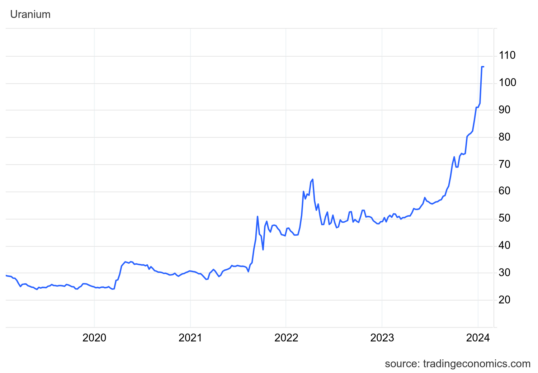
    Uranium prices soared for much of 2023 due to this surge in demand.

    Dormant mines around the world scrambled to resume production, but it’s a significant task requiring time and money.

    Boss Energy was a step ahead of the rest, thanks to conducting that feasibility study in 2021.

    How one winner can carry a bunch of losers

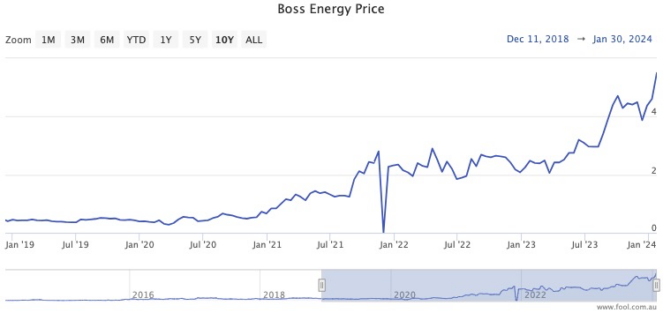
    In July 2019, you could still buy Boss Energy shares for 36 cents apiece.

    Let’s say you had the foresight to buy $40,000 worth back then. 

    Over the last couple of years the market has recognised the huge potential and advantage for Boss Energy.

    On Tuesday Boss Energy shares were trading around $5.44.

    This means that the $40,000 you put in not even five years ago would now be $604,444.

    Remember, this case study isn’t to encourage you to go for get-rich-quick schemes.

    It’s to point out that one or two winners can make all the difference in your ASX stock portfolio. You don’t have to aim for perfection.

    Consider this. 

    At the time you bought Boss Energy shares, you might have bought nine other stocks for $40,000 each to diversify your investments.

    Even if all nine of those somehow went to $0, your portfolio would still be 75% in the black.

    Crazy, but that’s maths for you.

    The post If you’d put $40,000 in this ASX uranium stock 5 years ago, you’d have $600,000 now appeared first on The Motley Fool Australia.

    Wondering where you should invest $1,000 right now?

    When investing expert Scott Phillips has a stock tip, it can pay to listen. After all, the flagship Motley Fool Share Advisor newsletter he has run for over ten years has provided thousands of paying members with stock picks that have doubled, tripled or even more.*

    Scott just revealed what he believes could be the ‘five best ASX stocks’ for investors to buy right now. These stocks are trading at near dirt-cheap prices and Scott thinks they could be great buys right now…

    See The 5 Stocks
    *Returns as of 10 November 2023

    (function() {
    function setButtonColorDefaults(param, property, defaultValue) {
    if( !param || !param.includes(‘#’)) {
    var button = document.getElementsByClassName(“pitch-snippet”)[0].getElementsByClassName(“pitch-button”)[0];
    button.style[property] = defaultValue;
    }
    }

    setButtonColorDefaults(“#0095C8”, ‘background’, ‘#5FA85D’);
    setButtonColorDefaults(“#0095C8”, ‘border-color’, ‘#43A24A’);
    setButtonColorDefaults(“#fff”, ‘color’, ‘#fff’);
    })()

    More reading

    Motley Fool contributor Tony Yoo has no position in any of the stocks mentioned. The Motley Fool Australia’s parent company Motley Fool Holdings Inc. has no position in any of the stocks mentioned. The Motley Fool Australia has no position in any of the stocks mentioned. The Motley Fool has a disclosure policy. This article contains general investment advice only (under AFSL 400691). Authorised by Scott Phillips.

    from The Motley Fool Australia https://ift.tt/mKd5Tjs

  • Breaking! NAB shares (and CBA) just hit a new 52-week high

    A piggy bank on the cloud in the blue sky symbolising a record high share price.

    A piggy bank on the cloud in the blue sky symbolising a record high share price.

    This Tuesday’s session has been an especially lucrative one for the S&P/ASX 200 Index (ASX: XJO) and most ASX 200 shares. The ASX 200 got painfully close to breaking its all-time record high this morning, and remains up 0.23% at the time of writing at 7,596.3 points. But let’s talk about what is happening with ASX 200 bank shares like National Australia Bank Ltd (ASX: NAB).

    NAB shares have had a wild day. The ASX 200’s second-largest bank stock by market capitalisation had a strong start his morning, rising as high as $32.34 a share – a new 52-week high for NAB. However, soon after, NAB shares lost steam. The bank is currently in the red zone, down 0.16% for the day at $32.09 a share at present.

    Even so, the new 52-week high still counts.

    NAB wasn’t the only ASX 200 bank stock to close in on a new high today. This Tuesday also saw ANZ Group Holdings Ltd (ASX: ANZ) shares clock a new 52-week high of $26.99 a share. This bank is now up around 18% since June last year.

    But Commonwealth Bank of Australia (ASX: CBA) has done one better. CBA shares hit not just a new 52-week high today, but a fresh all-time, record high. Yep, CBA shares clocked a new high watermark of $116.94 earlier this morning – the highest this ASX 200 bank has ever traded at. CBA is now up more than 20% since only late October.

    Westpac Banking Corp (ASX: WBC) investors might be feeling a little left out right about now. They shouldn’t get too envious though. Westpac may not have broken any new highs today. But Westpac shares did get as high as $24.04 this morning, just a touch off this bank’s reigning 52-week high of $24.10.

    Why are ASX bank shares like NAB and CBA at new highs today?

    Unfortunately, there’s no obvious catalyst for these new highs from NAB shares and the other ASX 200 bank stocks. Earlier today, we did cover why the overall ASX stock market was nearing its own record high. Those same factors – falling inflation, strong economic growth with low unemployment, and the expectations of interest rate cuts this year – are probably also at play with the banks today.

    It’s worth noting that earnings season is almost upon us though. Only CBA is scheduled to give investors a complete half-year earnings report next month (14 February). It seems that the markets are anticipating quite the Valentine for investors on that day.

    However, we are still in line to receive quarterly trading updates from the other big banks in February. So perhaps investors are… banking… on some good numbers coming out. Perhaps even a CBA dividend hike.

    As such, it will interesting to see how the share prices of NAB, CBA and the other banks react to these reports. Until then, let’s see if we get any more 52-week (or all-time) highs from our bank stocks.

    The post Breaking! NAB shares (and CBA) just hit a new 52-week high appeared first on The Motley Fool Australia.

    Wondering where you should invest $1,000 right now?

    When investing expert Scott Phillips has a stock tip, it can pay to listen. After all, the flagship Motley Fool Share Advisor newsletter he has run for over ten years has provided thousands of paying members with stock picks that have doubled, tripled or even more.*

    Scott just revealed what he believes could be the ‘five best ASX stocks’ for investors to buy right now. These stocks are trading at near dirt-cheap prices and Scott thinks they could be great buys right now…

    See The 5 Stocks
    *Returns as of 10 November 2023

    (function() {
    function setButtonColorDefaults(param, property, defaultValue) {
    if( !param || !param.includes(‘#’)) {
    var button = document.getElementsByClassName(“pitch-snippet”)[0].getElementsByClassName(“pitch-button”)[0];
    button.style[property] = defaultValue;
    }
    }

    setButtonColorDefaults(“#0095C8”, ‘background’, ‘#5FA85D’);
    setButtonColorDefaults(“#0095C8”, ‘border-color’, ‘#43A24A’);
    setButtonColorDefaults(“#fff”, ‘color’, ‘#fff’);
    })()

    More reading

    Motley Fool contributor Sebastian Bowen has positions in National Australia Bank. The Motley Fool Australia’s parent company Motley Fool Holdings Inc. has no position in any of the stocks mentioned. The Motley Fool Australia has no position in any of the stocks mentioned. The Motley Fool has a disclosure policy. This article contains general investment advice only (under AFSL 400691). Authorised by Scott Phillips.

    from The Motley Fool Australia https://ift.tt/SECej4p

  • Top 5 most profitable ASX large-cap shares of 2023

    A girl is handed an oversized ice cream cone with lots of different flavours.A girl is handed an oversized ice cream cone with lots of different flavours.

    The wise and wealthy Warren Buffett, CEO and co-founder of Berkshire Hathaway Inc, has previously insisted investors ought to “Look for companies with high profit margins”. A high margin is typically linked to some form of competitive advantage, enabling a company to generate above-normal returns.

    Excess earnings can be beneficial for businesses and shareholders in many ways. Firstly, it can fortify the balance sheet to insulate against black swan events. Alternatively, the capital can be redeployed by the company to fuel growth. Another option is to turn on the dividend tap, passing on those lucrative profits to shareholders.

    In 2023, the five most profitable ASX large-cap shares (market capitalisation above $10 billion) all scored net margins greater than 35%. Meanwhile, the collective net margin of the S&P/ASX 200 Index (ASX: XJO) — Australia’s top 200 listed companies — hovers around 11%.

    The ASX large-cap shares with magnificent margins

    Here are the Aussie companies that raked in monumental margins last year.

    5. Commonwealth Bank of Australia

    Australia’s biggest bank is also its most profitable. Beating out the other three members of the big four, the Commonwealth Bank of Australia (ASX: CBA) posted a net profit margin of 38.6% last year, its best since FY2017 — a time before the banking Royal Commission.

    As with most banks in 2023, CommBank basked in the glory of higher interest rates. As rates rose, so did the lender’s net interest margin — a key determinant of overall profit margins.

    The CBA share price rallied 9% in 2023 — beating all the other big four banks bar ANZ Group Holdings Ltd (ASX: ANZ).

    4. Pro Medicus Limited

    Dialling it up a notch, this next ASX large-cap share achieved its highest net profit margin on record last year. Medical imaging software provider Pro Medicus Limited (ASX: PME) profited 48.6 cents from every dollar of revenue it generated in FY23.

    The company’s margin benefits from the innate unit economics of its software. Pro Medicus can onboard additional healthcare customers onto its products at a negligible cost, increasing margins as the company scales.

    The Pro Medicus share price surged 73% throughout 2023.

    3. Goodman Group

    Now we’re into the 50-plus club. Australian integrated commercial and industrial property company Goodman Group (ASX: GMG) took home a 52.1% net profit margin in 2023. Despite increased property investment and development income, the lofty figure declined from the 71% margin in the prior year.

    The year saw Goodman retain an occupancy rate of 99% across its property portfolio with growing rents. Notably, the business holds $81 billion in assets under management and $13 billion of work in progress while maintaining a debt-to-equity ratio below 20%.

    Goodman shares gained a glamorous 46% during the year.

    2. Washington H Soul Pattinson and Company Ltd

    At 121 years old, the investment house known as Washington H Soul Pattinson and Company Ltd (ASX: SOL) and its earnings margin is no worse off for its age. The large-cap ASX share takes the runner-up position in 2023 with an impressive 58.4% net margin.

    The period provided improved net cash flows from Soul Patts’ investments ($118.5 million versus $116.9 million) despite a reduced weighting toward ASX large-cap shares in FY23 (21% versus 31%). A greater allocation towards diversified financials, industrials, and materials may have helped.

    Reclaiming lost ground from 2022, the Soul Patts share price climbed 19% in 2023.

    1. Pilbara Minerals Ltd

    Despite holding the mantle as the most shorted ASX share for too many weeks to recall, Pilbara Minerals Ltd (ASX: PLS) was the most profitable large-cap of 2023. The lithium miner earned 58.8 cents from every dollar of revenue, as per its last full-year result.

    It was a completely different landscape for lithium shares in the year leading up to FY2023 results. Prevailing prices for the commodity were far beyond even some of the highest-cost producers, minting money for those capable of mining lithium cheaply.

    The company’s latest quarterly update paints a slightly different picture.

    Shares in this ASX large-cap share lifted 5% in 2023, ironically the smallest return among the five.

    The post Top 5 most profitable ASX large-cap shares of 2023 appeared first on The Motley Fool Australia.

    Wondering where you should invest $1,000 right now?

    When investing expert Scott Phillips has a stock tip, it can pay to listen. After all, the flagship Motley Fool Share Advisor newsletter he has run for over ten years has provided thousands of paying members with stock picks that have doubled, tripled or even more.*

    Scott just revealed what he believes could be the ‘five best ASX stocks’ for investors to buy right now. These stocks are trading at near dirt-cheap prices and Scott thinks they could be great buys right now…

    See The 5 Stocks
    *Returns as of 10 November 2023

    (function() {
    function setButtonColorDefaults(param, property, defaultValue) {
    if( !param || !param.includes(‘#’)) {
    var button = document.getElementsByClassName(“pitch-snippet”)[0].getElementsByClassName(“pitch-button”)[0];
    button.style[property] = defaultValue;
    }
    }

    setButtonColorDefaults(“#0095C8”, ‘background’, ‘#5FA85D’);
    setButtonColorDefaults(“#0095C8”, ‘border-color’, ‘#43A24A’);
    setButtonColorDefaults(“#fff”, ‘color’, ‘#fff’);
    })()

    More reading

    Motley Fool contributor Mitchell Lawler has positions in Commonwealth Bank Of Australia and Pro Medicus. The Motley Fool Australia’s parent company Motley Fool Holdings Inc. has positions in and has recommended Berkshire Hathaway, Goodman Group, Pro Medicus, and Washington H. Soul Pattinson and Company Limited. The Motley Fool Australia has positions in and has recommended Washington H. Soul Pattinson and Company Limited. The Motley Fool Australia has recommended Berkshire Hathaway, Goodman Group, and Pro Medicus. The Motley Fool has a disclosure policy. This article contains general investment advice only (under AFSL 400691). Authorised by Scott Phillips.

    from The Motley Fool Australia https://ift.tt/wUlo1W3

  • $30 each? Here’s why the Fortescue share price just hit a new all-time high

    A female employee in a hard hat and overalls with high visibility stripes sits at the wheel of a large mining vehicle with mining equipment in the background.

    A female employee in a hard hat and overalls with high visibility stripes sits at the wheel of a large mining vehicle with mining equipment in the background.

    It’s been a great day, and week so far, for ASX shares and the S&P/SX 200 Index (ASX: XJO). This Tuesday has seen the ASX 200 rise by another 0.25% at the time of writing, having almost hit a new record high earlier in the trading day. But let’s talk about the Fortescue Ltd (ASX: FMG) share price.

    Fortescue shares are on fire today. The ASX 200 iron ore mining giant closed at $29.25 yesterday. But this morning, those same shares opened at $29.50 each before climbing to a new record high of $29.75. The shares are hovering around that level at present at $29.70, up 1.54% for the day.

    As recently as September 2023, it would have been unthinkable for most investors to picture Fortescue shares at $30 each. After all, that was when Fortescue stock was going for less than $20 a pop.

    But as it stands today, these latest gains put the iron miner up a chunky 33.93% over the past 12 months, and up more than 400% since early 2019.

    No doubt Andrew ‘Twiggy’ Forrest is a very happy man right now.

    So why is the Fortescue share price sitting at almost $30 each today?

    Why are Fortescue shares at a new record high this Tuesday?

    Well, there’s little doubt that Forescue’s latest quarterly report is helping to lure investors into the stock. As my Fool colleague Bernd covered just last week, Forescue’s report covering the three months to 31 December was exceptionally well received.

    The company revealed that it shipped 48.7 million tonnes over the period. That brought its shipments for the six months to 31 December to 94.6 million tonnes, the second-highest half-year in Fortescue’s history. What’s more, the company was able to achieve average revenue of US$116 per tonne. You do the maths.

    Fortescue also maintained its guidance for the whole 2024 financial year at between 192-197 million tonnes.

    In some other news, we also looked at broker Citi’s forecasts for the iron ore price just today. As my Fool colleague reported, Citi is expecting iron ore to surge as high as US$150 per tonne in the coming three months.

    As such, it’s not difficult to see why investors are fighting over themselves to get a slice of the action over at Forescue. At the current Fortescue share price, this ASX 200 miner has a market capitalisation of $90.05 billion, with a dividend yield of 5.89%.

    The post $30 each? Here’s why the Fortescue share price just hit a new all-time high appeared first on The Motley Fool Australia.

    Wondering where you should invest $1,000 right now?

    When investing expert Scott Phillips has a stock tip, it can pay to listen. After all, the flagship Motley Fool Share Advisor newsletter he has run for over ten years has provided thousands of paying members with stock picks that have doubled, tripled or even more.*

    Scott just revealed what he believes could be the ‘five best ASX stocks’ for investors to buy right now. These stocks are trading at near dirt-cheap prices and Scott thinks they could be great buys right now…

    See The 5 Stocks
    *Returns as of 10 November 2023

    (function() {
    function setButtonColorDefaults(param, property, defaultValue) {
    if( !param || !param.includes(‘#’)) {
    var button = document.getElementsByClassName(“pitch-snippet”)[0].getElementsByClassName(“pitch-button”)[0];
    button.style[property] = defaultValue;
    }
    }

    setButtonColorDefaults(“#0095C8”, ‘background’, ‘#5FA85D’);
    setButtonColorDefaults(“#0095C8”, ‘border-color’, ‘#43A24A’);
    setButtonColorDefaults(“#fff”, ‘color’, ‘#fff’);
    })()

    More reading

    Motley Fool contributor Sebastian Bowen has no position in any of the stocks mentioned. The Motley Fool Australia’s parent company Motley Fool Holdings Inc. has no position in any of the stocks mentioned. The Motley Fool Australia has no position in any of the stocks mentioned. The Motley Fool has a disclosure policy. This article contains general investment advice only (under AFSL 400691). Authorised by Scott Phillips.

    from The Motley Fool Australia https://ift.tt/FP8XMw1

  • ASX 200 record! Here’s why Aussie shares are on the cusp of a new all-time high

    A man wearing a red jacket and mountain hiking clothes stands at the top of a mountain peak and looks out over countless mountain ranges.

    A man wearing a red jacket and mountain hiking clothes stands at the top of a mountain peak and looks out over countless mountain ranges.

    It’s been a joyous day for ASX shares and particularly the S&P/ASX 200 Index (ASX: XJO) so far this Tuesday.

    The ASX 200 has been on a stunning run for a few months now. It was only back in late October that the ASX 200 was at what was then a new 52-week low of 6,751.3 points. But fast forward to today, and we see that same index at over 7,600 points.

    This means that the ASX 200 has gained a whopping 12.3% or so over just three months. That three-month gain well exceeds its annual average return.

    What’s more, we’ve seen the ASX 200 hit a new high today. During this morning’s trading, the index climbed as high as 7,630.5 points. That exceeds the highest point the ASX 200 has ever closed at (7,628.9 points in August 2021).

    However, it is just a tantalising whisker away from the index’s real all-time high of 7,632.8 points, which was achieved during intra-day trading in the same month.

    At present, investors have cooled a little, with the index sitting at 7,599.8 points, up 0.28% for the day so far.

    Saying that, the index got laughably close to this high earlier this month. On 2 January earlier this month, we saw the ASX 200 climb as high as 7,632.7 points – just 0.1 point from that August 2021 high.

    Still, we can’t deny that this is exciting territory for ASX 200 shares to be exploring.

    So what’s behind the recent runup for the Australian stock market that is seeing the market attempting to crack these records?

    Why are ASX 200 shares at record highs today?

    It’s difficult to pinpoint exactly why an entire share market might be at or near a new record high. But in this case, here are a few factors we can point to.

    Firstly, the US markets are currently at all-time record highs. Just last night (our time), the S&P 500 Index (INDEXSP: .INX) hit an all-time high of 4,929.31 points.

    At the same time, the Dow Jones Industrial Average (INDEXDJX: .DJI) also clocked a new record high of 38,343,93 points, while the Nasdaq Composite (INDEXNASDAQ: .IXIC) Index achieved a new 52-week high of 15,630.58 points.

    As the financial centre of the world’s economy, the US markets often dictate the mood on the ASX. So it was always going to be fertile ground for a new high on the ASX today.

    But more broadly, it’s likely that the ongoing success of both the US economy and the Australian economy are helping our respective stock markets too.

    Across both the US and here at home, the respective central banks seem on track to achieve something that most commentators thought was an unachievable pipedream: cooling rampant inflation while preventing an economic recession.

    The Goldilocks zone

    In the past, most periods of high inflation have been broken only by rising interest rates sparking an economic contraction.

    However, the US Federal Reserve, as well as our own Reserve Bank of Australia, seem to have softly landed the economic plane this time around.

    The US economy in particular remains remarkably resilient. Inflation is falling, yet economic growth is robust, and unemployment remains at historic lows. Commodity prices, particularly oil, are also at relatively moderate levels.

    What’s more, most American and Australian commentators think the next interest rate move will be a cut, rather than a hike. If that isn’t enough to elicit new records on the stock market, I don’t know what is.

    Of course, the rest of 2024 is still unknown. There’s a chance that this economic miracle will come back to earth. If it does, we could see the US and Australian share markets retreat.

    But equally, if the good economic news continues to flow in, then we could see even higher highs for both the ASX 200 and the S&P 500.

    The post ASX 200 record! Here’s why Aussie shares are on the cusp of a new all-time high appeared first on The Motley Fool Australia.

    Wondering where you should invest $1,000 right now?

    When investing expert Scott Phillips has a stock tip, it can pay to listen. After all, the flagship Motley Fool Share Advisor newsletter he has run for over ten years has provided thousands of paying members with stock picks that have doubled, tripled or even more.*

    Scott just revealed what he believes could be the ‘five best ASX stocks’ for investors to buy right now. These stocks are trading at near dirt-cheap prices and Scott thinks they could be great buys right now…

    See The 5 Stocks
    *Returns as of 10 November 2023

    (function() {
    function setButtonColorDefaults(param, property, defaultValue) {
    if( !param || !param.includes(‘#’)) {
    var button = document.getElementsByClassName(“pitch-snippet”)[0].getElementsByClassName(“pitch-button”)[0];
    button.style[property] = defaultValue;
    }
    }

    setButtonColorDefaults(“#0095C8”, ‘background’, ‘#5FA85D’);
    setButtonColorDefaults(“#0095C8”, ‘border-color’, ‘#43A24A’);
    setButtonColorDefaults(“#fff”, ‘color’, ‘#fff’);
    })()

    More reading

    Motley Fool contributor Sebastian Bowen has no position in any of the stocks mentioned. The Motley Fool Australia’s parent company Motley Fool Holdings Inc. has no position in any of the stocks mentioned. The Motley Fool Australia has no position in any of the stocks mentioned. The Motley Fool has a disclosure policy. This article contains general investment advice only (under AFSL 400691). Authorised by Scott Phillips.

    from The Motley Fool Australia https://ift.tt/PlQBsRy

  • Buying ASX retail shares? You’ll want to see these numbers

    Two fashionable asx investors dancing among confetti.Two fashionable asx investors dancing among confetti.

    Official data released by the Australian Bureau of Statistics (ABS) today shows retail turnover fell 2.7% in the month of December, but at the same time ASX retail share prices soared.

    And they continued their upward trajectory in January, too.

    Let’s review the ABS data and the price performance of ASX retail shares over the past two months.

    ABS reports ‘large fall in retail turnover’ last month

    In December, seasonally adjusted retail trade fell by 2.7%. This was better than the 4% fall expected by CBA analysts.

    The ABS said Australians are changing the way they shop, with the Black Friday sales in November becoming much more popular.

    This is impacting how much consumers are spending at the post-Christmas sales in December and January.

    Retail turnover lifted by 1.6% in November after a fall of 0.2% in October.

    Ben Dorber, ABS head of retail statistics, said:

    The large fall in retail turnover in December was caused by a fall in discretionary spending. Consumers brought forward some of their usual December spending to November to take advantage of Black Friday sales. 

    This shift in spending from December to November reflects the growing popularity of Black Friday sales and the impact of cost-of-living pressures, with consumers seeking out bargains and taking advantage of discounts in November. 

    In trend terms, Dorber said retail turnover rose by 0.1% in December, adding:

    This shows that underlying retail spending remains subdued when we look through the volatile movements over recent months in the lead up to Christmas.

    Retailers told us that trading conditions were slow in early December following the success of Black Friday before picking up again in the lead up to Christmas and Boxing Day sales where discounting activity returned.

    But ASX retail shares kept climbing in December

    The S&P/ASX 200 Consumer Discretionary Index (ASX: XDJ) lifted 6.3% over the month of December.

    At the same time, the S&P/ASX All Ordinaries Index (ASX: XAO) rose by 7.3% during a strong Santa Rally.

    Here is a snapshot of how ASX retail shares performed in December:

    • The Lovisa Holdings Ltd (ASX: LOV) share price increased by 27.5%
    • The Universal Store Holdings Ltd (ASX: UNI) share price rose by 24.3%
    • The Myer Holdings Ltd (ASX: MYR) share price lifted by 15.4%
    • The Super Retail Group Ltd (ASX: SUL) share price rose by 14.5%
    • The Premier Investments Limited (ASX: PMV) share price advanced by 13%
    • The Nick Scali Limited (ASX: NCK) share price rose by 12.1%
    • The JB Hi-Fi Limited (ASX: JBH) share price rose by 10.9%
    • The Accent Group Ltd (ASX: AX1) share price increased by 7.2%
    • The Harvey Norman Holdings Limited (ASX: HVN) share price rose by 6.9%

    And look what they did in January…

    Only two of these ASX retail shares lost value this month after their December gains.

    Meantime, the Consumer Discretionary Index is up 1.96% in January while the All Ords is up 0.17%.

    The post Buying ASX retail shares? You’ll want to see these numbers appeared first on The Motley Fool Australia.

    Wondering where you should invest $1,000 right now?

    When investing expert Scott Phillips has a stock tip, it can pay to listen. After all, the flagship Motley Fool Share Advisor newsletter he has run for over ten years has provided thousands of paying members with stock picks that have doubled, tripled or even more.*

    Scott just revealed what he believes could be the ‘five best ASX stocks’ for investors to buy right now. These stocks are trading at near dirt-cheap prices and Scott thinks they could be great buys right now…

    See The 5 Stocks
    *Returns as of 10 November 2023

    (function() {
    function setButtonColorDefaults(param, property, defaultValue) {
    if( !param || !param.includes(‘#’)) {
    var button = document.getElementsByClassName(“pitch-snippet”)[0].getElementsByClassName(“pitch-button”)[0];
    button.style[property] = defaultValue;
    }
    }

    setButtonColorDefaults(“#0095C8”, ‘background’, ‘#5FA85D’);
    setButtonColorDefaults(“#0095C8”, ‘border-color’, ‘#43A24A’);
    setButtonColorDefaults(“#fff”, ‘color’, ‘#fff’);
    })()

    More reading

    Motley Fool contributor Bronwyn Allen has positions in Harvey Norman and Nick Scali. The Motley Fool Australia’s parent company Motley Fool Holdings Inc. has positions in and has recommended Lovisa. The Motley Fool Australia has positions in and has recommended Harvey Norman and Super Retail Group. The Motley Fool Australia has recommended Accent Group, Jb Hi-Fi, Lovisa, Nick Scali, and Premier Investments. The Motley Fool has a disclosure policy. This article contains general investment advice only (under AFSL 400691). Authorised by Scott Phillips.

    from The Motley Fool Australia https://ift.tt/BkngV4b

  • Get a big income boost from these high-yield ASX dividend stocks

    A woman relaxes on a yellow couch with a book and cuppa, and looks pensively away as she contemplates the joy of earning passive income.

    A woman relaxes on a yellow couch with a book and cuppa, and looks pensively away as she contemplates the joy of earning passive income.

    Looking for ASX dividend stocks for your income portfolio? If you are, then you could check out the three listed below that have been named as buys and tipped to offer big yields.

    Here’s what brokers are saying about these shares:

    Dalrymple Bay Infrastructure Ltd (ASX: DBI)

    The first ASX dividend stock that could be a buy is Dalrymple Bay Infrastructure. It is the long-term operator of the Dalrymple Bay Coal Terminal (DBCT).

    DBCT is the world’s largest metallurgical coal export facility, serving as a global gateway from the Bowen Basin and is a critical link in the global steelmaking supply chain.

    Citi is feeling positive on the company thanks to its big yields and hedged debt.

    In respect to the former, the broker is forecasting dividends per share of 20.6 cents in FY 2023 and 22 cents in FY 2024. Based on the latest Dalrymple Bay Infrastructure share price of $2.80, this will mean juicy yields of 7.35% and 7.9%, respectively.

    Citi has a buy rating and $3.00 price target on its shares.

    Dexus Convenience Retail REIT (ASX: DXC)

    Another ASX dividend stock that analysts are positive on is Dexus Convenience Retail REIT.

    Bell Potter is a big fan of the convenience retail and service station property fund. It believes its shares are cheap and deserve to trade on higher multiples. Particularly given that it operates in a “sub-sector where there is clear price discovery, and investors for commercial real estate have a clear preference for smaller cheque size assets.”

    In addition, the broker is expecting some big dividend yields. It is forecasting dividends per share of 20.9 cents in FY 2024 and 20.5 cents in FY 2025. Based on its current share price of $2.65, this equates to yields of 7.9% and 7.7%, respectively.

    Bell Potter has a buy rating and $2.85 price target on Dexus Convenience Retail REIT’s shares.

    Universal Store Holdings Ltd (ASX: UNI)

    This youth fashion retailer could be another ASX dividend stock for investors to buy.

    That’s the view of the bullish analysts at Morgans, which highlight the company’s “attractive array of medium-term growth prospects.”

    The broker is expecting this to allow Universal Store to pay fully franked dividends of 26 cents in FY 2024 and then 29 cents in FY 2025. Based on the latest Universal Store share price of $4.10, this equates to yields of 6.3% and 7.1%, respectively.

    Its analysts have an add rating and $4.55 price target on its shares.

    The post Get a big income boost from these high-yield ASX dividend stocks appeared first on The Motley Fool Australia.

    Wondering where you should invest $1,000 right now?

    When investing expert Scott Phillips has a stock tip, it can pay to listen. After all, the flagship Motley Fool Share Advisor newsletter he has run for over ten years has provided thousands of paying members with stock picks that have doubled, tripled or even more.*

    Scott just revealed what he believes could be the ‘five best ASX stocks’ for investors to buy right now. These stocks are trading at near dirt-cheap prices and Scott thinks they could be great buys right now…

    See The 5 Stocks
    *Returns as of 10 November 2023

    (function() {
    function setButtonColorDefaults(param, property, defaultValue) {
    if( !param || !param.includes(‘#’)) {
    var button = document.getElementsByClassName(“pitch-snippet”)[0].getElementsByClassName(“pitch-button”)[0];
    button.style[property] = defaultValue;
    }
    }

    setButtonColorDefaults(“#0095C8”, ‘background’, ‘#5FA85D’);
    setButtonColorDefaults(“#0095C8”, ‘border-color’, ‘#43A24A’);
    setButtonColorDefaults(“#fff”, ‘color’, ‘#fff’);
    })()

    More reading

    Citigroup is an advertising partner of The Ascent, a Motley Fool company. Motley Fool contributor James Mickleboro has positions in Universal Store. The Motley Fool Australia’s parent company Motley Fool Holdings Inc. has no position in any of the stocks mentioned. The Motley Fool Australia has no position in any of the stocks mentioned. The Motley Fool has a disclosure policy. This article contains general investment advice only (under AFSL 400691). Authorised by Scott Phillips.

    from The Motley Fool Australia https://ift.tt/5F9aAWy

  • Buying ASX 200 mining shares? Here’s Citi’s 2024 prediction for the iron ore price

    Female miner standing next to a haul truck in a large mining operation.

    Female miner standing next to a haul truck in a large mining operation.

    The iron ore price edged higher again overnight to be trading at just under US$136 per tonne.

    That’s helping all three of the big S&P/ASX 200 Index (ASX: XJO) iron ore stocks outpace the benchmark today.

    At the time of writing in early afternoon trade on Tuesday, the ASX 200 is up a healthy 0.5%.

    Here’s how these top mining shares are performing at this same time:

    • BHP Group Ltd (ASX: BHP) shares are up 0.8%
    • Rio Tinto Ltd (ASX: RIO) shares are up 1%
    • Fortescue Metals Group Ltd (ASX: FMG) shares are up 1.5%

    That’s certainly welcome news to shareholders.

    But if Citi’s outlook for the iron ore price proves out, then there could be more outperformance ahead for BHP, Rio Tinto and Fortescue shares.

    Iron ore price flagged to hit US$150 per tonne

    As you likely recall, the iron ore price dipped below US$100 per tonne in late May last year. The industrial metal, and the ASX 200 mining stocks, came under pressure amid concerns over falling steel demand from China.

    At the time, a number of analysts were forecasting that the critical steel-making metal would remain below US$100 per tonne in 2024, as China’s policymakers were seen as not doing enough to spur the nation’s sluggish economy and property markets.

    What a difference a few months can make.

    Last week the People’s Bank of China (PBoC) said it will cut the reserve requirements for Chinese banks, commencing in February. China’s government is also moving to shore up its steel-hungry real estate sector.

    This sees Citi upgrading its forecast for copper prices – the number two revenue earner for BHP shares and the other big ASX 200 miners – along with predicting the iron ore price will reach US$150 per tonne in the three months ahead.

    According to Citi analyst Wenyu Yao (quoted by The Australian Financial Review):

    We see these measures as positive and can see this risk rally continuing over the coming month on the back of further details regarding urban village redevelopment and anticipated strong total social financing figures.

    And in further good news for investors in Rio Tinto, BHP and Fortescue shares, the iron ore price could get some added tailwinds heading into the second quarter, according to the broker.

    “As policy momentum could gather speed ahead of the National People’s Congress in March, we see rising upside catalysts into the second quarter from both macro expectations and strengthening fundamental,” Yao said.

    The post Buying ASX 200 mining shares? Here’s Citi’s 2024 prediction for the iron ore price appeared first on The Motley Fool Australia.

    Wondering where you should invest $1,000 right now?

    When investing expert Scott Phillips has a stock tip, it can pay to listen. After all, the flagship Motley Fool Share Advisor newsletter he has run for over ten years has provided thousands of paying members with stock picks that have doubled, tripled or even more.*

    Scott just revealed what he believes could be the ‘five best ASX stocks’ for investors to buy right now. These stocks are trading at near dirt-cheap prices and Scott thinks they could be great buys right now…

    See The 5 Stocks
    *Returns as of 10 November 2023

    (function() {
    function setButtonColorDefaults(param, property, defaultValue) {
    if( !param || !param.includes(‘#’)) {
    var button = document.getElementsByClassName(“pitch-snippet”)[0].getElementsByClassName(“pitch-button”)[0];
    button.style[property] = defaultValue;
    }
    }

    setButtonColorDefaults(“#0095C8”, ‘background’, ‘#5FA85D’);
    setButtonColorDefaults(“#0095C8”, ‘border-color’, ‘#43A24A’);
    setButtonColorDefaults(“#fff”, ‘color’, ‘#fff’);
    })()

    More reading

    Citigroup is an advertising partner of The Ascent, a Motley Fool company. Motley Fool contributor Bernd Struben has no position in any of the stocks mentioned. The Motley Fool Australia’s parent company Motley Fool Holdings Inc. has no position in any of the stocks mentioned. The Motley Fool Australia has no position in any of the stocks mentioned. The Motley Fool has a disclosure policy. This article contains general investment advice only (under AFSL 400691). Authorised by Scott Phillips.

    from The Motley Fool Australia https://ift.tt/A6R0ITb

  • Can Coles shares go from loser to winner in 2024?

    A man pushes a supermarket trolley with phone in hand down a supermarket aisle looking at the products on the shelves.A man pushes a supermarket trolley with phone in hand down a supermarket aisle looking at the products on the shelves.

    Looking at Coles Group Ltd (ASX: COL) shares, and investors might not grasp just how little they’ve managed to squeeze out of this ASX 200 consumer staples stock in recent years.

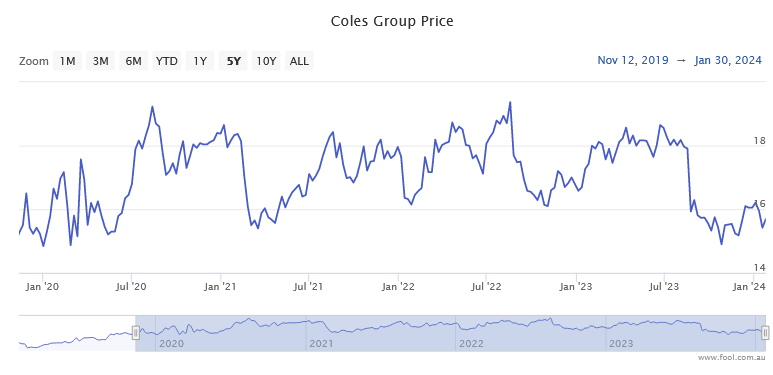
    Coles shares have always been a bouncy investment. Over the past 12 months alone, the grocery and supermarket giant has fluctuated between $14.82 and $18.85 a share. That’s a difference worth more than 20%.

    But at today’s share price of $15.74 (at the time of writing), one thing is painfully evident: Coles shares have gone nowhere over the past four years.

    Yes, Coles was also going for around this same share price way back in November of 2019. So if you bought Coles shares back then, you’ve only had the company’s dividend to keep you warm at night.

    See for yourself below:

    Coles shares

    Not that Coles’ dividend has been insubstantial. Investors have long enjoyed a dividend yield of just over 4% from the supermarket operator. That yield has always come fully franked as well.

    But the fact remains that Coles has functioned as more of a term deposit over the past four years than a successful, compounding stock market investment.

    Rubbing salt in the wound, shares of Coles’ arch-rival Woolworths Group Ltd (ASX: WOW) have enjoyed capital growth of around 10% over the same period.

    So perhaps Coles investors are hoping that 2024 is the year that the company goes from loser to winner.

    Can Coles shares turn it around in 2024?

    Well, the good news is that while the Coles share price has been stagnant over the past four years or so, the company has still been growing. In its 2019 earnings report, Coles posted total group revenue of $38.18 billion, with an earnings before interest and tax (EBIT) of $1.47 billion.

    Fast forward to the company’s full-year earnings for FY2023 from August last year, and we can see that group sales had increased to $41.47 billion, with an EBIT of $1.97 billion.

    This should give investors some comfort as we head into 2024.

    But let’s see what an ASX expert is predicting when it comes to Coles shares this year.

    Just yesterday, my Fool colleague James covered the views of ASX broker Citi on Coles shares.

    ASX broker names Coles as a buy

    Citi indeed believes that Coles shares are going to have a great year in 2024. The broker has given Coles a 12-month share price target of $17.50 a share, alongside a buy rating. If realised, this would see the Coles share price gain approximately 11% from where the company sits today.

    Citi is taking a long view of Coles. The broker reckons the grocer will struggle to grow its earnings over FY2024. However, it is also anticipating Coles will be able to bank solid earnings growth over both FY2025 and FY2026.

    That in turn, according to Citi, will see the company increase its dividends substantially over those financial years as well, resulting in an annual dividend of 70 cents per share over FY2025. If Citi is on the money here, it could see Coles shares with a forward dividend yield of 4.45% today.

    So that’s what one ASX expert has in mind for Coles this year. But we’ll have to wait and see whether the market does decide to yank the supermarket operator out of its four-year slump in 2024. No doubt investors have their fingers crossed.

    The post Can Coles shares go from loser to winner in 2024? appeared first on The Motley Fool Australia.

    Wondering where you should invest $1,000 right now?

    When investing expert Scott Phillips has a stock tip, it can pay to listen. After all, the flagship Motley Fool Share Advisor newsletter he has run for over ten years has provided thousands of paying members with stock picks that have doubled, tripled or even more.*

    Scott just revealed what he believes could be the ‘five best ASX stocks’ for investors to buy right now. These stocks are trading at near dirt-cheap prices and Scott thinks they could be great buys right now…

    See The 5 Stocks
    *Returns as of 10 November 2023

    (function() {
    function setButtonColorDefaults(param, property, defaultValue) {
    if( !param || !param.includes(‘#’)) {
    var button = document.getElementsByClassName(“pitch-snippet”)[0].getElementsByClassName(“pitch-button”)[0];
    button.style[property] = defaultValue;
    }
    }

    setButtonColorDefaults(“#0095C8”, ‘background’, ‘#5FA85D’);
    setButtonColorDefaults(“#0095C8”, ‘border-color’, ‘#43A24A’);
    setButtonColorDefaults(“#fff”, ‘color’, ‘#fff’);
    })()

    More reading

    Citigroup is an advertising partner of The Ascent, a Motley Fool company. Motley Fool contributor Sebastian Bowen has no position in any of the stocks mentioned. The Motley Fool Australia’s parent company Motley Fool Holdings Inc. has no position in any of the stocks mentioned. The Motley Fool Australia has positions in and has recommended Coles Group. The Motley Fool has a disclosure policy. This article contains general investment advice only (under AFSL 400691). Authorised by Scott Phillips.

    from The Motley Fool Australia https://ift.tt/6q5OP71