Tag: Motley Fool

  • Want to be a millionaire investor? Consider this Warren Buffett pick

    This article was originally published on Fool.com. All figures quoted in US dollars unless otherwise stated.

    A male sharemarket analyst sits at his desk looking intently at his laptop with two other monitors next to him showing stock price movements

    This article was originally published on Fool.com. All figures quoted in US dollars unless otherwise stated.

    Investing can make you rich if you do it right. Perhaps the best example of this is Warren Buffett who has become a billionaire largely through a series of sound investments.

    The good news is, anyone can follow Buffett’s advice and have a very good chance of building substantial wealth for themselves over time. In particular, there’s one solid investment that carries very low risk that Buffett recommends and that’s all but certain to leave you with a seven-figure nest egg if you invest enough money in it.

    Here’s what it is. 

    This Warren Buffett recommendation can pay off for you

    Although Buffett has made his fortune by selecting individual stocks (and companies) to invest in, his recommendation for most investors is not to follow in his footsteps. Instead, he suggests the majority of people are better off putting most of their money into one single investment: an S&P 500 index fund. 

    The S&P 500 is a stock index commonly used as a measure of how the market as a whole is doing. The index consists of 500 of the country’s largest companies and is weighted by market capitalization. Market capitalization is calculated by multiplying the total number of shares times the price per share, so this means that companies with higher valuations have an outsized impact on the performance of the index as whole.  

    Because the S&P 500 is intended to track the performance of these 500 large companies, with larger companies making a bigger impact, its performance is determined by how well America’s biggest businesses do over time. And that’s one big reason why Buffett recommends this index for most investors. He’s made clear he’d never bet against the American economy, and these companies are the driver’s of it.

    Why bet big on the S&P 500?

    An S&P index fund has a number of huge advantages for investors. Those who put their money into an S&P 500 index fund don’t have to individually analyze dozens or hundreds of companies to decide which ones to buy stock shares in. Instead, their purchase of the index fund gives them a small ownership stake in a huge number of companies that are household names.

    The companies that make up the S&P 500 are also diverse, ranging from Apple (NASDAQ: AAPL) to Harley-Davidson (NYSE: HOG) to Caesars Entertainment (NASDAQ: CZR) to Kohl’s (NYSE: KSS). So not only are you investing in established businesses, but you’re also benefiting from instant diversification with the purchase of one simple investment. This instant diversification reduces investing risk and is another reason why Buffett’s recommendation is a solid one for most people. 

    Investors who follow Buffett’s advice will also benefit from low investing fees. Fees are low because no one has to manually select the stocks included in an S&P 500 index fund, as the fund’s composition is simply determined by each company’s inclusion in the S&P 500 and its valuation.

    Low fees mean investors get to keep more of their returns and their portfolio balance isn’t reduced by paying a professional fund manager to individually select investments.

    Is this investment really likely to make you a millionaire?

    While it’s clear there’s plenty of benefits to investing in an S&P 500 index fund, the big question is, can you really build a seven-figure nest egg with a single investment that isn’t going to outperform the market? 

    The answer is an unequivocal yes. The S&P 500 has consistently produced average 10% annual returns over the long term. So if you invest just $506 per month over 30 years in an S&P index fund, you’ll almost certainly hit your $1 million goal. And the more you invest, the faster you can reach that milestone. 

    If you want a safe, simple, hands-off investment that requires no effort on your part to make you a millionaire, buying into this Buffett pick is a no-brainer. 

    This article was originally published on Fool.com. All figures quoted in US dollars unless otherwise stated.

    The post Want to be a millionaire investor? Consider this Warren Buffett pick appeared first on The Motley Fool Australia.

    Wondering where you should invest $1,000 right now?

    When investing expert Scott Phillips has a stock tip, it can pay to listen. After all, the flagship Motley Fool Share Advisor newsletter he has run for over ten years has provided thousands of paying members with stock picks that have doubled, tripled or even more.*

    Scott just revealed what he believes could be the five best ASX stocks for investors to buy right now. These stocks are trading at near dirt-cheap prices and Scott thinks they could be great buys right now.

    *Returns as of January 12th 2022

    More reading

    The Motley Fool Australia’s parent company Motley Fool Holdings Inc. has no position in any of the stocks mentioned. The Motley Fool Australia has recommended Apple. The Motley Fool has a disclosure policy. This article contains general investment advice only (under AFSL 400691). Authorised by Bruce Jackson.

    This article was originally published on Fool.com. All figures quoted in US dollars unless otherwise stated.

    from The Motley Fool Australia https://ift.tt/aSZOFHm9N

  • Here’s why the Vulcan Energy (ASX:VUL) share price is climbing today

    high, climbing, record highhigh, climbing, record highhigh, climbing, record high

    Key Points

    • Vulcan Energy shares lift on back of new lithium supply deal
    • Up to 50,000 metric tonnes of lithium chemical to be provided to LG Energy Solution
    • Vulcan Energy has sold out its entire planned lithium production for the first five years of operation

    The Vulcan Energy Resources Ltd (ASX: VUL) share price is edging into positive territory today. This follows the company announcement that it has teamed up with a future eco-friendly energy powerhouse.

    At the time of writing, the clean lithium developer’s shares are fetching for $9.01 apiece, up 2.04%. Despite today’s slight gain, its shares have fallen 11% in the past month.

    Vulcan Energy secures another partner for its Zero Carbon Lithium Project

    In today’s statement, Vulcan Energy advised it has signed a binding lithium hydroxide offtake agreement with LG Energy Solution (LGES).

    Founded in 2020, LGES is the second largest battery maker in the world, holding over 20% market share. The storage battery manufacturing company supplies its products to leading Original Equipment Manufacturers (OEM) worldwide.

    Currently, LGES manufactures lithium-ion batteries in Poland, the US, China, and South Korea, and is seeking to expand production capacity.

    Under the deal, LGES will purchase between 41,000 to 50,000 metric tonnes of battery grade lithium chemicals from Vulcan Energy.

    The agreement will last for an initial period of five years and can be extended by a further five years. Commercial delivery of the battery-making ingredient is expected to begin in 2025.

    In terms of pricing, this will be based on the ongoing market price for lithium hydroxide.

    Vulcan is aiming to become the world’s first lithium producer with net zero greenhouse gas emissions. Its Zero Carbon Lithium Project is seeking to produce a lithium-hydroxide chemical product for the European electric vehicle battery market.

    Vulcan managing director, Dr Francis Wedin commented:

    Our initial partnership with LG Energy Solution, the second largest battery producer in the world, was a significant first step in our strategy to engage with tier one battery, cathode and automakers in the European market.

    The completion of the binding lithium offtake agreement with LG, in addition to our binding lithium offtake agreements with Volkswagen Group, Stellantis, Renault Group and Umicore, represents a globally unique achievement by the Vulcan Zero Carbon Lithium team. It means that we are fully sold out for the first five years of planned lithium production, which is an important foundation toward securing project finance.

    Vulcan Energy hare price snapshot

    Over the last 12 months, the Vulcan Energy share price has risen by more than 10% for shareholders. The company’s shares reached an all-time high of $16.65 in September, before moving on a downward channel.

    Based on today’s price, Vulcan commands a market capitalisation of around $1.16 billion with approximately 131.61 million shares on issue.

    The post Here’s why the Vulcan Energy (ASX:VUL) share price is climbing today appeared first on The Motley Fool Australia.

    Should you invest $1,000 in Vulcan Energy right now?

    Before you consider Vulcan Energy, you’ll want to hear this.

    Motley Fool Investing expert Scott Phillips just revealed what he believes are the 5 best stocks for investors to buy right now… and Vulcan Energy wasn’t one of them.

    The online investing service he’s run for over a decade, Motley Fool Share Advisor, has provided thousands of paying members with stock picks that have doubled, tripled or even more.* And right now, Scott thinks there are 5 stocks that are better buys.

    *Returns as of January 13th 2022

    More reading

    Motley Fool contributor Aaron Teboneras has no position in any of the stocks mentioned. The Motley Fool Australia’s parent company Motley Fool Holdings Inc. has no position in any of the stocks mentioned. The Motley Fool Australia has no position in any of the stocks mentioned. The Motley Fool has a disclosure policy. This article contains general investment advice only (under AFSL 400691). Authorised by Bruce Jackson.

    from The Motley Fool Australia https://ift.tt/9QgfURpo5

  • Broker upgrade sends ResMed (ASX:RMD) share price charging higher

    a man looks down at his phone with a look of happy surprise on his face as though he is thrilled with good news.

    a man looks down at his phone with a look of happy surprise on his face as though he is thrilled with good news.a man looks down at his phone with a look of happy surprise on his face as though he is thrilled with good news.

    Key points

    • ResMed shares have been upgraded by Goldman Sachs
    • Broker wasn’t blown away by its second quarter update
    • Analysts see enough long term potential to make it a buy

    The ResMed Inc (ASX: RMD) share price is charging higher on Monday.

    In morning trade, the sleep treatment focused medical device company’s shares are up 3% to $32.17.

    Why is the ResMed share price charging higher?

    Investors have been bidding the ResMed share price higher today following the release of a bullish broker note.

    According to a note out of Goldman Sachs, its analysts have upgraded the company’s shares to a buy rating with a slightly trimmed price target of $35.80.

    Based on the current ResMed share price, this implies potential upside of 11% for investors over the next 12 months.

    Why is Goldman bullish on ResMed?

    Goldman notes that ResMed’s second quarter update was a bit of a disappointment. Not only did its revenue and earnings fall a touch short of the broker’s estimates, Goldman’s concerns about the impact of supply shortages on the company’s ability to capitalise on a competitor recall were only heightened.

    Goldman said: “The 2Q22 update did little to ease our concerns that supply shortages will materially restrict the near-term upside from competitor challenges. The recall tailwind of $45-55m in 2Q represented a sharp sequential slowdown from $80-90m in 1Q, and we now forecast the FY22 benefit at $285m, below the guided range of $300-350m.”

    Nevertheless, the broker notes that the ResMed share price has pulled back recently to a more attractive level. This, combined with its bullish view on the company’s long term prospects, warranted an upgrade to buy.

    The broker explained: “RMD is the clear leader in an attractive market with long-term, realizable penetration upside (underpinning a high-single digit organic profile). Competitive positioning has consistently strengthened over the last decade and looks set to continue to do so. The pricing profile is the most supportive in years, and whilst the ongoing supply/distribution headwinds add cost and complexity to near-term performance, these pressures should progressively ease through the coming quarters, and so have created an attractive entry point in the shares, in our view.”

    The post Broker upgrade sends ResMed (ASX:RMD) share price charging higher appeared first on The Motley Fool Australia.

    Should you invest $1,000 in ResMed right now?

    Before you consider ResMed, you’ll want to hear this.

    Motley Fool Investing expert Scott Phillips just revealed what he believes are the 5 best stocks for investors to buy right now… and ResMed wasn’t one of them.

    The online investing service he’s run for over a decade, Motley Fool Share Advisor, has provided thousands of paying members with stock picks that have doubled, tripled or even more.* And right now, Scott thinks there are 5 stocks that are better buys.

    *Returns as of January 13th 2022

    More reading

    Motley Fool contributor James Mickleboro has no position in any of the stocks mentioned. The Motley Fool Australia’s parent company Motley Fool Holdings Inc. has no position in any of the stocks mentioned. The Motley Fool Australia has recommended ResMed Inc. The Motley Fool has a disclosure policy. This article contains general investment advice only (under AFSL 400691). Authorised by Bruce Jackson.

    from The Motley Fool Australia https://ift.tt/gsrNnq6KE

  • Here’s what higher interest rates could mean for ASX bank shares

    Young boy wearing suit and glasses adds up on calculator with coins on tableYoung boy wearing suit and glasses adds up on calculator with coins on tableYoung boy wearing suit and glasses adds up on calculator with coins on table

    Key points

    • ASX bank shares are in the spotlight amid rising rate expectations
    • Higher rates help banks’ lending margins
    • Higher rates could also depress mortgage lending markets

    ASX banks shares are in the spotlight as investors are increasingly convinced that the Reserve Bank of Australia (RBA) will follow the US Fed and begin ratcheting up the official cash rate.

    Atop the cash rate likely rising from the current historic low of 0.10%, analysts also are flagging an unwinding of the RBA’s bond buying – or quantitative easing (QE) – program.

    If you own ASX bank shares, or are thinking of investing, here’s what the prospect of higher rates could mean for the likes of Commonwealth Bank of Australia (ASX: CBA), Australia and New Zealand Banking Group Ltd (ASX: ANZ), National Australia Bank Ltd (ASX: NAB), and Westpac Banking Corp (ASX: WBC).

    What these experts are saying on rate rises

    On the plus side for ASX bank share prices, higher interest rates tend to increase banks’ lending margins. But that benefit could be impacted by higher rates dragging on new lending in mortgage markets. And then there’s the looming end to government pandemic funding benefits.

    Commenting on the potential impact on ASX banks shares, Citigroup analyst Brendan Sproules said (quoted by the Australian Financial Review):

    Despite a better short-term rate outlook over the next two years, revenue challenges will remain as the unwinding of COVID-related funding benefits (11 basis points), as well as continued mortgage competition (19 basis points), will consume much of the deposit margin benefit…

    Higher rates will invariably lower borrowing capacity and pressure the housing market.

    While housing market lending could take a hit, Sproules was bullish on the outlook for business lending. “System credit growth will also benefit from accelerating business credit, which we estimate will print 7.5 per cent in financial year 2022 as under-leveraged businesses gear up,” he said.

    Jarden analyst Carlos Cacho also thinks ASX bank shares could be battling some headwinds in the year ahead.

    According to Cacho (quoted by the AFR):

    While 2022 is likely to be a solid year for the Australian economy, we expect it to be a tougher one for the banks – margin pressure, while fading, is set to remain, while credit growth is likely near its peak and mortgage competition remains intense…

    Looking ahead, we still expect margin compression but see scope for moderating pressure given support from the repricing of fixed-rate mortgages, higher swap rates and moderating funding cost tailwinds.

    Cacho added that he sees “the business-oriented banks” – ANZ and NAB – as “better placed in managing margin contractions in financial year 2022”.

    How have these ASX bank shares been performing in 2022?

    The S&P/ASX 200 Index (ASX: XJO) is down 6.77% so far in 2022.

    By comparison, the NAB share price has fallen 4.13%; the CBA share price is down 5.28%; ANZ shares have lost 0.15%; and Westpac is down 3.37%.

    Not exactly shooting the lights out, but all the ASX bank shares are beating the benchmark…so far.

    The post Here’s what higher interest rates could mean for ASX bank shares appeared first on The Motley Fool Australia.

    Wondering where you should invest $1,000 right now?

    When investing expert Scott Phillips has a stock tip, it can pay to listen. After all, the flagship Motley Fool Share Advisor newsletter he has run for over ten years has provided thousands of paying members with stock picks that have doubled, tripled or even more.*

    Scott just revealed what he believes could be the five best ASX stocks for investors to buy right now. These stocks are trading at near dirt-cheap prices and Scott thinks they could be great buys right now.

    *Returns as of January 12th 2022

    More reading

    The Motley Fool Australia’s parent company Motley Fool Holdings Inc. has no position in any of the stocks mentioned. The Motley Fool Australia has recommended Westpac Banking Corporation. The Motley Fool has a disclosure policy. This article contains general investment advice only (under AFSL 400691). Authorised by Bruce Jackson.

    from The Motley Fool Australia https://ift.tt/GbhJg4Ho9

  • Sezzle (ASX:SZL) share price higher after reporting 75% Q4 sales jump

    BNPL written on a smartphone.BNPL written on a smartphone.

    BNPL written on a smartphone.

    Key points

    • Sezzle delivered strong growth during the fourth quarter
    • Customer and merchant numbers continue to rise
    • Key merchant additions expected to boost its performance in FY 2022

    The Sezzle Inc (ASX: SZL) share price is on the move on Monday morning following the release of its fourth quarter update.

    In early trade, the buy now pay later (BNPL) provider’s shares are up 2% to $2.39.

    Sezzle share price rises on strong Q4 growth

    • Underlying merchant sales (UMS) up 74.9% to US$561 million (A$772.2 million)
    • Fourth quarter total income grew 49.1% to US$32.9 million
    • Total income to UMS margin of 5.9%
    • Active merchants rose 76% year on year and 5.8% quarter on quarter to 47,000
    • Active consumers reached 3.4 million at year end, up 51.5% year on year and 6.5% quarter on quarter
    • IKEA signs up in USA and Canada

    What happened in the fourth quarter?

    For the three months ended 31 December, Sezzle’s UMS grew 74.9% over the prior corresponding period and 21.8% quarter on quarter to US$561 million (A$772.2 million).

    A key driver of this strong growth was its performance during the key holiday period. For the four-day period of Black Friday through to Cyber Monday, Sezzle’s UMS rose 53% year on year. This reflects instore growth of 783% and online growth of 46%.

    Also supporting its growth were further rises in its customer and merchant numbers. Active customers rose 51.5% to 3.4 million year on year and active merchants rose 76% year on year to 47,000. Among those merchants is IKEA in the US and Canada after the retail giant selected Sezzle as its preferred BNPL partner in these markets.

    While the company reported a slight contraction in its total income to UMS margin to 5.9%, Sezzle still delivered strong total income growth of 49.1% to US$32.9 million. Positively, as a percentage of UMS, the provision for uncollectible accounts receivable and transaction expense remains flat year on year.

    At the end of the period, Sezzle had total cash on hand of US$78.9 million.

    Management commentary

    Sezzle’s Executive Chairman and CEO, Charlie Youakim, was pleased with the quarter.

    He commented: “Our 4Q21 results demonstrate our strong secular growth, as we reached new highs in UMS, Active Merchants, and Active Consumers. We are also enthusiastic about our in-store growth reflecting the significant opportunity to be more than just an online option for consumers.”

    No further updates were given on its potential merger with Zip Co Ltd (ASX: Z1P).

    The post Sezzle (ASX:SZL) share price higher after reporting 75% Q4 sales jump appeared first on The Motley Fool Australia.

    Should you invest $1,000 in Sezzle right now?

    Before you consider Sezzle, you’ll want to hear this.

    Motley Fool Investing expert Scott Phillips just revealed what he believes are the 5 best stocks for investors to buy right now… and Sezzle wasn’t one of them.

    The online investing service he’s run for over a decade, Motley Fool Share Advisor, has provided thousands of paying members with stock picks that have doubled, tripled or even more.* And right now, Scott thinks there are 5 stocks that are better buys.

    *Returns as of January 13th 2022

    More reading

    Motley Fool contributor James Mickleboro has no position in any of the stocks mentioned. The Motley Fool Australia’s parent company Motley Fool Holdings Inc. owns and has recommended ZIPCOLTD FPO. The Motley Fool Australia has no position in any of the stocks mentioned. The Motley Fool has a disclosure policy. This article contains general investment advice only (under AFSL 400691). Authorised by Bruce Jackson.

    from The Motley Fool Australia https://ift.tt/FfKZbqk8x

  • Bubs (ASX:BUB) share price jumps 14% amid strong daigou-fuelled Q2 growth

    hands throwing smiling baby up in the air representing rising asx share price

    hands throwing smiling baby up in the air representing rising asx share pricehands throwing smiling baby up in the air representing rising asx share price

    Key points

    • Bubs has delivered strong growth during the second quarter
    • Demand in daigou channel improving
    • Solid growth in Australian channels

    The Bubs Australia Ltd (ASX: BUB) share price has started the week with a bang following the release of its second quarter update.

    At the time of writing, the infant formula company’s shares are up 14% to 51 cents.

    Bubs share price jumps on improved performance

    • Quarterly gross revenue up 8% quarter on quarter and 56% over the COVID-impacted prior corresponding period to $19.9 million
    • Half year revenue of $38.5 million, which is up 73% over the prior corresponding period
    • Infant formula revenue up 83% across all markets
    • Corporate daigou channel revenue up 196% and China CBEC sales up 48%
    • Generated positive cash flow for second quarter in a row, improving cash balance by $2.3 million to $30.6 million

    What happened during the second quarter?

    The Bub share price is storming higher today after revealing a major improvement in its performance during the second quarter. This saw revenue grow 56% over the COVID-impacted prior corresponding period to $19.9 million.

    Management advised that this was driven by demand for its infant formula, particularly in China. Its corporate daigou channel delivered growth of 196% after demand exceeded pre-pandemic levels. This was supported by the Chinese cross border ecommerce channel, which reported a 48% lift in sales.

    Bubs also revealed that sales have been strong in Australian supermarkets and chemists. And while it claims to be the fastest growing infant formula brand across these channels, it is worth remembering that it is growing from a very small base compared to its larger rivals. The company’s current market share stands at 3.9%.

    All in all, this improved performance led to Bubs generating positive cash flow during the quarter, lifting its cash balance by $2.3 million to $30.6 million. Though, this was also due to its cash receipts being $4 million larger than its revenues during the period.

    Management commentary

    Bubs Founder and CEO Kristy Carr, commented: “Bubs has consolidated the solid gains of its COVID turnaround in the first quarter into a pattern of growth momentum across all key markets and product groups. Bubs Infant Formula remains our hero product line and lead margin driver, up 83% on prior year, accounting for nearly two thirds of revenues.

    “On the home front, sales revenue of branded products increased 17 percent quarter-on-quarter. Despite the subdued market, Bubs Infant Formula grew in both absolute terms and in market share with scan sales growth of 31 percent in Coles, Woolworths and Chemist Warehouse consolidating its strong market share position to remain the fastest growing infant formula manufacturer, achieving nearly 4 percent market share of the total infant formula category.”

    Outlook

    Bubs’ Executive Chair, Dennis Lin, said: “Against the backdrop of myriad challenges, the team continue to execute strategy with precision through operational excellence, and the results speak for themselves as we lead the return to growth for our category.”

    “As our momentum gains further pace, we will continue to look for ways to grow through market and products expansion as we aspire to become the leading global family nutrition brand from Australia,” Mr Lin concluded.

    The post Bubs (ASX:BUB) share price jumps 14% amid strong daigou-fuelled Q2 growth appeared first on The Motley Fool Australia.

    Should you invest $1,000 in Bubs right now?

    Before you consider Bubs, you’ll want to hear this.

    Motley Fool Investing expert Scott Phillips just revealed what he believes are the 5 best stocks for investors to buy right now… and Bubs wasn’t one of them.

    The online investing service he’s run for over a decade, Motley Fool Share Advisor, has provided thousands of paying members with stock picks that have doubled, tripled or even more.* And right now, Scott thinks there are 5 stocks that are better buys.

    *Returns as of January 13th 2022

    More reading

    Motley Fool contributor James Mickleboro has no position in any of the stocks mentioned. The Motley Fool Australia’s parent company Motley Fool Holdings Inc. has no position in any of the stocks mentioned. The Motley Fool Australia has recommended BUBS AUST FPO. The Motley Fool has a disclosure policy. This article contains general investment advice only (under AFSL 400691). Authorised by Bruce Jackson.

    from The Motley Fool Australia https://ift.tt/8g3EwmNDB

  • Thank Bitcoin for Making this stock so cheap in 2022

    This article was originally published on Fool.com. All figures quoted in US dollars unless otherwise stated.

    Man sitting at a desk facing his computer screen and holding a coin representing discussion by the RBA Governor about cryptocurrency and digital tokens

    This article was originally published on Fool.com. All figures quoted in US dollars unless otherwise stated.

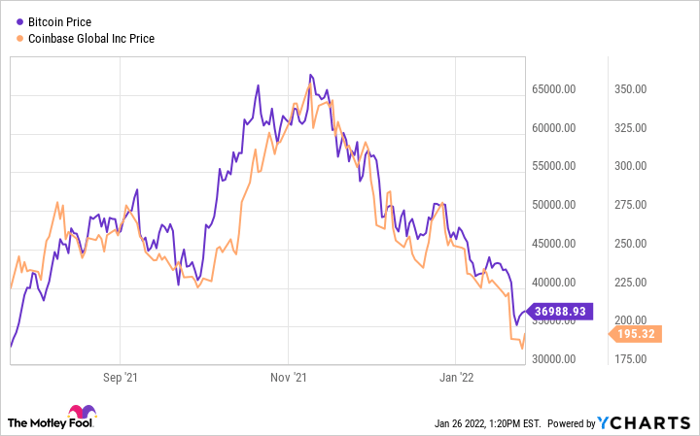
    The recent sell-off in the stock market hasn’t spared crypto; Bitcoin is barely up over the past year and down almost 60% from its all-time high. Shares of cryptocurrency technology company Coinbase Global (NASDAQ: COIN) are facing a similar struggle, down roughly the same amount.

    Bitcoin and Coinbase tend to trade together, so the recent slide could be seen as an opportunity for investors to consider Coinbase as a long-term holding. Here’s why.

    Bitcoin influences Coinbase stock

    Coinbase is a cryptocurrency technology company, but its primary business is its exchange that allows people to buy and sell crypto. It charges transaction fees for these trades, generating revenue.

    Users can buy and sell nearly 100 different cryptocurrencies on Coinbase, but Bitcoin and Ethereum are the two largest, contributing 21% and 22% of transaction revenue, respectively. All of the other cryptos add up to the remaining 57%.

    Bitcoin Price Chart

    Bitcoin price. Data by YCharts.

    The strong link between Coinbase and Bitcoin seems to influence how the stock trades. You can see in the above chart how they show nearly identical price action.

    But there’s a crucial difference between the two assets: Coinbase’s stock price is a function of supply and demand in the short term, but it’s a real business that generates revenue and earnings, which tend to influence a stock’s value over the long term. Cryptocurrency prices, including Bitcoin’s, are almost solely a matter of supply and demand; they don’t have underlying fundamentals, which could make them more volatile. Bitcoin’s recent drop in price may be influencing Coinbase’s stock, regardless of the company’s underlying financials.

    Stellar financials

    Cryptocurrency has become increasingly mainstream in the investment community, both among retail users and institutions. In Coinbase’s 2021 third quarter, trading volume rose to $327 billion from just $45 billion the year-earlier period.

    This leap in volume created triple-digit revenue growth for Coinbase; revenue in the third quarter increased more than 300% year over year, but declined from the previous quarter, indicating how the business can fluctuate based on how actively crypto is trading on the platform.

    The business is very profitable because Coinbase doesn’t need to spend much to maintain its platform. It turned 25% of its revenue into free cash flow in the 2021 third quarter, and $406 million of its $1.2 billion in revenue fell to the bottom line, a net profit margin of almost 33%.

    COIN Revenue (Quarterly YoY Growth) Chart

    COIN revenue (quarterly YOY growth). Data by YCharts. YOY = year over year.

    Analysts are looking for full 2021 revenue of $7.29 billion, which puts the stock at a price-to-sales ratio of less than 6, despite its tremendous growth. Expected earnings per share (EPS) for 2021 are $13.06, a price-to-earnings (P/E) ratio of just under 15.

    The company is growing and is profitable, yet the stock trades at almost half the P/E ratio of Coca-Cola, which produces EPS growth at a mid-single-digit rate!

    Now, Coca-Cola is a more proven business than Coinbase, and investors might not be sure yet of crypto’s future, which would, in turn, mean that Coinbase’s long-term prospects are uncertain. Still, the financials seem to be easily justified by this low valuation. If sentiment toward crypto picks up in the future, it could create a lot of upside in Coinbase’s stock via a higher valuation.

    A long runway for growth

    In other words, an investment in Coinbase probably means that you’re a believer in cryptocurrency as a whole. Assuming that crypto has a long-term future, the company is well positioned for many potential growth opportunities. It’s going to release Coinbase Card, a physical payment card that lets you spend any assets in your Coinbase portfolio (both U.S. dollars and cryptocurrencies), earning crypto rewards. Hardly any businesses accept crypto as payment, and while this isn’t a direct solution, it could significantly help crypto investors get more use out of it.

    Coinbase is also developing a marketplace for non-fungible tokens (NFTs), digital assets that use blockchain technology to authenticate and record their ownership. The waiting list for this marketplace runs to more than 2.6 million names, making it potentially the largest NFT marketplace at launch. According to investment bank Jefferies, the NFT industry is small but rapidly growing, and could reach $80 billion in value by 2025.

    There could be ups and downs along the way

    More people are steadily adopting cryptocurrencies, so Coinbase’s role as one of the primary exchanges for these digital assets could make for tremendous long-term growth. However, it’s important to remember that Coinbase might be more volatile than most stocks.

    So much of its current revenue comes from transaction volume, which can fluctuate depending on the overall price level of cryptocurrencies. Coinbase might see periods of explosive growth, and then it might contract. Investors will want to keep this in mind and remember that it’s the long-term trends that matter most. This is a young company in a rapidly growing industry; the road will probably be bumpy, but the destination could be worth it. 

    This article was originally published on Fool.com. All figures quoted in US dollars unless otherwise stated.

    The post Thank Bitcoin for Making this stock so cheap in 2022 appeared first on The Motley Fool Australia.

    Wondering where you should invest $1,000 right now?

    When investing expert Scott Phillips has a stock tip, it can pay to listen. After all, the flagship Motley Fool Share Advisor newsletter he has run for over ten years has provided thousands of paying members with stock picks that have doubled, tripled or even more.*

    Scott just revealed what he believes could be the five best ASX stocks for investors to buy right now. These stocks are trading at near dirt-cheap prices and Scott thinks they could be great buys right now.

    *Returns as of January 12th 2022

    More reading

    The Motley Fool Australia’s parent company Motley Fool Holdings Inc. owns and recommends Bitcoin, Coinbase Global, Inc., Ethereum, and Jefferies Financial Group Inc. The Motley Fool Australia owns and recommends Bitcoin and Ethereum. The Motley Fool has a disclosure policy. This article contains general investment advice only (under AFSL 400691). Authorised by Bruce Jackson.

    This article was originally published on Fool.com. All figures quoted in US dollars unless otherwise stated.

    from The Motley Fool Australia https://ift.tt/ygzsUBTX8

  • Is Qantas (ASX:QAN) poised to smash its rivals once travel recovers?

    Yellow paper plane flying high above other paper planes representing asx travel shares.Yellow paper plane flying high above other paper planes representing asx travel shares.Yellow paper plane flying high above other paper planes representing asx travel shares.

    Key Points

    • Qantas shares down 6% last week due to market fears and WA border closure
    • Retains lowest domestic capacity needed to break-even against rivals
    • Scheduled to report H1 FY22 results on 24 February

    A few turbulent weeks has led the Qantas Airways Limited (ASX: QAN) share price lower in 2022.

    Stock markets around the world plummeted following concerns of military tension between Russia and Ukraine. In addition, interest rate rises and the spread of Omicron has fuelled investors’ worries.

    Nonetheless, after a strong sell-off during the week, the airline operator’s shares rebounded by 3.96% to $4.73 apiece. It is worth noting though that Qantas shares are still down by 6% over the last five trading days.

    In contrast, the S&P/ASX 200 Index (ASX: XJO) rose 2.19% to 6,988.1 points on Friday. While ending the day on a positive note, the benchmark index shed 4.83% for the week, hitting a 9-month low.

    How’s Qantas coping with COVID-19?

    Known as the ‘flying kangaroo’, Qantas has been diligent in its fight against the COVID-19 pandemic.

    Management’s focus on trimming down costs has helped the company stay afloat during the last two years.

    The airline can sell fewer seats and still make a profit as compared to industry rivals, Virgin Australia, Regional Express Holdings Ltd (ASX: REX) and upcoming low-cost carrier, Bonza.

    In the past 12 months, domestic planes flying across Australia were at 55% capacity. This is compared to around 80% before the pandemic struck, with Qantas and Virgin taking the lion’s share.

    According to Jarden analyst, Jakob Cakarnis, Qantas only needs 55% of its seat to fill in order to break even. For low-cost subsidiary, Jetstar, this number stands at just 43% due to its ‘no frills’ approach.

    On the other hand, out of voluntary administration, Virgin, needs 76% of its seats to be bought to reach break-even.

    Regional Express, which launched several new domestic routes to compete with Qantas and Virgin, requires at least 80% capacity.

    Bonza is expected to arrive to Australia sometime this year and be ultra-cost competitive with Jetstar.

    Without a doubt, Qantas remains in a strong position given its premium offering and wide network of flights. As the most established airline in Australia, it is only a matter of time before Qantas returns to pre-COVID profitability.

    This is despite providing an update on its domestic capacity settings following the border closure of West Australia.

    Consequently, management advised that it will cut its planned domestic capacity by roughly 10% from 5 February to 31 March. Qantas stated that whilst it operates at a reduced capacity, core connections between Perth and other capital cities will remain.

    Factoring in the latest changes, total group domestic capacity stands around 60% of pre-COVID levels for the third-quarter of FY22.

    Qantas is scheduled to report its FY22 half-year results on 24 February.

    What do the brokers think?

    A couple of brokers believe that the Qantas share price is attractively valued at its current price.

    Last month, UBS slashed its outlook by 3.1% to $6.20 per share, representing a potential upside of 26%.

    Similar to UBS’s view, the team at JPMorgan also reduced its valuation by 1.6% to $6.15 on Thursday. It appears the broker thinks that there is still significant value in the airline and that a recovery is inevitable.

    Qantas share price summary

    Since the start of 2022, the Qantas share price has fallen by 5% amid negative investor sentiment across global markets. However, when looking at a larger time frame such as the last 12 months, its shares are up 4%.

    Based on valuation grounds, Qantas has a market capitalisation of around $8.92 billion, with approximately 1.89 billion shares on issue.

    The post Is Qantas (ASX:QAN) poised to smash its rivals once travel recovers? appeared first on The Motley Fool Australia.

    Should you invest $1,000 in Qantas right now?

    Before you consider Qantas, you’ll want to hear this.

    Motley Fool Investing expert Scott Phillips just revealed what he believes are the 5 best stocks for investors to buy right now… and Qantas wasn’t one of them.

    The online investing service he’s run for over a decade, Motley Fool Share Advisor, has provided thousands of paying members with stock picks that have doubled, tripled or even more.* And right now, Scott thinks there are 5 stocks that are better buys.

    *Returns as of January 13th 2022

    More reading

    Motley Fool contributor Aaron Teboneras owns Qantas Airways Limited. The Motley Fool Australia’s parent company Motley Fool Holdings Inc. has no position in any of the stocks mentioned. The Motley Fool Australia has no position in any of the stocks mentioned. The Motley Fool has a disclosure policy. This article contains general investment advice only (under AFSL 400691). Authorised by Bruce Jackson.

    from The Motley Fool Australia https://ift.tt/JVQHa0jEN

  • What to expect from the NAB (ASX:NAB) Q1 update next month

    Bank building with the word bank on it.

    Bank building with the word bank on it.Bank building with the word bank on it.

    Key points

    • NAB’s first quarter update will be released early next month
    • Bell Potter expects a quarterly cash earnings of $1.59 billion
    • The broker thinks now is a good time to buy. It has a buy rating and $31.00 price target on its shares

    The National Australia Bank Ltd (ASX: NAB) share price will be one to watch next month when it releases its first quarter update.

    Ahead of the release, let’s take a look to see what the market is expecting from the banking giant.

    What should you expect from the NAB Q1 update?

    According to a note out of Bell Potter, the broker is expecting NAB to deliver a result largely in line with what was achieved in FY 2021.

    Bell Potter is forecasting cash earnings of $1.59 billion and cash earnings per share (EPS) of 49 cents.

    It explained: “Back in FY21, cash earnings and cash EPS were $6.56bn and 199¢ and there was no difference to numbers ex-large notable items (i.e. excluding restructuring-related costs and customer-related remediation). On a quarterly basis, these would be around $1.61bn cash earnings and 49¢ cash EPS respectively and would be equivalent to our forecasts of close to $1.59bn cash earnings and around 49¢ cash EPS in 1Q22 (again with no difference to ex-large notable items).”

    As for its CET1 ratio, the broker expects this to come in at 12.2% after taking into account the Citi acquisition and its $2.5 billion share buyback. This is still ahead of its target range of 10.75% to 11.25%.

    Another positive that Bell Potter is expecting is the bank’s credit impairment charge. It expects better credit impairment outcomes overall including ongoing momentum across home lending, SME lending, and New Zealand.

    As for its outlook, Bell Potter concluded: “The COVID-19 outlook still calls for calm but the bank remains “optimistic about the long-term outlook for Australia and New Zealand” – something that we can still agree with.

    Is the NAB share price in the buy zone?

    Bell Potter believes the NAB share price is good value at the current level.

    It has retained its buy rating and $31.00 price target. Based on the current NAB share price of $27.65, this implies potential upside of 12% over the next 12 months. In addition, Bell Potter expects a fully franked 4.9% dividend yield in FY 2022, boosting the total potential return to almost 17%.

    The post What to expect from the NAB (ASX:NAB) Q1 update next month appeared first on The Motley Fool Australia.

    Should you invest $1,000 in NAB right now?

    Before you consider NAB, you’ll want to hear this.

    Motley Fool Investing expert Scott Phillips just revealed what he believes are the 5 best stocks for investors to buy right now… and NAB wasn’t one of them.

    The online investing service he’s run for over a decade, Motley Fool Share Advisor, has provided thousands of paying members with stock picks that have doubled, tripled or even more.* And right now, Scott thinks there are 5 stocks that are better buys.

    *Returns as of January 13th 2022

    More reading

    Motley Fool contributor James Mickleboro has no position in any of the stocks mentioned. The Motley Fool Australia’s parent company Motley Fool Holdings Inc. has no position in any of the stocks mentioned. The Motley Fool Australia has no position in any of the stocks mentioned. The Motley Fool has a disclosure policy. This article contains general investment advice only (under AFSL 400691). Authorised by Bruce Jackson.

    from The Motley Fool Australia https://ift.tt/eHvUxmV9y

  • 2 growing small cap ASX shares to watch

    Contented looking man leans back in his chair at his desk and smiles.

    Contented looking man leans back in his chair at his desk and smiles.Contented looking man leans back in his chair at his desk and smiles.

    If you’re a fan of small cap ASX shares, then you may want to add the two shares listed below to your watch list.

    Here’s what you need to know about these growing small cap ASX shares:

    PlaySide Studios Limited (ASX: PLY)

    The first small cap to watch is PlaySide Studios. It is one of the largest independent video game developers in Australia. At present, the company’s portfolio comprises 50+ titles that are delivered across four platforms – mobile, virtual reality, augmented reality, and PC. Among these titles are games developed in collaboration with studios such as Disney, Pixar, Warner Bros, and Nickelodeon. PlaySide has also recently announced promising deals with games publishing giant 2K Games and gaming influencer company One True King that could be a big boost to its growth in the coming years. Management estimates that it has a US$159 billion global addressable market to grow into over the next decade.

    Canaccord Genuity currently has a buy rating and $1.00 price target on its shares.

    Serko Ltd (ASX: SKO)

    Another small cap to watch is Serko. It is the online travel booking and expense management provider behind the Zeno Travel and Zeno Expense platforms. The Zeno Travel platform provides artificial intelligence-powered end-to-end travel itineraries, cost control and travel policy compliance to corporate customers. Whereas the Zeno Expense platform allows users to automate and streamline the expense administration function, identify out-of-policy expense claims, and prevent fraud. While demand for its offering has suffered during the pandemic, demand has been rebounding. For example, Serko reported an 81% jump in operating revenue to NZ$9.2 million during the first half of FY 2022. The good news is that the second half should be boosted by the Booking.com deal, which has seen 300,000 business customers migrated to the Zeno platform.

    Ord Minnett has a buy rating and $8.10 price target on Serko’s shares.

    The post 2 growing small cap ASX shares to watch appeared first on The Motley Fool Australia.

    Wondering where you should invest $1,000 right now?

    When investing expert Scott Phillips has a stock tip, it can pay to listen. After all, the flagship Motley Fool Share Advisor newsletter he has run for over ten years has provided thousands of paying members with stock picks that have doubled, tripled or even more.*

    Scott just revealed what he believes could be the five best ASX stocks for investors to buy right now. These stocks are trading at near dirt-cheap prices and Scott thinks they could be great buys right now.

    *Returns as of January 12th 2022

    More reading

    Motley Fool contributor James Mickleboro has no position in any of the stocks mentioned. The Motley Fool Australia’s parent company Motley Fool Holdings Inc. owns and has recommended Serko Ltd. The Motley Fool Australia has recommended Serko Ltd. The Motley Fool has a disclosure policy. This article contains general investment advice only (under AFSL 400691). Authorised by Bruce Jackson.

    from The Motley Fool Australia https://ift.tt/wpsLjR30f