Tag: Motley Fool

  • The Sandfire (ASX:SFR) share price lifts on positive quarterly results

    A mining worker wearing a white hardhat stands on a platform overlooking a huge coal mineA mining worker wearing a white hardhat stands on a platform overlooking a huge coal mineA mining worker wearing a white hardhat stands on a platform overlooking a huge coal mine

    Key points:

    • The Sandfire share price is up 1.1% this morning
    • The miner released its latest quarterly report today
    • Sandfire included in the benchmark S&P ASX-200 index

    The Sandfire Resources Ltd (ASX: SFR) share price is finally taking off after the company released a positive December 2021 quarterly report this morning.

    Despite revealing promising updates on its various projects, shares in the Australian miner and explorer had a shaky start in early trading before heading into the green. At the time of writing, the Sandfire share price is up 1.1% trading at $7.27 apiece.

    Let’s take a closer look at Sandfire’s operations for the second quarter ending 31 December 2021…

    Q2 FY22 results for Australian miner

    • Production guidance maintained but cost guidance increased at Degrussa site
    • “Maiden” mineral resource estimate completed at gold deposit project in Western Australia
    • Acquisition of MATSA mine to completed by 31 January
    • Construction of Botswana project continuing
    • Definitive feasibility study of Motheo site to be completed by fourth quarter
    • Legal challenges ongoing over USA Black Butte site.

    What happened in Sandfire’s second quarter?

    Sandfire’s big picture plans appear to be right on track with managing director and CEO Karl Simich saying the miner had “hit the ground running” this year.

    Its acquisition of the MATSA Mining Complex in Spain (initially announced back in September) was approved by Spanish Government officials last month and is set to be completed by the end of January.

    Simich said the merge would make Sandfire “the largest copper-focused base metal producers on the ASX, with high quality operations in Spain and Australia and an impressive growth pipeline and exploration portfolio that will drive our growth for decades to come”.

    Sandfire and MATSA teams had been working together to combine and integrate operations, he said.

    Looking more locally, Sandfire produced strong copper and gold results from its DeGrussa site in Western Australia. This is on track with the company’s guidance for FY2022.

    Despite praise for the overall “operational, cost and financial performance” of the site, the company advised cost guidance was increased from $1.10 to $1.20/lb due to the price of fuel, shipping costs and trending inflation.

    Back in December, an indicated 2.8 million tonnes grading 2.5g/t gold for 223,000 ounces of contained gold was obtained from Sandfire’s Old Highway Gold Deposit in WA.

    What did management say?

    Commenting on the results, Simich said:

    Sandfire has hit the ground running in 2022 following an excellent December quarter for the group.

    Sandfire’s inclusion in the benchmark S&P ASX-200 index towards the end of the quarter marked a fitting culmination to what was a transformational year for our business in 2021 and will put Sandfire on the radars of a much wider range of global investors.

    Challenges ahead in 2022

    In today’s release, Sandfire advised coronavirus challenges were still front of mind as the company prepared for the reopening of WA borders in early February.

    Construction of its Botswana copper mine was progressing on schedule, while Sandfire was managing the transmission of the COVID variants.

    The company said drilling at the Montana-based Black Butte project (in which Sandfire holds an 87% interest) was continuing with 4,000 metres already achieved and two extra drills implemented to boost completion.

    Meanwhile, the company has experienced “legal challenges” over environmental concerns with the project.

    Even though this not yet interfered with the development and construction of the site, and Sandfire “does not believe that the legal challenge has any merit”, the miner says interruption is still possible while a decision remains pending.

    As of 31 December, the (unaudited) Group cash on hand was $1.65 million.

    Sandfire share price snapshot

    The Sandfire share price has increased 49% over the last 12 months.

    Sandfire shares hit a 52-week-low of $4.45 in late January last year, the day before the company released its previous December quarterly report.

    The company has a market capitalisation of around $2.97 billion at the time of writing and a price-to-earnings ratio (P/E) of 7.91.

    The post The Sandfire (ASX:SFR) share price lifts on positive quarterly results appeared first on The Motley Fool Australia.

    Wondering where you should invest $1,000 right now?

    When investing expert Scott Phillips has a stock tip, it can pay to listen. After all, the flagship Motley Fool Share Advisor newsletter he has run for over ten years has provided thousands of paying members with stock picks that have doubled, tripled or even more.*

    Scott just revealed what he believes could be the five best ASX stocks for investors to buy right now. These stocks are trading at near dirt-cheap prices and Scott thinks they could be great buys right now.

    *Returns as of January 12th 2022

    More reading

    Motley Fool contributor Alice de Bruin has no position in any of the stocks mentioned. The Motley Fool Australia’s parent company Motley Fool Holdings Inc. has no position in any of the stocks mentioned. The Motley Fool Australia has no position in any of the stocks mentioned. The Motley Fool has a disclosure policy. This article contains general investment advice only (under AFSL 400691). Authorised by Bruce Jackson.

    from The Motley Fool Australia https://ift.tt/3Ajai51

  • What’s going on with the BetMakers (ASX:BET) share price today?

    Two men excited to win online betTwo men excited to win online betTwo men excited to win online bet

    Key Points

    • BetMakers share price up 7.87% to 68.5 cents
    • New CEO of North American operations
    • Bolsters existing management team

    The BetMakers Technology Group Ltd (ASX: BET) share price is making a comeback on Thursday. This follows the company’s latest announcement regarding the appointment of a new CEO for its North American operations.

    At the time of writing, the betting technology company’s shares are swapping hands for 68.5 cents, up 7.87%.

    BetMakers bolsters leadership team

    Investors are snapping up BetMakers shares after the company revealed that it has secured the services of an experienced gaming industry leader.

    According to its release, BetMakers advised that Christian Stuart has been appointed as CEO of the North American operations, effective immediately.

    Mr Stuart brings a wealth of knowledge to the key role, after spending the past 16 years in the United States gaming industry.

    His previous experience includes holding several executive leadership positions with the largest gaming company in the US, Caesars Entertainment Inc.

    Mr Stuart took on the role of senior vice president of business development at Caesars digital. Furthermore, he also served as head of Caesars Sports and Online Gaming, and EVP Gaming & Interactive Entertainment.

    Mr Stuart’s skill set comprises of gaming strategies, executive operations management, mergers and acquisitions, and online gaming and sports betting divisions.

    BetMakers CEO, Todd Buckingham commented:

    We have been investing heavily into the US market for the past 3 years while at the same time building up a US-focused management team.

    As a next milestone in these efforts, I am excited that Christian is joining the BetMakers leadership team as CEO of North America, given his vast leadership experience in the US gaming industry.

    North America is a critical market for our Company with its potential for significant growth on the back of the widespread US sports betting expansion and the potential growth of fixed odds wagering.

    BetMakers share price snapshot

    The BetMakers share price has failed to take off in the past 12 months, losing more than 10% in value. The company’s shares hit a near 52-week low of 63.5 cents yesterday before staging a small rebound.

    Based on today’s price, BetMakers commands a market capitalisation of around $553.15 million, with approximately 857.60 million shares outstanding.

    The post What’s going on with the BetMakers (ASX:BET) share price today? appeared first on The Motley Fool Australia.

    Should you invest $1,000 in BetMakers right now?

    Before you consider BetMakers, you’ll want to hear this.

    Motley Fool Investing expert Scott Phillips just revealed what he believes are the 5 best stocks for investors to buy right now… and BetMakers wasn’t one of them.

    The online investing service he’s run for over a decade, Motley Fool Share Advisor, has provided thousands of paying members with stock picks that have doubled, tripled or even more.* And right now, Scott thinks there are 5 stocks that are better buys.

    *Returns as of January 13th 2022

    More reading

    Motley Fool contributor Aaron Teboneras has no position in any of the stocks mentioned. The Motley Fool Australia’s parent company Motley Fool Holdings Inc. owns and has recommended Betmakers Technology Group Ltd. The Motley Fool Australia has recommended Betmakers Technology Group Ltd. The Motley Fool has a disclosure policy. This article contains general investment advice only (under AFSL 400691). Authorised by Bruce Jackson.

    from The Motley Fool Australia https://ift.tt/358oLp5

  • Why is the Evolution Mining (ASX:EVN) share price surging 10% today?

    a woman wearing a top of gold coins and large gold hoop earrings and a heavy gold bracelet stands amid a shower of gold coins with her mouth open wide and an excited look on her face.a woman wearing a top of gold coins and large gold hoop earrings and a heavy gold bracelet stands amid a shower of gold coins with her mouth open wide and an excited look on her face.a woman wearing a top of gold coins and large gold hoop earrings and a heavy gold bracelet stands amid a shower of gold coins with her mouth open wide and an excited look on her face.

    Key points

    • The Evolution Mining share price is currently trading 9.97% higher at $4.19
    • The gold producer’s stock might be being driven by the gold price’s overnight rally
    • At the end of Wednesday’s session, February gold futures was sitting at US$1,843.20

    The Evolution Mining Ltd (ASX: EVN) share price is on a roll today despite no news having been released by the company.

    However, it might be being boosted by soaring gold prices. The price of the golden commodity surged 1.7% overnight, perhaps bolstering confidence in the gold producer.

    At the time of writing, the Evolution Mining share price is $4.19, 9.97% higher than its previous close.

    For context, the S&P/ASX 200 Index (ASX: XJO) and the All Ordinaries Index (ASX: XAO) have slipped 0.23% and 0.19% respectively today.

    Let’s take a closer look at what might have boosted the gold miner’s stock into the green on Thursday.

    What’s driving the Evolution Mining share price higher?

    The Evolution Mining share price is soaring in the wake of gold futures’ strong Wednesday gain.

    Overnight, February gold futures closed 1.7% higher at US$1,843.20 an ounce. That’s the highest the price of gold has been in 2 months.

    However, it’s dropping once more in Thursday’s trade. It’s currently going for US$1840.40 per ounce – representing a 0.15% dip.

    According to commodities-focused media outlet Kitco, the metal’s price was likely driven by rising inflation in both the United Kingdom and Canada

    As gold is generally seen as an inflation hedge, international concerns probably had a positive effect on its value.

    And, of course, the metal’s price is generally a direct tie to Evolution Mining’s earnings.

    As one might expect, Evolution Mining isn’t the only ASX gold producer seemingly benefiting from gold’s gains.

    The Northern Star Resources Ltd (ASX: NST) share price is currently up 9% while that of Perseus Mining Limited (ASX: PRU) has gained 7%.

    Today’s surge has also placed the Evolution Mining share price back into the year-to-date green.

    Right now, it’s 3.2% higher than it was at the start of 2022. Though, it’s still 10% lower than it was this time last year.

    The post Why is the Evolution Mining (ASX:EVN) share price surging 10% today? appeared first on The Motley Fool Australia.

    Should you invest $1,000 in Evolution Mining right now?

    Before you consider Evolution Mining, you’ll want to hear this.

    Motley Fool Investing expert Scott Phillips just revealed what he believes are the 5 best stocks for investors to buy right now… and Evolution Mining wasn’t one of them.

    The online investing service he’s run for over a decade, Motley Fool Share Advisor, has provided thousands of paying members with stock picks that have doubled, tripled or even more.* And right now, Scott thinks there are 5 stocks that are better buys.

    *Returns as of January 13th 2022

    More reading

    Motley Fool contributor Brooke Cooper has no position in any of the stocks mentioned. The Motley Fool Australia’s parent company Motley Fool Holdings Inc. has no position in any of the stocks mentioned. The Motley Fool Australia has no position in any of the stocks mentioned. The Motley Fool has a disclosure policy. This article contains general investment advice only (under AFSL 400691). Authorised by Bruce Jackson.

    from The Motley Fool Australia https://ift.tt/33zNwtF

  • ASX 200 (ASX:XJO) midday update: Zip’s Q2 update, Santos and Woodside deliver record revenue

    A woman looks quizzical as she looks at a graph of the share market.

    A woman looks quizzical as she looks at a graph of the share market.A woman looks quizzical as she looks at a graph of the share market.

    At lunch on Thursday, the S&P/ASX 200 Index (ASX: XJO) is out of form again and trading lower. The benchmark index is currently down 0.2% to 7,319.8 points.

    Here’s what is happening on the ASX 200 today:

    Zip delivers strong second quarter growth

    The Zip Co Ltd (ASX: Z1P) share price is trading lower today despite smashing records in the second quarter. The buy now pay later provider reported a 53% increase in transaction volume to a record of $2.6 billion and a 58% lift in quarterly revenue to a record of $167.4 million. A key driver of this growth was a 57% increase in customer numbers to 9.9 million.

    Netwealth Q2 update

    The Netwealth Group Ltd (ASX: NWL) share price is pushing higher today after reporting a $4.7 billion or 9% quarterly increase in funds under administration (FUA) during the second quarter. The $4.7 billion increase comprises quarterly net inflows of $3.6 billion and $1.1 billion in positive market movements. This took Netwealth’s FUA to $56.6 billion at the end of December, which is up 46% year on year.

    Santos and Woodside deliver record revenue

    Energy producers Santos Ltd (ASX: STO) and Woodside Petroleum Limited (ASX: WPL) had strong fourth quarters. This morning both companies reported record quarterly revenue thanks largely to rising commodity prices. You can read about Santos’ performance here and Woodside’s here. However, it appears as though the market was expecting even better. Both shares are trading largely flat at lunch.

    Best and worst ASX 200 performers

    The best performer on the ASX 200 today has been the Evolution Mining Ltd (ASX: EVN) share price with a 9% gain. Investors have been buying gold miners today, driving the S&P/ASX All Ordinaries Gold index 6% higher. The worst performer has been the Premier Investments Limited (ASX: PMV) share price with a 4% decline on no news.

    The post ASX 200 (ASX:XJO) midday update: Zip’s Q2 update, Santos and Woodside deliver record revenue appeared first on The Motley Fool Australia.

    Wondering where you should invest $1,000 right now?

    When investing expert Scott Phillips has a stock tip, it can pay to listen. After all, the flagship Motley Fool Share Advisor newsletter he has run for over ten years has provided thousands of paying members with stock picks that have doubled, tripled or even more.*

    Scott just revealed what he believes could be the five best ASX stocks for investors to buy right now. These stocks are trading at near dirt-cheap prices and Scott thinks they could be great buys right now.

    *Returns as of January 12th 2022

    More reading

    Motley Fool contributor James Mickleboro has no position in any of the stocks mentioned. The Motley Fool Australia’s parent company Motley Fool Holdings Inc. owns and has recommended Netwealth and ZIPCOLTD FPO. The Motley Fool Australia owns and has recommended Netwealth. The Motley Fool Australia has recommended Premier Investments Limited. The Motley Fool has a disclosure policy. This article contains general investment advice only (under AFSL 400691). Authorised by Bruce Jackson.

    from The Motley Fool Australia https://ift.tt/3tEgDH7

  • Has the Zip (ASX:Z1P) share price fallen on Block’s ASX debut?

    Woman looking sad while paying.Woman looking sad while paying.Woman looking sad while paying.

    Key points

    • ASX BNPL pioneer Afterpay has left the building
    • In its place, Block shares have made their ASX debut
    • But how has the Zip share price reacted to its promotion to ‘biggest BNPL share’?

    Today is a watershed moment for ASX buy now, pay later (BNPL) investors. Afterpay Ltd, long the pioneer of BNPL on the ASX as well as the largest BNPL share on offer for investors, has just left the building. So what does this mean for the ASX’s BNPL silver medallist, the Zip Co Ltd (ASX: Z1P) share price?

    Yes, Afterpay shares are no longer available for investment. If you want a piece of the BNPL leader, you will instead have to buy the newly created Block Inc (ASX: SQ2) CHESS depository interests (CDIs). A Block share now represents an investment in Afterpay since the two companies are now effectively one. But that also means that you will have to accept that all the other parts of Block’s business come with the deal as well. That includes Block’s uber-popular Cash payments app, as well as its holdings in cryptocurrencies like Bitcoin (CRYPTO: BTC).

    So if an ASX investor wanted to remain invested in a pureplay BNPL company, Zip is the next cab off the rank in terms of market capitalisation, now that Afterpay has departed the ASX.

    How has the Zip share price reacted to its new BNPL crown?

    So how has the Zip share price reacted to its new place at the top of the ASX’s BNPL ladder? Well, not too happily, as it turns out. Zip shares are currently down by a nasty 1.9% today, trading for $3.59 each at the time of writing. That’s actually a new 52-week low for Zip as of this Thursday. So if Zip shareholders were expecting a boost from the company’s promotion to the ASX’s top BNPL dog, unfortunately, that hasn’t turned out to be the case.

    That might be especially disappointing for Zip’s investors, who watched the company deliver a second-quarter update this morning that had Zip’s strong growth on display. As my Fool colleague James covered earlier, Zip reported a 53% year-on-year increase in quarterly transaction volume to a record of $2.6 billion. That was along with a 58% increase in quarterly revenues to $167.4 million. Customer numbers also grew by 57% to 9.9 million, helped enormously by strong growth in the US market.

    Meanwhile, the ASX’s new Block shares have debuted and are trading at roughly $176.31 per share so far. That’s a lot more expensive than the $66.47 per share price that Afterpay closed at and left the ASX on yesterday. But then again, this is a whole different company that has taken Afterpay’s place.

    The post Has the Zip (ASX:Z1P) share price fallen on Block’s ASX debut? appeared first on The Motley Fool Australia.

    Should you invest $1,000 in Zip right now?

    Before you consider Zip , you’ll want to hear this.

    Motley Fool Investing expert Scott Phillips just revealed what he believes are the 5 best stocks for investors to buy right now… and Zip wasn’t one of them.

    The online investing service he’s run for over a decade, Motley Fool Share Advisor, has provided thousands of paying members with stock picks that have doubled, tripled or even more.* And right now, Scott thinks there are 5 stocks that are better buys.

    *Returns as of January 13th 2022

    More reading

    Motley Fool contributor Sebastian Bowen owns Bitcoin and Block, Inc. The Motley Fool Australia’s parent company Motley Fool Holdings Inc. owns and has recommended Afterpay Limited, Block, Inc., and ZIPCOLTD FPO. The Motley Fool Australia owns and has recommended Afterpay Limited. The Motley Fool has a disclosure policy. This article contains general investment advice only (under AFSL 400691). Authorised by Bruce Jackson.

    from The Motley Fool Australia https://ift.tt/3Iinnyr

  • Here’s why the Vulcan Energy (ASX:VUL) share price is powering ahead today

    Man wearing green shirt and pink watch flexes his muscle.Man wearing green shirt and pink watch flexes his muscle.Man wearing green shirt and pink watch flexes his muscle.

    Key points

    • Vulcan Energy share price up 2.03% to $10.06
    • On track to be listed on the German stock exchange in February 2022
    • Increased exposure to International investors

    The Vulcan Energy Resources Ltd (ASX: VUL) share price is in positive territory today. This follows the company’s latest update on its quest to be listed on the Frankfurt Stock Exchange (FSE).

    At the time of writing, the clean lithium developer’s shares are fetching $10.06 apiece, up 2.03%. Despite today’s gains, its shares have fallen 17% in the past month.

    Vulcan Energy progresses on dual listing application

    In today’s statement, Vulcan Energy provided an update on its application to have its shares listed on the FSE.

    The company advised it expects to be formally admitted to the German stock exchange in the first half of February 2022.

    Once admitted, Vulcan Energy will be the first ASX-listed company to be listed on the regulated market of the FSE. This not only increases the international profile of the company to European investors but also provides an investment opportunity.

    Vulcan Energy noted that it’s reviewing options to ensure the business and trading liquidity has the support it needs following the FSE listing. A potential capital increase could be on the cards, but no definitive decision has been made yet.

    Vulcan Energy is aiming to become the world’s first lithium and energy renewables producer with net-zero greenhouse gas emissions. Its Zero Carbon Lithium Project is seeking to produce a lithium-hydroxide chemical product for the European electric vehicle battery market.

    Speaking on the news possibly fuelling the Vulcan Energy share price, managing director Dr Francis Wedin commented:

    Vulcan is developing the Zero Carbon Lithium Project in Germany, the heart of the fastest growing lithium battery market in the world and also aims to play a crucial role in decarbonising the region’s power and heating requirements through the provision of baseload geothermal energy.

    With our projects and more than 90% of our team based in Germany, the dual listing on the FSE is an important step in expanding our European investor base and international exposure, while also fostering public and community acceptance of our Zero Carbon Lithium Project in the Upper Rhine Valley.

    Vulcan Energy share price snapshot

    Over the last 12 months, the Vulcan Energy share price has gained 4.3%. The company’s shares reached an all-time high of $16.65 in September, before moving on a downward channel.

    Based on today’s price, Vulcan commands a market capitalisation of around $1.29 billion with approximately 131.61 million shares on issue.

    The post Here’s why the Vulcan Energy (ASX:VUL) share price is powering ahead today appeared first on The Motley Fool Australia.

    Should you invest $1,000 in Vulcan Energy right now?

    Before you consider Vulcan Energy, you’ll want to hear this.

    Motley Fool Investing expert Scott Phillips just revealed what he believes are the 5 best stocks for investors to buy right now… and Vulcan Energy wasn’t one of them.

    The online investing service he’s run for over a decade, Motley Fool Share Advisor, has provided thousands of paying members with stock picks that have doubled, tripled or even more.* And right now, Scott thinks there are 5 stocks that are better buys.

    *Returns as of January 13th 2022

    More reading

    Motley Fool contributor Aaron Teboneras has no position in any of the stocks mentioned. The Motley Fool Australia’s parent company Motley Fool Holdings Inc. has no position in any of the stocks mentioned. The Motley Fool Australia has no position in any of the stocks mentioned. The Motley Fool has a disclosure policy. This article contains general investment advice only (under AFSL 400691). Authorised by Bruce Jackson.

    from The Motley Fool Australia https://ift.tt/33W4Rx2

  • Block (ASX:SQ2) shares are now trading on the ASX

    Woman using Square at the counter of a shop.

    Woman using Square at the counter of a shop.Woman using Square at the counter of a shop.

    The S&P/ASX 200 Index (ASX: XJO) has welcomed its latest addition this morning. At 11am AEST, the Block, Inc. (ASX: SQ2) share price started to trade on the Australian share market on a deferred settlement basis.

    This follows the completion of its takeover of Afterpay Ltd (ASX: APT) and the removal of the buy now pay later provider’s shares from the ASX boards at the close of play on Wednesday.

    The Block share price is currently trading at $176.28. This follows a morning peak of $178.88 and a low of $176.08.

    How is the new Block share price decided?

    The new SQ2 CDIs on the ASX represent shares of Square Class A common stock at a ratio of 1 for 1.

    This means that they are worth the same as the NYSE-listed Block shares, adjusted for current exchange rates.

    This isn’t a new phenomenon. ResMed Inc (ASX: RMD) shares have traded as CDIs on the Australian share market for years, though they have a different ratio.

    Overnight the Block share price in New York closed at US$128.14. This equates to $177.50 at current exchange rates, which means its ASX listed shares are trading at a slight discount to their US equivalents. But this is largely to be expected given exchange rate risks and Block’s ongoing slide.

    Is this a buying opportunity?

    The team at BTIG research in the United States appear to see this as a buying opportunity.

    It currently has a buy rating and very ambitious US$320 price target on Block’s US shares. This equates to a price target of $442 for its ASX listed shares, which implies more than 135% upside over the next 12 months.

    Time will tell if it gets there.

    The post Block (ASX:SQ2) shares are now trading on the ASX appeared first on The Motley Fool Australia.

    Should you invest $1,000 in Square right now?

    Before you consider Square, you’ll want to hear this.

    Motley Fool Investing expert Scott Phillips just revealed what he believes are the 5 best stocks for investors to buy right now… and Square wasn’t one of them.

    The online investing service he’s run for over a decade, Motley Fool Share Advisor, has provided thousands of paying members with stock picks that have doubled, tripled or even more.* And right now, Scott thinks there are 5 stocks that are better buys.

    *Returns as of January 13th 2022

    More reading

    Motley Fool contributor James Mickleboro has no position in any of the stocks mentioned. The Motley Fool Australia’s parent company Motley Fool Holdings Inc. owns and has recommended Afterpay Limited and Block, Inc. The Motley Fool Australia owns and has recommended Afterpay Limited. The Motley Fool Australia has recommended ResMed Inc. The Motley Fool has a disclosure policy. This article contains general investment advice only (under AFSL 400691). Authorised by Bruce Jackson.

    from The Motley Fool Australia https://ift.tt/3nCGfQI

  • Supermarkets were once ‘COVID winners’, so why is the Coles (ASX:COL) share price struggling amid Omicron?

    SCA share price a child who's been crying with a sad look on his face sits iin the child seat of a supermarket trolley in a supermarket aisle lined with grocery items.SCA share price a child who's been crying with a sad look on his face sits iin the child seat of a supermarket trolley in a supermarket aisle lined with grocery items.SCA share price a child who's been crying with a sad look on his face sits iin the child seat of a supermarket trolley in a supermarket aisle lined with grocery items.

    Key points

    • The Coles share price previously performed well during COVID-19 outbreaks and lockdowns
    • However, the supermarket’s stock has slumped 9% since the emergence of the Omicron variant
    • The dip might be due to the pressures of COVID-19 and the absence of lockdowns

    The Coles Group Ltd (ASX: COL) share price has been having a rocky few months lately.

    That’s despite a resurgence of COVID-19 cases around Australia. While higher case numbers haven’t necessarily boosted supermarket stocks in the past, the Coles share price generally performed well through lockdowns in 2020 and 2021.

    So, why are the supermarket’s shares slipping amid the Omicron outbreak? Let’s take a look.

    How did Coles perform during previous outbreaks?

    The supermarket giant reported a COVID-19-induced lift in sales for both financial year 2020 and financial year 2021.

    The lift was spurred by at home consumption, as lockdowns saw more people sitting at dining tables rather than pubs.

    Unsurprisingly, as The Motley Fool Australia has previously reported, the Coles share price was generally buoyed through lockdowns over the previous 2 years.

    However, current outbreaks seem to be having the opposite effect.

    What might be weighing on the Coles share price in the age of Omicron?

    The COVID-19 Omicron variant was first noted in South Africa in late November and quickly spread around the globe.

    Since the variant’s emergence, the Coles share price has slumped 9%. There are three notable happenings – aside from Omicron itself – that could correlate to the supermarket’s slump.

    The first is the Prime Minister’s resolve to stop locking down in the face of the pandemic.

    On 20 December, Prime Minister Scott Morrison told a press conference “we’re not going back to lockdowns”. Morrison stated:

    [O]ne of the key messages is, yes, we’re going to need to continue to calibrate how we manage this virus and how we live with this virus in the face of Omicron… we’re not going back to shutting down people’s lives.

    Other news that might have put pressure on the Coles share price came from its major competitor, Woolworths Group Ltd (ASX: WOW).

    It released an update on the first half of financial year 2022 on 14 December. Within the update, Woolworths CEO Brad Banducci described the period as “one of the most challenging halves we have experienced in recent memory”.

    Woolworths’ challenges were brought on by COVID-19’s Delta strain, which impacted the supermarket’s stock flow and caused increased operating costs.

    Market watchers might be assuming such impacts haven’t waned amid the Omicron outbreak.

    Finally, the Coles share price might be being weighed down by now-routine COVID-19 impacts that have been reintroduced, such as product limits.

    Additionally, the ABC reported last week that around 30% to 35% of Coles’ distribution centre’s staff and about 10% of its in-store staff were absent due to COVID.

    That’s likely putting pressure on its supply chain and store network.

    The post Supermarkets were once ‘COVID winners’, so why is the Coles (ASX:COL) share price struggling amid Omicron? appeared first on The Motley Fool Australia.

    Should you invest $1,000 in Coles right now?

    Before you consider Coles, you’ll want to hear this.

    Motley Fool Investing expert Scott Phillips just revealed what he believes are the 5 best stocks for investors to buy right now… and Coles wasn’t one of them.

    The online investing service he’s run for over a decade, Motley Fool Share Advisor, has provided thousands of paying members with stock picks that have doubled, tripled or even more.* And right now, Scott thinks there are 5 stocks that are better buys.

    *Returns as of January 13th 2022

    More reading

    Motley Fool contributor Brooke Cooper has no position in any of the stocks mentioned. The Motley Fool Australia’s parent company Motley Fool Holdings Inc. has no position in any of the stocks mentioned. The Motley Fool Australia owns and has recommended COLESGROUP DEF SET. The Motley Fool has a disclosure policy. This article contains general investment advice only (under AFSL 400691). Authorised by Bruce Jackson.

    from The Motley Fool Australia https://ift.tt/3FQDba8

  • The Xero (ASX:XRO) share price has fallen 20% since the start of the year. Is it a buy?

    Female Xero investor with surprised expression drinks a cup of tea while reading the newspaper at her deskFemale Xero investor with surprised expression drinks a cup of tea while reading the newspaper at her deskFemale Xero investor with surprised expression drinks a cup of tea while reading the newspaper at her desk

    Key points

    • ASX tech shares have been hit hard in 2022 amid a sector-wide correction
    • Rising bond yields have impacted the lofty valuations in the ASX tech basket
    • Xero leads the sector in losses and is down 20% this year to date
    • Yet, amid the tech sell-off, several brokers still name Xero as a buy

    Shares in Xero Limited (ASX: XRO) are down by 1.5% to $115.96 in early trade on Thursday, extending the SaaS company’s deep run into the red in 2022. To date, the Xero share price has lost 20% of its value since January 1.

    ASX tech shares have been hit hard in 2022 amid a sector-wide correction spurred on by rising yields on the long end of the US Treasury yield curve.

    The rising yields have impacted the lofty valuations in the ASX tech basket, compounded by the inflation narrative circling markets right now.

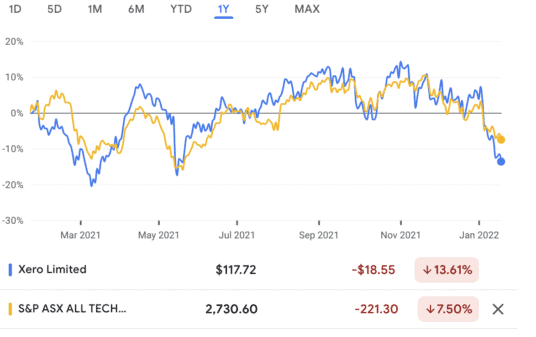
    For instance, the S&P/ASX All Technology index (ASX: XTX) – the benchmark for Australian tech-oriented companies – has fallen by more than 11% since January 1. Xero leads the sector in losses with its share price decline of 20.69%.

    The online accounting and business service appears to track the index fairly closely, albeit reacting more sensitively to price dispersion within the broader sector. As such, any downside moves in the All-tech index are likely to be somewhat mirrored in the Xero share price.

    Xero share price vs ASX All Tech Index single year performance

    Source: Google Finance. Google and the Google logo are registered trademarks of Google LLC, used with permission.

    Xero has struggled amid weakness in the sector, a changing interest rate regime, and the resulting shift in investor capital.

    The Xero share price was near a 3-month high of $141.44 in late December. However, it immediately sank as we rolled into the new year.

    But Xero isn’t the only ASX tech share to take a beating in the past couple of weeks. The entire tech sector is under pressure, which could mean some stocks are now ‘on sale’, given their outlook.

    That’s why some of the leading brokers covering Xero are still bullish. They reckon there is still plenty of value to be had in 2022. Let’s take a look.

    Is Xero a buy despite the weakness?

    First of all, UBS has Xero as a hard sell and values the company at just $88. That bakes in a considerable amount of downside in the investment bank’s view.

    Central to UBS’ thesis are assumptions around Xero’s expenditure that may compress margins and earnings performance, plus the company’s valuation.

    UBS is joined by Macquarie, which expects Xero to underperform, but it tips a higher share price valuation of $130.

    On the other hand, Credit Suisse has Xero as a buy and values the company at $160. The firm likes Xero’s growth outlook, particularly its average revenue per user (ARPU) metrics. For instance, Xero grew APRU by 5% in 1H FY22. Ultimately, Credit Suisse reckons this will expand operating cash flow and recurring revenue moving forward.

    Goldman Sachs and Morgan Stanley are bullish on Xero as well. The brokers have a $158 and $148 share price target respectively.

    So, amid the tech sell-off, there is still bullish sentiment to be found for the Xero share price, and at least 2 brokers advocate it as a buy right now.

    The post The Xero (ASX:XRO) share price has fallen 20% since the start of the year. Is it a buy? appeared first on The Motley Fool Australia.

    These 5 Cheap Shares Could Be Set For Huge Gains (FREE REPORT)

    We hear it over and over from investors, “I wish I had bought Altium or Afterpay when they were first recommended by The Motley Fool. I’d be sitting on a gold mine!” And it’s true.

    And while Altium and Afterpay have had a good run, we think these 5 other stocks are screaming buys. And you can find out the names of these stocks in the FREE stock report.

    *Extreme Opportunities returns as of February 15th 2021

    More reading

    Motley Fool contributor Zach Bristow has no position in any of the stocks mentioned. The Motley Fool Australia’s parent company Motley Fool Holdings Inc. owns and has recommended Xero. The Motley Fool Australia owns and has recommended Xero. The Motley Fool has a disclosure policy. This article contains general investment advice only (under AFSL 400691). Authorised by Bruce Jackson.

    from The Motley Fool Australia https://ift.tt/3qL71bM

  • Expectations investing: A Q&A with Michael Mauboussin and Alfred Rappaport

    This article was originally published on Fool.com. All figures quoted in US dollars unless otherwise stated.

    Michael Mauboussin and Al Rappaport

    This article was originally published on Fool.com. All figures quoted in US dollars unless otherwise stated.

    A revised and updated Expectations Investing by Michael Mauboussin and Al Rappaport was released in 2021 by Columbia University Press and it’s the best investing book I’ve ever read! Period.

    As the Head of Investor Training and Development at The Motley Fool, I am recommending that our entire team read this fresh update from these investing experts. Mauboussin is the Head of Consilient Research at Counterpoint Global, a division of Morgan Stanley, and a professor at Columbia Business School. Rappaport is the Leonard Spacek Professor Emeritus at Northwestern University and the author of one of the most important corporate finance and valuation books, Creating Shareholder Value.

    I’ve now read Expectations Investing three times, the original version once over a decade ago, and the updated edition twice. I also own two copies of the new edition, one with all my markups and highlights, and another unmarked version that I may lock away in a safe for posterity’s sake. Not only is it the best investing book I’ve read, but Mauboussin and Rappaport have launched a website that offers 10 free tutorials, including a reverse discounted cash flow (DCF) spreadsheet that investors can use to calculate the price-implied expectations (PIE) baked into a stock price. As a value investor, I’m not aware of a better deal on the market than a free spreadsheet created by these two stars.

    I was so excited after reading the book that I decided to reach out to the authors to ask some follow-up questions. It’s been a while since I’ve interviewed Michael, but Mauboussin and his mentor Rappaport said they were willing to do an interview and offer me (and you) some additional insight on Expectations Investing.

    What follows is my written question-and-answer session with the two men.

    Question: Can you please define “expectations investing” and give us an overview of the steps of the process/framework?

    Answer: In a nutshell, expectations investing reverses the traditional approach to assessing whether the stock of a company might promise superior returns. Most investors make an estimate of value and then compare it to the current market price. Expectations investing starts with what we know, the stock price, and asks whether the expectations for the company’s financial performance implied by the stock price are justified.

    There are three steps in the process. We first put the consensus expectations into a long-term discounted cash flow model and solve for the forecast horizon that justifies the stock price. The essential determinants of value include the cash flows of the business and the opportunity cost of capital.

    Second is to do a historical and strategic analysis to judge the likely performance of the company. Here we like to think in scenarios and to invoke base rates. The product of this step is an expected value for the company’s shares.

    Finally, the difference between the expected value and the price provides guidance for buy, sell, or hold decisions. Here we also take into consideration other issues such as taxes.

    Q: What is the goal of investors using the Expectations Investing framework?

    A: The goal is to identify securities with superior return prospects. Because stock price changes are the result of revisions of expectations, we believe that getting a fix on current expectations and anticipating how expectations will change is a useful approach to security selection.

    Q: What is a variant perception and what is your definition of an attractive investment thesis?

    A: Variant perception is holding a well-founded view about a company’s financial prospects that are not priced into the stock. In other words, your expectations and the expectations implied by the market are different and noteworthy.

    An attractive thesis, therefore, would be one where you can identify the specific differences in expectations. For example, you have an attractive thesis if your strategic and financial analysis suggest that operating profit margins will rise when the market has priced in a decline, all else being equal.

    Q: What is the difference between estimating fair value using a discounted cash flow (DCF) model and using a reverse DCF?

    A: The valuation model is the same, of course, but in order to estimate fair value an investor needs to make forecasts about value drivers such as sales growth, operating profit margins, investment needs, and the number of years the company will generate returns above the cost of capital. With a reverse DCF an investor makes an informed assessment about the consensus estimates of those values.

    Q: It seems as if there are two main skills for Expectations Investing, using a reverse DCF to read the expectations in the current stock price and to anticipate revisions (or shifts) in the consensus expectations? Is that right?

    A: That’s right. As an analogy, the first skill is determining how high the bar is set for the high jumper and the second skill is judging how high the jumper can leap. This underscores an important consideration. Low bars are equivalent to low expectations and high bars are high expectations. But differences between expectations today and tomorrow, which are generally driven by financial results, are the key to superior returns. Some companies fail to clear low bars of expectations and others exceed the expectations implied by a high bar.

    Q: What is your definition of a great business? And what is the difference between a great business and a great stock?

    A: A great business is one that can invest large amounts of capital that generate returns in excess of the cost of capital for a long time. A great stock is one that can provide superior returns as the result of substantial positive revisions of expectations. A great business is not a great stock if the expectations for lofty performance are already priced in. In other words, the market has priced in terrific corporate performance and hence shareholders earn only their expected return — the cost of equity.

    Q: The book says that it’s a myth that the stock market takes a short-term view. Can you explain?

    A: Business leaders, politicians, and other pundits like to complain that the stock market is short-term oriented. One simple way to test that thesis is to ask: how many years of value creation must a company achieve in order to justify today’s stock price? In many cases, the answer is a decade or more.

    The very fact that we have lots of money-losing companies with significant valuations suggests that the market is looking past the short term and reflecting the long term.

    Now that’s not to say that investors don’t buy and sell too frequently. We say, “Investors make short-term bets on long-term outcomes.” That may be where the point of confusion arises.

    Q: The book says, “We need to assess how many years of free cash flow the market impounds in a stock price.” Is it also important to reverse engineer the rate of free cash flow growth that is baked into the stock price?

    A: It’s worth taking a brief moment to explain how a standard DCF model works. There are generally two parts: the explicit forecast period and the continuing value. The explicit forecast period has estimates of free cash flow, whether the investor is trying to estimate a fair value or assessing expectations. Free cash flow equals net operating profit after taxes minus investments in future growth. The continuing value captures the company’s cash flows after the explicit forecast period. Ideally, the explicit forecast period reflects the time during which the company can make value-creating investments and the continuing value assumes that investments will earn the cost of capital.

    So, yes, understanding free cash flow, including its rate of growth, during the explicit forecast period is important for at least a couple of reasons. One is that free cash flow captures a lot of information, including sales growth and operating profit margins, the magnitude and form of investment, and the return on investment, as today’s investments lead to tomorrow’s profits.

    Another is that the continuing value is commonly based on the net operating profit after taxes, or another measure of earnings, at the end of the explicit forecast period. For example, the perpetuity method is one approach to estimating continuing value. The perpetuity takes the net operating profit after taxes from the last year in the explicit forecast period and capitalizes it by the cost of capital.

    So, for instance, if the net operating profit after taxes is $100 and the cost of capital is 8%, the continuing value is $1,250 ($100/0.08). But if growth is higher and net operating profit after taxes is instead $110, then the continuing value is $1,375 ($110/0.08).

    Q: The book also says, “Analysts typically choose a forecast period that is too short when they perform a discounted cash flow valuation.” Most forecast periods I’ve seen are five to 10 years before they calculate the terminal value. Can you explain how analysts should determine how long the forecast period should be?

    A: This is interesting. Most DCF models use an explicit forecast horizon of five years. Some go out 10 years or more, but they tend to be rare. I think the five-year horizon is an outgrowth of the leveraged buyout models used in private equity. Five years may make sense for a private equity firm that has an explicit objective of exiting an investment in about five years. But just because we have five fingers on a hand, or because private equity firms hold investments for five years on average, does not have any relevance for properly modeling the economics of a public company.

    The result is that investors have to allocate value in the continuing value estimate, often through using an unrealistic calculation of growth in perpetuity or multiples of earnings before taxes, depreciation, and amortization. The goal of a model is to represent reality, and this approach fails in that objective.

    You determine the market-implied forecast period by using consensus estimates for free cash flow growth plus an appropriate continuing value, an estimate of the cost of capital, and seeing how many years are necessary to solve for today’s stock price. For example, in the case study we did on Domino’s Pizza we found that the market-implied forecast period was eight years.

    Q: You write that the terminal growth rate for most companies should be a rate that is less than inflation. Why is that?

    A: Let’s go back to the idea that the explicit forecast period captures the company’s value-creating investments and that the continuing value does not reflect investments that create value. If you accept that premise, the main question is whether a company can price its good or service such that it keeps up with inflation. Companies fall along a continuum in their ability to price in line, or above, the rate of inflation. While it is difficult to determine empirically, we offer some qualitative ways to assess pricing power and suggest that most companies struggle to raise prices so as to keep up with inflation over time.

    Q: You say that “most companies need over ten years of value-creating cash flows to justify their stock price.” By “value-creating” do you mean that the company is generating positive net operating profit after tax (NOPAT) and has a positive economic spread (return on invested capital (ROIC) above its cost of capital)? And if so, does this statement imply that companies that don’t yet generate a positive economic spread likely have to generate cash flows for much longer than 10 years to justify their stock prices?

    A: Yes. Creating value means the present value of cash flows from an investment, discounted at the cost of capital, exceeds its cost. This is the standard net present value calculation. Warren Buffett has referred to the $1 test. The idea is that every dollar invested in the business should create value in excess of $1.

    Companies that are creating value can be unprofitable in the short term for at least a couple of reasons. One is that for many subscription businesses, the cost to acquire a customer is an upfront expense and the cash flows are off in the future. That creates a timing mismatch which can lead to a loss on the income statement even in cases when acquiring a customer creates value.

    Another reason relates to operating leverage, which refers to the process of absorbing pre-production costs. Think of a retailer adding a new store. It typically takes 2-3 years for a large store to get to its revenue and profit potential. Again, the investment may be attractive, but the short-term results may not reveal that.

    Q: The three value drivers of sales growth, operating profit margin, and incremental investments (into working capital, capital expenditures, and acquisitions) drive free cash flow (FCF). In the book, you write that “The higher the [operating] margin, the better.” So, in addition to high ROIC, do you think that consistently high operating margins or even FCF margins are a sign of competitive advantage?

    A: All things being equal, higher operating profit margins are better than lower ones. We discuss the concept of “threshold margin,” the operating profit margin a company must earn to maintain its value. But a more fruitful way to think about this might be through the lens of competitive strategy.

    Low-cost producer or differentiation are two generic strategies to sustain a competitive advantage. Generally speaking, low-cost producers have lower operating profit margins but generate substantial sales. Think of an efficient grocery store as an example. Companies that pursue a differentiation strategy often have higher operating profit margins but less throughput. Imagine a luxury goods manufacturer.

    The common denominator is free cash flow, but the path to value creation is different depending on a company’s strategic positioning.

    Q: What about the FCF-to-net income ratio? Do you consider a sustainable ratio above 1 to be a sign of competitive advantage?

    A: We view earnings as an inherently limited measure of corporate performance. As a result, we do not spend time on comparing it to free cash flow.

    Q: The book also discusses the cash conversion cycle and negative working capital. Do you consider a low (or declining) cash conversion cycle or negative working capital to be a sign of competitive advantage?

    A: Here again, a lot depends on the business model. The cash conversion cycle is a measure of how many days it takes a company to convert its investments in inventory and accounts receivable into cash flow. A negative cash conversation cycle means the company gets cash from customers before it has to pay its suppliers. In effect, suppliers are a provider of capital. This has benefited Amazon.com over the years as an example.

    Cash conversion cycles vary by industry. What’s more important is that a company manages its working capital efficiently.

    Q: Economies of scale and operating leverage both rely on sales growth. Or said another way, companies cannot achieve economies of scale or operating leverage without sales growth. Can you discuss the difference between them?

    A: These terms are often used interchangeably but they are distinct concepts. Operating leverage, as we mentioned a moment ago, is about absorbing pre-production costs. Imagine you build a factory that can produce 100 widgets but today you are producing only 50. As sales go from 50 to 100 widgets, the company will realize positive leverage on the fixed preproduction costs. Perhaps an even more extreme example is software, where preproduction costs are high but the incremental cost to distribute the software is low.

    Economies of scale exist when a company can perform essential tasks cheaper as it gets bigger. In the book, we use the example of swipe fees, the percentage of a transaction the banks charge when a customer uses a credit card. Big retailers such as Walmart or Amazon pay lower swipe fees than mom and pop retailers.

    Higher sales drive both operating leverage and economies of scale, but they are distinct drivers of operating profit margin improvement.

    Q: You have written that sales growth is the primary driver of intrinsic value for most businesses that generate a ROIC above cost of capital. And in Expectations Investing you write that “Revisions in sales growth expectations are your most likely source of investment opportunities, but only when a company earns above the cost of capital.” So, do you think investors should spend most of their time trying to really understand the drivers of sales growth?

    A: The first and foremost consideration is whether a company’s investments create value. A company can grow rapidly, but if its investments earn the cost of capital only, there is no value creation. Likewise, growth while earning below the cost of capital destroys value. The importance of growth is contingent on the prospects for value creation.

    That said, sales growth is very important. To help guide analysis, we developed what we call the “expectations infrastructure” that takes you from the “value triggers,” which include sales, costs, and investments, to the “value drivers,” which include sales growth, operating profit margins, and investment needs. Value drivers are the inputs for a DCF model. Between the triggers and drivers are what we call the “value factors,” the six microeconomic determinants of the value drivers. Four of the six are driven by sales growth and have a direct impact on the operating profit margin.

    Sales growth can lead to operating profit margin expansion that can lead to value creation. So, sales growth is important both for companies that create value and for companies to get to value creation.

    Q: What are base rates and why should investors incorporate them into their business and valuation analysis?

    A: A base rate is a measure of what occurred before in situations similar to what you are looking at today. Rather than answering the question “what do I think will happen?” it addresses the question “what happened when others were in this situation?”

    Psychologists have documented that melding your own analysis with base rates leads to more accurate statistical predictions.

    This comes into play when you are forecasting ranges of possible outcomes. Let’s take sales growth as an example since we just talked about it. Say you are looking at a company with $5 billion of revenue. You can do a bottom-up analysis to estimate what you think the distribution of possible sales growth rates looks like. You can also look at the base rate, or distribution of sales growth rates for all companies that started at $5 billion in sales. In many cases, the base rate will have a wider distribution of outcomes than an investor’s bottom-up estimate.

    Q: You mention learning curve benefits as one of a few potential “insurmountable advantages.” Can you explain learning curve benefits and how they might create an insurmountable competitive advantage or barrier to entry?

    A: Just to be clear, we used the phrase “insurmountable advantages” to describe a sufficiently large cluster of incumbent advantages that are sufficient to dissuade a potential entrant. The learning curve, one of those potential advantages, refers to the ability to reduce unit costs as a function of cumulative experience. Researchers who studied the learning curve find that a doubling of cumulative output reduces unit costs by about 20% for the median firm. That means that a company seeking to enter an industry has to figure out how to compensate for the experience of an established company.

    Q: When should investors complement a DCF with a real options value analysis?

    A: We suggest that for some companies it’s a mistake to conclude automatically that the stocks are unattractive because expectations for the current operations seem too optimistic. When there’s a lot of uncertainty, there may be real option value. The approach is to apply the theory of financial options to real investments, including manufacturing plants, new lines of business, and wells and mines in extractive industries. A financial option gives its owner the right, but not the obligation, to buy or sell a security at a set price. A real option gives a company that owns it the right, but not the obligation, to make strategic investments.

    For example, think of Amazon‘s growth since its founding. It has exercised lots of real options, none bigger than Amazon Web Services, along the way. If you had valued the company in the late 1990s as a bookseller only, you would have missed a lot of its potential.

    Q: What types of businesses tend to have embedded optionality?

    A: We believe there should be four conditions in place. Some of these are qualitative judgments. First, there must be a high level of uncertainty in the industry outcomes. Options are more valuable with uncertainty, so predictable businesses are unlikely to have much real option value. Next is a management team that has the strategic vision to create, identify, evaluate, and exercise real options. Third is the business should be a market leader, which commonly provides resources and access to opportunity. Finally, there must be access to capital. Options cost money to exercise, and in the absence of capital, a valuable option can expire worthless.

    Q: You performed a reverse DCF and real options value analysis on Shopify when its market value was about $100 billion and its stock price was $900 and you concluded that Shopify would have to invest about $60 billion in additional capital in the next three years to justify its valuation, even though it invested only around $2 billion (liberally calculated) in the prior three years. Today, Shopify’s stock price is about $1,400 and its market cap is about $177 billion. My question refers broadly to fast-growing companies earlier in their life cycle, many of which may be non-earning and cash-burning and that have very high expectations with embedded real options baked into their stock prices, and the question is do they, as a group, need to not only grow at extreme rates for at least 10 years (and in many cases much longer) but also find places to invest massive amounts of capital at returns on invested capital above their cost of capital to justify their current stock prices? Is that the secret to growing into their current valuations? Finding places to invest massive amounts of new capital to build new profitable growth streams (S-curves) over time?

    A: We don’t have any specific advice here. But here are some thoughts that may be useful. While we highlight the importance of real options in some cases, it’s a mistake to overstate their value. Ideally, you want to find the stocks of companies that have real options without paying much for them. Second, the investment to exercise a real option can show up on the income statement via intangible investments as well as the balance sheet through tangible investments. Finally, Work by Henrik Bessembinder shows that a majority of stocks earn poor returns during their lifetime.

    Q: What is reflexivity and how is it important to Expectations Investing?

    A: Reflexivity is an idea that’s been around for a long time that was popularized by the well-known investor, George Soros. It’s basically a form of positive feedback. In asset pricing theory, we like to think of a stock price as reflecting the expectations about a company’s future financial performance. But reflexivity emphasizes that the stock price can also have an impact on a company’s fundamentals.

    One of the best examples in recent years is Tesla. That the stock has done well has allowed the company to raise capital easily in order to fund growth. Further, the stock increase provides attractive remuneration for employees who are paid in part with stock.

    Similar to real options, we believe that users of expectations investing should be aware of reflexivity and how the stock price itself can lead to revisions in expectations for value drivers.

    Q: Are start-up business models at least partly based on stock-based compensation (SBS) and high stock prices? And if so, if the stock price crashes, does that put the business model at risk?

    A: Certainly, healthy stock price returns can help young companies with recruiting, remuneration, and financing growth. The inverse is true as well. For instance, the precipitous stock price declines following the dot-com bubble made it difficult for even viable businesses to continue.

    Q: You and Al create a Golden Rule for Share Buybacks, which creates a very high hurdle for when companies should buy back their own stock. What is the rule and why create such a high hurdle?

    A: The golden rule states: “A company should repurchase its shares only when its stock is trading below its expected value and no better investment opportunities are available.” We don’t perceive this as a high bar. Essentially, what we are saying is that executives should be good capital allocators. Buying back stock below expected value creates a wealth transfer from selling shareholders to ongoing shareholders, which results in a higher expected value per share for continuing holders.

    The second part is really about priorities. Investing in the business may be more attractive than buying back stock even when the shares are below the expected value. Executives should try to allocate capital to the investments that promise the highest returns first.

    Q: You write that fast asset growth rates typically lead to low future returns? Is this because asset growth (the denominator) outpaces earnings growth (the numerator) and results in falling return on assets (ROA)? If so, should investors be looking for declining ROA as a potential red flag?

    A: This is established empirically and is often considered a factor in an asset-pricing model. Other factors include beta, size, value, momentum, and quality. The intuition is that it is really hard to allocate large sums of capital while creating value.

    Not surprisingly, the main driver of asset growth is mergers and acquisitions. Here again, it has been well established that it is hard, albeit possible, to create substantial value via M&A.

    Q: Do numbers tell the whole story, or at least most of the story? What I mean by this is, let’s assume a company has a strong balance sheet with net cash and has stable or increasing gross and operating margins, high and/or rising ROICs, and a consistent history of growing sales, earnings, and FCF. Does that economic profile usually mean that the company is also well managed and is riding long-term trends and possibly is protected by competitive advantages or high barriers to entry? In other words, do you believe that a strong quantitative business profile is often a sign of a strong qualitative profile as well?

    A: Expectations investing really combines the quantitative and the qualitative. Of course, we need to have a good sense of the expectations baked into the stock price before we assess whether the company will meet or exceed those expectations. To evaluate the reasonableness of expectations we combine historical, financial, and strategic analysis. Strategic analysis in particular is very important, which is why we dedicate an entire chapter to that topic.

    Q: Most M&A deals are assessed on their strategic merit and accretion to earnings. You say those things aren’t enough. How should an investor assess M&A?

    A: M&A deals generally have a strategic and a financial rationale. A target company may be a great business but the acquirer still risks overpaying if its prospects are fully priced into the offer price. Further, earnings accretion is a demonstrably poor way to assess a deal’s financial merit. A much better approach is to compare the present value of the synergies the deal is expected to generate to the control premium the buyer offers. When the synergy value is greater than the premium, the deal adds value for the buyer. When the premium is greater than the synergy value, the deal destroys value for the buyer.

    Taking a step back, we suggest addressing four issues when a deal is announced. The first is how material the deal is for the buyer. We answer this through the calculation of “shareholder value at risk,” or SVAR. SVAR determines what percentage of the acquiring company’s value is at risk if the deal creates no synergy at all. For a cash deal, SVAR is the premium pledged divided by the market capitalization of the acquirer. If no synergy materializes, the premium is a wealth transfer from the shareholders of the company buying to the shareholders of company selling. So SVAR measures the downside in the case the deal is a dud.

    We also note what type of deal it is. Intuitively, opportunistic deals that are close to the buyer’s core business tend to succeed at a high rate, while transformation deals that launch a company into a new industry, rarely succeed.

    How the company chooses to pay for the deal is also important. Historically, deals funded with cash do better than those financed with stock. The SVAR is higher for a cash deal than a stock deal, so confident buyers should always prefer to pay with cash if they can because there is more upside. Further, deal financed with stock may signal less confidence in the deal and may also suggest that management views its own stock as overvalued. While the signal from the form of financing is not always straightforward, expectations investors are attuned to the potential implications of the chosen form of remuneration.

    Finally, comparing the present value of the synergy to the premium can help anticipate how the stocks of the buyer and seller are likely to react. Our website provides a tutorial, along with a downloadable spreadsheet, to guide this analysis: https://www.expectationsinvesting.com/online-tutorial-9.

    Q: What else do investors need to know about Expectations Investing?

    A: We have observed that most investors and executives nod approvingly when they hear about expectations investing, but remarkably few of them actually go through the process explicitly. Aswath Damodaran, a professor of finance and leading expert in valuation, wrote this in the foreword to the book, “Some ideas are so powerful, and yet so obvious, that when you hear them or read about them for the first time, your inclination is to whack your head and ask yourself why you did not think of them first.” We find little resistance to the ideas in the book but still see a large gap in the implementation of the ideas.

    Q: Where can investors read your reports or find you on social media, and what are you working on next?

    A: First we would note that we have made a lot of resources available for investors at www.expectationsinvesting.com, including tutorials with spreadsheets that can be downloaded.

    You can follow Michael Mauboussin on Twitter at @mjmauboussin.

    This article was originally published on Fool.com. All figures quoted in US dollars unless otherwise stated.

    The post Expectations investing: A Q&A with Michael Mauboussin and Alfred Rappaport appeared first on The Motley Fool Australia.

    Wondering where you should invest $1,000 right now?

    When investing expert Scott Phillips has a stock tip, it can pay to listen. After all, the flagship Motley Fool Share Advisor newsletter he has run for over ten years has provided thousands of paying members with stock picks that have doubled, tripled or even more.*

    Scott just revealed what he believes could be the five best ASX stocks for investors to buy right now. These stocks are trading at near dirt-cheap prices and Scott thinks they could be great buys right now.

    *Returns as of January 12th 2022

    More reading

    John Rotonti owns Shopify, Tesla, and Twitter. John Mackey, CEO of Whole Foods Market, an Amazon subsidiary, is a member of The Motley Fool’s board of directors. The Motley Fool Australia’s parent company Motley Fool Holdings Inc. owns and recommends Amazon, Domino’s Pizza, Shopify, Tesla, and Twitter. The Motley Fool Australia has recommended Amazon and Dominos Pizza Enterprises Limited. The Motley Fool has a disclosure policy. The Motley Fool Australia’s parent company Motley Fool Holdings Inc. recommends the following options: long January 2022 $1,920 calls on Amazon, long January 2023 $1,140 calls on Shopify, short January 2022 $1,940 calls on Amazon, and short January 2023 $1,160 calls on Shopify. This article contains general investment advice only (under AFSL 400691). Authorised by Bruce Jackson.

    This article was originally published on Fool.com. All figures quoted in US dollars unless otherwise stated.

    from The Motley Fool Australia https://ift.tt/33SPp4I