Tag: Motley Fool

  • 5 excellent ASX ETFs to buy when the market reopens

    ETF spelt out with a rising green arrow.

    ETF spelt out with a rising green arrow.

    If you have room for some new exchange-traded funds (ETFs) in your portfolio, then read on!

    Listed below are five ASX ETFs that are highly rated right now and could be good options for investors in 2024.

    Here’s what you need to know about them:

    BetaShares Asia Technology Tigers ETF (ASX: ASIA)

    The BetaShares Asia Technology Tigers ETF could be a top ASX ETF to buy right now. It provides investors with super-easy access to many of the best tech stocks from China and the rest of Asia (but not Japan). Many of these are the region’s equivalents of the West’s biggest and best tech companies and appear well-positioned for long-term growth.

    BetaShares Global Cybersecurity ETF (ASX: HACK)

    Another ASX ETF to consider buying is the BetaShares Global Cybersecurity ETF. As you might have guessed from its name, it provides investors with access to the global cybersecurity sector. And this could be a great place to be given that it is predicted to grow materially over the next decade or two. This is being driven by the rising threat of cybercrime and more infrastructure moving to the cloud.

    BetaShares NASDAQ 100 ETF (ASX: NDQ)

    It would be remiss to not name the hugely popular BetaShares NASDAQ 100 ETF on this list. It gives investors access to many of the most iconic and highest quality companies that the world has to offer. These are the companies behind the phones, the search engines, the social media platforms, and the spreadsheets many of us use on a daily basis.

    Vanguard MSCI Australian Small Companies Index ETF (ASX: VSO)

    Another ASX ETF for investors to consider is the Vanguard MSCI Australian Small Companies Index ETF. This ASX ETF gives investors access to approximately 200 small and mid-cap ASX shares. This could be a good time to pick up the ETF as small-caps have been tipped to rebound when interest rates fall after a couple of years of underperformance.

    Vanguard MSCI Index International Shares ETF (ASX: VGS)

    A final ASX ETF for investors to consider buying and holding is the Vanguard MSCI Index International Shares ETF. This massively popular ETF gives investors access to more than 1,000 of the world’s largest listed companies. Many of these are absolute behemoths and household names.

    The post 5 excellent ASX ETFs to buy when the market reopens appeared first on The Motley Fool Australia.

    Wondering where you should invest $1,000 right now?

    When investing expert Scott Phillips has a stock tip, it can pay to listen. After all, the flagship Motley Fool Share Advisor newsletter he has run for over ten years has provided thousands of paying members with stock picks that have doubled, tripled or even more.*

    Scott just revealed what he believes could be the ‘five best ASX stocks’ for investors to buy right now. These stocks are trading at near dirt-cheap prices and Scott thinks they could be great buys right now…

    See The 5 Stocks
    *Returns as of 10 November 2023

    (function() {
    function setButtonColorDefaults(param, property, defaultValue) {
    if( !param || !param.includes(‘#’)) {
    var button = document.getElementsByClassName(“pitch-snippet”)[0].getElementsByClassName(“pitch-button”)[0];
    button.style[property] = defaultValue;
    }
    }

    setButtonColorDefaults(“#0095C8”, ‘background’, ‘#5FA85D’);
    setButtonColorDefaults(“#0095C8”, ‘border-color’, ‘#43A24A’);
    setButtonColorDefaults(“#fff”, ‘color’, ‘#fff’);
    })()

    More reading

    Motley Fool contributor James Mickleboro has positions in BetaShares Nasdaq 100 ETF. The Motley Fool Australia’s parent company Motley Fool Holdings Inc. has positions in and has recommended BetaShares Global Cybersecurity ETF and BetaShares Nasdaq 100 ETF. The Motley Fool Australia has positions in and has recommended BetaShares Global Cybersecurity ETF and BetaShares Nasdaq 100 ETF. The Motley Fool Australia has recommended Betashares Capital – Asia Technology Tigers Etf and Vanguard Msci Index International Shares ETF. The Motley Fool has a disclosure policy. This article contains general investment advice only (under AFSL 400691). Authorised by Scott Phillips.

    from The Motley Fool Australia https://ift.tt/0u5cwBy

  • Which had the better year in 2023: Telstra, Woodside or Wesfarmers shares?

    An older woman clasps her hands with joy, smiling at the news on her computer as she sits at her kitchen bench..An older woman clasps her hands with joy, smiling at the news on her computer as she sits at her kitchen bench..

    The S&P/ASX 200 Index (ASX: XJO) experienced much volatility in 2023 due to fears over the impact of high inflation and interest rates. It eventually came good and delivered an 8.1% gain by 31 December.

    In this article, we look at the performance of three of the top 15 ASX 200 shares by market capitalisation.

    On the basis of share price movement, did Telstra Group Ltd (ASX: TLS), Woodside Energy Group Ltd (ASX: WDS) or Wesfarmers Ltd (ASX: WES) shares have a better year in 2023?

    On share price movement, Wesfarmers shares win

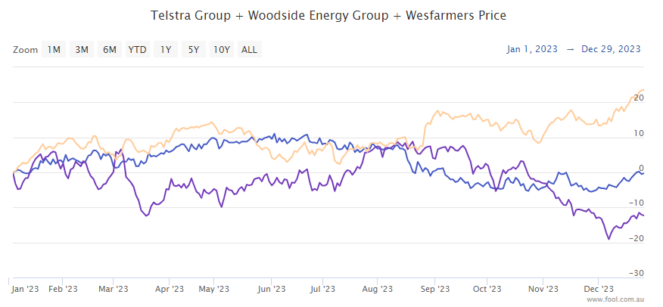
    As the chart below shows, Wesfarmers shares delivered superior gains last year.

    The Wesfarmers share price rose by 24.2% to close 2023 at $57.04. Yesterday, the Wesfarmers share price was trading for $57.17 at the close.

    Telstra shares fell 0.75% to close 2023 at $3.96. The Telstra share price finished the week trading at $3.97.

    The Woodside share price fell by 12.4% to close 2023 at $31.06. Woodside shares were trading for $30.91 at Friday’s close.

    On dividends, Woodside shares win… or do they?

    In 2023, Woodside shares delivered a $2.15 interim dividend in April. The ASX 200 energy share paid a $1.24 final dividend in September for a total annual dividend of $3.49 plus full franking credits.

    Wesfarmers shares paid an interim dividend of 88 cents in March. They paid a final dividend of $1.03 in October. That’s a total annual dividend of $1.91 fully franked.

    Telstra shares paid an interim dividend of 8.5 cents in March and a final dividend of 8.5 cents in September. This totalled 17 cents in annual dividends, fully franked.

    So, in dollar value terms, Woodside shares win.

    But what about yield terms?

    Heck, yes, they win! By a mile, in fact.

    The trailing Woodside dividend yield is currently a staggering 11.24%.

    Telstra shares are on a trailing dividend yield of 4.28%.

    Wesfarmers shares are paying a trailing dividend yield of 3.24%.

    As always, a trailing dividend yield like Woodside’s is cause for alarm bells. After all, the average ASX 200 stock delivers a yield of 4%.

    Plus, Woodside is an oil and gas company, which means it’s a ‘price-taker’ stock. That means commodity prices for gas and oil have a fundamental impact on the company’s earnings, and hence, dividends.

    We took a peek at the consensus analyst forecast for Woodside’s dividend in 2024, as published today on CommSec, and it is much lower than the $3.49 paid in 2023.

    The forecast dividend is $1.77, which equates to a still healthy yield of 5.74%.

    The post Which had the better year in 2023: Telstra, Woodside or Wesfarmers shares? appeared first on The Motley Fool Australia.

    Wondering where you should invest $1,000 right now?

    When investing expert Scott Phillips has a stock tip, it can pay to listen. After all, the flagship Motley Fool Share Advisor newsletter he has run for over ten years has provided thousands of paying members with stock picks that have doubled, tripled or even more.*

    Scott just revealed what he believes could be the ‘five best ASX stocks’ for investors to buy right now. These stocks are trading at near dirt-cheap prices and Scott thinks they could be great buys right now…

    See The 5 Stocks
    *Returns as of 10 November 2023

    (function() {
    function setButtonColorDefaults(param, property, defaultValue) {
    if( !param || !param.includes(‘#’)) {
    var button = document.getElementsByClassName(“pitch-snippet”)[0].getElementsByClassName(“pitch-button”)[0];
    button.style[property] = defaultValue;
    }
    }

    setButtonColorDefaults(“#0095C8”, ‘background’, ‘#5FA85D’);
    setButtonColorDefaults(“#0095C8”, ‘border-color’, ‘#43A24A’);
    setButtonColorDefaults(“#fff”, ‘color’, ‘#fff’);
    })()

    More reading

    Motley Fool contributor Bronwyn Allen has positions in Woodside Energy Group. The Motley Fool Australia’s parent company Motley Fool Holdings Inc. has positions in and has recommended Wesfarmers. The Motley Fool Australia has positions in and has recommended Telstra Group and Wesfarmers. The Motley Fool has a disclosure policy. This article contains general investment advice only (under AFSL 400691). Authorised by Scott Phillips.

    from The Motley Fool Australia https://ift.tt/lfMhNuS

  • Forget term deposits and get rich the Warren Buffett way

    A head shot of legendary investor Warren Buffett speaking into a microphone at an event.

    A head shot of legendary investor Warren Buffett speaking into a microphone at an event.

    Due to the Reserve Bank’s battle with inflation, interest rates have risen strongly over the last 12 months.

    This has been great news for users of term deposits, which have gone from offering barely a flicker of interest to something semi-reasonable.

    For example, at present, Australia’s biggest bank, Commonwealth Bank of Australia (ASX: CBA), is offering 4% per annum on 36-month term deposits.

    While this is better than what you would have received 12 months ago, it pales in comparison to the returns that ASX shares have delivered in the past.

    Furthermore, with many economists predicting that the next move for interest rates will be lower, this may be as good as it gets for term deposits for the foreseeable future.

    In light of this, it could be better to make investments like Warren Buffett instead of sinking your money into a term deposit.

    ASX shares versus term deposits

    To demonstrate why ASX shares could be superior to term deposits, let’s take a look at what a $100,000 investment could generate from both.

    Imagine you were to invest $100,000 into a term deposit that yields 4% per annum. In 20 years, your investment would have grown to almost $220,000 if you reinvested the proceeds each year.

    Whereas, if you were able to generate a 10% per annum return from the share market, your $100,000 investment would have become almost $675,000 in two decades.

    That’s a ~$450,000 difference!

    And while there are of course risks to investing in the share market, unlike risk-free term deposits, and past performance is not a guarantee of future returns, the risk/reward on offer is arguably compelling enough to choose ASX shares over term deposits.

    How to invest like Warren Buffett

    If you want to invest like Warren Buffett, I have some good news for you.

    The Oracle of Omaha has achieved market-beating returns for his company Berkshire Hathaway (NYSE: BRK.B) for decades through an investment style that anyone can replicate.

    Buffett likes to focus on buying high-quality companies with competitive advantages, strong business models, and fair valuations.

    He then holds onto them for the long term, allowing compounding to work its magic and grow his wealth.

    If you’re not a fan of stock-picking, then you could consider the very popular VanEck Morningstar Wide Moat ETF (ASX: MOAT). It allows investors to buy a collection of Buffett-type stocks through a single investment.

    Over the last decade, the index the ETF tracks has generated a return of 16.3% per annum. That would have turned a $100,000 investment into $450,000 in just 10 years.

    The post Forget term deposits and get rich the Warren Buffett way appeared first on The Motley Fool Australia.

    Wondering where you should invest $1,000 right now?

    When investing expert Scott Phillips has a stock tip, it can pay to listen. After all, the flagship Motley Fool Share Advisor newsletter he has run for over ten years has provided thousands of paying members with stock picks that have doubled, tripled or even more.*

    Scott just revealed what he believes could be the ‘five best ASX stocks’ for investors to buy right now. These stocks are trading at near dirt-cheap prices and Scott thinks they could be great buys right now…

    See The 5 Stocks
    *Returns as of 10 November 2023

    (function() {
    function setButtonColorDefaults(param, property, defaultValue) {
    if( !param || !param.includes(‘#’)) {
    var button = document.getElementsByClassName(“pitch-snippet”)[0].getElementsByClassName(“pitch-button”)[0];
    button.style[property] = defaultValue;
    }
    }

    setButtonColorDefaults(“#0095C8”, ‘background’, ‘#5FA85D’);
    setButtonColorDefaults(“#0095C8”, ‘border-color’, ‘#43A24A’);
    setButtonColorDefaults(“#fff”, ‘color’, ‘#fff’);
    })()

    More reading

    Motley Fool contributor James Mickleboro has no position in any of the stocks mentioned. The Motley Fool Australia’s parent company Motley Fool Holdings Inc. has positions in and has recommended Berkshire Hathaway. The Motley Fool Australia has recommended Berkshire Hathaway and VanEck Morningstar Wide Moat ETF. The Motley Fool has a disclosure policy. This article contains general investment advice only (under AFSL 400691). Authorised by Scott Phillips.

    from The Motley Fool Australia https://ift.tt/sEMdomC

  • Why the BHP share price has a nickel thorn in its side

    Female worker sitting desk with head in hand and looking fed upFemale worker sitting desk with head in hand and looking fed up

    The BHP Group Ltd (ASX: BHP) share price has struggled so far in 2024.

    As at Friday’s close, shares in the S&P/ASX 200 Index (ASX: XJO) mining giant were down 9.4% since the opening bell sounded on 2 January.

    For some context, the ASX 200 is down 2.7% so far in 2024.

    Much of the headwinds dragging on the BHP share price have come from a slumping iron ore price, the miner’s top revenue earner. The price of copper, BHP’s number two revenue earner, is down sharply too.

    But it looks to be nickel, which accounts for a much smaller percentage of BHP’s revenue, that’s putting an extra thorn in the ASX 200 miner’s side.

    What’s happening with the ASX 200 miner’s nickel operations?

    The BHP share price closed down 1.8% on Thursday following the release of the company’s quarterly production update. (The ASX 200 fell 0.6% on the day.)

    Investors may not have been overly focused on the miner’s nickel operations, yet a 50% year-on-year fall in nickel prices didn’t go unnoticed.

    “At Nickel West, we are evaluating options to mitigate the impacts of the sharp fall in nickel prices,” BHP said.

    The miner’s quarterly nickel production was up 4% to 40,000 tonnes. But the average realised price of US$18,602 per tonne was down 24%.

    According to BHP:

    The nickel industry is undergoing a number of structural changes and is at a cyclical low in realised pricing. Nickel West is not immune to these challenges. Operations are being actively optimised, and options are being evaluated to mitigate the impacts of the sharp fall in nickel prices.

    BHP said that under the existing market conditions, “a carrying value assessment of the group’s nickel assets is ongoing”. Investors can expect more details on 20 February with the release of its financial results.

     Nickel prices have been under pressure amid a big increase in supply from Indonesia, whose nickel carries a bigger carbon footprint but comes with a cheaper price tag.

    Commenting on that situation, Wyloo Metals CEO Luca Giacovazzi said (quoted by The Australian Financial Review):

    The industry needs a more appropriate and transparent pricing mechanism, that distinguishes between clean and dirty nickel, so consumers can be confident their EV really is a better choice for the environment.

    BHP Nickel West Asset president Jessica Farrell said, “We are working hard to remain globally competitive in a very tough operating environment.”

    She noted, “Costs have risen sharply and continue to go up while prices have fallen as new supply comes into the market.”

    BHP share price snapshot

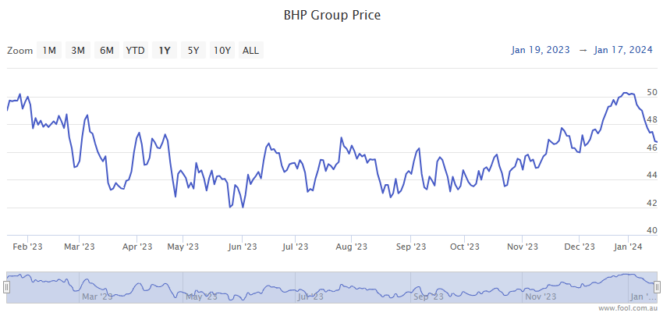
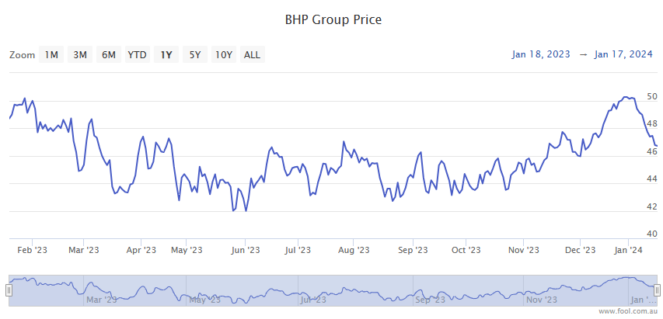
    The BHP share price is down 7% over 12 months. Shares are up 3% over the past six months.

    The post Why the BHP share price has a nickel thorn in its side appeared first on The Motley Fool Australia.

    Wondering where you should invest $1,000 right now?

    When investing expert Scott Phillips has a stock tip, it can pay to listen. After all, the flagship Motley Fool Share Advisor newsletter he has run for over ten years has provided thousands of paying members with stock picks that have doubled, tripled or even more.*

    Scott just revealed what he believes could be the ‘five best ASX stocks’ for investors to buy right now. These stocks are trading at near dirt-cheap prices and Scott thinks they could be great buys right now…

    See The 5 Stocks
    *Returns as of 10 November 2023

    (function() {
    function setButtonColorDefaults(param, property, defaultValue) {
    if( !param || !param.includes(‘#’)) {
    var button = document.getElementsByClassName(“pitch-snippet”)[0].getElementsByClassName(“pitch-button”)[0];
    button.style[property] = defaultValue;
    }
    }

    setButtonColorDefaults(“#0095C8”, ‘background’, ‘#5FA85D’);
    setButtonColorDefaults(“#0095C8”, ‘border-color’, ‘#43A24A’);
    setButtonColorDefaults(“#fff”, ‘color’, ‘#fff’);
    })()

    More reading

    Motley Fool contributor Bernd Struben has no position in any of the stocks mentioned. The Motley Fool Australia’s parent company Motley Fool Holdings Inc. has no position in any of the stocks mentioned. The Motley Fool Australia has no position in any of the stocks mentioned. The Motley Fool has a disclosure policy. This article contains general investment advice only (under AFSL 400691). Authorised by Scott Phillips.

    from The Motley Fool Australia https://ift.tt/Fcjp7kJ

  • Are Pilbara Minerals shares a buy for that 7% dividend yield?

    A woman has a thoughtful look on her face as she studies a fan of Australian 20 dollar bills she is holding on one hand while he rest her other hand on her chin in thought.

    A woman has a thoughtful look on her face as she studies a fan of Australian 20 dollar bills she is holding on one hand while he rest her other hand on her chin in thought.

    Looking at the Pilbara Minerals Ltd (ASX: PLS) share price today, one thing might stand out to you, especially if you’re an income investor. That would be Pilbara shares’ stonking dividend yield.

    The ASX 200 lithium stock was going for $3.47 a share at the close of trade yesterday. At this share price, Pilbara has a trailing dividend yield of 7.20% on the table.

    Now, 7.20% is obviously a massive dividend yield for any ASX 200 share to possess. Heck, it even comes in above what all four of the major ASX bank shares are currently offering.

    So does this yield make Pilbara shares a no-brainer buy today?

    Should you buy Pilbara Minerals shares for that 7% yield?

    At face value, this dividend yield checks out. It comes from the two dividend payments Pilbara Minerals made to investors over 2023, which was a first for the company.

    The first of these payments was the March interim (and Pilbara’s maiden) dividend worth 11 cents per share. The second is the final dividend from September worth 14 cents per share. Both dividends came with full franking credits attached.

    That 2023 total of 25 cents per share works out to be worth a 7.17% yield at the current $3.48 share price.

    However, as any good dividend investor knows, a company’s trailing dividend yield does not guarantee any future income whatsoever.

    There’s absolutely nothing stopping Pilbara Minerals from halving or even eliminating its dividend for 2024 and beyond.

    And I happen to think there’s a strong possibility that this will happen.

    A lithium dividend trap?

    Like any commodity company, Pilbara’s ability to fund dividends is almost entirely dependent on what it can sell its commodity for. A boom in lithium prices over 2022 and 2023 enabled the company to fund these bumper dividends. However, the back half of last year saw lithium prices dramatically come off the boil.

    That’s partially why Pilbara Minerals shares have lost so much steam in recent months, falling around 35% from more than $5.30 a share in August last year to the current levels.

    Unless lithium prices rebound this year, it seems unlikely Pilbara will be able to fund those kinds of dividend payments again in 2024.

    ASX broker Goldman Sachs would probably agree. Earlier this week, my Fool colleague James covered Goldman’s recent sell rating on Pilbara shares. The broker gave the miner a 12-month share price target of $3.20 and stated the following:

    With our view of ongoing supply pressure in the lithium market, and PLS recently outperforming peers despite near-term FCF [free cash flow] continuing to decline on lithium prices and increasing growth spend… we see PLS as relatively expensive on fundamentals, and downgrade to Sell.

    So, all in all, I think Pilbara shares are a high-risk investment for dividend seekers today. There are simply more reliable dividend stocks on the ASX to choose from in my view.

    Pilbara Minerals may still have a bright future ahead of it. But I wouldn’t say it’s a buy for dividend income today.

    The post Are Pilbara Minerals shares a buy for that 7% dividend yield? appeared first on The Motley Fool Australia.

    Wondering where you should invest $1,000 right now?

    When investing expert Scott Phillips has a stock tip, it can pay to listen. After all, the flagship Motley Fool Share Advisor newsletter he has run for over ten years has provided thousands of paying members with stock picks that have doubled, tripled or even more.*

    Scott just revealed what he believes could be the ‘five best ASX stocks’ for investors to buy right now. These stocks are trading at near dirt-cheap prices and Scott thinks they could be great buys right now…

    See The 5 Stocks
    *Returns as of 10 November 2023

    (function() {
    function setButtonColorDefaults(param, property, defaultValue) {
    if( !param || !param.includes(‘#’)) {
    var button = document.getElementsByClassName(“pitch-snippet”)[0].getElementsByClassName(“pitch-button”)[0];
    button.style[property] = defaultValue;
    }
    }

    setButtonColorDefaults(“#0095C8”, ‘background’, ‘#5FA85D’);
    setButtonColorDefaults(“#0095C8”, ‘border-color’, ‘#43A24A’);
    setButtonColorDefaults(“#fff”, ‘color’, ‘#fff’);
    })()

    More reading

    Motley Fool contributor Sebastian Bowen has no position in any of the stocks mentioned. The Motley Fool Australia’s parent company Motley Fool Holdings Inc. has positions in and has recommended Goldman Sachs Group. The Motley Fool Australia has no position in any of the stocks mentioned. The Motley Fool has a disclosure policy. This article contains general investment advice only (under AFSL 400691). Authorised by Scott Phillips.

    from The Motley Fool Australia https://ift.tt/bdhvOTM

  • Should I buy ASX shares or top up my superannuation?

    Woman and man calculating a dividend yield.

    Woman and man calculating a dividend yield.

    It’s a choice facing so many Australians: should I buy ASX shares, or top up my superannuation account? Investing is always about choices and opportunity costs. As it is with this particular question.

    There is no right or wrong answer here, but both options have both upsides and downsides.

    So let’s talk about whether you should invest in ASX shares, or your super fund in 2024.

    Super vs shares

    To be clear, investing in shares and your super is really two sides of the same coin. Most super funds allocate most of their members’ cash to shares anyway. And even if you have a self-managed super fund, chances are you’ll have at least some of the fund invested in the share market.

    But that doesn’t mean we don’t have a real contest here.

    Let’s start with superannuation.

    As most of us would be aware, superannuation exists in order to provide an avenue for a comfortable, self-funded retirement for Australians. It involves locking up our money in a tax-sheltered account until we reach retirement age. Whilst we wait, that capital sits invested in assets like ASX shares.

    And that gives us both the main advantage and the main disadvantage of choosing the super route.

    Is topping up your superannuation your best bet?

    The main advantage of super is that you will never find a better (legal) tax dodge for your investing. Funds going into superannuation accounts are usually taxed at just 15%. And once you’re in pension mode, any earnings are normally tax-free. Of course, this depends on individual circumstances, but that’s the general rule (make sure you check with a tax adviser though).

    However, the main disadvantage is that you can’t actually enjoy the benefits of this tax shelter until you reach your preservation age. This will range from 55 to 60, depending on your year of birth. Until then, your investments will be held under lock and key. Bad news if you are trying to FIRE your way to an early retirement.

    If you are planning to retire early, using the passive income from your ASX shares to do so, you might want to think about investing in ASX shares outside your superannuation instead.

    Of course, you won’t get those lucrative super tax perks. However, you can still take advantage of some of the other significant tax advantages that investing in ASX shares still offers.

    So when it comes to choosing to invest in ASX shares or topping up your super, it really depends on your work and life goals.

    If early retirement is something you want to pursue, you might want to maximise your non-super assets. But if you just wish to build wealth as effectively as possible, a super top-up might be your best bet.

    The post Should I buy ASX shares or top up my superannuation? appeared first on The Motley Fool Australia.

    Wondering where you should invest $1,000 right now?

    When investing expert Scott Phillips has a stock tip, it can pay to listen. After all, the flagship Motley Fool Share Advisor newsletter he has run for over ten years has provided thousands of paying members with stock picks that have doubled, tripled or even more.*

    Scott just revealed what he believes could be the ‘five best ASX stocks’ for investors to buy right now. These stocks are trading at near dirt-cheap prices and Scott thinks they could be great buys right now…

    See The 5 Stocks
    *Returns as of 10 November 2023

    (function() {
    function setButtonColorDefaults(param, property, defaultValue) {
    if( !param || !param.includes(‘#’)) {
    var button = document.getElementsByClassName(“pitch-snippet”)[0].getElementsByClassName(“pitch-button”)[0];
    button.style[property] = defaultValue;
    }
    }

    setButtonColorDefaults(“#0095C8”, ‘background’, ‘#5FA85D’);
    setButtonColorDefaults(“#0095C8”, ‘border-color’, ‘#43A24A’);
    setButtonColorDefaults(“#fff”, ‘color’, ‘#fff’);
    })()

    More reading

    Motley Fool contributor Sebastian Bowen has no position in any of the stocks mentioned. The Motley Fool Australia’s parent company Motley Fool Holdings Inc. has no position in any of the stocks mentioned. The Motley Fool Australia has no position in any of the stocks mentioned. The Motley Fool has a disclosure policy. This article contains general investment advice only (under AFSL 400691). Authorised by Scott Phillips.

    from The Motley Fool Australia https://ift.tt/bS81T9C

  • 3 ASX 200 dividend shares I think you could safely hold for decades

    three men stand on a winner's podium with medals around their necks with their hands raised in triumph.three men stand on a winner's podium with medals around their necks with their hands raised in triumph.

    Some S&P/ASX 200 Index (ASX: XJO) dividend shares offering attractive yields today may not look nearly so attractive 10 or 20 years down the road.

    The world is changing faster than ever before.

    And with it, the future demand for services and commodities is likely to see some major transformations as well.

    But some ASX 200 dividend shares will stand the test of time far better than others.

    While there are no guarantees in life or in the stock markets, below we’ll look at three blue-chip ASX companies I believe you could safely hold for decades of reliable passive income.

    Three ASX 200 dividend shares to buy and hold onto

    First up, we have mining giant BHP Group Ltd (ASX: BHP), the largest stock listed on the ASX.

    With its vast land holdings and diverse operations, I believe this ASX 200 dividend share is well-positioned to adjust to the world’s changing commodity demands.

    BHP currently derives most of its revenue from iron ore, with copper coming in at number two. But the miner also has a large exposure to uranium. And, if desired, it has plenty of cash and scope to enter the lithium space or other minerals that may be in greater demand in 2050 than they are today.

    BHP currently trades on a 5.7% fully franked trailing dividend yield.

    Which brings us to our second ASX 200 dividend share to buy and hold for decades, Commonwealth Bank of Australia (ASX: CBA).

    The biggest bank stock in Australia, CommBank offers a wide range of integrated financial services.

    As the requirements for these services change over the decades, I believe CBA is well-placed to adapt to and, indeed, be a front runner on these changes.

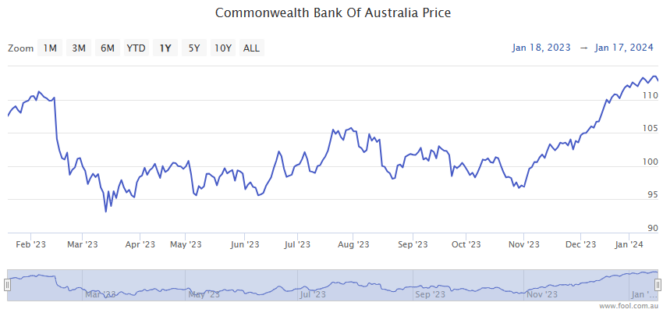
    CBA currently trades on a fully franked trailing dividend yield of 4.0%.

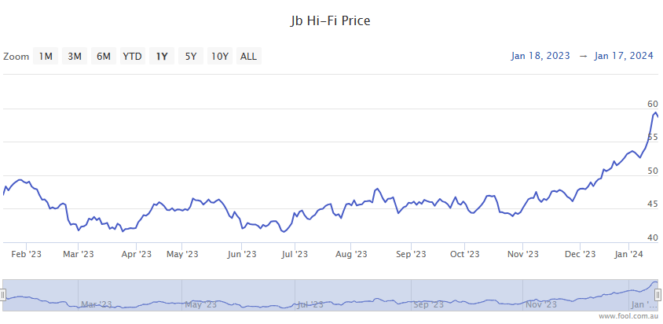
    Rounding off the list of ASX 200 dividend shares I think you could safely hold for decades is retail stock JB Hi Fi Ltd (ASX: JBH).

    Over the coming years, I reckon the demand for electronics of all shapes and sizes (some we’ve yet to even think up) will only continue to tick higher.

    As with the above two blue-chip stocks, I think JB Hi-Fi is well-positioned to adapt to that shift in consumer demand, embracing items like those AI-enabled homewares everyone will just have to have.

    JB Hi-Fi currently trades on a fully franked 5.4% trailing dividend yield.

    Looking over the horizon

    Now, to be sure, the passive income delivered by these three ASX 200 dividend shares will vary over the decades. Some years their yields may be higher than what we see today. Others, they may be lower.

    But I do believe they’ll all be strong market players and income payers for many, many years to come.

    The post 3 ASX 200 dividend shares I think you could safely hold for decades appeared first on The Motley Fool Australia.

    Wondering where you should invest $1,000 right now?

    When investing expert Scott Phillips has a stock tip, it can pay to listen. After all, the flagship Motley Fool Share Advisor newsletter he has run for over ten years has provided thousands of paying members with stock picks that have doubled, tripled or even more.*

    Scott just revealed what he believes could be the ‘five best ASX stocks’ for investors to buy right now. These stocks are trading at near dirt-cheap prices and Scott thinks they could be great buys right now…

    See The 5 Stocks
    *Returns as of 10 November 2023

    (function() {
    function setButtonColorDefaults(param, property, defaultValue) {
    if( !param || !param.includes(‘#’)) {
    var button = document.getElementsByClassName(“pitch-snippet”)[0].getElementsByClassName(“pitch-button”)[0];
    button.style[property] = defaultValue;
    }
    }

    setButtonColorDefaults(“#0095C8”, ‘background’, ‘#5FA85D’);
    setButtonColorDefaults(“#0095C8”, ‘border-color’, ‘#43A24A’);
    setButtonColorDefaults(“#fff”, ‘color’, ‘#fff’);
    })()

    More reading

    Motley Fool contributor Bernd Struben has no position in any of the stocks mentioned. The Motley Fool Australia’s parent company Motley Fool Holdings Inc. has no position in any of the stocks mentioned. The Motley Fool Australia has recommended Jb Hi-Fi. The Motley Fool has a disclosure policy. This article contains general investment advice only (under AFSL 400691). Authorised by Scott Phillips.

    from The Motley Fool Australia https://ift.tt/7COvyxp

  • How I’d invest $300 a month in ASX shares to target $22,000 annual passive income!

    Friend enjoying a meal at a restaurant, symbolising passive income.Friend enjoying a meal at a restaurant, symbolising passive income.

    How would I invest to create passive income?

    I personally am a fan of ASX growth shares, so would try to construct a well diversified portfolio of those stocks.

    I reckon putting in just $300 a month could eventually land you a perpetual passive income that averages out to $22,000 each year.

    Imagine what you could do with $22,000 extra every 12 months in addition to your day job.

    It can go a long way into paying off the mortgage, fund the children’s education, or buying a luxurious international holiday with your loved ones.

    Let’s check out hypothetically how this can be done:

    3 growth shares that look great to me

    Comparison site Finder last year found the average Australian has around $40,000 saved up.

    So let’s start with that.

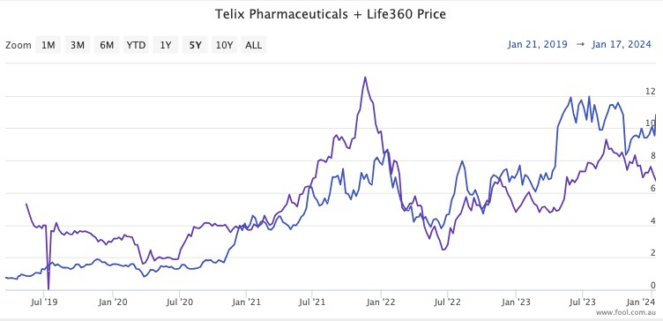
    I want to diversify the growth stocks I buy, so I would perhaps choose a range like Life360 Inc (ASX: 360), Telix Pharmaceuticals Ltd (ASX: TLX) and Block Inc CDI (ASX: SQ2).

    That’s one software maker, one pharmaceutical, and one fintech.

    All three are well favoured by professionals at the moment.

    Seven out of eight analysts covering Life360 rate the tech stock as a buy, according to CMC Invest. All seven that study Telix recommend it as a buy, while all three professionals that have evaluated Block reckon it’s an add.

    Now, the past should never be taken as a sign of what’s to come in the future. But to demonstrate just how viable it is to generate decent passive income, let’s take a look at their returns.

    Life360 has been on the bourse for just four months shy of five years, and the stock has climbed 34% in that time. Telix has been sensational over that half-decade, soaring an amazing 1,392%.

    Block Inc, since its listing on the ASX in January 2022, has been a disaster, trading 43% lower.

    Assuming a full five-year period, Life360’s compound annual growth rate (CAGR) calculates to be 6%. Telix was a sensational 71.7%.

    A decade of patience, then turn on the passive income

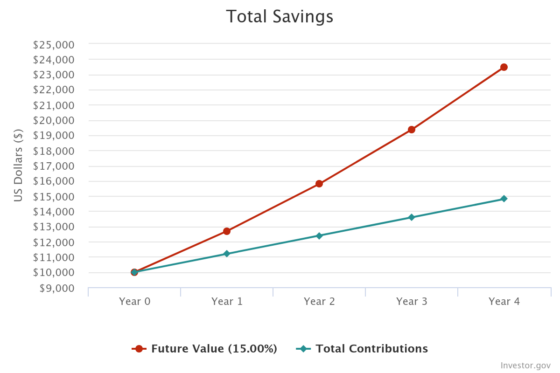
    With a diversified mixture of sectors, geographies and stock performance, perhaps you could manage a CAGR of 12% with that $40,000 portfolio.

    If you are disciplined with your saving and can thus add $300 each month, the growth will very much accelerate to the promised land.

    After 10 years, the portfolio will have fattened up to $187,409.

    From then on, the 12% return each year can be sold off to provide passive income.

    That’s an average of $22,489 cash coming your way annually, as long as you maintain that stock portfolio.

    Ten years. That’s all you need.

    The post How I’d invest $300 a month in ASX shares to target $22,000 annual passive income! appeared first on The Motley Fool Australia.

    Wondering where you should invest $1,000 right now?

    When investing expert Scott Phillips has a stock tip, it can pay to listen. After all, the flagship Motley Fool Share Advisor newsletter he has run for over ten years has provided thousands of paying members with stock picks that have doubled, tripled or even more.*

    Scott just revealed what he believes could be the ‘five best ASX stocks’ for investors to buy right now. These stocks are trading at near dirt-cheap prices and Scott thinks they could be great buys right now…

    See The 5 Stocks
    *Returns as of 10 November 2023

    (function() {
    function setButtonColorDefaults(param, property, defaultValue) {
    if( !param || !param.includes(‘#’)) {
    var button = document.getElementsByClassName(“pitch-snippet”)[0].getElementsByClassName(“pitch-button”)[0];
    button.style[property] = defaultValue;
    }
    }

    setButtonColorDefaults(“#0095C8”, ‘background’, ‘#5FA85D’);
    setButtonColorDefaults(“#0095C8”, ‘border-color’, ‘#43A24A’);
    setButtonColorDefaults(“#fff”, ‘color’, ‘#fff’);
    })()

    More reading

    Motley Fool contributor Tony Yoo has positions in Block, Life360, and Telix Pharmaceuticals. The Motley Fool Australia’s parent company Motley Fool Holdings Inc. has positions in and has recommended Block, Life360, and Telix Pharmaceuticals. The Motley Fool Australia has positions in and has recommended Block. The Motley Fool Australia has recommended Telix Pharmaceuticals. The Motley Fool has a disclosure policy. This article contains general investment advice only (under AFSL 400691). Authorised by Scott Phillips.

    from The Motley Fool Australia https://ift.tt/mbITMSk

  • Got a spare $1,000? I’d buy 10 shares of this ASX 200 stock to aim for a million

    A businessman stacks building blocks.A businessman stacks building blocks.

    Just one grand could be the start of something special.

    It sounds corny, but it’s true with the magic of ASX shares and compounding.

    Maybe it’s a reflection on the state of numeracy in the general population, but many Australians are walking around without realising how a million bucks could be within reach.

    Let’s check out how one could achieve this with one particular S&P/ASX 200 Index (ASX: XJO) stock as an example:

    ASX 200 outfit cleaning up its act

    Fintech Block Inc CDI (ASX: SQ2) might be a US$40 billion giant, but it’s been making some huge changes in the way it operates.

    The previously profligate startup is cleaning up its expenses and focusing on cash flow. And the market is sitting up and taking notice.

    “Block Inc outperformed in December following the release of its 3Q23 result the month prior, which exceeded investor expectations with respect to future cost discipline, and strong messaging about internal personnel productivity,” read a memo to clients from ECP analysts.

    “The result is an expectation of faster operating leverage to emerge across business units, with a plan to hit Block’s ‘rule of 40’ in 2026.”

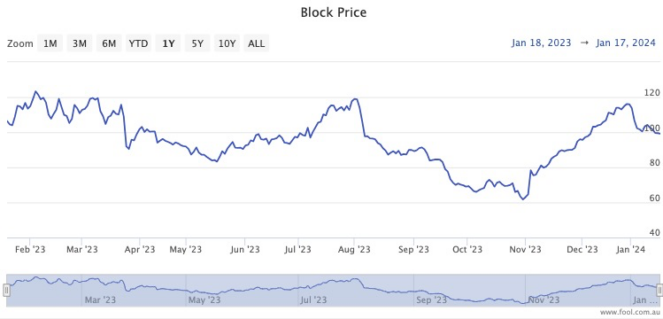
    Indeed the Block share price has rocketed 61.8% since the start of November.

    Block Inc shares, however, have pulled back 13.7% so far this year with the market volatility caused by the uncertainty of how soon interest rate cuts might come.

    Despite this, according to CMC Invest, all three analysts that cover the ASX 200 stock still reckon it’s a strong buy.

    And this buying opportunity means you can now pick up 10 Block shares with your $1,000.

    Let’s make a million

    Past is never an indicator of future performance, but checking out the track record of Block shares gives us an idea of what’s realistic for that $1,000 to achieve.

    The ASX 200 stock only listed in 2022, so for long term history we need to examine the original US version, Block Inc (NYSE: SQ).

    That has returned 402% since listing in November 2015.

    If we round those figures to a 400% gain over eight years, the compound annual growth rate (CAGR) works out to be 22.3%.

    That’s not a bad result at all, considering that period has seen multiple market corrections, such as the 2018 correction, the 2020 COVID-19 crash, and the 2022 inflation crisis.

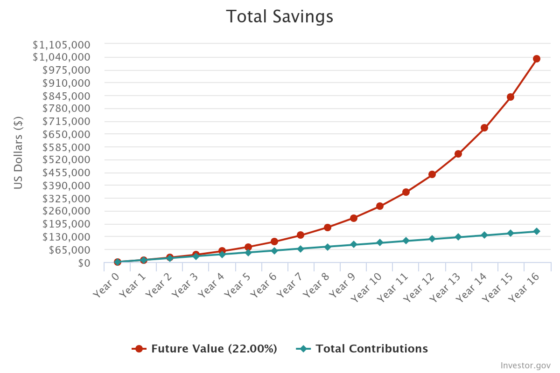
    So if your $1,000 of Block shares can grow at 22% each year, and you can chip in $800 a further each month, you’re on your way.

    After 16 years at that rate, your investment will have grown to $1,031,456.

    There’s your million.

    If you can start when you are 35 years old, you will have reached seven figures at 51, which is not a bad age to retire at.

    The post Got a spare $1,000? I’d buy 10 shares of this ASX 200 stock to aim for a million appeared first on The Motley Fool Australia.

    Wondering where you should invest $1,000 right now?

    When investing expert Scott Phillips has a stock tip, it can pay to listen. After all, the flagship Motley Fool Share Advisor newsletter he has run for over ten years has provided thousands of paying members with stock picks that have doubled, tripled or even more.*

    Scott just revealed what he believes could be the ‘five best ASX stocks’ for investors to buy right now. These stocks are trading at near dirt-cheap prices and Scott thinks they could be great buys right now…

    See The 5 Stocks
    *Returns as of 10 November 2023

    (function() {
    function setButtonColorDefaults(param, property, defaultValue) {
    if( !param || !param.includes(‘#’)) {
    var button = document.getElementsByClassName(“pitch-snippet”)[0].getElementsByClassName(“pitch-button”)[0];
    button.style[property] = defaultValue;
    }
    }

    setButtonColorDefaults(“#0095C8”, ‘background’, ‘#5FA85D’);
    setButtonColorDefaults(“#0095C8”, ‘border-color’, ‘#43A24A’);
    setButtonColorDefaults(“#fff”, ‘color’, ‘#fff’);
    })()

    More reading

    Motley Fool contributor Tony Yoo has positions in Block. The Motley Fool Australia’s parent company Motley Fool Holdings Inc. has positions in and has recommended Block. The Motley Fool Australia has positions in and has recommended Block. The Motley Fool has a disclosure policy. This article contains general investment advice only (under AFSL 400691). Authorised by Scott Phillips.

    from The Motley Fool Australia https://ift.tt/MEfw7Fo

  • Here’s how the ASX 200 market sectors stacked up this week

    A young man talks tech on his phone while looking at a laptop. A financial graph is superimposed across the image.A young man talks tech on his phone while looking at a laptop. A financial graph is superimposed across the image.

    Technology led the ASX 200 market sectors again this week, gaining 2.85% over the five trading days.

    The S&P/ASX 200 Index (ASX: XJO) weakened by 0.94% over the week to finish at 7,421.2 points on Friday.

    Four market sectors finished the week in the green.

    Let’s review what happened.

    Tech shares led the ASX sectors again this week

    This is the second consecutive week that tech stocks have led the market.

    As we reported, ASX 200 tech shares gained 2.76% last week. Combined with this week’s gains, tech stocks have gathered 5.6% over the past fortnight.

    We saw a historic moment overseas with tech stocks this week. On Tuesday, long-time leader Apple Inc (NASDAQ: AAPL) was knocked off its perch as the world’s largest company by market cap.

    Microsoft Corp (NASDAQ: MSFT) took the mantle, with my colleague Tony reporting that the company’s stake in OpenAI has encouraged more investment in recent times.

    On the ASX 200 boards this week, Xero Limited (ASX: XRO) set the pace among the five biggest ASX tech shares. The Xero share price lifted 5.02% over the five trading days to close at $114.73 on Friday.

    The Altium Limited (ASX: ALU) share price rose by 3.5% over the five days to finish at $48.22 on Friday. Tech sector heavyweight Wisetech Global Ltd (ASX: WTC) rose by 1.06% to $73.74.

    The Nextdc Ltd (ASX: NXT) share price faltered by 1.51% to $13.72. TechnologyOne Ltd (ASX: TNE) shares were barely in the green, up by 0.33% this week to $15.42.

    None of these big ASX 200 tech players released any price-sensitive news this week.

    Among the smaller tech companies, EML Payments Ltd (ASX: EML) gained 34% this week. This was largely due to news that EML will close its PFS Card Services Ireland Limited (PCSIL) segment as recommended by the reconstituted board of PCSIL. EML shares closed on Friday at $1, up 9.9% for the day.

    DroneShield Ltd (ASX: DRO) shares flew 4.05% higher this week to close at 39 cents on Friday. The company reported a maiden before-tax profit this week of $4 million. This compares to a $2.9 million loss in 2022.

    By the way, if you’re curious to know the best-performing ASX tech shares of 2023, click here.

    ASX 200 market sector snapshot

    Here’s how the 11 market sectors stacked up this week, according to CommSec data.

    Over the past five days:

    S&P/ASX 200 market sector Change this week
    Information Technology (ASX: XIJ) 2.85%
    Consumer Discretionary (ASX: XDJ) 1.15%
    Financials (ASX: XFJ) 0.46%
    Communication (ASX: XTJ) 0.19%
    Energy (ASX: XEJ) (0.46%)
    Healthcare (ASX: XHJ) (0.48%)
    Consumer Staples (ASX: XSJ) (0.51%)
    Industrials (ASX: XNJ) (1.6%)
    Utilities (ASX: XUJ) (2.51%)
    A-REIT (ASX: XPJ) (2.76%)
    Materials (ASX: XMJ) (3.72%)

    The post Here’s how the ASX 200 market sectors stacked up this week appeared first on The Motley Fool Australia.

    Wondering where you should invest $1,000 right now?

    When investing expert Scott Phillips has a stock tip, it can pay to listen. After all, the flagship Motley Fool Share Advisor newsletter he has run for over ten years has provided thousands of paying members with stock picks that have doubled, tripled or even more.*

    Scott just revealed what he believes could be the ‘five best ASX stocks’ for investors to buy right now. These stocks are trading at near dirt-cheap prices and Scott thinks they could be great buys right now…

    See The 5 Stocks
    *Returns as of 10 November 2023

    (function() {
    function setButtonColorDefaults(param, property, defaultValue) {
    if( !param || !param.includes(‘#’)) {
    var button = document.getElementsByClassName(“pitch-snippet”)[0].getElementsByClassName(“pitch-button”)[0];
    button.style[property] = defaultValue;
    }
    }

    setButtonColorDefaults(“#0095C8”, ‘background’, ‘#5FA85D’);
    setButtonColorDefaults(“#0095C8”, ‘border-color’, ‘#43A24A’);
    setButtonColorDefaults(“#fff”, ‘color’, ‘#fff’);
    })()

    More reading

    Motley Fool contributor Bronwyn Allen has no position in any of the stocks mentioned. The Motley Fool Australia’s parent company Motley Fool Holdings Inc. has positions in and has recommended Altium, Apple, DroneShield, EML Payments, Microsoft, Technology One, WiseTech Global, and Xero. The Motley Fool Australia has positions in and has recommended WiseTech Global and Xero. The Motley Fool Australia has recommended Apple, DroneShield, and Technology One. The Motley Fool has a disclosure policy. This article contains general investment advice only (under AFSL 400691). Authorised by Scott Phillips.

    from The Motley Fool Australia https://ift.tt/GUa7RI4