Tag: Motley Fool

  • 3 rookie mistakes to avoid making in the stock market

    This article was originally published on Fool.com. All figures quoted in US dollars unless otherwise stated.

    man looking at laptop waiting for Pilbara Minerals trading halt to end

    This article was originally published on Fool.com. All figures quoted in US dollars unless otherwise stated.

    Both the pandemic as well as commission-free trading platforms like Robinhood have attracted a flurry of new investors into the stock market over the past couple of years. Retail investors have been playing a much larger role than ever before and have helped such meme stocks as AMC Entertainment and GameStop rally hundreds of percentage points at various times this year while the S&P 500 has enjoyed a strong but much more modest gain of 28%.

    Yet not everyone has become rich from investing in these risky stocks and trends. Many investors have lost big money betting on stocks. If you’re a novice investor who has recently begun trading or are looking to get started investing in stocks next year, there are a few mistakes you’ll want to avoid making. Here are three of the biggest ones that rookie investors make.

    1. Focusing too much on stock price

    Oftentimes when I talk to relatively new investors, one of the things that comes up is a stock’s price. But whether a stock is trading at $20, $200, or $2,000 is completely irrelevant. The more important question is the stock price in relation to the company’s earnings — known as its price-to-earnings (P/E) ratio. Investors might also look at the stock price in relation to the company’s sales — known as its price-to-sales multiple.

    Consider tech giant Amazon (NASDAQ: AMZN), which trades at more than $3,400. That’s a big number, but that alone doesn’t mean it’s an expensive stock. Amazon reported diluted earnings per share of about $51 over the trailing 12 months, so the stock is trading at around 67 times those earnings (and less than four times its revenue). That isn’t cheap since the average stock in the Technology Select Sector SPDR Fund trades at only 34 times its profit. If Amazon’s stock were to fall to a P/E of 34, its shares would still be worth more than $1,700 — which again may look expensive — but its valuation would now be in line with a typical tech stock.

    Thus, looking solely at a stock’s price without taking into context the company’s underlying earnings or revenue should not be used to evaluate whether its shares are expensive.

    2. Focusing on the number of shares

    One thing a stock price can impact is how many shares you may end up owning. If you’ve got $10,000, you’ll be able to buy roughly three shares of Amazon. But if you invested the same amount in tiny veterinarian health company Zomedica (NYSEMKT: ZOM), which trades at around $0.35, you could own more than 28,570 shares of the company.

    In the end, it doesn’t matter how many shares you own. It’s the overall value of your investment that counts. A 10% increase in a $10,000 investment still represents a $1,000 profit, regardless of how many shares you own. So you want to be sure to own enough shares to meet your investment goal.

    With Zomedica, you might be tempted to think that investing $100 in the stock is fine since you’ll own about 285 shares of the company. But a $100 investment is still a $100 investment, regardless of your stock count. If you’re spending the time to research stocks and find a good investment, make sure the investment is appropriately sized.

    Of course, it’s also important to consider the size of any individual investment in relation to your overall stock portfolio, making sure not to be overly concentrated in any one stock.

    3. Ignoring fundamentals

    If you don’t spend much time researching and just feel as though you can risk taking a bet on the latest meme stock, that would be a big mistake as you could lose all your money. The fundamentals count.

    Again, let’s look at Zomedica, for example. This stock was popular with retail investors in the early part of the year, hitting a peak of $2.91 on Feb. 8. It has since fallen a mammoth 88%. Even if you bought it at just $1.00 a few months later, it would still be down more than 60% today — a huge loss.

    However, had you looked at the company’s fundamentals before investing in its shares, you would have been aware of some significant risks. It was only in March that the company announced the first commercial sale of Truforma, its flagship product that helps veterinarians run diagnostics on animals. Through the first nine months of this year, the company has generated just $52,000 in revenue while incurring losses of more than $15 million.

    So with an unproven product and a stock that is soaring for no clear reason, the writing was on the wall that this was an extremely risky investment. Lesson: Do your homework before you invest.

    Investors need to be more careful heading into 2022

    Although the S&P 500 has been having another strong year in 2021, with a new COVID-19 variant out there and interest rate increases on the horizon, next year could be a perilous one for the economy and stock market. So it’s paramount that investors avoid big mistakes and make the best decisions they can with their money as 2022 approaches. 

    This article was originally published on Fool.com. All figures quoted in US dollars unless otherwise stated.

    The post 3 rookie mistakes to avoid making in the stock market appeared first on The Motley Fool Australia.

    Wondering where you should invest $1,000 right now?

    When investing expert Scott Phillips has a stock tip, it can pay to listen. After all, the flagship Motley Fool Share Advisor newsletter he has run for more than eight years has provided thousands of paying members with stock picks that have doubled, tripled or even more.*

    Scott just revealed what he believes could be the five best ASX stocks for investors to buy right now. These stocks are trading at near dirt-cheap prices and Scott thinks they could be great buys right now.

    *Returns as of August 16th 2021

    More reading

    David Jagielski has no position in any of the stocks mentioned. John Mackey, CEO of Whole Foods Market, an Amazon subsidiary, is a member of The Motley Fool’s board of directors. The Motley Fool Australia’s parent company Motley Fool Holdings Inc. owns and recommends Amazon. The Motley Fool Australia has recommended Amazon. The Motley Fool has a disclosure policy. This article contains general investment advice only (under AFSL 400691). Authorised by Bruce Jackson.

    This article was originally published on Fool.com. All figures quoted in US dollars unless otherwise stated.

    from The Motley Fool Australia https://ift.tt/3qxLjq7

  • 2 compelling ASX shares that could be buys in 2022

    bull market encapsulated by bull running up a rising stock market price

    Share prices are always on the move. But after recent movements and business updates, there are some very interesting ASX shares that could be good options for 2022.

    Companies that have long-term growth plans and could be good value today are ones that may be able to do well in 2022, particularly if they positively surprise the market.

    These stocks could be compelling ones to watch next year:

    Airtasker Ltd (ASX: ART)

    Airtasker is a leading marketplace business that provides a platform for people who need work doing to connect with people who have the ability and desire to do that work.

    There are numerous categories on the platform such as accounting, administration, tradesman, flatpack assembly, car-related activities like detailing, computer and IT. It offers a wide array of categories and continues to add more.

    The Airtasker share price has dropped by more than 20% since the October 2021 high.

    However, the business has continued to grow and is optimistic about 2022 and beyond.

    COVID-19 has been impacting the business for quite a while. Despite that, it was able to achieve FY21 gross marketplace volume (GMV) growth of 38% year on year. The FY22 first quarter GMV increased another 6.2% despite lockdowns in both Sydney and Melbourne during the period.

    Airtasker management boast of the strong economics of its business model – it had a gross profit margin of more than 93% and achieved positive operating cashflow of $5.5 million in FY21.

    The ASX share is continuing to expand in the US and UK. FY22 first quarter GMV was up more than 100%. It’s looking to reach an international annualised GMV run rate of between $8 million to $10 million by June 2022. Some of the city markets that the business is launching in are Dallas, Kansas City, Miami and Atlanta.

    Airtasker is also seeing more Aussies trusting the marketplace, leading to more complex and higher value tasks going through Airtasker.

    Morgans currently rates it as a buy, with a price target of $1.27.

    VanEck Vectors Morningstar Wide Moat ETF (ASX: MOAT)

    This exchange-traded fund (ETF) is full of businesses with good returns potential according to the analysts at Morningstar.

    The only businesses that can even be considered for the portfolio are ones where the economic moat – also known as the competitive advantage(s) – is expected to endure for many years to come and allow the businesses to generate outsized profits for at least a decade.

    A moat can come in many different forms such as a cost advantage, intangible assets (like patents and brands) or network effects.

    Added to that moat factor, the shares that are bought for this ETF’s portfolio only make it in if they are trading at good value compared to Morningstar’s estimate of fair value.

    At 28 December 2021, some of the businesses that were in the ASX share’s portfolio were: Compass Minerals, Campbell Soup, Salesforce.com, Corteva, Dominion Energy and Walt Disney.

    Whist the portfolio is invested in a number of sectors, there are four industries that have the biggest exposures: IT (26.8%), healthcare (18.6%), industrials (13.6%) and consumer staples (11.8%).

    As VanEck mentions, past performance is not a guarantee of future results. VanEck Vectors Morningstar Wide Moat ETF has produced an average return per annum of 19.5% over the last three years.

    The post 2 compelling ASX shares that could be buys in 2022 appeared first on The Motley Fool Australia.

    Should you invest $1,000 in Airtasker right now?

    Before you consider Airtasker, you’ll want to hear this.

    Motley Fool Investing expert Scott Phillips just revealed what he believes are the 5 best stocks for investors to buy right now… and Airtasker wasn’t one of them.

    The online investing service he’s run for nearly a decade, Motley Fool Share Advisor, has provided thousands of paying members with stock picks that have doubled, tripled or even more.* And right now, Scott thinks there are 5 stocks that are better buys.

    *Returns as of August 16th 2021

    More reading

    Motley Fool contributor Tristan Harrison has no position in any of the stocks mentioned. The Motley Fool Australia’s parent company Motley Fool Holdings Inc. has recommended Airtasker Limited. The Motley Fool Australia has recommended VanEck Vectors Morningstar Wide Moat ETF. The Motley Fool has a disclosure policy. This article contains general investment advice only (under AFSL 400691). Authorised by Bruce Jackson.

    from The Motley Fool Australia https://ift.tt/3pDhFRh

  • Here’s why the Resonance Health (ASX:RHT) share price is rocketing 36% today

    Two scientists in a Rhythm Biosciences lab cheer while looking at results on a computer.

    The Resonance Health Limited (ASX: RHT) share price is shooting the lights out on Thursday. This comes after the company announced it has received a 510(k) clearance from the US Food and Drug Administration (FDA) regarding its newest medical device.

    At the time of writing, the Australian healthcare technology and services company’s shares are up 36.36% to 15 cents. In comparison, the All Ordinaries Index (ASX: XAO) is down 0.16% to 7,827.5 points.

    What did Resonance Health announce?

    The Resonance Health share price is surging today after the company advised the United States FDA has cleared the pathway for it to begin commercialisation for LiverSmart.

    LiverSmart is a software medical device that provides a more comprehensive assessment of a person’s liver iron and liver fat. The technology combines two of the company’s existing health products, FerriSmart and HepaFat-AI, into a single multi-parametric MRI session.

    Instead of obtaining separate individual reports from either product, LiverSmart saves costs and improves convenience for the customer and clinician.

    Furthermore, Resonance Health believes LiverSmart may be eligible for two new US (Cat III) Current Procedural Technology (CPT) codes. It is awaiting definitive determination of LiverSmart’s eligibility for these codes from a US-certified CPT coder.

    Obtaining the codes allows reimbursement by government payers such as Medicare and Medicaid, and private payers including private health insurers. This becomes more enticing to a paying consumer as a portion of the expenses is refunded.

    It’s expected the codes will be active some time in January 2022.

    Commenting on the news driving the Resonance Health share price, chief scientific officer Dr Wenjie Pang said:

    We are delighted that the FDA has moved so quickly in clearing LiverSmart, with this being the fastest FDA clearance we have achieved for any of our FDA cleared medical devices, which speaks to the quality and depth of experience we have in navigating the FDA regulatory framework.

    LiverSmart is a natural evolution of our existing product offering and responds to the growing trend in software as medical devices (SaMD), for more holistic assessment of organs. We’ve used AI in this device to further evolve our products and to achieve rapid turnaround and enhanced scalability.

    Resonance Health share price summary

    Over the last 12 months, the Resonance Health share price has lost around 35%.

    Based on today’s price, Resonance Health presides a market capitalisation of roughly $62.22 million.

    The post Here’s why the Resonance Health (ASX:RHT) share price is rocketing 36% today appeared first on The Motley Fool Australia.

    Should you invest $1,000 in Resonance Health right now?

    Before you consider Resonance Health, you’ll want to hear this.

    Motley Fool Investing expert Scott Phillips just revealed what he believes are the 5 best stocks for investors to buy right now… and Resonance Health wasn’t one of them.

    The online investing service he’s run for nearly a decade, Motley Fool Share Advisor, has provided thousands of paying members with stock picks that have doubled, tripled or even more.* And right now, Scott thinks there are 5 stocks that are better buys.

    *Returns as of August 16th 2021

    More reading

    Motley Fool contributor Aaron Teboneras has no position in any of the stocks mentioned. The Motley Fool Australia’s parent company Motley Fool Holdings Inc. owns and has recommended Resonance Health Ltd. The Motley Fool Australia has no position in any of the stocks mentioned. The Motley Fool has a disclosure policy. This article contains general investment advice only (under AFSL 400691). Authorised by Bruce Jackson.

    from The Motley Fool Australia https://ift.tt/3EKWVeM

  • What’s going on with the Australian Clinical Labs (ASX:ACL) share price lately?

    young female doctor with digital tablet looking confused.

    The Australian Clinical Labs Ltd (ASX: ACL) share price is tumbling today, but it’s had a whopping run lately.

    At the time of writing, the Australian Clinical Labs share price is $5.87. That’s 1.51% lower than its previous close but 38% higher than it was at the end of last month.

    Additionally, it reached a new 52-week high in yesterday’s session, hitting $6.39 in intraday trade.

    Let’s take a look at what’s been driving the company’s stock lately.

    Australian Clinical Labs share price soars in December

    Australian Clinical Labs’ stock took off last week after the company upgraded its guidance for the first half of financial year 2022 (FY22).

    It now expects to bring in between $497.3 million and $517.2 million of revenue and net profits after tax of $116.3 million to $128 million.

    The boosted expectations followed continuous strong demand for COVID-19 testing, particularly in New South Wales and Victoria. The company’s revenue is also being helped along by the resilience of its non-COVID business.

    The company’s CEO Melinda McGrath commented on the company’s new outlook, saying:

    We anticipate heightened volumes of COVID-19 testing to continue during the remainder of FY22 due to the impact of new variants and outbreaks, the lifting of travel restrictions and increased demand for both commercial and travel testing.

    Thus, this week’s case numbers might have brought the stock some extra attention.

    Over the 7 days to 8pm last night, New South Wales had reported 52,775 new cases of COVID-19. Of those, 12,226 were recorded in the previous 24 hours.

    Victoria also announced a new record number of new daily cases today, with 5,137 of the state’s residents testing positive for the virus.

    While the month so far has been a good one for the Australian Clinical Labs share price, today seems to be telling a different story. The company’s stock is tumbling for no obvious reason this morning.

    However, despite the slump, it’s still in the long-term green. Right now, the Australian Clinical Labs share price is 72% higher than it was at the start of 2021.

    Additionally, it isn’t alone in its recent gains. Fellow pathology companies, Healius Ltd (ASX: HLS) and Sonic Healthcare Limited (ASX: SHL) have seen their share prices increase 13% and 9% respectively this month.

    The post What’s going on with the Australian Clinical Labs (ASX:ACL) share price lately? appeared first on The Motley Fool Australia.

    Should you invest $1,000 in Australian Clinical Labs right now?

    Before you consider Australian Clinical Labs, you’ll want to hear this.

    Motley Fool Investing expert Scott Phillips just revealed what he believes are the 5 best stocks for investors to buy right now… and Australian Clinical Labs wasn’t one of them.

    The online investing service he’s run for nearly a decade, Motley Fool Share Advisor, has provided thousands of paying members with stock picks that have doubled, tripled or even more.* And right now, Scott thinks there are 5 stocks that are better buys.

    *Returns as of August 16th 2021

    More reading

    Motley Fool contributor Brooke Cooper has no position in any of the stocks mentioned. The Motley Fool Australia’s parent company Motley Fool Holdings Inc. has no position in any of the stocks mentioned. The Motley Fool Australia has recommended Australian Clinical Labs Limited and Sonic Healthcare Limited. The Motley Fool has a disclosure policy. This article contains general investment advice only (under AFSL 400691). Authorised by Bruce Jackson.

    from The Motley Fool Australia https://ift.tt/3JuNGD1

  • 3 fantastic ASX 200 shares to buy in 2022

    A female executive smiles as she carries out business on her mobile phone.

    With a new year on the horizon, now could be an opportune time to consider making some new additions to your portfolio.

    To help you on your way, I’ve picked out three ASX 200 shares which have been tipped as buys. They are as follows:

    Altium Limited (ASX: ALU)

    The first ASX 200 share to look at is Altium. It is an award-winning printed circuit board (PCB) design software provider. Over the last few years, Altium has earned itself a leading position in a growing electronic design market. But the company isn’t settling for that and is now aiming to dominate this market with its cloud-based Altium 365 product. Analysts at Jefferies are positive on its future. The broker currently has a buy rating and $48.83 price target on its shares.

    IDP Education Ltd (ASX: IEL)

    Another ASX 200 share to look at is IDP Education. It is a provider of international student placement and English language testing services. While IDP was hit hard by the pandemic, it has bounced back strongly and delivered impressive growth during the first quarter. And although the Omicron variant may stifle its recovery, it has been tipped to ultimately come out of the crisis in an even stronger market position. Morgan Stanley expects this to be the case. As a result, it has put an overweight rating and $40.20 price target on the company’s shares.

    NEXTDC Ltd (ASX: NXT)

    A final ASX 200 share to look at is NEXTDC. It is a leading data centre operator with operations across Australia. It has also recently opened up offices in Singapore and Tokyo with a view to expanding into these potentially lucrative markets. This could give its already strong growth a boost, especially thanks to the increasing demand for its services due to the structural shift to the cloud. Goldman Sachs is very positive on its future and is forecasting operating earnings growth of ~20% per annum through to at least FY 2024. Goldman has a buy rating and $14.40 price target on the company’s shares.

    The post 3 fantastic ASX 200 shares to buy in 2022 appeared first on The Motley Fool Australia.

    Wondering where you should invest $1,000 right now?

    When investing expert Scott Phillips has a stock tip, it can pay to listen. After all, the flagship Motley Fool Share Advisor newsletter he has run for more than eight years has provided thousands of paying members with stock picks that have doubled, tripled or even more.*

    Scott just revealed what he believes could be the five best ASX stocks for investors to buy right now. These stocks are trading at near dirt-cheap prices and Scott thinks they could be great buys right now.

    *Returns as of August 16th 2021

    More reading

    Motley Fool contributor James Mickleboro owns NEXTDC Limited. The Motley Fool Australia’s parent company Motley Fool Holdings Inc. owns and has recommended Altium and Idp Education Pty Ltd. The Motley Fool Australia has no position in any of the stocks mentioned. The Motley Fool has a disclosure policy. This article contains general investment advice only (under AFSL 400691). Authorised by Bruce Jackson.

    from The Motley Fool Australia https://ift.tt/3z9RGE6

  • Better crypto to own in 2022: Dogecoin or Shiba Inu?

    This article was originally published on Fool.com. All figures quoted in US dollars unless otherwise stated.

    A shiba inu dog lying on the sand at a beach.

    This article was originally published on Fool.com. All figures quoted in US dollars unless otherwise stated.

    The 2021 year was arguably a breakthrough for alternative “meme” cryptocurrencies like Shiba Inu (CRYPTO: SHIB) and Dogecoin (CRYPTO: DOGE). They were seen as a joke by some, but early investors in these cryptos have made fortunes.

    After a year that saw Shiba Inu return 63,000,000% and Dogecoin go up 4,600%, can investors still strike it rich in 2022? Here is what you need to know before buying either of these cryptos.

    Understanding Shiba Inu

    Shiba Inu is a relatively new altcoin, meaning a crypto other than Bitcoin (CRYPTO: BTC), developed in August 2020 on the Ethereum (CRYPTO: ETH) blockchain. It currently carries a $19.4 billion market cap and is the 10th-most-popular crypto on the Coinbase exchange.

    An anonymous group called Ryoshi started Shiba Inu as an experiment in decentralised spontaneous community building. In other words, could Shiba Inu survive with “no centralised team, no funding, and no direct leadership?” according to the coin’s white paper.

    Shiba Inu’s gains seem to answer that question, and with a price per coin of fractions of a cent, investors can accumulate large amounts for relatively little money.

    Understanding Dogecoin

    Dogecoin, often referred to as the original “meme coin”, is an altcoin created in 2013 as a literal joke by its founders. They created Dogecoin to poke fun at the wild speculation around cryptocurrencies back then.

    However, Dogecoin is no longer a joke; it’s the ninth-most-popular cryptocurrency on Coinbase and carries a $23.4 billion market cap, making it larger than some of the market’s most popular growth stocks. It also has a relatively small per-coin price of about $0.18.

    Like Shiba Inu, Dogecoin uses an easily recognisable logo of a Shiba Inu dog, which has helped feed the coin’s popularity on the internet. Although Shiba Inu is built on the Ethereum blockchain, Dogecoin runs on its own network, the Dogecoin blockchain.

    Value built on going viral

    It’s important to know what drives the value of a cryptocurrency and how altcoins like Shiba Inu and Dogecoin differ from Bitcoin. Whereas the US dollar is issued and regulated by the US government and central bank, cryptos are not. This detachment from the traditional monetary system (hence the term decentralised) appeals to many crypto investors.

    But there are significant differences between Bitcoin and altcoins like Dogecoin and Shiba Inu. Bitcoin’s scarcity and growing acceptance have played a key role in driving its increase in value over the years. There is a maximum supply of 21 million Bitcoins; there can never be any more.

    Bitcoin has also gotten notable traction in gaining acceptance in the broader economy. Some merchants accept Bitcoin as payment, some athletes take their salaries in Bitcoin, and some corporations are even accumulating it to hold on their balance sheets as an asset.

    In contrast, Shiba Inu and Dogecoin have no notable economic use at this point. Meanwhile, both altcoins have a much larger supply in circulation than Bitcoin. Dogecoin now has 132 billion DOGE circulating, while Shiba Inu has 549 trillion SHIB. These huge supplies are increasing, which is partly why their per-coin prices are so low. To date, the only way that these coins have gained value is by going viral on the internet; these temporary surges in demand have caused prices to be very volatile.

    Managing risk is key

    Investments that fluctuate primarily because of hype are speculative, and investing a lot in them is reckless. What goes up, can just as easily come back down, so assets that have appreciated as much as Shiba Inu and Dogecoin have, can significantly drop without much warning.

    Shiba Inu is a newer coin and probably has more buzz going for it now, as Dogecoin’s peak seems to have come when Tesla chief executive officer Elon Musk was tweeting about it a few months back.

    Investors must manage their risk by never investing more than they can afford to lose. With wild swings in speculative cryptocurrencies, it doesn’t take vast sums to make big profits. If you are fortunate enough to strike some significant gains, don’t be afraid to take profits.

    This article was originally published on Fool.com. All figures quoted in US dollars unless otherwise stated.

    The post Better crypto to own in 2022: Dogecoin or Shiba Inu? appeared first on The Motley Fool Australia.

    Wondering where you should invest $1,000 right now?

    When investing expert Scott Phillips has a stock tip, it can pay to listen. After all, the flagship Motley Fool Share Advisor newsletter he has run for more than eight years has provided thousands of paying members with stock picks that have doubled, tripled or even more.*

    Scott just revealed what he believes could be the five best ASX stocks for investors to buy right now. These stocks are trading at near dirt-cheap prices and Scott thinks they could be great buys right now.

    *Returns as of August 16th 2021

    More reading

    Justin Pope has no position in any of the stocks mentioned. The Motley Fool Australia’s parent company Motley Fool Holdings Inc. owns shares of and has recommended Bitcoin and Ethereum. The Motley Fool Australia has no position in any of the stocks mentioned. The Motley Fool has a disclosure policy. This article contains general investment advice only (under AFSL 400691). Authorised by Bruce Jackson.

    This article was originally published on Fool.com. All figures quoted in US dollars unless otherwise stated.


    from The Motley Fool Australia https://ift.tt/3qGlO6m
  • Insiders have been buying Nuix (ASX:NXL) this ASX share

    a woman whispering a secret to a man who looks surprised

    It can be useful for investors to keep an eye on which shares have experienced meaningful insider buying.

    This is because insider buying is often regarded as a bullish indicator, as few people know a company and its intrinsic value better than its own directors. If they are buying, it suggests that they are confident in the direction the company is heading.

    With that in mind, listed below are a couple of ASX shares that have reported meaningful insider buying recently. They are as follows:

    Nuix Ltd (ASX: NXL)

    According to a series of change of director’s interests notices, a number of insiders have been buying this investigative analytics and intelligence software provider’s shares in December. This includes the company’s CEO, Jonathan Rubinsztein. He picked up a total of 35,000 shares through on-market purchases on 21 and 22 December, more than doubling his holding to 65,000 shares. The CEO paid a total of $77,647 for the shares, which equates to an average of $2.22 per share.

    Also buying shares this month have been non-executive directors Robert Mactier and Sue Thomas. They bought 100,000 shares and 67,000 shares, respectively, through on market trades. These purchases set the directors back $214,800 and $149,372.

    Transurban Group (ASX: TCL)

    One of this toll road operator’s independent non-executive directors has been topping up their holding this month. According to the change of director’s interests notice, Rob Whitfield AM picked up a total of 10,000 shares via on-market trades on 21 and 22 December. He paid approximately $13.57 per share or a total consideration of ~$136,000. These purchases doubled Mr Whitfield’s holding to 21,112 shares.

    One broker that would support these purchases is UBS. It currently has a buy rating and $15.25 price target on the company’s shares.

    The post Insiders have been buying Nuix (ASX:NXL) this ASX share appeared first on The Motley Fool Australia.

    Wondering where you should invest $1,000 right now?

    When investing expert Scott Phillips has a stock tip, it can pay to listen. After all, the flagship Motley Fool Share Advisor newsletter he has run for more than eight years has provided thousands of paying members with stock picks that have doubled, tripled or even more.*

    Scott just revealed what he believes could be the five best ASX stocks for investors to buy right now. These stocks are trading at near dirt-cheap prices and Scott thinks they could be great buys right now.

    *Returns as of August 16th 2021

    More reading

    Motley Fool contributor James Mickleboro has no position in any of the stocks mentioned. The Motley Fool Australia’s parent company Motley Fool Holdings Inc. has recommended Nuix Pty Ltd. The Motley Fool Australia has no position in any of the stocks mentioned. The Motley Fool has a disclosure policy. This article contains general investment advice only (under AFSL 400691). Authorised by Bruce Jackson.

    from The Motley Fool Australia https://ift.tt/3znpI89

  • If you’d invested $5,000 in Amazon in 2015, this is how much you would have today

    This article was originally published on Fool.com. All figures quoted in US dollars unless otherwise stated.

    woman delivering Amazon Prime parcel

    This article was originally published on Fool.com. All figures quoted in US dollars unless otherwise stated.

    Amazon (NASDAQ: AMZN) has generated massive multibagger gains since its initial public offering (IPO) on May 15, 1997. The stock went public at $18, or a split-adjusted price of $1.50 per share. If you had invested just $5,000 in that IPO, your stake would be worth nearly $11.4 million today.

    Investors might be kicking themselves for missing out on those life-changing returns, but Amazon has also generated multibagger gains for investors who bought shares long after it became the 800-pound gorilla of the e-commerce market. In fact, a $5,000 investment in Amazon on the first trading day of 2015 would still be worth about $55,000 today.

    Let’s see why Amazon experienced such a growth spurt over the past seven years, and if that momentum will continue in the future.

    What happened in 2015?

    2015 marked an inflection point for Amazon because the company finally started breaking out Amazon Web Services’ (AWS) revenue and operating profits in its quarterly reports.

    Amazon launched the first version of AWS in 2002, but investors didn’t know how fast the cloud infrastructure platform was actually growing or if it was even profitable. Amazon answered both questions in the first quarter of 2015: AWS was generating high-double-digit percentage revenue growth, with much higher operating margins than its e-commerce business.

    With that revelation, Amazon’s long-term strategy became clear: It could support the expansion of its lower-margin retail business with its higher-margin cloud business. That business model enabled Amazon to expand its retail business by launching new perks for its Prime members, selling cheap hardware devices, opening new brick-and-mortar stores, and pursuing other loss-leading strategies to tether more shoppers to its ecosystem.

    That’s why Amazon aggressively rolled out its Echo speakers across the U.S. in 2015, why it bought Whole Foods Market in 2017, and why it continues to launch new hardware devices and fund the development of new streaming content and video games for Prime members.

    Between 2015 and 2020, AWS’ annual revenue increased from $7.9 billion to $45.4 billion, representing a compound annual growth rate (CAGR) of 41.9%. During those five years, the segment’s annual operating income rose from $1.9 billion to $13.5 billion, which represented a CAGR of 48.9%.

    AWS controlled 32% of the global cloud infrastructure market in the third quarter of 2021, according to Canalys. Microsoft‘s Azure ranked second with a 21% share, while all of the other competitors held single-digit slivers of that growing market.

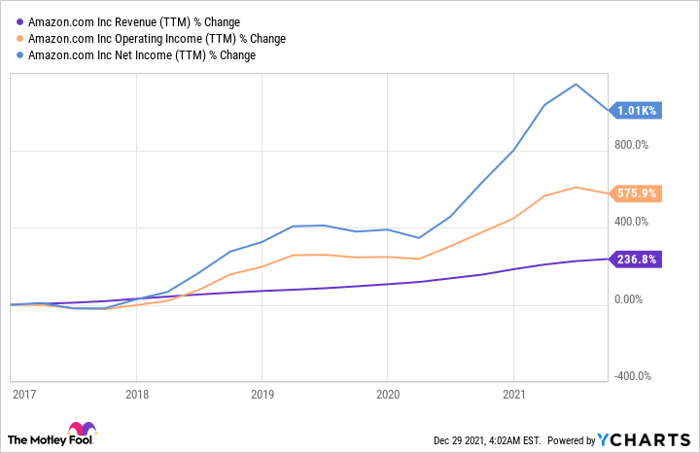
    AWS accounted for 59% of Amazon’s operating profits in 2020, compared to 41% of its operating profits in 2015. The overall impact of AWS on Amazon’s revenue, operating profits, and net income is very easy to see:

    AMZN Revenue (TTM) Chart

    Source: YCharts

    Without AWS, Amazon probably wouldn’t have been able to consistently sell its products at low prices or expand its Prime ecosystem to lock in more than 200 million paid members worldwide.

    Simply put, it’s the bedrock of Amazon’s business, and gives it a killer advantage against other retailers. That’s probably why Jeff Bezos chose Andy Jassy, the CEO of AWS at the time, to be his successor in early 2021.

    But will Amazon maintain its momentum?

    The past seven years were transformational for Amazon, but its stock has only risen about 4% over the past 12 months as investors fretted over the decelerating growth of its retail business in a post-pandemic market. Amazon’s commitment to ramping up its investments in new digital media projects also sparked concerns about its near-term earnings growth.

    With a market cap of $1.7 trillion, I think it would be very difficult for Amazon to replicate its multibagger gains of the past seven years. That said, I still believe Amazon could double in value over the next few years as AWS continues to expand and lock in more businesses — and that expansion should feed the continued growth of its retail and Prime ecosystems. In other words, Amazon is still a rock-solid core holding for long-term investors. 

    This article was originally published on Fool.com. All figures quoted in US dollars unless otherwise stated.

    The post If you’d invested $5,000 in Amazon in 2015, this is how much you would have today appeared first on The Motley Fool Australia.

    Should you invest $1,000 in Amazon right now?

    Before you consider Amazon, you’ll want to hear this.

    Motley Fool Investing expert Scott Phillips just revealed what he believes are the 5 best stocks for investors to buy right now… and Amazon wasn’t one of them.

    The online investing service he’s run for nearly a decade, Motley Fool Share Advisor, has provided thousands of paying members with stock picks that have doubled, tripled or even more.* And right now, Scott thinks there are 5 stocks that are better buys.

    *Returns as of August 16th 2021

    More reading

    Leo Sun owns Amazon. Teresa Kersten, an employee of LinkedIn, a Microsoft subsidiary, is a member of The Motley Fool’s board of directors. John Mackey, CEO of Whole Foods Market, an Amazon subsidiary, is a member of The Motley Fool’s board of directors. The Motley Fool Australia’s parent company Motley Fool Holdings Inc. owns and has recommended Amazon and Microsoft. The Motley Fool Australia has recommended Amazon. The Motley Fool has a disclosure policy. This article contains general investment advice only (under AFSL 400691). Authorised by Bruce Jackson.

    This article was originally published on Fool.com. All figures quoted in US dollars unless otherwise stated.

    from The Motley Fool Australia https://ift.tt/3sEQTd7

  • Is the Wesfarmers (ASX:WES) share price an opportunity right now?

    ASX 200 shares broker downgrade origami paper fortune teller with buy hold sell and dollar sign options

    The Wesfarmers Ltd (ASX: WES) share price is in focus after a period of strong growth from the effects of COVID-19. But now, is the conglomerate a buy?

    Wesfarmers is a diversified business with some major retail brands including Bunnings, Officeworks, Kmart, Target and Catch. However, it also has other lesser known divisions including its businesses in chemicals, energy and fertilisers, and industrial and safety products.

    What has been going on with the Wesfarmers share price?

    Wesfarmers shares have risen by around 30% since the pre-COVID peak in February 2020.

    However, Wesfarmers is down by around 9% from the 52-week high in August 2021, which was the latest reporting season.

    In that result, Wesfarmers said that its continuing operations revenue rose 10% to $33.9 billion and underlying net profit after tax (NPAT) grew 16.2% to $2.4 billion. ‘

    Total divisional earnings before tax and excluding significant items increased 23.7% to $3.54 billion. There were two divisions that drove profit significantly higher. Bunnings grew EBT by 19.7% to $2.2 billion and Kmart Group’s EBT surged 69% to $693 million.

    However, the August trading update showed year on year sales declines across all of its retail divisions. Bunnings sales were down 4.7%, Kmart and Target sales were down 14.3%, Catch’s gross transaction value fell 8.5% and Officeworks sales were down 1.5%.

    Management said that COVID-19 lockdowns were impacting the business and it was also cycling against strong sales in the prior corresponding period. In other words, Wesfarmers was finding it difficult to beat the sales in the corresponding times in the 2020 calendar year.

    Recent trading

    On 21 October 2021, Wesfarmers released a trading update at its annual general meeting (AGM). Recent trading can have an impact on investor thoughts regarding the Wesfarmers share price.

    The company said that since August, its sales growth had improved in Bunnings, Officeworks and Catch, whilst results in Kmart and Target had continued to be impacted by temporary store closures.

    In the key Bunnings division, its sales have been “robust” with sales growth from commercial customers partially offsetting the impact of lower consumer sales growth.

    It said that it has seen strong sales growth in stores in affected areas that had started to re-open, which management said demonstrated pent-up demand in those areas.

    Online sales have remained strong, despite capacity constraints in some online distribution channels. Over half of Officeworks’ sales had been online in the year to date, whilst Kmart and Bunnings had online penetration of 21% and 6% respectively.

    Is the Wesfarmers share price a buy?

    Wesfarmers is focused on a number of strategic initiatives at the moment.

    One priority is to develop a leading data and digital ecosystem which will help deliver better value and experiences to customers, as well as create new growth opportunities.

    It’s looking to increase its investments in its businesses for long-term growth. Most of that investment will be ‘organic’, but it is also open to acquisitions. Recent examples include the Mt Holland lithium project, the acquisition of Catch, and the bolt-on acquisitions for Bunnings such as Beaumont Tiles.

    Most brokers have a neutral/hold rating on the business at the moment, such as UBS and Morgans.

    Whilst Citi likes the attempt by Wesfarmers to buy Australian Pharmaceutical Industries Ltd (ASX: WES), it currently rates it as a sell with the valuation being a bit too expensive. The price target is $50.

    However, Ord Minnett currently rates Wesfarmers as a buy with a price target of $64 because it thinks that 2022 could be another good year for some retailers.

    The post Is the Wesfarmers (ASX:WES) share price an opportunity right now? appeared first on The Motley Fool Australia.

    Should you invest $1,000 in Wesfarmers right now?

    Before you consider Wesfarmers, you’ll want to hear this.

    Motley Fool Investing expert Scott Phillips just revealed what he believes are the 5 best stocks for investors to buy right now… and Wesfarmers wasn’t one of them.

    The online investing service he’s run for nearly a decade, Motley Fool Share Advisor, has provided thousands of paying members with stock picks that have doubled, tripled or even more.* And right now, Scott thinks there are 5 stocks that are better buys.

    *Returns as of August 16th 2021

    More reading

    Motley Fool contributor Tristan Harrison has no position in any of the stocks mentioned. The Motley Fool Australia’s parent company Motley Fool Holdings Inc. has no position in any of the stocks mentioned. The Motley Fool Australia owns and has recommended Wesfarmers Limited. The Motley Fool has a disclosure policy. This article contains general investment advice only (under AFSL 400691). Authorised by Bruce Jackson.

    from The Motley Fool Australia https://ift.tt/3JvMfE7

  • Why has the South32 (ASX:S32) share price surged another 14% in December?

    A businessman points to and arrow going up on a graph, indicating a share price rise for an ASX company

    The South32 Ltd (ASX: S32) share price seems to have recovered from a rocky November to post a significant gain this month.

    Over the course of December so far, the company’s stock has soared 13.88%. That’s despite no price sensitive news having been released by the company.

    At the time of writing, the South32 share price is $4.02 – 9 cents higher than it ended November.

    Additionally, it hit a new 52-week high in intraday trade yesterday when it was swapping hands for $4.08.

    Let’s take a look at what’s been going on with the mining company this month.

    South32 share price surges 14% in December

    The South32 share price has had a great month despite no price sensitive news from the company hitting the market.

    However, the company made headlines earlier this month when the NSW Government overturned a previous decision to block a proposed extension of its Dendrobium coal mine.

    The mine is a part of the company’s Illawarra Metallurgical Coal operation.

    The state’s deputy premier, Paul Toole and planning minister, Rob Stokes declared the mine ‘state significant infrastructure’ on 4 December. Toole stated:

    Dendrobium is a critical source of coking coal for the Port Kembla steelworks…

    This decision recognises the proposal’s potential economic benefits, with the mine already contributing $1.9 billion to the State’s economy each year, employing 4,500 workers, and supporting another 10,000 jobs across the Illawarra.

    In February, the NSW Independent Planning Commission blocked the extension on concerns it risked causing irreversible damage to Sydney’s water supply.

    South32 also announced a new revolving credit facility in December.

    The new facility is a refinancing of its multi-currency revolving syndicated credit facility. It leaves the company with US$1.4 billion of commitments from lenders for a five-year term.

    The facility was established as a sustainability-linked loan. It links to the company’s emissions reduction commitments and energy and water use efficiency.

    December’s gains have added to the South32 share price’s strong long-term performance. Right now, it is 60.8% higher than it was at the start of 2021.

    The post Why has the South32 (ASX:S32) share price surged another 14% in December? appeared first on The Motley Fool Australia.

    Should you invest $1,000 in South32 right now?

    Before you consider South32, you’ll want to hear this.

    Motley Fool Investing expert Scott Phillips just revealed what he believes are the 5 best stocks for investors to buy right now… and South32 wasn’t one of them.

    The online investing service he’s run for nearly a decade, Motley Fool Share Advisor, has provided thousands of paying members with stock picks that have doubled, tripled or even more.* And right now, Scott thinks there are 5 stocks that are better buys.

    *Returns as of August 16th 2021

    More reading

    Motley Fool contributor Brooke Cooper has no position in any of the stocks mentioned. The Motley Fool Australia’s parent company Motley Fool Holdings Inc. has no position in any of the stocks mentioned. The Motley Fool Australia has no position in any of the stocks mentioned. The Motley Fool has a disclosure policy. This article contains general investment advice only (under AFSL 400691). Authorised by Bruce Jackson.

    from The Motley Fool Australia https://ift.tt/3EDOlON