Tag: Motley Fool

  • St Barbara (ASX:SBM) share price tumbles after announcing Bardoc Gold acquisition

    a woman wearing a gold top and carrying a gold bar gives the thumbs down signal as she leans against a wall with a sombre look on her face.

    The St Barbara Ltd (ASX: SBM) share price has started the week deep in the red.

    In morning trade, the gold miner’s shares are down 6% to $1.38.

    Why is the St Barbara share price sinking on Monday?

    As well as being weighed down by a spot of weakness in the gold sector, the St Barbara share price has come under pressure after announcing an acquisition.

    According to the release, the company has entered into a binding scheme implementation deed under which it will acquire Bardoc Gold Limited (ASX: BDC). This follows the successful completion of a strategic review of the Bardoc Gold Project initiated by Bardoc in September 2021.

    The release explains that St Barbara has offered 0.3604 new St Barbara shares for each Bardoc share. Based on the St Barbara share price at the close of play on Friday, this values Bardoc at approximately $157 million and each Bardoc share at 53 cents.

    This represents a 29.2% premium to the closing price of Bardoc shares on 17 December. Judging by the St Barbara share price performance, the market may believe St Barbara is paying too much to acquire Bardoc.

    Bardoc also notes that it will be looking at spinning out its Woodie Manganese Project in Western Australia into a new separate vehicle, creating additional value for Bardoc shareholders.

    Leonora Province expansion

    St Barbara’s Managing Director and CEO, Craig Jetson, notes that the acquisition allows the company to expand its footprint in the Leonora Province.

    He said: “St Barbara has been focused on expanding our footprint within the Leonora Province to fill the mill by growing our deposits, through acquisitions and exploration. Acquiring Bardoc Gold unlocks access to extensive land packages near our Leonora Operations.”

    “The location of the Bardoc Gold Project, situated near the rail line and highway to the south of Leonora, brings the Bardoc ore bodies within economic haulage range of our Leonora processing plant. Combined with our existing regional opportunities such as Tower Hill and Harbour Lights, the acquisition of Bardoc facilitates the accelerated delivery of a multi-decade province of satellite mines feeding the Leonora processing plant. This provides St Barbara with significant operating flexibility and value as part of the Leonora Province Plan,” he concluded.

    The post St Barbara (ASX:SBM) share price tumbles after announcing Bardoc Gold acquisition appeared first on The Motley Fool Australia.

    Should you invest $1,000 in St Barbara right now?

    Before you consider St Barbara, you’ll want to hear this.

    Motley Fool Investing expert Scott Phillips just revealed what he believes are the 5 best stocks for investors to buy right now… and St Barbara wasn’t one of them.

    The online investing service he’s run for nearly a decade, Motley Fool Share Advisor, has provided thousands of paying members with stock picks that have doubled, tripled or even more.* And right now, Scott thinks there are 5 stocks that are better buys.

    *Returns as of August 16th 2021

    More reading

    Motley Fool contributor James Mickleboro has no position in any of the stocks mentioned. The Motley Fool Australia’s parent company Motley Fool Holdings Inc. has no position in any of the stocks mentioned. The Motley Fool Australia has no position in any of the stocks mentioned. The Motley Fool has a disclosure policy. This article contains general investment advice only (under AFSL 400691). Authorised by Bruce Jackson.

    from The Motley Fool Australia https://ift.tt/3FcBmol

  • Westpac (ASX:WBC) share price falls despite asset sale announcement

    questioning whether asx share price is a buy represented by man in red shirt scratching his head

    The Westpac Banking Corp (ASX: WBC) share price is under pressure on Monday despite the release of a positive announcement.

    At the time of writing, the banking giant’s shares are down 0.5% to $20.91.

    This means the Westpac share price is now down almost 19% in the space of two months.

    Why is the Westpac share price falling?

    The weakness in the Westpac share price today appears to have been driven by events on Wall Street on Friday night.

    A number of major banks fell heavily following a very poor night of trade on the Dow Jones and S&P 500 indices.

    This has led to Westpac and the rest of the big four banks starting the week in the red today.

    What did Westpac announce?

    As mentioned at the top, not even a positive announcement has been able to stop the Westpac share price from sliding today.

    According to the announcement, Westpac has completed the sale of its wholesale dealer loan book of approximately $1 billion in receivables to Angle Auto Finance.

    Management notes that this is the key milestone in its plan to sell its dealer finance and novated leasing businesses to Angle Auto Finance. It also advised that the transition of Westpac’s retail, wholesale dealer and introducer networks to Angle Auto Finance is underway and is expected to complete by the end of March 2022.

    The transaction is expected to add 6 basis points to Westpac’s Common Equity Tier 1 capital ratio and generate an accounting gain on sale.

    Westpac’s Group Chief Executive, Specialist Businesses, Jason Yetton, notes that the sale will simplify the bank’s operations while supporting the Auto Finance industry.

    He said: “Westpac is confident that Angle will provide a high level of support for dealers and customers and is committed to investing and growing the business to help more Australians get behind the wheel.”

    The post Westpac (ASX:WBC) share price falls despite asset sale announcement appeared first on The Motley Fool Australia.

    Should you invest $1,000 in Westpac right now?

    Before you consider Westpac, you’ll want to hear this.

    Motley Fool Investing expert Scott Phillips just revealed what he believes are the 5 best stocks for investors to buy right now… and Westpac wasn’t one of them.

    The online investing service he’s run for nearly a decade, Motley Fool Share Advisor, has provided thousands of paying members with stock picks that have doubled, tripled or even more.* And right now, Scott thinks there are 5 stocks that are better buys.

    *Returns as of August 16th 2021

    More reading

    Motley Fool contributor James Mickleboro owns Westpac Banking Corporation. The Motley Fool Australia’s parent company Motley Fool Holdings Inc. has no position in any of the stocks mentioned. The Motley Fool Australia has recommended Westpac Banking Corporation. The Motley Fool has a disclosure policy. This article contains general investment advice only (under AFSL 400691). Authorised by Bruce Jackson.

    from The Motley Fool Australia https://ift.tt/3FgVwNW

  • Magellan (ASX:MFG) share price crashes 23% after losing major contract

    woman looks shocked at mobile phone

    The Magellan Financial Group Ltd (ASX: MFG) share price has returned from its trading halt with a thud.

    In morning trade, the fund manager’s shares are down a disappointing 23% to a multi-year low of $22.46.

    This means the Magellan share price is now down a whopping 58% since the start of 2021.

    Why is the Magellan share price sinking again?

    Investors have been selling down the Magellan share price this morning after it confirmed the loss of a major contract.

    According to the release, Magellan has been notified by UK-based multinational wealth management business St James’s Place that it has terminated its mandate with the fund manager.

    The release notes that St James’s Place’s mandate was a separate account and not an investment in any of Magellan’s retail global funds.

    However, it represents approximately 12% of the company’s current annual revenues. As a result, the termination of the mandate at this point in the financial year is anticipated to have approximately a 6% impact on the revenues for FY 2022. Though, the timing also means the impact on the company’s half year results will be immaterial. No details have been provided in respect to the impact on its earnings in FY 2022.

    Magellan’s announcement, which was lacking in detail, concluded by thanking St James’s Place for its partnership and support over many years.

    A difficult period

    Today’s news caps off a very difficult period for the Magellan share price.

    Earlier this month the company announced the sudden and surprise exit of its Chief Executive Officer, Brett Cairns.

    Once again, the announcement lacked details, advising that Mr Cairns was leaving for personal reasons. This sparked speculation of a major fall out in the boardroom.

    And with Magellan recording significant fund outflows this year and its flagship fund underperforming its benchmarks materially, the company is arguably facing the most difficult period in its existence.

    The post Magellan (ASX:MFG) share price crashes 23% after losing major contract appeared first on The Motley Fool Australia.

    Should you invest $1,000 in Magellan right now?

    Before you consider Magellan, you’ll want to hear this.

    Motley Fool Investing expert Scott Phillips just revealed what he believes are the 5 best stocks for investors to buy right now… and Magellan wasn’t one of them.

    The online investing service he’s run for nearly a decade, Motley Fool Share Advisor, has provided thousands of paying members with stock picks that have doubled, tripled or even more.* And right now, Scott thinks there are 5 stocks that are better buys.

    *Returns as of August 16th 2021

    More reading

    Motley Fool contributor James Mickleboro has no position in any of the stocks mentioned. The Motley Fool Australia’s parent company Motley Fool Holdings Inc. has no position in any of the stocks mentioned. The Motley Fool Australia has no position in any of the stocks mentioned. The Motley Fool has a disclosure policy. This article contains general investment advice only (under AFSL 400691). Authorised by Bruce Jackson.

    from The Motley Fool Australia https://ift.tt/3J45fJJ

  • 3 things you shouldn’t do if the stock market crashes

    This article was originally published on Fool.com. All figures quoted in US dollars unless otherwise stated.

    woman meditating and keeping calm

    This article was originally published on Fool.com. All figures quoted in US dollars unless otherwise stated.

    There’s a right way and a wrong way to handle stock market crashes. Getting the next one wrong might permanently reduce your investment returns. Avoid these three common mistakes if you want to navigate the market cycle like a pro.

    1. You shouldn’t panic

    It’s nearly impossible to remove emotion from your financial plan. Who could be completely dispassionate when it comes to their kids’ college funds or their retirement nest egg? You’ve spent years diligently saving and investing for growth, of course you’re going to freak out a bit if your assets suddenly tank in value.

    However, you have to resist the instinct to panic if you want the best long-term investment outcomes. That’s easier said than done, but consider historical market dynamics for some valuable perspective. Volatility is a natural part of equity investing, and market crashes happen. If you’re in the market for the long haul, bear markets are unavoidable. Don’t blame yourself or your advisor when an event occurs that we should recognize as inevitable.

    It might sound grim just to accept periodic severe losses, but there’s a good reason for it: Downturns are temporary. Over every 15-year period, starting on any single day in its history, returns for the S&P 500 have been positive. Capital moves in and out of the stock market, but economic growth ultimately spurs the value of companies higher.

    Recognize this fact ahead of time, and build your financial plan with this knowledge. When the market is down, remind yourself of this, and look forward to new opportunities that are around the corner.

    2. You shouldn’t sell your stocks

    This one is a lot easier once you’ve mastered the “don’t panic” approach. Selling your stocks in the midst of a market crash might be the worst thing you can do. It’s the exact opposite of the buy-low,-sell-high cliché.

    You can check the value of your portfolio any given day, but those gains are unrealized until the positions are closed. Open positions are like chips still on the table in a casino — you’re not really a winner until you cash out and leave the building. Obviously, it feels good when your accounts are up, but you have to sell your stocks in exchange for cash in order to purchase something else.

    Selling your stocks at a market bottom locks in your losses. Even worse, if you get rid of your stocks and fail to buy back in, you’ll miss out on some of the growth when the market inevitably recovers.

    The key is understanding your time horizon and personal risk tolerance. If you’re still 20 to 30 years away from retirement, your IRA or 401(k)’s exact balance today isn’t exactly relevant. You’ll go through a few more market cycles before you start making withdrawals. Since you have time to wait for another market recovery, you should prioritize long-term growth.

    On the other hand, you shouldn’t expose your investments to volatility if you need to liquidate them soon. Retirees, for example, might need to sell their stocks for cash in the next few years. They should build a more balanced asset portfolio to complement Social Security income. Adding bonds or cash will reduce volatility and limit losses. Don’t put yourself in a position where you’re forced to sell during a crash. Moreover, you’ll have extra cash on hand to purchase stocks at lower valuations.

    3. You shouldn’t be scared of growth stocks

    This takes the “don’t sell” approach a step further. Market crashes are actually the best times to focus even more on growth, but some scary stock charts will probably cause some trepidation.

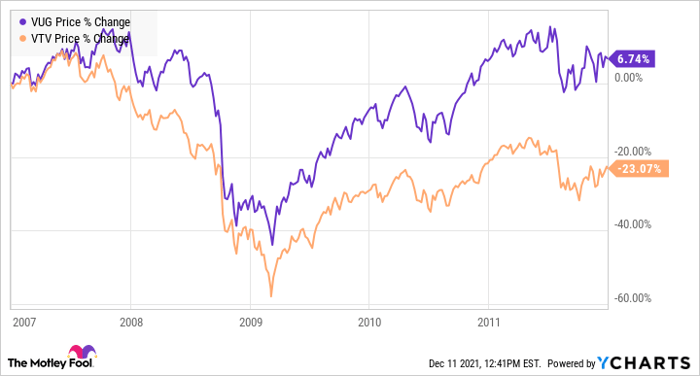
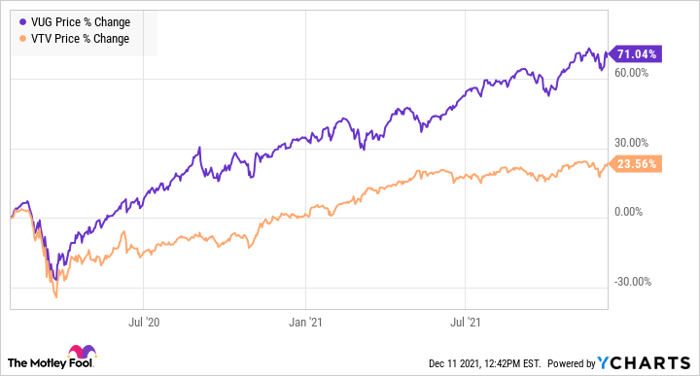
    Growth stocks take a pounding during bear markets, so they’ll probably have much uglier returns relative to value stocks and the market in general. History can be a valuable guide, but investment returns are built on future results. The stocks that drop the hardest in market crashes tend to be the ones that perform the best in subsequent bull markets.

    This becomes clear when we look at the Vanguard Growth ETF‘s (NYSEMKT: VUG) performance relative to the Vanguard Value ETF (NYSEMKT: VTV) over the last two major collapse-recovery cycles.

    VUG Chart

    VUG Chart

    Data by YCharts.

    The merits of each stock play an important role in returns, but the trend applies, all other things being equal. This isn’t to imply that you should be drastically changing your portfolio allocation. Overall, you should come up with a target allocation based on your personal goals and risk tolerance. However, shifts in valuation change the risk/reward profile of stocks over time. When the market crashes, growth stocks will look more favorable, and it’s not a bad idea to modestly shift your portfolio to the most aggressive allocation that’s acceptable within your personal risk profile. 

    This article was originally published on Fool.com. All figures quoted in US dollars unless otherwise stated.

    The post 3 things you shouldn’t do if the stock market crashes appeared first on The Motley Fool Australia.

    Wondering where you should invest $1,000 right now?

    When investing expert Scott Phillips has a stock tip, it can pay to listen. After all, the flagship Motley Fool Share Advisor newsletter he has run for more than eight years has provided thousands of paying members with stock picks that have doubled, tripled or even more.*

    Scott just revealed what he believes could be the five best ASX stocks for investors to buy right now. These stocks are trading at near dirt-cheap prices and Scott thinks they could be great buys right now.

    *Returns as of August 16th 2021

    More reading

    Ryan Downie has no position in any of the stocks mentioned. The Motley Fool Australia’s parent company Motley Fool Holdings Inc. owns and recommends Vanguard Growth ETF and Vanguard Value ETF. The Motley Fool Australia has no position in any of the stocks mentioned. The Motley Fool has a disclosure policy. This article contains general investment advice only (under AFSL 400691). Authorised by Bruce Jackson.

    This article was originally published on Fool.com. All figures quoted in US dollars unless otherwise stated.

    from The Motley Fool Australia https://ift.tt/3mf39gk

  • Here’s how the stock market could turn $10,000 into $450,000

    This article was originally published on Fool.com. All figures quoted in US dollars unless otherwise stated.

    a smiling woman sits at her computer at home with a coffee alongside her, as if pleased with her investments.

    This article was originally published on Fool.com. All figures quoted in US dollars unless otherwise stated.

    The stock market turns ordinary people into millionaires every day, and it’s actually one of the easiest ways for the average person to grow wealth. The sheer number of investment options can be intimidating and the risk of loss concerning, but overcoming those obstacles is actually a lot easier than you think.

    Here’s a look at one of the simplest ways you can turn $10,000 into more than $450,000 using the stock market.

    How does the stock market grow your money?

    When you invest in a stock, you buy an ownership stake in a company at whatever the current market value is. You can hold on to that for as long as you’d like. Then, when you need money, you can sell it at whatever the current market value is. The difference between what you initially paid for the stock and what you sell it for is known as your earnings.

    If you’ve invested wisely, the market value of your shares should go up over time. Stock prices can change wildly in the short term, sometimes rising and falling many times within a single day. But over the long term, the S&P 500, one of the best-known market indexes, averages about a 10% return per year.

    That means that if you invested in an index fund containing all the same stocks as the S&P 500, you could also see your savings grow by an average of about 10% per year over several decades. Your actual return will likely be a little less than that of the index itself because index funds charge annual fees to shareholders. However, these fees are usually pretty low, amounting to a few dollars per year for most people.

    How to turn $10,000 into over $450,000

    If you invested $10,000 into an S&P 500 index fund today and it had a 10% average annual rate of return over the next 40 years, you’d end up with nearly $452,600. And that’s without ever investing another dime after the initial $10,000.

    Those who routinely invest more money could end up with a much larger sum, as could those who reinvest their dividends — or excess earnings that companies split with their shareholders. Not all stocks pay them, and those that do usually only pay them quarterly. They’re often only a few dollars, but they can still add up over time, especially after being reinvested for a few decades.

    Now, I imagine some of you are thinking, “That’s great for someone who has $10,000 to spare, but I don’t”. And the good news is you don’t have to. You can reach the same $450,000 over 40 years by investing less than $81 per month, assuming you still earn a 10% average annual rate of return.

    You’ll contribute more of your own money this way. Investing $81 per month for 40 years will cost you close to $39,000. That’s because a lot of your funds won’t be invested for the full 40 years. But it’s a lot easier for most people to set aside a few dollars every month than to come up with thousands of dollars all at once.

    The beauty of investing this way is its simplicity. All you have to do is keep putting in money, and the index fund will do the rest of the work for you. It’ll automatically give you an ownership stake in hundreds of companies across several industries, so your savings are diversified. This helps reduce your risk of substantial loss. 

    The only other thing you really need is patience. You will likely experience some ups and downs along the way, but as long as you trust your investment strategy and avoid emotional decisions, you can grow yourself a pretty substantial nest egg over time.

    This article was originally published on Fool.com. All figures quoted in US dollars unless otherwise stated.

    The post Here’s how the stock market could turn $10,000 into $450,000 appeared first on The Motley Fool Australia.

    Wondering where you should invest $1,000 right now?

    When investing expert Scott Phillips has a stock tip, it can pay to listen. After all, the flagship Motley Fool Share Advisor newsletter he has run for more than eight years has provided thousands of paying members with stock picks that have doubled, tripled or even more.*

    Scott just revealed what he believes could be the five best ASX stocks for investors to buy right now. These stocks are trading at near dirt-cheap prices and Scott thinks they could be great buys right now.

    *Returns as of August 16th 2021

    More reading

    The Motley Fool has a disclosure policy.

    This article was originally published on Fool.com. All figures quoted in US dollars unless otherwise stated.


    from The Motley Fool Australia https://ift.tt/324O1LR
  • Could 2022 be a good year for the AGL (ASX:AGL) share price?

    a woman holds her finger to the side of her lips in contemplation as she looks upwards to an array of graphic images of light bulbs above her head, one of which is on and glowing.

    The AGL Energy Limited (ASX: AGL) share price has struggled through 2021 — does that make it a good 2022 investment?

    As of Friday’s close, the AGL share price is $5.96. That’s 50.8% lower than it was at the start of this year.

    For context, the S&P/ASX 200 Index (ASX: XJO) has gained 9.2% over the same period.

    Let’s take a look at what the experts think 2022 could bring for the embattled company’s stock.

    What might 2022 bring for the AGL share price?

    The big happening expected to drive the energy provider’s share price in the new year is, of course, its planned split.

    Under the plan, AGL Energy’s electricity-generating assets will be taken on by the newly formed, Accel Energy. Meanwhile, its retail, energy storage, and supply leg with be run by AGL Australia.

    That’s got Ord Minnett bullish on the stock.

    As The Motley Fool Australia recently reported, the broker believes the AGL share price is priced so low that it’s a good investment for its future retail division alone.

    Late last month, it slapped AGL’s stock with a $7.55 price target – which currently implies a 26% upside on the company’s share price.

    Another expert is also optimistic about the energy provider’s performance next year.

    Author of Market Matters and Shaw and Partners senior investment advisor James Gerrish agreed with Ord Minnett, saying AGL is now “an asset at play”.

    Gerrish told Livewire he expects the company’s stock to “do better in ’22 than it did in ’21”.

    However, not everyone thinks AGL’s planned demerger is a good idea.

    Earlier this year, former energy industry leader Matthew Warren expressed his belief the split could see AGL without its major shield from energy prices – conglomeration.  

    Additionally, he believes Australians will increasingly create their own household electricity using renewable power, as will smaller, up-and-coming energy companies.

    Still, the company’s stock has been recovering lost ground lately. The AGL share price has gained 13.7% over the last 30 days.

    The post Could 2022 be a good year for the AGL (ASX:AGL) share price? appeared first on The Motley Fool Australia.

    Should you invest $1,000 in AGL Energy right now?

    Before you consider AGL Energy, you’ll want to hear this.

    Motley Fool Investing expert Scott Phillips just revealed what he believes are the 5 best stocks for investors to buy right now… and AGL Energy wasn’t one of them.

    The online investing service he’s run for nearly a decade, Motley Fool Share Advisor, has provided thousands of paying members with stock picks that have doubled, tripled or even more.* And right now, Scott thinks there are 5 stocks that are better buys.

    *Returns as of August 16th 2021

    More reading

    Motley Fool contributor Brooke Cooper has no position in any of the stocks mentioned. The Motley Fool Australia’s parent company Motley Fool Holdings Inc. has no position in any of the stocks mentioned. The Motley Fool Australia has no position in any of the stocks mentioned. The Motley Fool has a disclosure policy. This article contains general investment advice only (under AFSL 400691). Authorised by Bruce Jackson.

    from The Motley Fool Australia https://ift.tt/3mlmbSp

  • Is the Santos (ASX:STO) share price well oiled and gassed up for 2022?

    A male oil and gas mechanic wearing a white hardhat walks along a steel platform above a series of gas pipes in a gas plant

    The Santos Ltd (ASX: STO) share price has been going nowhere fast over the past 12 months.

    Despite the oil and gas company’s net earnings swinging back into profit for its half-year results at the end of June, the market has seen little reason to bid up the Santos share price this year. As a result, shareholders are sitting roughly where they started at the beginning of the year — plus 14 cents per share worth of dividends.

    However, a lot has changed in recent weeks for one of Australia’s largest energy companies. For starters, it’s gotten a whole lot bigger after gobbling up formerly listed Oil Search Ltd.

    So, what could be on the cards for this energy giant in 2022?

    Merging with the times

    After pitching a mega-merger with Oil Search in September, Santos announced that the deal was officially implemented today. From here, the new Santos shares (accounting for the integration of Oil Search) are expected to commence trading on Monday 20 December.

    Following the implementation, Santos will likely spend some time fully integrating Oil Search’s operations. As part of this process, the company will seek to realise pre-tax synergies of between US$90 million and US$115 million. If the company can deliver on these synergies, it could benefit the Santos share price.

    The consolidation reflects added pressure within the oil and gas industry as environmental, social, and corporate governance (ESG) considerations begin to weigh more heavily.

    Santos is not alone in its efforts to reinforce itself through a merger and acquisition approach. This week Woodside Petroleum Limited (ASX: WPL) received a green light from the Australian Competition and Consumer Commission to acquire BHP Group Ltd‘s (ASX: BHP) petroleum division.

    While Santos remains focused on its gas developments in Papua New Guinea, investors might see a green shoot from the company. In its original release to shareholders regarding the Oil Search deal, Santos’ CEO Kevin Gallagher said:

    The merger will create a company with a balance sheet and strong cash flows necessary to successfully navigate the transition to a lower-carbon future with the combination of Santos’ leading CCS capability combining with Oil Search’s ESG programs in PNG and Alaska to provide a strong foundation.

    What do brokers think of the Santos share price?

    Despite a year of underperformance, Ord Minnett thinks Santos has what it takes to deliver for shareholders in 2022. According to the broker, the newly merged entity could be a positive catalyst for the company’s valuation.

    For this reason, Ord Minnett has put an $8.45 price target on the oil and gas company. This would suggest there could be a further ~32% upside to the Santos share price.

    The post Is the Santos (ASX:STO) share price well oiled and gassed up for 2022? appeared first on The Motley Fool Australia.

    Should you invest $1,000 in Santos right now?

    Before you consider Santos, you’ll want to hear this.

    Motley Fool Investing expert Scott Phillips just revealed what he believes are the 5 best stocks for investors to buy right now… and Santos wasn’t one of them.

    The online investing service he’s run for nearly a decade, Motley Fool Share Advisor, has provided thousands of paying members with stock picks that have doubled, tripled or even more.* And right now, Scott thinks there are 5 stocks that are better buys.

    *Returns as of August 16th 2021

    More reading

    Motley Fool contributor Mitchell Lawler has no position in any of the stocks mentioned. The Motley Fool Australia’s parent company Motley Fool Holdings Inc. has no position in any of the stocks mentioned. The Motley Fool Australia has no position in any of the stocks mentioned. The Motley Fool has a disclosure policy. This article contains general investment advice only (under AFSL 400691). Authorised by Bruce Jackson.

    from The Motley Fool Australia https://ift.tt/3e7G76H

  • How high will ASX travel shares fly in 2022?

    a woman looks nervous and uncertain holding a hand to her chin while looking at a paper cut out of a plane that she's holding in her other hand.

    No ASX shares have been through more turbulence in the past two years than travel stocks.

    The closing of international borders for more than 18 months, plus the constant closing and opening of domestic crossings, has knocked the industry for six. 

    Not only has it caused upheaval for customers who have booked trips, the industry is simply missing out on all those Australians who don’t even bother because of all the uncertainty.

    But despite all that, by early November, optimism was abundant.

    Australia’s international exile ended, most states were reopening — with some declaring “no more lockdowns” — and ASX travel shares like Webjet Limited (ASX: WEB) and Qantas Airways Limited (ASX: QAN) hit their 52-week highs.

    Then COVID-19 Omicron arrived.

    The Motley Fool reported that the month ended with just three out of 12 travel shares on the ASX higher than where they started.

    The Qantas share price is now almost 19% off peak, while Webjet has been hammered more than 23%.

    So now what? After a November bloodbath, are travel shares ready to roar again in 2022?

    Travel shares looking ‘relatively poor’

    Unfortunately, Datt Capital managing director Emanuel Datt reckons prospects for travel shares next year are “relatively poor”.

    There is just too much uncertainty around how governments will behave, as they’re motivated by political forces as much as health or economic advice.

    “Ultimately, the prospects surrounding these businesses all depend on the response of the Australian federal government and the respective state governments during the calendar year 2022,” Datt told The Motley Fool.

    “If border closures remain a persistent theme in the new year, then this does not bode well for these companies.”

    Unfortunately for the industry, even when borders are open, the extra red tape and costs required of travellers is dampening demand.

    “We believe [that] restricts these businesses from climbing back to their pre-COVID revenues, meaning there is likely going to be a period of lower returns going forward.”

    2022 is full of anxiety caused by unknowns

    Taking Webjet, Flight Centre Travel Group Ltd (ASX: FLT) and Corporate Travel Management Ltd (ASX: CTD) as proxies for the industry in general, next year is packed with uncertainty.

    “Flight Centre may be impacted should social confidence remain low in visiting stores physically, whilst Corporate Travel Management may suffer due to the corporate transition towards easy video conference utilities like Zoom becoming the norm,” said Datt.

    “Webjet is likely to be the least impacted due to its strong emphasis on digital sales channels.”

    Not unusual for an industry in turmoil, there seems to be some consolidation happening.

    Just last week Corporate Travel Management revealed it would acquire consumer travel agent Helloworld Travel Ltd (ASX: HLO) in a $175 million deal.

    The post How high will ASX travel shares fly in 2022? appeared first on The Motley Fool Australia.

    Wondering where you should invest $1,000 right now?

    When investing expert Scott Phillips has a stock tip, it can pay to listen. After all, the flagship Motley Fool Share Advisor newsletter he has run for more than eight years has provided thousands of paying members with stock picks that have doubled, tripled or even more.*

    Scott just revealed what he believes could be the five best ASX stocks for investors to buy right now. These stocks are trading at near dirt-cheap prices and Scott thinks they could be great buys right now.

    *Returns as of August 16th 2021

    More reading

    Motley Fool contributor Tony Yoo owns Corporate Travel Management Limited. The Motley Fool Australia’s parent company Motley Fool Holdings Inc. owns and has recommended Helloworld Limited. The Motley Fool Australia owns and has recommended Helloworld Limited. The Motley Fool Australia has recommended Corporate Travel Management Limited, Flight Centre Travel Group Limited, and Webjet Ltd. The Motley Fool has a disclosure policy. This article contains general investment advice only (under AFSL 400691). Authorised by Bruce Jackson.

    from The Motley Fool Australia https://ift.tt/3e439LM

  • 2 ASX growth shares analysts rate as buys

    ASX shares profit upgrade chart showing growth

    Are you interested in adding some ASX growth shares to your portfolio this month? If you are, you may want to look at the ones listed below that have recently been named as buys.

    Here’s what you need to know about them:

    Altium Limited (ASX: ALU)

    The first ASX growth share to look at is Altium. It is an award-winning printed circuit board design software provider. Altium could be a top option for investors due to its positive long term growth outlook thanks to its exposure to the rapidly growing Internet of Things and artificial intelligence markets.

    These are underpinning strong demand for its Altium Designer and Altium 365 software and also its other businesses such as the Octopart search engine.

    Jefferies is positive on Altium’s outlook and has a buy rating and $48.83 price target on its shares. The broker sees an opportunity for Altium to win a significant share of the enterprise market due to the quality and price of its platform.

    NEXTDC Ltd (ASX: NXT)

    Another ASX growth share for investors to consider is NEXTDC. It owns a collection of world class Tier III and Tier IV data centre facilities in key locations across Australia. From these centres, NEXTDC provides scalable, on-demand services to support outsourced data centre infrastructure and cloud connectivity for enterprises of all sizes.

    NEXTDC has been growing at a strong rate for many years and appears well-placed to continue this positive trend long into the future. This is thanks to the ongoing structural shift to the cloud which is underpinning growing demand for capacity in its centres. In addition, its future growth looks set to be supported by an expansion into Asia and Edge data centres. The latter are centres in regional areas.

    The team at Goldman Sachs is very positive on the company’s outlook. In fact, the broker believes NEXTDC will grow its operating earnings by ~20% per annum through to at least FY 2024. Goldman has a buy rating and $14.40 price target on the company’s shares

    The post 2 ASX growth shares analysts rate as buys appeared first on The Motley Fool Australia.

    Wondering where you should invest $1,000 right now?

    When investing expert Scott Phillips has a stock tip, it can pay to listen. After all, the flagship Motley Fool Share Advisor newsletter he has run for more than eight years has provided thousands of paying members with stock picks that have doubled, tripled or even more.*

    Scott just revealed what he believes could be the five best ASX stocks for investors to buy right now. These stocks are trading at near dirt-cheap prices and Scott thinks they could be great buys right now.

    *Returns as of August 16th 2021

    More reading

    Motley Fool contributor James Mickleboro owns NEXTDC Limited. The Motley Fool Australia’s parent company Motley Fool Holdings Inc. owns and has recommended Altium. The Motley Fool Australia has no position in any of the stocks mentioned. The Motley Fool has a disclosure policy. This article contains general investment advice only (under AFSL 400691). Authorised by Bruce Jackson.

    from The Motley Fool Australia https://ift.tt/3F79Msx

  • How will ASX retail shares go in 2022?

    Close-up of a woman waring a hay and smiling as she carries shopping bags over her shoulder.

    ASX retail shares have endured the COVID-19 pandemic reasonably well.

    As Australians received government support and spent less money on discretionary items like travel, supermarkets like Woolworths Group Ltd (ASX: WOW) cashed in on increased demand for staples. And online merchants such as Temple & Webster Group Ltd (ASX: TPW) went gangbusters from customers trapped at home.

    But perhaps they all had their strong upwards run in 2020, because 2021 wasn’t super-impressive for the prices of retail shares.

    “Retail stocks mostly tracked sideways for the better part of 2021 despite delivering big growth and increased dividends and buybacks,” Tribeca Investment Partners portfolio manager Jun Bei Liu told The Motley Fool.

    Indeed Woolworths shares are up 11% this year while Temple & Webster is down 11%, cancelling each other out.

    So how will 2022 fare for Australian retail as the world battles inflation, supply constraints and new coronavirus variants?

    The year of ‘small returns’

    Unfortunately, Liu predicts next year will be another period of “small returns” that will mostly come from “higher dividends”.

    “Retail sector has been the key beneficiary of COVID stimulus/handouts and lack of travel,” she said.

    “Many of the mega-cap retailers are going to experience some of the toughest comparable periods — most will have revenue declines.”

    International border blocks, now exacerbated by the Omicron variant of COVID-19, remain a worry.

    “Costs will be going up for them with severe global supply chain disruptions as a result of border closures.”

    Liu feels like Wesfarmers Ltd (ASX: WES) and food retailers — such as Woolworths, Coles Group Ltd (ASX: COL) and Metcash Limited (ASX: MTS) — already have “stretched valuations” while seeing “declining earnings”.

    The election could bring a windfall for consumers

    However, merchants selling discretionary products might have better luck.

    “Aside from just cheap valuations, Australian elections generally prove to be positive for the consumer sector,” Liu said.

    “We see possibilities for tax cuts to be pulled forward which will be positive for the discretionary retailers such as JB Hi-Fi Limited (ASX: JBH).”

    A federal election must be held no later than 21 May, with both major parties already in campaign mode.

    “We are likely to see more stimulus to consumers though not meaningful in comparison to the handout over the past few years,” said Liu.

    “Fiscal spending will be another area of focus, though most have been discussed in the past 12 months.”

    The other angle for discretionary retailers, of course, is increased foot traffic in shopping centres. 

    “Retailers whose earnings will benefit from a reopening economy such as Lovisa Holdings Ltd (ASX: LOV) will likely to outperform.”

    The post How will ASX retail shares go in 2022? appeared first on The Motley Fool Australia.

    Wondering where you should invest $1,000 right now?

    When investing expert Scott Phillips has a stock tip, it can pay to listen. After all, the flagship Motley Fool Share Advisor newsletter he has run for more than eight years has provided thousands of paying members with stock picks that have doubled, tripled or even more.*

    Scott just revealed what he believes could be the five best ASX stocks for investors to buy right now. These stocks are trading at near dirt-cheap prices and Scott thinks they could be great buys right now.

    *Returns as of August 16th 2021

    More reading

    Motley Fool contributor Tony Yoo owns Temple & Webster Group Ltd. The Motley Fool Australia’s parent company Motley Fool Holdings Inc. owns and has recommended Temple & Webster Group Ltd. The Motley Fool Australia owns and has recommended COLESGROUP DEF SET. The Motley Fool Australia has recommended Lovisa Holdings Ltd and Temple & Webster Group Ltd. The Motley Fool has a disclosure policy. This article contains general investment advice only (under AFSL 400691). Authorised by Bruce Jackson.

    from The Motley Fool Australia https://ift.tt/3e9v90l