Tag: Motley Fool

  • Is Bitcoin a good inflation edge?

    This article was originally published on Fool.com. All figures quoted in US dollars unless otherwise stated.

    The word inflation with a zig zaggy arrow.

    This article was originally published on Fool.com. All figures quoted in US dollars unless otherwise stated.

    One of the common investment theses behind Bitcoin (CRYPTO: BTC) is that it’s a great hedge against inflation. There are only 21 million Bitcoin available once they’re all mined, limiting supply. In theory, this limited supply should mean that Bitcoin is a good hedge against the increased supply of the U.S. dollar. 

    This theory comes into question when we look at the data about Bitcoin’s price trends and real inflation. Does Bitcoin really trade as an effective hedge to inflation, or is there something else to its moves? 

    Why Bitcoin is viewed as an inflation hedge

    The theory behind Bitcoin as an inflation hedge is simple enough. The number of Bitcoin is limited to 21 million, while the number of U.S. dollars typically increases over time. With everything else being equal, if the supply of the U.S. dollar increases, the value of Bitcoin in dollars should also increase. 

    Here is an extremely simplistic example of the value of Bitcoin if the supply of dollars doubles. I assume that the “market cap” of U.S. dollars and Bitcoin are equal in both scenarios. 

    Currency Supply Scenario 1 Price Scenario 1 Supply Scenario 2 Price Scenario 2
    U.S. Dollar 1 trillion $1 2 trillion $1
    Bitcoin 21 million $47,619 21 million $95,238

    Note: Author’s calculations.

    If the supply of U.S. dollars doubles, then it makes sense that the value of a Bitcoin would double in relation to the U.S. dollar. The market doesn’t always work in this simple way, though. 

    Bitcoin hasn’t been a hedge so far

    If we go back to pre-pandemic days, Bitcoin doesn’t look like a hedge at all. Bitcoin rose in popularity in late 2017 but then crashed in 2018 and early 2019, and that didn’t have anything to do with inflation. Over this time, the M2 money supply rose 25.3%, and gold would have been a better direct hedge, rising 51.9%. 

    Bitcoin Price Chart

    Bitcoin Price data by YCharts

    More recently, Bitcoin hasn’t acted like a hedge as actual inflation has taken hold. You can see below that inflation, and inflation expectations, have been rising all year, but Bitcoin is actually down compared to late February. Investors looking to hedge inflation would have been better off buying the iShares TIPS Bond ETF (NYSEMKT: TIP), a bond fund of inflation-protected treasuries. 

    Bitcoin Price Chart

    Bitcoin Price data by YCharts

    What is Bitcoin if it’s not a hedge? 

    Over the last decade, we’ve seen Bitcoin’s value swing wildly. However, it hasn’t been correlated with inflation in any meaningful way. You can see below that Bitcoin hasn’t been consistently correlated with growth stocks or inflation stocks and for large portions of the last year were negatively correlated (a correlation coefficient of 1.0 means they’re highly correlated while a coefficient of -1.0 means they move in opposite directions). 
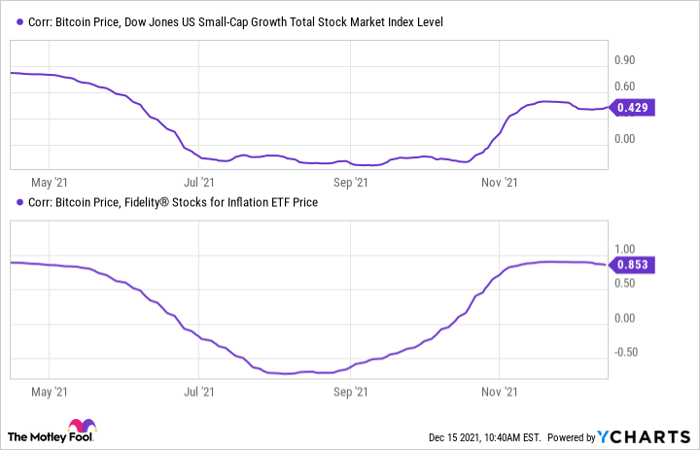
    Fundamental Chart Chart

    Fundamental Chart data by YCharts

    I see the recent rise in Bitcoin as a speculative move driven by millions of people with excess stimulus cash and ample time to trade in the high-flying cryptocurrency market. That has brought in more institutional money, pushing values even higher. At the end of the day, it’s not clear whether Bitcoin is like digital gold, some kind of utility, or just a speculative asset. 

    From what I can see, based on the fact that inflation is rising in 2021 while Bitcoin is heading lower, Bitcoin isn’t a good inflation hedge, and investors should seek a better investment thesis for this digital asset. 

    This article was originally published on Fool.com. All figures quoted in US dollars unless otherwise stated.

    The post Is Bitcoin a good inflation edge? appeared first on The Motley Fool Australia.

    Wondering where you should invest $1,000 right now?

    When investing expert Scott Phillips has a stock tip, it can pay to listen. After all, the flagship Motley Fool Share Advisor newsletter he has run for more than eight years has provided thousands of paying members with stock picks that have doubled, tripled or even more.*

    Scott just revealed what he believes could be the five best ASX stocks for investors to buy right now. These stocks are trading at near dirt-cheap prices and Scott thinks they could be great buys right now.

    *Returns as of August 16th 2021

    More reading

    Travis Hoium has no position in any of the stocks mentioned. The Motley Fool Australia’s parent company Motley Fool Holdings Inc. owns shares of and has recommended Bitcoin. The Motley Fool Australia has no position in any of the stocks mentioned. The Motley Fool has a disclosure policy. This article contains general investment advice only (under AFSL 400691). Authorised by Bruce Jackson.

    This article was originally published on Fool.com. All figures quoted in US dollars unless otherwise stated.

    from The Motley Fool Australia https://ift.tt/325WIVE

  • Here’s the latest on the Stockland (ASX:SGP) dividend

    real estate asx share price represented by growing coin piles next to wooden house

    When it comes to investing in ASX Real Estate Investment Trusts (REITs), most investors come for the income, and, well, stay for the income. REITs are governed by special rules, which means that they can often pay out pre-tax dividend distributions. This can lead to market-leading yields on some ASX REITs (although most don’t come with franking for this very same reason). So let’s check out Stockland Corporation Ltd (ASX: SGP).

    Why Stockland? Because, as of this morning, we’ve got some news on Stockland’s own dividend.

    Like many ASX REITs and dividend-paying shares, Stockland’s dividends took a beating with the onset of the COVID-19 pandemic. This was a REIT that paid out 27.6 cents per share in dividend distributions in 2019. But 2020 only saw 21.9 cents per share paid out to investors, split into a 10.6 cents per share interim payout and an 11.3 cents per share final distribution.

    This year, Stockland has lifted its payments off of those lows. Its June 2021 interim payment came in at 13.3 cents per share, just 0.2 cents lower than the same interim payment from 2019.

    So what has Stockland announced this morning? Could its dividend distributions have recovered even more?

    Well, Stockland has just announced that its 2021 final dividend distribution will come in at 12 cents per share, to be paid out on 31 December. That will bring its total dividend distributions for 2021 to 25.3 cents per share. That’s well above 2020’s 21.9 cents, but not yet at 2019’s high watermark of 27.6 cents.

    Even so, no doubt Stockland shareholders will be pleased with this news. On recent Stockland pricing, that gives this company a forward yield of 5.93%

    Stockland share price snapshot

    2021 has been a rough year for Stockland. Its shares remain down 0.23% year to date, and 4.9% over the past 12 months. Stockland is even down around 2.3% over the past 5 years. At the latest pricing, the company has a market capitalisation of $10.2 billion.

    The post Here’s the latest on the Stockland (ASX:SGP) dividend appeared first on The Motley Fool Australia.

    Should you invest $1,000 in Stockland right now?

    Before you consider Stockland, you’ll want to hear this.

    Motley Fool Investing expert Scott Phillips just revealed what he believes are the 5 best stocks for investors to buy right now… and Stockland wasn’t one of them.

    The online investing service he’s run for nearly a decade, Motley Fool Share Advisor, has provided thousands of paying members with stock picks that have doubled, tripled or even more.* And right now, Scott thinks there are 5 stocks that are better buys.

    *Returns as of August 16th 2021

    More reading

    Motley Fool contributor Sebastian Bowen has no position in any of the stocks mentioned. The Motley Fool Australia’s parent company Motley Fool Holdings Inc. has no position in any of the stocks mentioned. The Motley Fool Australia has no position in any of the stocks mentioned. The Motley Fool has a disclosure policy. This article contains general investment advice only (under AFSL 400691). Authorised by Bruce Jackson.

    from The Motley Fool Australia https://ift.tt/3GMbtvR

  • Vulcan (ASX:VUL) share price storms higher after receiving short seller apology

    a man looks down at his phone with a look of happy surprise on his face as though he is thrilled with good news.

    The Vulcan Energy Resources Ltd (ASX: VUL) share price is storming higher on Thursday morning.

    In early trade, the lithium developer’s shares are up 4% to $11.90.

    Why is the Vulcan Energy share price storming higher?

    Investors have been bidding the Vulcan Energy share price higher today after the company received an apology from short seller J Capital.

    According to the release, last month Vulcan Energy issued proceedings against Timothy Murray and J Capital Research in the Federal Court of Australia in relation to a scathing short report. These proceedings have now been settled out of court.

    The settlement includes permanent restraints preventing J Capital and Mr Murray from disseminating, publishing or republishing any matter of and concerning the company, its directors, and officers.

    In addition, J Capital and Mr Murray have provided an open apology to the company, Dr Wedin, Mr Rezos, Mr Weimann and Dr Kreuter.

    The J Capital apology

    J Capital commented: “While J Capital and Mr Murray may have different views about the potential of Vulcan’s Zero Carbon Lithium Project, J Capital and Mr Murray apologise for the allegations regarding Vulcan’s Board and management.”

    “J Capital and Mr Murrary sincerely apologise for any damage, distress and embarrassment caused to Vulcan’s Board and management, and in particular, to Dr Wedin, Mr Rezos, Mr Weimann and Dr Kreuter,” it added.

    Vulcan Energy can now go back to focusing on more important things, such as working to become the world’s first lithium producer with net zero greenhouse gas emissions through its Zero Carbon Lithium project in Germany.

    Following today’s gain, the Vulcan Energy share price is now up 330% since the start of the year. Recent gains have been driven by the announcement of binding lithium offtake agreements with car giants Stellantis, Volkswagen, and Renault.

    The post Vulcan (ASX:VUL) share price storms higher after receiving short seller apology appeared first on The Motley Fool Australia.

    Should you invest $1,000 in Vulcan Energy right now?

    Before you consider Vulcan Energy, you’ll want to hear this.

    Motley Fool Investing expert Scott Phillips just revealed what he believes are the 5 best stocks for investors to buy right now… and Vulcan Energy wasn’t one of them.

    The online investing service he’s run for nearly a decade, Motley Fool Share Advisor, has provided thousands of paying members with stock picks that have doubled, tripled or even more.* And right now, Scott thinks there are 5 stocks that are better buys.

    *Returns as of August 16th 2021

    More reading

    Motley Fool contributor James Mickleboro has no position in any of the stocks mentioned. The Motley Fool Australia’s parent company Motley Fool Holdings Inc. has no position in any of the stocks mentioned. The Motley Fool Australia has no position in any of the stocks mentioned. The Motley Fool has a disclosure policy. This article contains general investment advice only (under AFSL 400691). Authorised by Bruce Jackson.

    from The Motley Fool Australia https://ift.tt/3GMaP1p

  • Why is the PointsBet (ASX:PBH) share price charging 4% higher?

    Couple cheer and celebrate after winning on online bet while sitting on sofa

    The PointsBet Holdings Ltd (ASX: PBH) share price is rising on Thursday morning.

    At the time of writing, the sports betting company’s shares are up 4% to $7.11.

    Why is the PointsBet share price rising?

    The PointsBet share price is pushing higher today following the release of an update on its US operations.

    According to the release, PointsBet has now launched online and mobile sports betting operations in Virginia.

    Virginia marks the eighth operational state for PointsBet. This follows successful launches in New Jersey, Iowa, Indiana, Illinois, Colorado, Michigan, and West Virginia.

    This launch was possible after the Virginia Lottery issued PointsBet, together with partner Colonial Downs, an official supplier license to offer online sports wagering in Virginia last month.

    PointsBet’s US CEO, Johnny Aitken, was delighted with the launch. He said: “We are thrilled to be launching in Virginia with our partner Colonial Downs. Virginian sports bettors will now have access to PointsBet’s fast online sports betting product with the most betting options, including robust in-play capabilities.”

    PointsBet’s brand ambassador and former NBA star, Allen Iverson, added: “I am excited to welcome PointsBet to my home state. Speed and agility always defined my game, and that is exactly what puts PointsBet above the rest.”

    What else?

    The release notes that as the official and exclusive sports betting partner of NBC Sports, PointsBet will leverage the media giant’s premium television and digital assets to promote the PointsBet brand in the state of Virginia across its local sports communities.

    Furthermore, the company highlights that its sportsbook has already been integrated into NBC Sports Regional Networks, like NBC Sports Washington, appearing regularly on programming for the Washington Football Team, Wizards, and Capitals.

    PointsBet’s USA CMO Kyle Christensen commented: “Our partnership with NBC Sports has positioned us well as we enter the market. Viewers who have become familiar with the PointsBet brand through our odds integrations and expert analysis during television broadcasts can now truly experience what sets PointsBet apart.”

    The post Why is the PointsBet (ASX:PBH) share price charging 4% higher? appeared first on The Motley Fool Australia.

    Should you invest $1,000 in PointsBet right now?

    Before you consider PointsBet, you’ll want to hear this.

    Motley Fool Investing expert Scott Phillips just revealed what he believes are the 5 best stocks for investors to buy right now… and PointsBet wasn’t one of them.

    The online investing service he’s run for nearly a decade, Motley Fool Share Advisor, has provided thousands of paying members with stock picks that have doubled, tripled or even more.* And right now, Scott thinks there are 5 stocks that are better buys.

    *Returns as of August 16th 2021

    More reading

    Motley Fool contributor James Mickleboro has no position in any of the stocks mentioned. The Motley Fool Australia’s parent company Motley Fool Holdings Inc. owns and has recommended Pointsbet Holdings Ltd. The Motley Fool Australia has recommended Pointsbet Holdings Ltd. The Motley Fool has a disclosure policy. This article contains general investment advice only (under AFSL 400691). Authorised by Bruce Jackson.

    from The Motley Fool Australia https://ift.tt/3F3gbox

  • CSL (ASX:CSL) share price down 8.5% after raising US$4.5bn

    A healthcare worker or doctor looks worried and bites his nails

    The CSL Limited (ASX: CSL) share price has returned from its trading halt on Thursday morning.

    At the time of writing, the biotherapeutics company’s shares are down 8.5% to $272.51.

    Why was the CSL share price halted?

    The CSL share price was placed into a trading halt on Tuesday whilst it launched an equity raising.

    The institutional component of the capital raising is now complete and raised US$4.5 billion (A$6.3 billion) at A$273.00 per new share. This represents an 8.2% discount to its last close price.

    Management advised that the placement received strong support from existing shareholders and new investors.

    CSL will now push ahead with its non-underwritten US$534 million (A$750 million) share purchase plan. These funds will be raised at the lower of the placement price and a 2% discount to the five-day volume weighted average price of CSL’s shares up to and including the closing date.

    CSL’s Chief Executive Officer and Managing Director, Mr Paul Perreault, said “We appreciate the support we received from the investment community, including existing and new shareholders, for what is the largest ever primary equity raise in Australia. We are now pleased to launch our share purchase plan for eligible shareholders on Tuesday, 21 December 2021.”

    Why is CSL raising funds?

    The proceeds from the equity raising will be used, along with new debt and existing cash reserves, to fund the acquisition of Swiss biotech giant Vifor Pharma for US$12.3 billion (A$17.2 billion) in cash.

    Management notes that the deal expands its leadership across an attractive portfolio focused on renal disease and iron deficiency. It also highlights that Vifor has a high quality pipeline and complements CSL’s existing therapeutic focus areas including Haematology, Thrombosis, Cardiovascular, and Transplant.

    The deal is expected to be low-to-mid teens NPATA per share accretive in the first full year of CSL ownership, including full run rate cost synergies.

    Mr Perreault, commented: “Vifor Pharma enhances CSL’s patient focus and ability to protect the health of those facing a range of rare and serious medical conditions.”

    “It brings an outstanding team and a leading portfolio of products across Renal Disease and Iron Deficiency and a proven partnering and business development and licensing strategy. Vifor Pharma will also expand our presence in the rapidly growing nephrology market, while giving us the opportunity to leverage our complementary scientific expertise.”

    What was the response?

    One leading broker that was particularly pleased with the deal was Citi. In response to the news, the broker upgraded CSL’s shares to a buy rating with an improved price target of $340.00.

    Based on the current CSL share price, this implies potential upside of 25% over the next 12 months.

    Citi commented: “We calculate the acquisition to be ~9% accretive to NPATA per share (NPAT before acquisition-related amortization) – a proxy for cash flow.”

    The post CSL (ASX:CSL) share price down 8.5% after raising US$4.5bn appeared first on The Motley Fool Australia.

    Should you invest $1,000 in CSL right now?

    Before you consider CSL, you’ll want to hear this.

    Motley Fool Investing expert Scott Phillips just revealed what he believes are the 5 best stocks for investors to buy right now… and CSL wasn’t one of them.

    The online investing service he’s run for nearly a decade, Motley Fool Share Advisor, has provided thousands of paying members with stock picks that have doubled, tripled or even more.* And right now, Scott thinks there are 5 stocks that are better buys.

    *Returns as of August 16th 2021

    More reading

    Motley Fool contributor James Mickleboro has no position in any of the stocks mentioned. The Motley Fool Australia’s parent company Motley Fool Holdings Inc. owns and has recommended CSL Ltd. The Motley Fool Australia has no position in any of the stocks mentioned. The Motley Fool has a disclosure policy. This article contains general investment advice only (under AFSL 400691). Authorised by Bruce Jackson.

    from The Motley Fool Australia https://ift.tt/3s60U2I

  • Revealed: How much ASX shares are predicted to grow

    share price rise

    As we bring another year to a close, we will see much commentary around what ASX shares have in store for 2022 and beyond.

    But it’s extremely rare that any report or analyst would be courageous enough to put a number on their prediction.

    This is why the outlook report released this week by Sydney’s Evergreen Consultants stands out.

    The investment consulting firm reckons ASX and global shares will continue to outperform other asset types, not just next year, but for the next decade.

    “While higher inflation has traditionally provided a case to lift equity risk premia, we have decided to retain our estimate for the Australian equity long-term ERP [equity risk premium],” said Evergreen Consultants chief Angela Ashton.

    “We believe that the impact of financial repression, where nominal rates are kept relatively low, will see investors continue to favour equities.”

    ASX small caps better than global shares

    Based on the ERP not changing, the report forecast that ASX shares would grow 7.75% per annum in the long term, with annualised volatility of 13.5%.

    The prospects for small companies on the ASX are even better, with a return of 8.65% per annum, with annualised volatility of 17%.

    That beats global shares, which is forecast for growth of 8.05% per annum with 14% volatility.

    Ashton admitted the current environment is “running hot” with inflation, especially in the US and some parts of Europe. 

    “But as supply chain disruptions slowly fade, we expect these elevated price pressures to abate by the end of 2022,” she said.

    “Over the longer term, we anticipate that the forces of innovation and technological change will prevent much larger and sustained rises to the general price level.”

    Evergreen now predicts inflation will run at 2.25%.

    “We note that 2.25% is within the RBA’s target inflation band and that our volatility projection is close to, but above, levels experienced in the five years prior to the COVID-19 breakout.”

    End of free money

    According to T Rowe Price Group Inc (NASDAQ: TROW) head of Australian equity Randal Jenneke, in the new year, investors will have to deal with the end of ‘free money’.

    “The withdrawal by governments and central banks of massive post-pandemic stimulus is set to become a significant headwind for global growth in 2022,” he said.

    “We believe we are entering a new phase of the market cycle — the ‘deceleration’ phase characterised by slowing economic and earnings growth.”

    He added it would be best to stick with “quality” companies and expect lower returns than previous years.

    “We are less keen on domestic and global cyclical names that have outperformed in 2021,” Jenneke said.

    “Reflecting our near-term caution, we have increasingly favoured quality and the more defensive areas of the market such as healthcare, staples, and utilities.”

    The post Revealed: How much ASX shares are predicted to grow appeared first on The Motley Fool Australia.

    Wondering where you should invest $1,000 right now?

    When investing expert Scott Phillips has a stock tip, it can pay to listen. After all, the flagship Motley Fool Share Advisor newsletter he has run for more than eight years has provided thousands of paying members with stock picks that have doubled, tripled or even more.*

    Scott just revealed what he believes could be the five best ASX stocks for investors to buy right now. These stocks are trading at near dirt-cheap prices and Scott thinks they could be great buys right now.

    *Returns as of August 16th 2021

    More reading

    Motley Fool contributor Tony Yoo has no position in any of the stocks mentioned. The Motley Fool Australia’s parent company Motley Fool Holdings Inc. has no position in any of the stocks mentioned. The Motley Fool Australia has no position in any of the stocks mentioned. The Motley Fool has a disclosure policy. This article contains general investment advice only (under AFSL 400691). Authorised by Bruce Jackson.

    from The Motley Fool Australia https://ift.tt/3DUfblb

  • Qantas (ASX:QAN) share price on watch after ‘one of the worst halves of the entire pandemic’

    Woman sitting looking miserable at airport

    The Qantas Airways Limited (ASX: QAN) share price will be one to watch on Thursday.

    This follows the release of a market update which revealed that the first half of FY 2022 has been incredibly tough.

    What did Qantas announce?

    This morning Qantas revealed that it has been able to accelerate the repair of its balance sheet and expects to finish the first half of FY 2022 with a materially better net debt position than it had prior to the start of Delta variant lockdowns in June.

    According to the release, this has been driven by strong sales once international and domestic border reopenings were announced, continued strength from the Qantas Freight and Qantas Loyalty businesses, and the $802 million sale of land in Mascot that was not core to the company’s long-term strategy.

    This helped to partly offset difficult trading conditions for most of the first half due to lengthy lockdowns in Melbourne and Sydney, which were compounded by border closures in other states that brought domestic flying down to a low of ~30% of pre-COVID levels at times.

    Based on the above, Qantas expects its net debt to be $5.65 billion at the end of the first half. Positively, the airline’s liquidity remains strong, with cash of $2.6 billion and undrawn debt facilities of $1.6 billion.

    Qantas share price on watch amid $1.1 billion+ first half loss

    Unfortunately, the above will not be enough to make the company profitable. In fact, management warned that it “anticipates a significant loss in the first half” because of months of lockdowns.

    The release advises that, assuming no further lockdowns or significant travel restrictions, Qantas expects to record an underlying earnings before interest, tax, depreciation and amortisation (EBITDA) loss in the range of $250 million to $300 million for the first half.

    However, once non-cash depreciation and amortisation costs are added into the mix, Qantas expects to record an underlying earnings before interest and tax (EBIT) loss exceeding $1.1 billion.

    Management also advised that it expects to incur additional ramp-up costs in the second half of FY 2022. This reflects all Australian-based employees returning to work earlier than expected and ahead of demand. This is to ensure capability is maintained and to end a long period of stand down for employees.

    “One of the worst halves of the pandemic”

    Qantas’ CEO, Alan Joyce, commented: “This has been one of the worst halves of the entire pandemic, where most states had their borders closed and the majority of Australians were in lockdown. Domestically, our capacity fell to around 30 per cent of preCOVID levels for several months.”

    Positively, Mr Joyce remains positive on the future, particularly given the structural changes the company made during the pandemic.

    He explained: “Fortunately, the structural changes we made earlier in the pandemic put us in a good position to weather these extremely poor trading conditions while the national vaccination rate reached a point where states started to open back up.”

    “Australia now has one of the highest levels of vaccination and it’s still rising. That sets us apart from many other countries and puts us in a much better position to manage uncertainty around variants and seasonal surges.”

    And while the Omicron variant has hit traveller confidence, Mr Joyce notes that the intent to travel overseas remains robust and the domestic business is recovering strongly.

    “The news of the Omicron variant had a clear impact on people’s confidence to book international trips in particular, but we haven’t seen large numbers of cancellations. Many customers have strong intentions to travel if the border and quarantine settings are right and in the past few days we have seen intakes improve. Domestic demand has started to pick up again and we’re expecting a strong performance over the Christmas period and continued strength into early next year as more restrictions ease,” concluded Mr Joyce.

    Airbus orders

    Finally, in other news, Qantas revealed that it has signed an in-principle agreement with Airbus for up to 134 orders and purchase right options over 10+ years with deliveries from FY 2024 onwards.

    Once finalised, this will represent the largest aircraft order in Australian aviation history. Financial details of the deal are commercial in confidence but represent a material discount from list prices.

    The post Qantas (ASX:QAN) share price on watch after ‘one of the worst halves of the entire pandemic’ appeared first on The Motley Fool Australia.

    Should you invest $1,000 in Qantas right now?

    Before you consider Qantas, you’ll want to hear this.

    Motley Fool Investing expert Scott Phillips just revealed what he believes are the 5 best stocks for investors to buy right now… and Qantas wasn’t one of them.

    The online investing service he’s run for nearly a decade, Motley Fool Share Advisor, has provided thousands of paying members with stock picks that have doubled, tripled or even more.* And right now, Scott thinks there are 5 stocks that are better buys.

    *Returns as of August 16th 2021

    More reading

    Motley Fool contributor James Mickleboro has no position in any of the stocks mentioned. The Motley Fool Australia’s parent company Motley Fool Holdings Inc. has no position in any of the stocks mentioned. The Motley Fool Australia has no position in any of the stocks mentioned. The Motley Fool has a disclosure policy. This article contains general investment advice only (under AFSL 400691). Authorised by Bruce Jackson.

    from The Motley Fool Australia https://ift.tt/3maD8Po

  • 4 monster Metaverse stocks for the long haul

    This article was originally published on Fool.com. All figures quoted in US dollars unless otherwise stated.

    Meta universe.

    This article was originally published on Fool.com. All figures quoted in US dollars unless otherwise stated.

    These days, it seems like every company has some grand ideas for the “metaverse,” which will merge the physical and digital worlds. Some companies are starting small by selling non-fungible tokens (NFTs) for virtual goods, while others are planning to build entire virtual worlds.

    All that noise can make it hard to distinguish the hype from the reality. So today, I’ll take a look at four companies that could actually benefit from this secular trend and permanently transform how we interact with each other.

    1. Meta Platforms

    Meta Platforms (NASDAQ: FB), the company formerly known as Facebook, adopted its new name to reflect its long-term focus on the metaverse. It already has many of the building blocks to construct that virtual world.

    A whopping 3.58 billion people already use at least one of its apps (Facebook, Messenger, Instagram, or WhatsApp) every month. It’s reportedly sold over 10 million Quest 2 VR headsets over the past year, and it just launched Horizon Worlds — a VR world that will enable those headset users to interact with each other. It recently released its first pair of smart glasses, and it plans to launch more advanced AR headsets in the future.

    As Meta puts all those pieces together, it will expand its reach far beyond PCs and mobile devices. People will eventually be visiting each other’s profiles in VR or using its AR tools to scan real-life objects. In other words, it could transform the entire world into one big computing platform.

    2. Roblox

    Roblox‘s (NYSE: RBLX) ambitions aren’t as grand as Meta’s, but they’re easier to understand. Roblox’s platform enables its users to create simple block-based environments and games for each other without any coding knowledge. It’s tremendously popular with children, and its creators can monetize their games with an in-game currency called Robux.

    Roblox is a self-sufficient ecosystem because it relies on its audience of nearly 50 million daily active users to create and explore new virtual worlds. The expansion of that ecosystem will convince more companies to build their own worlds within Roblox’s universe to reach more consumers.

    That’s why Nike (NYSE: NKE) just launched a virtual theme park called Nikeland on Roblox, which lets players compete in virtual sporting events. If more brands follow Nike’s lead, these metaverse-based promotions could become much more important than traditional marketing campaigns.

    3. Nintendo

    The Japanese gaming giant Nintendo (OTC: NTDOY) also owns many of the ingredients to create a massive metaverse ecosystem. It’s shipped 98.1 million Switches since March 2017, and those hybrid devices can be easily converted between home console and handheld modes.

    Carrying a Switch around is less cumbersome than wearing a VR headset, and the devices can also be converted into VR headsets with a Labo kit. That versatility makes the Switch an ideal platform to launch immersive multiplayer games like Animal Crossing: New Horizons.

    Nintendo has already shipped nearly 35 million copies of Animal Crossing: New Horizons worldwide, and the hit game is already a mini-metaverse that allows players to own homes, perform jobs to earn an in-game currency, and socialize with other players. That foundation could lead to the development of other Switch-based metaverse experiences in the future.

    4. Match Group

    Match Group (NASDAQ: MTCH), the online dating giant that owns Tinder and more than a dozen popular dating apps, serves over 16 million paying users worldwide. On their own, Match’s dating apps can already be considered metaverse products that help people meet each other digitally.

    However, Match has much bigger plans for the metaverse. It’s currently testing out a new feature called Single Town across college campuses in Seoul, South Korea. The app enables its users to communicate with each other through digital avatars in virtual environments like a bar or a park. It’s a bit like a dating-oriented version of Animal Crossing.

    During last quarter’s conference call, CEO Shar Dubey said Match was seeing “encouraging early signals” in terms of engagement rates among Gen Z users on Single Town — which strongly suggests we might see similar game-like features for its other dating apps in the near future.

    It’s not just a hot new buzzword

    It’s tempting to dismiss the metaverse as another hot tech buzzword that tethers existing technologies like multiplayer games, persistent online worlds, and virtual goods to the AR and VR markets.

    However, the metaverse can fundamentally change how we interact with each other — as Meta, Roblox, Nintendo, and Match are now demonstrating. These efforts might not boost their near-term revenue, but they could help them eventually evolve into very different companies over the long term. 

    This article was originally published on Fool.com. All figures quoted in US dollars unless otherwise stated.

    The post 4 monster Metaverse stocks for the long haul appeared first on The Motley Fool Australia.

    Wondering where you should invest $1,000 right now?

    When investing expert Scott Phillips has a stock tip, it can pay to listen. After all, the flagship Motley Fool Share Advisor newsletter he has run for more than eight years has provided thousands of paying members with stock picks that have doubled, tripled or even more.*

    Scott just revealed what he believes could be the five best ASX stocks for investors to buy right now. These stocks are trading at near dirt-cheap prices and Scott thinks they could be great buys right now.

    *Returns as of August 16th 2021

    More reading

    Leo Sun owns Nintendo. Randi Zuckerberg, a former director of market development and spokeswoman for Facebook and sister to Meta Platforms CEO Mark Zuckerberg, is a member of The Motley Fool’s board of directors. The Motley Fool Australia’s parent company Motley Fool Holdings Inc. owns and has recommended Meta Platforms, Inc. and Roblox Corporation. The Motley Fool Australia has recommended Match Group, Meta Platforms, Inc., and Nike. The Motley Fool has a disclosure policy. This article contains general investment advice only (under AFSL 400691). Authorised by Bruce Jackson.

    This article was originally published on Fool.com. All figures quoted in US dollars unless otherwise stated.

    from The Motley Fool Australia https://ift.tt/3ITgNzC

  • What crypto investors should know about these ‘Ethereum killers’

    a woman holds her hands to the side of her face as she sits back in shock at something she is reading or seeing on her computer screen.

    Ethereum (CRYPTO: ETH) has had a great run in 2021.

    Although it’s down some 22% from its 10 November all-time high of US$4,865, the world’s number 2 token is up by 427% year-to-date.

    At the current price of US$3,857, it has a market cap of some US$460 billion.

    But faced with what crypto analysts are calling ‘Ethereum killers”, can it hold onto its mantle in 2022 and beyond?

    For the answer to that question, the Motley Fool turned to Ray Brown, market analyst at crypto exchange CoinSpot.

    What are Ethereum killers…and why investors should pay attention

    Addressing the issues that are currently hindering Ethereum’s growth, Brown told us:

    Ethereum’s scalability is one of the biggest hurdles that is currently limiting the success of its network and the countless dApps (decentralised applications) that run on the network. To be fair to the founder Vitalik Buterin and his team, they could not have anticipated the significant demand the platform has garnered since Ethereum launched back in 2015.

    Brown pointed to the outdated working model and volatile fees as some of the problems Ethereum is working to overcome:

    Ethereum’s Proof-of-Work (PoW) consensus model has become outdated, as it can only handle around 13 transactions per second, leading to a congested network and highly volatile gas fees.

    The current PoW model requires a significant amount of computational power, which means the energy required to maintain the network is extremely high. It’s currently estimated to consume 54.57 TWh per year.

    So, what’s all this about Ethereum killers?

    According to Brown:

    While Ethereum 2.0 is being rolled out and being transitioned to Proof-of-Stake (PoS), the competition to take the DeFi [decentralised finance] crown is heating up by what some are labelling as the Ethereum killers.

    Some of the contenders for the title of ‘The Ethereum Killers’ are considered to be Cardano (CRYPTO: ADA), Solana (CRYPTO: SOL) and Polkadot (CRYPTO: DOT).

    What do these cryptos do?

    Solana is the number 5 crypto by market valuation. And it’s gained a whopping 8,864% in 2021, according to data from CoinMarketCap.

    Cardano is the number 6 crypto by market cap. It’s gained 616% this calendar year.

    And Polkadot currently ranks as the number 9 crypto. Polkadot is up 217% year-to-date.

    So, what do they do?

    Brown told us:

    Each of these cryptoassets tinker in the smart contracts space, each offering innovative advantages that Ethereum is currently lacking. They are all also building momentum quite quickly. Solana only launched in 2020 and is already the fifth biggest cryptoasset by market capitalisation.

    Should crypto investors pay attention to this fast-changing trend?

    “Certainly, there is even chatter that some of the Ethereum killers might someday overtake Ethereum in both utility and popularity, despite it being the first-mover,” Brown said.

    But he’s not expecting the number 2 token to get bumped off its throne anytime soon.

    “With Ethereum 2.0 on the horizon and its growing market cap, this may be unlikely,” he said. “However, while Ethereum’s dominance is clear in the DeFi industry, there’s room for other cryptoassets to coexist and contribute to the future of Web 3.0 together.”

    The post What crypto investors should know about these ‘Ethereum killers’ appeared first on The Motley Fool Australia.

    Wondering where you should invest $1,000 right now?

    When investing expert Scott Phillips has a stock tip, it can pay to listen. After all, the flagship Motley Fool Share Advisor newsletter he has run for more than eight years has provided thousands of paying members with stock picks that have doubled, tripled or even more.*

    Scott just revealed what he believes could be the five best ASX stocks for investors to buy right now. These stocks are trading at near dirt-cheap prices and Scott thinks they could be great buys right now.

    *Returns as of August 16th 2021

    More reading

    The Motley Fool Australia’s parent company Motley Fool Holdings Inc. owns shares of and has recommended Ethereum.  The Motley Fool Australia has no position in any of the stocks mentioned. The Motley Fool has a disclosure policy. This article contains general investment advice only (under AFSL 400691). Authorised by Bruce Jackson.

    from The Motley Fool Australia https://ift.tt/325J5Wu

  • 4 cheapest cloud software ASX shares right now

    asx shares involved with cloud tech represented by illuminated cloud on circuit board

    Cloud computing has been hot for a few years now, but the dilemma these days is about finding ASX shares that haven’t already blown up in value.

    When everyone knows cloud and software-as-a-service is the way of the future, a lot of money has already been ploughed into stocks that are involved in that area.

    This is why Clare Capital’s report this week was interesting.

    The Wellington investment firm put together a list of all publicly listed software-as-a-service from Australia and New Zealand, then analysed their multiples.

    Looking at the enterprise value to last 12 months’ revenue ratio, there were some very expensive businesses. 

    Pointerra Ltd (ASX: 3DP) topped the list at 55 times multiple, while both Dubber Corp Ltd (ASX: DUB) and Serko Ltd (ASX: SKO) were notable for exceeding 40. For context, the median multiple was 8.

    But you’re not interested in those. You want to know what the cheapies are, so that you can pick up some possible cloud bargains.

    Here are the 4 ASX shares with the lowest multiples:

    ‘Tide now turning’ for the cheapest ASX cloud software share

    Shares for finance software provider Bravura Solutions Ltd (ASX: BVS), which has had 2 different lives on the ASX, are going for just 2 times its last 12 months revenue.

    Even though the stock has doubled since its relisting 5 years ago, the price has fallen more than 56% since the pre-COVID high seen in February 2020.

    The shares were changing hands for $2.50 on Wednesday afternoon.

    While analyst coverage is scarce for Bravura, at least Goldman Sachs is bullish on it.

    “The broker reiterated its buy rating and $3.70 price target on the wealth management technology company’s shares,” The Motley Fool’s James Mickleboro reported last month.

    “With the tide now turning, Goldman appears to believe investors should be jumping on board before it’s too late.”

    Sure it’s cheap, but is it a trap?

    Faring not much better than Bravura are shares for analytics firm Nuix Ltd (ASX: NXL).

    The company has unfortunately become the poster child for overhyped initial public offers

    After listing on the ASX one year ago, a series of financial downgrades and governance scandals have sent the stock down from a high of $11.86 to $2.11 on Wednesday afternoon.

    That valuation now equates to roughly 3 times the last 12 months revenue, according to Clare Capital.

    With its own shareholders starting 2 separate class actions against the business, there is much more to play out before Nuix regains the confidence of the market.

    2 ASX shares that hit all-time highs this year

    Shares for billing solutions provider Hansen Technologies Limited (ASX: HSN) and finance software maker Iress Ltd (ASX: IRE) are both trading at 4 times their revenue.

    This year has been a wild ride for Iress shareholders, as the stock hit all-time highs in August. But it’s come off the boil since then, dropping 17.5%.

    Professional stock pickers are divided on the company. According to CMC Markets, 2 out of 6 analysts are each divided on “buy”, “hold” or “sell”.

    The Hansen share price also hit all-time highs just last month, but it’s sunk more than 21% in a few weeks.

    Analyst coverage is scarce, but CMC Markets reports 2 professionals think Hansen is a “strong buy” while one thinks it’s a “hold”.

    The post 4 cheapest cloud software ASX shares right now appeared first on The Motley Fool Australia.

    Wondering where you should invest $1,000 right now?

    When investing expert Scott Phillips has a stock tip, it can pay to listen. After all, the flagship Motley Fool Share Advisor newsletter he has run for more than eight years has provided thousands of paying members with stock picks that have doubled, tripled or even more.*

    Scott just revealed what he believes could be the five best ASX stocks for investors to buy right now. These stocks are trading at near dirt-cheap prices and Scott thinks they could be great buys right now.

    *Returns as of August 16th 2021

    More reading

    Motley Fool contributor Tony Yoo owns Dubber Corporation. The Motley Fool Australia’s parent company Motley Fool Holdings Inc. owns and has recommended Bravura Solutions Ltd, Dubber Corporation, Hansen Technologies, Pointerra Limited, and Serko Ltd. The Motley Fool Australia’s parent company Motley Fool Holdings Inc. has recommended Nuix Pty Ltd. The Motley Fool Australia owns and has recommended Bravura Solutions Ltd and Dubber Corporation. The Motley Fool Australia has recommended Pointerra Limited and Serko Ltd. The Motley Fool has a disclosure policy. This article contains general investment advice only (under AFSL 400691). Authorised by Bruce Jackson.

    from The Motley Fool Australia https://ift.tt/3oXttNE