Tag: Motley Fool

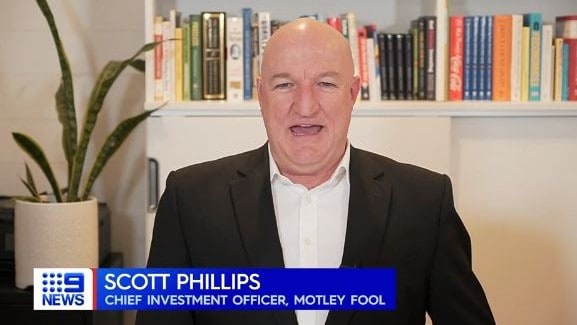
  • The week ahead: Interest rates, inflation and wages. Scott Phillips on Nine’s Late News

    Motley Fool Chief Investment Officer Scott Phillips appearing on Nine's Late News

    Motley Fool Australia Chief Investment Officer Scott Phillips joined Peter Overton on Nine’s Late News on Sunday night to discuss the big economic week ahead, including RBA minutes, a speech from Governor Lowe, the latest view of wage inflation, and hopes for a bumper Christmas retail season.

    The post The week ahead: Interest rates, inflation and wages. Scott Phillips on Nine’s Late News appeared first on The Motley Fool Australia.

    Wondering where you should invest $1,000 right now?

    When investing expert Scott Phillips has a stock tip, it can pay to listen. After all, the flagship Motley Fool Share Advisor newsletter he has run for more than eight years has provided thousands of paying members with stock picks that have doubled, tripled or even more.*

    Scott just revealed what he believes could be the five best ASX stocks for investors to buy right now. These stocks are trading at near dirt-cheap prices and Scott thinks they could be great buys right now.

    *Returns as of August 16th 2021

    More reading

    Motley Fool contributor Scott Phillips has no position in any of the stocks mentioned. The Motley Fool Australia’s parent company Motley Fool Holdings Inc. has no position in any of the stocks mentioned. The Motley Fool Australia has no position in any of the stocks mentioned. The Motley Fool has a disclosure policy. This article contains general investment advice only (under AFSL 400691). Authorised by Bruce Jackson.

    from The Motley Fool Australia https://ift.tt/30mVkNw

  • The Dreadnought (ASX:DRE) share price soared 18% this morning. Here’s why

    three young children weariing business suits, helmets and old fashioned aviator goggles wear aeroplane wings on their backs and jump with one arm outstretched into the air in an arid, sandy landscape.

    The Dreadnought Resources Ltd (ASX: DRE) share price was flying high at market open this morning. Dreadnought shares are up 6.82% at the time of writing, after earlier posting gains of more than 18%.

    We look at the latest update from the ASX resource explorer that looks to be piquing investor interest.

    Exploration update from Dreadnought

    The Dreadnought share price is soaring after the company reported positive assay results at its Tarraji-Yampi Project in Western Australia.

    The results come from the first 6 mineralised follow-up holes drilled in an area of the project known as Orion. The company is awaiting the assay results of an additional 13 drill holes, including its deepest.

    According to the release, results from the 6 assays returned so far confirm Orion as a high-grade resource discovery. Assays returned copper (Cu) grades up to 7.4% and silver (Ag) of up to 192 grams per tonne. Also gold (Au) of up to 34.2 grams per tonne and cobalt grades (Co) of up to 1.66%.

    Atop those strong results, the Dreadnought share price could be getting a further boost. The miner reports that the mineralisation commences from 1 metre under cover and extends to at least 240 metres along strike and 150 metres down dip.

    The company’s geophysical modelling indicates the mineralised body could extend to at least 500 metres depth.

    Dreadnought’s managing director, Dean Tuck, commented on the promising results:

    With multiple thick, high-grade intercepts now confirmed we are delighted to declare Orion a high-grade Cu-Ag-Au-Co discovery occurring just 1 metre below surface. With 13 mineralised holes remaining to be assayed, including our deepest, and our oxide and supergene intercepts, we expect more high-grade intercepts to come.

    This is an amazing outcome from what is our second ever drill program at Tarraji-Yampi, the first programs here since 1958/1972 and an indication of the potential for this highly prospective and underexplored ground to produce more discoveries.

    Dreadnought share price snapshot

    The Dreadnought share price has soared 135% in 2021. This well outpaces the 14% year-to-date gains posted by the All Ordinaries Index (ASX: XAO).

    Over the past month, Dreadnought shares have gained 27%.

    The post The Dreadnought (ASX:DRE) share price soared 18% this morning. Here’s why appeared first on The Motley Fool Australia.

    Should you invest $1,000 in Dreadnought Resources right now?

    Before you consider Dreadnought Resources, you’ll want to hear this.

    Motley Fool Investing expert Scott Phillips just revealed what he believes are the 5 best stocks for investors to buy right now… and Dreadnought Resources wasn’t one of them.

    The online investing service he’s run for nearly a decade, Motley Fool Share Advisor, has provided thousands of paying members with stock picks that have doubled, tripled or even more.* And right now, Scott thinks there are 5 stocks that are better buys.

    *Returns as of August 16th 2021

    More reading

    The Motley Fool Australia’s parent company Motley Fool Holdings Inc. has no position in any of the stocks mentioned. The Motley Fool Australia has no position in any of the stocks mentioned. The Motley Fool has a disclosure policy. This article contains general investment advice only (under AFSL 400691). Authorised by Bruce Jackson.

    from The Motley Fool Australia https://ift.tt/3wSRojN

  • What is inflation? Are Woolworths (ASX:WOW) shares the ‘ultimate inflation hedge’?

    inflation written on wooden cubes being balanced with a piggy bank and small shopping basket

    Inflation is a theme triangulating investor groups amid the latest statistics, which shows inflation rising at its fastest pace in over 10 years.

    Data from the Reserve Bank of Australia (RBA) shows the primary measure of inflation, the Consumer Price Index (CPI), rose by almost 1% this quarter, and 3% in the 12 months to September 2021. But more on that later.

    Thankfully Australia is faring better than its US counterparts, where inflation rose to 6.2% for the quarter – its highest rate of change in over 25 years.

    As such, market participants are now seeking avenues to park their hard earned capital without the looming threat of inflation eating into investment returns.

    Here we provide an in-depth understanding of inflation and what it means for investors, given the current narrative.

    Plus, find out why Rhett Kessler of Pengana Capital Group reckons shares in Woolworths Group Ltd (ASX: WOW) are an effective hedge against inflation.

    What is inflation?

    There are two sides to the meaning of inflation. The first is centred around the prices of goods and services in the economy.

    In this regard, inflation is defined as the progressive increase in the cost of general goods and services. For Australia, the ‘core’ measure of inflation is the CPI.

    The CPI is just a basket of consumer goods and services that tries to mimic purchases of everyday consumers.

    It includes things like food staples, fuel prices and clothing, but excludes a whole subset of expenses like energy, for instance.

    Consequently, the RBA actually has a whole suite of measures to report the level of inflation in the economy.

    For example, other indicators show ‘producer prices’ increasing 1.3% this quarter and export prices gaining 8.5%, whereas ‘food inflation’ is also up 1.3%.

    It is also one of the RBA’s roles to maintain inflation within a range of 2–3%, which it defines as a ‘healthy’ increase in prices over time.

    Loss of purchasing power

    The other facet of inflation is what we call the loss of ‘purchasing power’ of a currency.

    Let us explain using a broad example. Let’s assume a hamburger cost $5 in 2018. With inflation at 3% in the next year, the price of our burger is now $5.15.

    Imagine that trend continued for the next two years. Now it’s 2021, and we are paying $5.46 for our hamburger.

    What happened? Unfortunately, the hamburger isn’t any more delicious or hasn’t come with an extra side of chips.

    Obviously, the input costs to our burger went up, due to the cost of goods also rising – a consequence of inflation.

    But here’s what many people tend to gloss over. That $5 we had in 2019 – has effectively lost value, because it can’t purchase the same amount of product today as it did two years ago.

    In fact, it can only purchase a fraction of the same amount. We now need to pay an additional 9% to get the exact same burger. This is what is meant by a loss in purchasing power.

    In fact, The Economist’s Big Mac Index is one interesting way to visualise this. It tracks the cost of a McDonald’s Big Mac burger in each country year to year, to see how different currencies stack up with their purchasing power.

    So in short, inflation measures the increase in prices of an economy but also causes the value of a dollar to decrease over time.

    What causes inflation?

    There are a number of contributing factors that build up inflation, but the premise comes down to the unseen hands of demand and supply.

    Simple economics teaches us that when the aggregate demand of a good or service outpaces its supply, prices increase to reflect this dynamic.

    The most obvious example of this in recent times has been government induced lockdowns from COVID-19.

    Put simply, even though we were sent into global lockdowns, consumers didn’t slow their demand for purchases these past 2 years – it was the supply side that was shut off.

    Workers couldn’t even get to their place of work in order to produce the goods consumers wanted to buy.

    This has led to significant supply chain and manufacturing bottlenecks in just about every industry in 2021, and prices have shot up across the board in response.

    Doesn’t ‘printing money’ cause inflation too?

    You might hear the term ‘money printing’ being thrown around – but rest assured, the government isn’t out here churning out $50’s for you and me to line our pockets with.

    The term is actually called “quantitative easing (QE)“, and refers to actions taken by the RBA to prop the economy up in frothy times.

    Basically, QE is a cocktail of ultra-low interest rates and the RBA flooding the economy with currency reserves (cash, in other words) by purchasing assets, in order to prevent a full-scaled economic blowout. But it doesn’t mean printing more tangible banknotes.

    Zimbabwe did just that many years ago and remains the best case example of why we can’t just open up the printing press for currency. At its worst, inflation was over 79.6 billion – yes, billion – percent in 2008, and it once cost over 1 million Zimbabwe dollars just to buy a loaf of bread.

    Regardless, the RBA’s actions ensured there was plenty of free cash floating around during our recent spate of lockdowns.

    But as Newton said, for every action, there is an equal and opposite reaction.

    And the net reaction to all of these actions has been that aggregate demand has significantly outmatched the supply of goods and services in 2021.

    Not only that, QE programs have created the perfect environment for asset prices to shoot up – that includes shares and real estate, for example, two distinct out-performers this year.

    As such, many experts believe that QE programs around the world have set the stage for a high inflation regime, by allowing demand to outmatch supply, and by driving up asset valuations.

    What does inflation mean for investors?

    There are many sides to this debate, however, the general consensus is that inflation is a net negative for investors.

    Basically, inflation reduces the future value of investment returns, including capital gains and dividend income.

    If you expect to receive dividends out in the future, you can also expect inflation to lower the future value (purchasing power) of those dividends as well.

    And if inflation is at 3% p.a. for example, one can go ahead and subtract 3% from their overall investment return each year as a result.

    However, in the immediate term, inflation can also be good for company earnings – which does bode in well for share prices.

    Long-term, however, a level of inflation that exceeds the RBA’s targets of 2–3% is considered a negative for investors. We want to keep our returns and avoid seeing the value of any future returns diminish.

    So why then, are some experts looking to shares such as Woolworths Group Ltd (ASX: WOW) to protect against inflation?

    A ‘hedge’ against inflation

    Rhett Kessler of Pengana Capital was recently quoted on Livewire as stating that Woolworths is “the ultimate inflation hedge. When you’re moving boxes at a gross margin of about 35%, the more boxes you move, the more money you make if there is inflation”.

    It is for this reason that Kessler reckons Woolworths is an effective hedge to inflation because it won’t be as materially impacted by prices going up. In fact, it could even be a beneficiary, according to the expert.

    For reference, an inflation hedge is simply an asset or a purchase that protects against its eroding impact on investment returns.

    Not only that, but supermarkets have traditionally fared well in times of inflation, according to Bloomberg Intelligence. That’s because any raw increase in food prices can be passed directly onto customers, thereby boosting company earnings.

    And as Kessler submits, in this situation Woolworths’ would pass the cost on with the same gross margin rate of 35%, creating a compounding effect to the supermarket giant’s earnings profile.

    With that in mind, investors may want to start thinking of similar ways to hedge against the effects of inflation and seek similar expert opinions in doing so.

    At the time of writing, Woolworths shares have climbed 18% in the past 12 months, well ahead of the inflationary figure of 3%.

    Whether it is the ‘ultimate’ inflation hedge is yet to be seen, however, Kessler recommends Woolworths as a buy, and also likes CEO Brad Banducci’s management style to support his case.

    The post What is inflation? Are Woolworths (ASX:WOW) shares the ‘ultimate inflation hedge’? appeared first on The Motley Fool Australia.

    Should you invest $1,000 in Woolworths Group right now?

    Before you consider Woolworths Group, you’ll want to hear this.

    Motley Fool Investing expert Scott Phillips just revealed what he believes are the 5 best stocks for investors to buy right now… and Woolworths Group wasn’t one of them.

    The online investing service he’s run for nearly a decade, Motley Fool Share Advisor, has provided thousands of paying members with stock picks that have doubled, tripled or even more.* And right now, Scott thinks there are 5 stocks that are better buys.

    *Returns as of August 16th 2021

    More reading

    The author Zach Bristow has no positions in any of the stocks mentioned. The Motley Fool Australia’s parent company Motley Fool Holdings Inc. has no position in any of the stocks mentioned. The Motley Fool Australia has no position in any of the stocks mentioned. The Motley Fool has a disclosure policy. This article contains general investment advice only (under AFSL 400691). Authorised by Bruce Jackson.

    from The Motley Fool Australia https://ift.tt/31R0i5Q
  • Why the Wesfarmers (ASX:WES) share price has underperformed the ASX 200 in the last 3 months

    a woman leans on her shopping trolley as she rests her chin in her hand as if thinking as she stands in the middle of a grocery supermarket shopping aisle with a serious look on her face.

    The Wesfarmers Ltd (ASX: WES) share price has managed to shoot higher recently after hitting a 6-month low last month. The company’s shares touched the bottom at $53.83 on 11 October before zipping upwards.

    However, when looking at the past 3 months, the conglomerate’s shares have lost around 8.6%. By compassion, the S&P/ASX 200 Index (ASX: XJO) has fallen 1.7% over the same time frame.

    Below, we take a closer look at what’s been happening with the Wesfarmers share price.

    What’s troubling Wesfarmers shares?

    Investors have been mixed on the Wesfarmers share price as the company continues to navigate its way through COVID-19.

    Wesfarmers released the notes from its annual general meeting (AGM) last month, holding back on providing a new trading update.

    The company reported very similar commentary to how it performed over the FY21 period

    In particular, it stated that some of its businesses, such as Bunnings, K-mart and Target, were impacted by store closures. Although, it said strong online sales managed to offset the loss of potential revenue.

    On the other hand, Officeworks thrived as customer demand for technology and office furniture accelerated. This was attributed to more people working from home due to government-mandated restrictions.

    The Wesfarmers chemicals, energy and fertilisers division continued to grow on the back of ammonium nitrate and favourable LPG pricing.

    The company has progressed its proposal on acquiring Australian Pharmaceutical Industries Ltd (ASX: API). An all-cash proposal of $1.55 per share was made to buy up the remaining interest in the pharmaceutical chain operator.

    Wesfarmers recently upped its stake in Australian Pharmaceutical Industries to a 19.3% interest.

    Are Wesfarmers shares a buy?

    A number of brokers note weighed in on the company’s shares following the release of its AGM.

    Swiss global investment bank Credit Suisse raised its price target on Wesfarmers shares by 0.8% to $60.38. Following suit, Jarden also lifted its outlook by 1% to $60.60 apiece.

    While this is slightly above the current Wesfarmers share price of $60.09 at the time of writing, analysts at Citi had a different view.

    The firm retained its “sell” rating and put a bearish $50.00 price target on the conglomerate’s shares.

    Investors appear to be somewhere around the middle ground between Credit Suisse and Citi’s estimates.

    Wesfarmers share price review

    In 2021, the Wesfarmers share price has gained 19%, surging past pre-pandemic levels and making new record highs.

    Wesfarmers commands a market capitalisation of around $68 billion, making it the 8th largest company on the ASX.

    The post Why the Wesfarmers (ASX:WES) share price has underperformed the ASX 200 in the last 3 months appeared first on The Motley Fool Australia.

    Should you invest $1,000 in Wesfarmers right now?

    Before you consider Wesfarmers, you’ll want to hear this.

    Motley Fool Investing expert Scott Phillips just revealed what he believes are the 5 best stocks for investors to buy right now… and Wesfarmers wasn’t one of them.

    The online investing service he’s run for nearly a decade, Motley Fool Share Advisor, has provided thousands of paying members with stock picks that have doubled, tripled or even more.* And right now, Scott thinks there are 5 stocks that are better buys.

    *Returns as of August 16th 2021

    More reading

    Motley Fool contributor Aaron Teboneras has no position in any of the stocks mentioned. The Motley Fool Australia’s parent company Motley Fool Holdings Inc. has no position in any of the stocks mentioned. The Motley Fool Australia owns shares of and has recommended Wesfarmers Limited. The Motley Fool has a disclosure policy. This article contains general investment advice only (under AFSL 400691). Authorised by Bruce Jackson.

    from The Motley Fool Australia https://ift.tt/3c9T5jg

  • $6m shareholder says Sydney Airport (ASX:SYD) selling too cheap, calls for board spill

    an angry man in a suit stands with his hands outstretched in a questioning gesture of annoyance and displeasure while an airport check in attendant is on the telephone in the background.

    A major Sydney Airport (ASX: SYD) shareholder is reportedly contesting the airport’s takeover, saying he believes it’s worth $12 per share.

    Private investor Joe Cambria reportedly told the Australian Financial Review (AFR) he wants a board spill in response to the recently accepted $8.75 per share takeover offer. Cambria holds approximately $5.88 million dollars in stock based on the current share price.

    At the time of writing, Sydney Airport shares are selling for $8.40, 0.12% higher than their previous close.

    For context, the S&P/ASX 200 Index (ASX: XJO) has gained 0.38% today.

    Let’s take a closer look at the shareholder’s opposition to the takeover.  

    Cambria calls for to board spill

    Cambria, who owns 400,000 shares in Sydney Airport and indirectly holds another 300,000, has voiced his disappointment with the airport’s $23 billion takeover offer.

    He reportedly wrote to the airport’s board saying he was questioning its “competence, suitability for office, and independence”.

    He believes there should be an immediate spill and a new board instated. The AFR quoted Cambria as saying:

    I don’t believe that [chair David] Gonski is actually working in the interests of shareholders. This to me looks like it’s a friendly sale rather than an acquisition.

    The publication also claims Cambria is seeking legal advice in a bid to stop the takeover.

    The takeover bid was posed by the Sydney Aviation Alliance – led by IFM Investors and made up of various super funds.

    Cambria reportedly believes, post-COVID-19, the Sydney Airport share price could be $12 and described the takeover offer as a “theft”.

    Of course, the final say on the takeover will come from Sydney Airport’s shareholders. The decision is expected to be put to a shareholder vote in late January.

    At least 75% of Sydney Airport’s shareholders must approve of the takeover before it will go ahead.

    Sydney Airport share price

    Right now, the Sydney Airport share price is 0.84% higher than it was this time last month.

    It has also gained 31% since the start of 2021. That includes the 33% boost it received when the consortium first put forward its takeover bid.  

    The post $6m shareholder says Sydney Airport (ASX:SYD) selling too cheap, calls for board spill appeared first on The Motley Fool Australia.

    Should you invest $1,000 in Sydney Airport right now?

    Before you consider Sydney Airport, you’ll want to hear this.

    Motley Fool Investing expert Scott Phillips just revealed what he believes are the 5 best stocks for investors to buy right now… and Sydney Airport wasn’t one of them.

    The online investing service he’s run for nearly a decade, Motley Fool Share Advisor, has provided thousands of paying members with stock picks that have doubled, tripled or even more.* And right now, Scott thinks there are 5 stocks that are better buys.

    *Returns as of August 16th 2021

    More reading

    Motley Fool contributor Brooke Cooper has no position in any of the stocks mentioned. The Motley Fool Australia’s parent company Motley Fool Holdings Inc. has no position in any of the stocks mentioned. The Motley Fool Australia has no position in any of the stocks mentioned. The Motley Fool has a disclosure policy. This article contains general investment advice only (under AFSL 400691). Authorised by Bruce Jackson.

    from The Motley Fool Australia https://ift.tt/3neq6RC

  • ASX 200 (ASX:XJO) midday update: Incitec Pivot and Mesoblast jump, NAB drops

    Man looks shocked as he works on laptop on top a skyscraper with stockmarket figures in graphic behind him.

    At lunch on Monday, the S&P/ASX 200 Index (ASX: XJO) is on course to start the week with a solid gain. The benchmark index is currently up 0.4% to 7,472.9 points.

    Here’s what is happening on the ASX 200 today:

    Incitec Pivot results impress

    The Incitec Pivot Ltd (ASX: IPL) share price jumped as much as 17% this morning following the release of its full year results. As management promised, Incitec Pivot delivered a strong second half performance. This led to the agricultural chemicals company reporting a 10% lift in full year revenue to $4,348.5 million and 91% jump in net profit after tax (NPAT) excluding individually material items to $209 million. This was driven by a strong performance from its Fertilisers APAC business, which benefited from a commodity price upswing and strong ammonium phosphates production.

    Mesoblast shares jump

    The Mesoblast limited (ASX: MSB) share price is charging higher today after the allogeneic cellular medicines developer released positive data from a phase three trial of rexlemestrocel-L in 565 patients with New York Heart Association (NYHA) class II and class III chronic heart failure (CHF) with reduced ejection fraction (HFrEF). Among other things, the study notes that a single dose of rexlemestrocel-L on top of standard of care reduced the incidence of heart attacks or strokes by 65% across all 537 NYHA class II or class III treated patients compared with standard of care alone.

    NAB shares fall

    The National Australia Bank Ltd (ASX: ANZ) share price is trading lower on Monday. However, this has nothing to do with its performance. Today’s decline is attributable to the banking giant’s shares trading ex-dividend for its final dividend for FY 2021. Last week NAB declared a fully franked final dividend of 67 cents per share with its full year results. Eligible NAB shareholders can look forward to receiving this latest dividend on 15 December.

    Best and worst ASX 200 performers

    The best performer on the ASX 200 on Monday has been the Mesoblast share price with a 10% gain. This follows its trial update this morning. The worst performer on the ASX 200 has been the Ampol Ltd (ASX: ALD) share price with a decline of almost 3%. This is despite there being no news out of the fuel retailer.

    The post ASX 200 (ASX:XJO) midday update: Incitec Pivot and Mesoblast jump, NAB drops appeared first on The Motley Fool Australia.

    Wondering where you should invest $1,000 right now?

    When investing expert Scott Phillips has a stock tip, it can pay to listen. After all, the flagship Motley Fool Share Advisor newsletter he has run for more than eight years has provided thousands of paying members with stock picks that have doubled, tripled or even more.*

    Scott just revealed what he believes could be the five best ASX stocks for investors to buy right now. These stocks are trading at near dirt-cheap prices and Scott thinks they could be great buys right now.

    *Returns as of August 16th 2021

    More reading

    Motley Fool contributor James Mickleboro has no position in any of the stocks mentioned. The Motley Fool Australia’s parent company Motley Fool Holdings Inc. has no position in any of the stocks mentioned. The Motley Fool Australia has no position in any of the stocks mentioned. The Motley Fool has a disclosure policy. This article contains general investment advice only (under AFSL 400691). Authorised by Bruce Jackson.

    from The Motley Fool Australia https://ift.tt/3Dky4hY

  • How does the Pilbara Minerals (ASX:PLS) share price compare to Mineral Resources?

    Two couples having fun racing electric dodgem cars.

    Pilbara Minerals Ltd (ASX: PLS) and Mineral Resources Limited (ASX: MIN) are two shares that investors have been keeping a close eye on. Pilbara Minerals is the smaller of the two companies, but it has some big plans for future growth.

    It’s no secret that the potential for abundance within the electric vehicle market and other battery applications has the lithium sector booming. But, one fund manager believes there could be more value in Mineral Resources than its high-flying pure-play peer.

    Let’s take a look at how Pilbara Minerals compares, according to this expert investor.

    Comparing the pair

    To say that the ASX lithium space is rife with speculation would be somewhat of an understatement. Uncapped exuberance has spilled over as the beginning of an electric era dawns. Projections of a sixfold increase in lithium consumption under the International Energy Agency’s net-zero by 2050 emissions scenario offers a peek into what could be ahead.

    However, Airlie Funds portfolio manager Emma Fisher thinks there is still relative value to be found within the red-hot industry. In a self-published article on Livewire last week, Fisher gave her take on “The cheapest lithium stock in the market”.

    Although, perhaps to the surprise of some investors, it was not a ‘pure-play’ candidate among the ASX ranks. Instead, the fundie with over 10 years experience pointed out the recently battle-hardened mining services company Minerals Resources.

    Comparing the two, Fisher noted that both mining companies currently have a similar spodumene capacity. Across its Pilgan and Ngungaju plants, Pilbara Minerals’ assets add up to 536 kilotonne (kt) per annum of capacity. Meanwhile, Mineral Resources’ share of its Mt Marion and Wodgina operations equate to 535kt per year.

    Furthermore, both lithium contenders have plans for future expansion. The Pilbara Minerals share price has surged on the miner’s ambition to produce 1 million tonne of spodumene annually in the future. Similarly, the company intends to reach an estimated 13kt of lithium hydroxide production capacity within 3 years.

    Simultaneously, Mineral Resources will be charting its own course toward an estimated 40kt to 45kt of lithium hydroxide production over the same period.

    Pulling it all together, within three years Mineral Resources and Pilbara Minerals will have similar spodumene production and Mineral Resources will be producing three times more lithium hydroxide.

    Emma Fisher, Airlie Funds

    More value outside the Pilbara Minerals share price?

    After mapping out forecasts, the Airlie Funds portfolio manager deduces that Mineral Resources would likely be making more money from lithium than Pilbara Minerals 3 years from now.

    Specifically, Fisher estimates it would be around $1 billion in earnings before interest, tax, depreciation, and amortisation (EBITDA) for Mineral Resources. Whereas the pure-play lithium company has a FY24 EBITDA forecast of $569 million.

    As a result, Mineral Resources would be valued at 7 times FY24 EBITDA. Meanwhile, the Pilbara Minerals share price puts a near 13-times valuation on the company’s FY24 EBITDA. This stark difference in valuations is only exacerbated once we account for Mineral Resources’ other businesses.

    Importantly, Fisher notes that Minerals Resources’ mining services and iron ore businesses are being ascribed little to no value. This is despite the iron ore business pulling in $1.5 billion of EBITDA last year.

    Finally, Emma Fisher is not alone in seeing value in Mineral Resources. Analysts from Macquarie Group hold Pilbara Minerals and Mineral Resources shares as their ASX lithium picks.

    The Pilbara Minerals share price is up 437% in the past year. In contrast, the Mineral Resources share price is up only 50%.

    The post How does the Pilbara Minerals (ASX:PLS) share price compare to Mineral Resources? appeared first on The Motley Fool Australia.

    Should you invest $1,000 in Pilbara Minerals right now?

    Before you consider Pilbara Minerals, you’ll want to hear this.

    Motley Fool Investing expert Scott Phillips just revealed what he believes are the 5 best stocks for investors to buy right now… and Pilbara Minerals wasn’t one of them.

    The online investing service he’s run for nearly a decade, Motley Fool Share Advisor, has provided thousands of paying members with stock picks that have doubled, tripled or even more.* And right now, Scott thinks there are 5 stocks that are better buys.

    *Returns as of August 16th 2021

    More reading

    Motley Fool contributor Mitchell Lawler owns shares of Macquarie Group Limited. The Motley Fool Australia’s parent company Motley Fool Holdings Inc. has no position in any of the stocks mentioned. The Motley Fool Australia owns shares of and has recommended Macquarie Group Limited. The Motley Fool has a disclosure policy. This article contains general investment advice only (under AFSL 400691). Authorised by Bruce Jackson.

    from The Motley Fool Australia https://ift.tt/3qDB9px

  • Why the BrainChip (ASX:BRN) share price is sinking 9% today

    Man in shirt and tie falls face first down stairs

    The BrainChip Holdings Ltd (ASX: BRN) share price has started the week deep in the red.

    In morning trade, the artificial intelligence technology company’s shares are down 9% to 55 cents.

    Why is the BrainChip share price sinking?

    The BrainChip share price has come under pressure on Monday after announcing the appointment of its new Chief Executive Officer (CEO).

    According to the release, the company has appointed Sean Hehir as its new CEO, with effect from 29 November 2021.

    He will be replacing former CEO Louis DiNardo who left the company suddenly in March after leading the company for four and a half years.

    The release advises that Mr Hehir is a proven technology executive with significant experience in driving revenue growth for technology organisations. This includes sales-based executive roles with Compaq, Fusion-io, and HP.

    He will be tasked with guiding the company towards full commercialisation of the Akida neuromorphic computing platforms out of the Aliso Viejo office in California.

    Why the poor reaction?

    Judging by the BrainChip share price performance today, it appears that investors were hoping for a more experienced CEO or one with a background in artificial intelligence.

    Nevertheless, BrainChip’s Founder and Interim CEO Peter van der Made was pleased with the appointment.

    He said: “As outgoing (interim) CEO, I welcome Sean to the company and am happy to hand over the reins of a world-class company that is in an excellent position to commercialize our unique product that is years ahead of the competition. We have every confidence that Sean is the right executive to guide BrainChip into the future, to make sound decisions about the business opportunities before us and ignite industry enthusiasm for the new AI capabilities that are made possible by Akida.”

    “After more than a decade of R&D and design, he will lead the shift into commercialization and bringing new technologies to life, which has long been our vision,” he added.

    The BrainChip share price is up almost 30% in 2021.

    The post Why the BrainChip (ASX:BRN) share price is sinking 9% today appeared first on The Motley Fool Australia.

    Should you invest $1,000 in BrainChip right now?

    Before you consider BrainChip, you’ll want to hear this.

    Motley Fool Investing expert Scott Phillips just revealed what he believes are the 5 best stocks for investors to buy right now… and BrainChip wasn’t one of them.

    The online investing service he’s run for nearly a decade, Motley Fool Share Advisor, has provided thousands of paying members with stock picks that have doubled, tripled or even more.* And right now, Scott thinks there are 5 stocks that are better buys.

    *Returns as of August 16th 2021

    More reading

    Motley Fool contributor James Mickleboro has no position in any of the stocks mentioned. The Motley Fool Australia’s parent company Motley Fool Holdings Inc. has no position in any of the stocks mentioned. The Motley Fool Australia has no position in any of the stocks mentioned. The Motley Fool has a disclosure policy. This article contains general investment advice only (under AFSL 400691). Authorised by Bruce Jackson.

    from The Motley Fool Australia https://ift.tt/3FhdaRq

  • Telstra (ASX:TLS) share price edges lower amid new AI joint venture

    a woman holds her hand out under a graphic hologram image of a human brain with brightly lit segments and section points.

    The Telstra Corporation Ltd (ASX: TLS) share price is edging lower in morning trade, down 0.4% to $3.96 per share.

    The S&P/ASX 200 Index (ASX: XJO) is heading the other way, up 0.3% after briefly dipping into the red on opening.

    That’s this morning’s price action.

    Below we look at the telco giant’s latest foray into the world of artificial intelligence (AI).

    What AI plans are in the pipeline?

    According to Telstra’s head of product and technology, Kim Krogh Andersen, every week sees the company connect another 5,000 internet of things (IoT) devices. These range from ‘smart’ household appliances to broader home monitoring and environmental control systems.

    As the Australian Financial Review reports, this vast amount of new data is driving a surge in demand for a limited supply of tech savvy employees.

    Which brings us to Telstra’s new joint venture (JV) with data and analytics company Quantium, 75% owned Woolworths Group Ltd (ASX: WOW).

    Telstra’s CEO, Andy Penn said the JV will speed up the telco’s adopted of AI, and aid in its recruitment efforts of tech talent “eager to work on some of the biggest data sets in the country”.

    According to Penn (quoted by the AFR), “There is an absolute war for talent, and this talent in particular. But the single biggest defining difference is the data science problems that those people get to come and work on and to solve.”

    Penn continued:

    We will effectively identify the problems and the projects that we can work jointly on, and then we’ll apply our respective resources to go solve them. This is about accelerating what we’re already doing, but accelerating it by partnering with these guys, who are absolutely world-leading in the work that they’re doing.

    Commenting on the JV with Telstra, Quantium’s CEO, Adam Driussi said, “What we need to be careful of is how we deploy our resources. So, we’re not looking to do one-off small projects with a whole series of clients. We’d rather have big, deep partnerships with leading brands and that’s the way that we can then really work on the biggest problems for those clients.”

    Telstra share price snapshot

    The Telstra share price is up 31% in 2021, compared to the 12% year-to-date gain posted by the ASX 200.

    Over the past month, Telstra shares have gained 3%.

    The post Telstra (ASX:TLS) share price edges lower amid new AI joint venture appeared first on The Motley Fool Australia.

    Should you invest $1,000 in Telstra right now?

    Before you consider Telstra, you’ll want to hear this.

    Motley Fool Investing expert Scott Phillips just revealed what he believes are the 5 best stocks for investors to buy right now… and Telstra wasn’t one of them.

    The online investing service he’s run for nearly a decade, Motley Fool Share Advisor, has provided thousands of paying members with stock picks that have doubled, tripled or even more.* And right now, Scott thinks there are 5 stocks that are better buys.

    *Returns as of August 16th 2021

    More reading

    The Motley Fool Australia’s parent company Motley Fool Holdings Inc. has no position in any of the stocks mentioned. The Motley Fool Australia owns shares of and has recommended Telstra Corporation Limited. The Motley Fool has a disclosure policy. This article contains general investment advice only (under AFSL 400691). Authorised by Bruce Jackson.

    from The Motley Fool Australia https://ift.tt/3ccNKrw

  • Qantas (ASX:QAN) share price gains as Rex ramps up competition

    A happy woman flies with arms outstretched on her boyfriend's back on the beach at dusk.

    The Qantas Airways Limited (ASX: QAN) share price is in the green today despite heightened competition from another Australian airline.

    Regional Express Holdings Ltd (ASX: REX) announced this morning it will add Brisbane to its domestic network.

    The domestic airline’s chair stated he expects the new offering will force Qantas to drop the prices of its flights between the cities.

    At the time of writing, the Qantas share price is $5.69, 0.71% higher than its previous closing price.

    For context, the S&P/ASX 200 Index (ASX: XJO) is up 0.27% right now. Meanwhile, the All Ordinaries Index (ASX: XAO) has gained 0.35%.

    Additionally, the Rex share price has gained 5.07% to trade at $1.56 this morning.

    Let’s take a closer look at what the new competition might mean for Qantas.

    Qantas’ increased competition

    The Qantas share price is up despite new competition taking off in Australia’s ‘golden triangle’.

    Rex will be operating double-daily flights between Brisbane and Melbourne from 17 December. Ticket prices will start at sale rates of $79 each.

    The airline’s launch into the lucrative market between Melbourne, Sydney, and Brisbane has been its long-stated goal.

    Rex deputy chair the Honourable John Sharp AM noted the impact today’s news could have on Qantas:

    Every time we’ve entered a new market, airfares have fallen dramatically as Qantas and Virgin Australia scramble to match our prices and I have no doubt this will be the case again.

    Both Brisbane Airport Corporation CEO Gert-Jan de Graaff and Melbourne Airport chief of aviation Lorie Argus agree Rex’s new offering will increase competition between airlines operating the popular Australian route.

    Sharp also commented that Rex offers better value for money than other low-priced airlines, such as Qantas’ Jetstar:

    Rex is a full service airline so these fares represent incredible value. Unlike our competitors, Rex passengers don’t get slugged with hidden or extra costs as all fares on our domestic jet network include free 23kg checked baggage and refreshments on board.

    While it’s unlikely the news is weighing on the Qantas share price today, market watchers may want to keep an eye out for more planned growth from Qantas’ domestic competitor.

    Rex has ambitions to continue adding new routes to its offerings, particularly in Queensland.

    Qantas share price snapshot

    Right now, the Qantas share price is flat compared to this time last month.

    However, it is 15% higher than it was at the start of 2021.

    The post Qantas (ASX:QAN) share price gains as Rex ramps up competition appeared first on The Motley Fool Australia.

    Should you invest $1,000 in Qantas Airways right now?

    Before you consider Qantas Airways, you’ll want to hear this.

    Motley Fool Investing expert Scott Phillips just revealed what he believes are the 5 best stocks for investors to buy right now… and Qantas Airways wasn’t one of them.

    The online investing service he’s run for nearly a decade, Motley Fool Share Advisor, has provided thousands of paying members with stock picks that have doubled, tripled or even more.* And right now, Scott thinks there are 5 stocks that are better buys.

    *Returns as of August 16th 2021

    More reading

    Motley Fool contributor Brooke Cooper has no position in any of the stocks mentioned. The Motley Fool Australia’s parent company Motley Fool Holdings Inc. has no position in any of the stocks mentioned. The Motley Fool Australia has no position in any of the stocks mentioned. The Motley Fool has a disclosure policy. This article contains general investment advice only (under AFSL 400691). Authorised by Bruce Jackson.

    from The Motley Fool Australia https://ift.tt/3wNVeec