Tag: Motley Fool

  • Macquarie shares are going for cheap. Buy the dip?

    A blockchain investor sits at his desk with a laptop computer open and a phone checking information from a booklet in a home office setting.A blockchain investor sits at his desk with a laptop computer open and a phone checking information from a booklet in a home office setting.

    Investment bank Macquarie Group Ltd (ASX: MQG) has been an investors’ darling over the years, but the stock price has slumped in recent weeks.

    Macquarie shares are down about 8.5% since 7 March.

    One could wonder why this was happening, considering the finance giant had not announced any adverse news.

    Shaw and Partners portfolio manager James Gerrish explored the reasons for this dip and whether Macquarie is worth buying and holding.

    Diversification within one stock

    Firstly, Gerrish felt like the latest earnings result was positive.

    “It was a good result [but] I suspect the market was slightly concerned by the proportion of their earnings that came from the commodities division as a result of volatility caused in part by Russia,” he told a Market Matters Q&A.

    “If that’s an anomaly, they won’t have that tailwind again.”

    The great feature of Macquarie’s business model is that it has fingers in many pies. That means even if the benefits from the Ukraine crisis ebb away, other parts of the company will pick up the slack.

    “There are offsets, insofar as less volatility from a broader markets perspective will generally mean more M&A and deal flow, which was soft in the result they delivered,” said Gerrish.

    “Ultimately, it’s the reason we like the stock. Different divisions perform differently at different times and that creates a nice level of diversification in their earnings.”

    Long term wealth creator

    For Gerrish’s team, Macquarie shares are worth grabbing now.

    “We own Macquarie and intend to hold it.”

    For perspective, the Macquarie share price is down 1.8% over the past year while the broader S&P/ASX 200 Index (ASX: XJO) has gained 2.3%.

    Macquarie shares have gained 53.75% over the past five years, and currently pay out a dividend yield of 4.3%.

    The finance giant was recently revealed as the ninth most held stock in the portfolios of millionaires.

    The post Macquarie shares are going for cheap. Buy the dip? appeared first on The Motley Fool Australia.

    Should you invest $1,000 in Macquarie Group Limited right now?

    Before you consider Macquarie Group Limited, you’ll want to hear this.

    Motley Fool Investing expert Scott Phillips just revealed what he believes are the 5 best stocks for investors to buy right now… and Macquarie Group Limited wasn’t one of them.

    The online investing service he’s run for over a decade, Motley Fool Share Advisor, has provided thousands of paying members with stock picks that have doubled, tripled or even more.* And right now, Scott thinks there are 5 stocks that are better buys.

    See The 5 Stocks
    *Returns as of April 3 2023

    (function() {
    function setButtonColorDefaults(param, property, defaultValue) {
    if( !param || !param.includes(‘#’)) {
    var button = document.getElementsByClassName(“pitch-snippet”)[0].getElementsByClassName(“pitch-button”)[0];
    button.style[property] = defaultValue;
    }
    }

    setButtonColorDefaults(“#0095C8”, ‘background’, ‘#5FA85D’);
    setButtonColorDefaults(“#0095C8”, ‘border-color’, ‘#43A24A’);
    setButtonColorDefaults(“#fff”, ‘color’, ‘#fff’);
    })()

    More reading

    Motley Fool contributor Tony Yoo has positions in Macquarie Group. The Motley Fool Australia’s parent company Motley Fool Holdings Inc. has no position in any of the stocks mentioned. The Motley Fool Australia has positions in and has recommended Macquarie Group. The Motley Fool has a disclosure policy. This article contains general investment advice only (under AFSL 400691). Authorised by Scott Phillips.

    from The Motley Fool Australia https://ift.tt/px3OBud

  • Is it time to be a bull or a bear on NAB shares?

    Tug of WarTug of War

    The market responded unforgivingly to the latest figures from National Australia Bank Ltd (ASX: NAB). Shares in the banking major are now down more than 9% since entering 2023, despite a continued uptick in earnings.

    In light of the reaction, we asked two of the Foolish team to explain the bull and bear stance for this ASX bank share.

    Here’s what they had to say.

    Why I won’t be buying NAB shares

    By Mitchell Lawler: The NAB share price has been the worst-performing of the big four banks over the past year, with its share price falling 15%. Strangely, this underwhelming performance has occurred while net interest margins (NIMs) have expanded amid rising interest rates

    After a boom period for profits, investors will be looking to what comes next. I think the next year or so won’t be as fruitful as the last. I’m rarely pessimistic, but the outlook appears mediocre at best for ASX bank shares whichever way you slice it. 

    Credit quality will be tested across all forms of lending if the Reserve Bank of Australia determines rates need to go higher for longer. Meanwhile, if rates begin falling, we’re likely to see a reduction in NIM. Both ways, the outcome is most probably lower earnings for the big banks. 

    In my opinion, Macquarie Group Ltd (ASX: MQG) is a much higher quality alternative to NAB shares. Both trade on earnings multiples of around 12 to 13 times, however, Macquarie is less reliant on banking and financial services.

    NAB and Macquarie Group Return on Equity over time. Data by Trading View.

    Furthermore, Macquarie has a history of delivering a greater return on equity (ROE) than NAB. The investment bank’s ROE has been trending higher since 2015. In contrast, NAB has been unable to deliver a return on equity above 13% and trending sideways.

    Lastly, as competition remains stiff between the big four, keeping expenses in check will become more critical.

    Out of the four, NAB let its expenses blow out the most compared to the prior corresponding period (pcp), according to the latest round of updates. Total expenses grew by 11.5% pcp, with the next worst offender being the Commonwealth Bank of Australia (ASX: CBA), up 5% pcp.

    The considerable jump in costs is another reason why I am not on board with buying NAB shares at this point in time.

    Motley Fool contributor Mitchell Lawler does not own shares in National Australia Bank Ltd

    Heated competition beginning to settle

    By Tristan Harrison: The NAB share price has declined close to 20% since February 2023, despite reporting an impressive 17% rise in cash earnings in the first half of FY23.

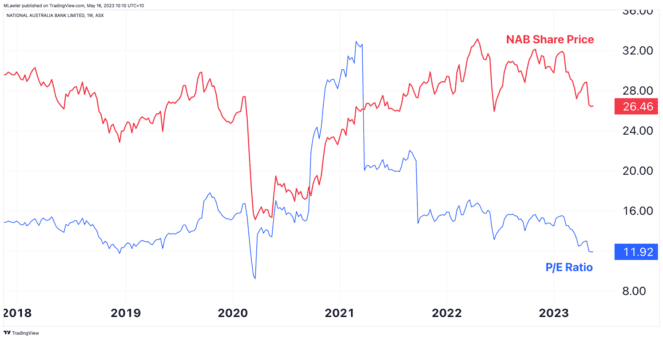
    This has led to the NAB price-to-earnings (P/E) ratio being the lowest it has been since the COVID-19 crash.

    We can see on the chart below that the (blue) P/E ratio line generally tracks the (red) share price line. But, while the NAB share price briefly dropped lower last year, it’s at the lowest earnings multiple because of its higher profits.

    NAB P/E ratio and share price. Data by Trading View.

    So, the key question is: will earnings hold up?

    There has reportedly been intense competition in the banking space, which has been lowering the net interest margin from its potential peak after the run of interest rate rises.

    However, we’ve recently heard the home loan battle could soon be softening, with NAB (and Commonwealth Bank of Australia) ending cash-back offers at the end of June.

    This could be a very promising step for NAB’s NIM and overall profitability if it doesn’t need to compete as hard to retain and win customers.

    In the meantime, NAB’s business bank continues to perform very well. During HY23, the bank’s business and private banking division saw a 20% increase in cash earnings to $1.7 billion. It was NAB’s most profitable division and saw a big improvement in profit.

    NAB’s profit doesn’t need to grow much for NAB shares to do well from here, partly because the lower valuation has boosted the grossed-up dividend yield to 9% for FY23, according to Commsec.

    I also think the bank can continue to perform well through this uncertain period under the stewardship of skilled banker and CEO Ross McEwan.

    Motley Fool contributor Tristan Harrison does not own shares in National Australia Bank Ltd

    The post Is it time to be a bull or a bear on NAB shares? appeared first on The Motley Fool Australia.

    Should you invest $1,000 in National Australia Bank Limited right now?

    Before you consider National Australia Bank Limited, you’ll want to hear this.

    Motley Fool Investing expert Scott Phillips just revealed what he believes are the 5 best stocks for investors to buy right now… and National Australia Bank Limited wasn’t one of them.

    The online investing service he’s run for over a decade, Motley Fool Share Advisor, has provided thousands of paying members with stock picks that have doubled, tripled or even more.* And right now, Scott thinks there are 5 stocks that are better buys.

    See The 5 Stocks
    *Returns as of April 3 2023

    (function() {
    function setButtonColorDefaults(param, property, defaultValue) {
    if( !param || !param.includes(‘#’)) {
    var button = document.getElementsByClassName(“pitch-snippet”)[0].getElementsByClassName(“pitch-button”)[0];
    button.style[property] = defaultValue;
    }
    }

    setButtonColorDefaults(“#0095C8”, ‘background’, ‘#5FA85D’);
    setButtonColorDefaults(“#0095C8”, ‘border-color’, ‘#43A24A’);
    setButtonColorDefaults(“#fff”, ‘color’, ‘#fff’);
    })()

    More reading

    The Motley Fool Australia’s parent company Motley Fool Holdings Inc. has no position in any of the stocks mentioned. The Motley Fool Australia has positions in and has recommended Macquarie Group. The Motley Fool has a disclosure policy. This article contains general investment advice only (under AFSL 400691). Authorised by Scott Phillips.

    from The Motley Fool Australia https://ift.tt/QLKJGT5

  • Citi says these ASX 200 dividend shares are buys for passive income

    Happy man holding Australian dollar notes, representing dividends.

    Happy man holding Australian dollar notes, representing dividends.

    Are you looking to bolster your passive income with some new dividend shares this month?

    If you are, you may want to look at the two listed below that have been forecast to provide attractive yields by Citi. Here’s what you need to know about these buy-rated ASX 200 dividend shares:

    ANZ Group Holdings Ltd (ASX: ANZ)

    The first ASX 200 dividend share that Citi has named as a buy is banking giant ANZ Bank.

    The broker was pleased with ANZ’s recent first-half results, which were in-line with expectations. And while it acknowledges that the bank is facing the same competitive pressures on both sides of its balance sheet as the other big banks, it continues to believe ANZ is the top pick in the sector.

    This is because it sees “ANZ’s unique capabilities as set to deliver relative outperformance in the current market conditions.”

    As for dividends, Citi is forecasting fully franked dividends of $1.64 per share in FY 2023 and then $1.66 per share in FY 2024. Based on the current ANZ share price of $23.54, this will mean yields of 7% and 7%, respectively.

    Citi has a buy rating and $26.50 price target on the bank’s shares.

    Stockland Corporation Ltd (ASX: SGP)

    Another ASX 200 dividend share that Citi rates as a buy is Stockland. It is a residential and land lease developer and retail, logistics and office real estate property manager.

    Citi believes it could be a top option for income investors right now. Particularly given how it sees a recent “sharp pickup in residential enquiries in 3Q23 (up c. 50% from 1H23 run-rate and inline with pre-Covid levels) as an early sign of a recovery in demand.”

    All in all, the broker believes this positions Stockland to pay dividends per share of 27 cents in FY 2023 and FY 2024. Based on the current Stockland share price of $4.48, this will mean yields of 6% in both years.

    Citi has a buy rating and $4.70 price target on Stockland’s shares.

    The post Citi says these ASX 200 dividend shares are buys for passive income appeared first on The Motley Fool Australia.

    Looking to buy dividend shares to help fight inflation?

    If you’re looking to buy dividend shares to help fight inflation then you’ll need to get your hands on this… Our FREE report revealing 3 stocks not only boasting inflation-fighting dividends…

    They also have strong potential for massive long-term returns…

    See the 3 stocks
    *Returns as of April 3 2023

    (function() {
    function setButtonColorDefaults(param, property, defaultValue) {
    if( !param || !param.includes(‘#’)) {
    var button = document.getElementsByClassName(“pitch-snippet”)[0].getElementsByClassName(“pitch-button”)[0];
    button.style[property] = defaultValue;
    }
    }

    setButtonColorDefaults(“#0095C8”, ‘background’, ‘#5FA85D’);
    setButtonColorDefaults(“#0095C8”, ‘border-color’, ‘#43A24A’);
    setButtonColorDefaults(“#fff”, ‘color’, ‘#fff’);
    })()

    More reading

    Motley Fool contributor James Mickleboro has no position in any of the stocks mentioned. The Motley Fool Australia’s parent company Motley Fool Holdings Inc. has no position in any of the stocks mentioned. The Motley Fool Australia has no position in any of the stocks mentioned. The Motley Fool has a disclosure policy. This article contains general investment advice only (under AFSL 400691). Authorised by Scott Phillips.

    from The Motley Fool Australia https://ift.tt/oOJTGuE

  • Warren Buffett is dumping bank stocks. Should you?

    A man wearing a blue jumper and a hat looks at his laptop with a distressed and fearful look on his face.

    A man wearing a blue jumper and a hat looks at his laptop with a distressed and fearful look on his face.

    Warren Buffett’s Berkshire Hathaway has recently revealed some major share sales. Interestingly, among the sell-offs were notable sales of bank stocks. So could this suggest that Aussie investors should consider the situation for ASX bank shares?

    First, let’s take a look at what moves Berkshire Hathaway has made.

    Berkshire Hathaway sells out of two bank stocks

    The giant US business has grown enormously over the last five decades, thanks to the stewardship of Warren Buffett and his partner Charlie Munger.

    While Buffett makes a lot of the stock portfolio changes, there are also two other investors who manage their own portfolios within the business. So not every investment decision will be Buffett’s, but it’s likely these large bank stock decisions came from him.

    Berkshire Hathaway sold out of its long-term holdings of Bank of New York Mellon and US Bancorp. This comes after the banking problems with names like Silicon Valley Bank and First Republic Bank.

    However, Berkshire Hathaway didn’t completely sell out of the financial sector. In fact, Buffett’s business added to its position in Bank of America shares to the tune of around 22.75 million shares, while also buying 9.9 million Capital One Financial shares.

    I think the Bank of America investment shows Buffett hasn’t lost complete confidence in the US bank stock sector, but he’s being more selective about which banks to be invested in. Credit card business Capital One could be more well-equipped to deal with the current economic climate. For one, it doesn’t have a huge deposit base which could be a problem if there were massive withdrawals, and it can benefit from higher interest rates.

    What to make of this for ASX bank shares?

    The situation is tricky in the US for smaller banks. If most depositors of a financial institution tried to withdraw their money in quick succession, it can cause major problems for that bank.

    The biggest US banks actually saw deposit inflows during that uncertainty a couple of months ago.

    If there were to be concerns over an Australian bank, I think we would see a similar outcome. Depositors might seek the safety of the biggest institutions, with money flowing out of the smaller banks.

    However, I think that Australian banks are in a strong financial position when it comes to their balance sheets. The Australian Prudential Regulation Authority (APRA) has set high minimum requirements for banks with their common equity tier 1 (CET1) ratios.

    Australian banks seem to be in a stronger financial position than many of their peers in the US, so I’m not worried about that side of things.

    However, it could be a good time to consider an investor’s weighting to ASX bank shares. All the banks face similar risks – Commonwealth Bank of Australia (ASX: CBA), Australia and New Zealand Banking Group Ltd (ASX: ANZ), and Bank of Queensland Ltd (ASX: BOQ) could all be hurt if there’s a material rise in loan arrears and bad debts.

    Of course, interest rates are now a lot higher than they were a year ago, which could spell trouble for heavily indebted businesses and households.

    I think there are some higher-quality bank stock names, such as National Australia Bank Ltd (ASX: NAB) and Macquarie Group Ltd (ASX: MQG), which have conservative operating settings, strong balance sheets, and very effective leadership. They’d be my top two choices in the sector.

    But if I had three or more banks in my portfolio, I’d certainly want to consider if owning multiple names in the same industry is providing me with enough diversification.

    The post Warren Buffett is dumping bank stocks. Should you? appeared first on The Motley Fool Australia.

    FREE Guide for New Investors

    Despite what some people may say – we believe investing in shares doesn’t have to be overwhelming or complicated…

    For over a decade, we’ve been helping everyday Aussies get started on their journey.

    And to help even more people cut through some of the confusion “experts’” seem to want to perpetuate – we’ve created a brand-new “how to” guide.

    Yes, Claim my FREE copy!
    *Returns as of April 3 2023

    (function() {
    function setButtonColorDefaults(param, property, defaultValue) {
    if( !param || !param.includes(‘#’)) {
    var button = document.getElementsByClassName(“pitch-snippet”)[0].getElementsByClassName(“pitch-button”)[0];
    button.style[property] = defaultValue;
    }
    }

    setButtonColorDefaults(“#0095C8”, ‘background’, ‘#5FA85D’);
    setButtonColorDefaults(“#0095C8”, ‘border-color’, ‘#43A24A’);
    setButtonColorDefaults(“#fff”, ‘color’, ‘#fff’);
    })()

    More reading

    Bank of America is an advertising partner of The Ascent, a Motley Fool company. Motley Fool contributor Tristan Harrison has no position in any of the stocks mentioned. The Motley Fool Australia’s parent company Motley Fool Holdings Inc. has positions in and has recommended Bank of America and Berkshire Hathaway. The Motley Fool Australia has positions in and has recommended Macquarie Group. The Motley Fool Australia has recommended Berkshire Hathaway. The Motley Fool has a disclosure policy. This article contains general investment advice only (under AFSL 400691). Authorised by Scott Phillips.

    from The Motley Fool Australia https://ift.tt/M6N7bEJ

  • 5 things to watch on the ASX 200 on Wednesday

    Investor sitting in front of multiple screens watching share prices

    Investor sitting in front of multiple screens watching share prices

    On Tuesday, the S&P/ASX 200 Index (ASX: XJO) had a disappointing session. The benchmark index fell 0.45% to 7,234.7 points.

    Will the market be able to bounce back from this on Wednesday? Here are five things to watch:

    ASX 200 expected to drop

    The Australian share market looks set to fall again on Wednesday following a poor night on Wall Street. According to the latest SPI futures, the ASX 200 is expected to open the day 42 points or 0.6% lower this morning. On Wall Street, the Dow Jones was down 1%, the S&P 500 fell 0.65% and the Nasdaq dropped 0.2%.

    Oil prices fall

    It could be a tough session for ASX 200 energy shares such as Beach Energy Ltd (ASX: BPT) and Woodside Energy Group Ltd (ASX: WDS) after oil prices fell overnight. According to Bloomberg, the WTI crude oil price is down 0.85% to US$70.50 a barrel and the Brent crude oil price has fallen 0.9% to US$74.55 a barrel. Weak economic data out of China weighed on prices.

    Incitec Pivot results

    The Incitec Pivot Ltd (ASX: IPL) share price will be one to watch on Wednesday. That’s because the agricultural chemicals company is scheduled to release its half-year results. In addition, after the market close on Tuesday, Incitec Pivot announced its entry into a new long term gas supply agreement for its ammonium nitrate plant in Moranbah. The new gas supply agreement is expected to sustain the long-term competitive advantage of its Moranbah ammonium nitrate plant.

    Gold price tumbles

    Gold miners Evolution Mining Ltd (ASX: EVN) and Northern Star Resources Ltd (ASX: NST) could come under pressure after the gold price fell overnight. According to CNBC, the spot gold price is down 1.4% to US$1,994.6 an ounce. This was driven by comments out of the US Federal Reserve about rate cut outlook.

    Life360 shares rated as a buy

    The Life360 Inc (ASX: 360) share price could be great value according to a note out of Goldman Sachs. In response to its first-quarter update, the broker has reiterated its buy rating with an improved price target of $8.35. It said: “[W]e now believe Life360 has reached its profitability inflection point with operating leverage and prudent cost management to drive a material earnings uplift from here as the company scales.”

    The post 5 things to watch on the ASX 200 on Wednesday appeared first on The Motley Fool Australia.

    Wondering where you should invest $1,000 right now?

    When investing expert Scott Phillips has a stock tip, it can pay to listen. After all, the flagship Motley Fool Share Advisor newsletter he has run for over ten years has provided thousands of paying members with stock picks that have doubled, tripled or even more.*

    Scott just revealed what he believes could be the ‘five best ASX stocks’ for investors to buy right now. These stocks are trading at near dirt-cheap prices and Scott thinks they could be great buys right now…

    See The 5 Stocks
    *Returns as of April 3 2023

    (function() {
    function setButtonColorDefaults(param, property, defaultValue) {
    if( !param || !param.includes(‘#’)) {
    var button = document.getElementsByClassName(“pitch-snippet”)[0].getElementsByClassName(“pitch-button”)[0];
    button.style[property] = defaultValue;
    }
    }

    setButtonColorDefaults(“#43B02A”, ‘background’, ‘#5FA85D’);
    setButtonColorDefaults(“#43B02A”, ‘border-color’, ‘#43A24A’);
    setButtonColorDefaults(“#fff”, ‘color’, ‘#fff’);
    })()

    More reading

    Motley Fool contributor James Mickleboro has positions in Life360. The Motley Fool Australia’s parent company Motley Fool Holdings Inc. has positions in and has recommended Life360. The Motley Fool Australia has no position in any of the stocks mentioned. The Motley Fool has a disclosure policy. This article contains general investment advice only (under AFSL 400691). Authorised by Scott Phillips.

    from The Motley Fool Australia https://ift.tt/Zd9bViN

  • Does the US business sale make Pointsbet shares dirt cheap?

    On Monday, the Pointsbet Holdings Ltd (ASX: PBH) share price came under significant pressure.

    The sports betting company’s shares lost 20% of their value to end the day at $1.46.

    They have continued to fall again on Tuesday and are currently down 7% to $1.35.

    This means Pointsbet shares are now down 45% over the last 12 months.

    Why did the Pointsbet share price crash into the red?

    Investors were selling down the sports betting company’s shares after it announced the sale of its US business.

    Pointsbet has agreed to sell its US operations to Fanatics Betting and Gaming for US$150 million ($222 million).

    Once complete, Pointsbet will retain both its Australian and Canadian businesses. Furthermore, shareholders will receive the net proceeds of the sale directly in the form of capital returns. The company estimates these returns will have a value of between $1.07 and $1.10 per share.

    Should you invest?

    The team at Bell Potter has been looking at the news. And while it doesn’t appear overly impressed, it still sees value in Pointsbet shares following recent weakness.

    In response to the news, the broker has retained its speculative buy rating with a heavily reduced price target of $2.00. This implies potential upside of 48% for investors over the next 12 months.

    The broker explains that it now values Pointsbet shares with a sum of the parts model. It ascribes a 72 cents per share valuation to the Australian business and a modest 8 cents per share valuation to the Canadian business. The balance reflects the proposed capital return from the US business sale. It explains:

    Following this announcement we move to a sum-of-the-parts valuation and assume the sale of the US business proceeds and $1.085 – the mid point of the range – is returned to shareholders. On top of that we assume a A$220m valuation for the Australian business ($0.72 per share), a token A$25m valuation for the Canadian business (A$0.08 per share) and cash of $35m ($0.11 per share). This equates to a valuation of $2.00 per share which is a 31% decrease on our previous valuation of $2.90. At a $2.00 valuation the expected return is still >30% so we retain our BUY (Spec.) recommendation.

    Bell Potter also highlights that the value of the remaining assets is far less than what the company was rumoured to be selling them for just a few months ago. It said:

    At the current share price the implied valuation for the Australian and Canadian businesses combined is <A$100m which is too low in our view especially when there was speculation of a sale price for the Australian business of >A$200m a few months ago.

    The post Does the US business sale make Pointsbet shares dirt cheap? appeared first on The Motley Fool Australia.

    Should you invest $1,000 in right now?

    Before you consider , you’ll want to hear this.

    Motley Fool Investing expert Scott Phillips just revealed what he believes are the 5 best stocks for investors to buy right now… and wasn’t one of them.

    The online investing service he’s run for over a decade, Motley Fool Share Advisor, has provided thousands of paying members with stock picks that have doubled, tripled or even more.* And right now, Scott thinks there are 5 stocks that are better buys.

    See The 5 Stocks
    *Returns as of April 3 2023

    (function() {
    function setButtonColorDefaults(param, property, defaultValue) {
    if( !param || !param.includes(‘#’)) {
    var button = document.getElementsByClassName(“pitch-snippet”)[0].getElementsByClassName(“pitch-button”)[0];
    button.style[property] = defaultValue;
    }
    }

    setButtonColorDefaults(“#43B02A”, ‘background’, ‘#5FA85D’);
    setButtonColorDefaults(“#43B02A”, ‘border-color’, ‘#43A24A’);
    setButtonColorDefaults(“#fff”, ‘color’, ‘#fff’);
    })()

    More reading

    Fetching Disclosure…

    from The Motley Fool Australia https://ift.tt/YT3ZbgV

  • 2 ASX dividend shares aiming to give investors a payrise every year

    A woman holds out a handful of Australian dollars.A woman holds out a handful of Australian dollars.

    Many ASX dividend shares can pay investors a solid dividend yield. Indeed, there are some names that have an impressive payout growth streak going on.

    Of course, nothing is guaranteed with dividend payments — they aren’t like term deposits. But if a business can grow its dividend per share year after year then it can be very rewarding, and a fine protection against inflation.

    We can’t know for sure which businesses are going to increase their payouts, but their past records can indicate how committed a company is to increasing shareholder returns over time. Below, I’m going to talk about two of the companies with the longest dividend growth streaks.

    Washington H. Soul Pattinson and Co. Ltd (ASX: SOL)

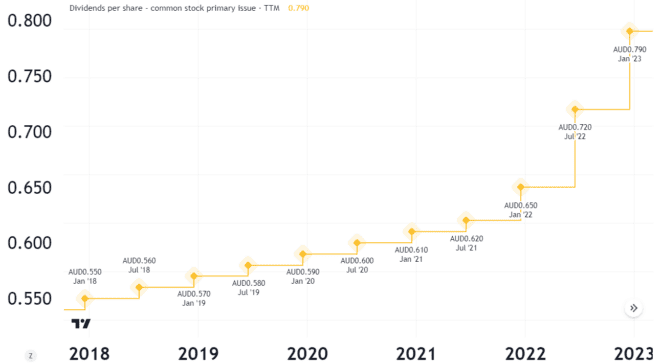
    I’d describe Soul Pattinson as the ASX dividend share with the strongest dividend record. It has grown its dividend every year since 2000. The business has also paid some sort of dividend every year since it listed more than 100 years ago.

    Source: TradeView trailing twelve month Soul Pattinson dividend

    As we can see on the graph above, the dividend growth rate has picked up in the last couple of results. The recent FY23 half-year result showed a 24.1% increase in the interim dividend.

    Soul Pattinson pays its dividend from the cash flow it receives from its investment portfolio of ASX shares, private businesses, and structured debt. Some of its biggest investments include Brickworks Limited (ASX: BKW), TPG Telecom Ltd (ASX: TPG), New Hope Corporation Limited (ASX: NHC), and Macquarie Group Ltd (ASX: MQG).

    After paying its dividend, the ASX dividend share can then re-invest in more opportunities.

    One of the company’s goals is to keep growing the dividend. Another objective is to outperform the market.

    Using the company’s last two declared dividends (including the special dividend), it has a grossed-up dividend yield of 4%.

    Sonic Healthcare Ltd (ASX: SHL)

    Sonic is one of the world’s largest pathology businesses with a significant presence in Australia, the US, the UK, and Germany.

    People can’t decide when to get sick based on economic cycles so ASX healthcare shares can provide shareholders with resilient earnings and dividends. As well, the increasing populations — and their ageing — in those major markets certainly provide a useful tailwind for healthcare earnings.

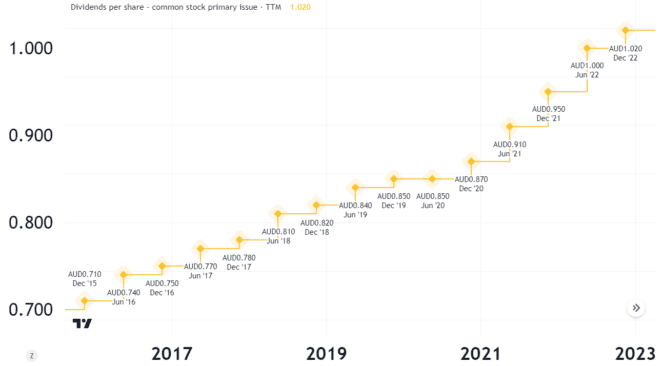
    The ASX dividend share has grown its dividend each year since 2013, so its growth streak has been going on for around a decade now.

    Source: TradeView trailing twelve months Sonic Healthcare dividend

    The company’s non-COVID testing revenue continues to grow, which bodes well for future profit generation and larger dividends. The business has a stated “progressive dividend policy”, meaning the board wants to grow the dividend each year, if possible.

    The business continues to make bolt-on acquisitions, such as its two recent acquisitions in Germany that, between them, are expected to add €115 million (A$186.6 million) of revenue in FY24.

    As well, the company’s expansion into artificial intelligence and its partnership with Microba Pty Ltd (ASX: MAP) in microbiome testing could boost Sonic Healthcare over time.   

    Sonic Healthcare’s trailing grossed-up dividend yield is also 4%.

    The post 2 ASX dividend shares aiming to give investors a payrise every year appeared first on The Motley Fool Australia.

    Where should you invest $1,000 right now? 3 dividend stocks to help beat inflation

    This FREE report reveals 3 stocks not only boasting sustainable dividends but that also have strong potential for massive long term returns…

    See the 3 stocks
    *Returns as of April 3 2023

    (function() {
    function setButtonColorDefaults(param, property, defaultValue) {
    if( !param || !param.includes(‘#’)) {
    var button = document.getElementsByClassName(“pitch-snippet”)[0].getElementsByClassName(“pitch-button”)[0];
    button.style[property] = defaultValue;
    }
    }

    setButtonColorDefaults(“#0095C8”, ‘background’, ‘#5FA85D’);
    setButtonColorDefaults(“#0095C8”, ‘border-color’, ‘#43A24A’);
    setButtonColorDefaults(“#fff”, ‘color’, ‘#fff’);
    })()

    More reading

    Motley Fool contributor Tristan Harrison has positions in Brickworks and Washington H. Soul Pattinson and Company Limited. The Motley Fool Australia’s parent company Motley Fool Holdings Inc. has positions in and has recommended Brickworks and Washington H. Soul Pattinson and Company Limited. The Motley Fool Australia has positions in and has recommended Brickworks, Macquarie Group, and Washington H. Soul Pattinson and Company Limited. The Motley Fool Australia has recommended Sonic Healthcare and TPG Telecom. The Motley Fool has a disclosure policy. This article contains general investment advice only (under AFSL 400691). Authorised by Scott Phillips.

    from The Motley Fool Australia https://ift.tt/D4P21qC

  • Are AGL shares going to become a dividend machine?

    AGL Energy Limited (ASX: AGL) shares have taken a big dive since 2020, but could this lower valuation mean the future dividend yield is really appealing?

    When the share price goes down, the dividend yield goes up, assuming the dividend payment doesn’t change in size.

    I’ll give you an example – if a share had a 5% dividend yield and then the share price drops 10%, it would increase the dividend yield to 5.5%.

    However, a heavy fall in a share price can suggest that operating conditions have worsened significantly, which could mean that a lower profit and lower dividend are possible.

    In the FY23 half-year result, AGL’s underlying net profit after tax (NPAT) dropped 55% to $87 million, while the interim dividend was halved to just 8 cents per share.

    However, with management commentary and analyst projections reflecting a positive future, could AGL shares be a future dividend machine?

    Dividend projections

    FY23 is not expected to be a very profitable year (after what was seen in HY23) for AGL, and the estimate on Commsec suggests that AGL shares could pay an annual dividend per share of 27 cents. That would be a dividend yield of just 3% – nothing to get excited about considering (safe) term deposits offer an interest rate of above 4%.

    But, the company pointed out with its HY23 result that wholesale electricity pricing was “elevated compared to prior periods with AGL expected to benefit as historical contract positions are reset in FY24 and FY25. Additionally, sustained periods of higher wholesale electricity prices are expected to flow through to retail pricing outcomes.”

    A profit recovery in FY24 and FY25 could enable the business to pay much bigger dividends in the next two financial years.

    In the 2024 financial year, the projection on Commsec suggests AGL shares might pay an annual dividend per share of 56 cents, which would be a dividend yield of 6.4%.

    There could be an even bigger dividend in FY25 according to the Commsec projection. There could be a dividend per share of 70 cents, which would be a dividend yield of 7.9%. This would be a better dividend yield than what’s offered by names like Telstra Group Ltd (ASX: TLS) and Commonwealth Bank of Australia (ASX: CBA) in FY25, according to the Commsec estimates. Though there’s more to the consideration of an investment than just the dividend yield of course.

    It’s very promising for AGL shares that both earnings and the dividend could rise strongly over the next two years.

    Forecasts are not guaranteed

    Just because experts have pencilled in these potential dividend payments, it doesn’t mean they’re a confirmed thing. AGL has to generate the profit before it can pay it out.

    On top of that, AGL has committed to the decarbonisation of its energy generation efforts, which could cost billions for the business to build all of the transmission assets, solar panels, batteries and so on. It will need to keep at least some of its generated profit to re-invest in power generation to ensure it doesn’t take on too much debt to fund the spending.

    But, if AGL is able to achieve the projected earnings per share (EPS) of 95.5 cents in FY25, this would mean the AGL share price is valued at just 9 times FY25’s estimated earnings.

    The post Are AGL shares going to become a dividend machine? appeared first on The Motley Fool Australia.

    Should you invest $1,000 in Agl Energy Limited right now?

    Before you consider Agl Energy Limited, you’ll want to hear this.

    Motley Fool Investing expert Scott Phillips just revealed what he believes are the 5 best stocks for investors to buy right now… and Agl Energy Limited wasn’t one of them.

    The online investing service he’s run for over a decade, Motley Fool Share Advisor, has provided thousands of paying members with stock picks that have doubled, tripled or even more.* And right now, Scott thinks there are 5 stocks that are better buys.

    See The 5 Stocks
    *Returns as of April 3 2023

    (function() {
    function setButtonColorDefaults(param, property, defaultValue) {
    if( !param || !param.includes(‘#’)) {
    var button = document.getElementsByClassName(“pitch-snippet”)[0].getElementsByClassName(“pitch-button”)[0];
    button.style[property] = defaultValue;
    }
    }

    setButtonColorDefaults(“#43B02A”, ‘background’, ‘#5FA85D’);
    setButtonColorDefaults(“#43B02A”, ‘border-color’, ‘#43A24A’);
    setButtonColorDefaults(“#fff”, ‘color’, ‘#fff’);
    })()

    More reading

    Motley Fool contributor Tristan Harrison has no position in any of the stocks mentioned. The Motley Fool Australia’s parent company Motley Fool Holdings Inc. has no position in any of the stocks mentioned. The Motley Fool Australia has positions in and has recommended Telstra Group. The Motley Fool has a disclosure policy. This article contains general investment advice only (under AFSL 400691). Authorised by Scott Phillips.

    from The Motley Fool Australia https://ift.tt/1pAMV5L

  • ‘Bright outlook’: 2 ‘high quality’ ASX 200 shares to pounce on now 

    A black cat waiting to pounce on a mouse.A black cat waiting to pounce on a mouse.

    The volatility that ASX investors suffered over the past 18 months is not expected to wane anytime soon.

    That’s why multiple experts are urging punters to back “quality” ASX shares rather than fall into the trap of becoming too speculative for quick riches.

    A pair of advisors this week rated two such stocks as buys:

    ‘A discounted energy stock’

    The Santos Limited (ASX: STO) share price has plunged 11.1% over the past 12 months.

    That makes it a bargain buy, according to Bell Potter investment advisor Christopher Watt.

    “In our view, Santos remains a discounted energy stock with the lowest implied oil price,” Watt told The Bull.

    “The energy giant reported a solid first quarter production result in fiscal year 2023.”

    Santos’ outlook is pleasing to Watt.

    “The company retained fiscal year 2023 guidance,” he said.

    “Santos is geographically diversified. Also, it offers a diversified product mix across LNG, domestic gas, crude oil and liquids.”

    A 4.7% dividend yield also helps the buy case.

    The team at Macquarie Group Limited (ASX: MQG) agrees with Watt’s bullishness.

    The Motley Fool reported a fortnight ago that those analysts had a price target of $9.95 for Santos. That’s about a 40% upside from the current level.

    The company with everything going for it

    Industrial real estate manager Goodman Group (ASX: GMG) is Medallion Financial Group private client advisor Stuart Bromley’s pick.

    The business has many tailwinds.

    “It has high quality properties, blue chip tenants, an occupancy rate of 99% and long average lease expiries,” he said.

    “Competition is modest and rental growth is accelerating.”

    The market has certainly woken up to Goodman’s potential, sending the share price 16% up so far this year.

    Bromley is confident the business is incubating further growth.

    “The company continues to build, as it progresses $13.9 billion of existing projects,” he said.

    “The gearing ratio is lower than other more exposed property plays. The company offers a bright outlook.”

    Citigroup Inc (NYSE: C) analysts concur.

    “Its analysts are forecasting double-digit earnings per share growth out until at least FY 2025,” reported The Motley Fool last week.

    “It’s no surprise, then, to learn that Citi has a buy rating on its shares with a $24.00 price target.”

    The target of $24 represents about a 20% premium on current levels.

    The post ‘Bright outlook’: 2 ‘high quality’ ASX 200 shares to pounce on now  appeared first on The Motley Fool Australia.

    FREE Guide for New Investors

    Despite what some people may say – we believe investing in shares doesn’t have to be overwhelming or complicated…

    For over a decade, we’ve been helping everyday Aussies get started on their journey.

    And to help even more people cut through some of the confusion “experts’” seem to want to perpetuate – we’ve created a brand-new “how to” guide.

    Yes, Claim my FREE copy!
    *Returns as of April 3 2023

    (function() {
    function setButtonColorDefaults(param, property, defaultValue) {
    if( !param || !param.includes(‘#’)) {
    var button = document.getElementsByClassName(“pitch-snippet”)[0].getElementsByClassName(“pitch-button”)[0];
    button.style[property] = defaultValue;
    }
    }

    setButtonColorDefaults(“#0095C8”, ‘background’, ‘#5FA85D’);
    setButtonColorDefaults(“#0095C8”, ‘border-color’, ‘#43A24A’);
    setButtonColorDefaults(“#fff”, ‘color’, ‘#fff’);
    })()

    More reading

    Citigroup is an advertising partner of The Ascent, a Motley Fool company. Motley Fool contributor Tony Yoo has positions in Macquarie Group. The Motley Fool Australia’s parent company Motley Fool Holdings Inc. has no position in any of the stocks mentioned. The Motley Fool Australia has positions in and has recommended Macquarie Group. The Motley Fool Australia has recommended Goodman Group. The Motley Fool has a disclosure policy. This article contains general investment advice only (under AFSL 400691). Authorised by Scott Phillips.

    from The Motley Fool Australia https://ift.tt/IgKctB7

  • Why is the Appen share price in a trading halt?

    The Appen Ltd (ASX: APX) share price won’t be going anywhere on Tuesday.

    That’s because the embattled artificial intelligence (AI) data service provider requested a trading halt this morning.

    The company has requested that the halt last until the commencement of trade on Wednesday.

    Why is the Appen share price paused?

    The Appen share price is out of action today after the company announced plans to raise capital.

    The request briefly explains:

    The trading halt is requested as Appen expects to make an announcement to ASX in connection with a pro rata accelerated non-renounceable entitlement offer and institutional placement (the Offer). (b) Appen requests that the trading halt remain in place until the earlier of: (i) Appen making an announcement to the market regarding the outcome of the institutional component of the Offer (ii) the commencement of trading on Wednesday, 17 May 2023.

    Capital raising

    Interestingly, brokers were discussing the prospect of a capital raising after the company’s abject trading update last week. Bell Potter, for example, commented:

    We have downgraded our 2023, 2024 and 2025 revenue forecasts by 17%, 18% and 18%. We now forecast an underlying EBITDA loss of US$(23.2)m in 2023 – previously we forecast positive US$14.3m – and have downgraded our underlying EBITDA forecasts in 2024 and 2025 by 49% and 30%. We now forecast Appen utilises some of its A$20m debt facility in 2H2023 and assume there is some increase in the size of the facility when the company refinances later this year. This should avoid any need of a capital raising and we have not assumed any in our forecasts.

    Perhaps this could be a sign that its lenders are not confident enough in its outlook to increase the size of its debt facility.

    What is Appen raising?

    Appen has revealed that it is raising ~A$60 million via a fully underwritten equity raising to support the company’s strategic refresh and return to profitability.

    The company is raising the funds at $1.85 per new share, which represents a 19.6% discount to where the Appen share price last traded.

    Proceeds will be used to fund one-off costs associated with its previously announced cost reduction program, provide balance sheet flexibility and general working capital to support Appen’s return to profitability, and transaction costs.

    The equity raising comprises a ~$38 million 1 for 6 pro rata accelerated non-renounceable entitlement offer and a ~$21 million institutional placement.

    The post Why is the Appen share price in a trading halt? appeared first on The Motley Fool Australia.

    Should you invest $1,000 in Appen Limited right now?

    Before you consider Appen Limited, you’ll want to hear this.

    Motley Fool Investing expert Scott Phillips just revealed what he believes are the 5 best stocks for investors to buy right now… and Appen Limited wasn’t one of them.

    The online investing service he’s run for over a decade, Motley Fool Share Advisor, has provided thousands of paying members with stock picks that have doubled, tripled or even more.* And right now, Scott thinks there are 5 stocks that are better buys.

    See The 5 Stocks
    *Returns as of April 3 2023

    (function() {
    function setButtonColorDefaults(param, property, defaultValue) {
    if( !param || !param.includes(‘#’)) {
    var button = document.getElementsByClassName(“pitch-snippet”)[0].getElementsByClassName(“pitch-button”)[0];
    button.style[property] = defaultValue;
    }
    }

    setButtonColorDefaults(“#43B02A”, ‘background’, ‘#5FA85D’);
    setButtonColorDefaults(“#43B02A”, ‘border-color’, ‘#43A24A’);
    setButtonColorDefaults(“#fff”, ‘color’, ‘#fff’);
    })()

    More reading

    Motley Fool contributor James Mickleboro has no position in any of the stocks mentioned. The Motley Fool Australia’s parent company Motley Fool Holdings Inc. has positions in and has recommended Appen. The Motley Fool Australia has no position in any of the stocks mentioned. The Motley Fool has a disclosure policy. This article contains general investment advice only (under AFSL 400691). Authorised by Scott Phillips.

    from The Motley Fool Australia https://ift.tt/2D9yucb