Tag: Motley Fool

  • Here’s why the EP&T Global (ASX:EPX) share price is rocketing 56% today

    a man sits on a rocket propelled office chair and flies high above a city

    Shares in EP&T Global Ltd (ASX: EPX) are exploding into the stratosphere following the company’s strong trading update.

    During late morning trade, the EP&T share price touched a 2-month high of 23.5 cents before pulling back. At the time of writing, its shares are swapping hands for 19.5 cents, up 56%.

    How did EP&T perform?

    In today’s release, EP&T advised it has delivered robust growth for the first quarter of FY22.

    Annualised recurring revenue (ARR) came to $6.4 million, an increase of 21% over the prior period ($5.3 million). The energy management solutions company installed its EDGE Intelligent Systems in 29 buildings which led to the higher ARR.

    The company noted that the easing of COVID-19 restrictions enabled building access and installations to accelerate. This has led to sales initiatives generating continued pipeline growth.

    As such, ARR is forecasted to swell to $9.8 million by 30 June 2022, a jump of 85% over the 12-month period.

    The 3-year contract with leading asset manager, DWS, is on track to be deployed and live before the end of FY22. The annual contract value (ACV) is $2 million with a total contract value (TCV) of $6.1 million.

    EP&T CEO, Trent Knox commented on the outlook for the company:

    We continue to have a strong focus on the conversion of ACV to annualised recurring revenue (ARR) which is key to increasing revenues and improving operating cash flows.

    We are well positioned to capitalise on future sales opportunities with an ever-expanding list of verticals including commercial office, retail, hospitals, schools, hotels, clubs, and industrial.

    About the EP&T share price

    Since listing on the ASX boards in May 2021, EP&T shares traded mostly sideways up until the beginning of September. Its shares continued to fall lower, hitting an all-time low of 10.5 cents on 8 October. However, today’s rise has put it back within August levels.

    EP&T commands a market capitalisation of roughly $22.66 million and has approximately 116.18 million shares on hand.

    The post Here’s why the EP&T Global (ASX:EPX) share price is rocketing 56% today appeared first on The Motley Fool Australia.

    Should you invest $1,000 in EP&T right now?

    Before you consider EP&T, you’ll want to hear this.

    Motley Fool Investing expert Scott Phillips just revealed what he believes are the 5 best stocks for investors to buy right now… and EP&T wasn’t one of them.

    The online investing service he’s run for nearly a decade, Motley Fool Share Advisor, has provided thousands of paying members with stock picks that have doubled, tripled or even more.* And right now, Scott thinks there are 5 stocks that are better buys.

    *Returns as of August 16th 2021

    More reading

    Motley Fool contributor Aaron Teboneras has no position in any of the stocks mentioned. The Motley Fool Australia’s parent company Motley Fool Holdings Inc. has no position in any of the stocks mentioned. The Motley Fool Australia has no position in any of the stocks mentioned. The Motley Fool has a disclosure policy. This article contains general investment advice only (under AFSL 400691). Authorised by Bruce Jackson.

    from The Motley Fool Australia https://ift.tt/2Zax14Z

  • Why A2 Milk, Eroad, Flight Centre, and Webjet shares are sinking

    A man stands in front of a chart with an arrow going down and slaps his forehead in frustration.

    The S&P/ASX 200 Index (ASX: XJO) is on course to record a decent gain. In afternoon trade, the benchmark index is up 0.25% to 7,433.3 points.

    Four ASX shares that have failed to follow the market’s lead today are listed below. Here’s why they are sinking:

    A2 Milk Company Ltd (ASX: A2M)

    The A2 Milk share price is down almost 4% to $7.11. This follows reports that the embattled infant formula company will be hit with a second class action. In addition, this morning the team at Credit Suisse retained their underperform rating and $5.50 price target on the company’s shares. The broker believes the market is mispricing A2 Milk’s shares.

    Eroad Ltd (ASX: ERD)

    The Eroad share price has tumbled 8% to $4.85 following the release of the transportation technology services company’s quarterly update. That update reveals that Eroad has downgraded its standalone revenue growth guidance for FY 2022 to 10% to 13%. Management blamed this on challenging trading conditions, particularly in North America. In that segment, the company saw a reduction in contracted units.

    Flight Centre Travel Group Ltd (ASX: FLT)

    The Flight Centre share price has fallen 5.5% to $20.42. This decline appears to have been driven by the issue of convertible notes. This morning the travel agent confirmed that it has raised $400 million through a senior unsecured convertible notes offering maturing in 2028. Flight Centre intends to use the net proceeds to pay down existing debt and fund its growth vision into the future.

    Webjet Limited (ASX: WEB)

    The Webjet share price is down 3.5% to $6.27. This morning the team at Macquarie downgraded the online travel agent’s shares to a neutral rating with a $6.65 price target. The broker made the move on valuation grounds following recent share price strength.

    The post Why A2 Milk, Eroad, Flight Centre, and Webjet shares are sinking appeared first on The Motley Fool Australia.

    Wondering where you should invest $1,000 right now?

    When investing expert Scott Phillips has a stock tip, it can pay to listen. After all, the flagship Motley Fool Share Advisor newsletter he has run for more than eight years has provided thousands of paying members with stock picks that have doubled, tripled or even more.*

    Scott just revealed what he believes could be the five best ASX stocks for investors to buy right now. These stocks are trading at near dirt-cheap prices and Scott thinks they could be great buys right now.

    *Returns as of August 16th 2021

    More reading

    Motley Fool contributor James Mickleboro has no position in any of the stocks mentioned. The Motley Fool Australia’s parent company Motley Fool Holdings Inc. owns shares of and has recommended EROAD Limited. The Motley Fool Australia owns shares of and has recommended EROAD Limited and Webjet Ltd. The Motley Fool Australia has recommended A2 Milk and Flight Centre Travel Group Limited. The Motley Fool has a disclosure policy. This article contains general investment advice only (under AFSL 400691). Authorised by Bruce Jackson.

    from The Motley Fool Australia https://ift.tt/3lZTv1v

  • The Webjet (ASX:WEB) share price is having a good month but it’s still 30% lower than pre-COVID levels

    A woman wearing a facemask slumps on a couch next to a globe of the world, indicating COVID travel restrictions in play

    The Webjet Limited (ASX: WEB) share price has been flying high recently.

    Over the last month, shares in the online travel agency have rocketed 9.41% and are currently sitting at $6.51 as of the time of writing. Compared to the S&P/ASX 200 Index (ASX: XJO), which is only up 1.92% in the same period, it is an impressive feat.

    Yet, the company is still not near its pre-COVID levels. On the first trading of 2020, Webjet shares ended the day at $9.49 – 45.8% higher than its current price.

    Let’s take a closer look.

    Webjet shares are high, but not as high as they once were

    First, let’s take a look at what might have contributed to the rising Webjet share price over the last month.

    When it comes to ASX travel shares, Webjet isn’t alone. Qantas Airways Limited’s (ASX: QAN) value has increased 4.18% over the month, Flight Centre Travel Group Ltd (ASX: FLT) shares are 16.2% higher, and the Helloworld Travel Ltd (ASX: HLO) share price is up an incredible 31.8% in that time.

    ASX travel shares have been buoyed by recent developments about the pandemic. NSW Premier Dominic Perrottet announced he is ending all quarantine requirements for international travel come 1 November. This was swiftly followed by the Prime Minister, Scott Morrison, saying Australians would be able to leave and return to the country at will on the same date – effectively ending Australia’s closed international border.

    Queensland, Victoria, and the ACT have all announced they would be effectively ending their closed border stances for fully vaccinated travellers as well.

    Australia’s high vaccine uptake has moved forward the country’s plans for re-opening faster than most anticipated. It’s clearly been good news for the Webjet share price, and other ASX travel shares.

    So, why isn’t the Webjet share price at pre-COVID levels yet?

    Put simply, it’s because we aren’t in pre-COVID times anymore.

    While Australians can come and go out of the country, this does not apply to international travellers. The Prime Minister, when he announced Australians could leave and enter the country when they wished, also made it abundantly clear that other nationals would not be extended the same privileges until sometime in the next year.

    As well, only NSW and Queensland have made plans to end quarantine for international arrivals, Queensland saying they won’t end quarantine until 90% of those 16+ are fully vaccinated. Western Australia, Tasmania, and South Australia haven’t even indicated when they will open their domestic borders.

    More generally, even with the opening of the borders, it is more onerous to travel than it once was. A person will need to test negative to the coronavirus before leaving and returning, wear masks on the plane, and prove they are fully vaccinated. Not every country has opened their border to Australia, such as Bali, for example.

    This could explain why the Webjet share price isn’t at its pre-pandemic levels.

    Another explanation is risk. The border hasn’t actually opened yet and won’t open for another 11 days. The future is more uncertain now than it was before the pandemic. Investors price risk into their decision making, and the risk may be too high for many buyers.

    Webjet share price snapshot

    Over the past 12 months, the Webjet share price has increased 56.8%. Year-to-date, shares in the company are up 22%. Webjet has a market capitalisation of approximately $2.4 billion.

    The post The Webjet (ASX:WEB) share price is having a good month but it’s still 30% lower than pre-COVID levels appeared first on The Motley Fool Australia.

    Should you invest $1,000 in Webjet right now?

    Before you consider Webjet, you’ll want to hear this.

    Motley Fool Investing expert Scott Phillips just revealed what he believes are the 5 best stocks for investors to buy right now… and Webjet wasn’t one of them.

    The online investing service he’s run for nearly a decade, Motley Fool Share Advisor, has provided thousands of paying members with stock picks that have doubled, tripled or even more.* And right now, Scott thinks there are 5 stocks that are better buys.

    *Returns as of August 16th 2021

    More reading

    Motley Fool contributor Marc Sidarous owns shares of Qantas Airways Limited. The Motley Fool Australia’s parent company Motley Fool Holdings Inc. owns shares of and has recommended Helloworld Limited. The Motley Fool Australia owns shares of and has recommended Helloworld Limited and Webjet Ltd. The Motley Fool Australia has recommended Flight Centre Travel Group Limited. The Motley Fool has a disclosure policy. This article contains general investment advice only (under AFSL 400691). Authorised by Bruce Jackson.

    from The Motley Fool Australia https://ift.tt/3bcmEQZ

  • Why is the Chalice Mining (ASX:CHN) share price struggling today?

    an unhappy miner poses with gloved hand on face wearing a hard hat with a light and frowning.

    The Chalice Mining Ltd (ASX: CHN) share price is nudging into the red during afternoon trade today.

    After a nifty start, Chalice Mining shares cratered as the company released its quarterly activities report for the 3 months ended September 30, 2021.

    At the time of writing, the Chalice MIning share price is down 0.72% to $6.85. It was at $6.96 when the company released the report just after midday before dropping sharply on the news.

    Chalice Mining share price slides following quarterly updates

    From the third quarter, Chalice outlined it had a cash balance of approximately $81.3 million. It also had a further $5.1 million in listed equity investments.

    The company also disposed of its main holding in O3 Mining Inc this quarter, obtaining $4.6 million from the sale.

    With regards to its 100%-owned Julimar Nickel-Copper-PGE project, all assays informing the mineral resource estimate (MRE) at the site have now been reported.

    Investors can expect the ‘pit-constrained’ MRE to be released in Q4 FY21, the company says.

    Chalice confirmed it is also proceeding with the previously announced demerger and potential ASX listing of what it calls its “highly prospective gold assets”.

    These include the company’s Pyramid Hill, Viking, and Mt Jackson gold projects. These will all be spun off into a new ASX-listed entity known as Falcon Metals Ltd.

    It is proposed to trade under the ticker “ASX: FAL”, should the ASX pass all resolutions and proposals under the demerger.

    The company has appointed a suite of highly skilled personnel to Falcon’s board. They have “a proven track record in making major discoveries and delivering exceptional returns to shareholders”.

    Aside from this, the company continues its drilling and survey programs at each of its other major projects. These include its Hawkstone nickel-copper-cobalt project and its Barrabarra and South West nickel-copper-PGE projects, all in WA.

    What’s next for Chalice Mining?

    Undoubtedly, the key upcoming catalyst for the company is the spin-out of its gold assets into the newly formed Falcon Metals.

    In addition, the Julimar project is set to continue studies for an initial mining development at Gonneville on private farmland. This will continue defining the “full extent of the mineralisation along the (more than) 26km long Julimar Complex”.

    Chalice has since commenced step-out drilling at the site. Geotechnical, metallurgical, hydrogeological, and infrastructure drilling will commence shortly, and continue until Q1 2022.

    Aside from this, metallurgical test work and support studies are now focused on optimising disseminated sulphide performance and assessing mining scenarios for its Gonneville deposit.

    The Chalice Mining share price has been an outsized winner this year to date. It has posted a return of 76% since January 1, and 117% in the past 12 months.

    The post Why is the Chalice Mining (ASX:CHN) share price struggling today? appeared first on The Motley Fool Australia.

    Should you invest $1,000 in Chalice Mining right now?

    Before you consider Chalice Mining, you’ll want to hear this.

    Motley Fool Investing expert Scott Phillips just revealed what he believes are the 5 best stocks for investors to buy right now… and Chalice Mining wasn’t one of them.

    The online investing service he’s run for nearly a decade, Motley Fool Share Advisor, has provided thousands of paying members with stock picks that have doubled, tripled or even more.* And right now, Scott thinks there are 5 stocks that are better buys.

    *Returns as of August 16th 2021

    More reading

    The author Zach Bristow has no positions in any of the stocks mentioned. The Motley Fool Australia’s parent company Motley Fool Holdings Inc. has no position in any of the stocks mentioned. The Motley Fool Australia has no position in any of the stocks mentioned. The Motley Fool has a disclosure policy. This article contains general investment advice only (under AFSL 400691). Authorised by Bruce Jackson.

    from The Motley Fool Australia https://ift.tt/2XA3voO

  • EV stocks may not be as infallible as you think

    This article was originally published on Fool.com. All figures quoted in US dollars unless otherwise stated.

    Electric vehicle being charged.

    This article was originally published on Fool.com. All figures quoted in US dollars unless otherwise stated.

    The stock market is giving incredibly high valuations to electric vehicle stocks, whether the companies have proven themselves effective manufacturers or not. Tesla (NASDAQ: TSLA) is one of the most valuable companies in the world, while start-ups like Lucid Motors (NASDAQ: LCID)NIO (NYSE: NIO), and Xpeng (NYSE: XPEV) are worth tens of billions of dollars with very little production, and a company like Rivian is eyeing a potential $80 billion valuation in an IPO. 

    Meanwhile, older manufacturers like General Motors (NYSE: GM), Ford (NYSE: GM), Toyota (NYSE: TM), Honda (NYSE: HMC), and Volkswagen are trading for less than the market’s price-to-earnings ratio, as you can see below, indicating that investors don’t think highly of their earnings growth potential. Is this because EV companies are disrupting the old guard or because EV stocks are overvalued? Let’s take a look. 
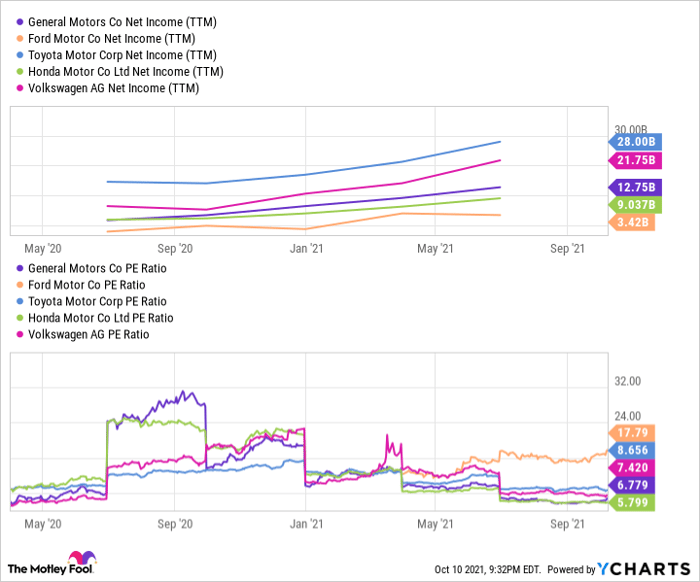
    GM Net Income (TTM) Chart

    GM Net Income (TTM) data by YCharts

    EV valuations versus the old auto industry

    If you had invested in traditional auto stocks since the start of 2000, your performance would hardly be impressive. General Motors, Toyota, Honda, Ford, and Volkswagen have all underperformed the market, and you could buy all five manufacturers for less than $600 billion, based on today’s market capitalizations. Their valuations haven’t fallen relative to historical valuations as EVs have hit the market — automakers have always had relatively low valuations because of the boom-and-bust nature of the business. 
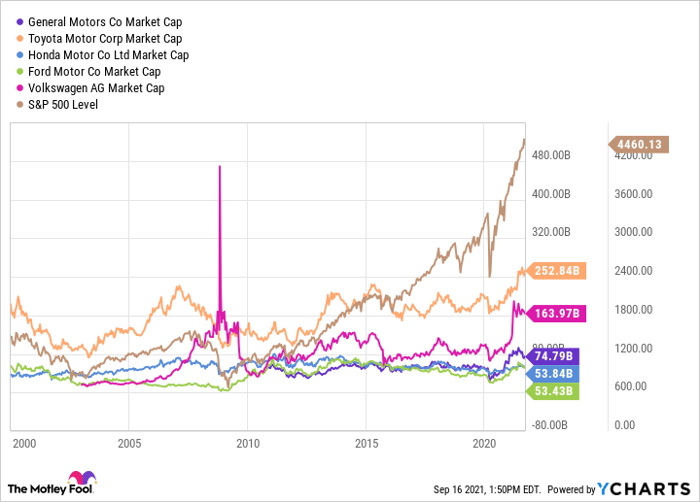
    GM Market Cap Chart

    GM Market Cap data by YCharts

    Compare these valuations to five of the most valuable EV manufacturers today. 
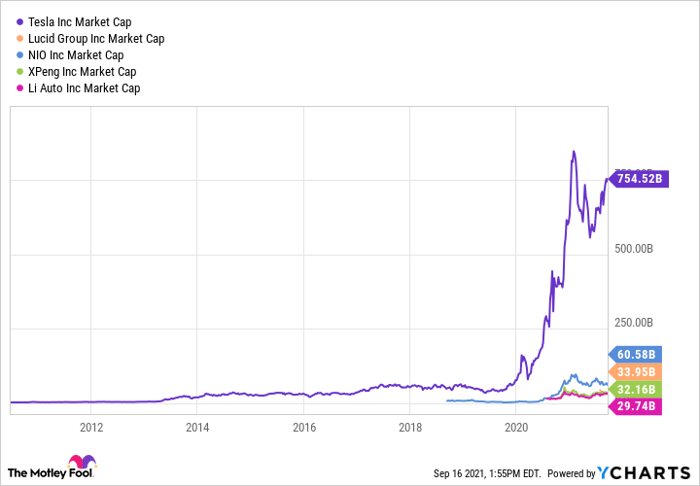
    TSLA Market Cap Chart

    TSLA Market Cap data by YCharts

    This chart doesn’t even include Rivian, which could go public with an $80 billion valuation, or Nikola, Workhorse Group, Canoo, Fisker, and a number of start-ups that are effectively pre-revenue. This is a very crowded field today. 

    Tesla is relatively established as a manufacturer, but companies like Lucid are still in pre-production and many manufacturers are just starting to ramp up operations in a meaningful way. Clearly, the market thinks the economics of manufacturing EVs long term is going to be far better than the economics of the traditional auto industry over the last century. I think we should be skeptical of that. 

    Why the auto business has traditionally been a terrible place to invest money

    A good way to understand the strategic position of auto manufacturers is to consider Porter’s Five Forces for the industry. Porter’s Five Forces is a method for analysing a business’s competitive position developed by Michael Porter at Harvard University and is commonly taught in business schools today. 

    I have laid out the five forces below and how I see the traditional auto fits into this analysis today, based on a low/medium/high level. You can adjust any of these factors if you disagree with my analysis. 

    Porter’s Five Forces Ideal Traditional Auto Industry
    Threat of new entrants Low Low
    Supplier power Low Medium
    Buyer’s bargaining power Low High
    Threat of substitutes Low High
    Intensity of rivalry Low High

    Data sources: Michael Porter, author’s analysis. 

    The threat of new entrants to the auto business is low and has been for decades, given the high cost to design vehicles and build manufacturing capacity. Suppliers have some power in the market because many are large and have significant scale, but there’s a limit to their power. Buyers do have bargaining power because they can simply go to any other automaker for a vehicle. The threat of substituting one brand for another is also high. And given relatively low margins for automakers and the money spent on advertising vehicles, we know that rivalry among competitors is high.

    The same forces don’t hold for the EV industry today, where economics will likely be far better for the next few years for some very critical reasons. 

    EV financials may never be better than they are today

    Looking at the same five forces for the EV industry, we see a much more attractive environment. 

    Porter’s Five Forces Ideal EV Industry
    Threat of new entrants Low Medium
    Supplier power Low Medium
    Buyer’s bargaining power Low Low
    Threat of substitutes Low Low
    Intensity of rivalry Low Low

    Data sources: Michael Porter, author’s analysis. 

    There’s a bigger potential threat of new entrants today than there was in the traditional auto industry, partially because many of these new entrants are public and can raise capital from equity markets relatively easily. But it’s still extremely difficult to establish an auto company today — so I only made that a medium threat level. But it’s also clear that the intensity of rivalry among EV manufacturers is nearly nonexistent, there are very few substitutable options for customers given a limited number of models available, and buyers have little bargaining power because there are so few options. 

    To add to the improved position of EV companies today, they’re getting a financial windfall from government regulations and tax incentives, and benefiting from disrupting a slow-moving legacy business. 

    • EVs have a tax credit windfall for buyers in the U.S. 
    • EV manufacturers are getting a regulatory credit windfall
    • There is limited competition from any EV manufacturer
    • EV start-ups are competing against a legacy cost structure (dealerships and unions) 
    • EV companies like Tesla are starting to charge a premium for technology like self-driving features

    What I see from both the Porter’s Five Forces analysis above and the five bullet points is there are tailwinds behind EV companies today. But in every single case, I think the tailwind has an end date. 

    • Eventually, all automakers will make enough EVs to render regulatory credits negligible
    • Tax credits will (likely) expire
    • Competition from start-ups and legacy companies is launching regularly, and eventually there will be ample supply of EVs for anyone who wants one
    • Most new start-ups are not using a traditional dealer model, reducing the benefit of any single company (Tesla) disrupting the dealer model
    • Premium features like self-driving are a novelty today, but they’ll eventually be standard and — depending on how autonomous driving technology and business models develop — may make the idea of purchasing a vehicle in the first place obsolete

    Add all of this up and I think we will see an increased level of rivalry, a bigger threat of substitutes from one EV to the next, and more bargaining power from buyers. Long term, Porter’s Five Forces and the strategic position of EV manufacturers resemble that of auto companies over the last 50 years. In all likelihood, EV manufacturers will face the same rise and fall of demand during recessions and ultimately pricing pressure that will hurt margins. Some of that threat will come from traditional auto companies themselves, but some competition will be EV-maker versus EV-maker in the marketplace. 

    Are EV manufacturers playing a new game? 

    When I consider EV companies over the long term, they look a lot like traditional automakers. They are manufacturers just like traditional automakers and some haven’t even proven the ability to be world-class manufacturers. They need to grow, develop technology, market products, hold off competitors, and at the end of the day hope they can make enough money on vehicle sales to cover enormous fixed costs associated with operating an auto company.

    EV companies will face the same challenges in the future that traditional auto companies have been facing for a century — which makes me wonder why EV companies are so highly valued compared to how traditional auto companies have been valued for decades? 

    Add it up and this looks like EV stocks are much more fallible than investors think right now, which makes me very hesitant about investing in this space at all. 

    This article was originally published on Fool.com. All figures quoted in US dollars unless otherwise stated.

    The post EV stocks may not be as infallible as you think appeared first on The Motley Fool Australia.

    Wondering where you should invest $1,000 right now?

    When investing expert Scott Phillips has a stock tip, it can pay to listen. After all, the flagship Motley Fool Share Advisor newsletter he has run for more than eight years has provided thousands of paying members with stock picks that have doubled, tripled or even more.*

    Scott just revealed what he believes could be the five best ASX stocks for investors to buy right now. These stocks are trading at near dirt-cheap prices and Scott thinks they could be great buys right now.

    *Returns as of August 16th 2021

    More reading

    Travis Hoium owns shares of General Motors and has the following options: long March 2023 $250 puts on Tesla. The Motley Fool Australia’s parent company Motley Fool Holdings Inc. owns shares of and has recommended NIO Inc. and Tesla. The Motley Fool Australia has no position in any of the stocks mentioned. The Motley Fool has a disclosure policy. This article contains general investment advice only (under AFSL 400691). Authorised by Bruce Jackson.

    This article was originally published on Fool.com. All figures quoted in US dollars unless otherwise stated.

    from The Motley Fool Australia https://ift.tt/3B07YyO

  • Top broker tips CBA (ASX:CBA) share price slide to $80

    a group of market analysts sit and stand around their computers in an open-plan office environment. The central figures are deep in thought over something appearing on one person's computer screen.

    The Commonwealth Bank of Australia (ASX: CBA) share price has been a very strong performer in 2021.

    Since the start of the year, the banking giant’s shares have risen a sizeable 25%.

    This is more than double the return of the S&P/ASX 200 Index (ASX: XJO) over the same period.

    Where next for the CBA share price?

    Unfortunately for shareholders, a number of leading brokers believe the CBA share price is overvalued and have the equivalent of sell ratings on the company.

    One of the most bearish brokers is Morgans. According to a recent note, its analysts have a reduce rating and $80.00 price target on the shares of Australia’s largest bank.

    Based on the current CBA share price of $105.10, this suggests there’s potential downside of almost 24% over the next 12 months.

    What is being said?

    The note reveals that Morgans believes CBA is a quality bank, it just feels its shares are overvalued at the current level.

    The broker has previously stated: “While we continue to believe that CBA has a relatively high quality retail franchise and a relatively good risk profile, we continue to believe that CBA is expensive relative to the other major banks.”

    Elsewhere, earlier this month the team at Morgan Stanley retained their underweight and $90.00 price target on the bank’s shares.

    Its analysts note that CBA has significant exposure to housing loans. In fact, it estimates that approximately 60% of its total loan balance relate to home loans.

    In light of this, home loan approvals are a key driver of loan growth for the bank. So, with APRA recently increasing bank loan serviceability expectations, it fears this could weigh on CBA’s performance if it leads to lower home loan approvals.

    Investors may not have to wait long to find out if this is the case. The banking giant is scheduled to release its first quarter results in the middle of next month. All eyes will be on the CBA share price that day.

    The post Top broker tips CBA (ASX:CBA) share price slide to $80 appeared first on The Motley Fool Australia.

    Should you invest $1,000 in CBA right now?

    Before you consider CBA, you’ll want to hear this.

    Motley Fool Investing expert Scott Phillips just revealed what he believes are the 5 best stocks for investors to buy right now… and CBA wasn’t one of them.

    The online investing service he’s run for nearly a decade, Motley Fool Share Advisor, has provided thousands of paying members with stock picks that have doubled, tripled or even more.* And right now, Scott thinks there are 5 stocks that are better buys.

    *Returns as of August 16th 2021

    More reading

    Motley Fool contributor James Mickleboro has no position in any of the stocks mentioned. The Motley Fool Australia’s parent company Motley Fool Holdings Inc. has no position in any of the stocks mentioned. The Motley Fool Australia has no position in any of the stocks mentioned. The Motley Fool has a disclosure policy. This article contains general investment advice only (under AFSL 400691). Authorised by Bruce Jackson.

    from The Motley Fool Australia https://ift.tt/3B1z5tl

  • ASX lithium shares higher as spot prices mark new all-time high

    green fully charged battery symbol surrounded by green charge lights

    ASX lithium shares, especially towards the more speculative end of town continue to make headway as spot prices continue to mark fresh all-time highs.

    Lithium heavyweights Orocobre Limited (ASX: ORE) and Pilbara Minerals Ltd (ASX: PLS) are up today 0.88% and up 1.41% respectively.

    Owner of the “globally significant” Kathleen Valley Lithium Project Liontown Resources Limited (ASX: LTR), is posting strong gains on Thursday and was up 5.63% to record highs of $1.69 earlier. It has since retraced and is now trading for $1.66, up 3.44%.

    Emerging clean lithium producer, Lake Resources N.L. (ASX: LKE) is up 7.89% to 82 cents. This comes after an extraordinary 18.75% jump on Wednesday.

    Arizona Lithium Ltd (ASX: AZL), previously known as Hawkstone Mining Limited (ASX: HWK), is a speculative lithium explorer that’s up 4.76% to 6.6 cents. Its shares have boomed 57% in the last seven trading days.

    Despite most ASX lithium shares posting modest gains in the past few weeks, there are some losers today including Core Lithium Ltd (ASX: CXO), as well as Charger Metals NL (CHR), down 2.48% and 2.33% respectively.

    Lithium marks another record high

    Domestic Chinese lithium carbonate and hydroxide prices lifted to another all-time high on 20 October, according to S&P Global.

    Battery-grade lithium carbonate prices stood at 195,000 yuan (~US$3,050) per metric tonne (mt) while battery-grade lithium hydroxide was fetching 190,000 yuan (~US$2,970).

    Lithium carbonate prices have lifted another 5,000 yuan/mt since their previous record high of 190,000 yuan/mt on 15 October.

    “The [spodumene] auction next week is sending some nervous energy in the market,” a Chinese lithium dealer said. “People are desperate to secure materials in the market today before prices shoots up again.”

    S&P flagged concerns from some market sources that said that lithium price gains were “unsustainable” after surging from multi-year lows to all-time highs in less than 12-months.

    Nevertheless, the surge in lithium demand and prices spells good news for ASX lithium shares.

    The post ASX lithium shares higher as spot prices mark new all-time high appeared first on The Motley Fool Australia.

    Wondering where you should invest $1,000 right now?

    When investing expert Scott Phillips has a stock tip, it can pay to listen. After all, the flagship Motley Fool Share Advisor newsletter he has run for more than eight years has provided thousands of paying members with stock picks that have doubled, tripled or even more.*

    Scott just revealed what he believes could be the five best ASX stocks for investors to buy right now. These stocks are trading at near dirt-cheap prices and Scott thinks they could be great buys right now.

    *Returns as of August 16th 2021

    More reading

    Motley Fool contributor Kerry Sun has no position in any of the stocks mentioned. The Motley Fool Australia’s parent company Motley Fool Holdings Inc. has no position in any of the stocks mentioned. The Motley Fool Australia has no position in any of the stocks mentioned. The Motley Fool has a disclosure policy. This article contains general investment advice only (under AFSL 400691). Authorised by Bruce Jackson.

    from The Motley Fool Australia https://ift.tt/3G9C4U0

  • If Paypal buys Pinterest, what could it mean for Afterpay shares?

    Group of thoughtful business people with eyeglasses reading documents in the office.

    It is the talk of the town today — rumours of Paypal Holdings Inc (NASDAQ: PYPL) engaging in discussions to acquire social media company Pinterest Inc (NYSE: PINS). The whispers on the grapevine likely have investors drawing comparisons between Square Inc‘s (NYSE: SQ) deal to acquire 100% of shares in Afterpay Ltd (ASX: APT). Although, Paypal shareholders didn’t seem to receive the news positively, with shares falling 4.9% overnight.

    The rumoured move comes amid a recent push in acquisitions among fintech companies. In both the United States and Australia, the crossover between payments and e-commerce businesses is becoming a more common phenomenon.

    With that being said, let’s evaluate the similarities and differences in acquisitions here.

    What’s the big deal?

    When news originally broke last night, Pinterest shares jumped around 12% higher. This was aligned with the rumoured valuation of US$39 billion that Paypal would potentially pay for the pinboard-style social platform. The speculation was met with a variety of perspectives. Some see the potential deal as a positive move for Paypal, while others were left scratching their heads.

    Speaking on the positives, Mizuho senior analyst Dan Dolev said:

    The key value proposition for PayPal would be to have an anchor in internet and/or e-commerce and social media, which helps diversify away from standard online checkout. Down the road, PayPal could potentially add more shopping capabilities, and boost its e-commerce presence, potentially competing with other large online retailers like Amazon.

    There are similarities between Paypal’s rumoured acquisition play and that of rival payment company, Square. For instance, both are financially big deals. When announced in August, Square’s all-stock deal valued Afterpay shares at US$29 billion. This equates to approximately a quarter of Square’s total market capitalisation. Similarly, if the rumours are correct, the acquisition value of Pinterest would be equivalent to roughly 15% of Paypal’s total current value.

    Another similarity is the growth profile of Afterpay and Pinterest. In the last financial year, Pinterest benefitted from a shift towards online, resulting in revenue increasing 83.6% year over year. Meanwhile, Afterpay dished out some tantalising revenue growth of its own, growing the top line by 75.4% year over year. As you would suspect, both Pinterest and Afterpay shares did similarly well.

    Differences from Square’s acquisition of Afterpay shares

    When the Square/Afterpay combination was announced, the market was largely excited and pleased. However, opinions on Paypal’s grab for Pinterest have been more mixed. This might be due to the overlaps and synergies being less clear for Paypal and Pinterest.

    To the benefit of Afterpay shareholders, the company is largely built on financial technology that allows shoppers to pay in installments easily. This payment method has exploded in popularity in recent years, giving rise to new payment giants such as Klarna and Affirm Holdings Inc (NASDAQ: AFRM).

    Hence, the connection between a payments processor, such as Square, and a buy now, pay later player is quite apparent. However, the compelling synergies between a social media platform and a payment processor, not as obvious.

    For now, the market will need to wait for clarification from Paypal to determine whether the rumours are true. Meanwhile, it appears Afterpay shareholders are unfazed, with shares trading 0.51% higher today.

    The post If Paypal buys Pinterest, what could it mean for Afterpay shares? appeared first on The Motley Fool Australia.

    Should you invest $1,000 in Afterpay right now?

    Before you consider Afterpay, you’ll want to hear this.

    Motley Fool Investing expert Scott Phillips just revealed what he believes are the 5 best stocks for investors to buy right now… and Afterpay wasn’t one of them.

    The online investing service he’s run for nearly a decade, Motley Fool Share Advisor, has provided thousands of paying members with stock picks that have doubled, tripled or even more.* And right now, Scott thinks there are 5 stocks that are better buys.

    *Returns as of August 16th 2021

    More reading

    Motley Fool contributor Mitchell Lawler owns shares of AFTERPAY T FPO. The Motley Fool Australia’s parent company Motley Fool Holdings Inc. owns shares of and has recommended AFTERPAY T FPO, Affirm Holdings, Inc., PayPal Holdings, Pinterest, and Square. The Motley Fool Australia’s parent company Motley Fool Holdings Inc. has recommended the following options: long January 2022 $75 calls on PayPal Holdings. The Motley Fool Australia owns shares of and has recommended AFTERPAY T FPO. The Motley Fool Australia has recommended PayPal Holdings and Pinterest. The Motley Fool has a disclosure policy. This article contains general investment advice only (under AFSL 400691). Authorised by Bruce Jackson.

    from The Motley Fool Australia https://ift.tt/3pkczJJ

  • Megaport (ASX:MP1) share price slides on record growth

    woman looks shocked at mobile phone

    The Megaport Ltd (ASX: MP1) share price is slipping down the red slope today.

    This afternoon, the elastic network services provider’s shares are down 1.16% to $17.86. However, earlier they were down as much as 2.88%.

    Let’s take a look at the company’s latest announcement.

    What’s moving the Megaport share price today?

    Shares in the software-defined networking provider are being sold off following the release of its first-quarter update for FY22.

    Surprisingly, the market is reacting negatively to the announcement, despite growth across all operational metrics. To summarise, here are some highlights from the quarter:

    • Monthly recurring revenue for September up 14% quarter-on-quarter to $8.6 million;
    • Quarterly revenue up 8% quarter-on-quarter to $24.6 million;
    • Customers increased 2.1% quarter-on-quarter to 2,332;
    • Total ports increased 5.1% quarter-on-quarter to 8,084;
    • Total Megaport Virtual Edges (MVEs) sold increased 33.3% quarter-on-quarter to 28; and
    • Average revenue per port up 8% quarter-on-quarter to $1,058.

    What happened during the quarter?

    It was a busy quarter for Megaport in Q1, achieving record underlying monthly recurring revenue (MRR) growth in dollar terms. Likewise, the company’s MRR reached a new record of $8.6 million during the quarter. The quarter marks a re-acceleration of growth after a slower period between June 2020 and March 2021.

    Additionally, the quarter’s total revenue of $24.6 million was helped along with the sale of 1,459 new services. This was in addition to the sale of 7 MVEs ahead of populating Cisco‘s global price list (GPL).

    On that topic, Megaport is now listed on Cisco’s GPL as of 29 September 2021. Being featured on this list means Megaport’s offerings will be easier to adopt by the $247 billion tech company’s customers.

    In another positive indicator, long-term commitments reached a record high during the quarter. Megaport states that 52% of net new ports signed for a term of 12 to 36 months. Despite this record achievement, the Megaport share price is floundering on Thursday.

    Furthermore, Megaport noted that an additional two software-defined wide area network (SD-WAN) providers will commercially launch on the company’s MVE platform. In turn, Megaport’s market share of SD-WAN infrastructure will be more than 70%.

    The acquisition of InnovoEdge, announced on 10 August 2021, is progressing with integration. The company expects it will provide more orchestration and automation for end-to-end control of network and IT resources.

    Words from the CEO

    Commenting on the quarterly update, Megaport CEO Vincent English said:

    With a record quarter of MRR growth and a continued increase in long-term commitments from our customers, we are seeing more substantial adoption of our platform. Ease-of-use and dependability continue to be driving factors for new service adoption as customers connect to more services and migrate more of their vital applications into public clouds.

    Our ecosystem of service providers and support for leading SD-WAN platforms on Megaport Virtual Edge provide our customers with more options to easily and securely connect between the services, locations, and users that are powering their businesses. The deployment of 400 Gbps capacity within our backbone will ensure we are able to satisfy the increasing customer requirements for on-demand cloud connectivity.

    In addition, English reiterated Megaport’s investment in innovation, positioning it well as SD-WAN adoption increases.

    Finally, the Megaport share price is up 22.6% in the last 12 months.

    The post Megaport (ASX:MP1) share price slides on record growth appeared first on The Motley Fool Australia.

    Should you invest $1,000 in Megaport right now?

    Before you consider Megaport, you’ll want to hear this.

    Motley Fool Investing expert Scott Phillips just revealed what he believes are the 5 best stocks for investors to buy right now… and Megaport wasn’t one of them.

    The online investing service he’s run for nearly a decade, Motley Fool Share Advisor, has provided thousands of paying members with stock picks that have doubled, tripled or even more.* And right now, Scott thinks there are 5 stocks that are better buys.

    *Returns as of August 16th 2021

    More reading

    Motley Fool contributor Mitchell Lawler has no position in any of the stocks mentioned. The Motley Fool Australia’s parent company Motley Fool Holdings Inc. owns shares of and has recommended MEGAPORT FPO. The Motley Fool Australia has recommended MEGAPORT FPO. The Motley Fool has a disclosure policy. This article contains general investment advice only (under AFSL 400691). Authorised by Bruce Jackson.

    from The Motley Fool Australia https://ift.tt/3joiJ86

  • Top brokers name 3 ASX shares to sell today

    ASX shares downgrade A young woman with tattoos puts both thumbs down and scrunches her face with the bad news.

    Yesterday I looked at three ASX shares brokers have given buy ratings to this week.

    Unfortunately, not all shares are in favour with them right now. Three ASX shares that have just been given sell ratings by brokers are listed below. Here’s why these brokers are bearish on them:

    A2 Milk Company Ltd (ASX: A2M)

    According to a note out of Credit Suisse, its analysts have retained their underperform rating and $5.50 price target on this infant formula company’s shares. Its analysts believes the market could be mispricing the company’s shares. Credit Suisse feels that the earnings multiples the company’s shares trade on should be for growth companies in growth sectors. And given how the Chinese infant formula market is maturing, it doesn’t think the latter is the case. The A2 Milk share price is trading at $7.11 this afternoon.

    Cochlear Limited (ASX: COH)

    A note out of Goldman Sachs reveals that its analysts have retained their sell rating and $197.00 price target on this hearing solutions company’s shares. The broker notes that while increasing vaccination rates are a positive for trading conditions, implant surgeries are highly elective. In light of this, it feels it is possible there is some persistent hesitancy amongst a proportion of its target market in the 70+ demographics. Overall, the broker sees better value for money elsewhere for investors. The Cochlear share price is fetching $221.48 today.

    Domino’s Pizza Enterprises Ltd (ASX: DMP)

    Another note out of Credit Suisse reveals that its analysts have retained their underperform rating and $82.28 price target on this pizza chain operator’s shares. This follows the release of an update on its European business. While the broker sees significant store growth potential and scale benefits, it continues to believe its shares are overvalued at the current level. As such, it isn’t in a rush to change its rating. The Domino’s share price is trading at $134.25 on Thursday.

    The post Top brokers name 3 ASX shares to sell today appeared first on The Motley Fool Australia.

    Should you invest $1,000 in A2 Milk right now?

    Before you consider A2 Milk, you’ll want to hear this.

    Motley Fool Investing expert Scott Phillips just revealed what he believes are the 5 best stocks for investors to buy right now… and A2 Milk wasn’t one of them.

    The online investing service he’s run for nearly a decade, Motley Fool Share Advisor, has provided thousands of paying members with stock picks that have doubled, tripled or even more.* And right now, Scott thinks there are 5 stocks that are better buys.

    *Returns as of August 16th 2021

    More reading

    Motley Fool contributor James Mickleboro has no position in any of the stocks mentioned. The Motley Fool Australia’s parent company Motley Fool Holdings Inc. owns shares of and has recommended Cochlear Ltd. The Motley Fool Australia has recommended A2 Milk, Cochlear Ltd., and Dominos Pizza Enterprises Limited. The Motley Fool has a disclosure policy. This article contains general investment advice only (under AFSL 400691). Authorised by Bruce Jackson.

    from The Motley Fool Australia https://ift.tt/3vukBki