Tag: Motley Fool

  • Self-driving cars are here and the leaders may surprise you

    This article was originally published on Fool.com. All figures quoted in US dollars unless otherwise stated.

    waymo truck

    This article was originally published on Fool.com. All figures quoted in US dollars unless otherwise stated.

    Self-driving technology has been advancing quickly over the last decade, and there are now a handful of companies operating fully autonomous commercial vehicles in the market. And it may surprise you to find out that Tesla (NASDAQ: TSLA) is not yet one of those launching fully autonomous vehicles, despite the attention it has received about its driver-assist technology. 

    Alphabet‘s (NASDAQ: GOOG) (NASDAQ: GOOGL) Waymo and General Motors‘ (NYSE: GM) Cruise are now operating fully autonomous ride-hailing services in the San Francisco area, and Waymo is also operating in the Phoenix area, both without a safety driver. If all goes according to plan, within the next few years, fully autonomous ridesharing will likely be available in some cities in the U.S., and the companies leading the way include some surprising names. 

    Where self-driving stands today

    There are eight companies with permits to operate driverless tests in California, where most of the country’s self-driving testing is taking place. Four have deep ties to China, and we’ll set them aside for now given the uncertainty facing Chinese technology companies both in China and in the U.S. Those companies are Auto X, Baidu, Pony AI, and Weride.

    The other four companies have received approval to bring self-driving technology to market and in some cases are already offering rides to the public. 

    • Cruise: This is GM’s self-driving unit, which currently has a permit to give autonomous rides to the public. The company has also already built about 100 Cruise Origin vehicles and is testing those vehicles right now. It doesn’t have a commercial launch date, but given the state of its testing, we can likely expect something sooner than most, at least on a limited basis.
    • Waymo: This is Alphabet’s self-driving unit, operating in both Phoenix and San Francisco. The company is currently operating Jaguar vehicles and has ambitions in commercial trucking as well. 
    • Nuro: This is the only company with a permit for commercial operation in California. Nuro isn’t a ride-hailing company, but rather a delivery company. It’s partnered with Domino’s, Chipotle, CVS, and others to bring goods to people’s doors. It’s an autonomous driving service and it’s here! 
    • Zoox: Owned by Amazon (NASDAQ: AMZN), the company announced a ridesharing vehicle late in 2020 but has been very quiet ever since. We don’t know if its ambitions are for commercial ridesharing operations or something within Amazon’s operations. 

    All four of these companies should be taken very seriously because of the technology they’ve developed. But they’re taking their technologies to market in very different ways. 

    Building a company to last

    Developing self-driving technology is one thing. Building a business will be another. Companies are going to have to build the physical vehicle infrastructure, attract a network of users, and continue to build and advance technology. This will take an incredible amount of cash. 

    Nuro’s path to the market is clear. It’s delivering goods to people’s doors, and, with a custom vehicle design and pods that keep items safe and secure while in transport, this could be a future vision of delivery if it can scale fast enough to beat the competition. 

    Waymo, being owned by Alphabet, has enormous resources and capital behind, so access to capital isn’t a problem compared to other independent ventures. The company has a product called Via that aims to bring autonomous driving to commercial vehicles. It’s also testing an autonomous ride-hailing service, which it could launch more broadly. But it’s not clear if there’s a custom vehicle in development, as Cruise and Zoox have developed, to make ridesharing a reality. 

    Cruise has been much more upfront with its plans, the Cruise Origin, which is under development. The company also has a war chest of $10 billion to deploy vehicles, $5 billion of which came from GM Financial. Cruise is majority-owned by GM, and that gives the company the ability to tap into GM’s manufacturing expertise and its financing muscle to grow. It’s already doing that, and that may give it a leg up in building an autonomous driving business.

    Why isn’t Tesla on the list? In its home state of California, the company reported only 12.2 miles of autonomous testing on California’s public roads during 2019 and zero miles in 2020. The company is clearly trying to sell autonomous driving features to customers, but they aren’t fully autonomous and are not meant to replace the driver. In fact, it’s not even testing a fully autonomous driving system — at least, it’s not doing any tests on public roads in California that it’s reporting to regulators. 

    Where should your autonomous dollars be going? 

    As a public stock investor, if I were to bet on any two companies in autonomous driving it would be Waymo and Cruise. Zoox seems to have great technology but it’s unknown what Amazon will do with it and Nuro is still privately held, so isn’t eligible for investment by retail investors. 

    Waymo and Cruise are clearly industry leaders in self-driving vehicles, and they’re already transporting people around cities in the U.S. The difference between them is the upside they could generate for their respective owners. 

    Alphabet is a nearly $2 trillion company, and Waymo’s impact on a company that size will be limited just because of the company’s current size.  GM, on the other hand, is a $72 billion company, and if Cruise becomes a valuable business it would be transformational. Cruise is already valued at about $30 billion, so the upside for GM from that level is simply much higher than it is for Alphabet. 
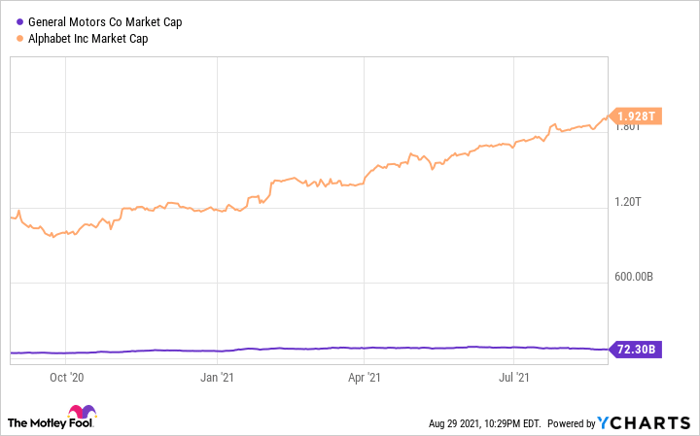
    GM Market Cap Chart

    GM Market Cap data by YCharts

    Despite being somewhat under the radar, GM has arguably built the most impressive autonomous driving business in Cruise. The company has a custom vehicle in testing, a manufacturing partner, billions in financing, and it could launch to the public in the next year or two based on plans to launch in Dubai late in 2023 and in San Francisco sometime ahead of Dubai. If self-driving cars are indeed going to be a revolution in transportation stocks, GM may have the most to gain. 

    This article was originally published on Fool.com. All figures quoted in US dollars unless otherwise stated.

    The post Self-driving cars are here and the leaders may surprise you appeared first on The Motley Fool Australia.

    Wondering where you should invest $1,000 right now?

    When investing expert Scott Phillips has a stock tip, it can pay to listen. After all, the flagship Motley Fool Share Advisor newsletter he has run for more than eight years has provided thousands of paying members with stock picks that have doubled, tripled or even more.*

    Scott just revealed what he believes could be the five best ASX stocks for investors to buy right now. These stocks are trading at near dirt-cheap prices and Scott thinks they could be great buys right now.

    *Returns as of August 16th 2021

    More reading

    Travis Hoium owns shares of Chipotle Mexican Grill and General Motors and has the following options: long March 2023 $250 puts on Tesla. John Mackey, CEO of Whole Foods Market, an Amazon subsidiary, is a member of The Motley Fool’s board of directors. Suzanne Frey, an executive at Alphabet, is a member of The Motley Fool’s board of directors. The Motley Fool Australia’s parent company Motley Fool Holdings Inc. owns shares of and has recommended Alphabet (A shares), Alphabet (C shares), Amazon, and Baidu. The Motley Fool Australia’s parent company Motley Fool Holdings Inc. has recommended CVS Health and Domino’s Pizza and has recommended the following options: long January 2022 $1,920 calls on Amazon and short January 2022 $1,940 calls on Amazon. The Motley Fool Australia has recommended Alphabet (A shares), Alphabet (C shares), and Amazon. The Motley Fool has a disclosure policy. This article contains general investment advice only (under AFSL 400691). Authorised by Bruce Jackson.

    This article was originally published on Fool.com. All figures quoted in US dollars unless otherwise stated.

    from The Motley Fool Australia https://ift.tt/3zXhbbh

  • The HCW (ASX:HCW) share price has gained 15% since the REIT’s IPO

    a doctor in white coat and stethoscope stands in front of a building holding an electronic device in his hands.

    The HealthCo Healthcare & Wellness REIT Units (ASX: HCW) share price has had a solid start to its time on the ASX.

    Healthco Healthcare & Wellness (HCW) is a real estate investment trust (REIT).

    Since it listed on Monday, the company’s stock has gained 4.54%. It is also currently 15% higher than its prospectus‘ offer price of $2 per share.

    Right now, the HealthCo REIT (HCW) share price is $2.30, up 0.88% on its previous closing price.

    Let’s take a look at the ASX’s newest REIT’s Initial Public Offering (IPO).  

    HCW share price soars on IPO

    What is HCW?

    HCW is a REIT focused on healthcare and wellness assets.

    It plans to keep a portfolio consisting of hospitals and facilities for aged care, childcare, government, life sciences and research, and primary care and wellness.

    Nearly all of the company’s 27 properties are located in Australia’s eastern states, with one in Western Australia. Its assets have an occupancy rate of 96% and a weighted average lease expiry of 9.4 years.

    Additionally, the company believes its portfolio has exposure to Australia’s upcoming megatrends, such as an ageing population, healthcare sector growth, and greater use of wellness services.

    HCW states its portfolio is valued at $555 million.

    The funds raised through its listing will go towards increasing its portfolio through acquisitions. They will also fund the remaining expenses related to 4 properties the company is developing.

    HCW’s IPO

    The HCW share price has been performing exceptionally well since it debuted on the ASX on Monday.

    The company’s prospectus’ offer included 325 million new shares, giving HCW an expected market capitalisation of $650 million.

    HCW’s shares began trading on the ASX at 11am Monday morning, opening at $2.20 and finishing their first day at $2.29.

    So far, the HCW share price’s record high is $2.39.

    At its current share price, HCW has a market capitalisation of $741 million.

    The post The HCW (ASX:HCW) share price has gained 15% since the REIT’s IPO appeared first on The Motley Fool Australia.

    Should you invest $1,000 in HealthCo Healthcare & Wellness right now?

    Before you consider HealthCo Healthcare & Wellness, you’ll want to hear this.

    Motley Fool Investing expert Scott Phillips just revealed what he believes are the 5 best stocks for investors to buy right now… and HealthCo Healthcare & Wellness wasn’t one of them.

    The online investing service he’s run for nearly a decade, Motley Fool Share Advisor, has provided thousands of paying members with stock picks that have doubled, tripled or even more.* And right now, Scott thinks there are 5 stocks that are better buys.

    *Returns as of August 16th 2021

    More reading

    Motley Fool contributor Brooke Cooper has no position in any of the stocks mentioned.

    The Motley Fool Australia’s parent company Motley Fool Holdings Inc. has no position in any of the stocks mentioned. The Motley Fool Australia has no position in any of the stocks mentioned. The Motley Fool has a disclosure policy. This article contains general investment advice only (under AFSL 400691). Authorised by Bruce Jackson.

    from The Motley Fool Australia https://ift.tt/3hc1s0H

  • Macquarie (ASX:MQG) share price gains 6% despite lower second half forecast

    green arrow representing a rise in the share price

    The Macquarie Group Ltd (ASX: MQG) share price has stepped into the green from the opening of trade on Wednesday.

    Macquarie shares are on the move after the company provided an update on its “short-term” outlook at the Jeffries Asia Forum.

    Let’s investigate further.

    What did Macquarie announce?

    In news that could weigh in on the Macquarie share price, the investment bank expects its 1H FY22 results to be “slightly down on 2H FY21”.

    Macquarie provided several pointers as to why it anticipates weaker earnings in the first half of FY22.

    Firstly, the group’s first half result in FY22 includes the Macquarie Infrastructure Corp (NYSE: MIC) disposition fee in Macquarie Asset Management.

    The bank also anticipates base fees associated with Macquarie Asset Management to be “broadly in line” with last year. This excludes the Waddell & Reed acquisition, however.

    In fact, it doesn’t expect the Waddell & Reed acquisition to “provide a meaningful net profit contribution in FY22” due to “integration and one off costs”.

    Net “other” operating income is also tipped to come in weaker in 1H FY22, due to “significant one off items in FY21” in Macquarie Asset Management.

    What else did Macquarie add?

    In its banking business, Macquarie believes competition amongst peers will “continue driving margin pressure”.

    The bank also forecasts higher expenses for this segment, to support growth and investment.

    Despite this, greater transaction activity is expected to continue in FY22 for Macquarie Capital, partially offsetting the softened forecasts in other segments.

    The bank’s commodities income is also “expected to be down following a strong FY21”. Although it does see opportunities if volatility remains in commodities markets.

    However, its commodities and global markets segment is still performing better than anticipated. There is also the disposal of the UK commercial and industrial smart meter portfolio that will impact results here, as per the release.

    Touching on its “short term outlook”, Macquarie said: “We continue to maintain a cautious stance, with a conservative approach to capital, funding and liquidity that positions us well to respond to the current environment”.

    Aside from its short-term forecasts, the company added some colour to its “medium term” outlook.

    Here Macquarie believes it remains “well positioned to deliver superior performance in the medium term”. A stark contrast to its near term forward estimates.

    Investors appear to have bought in on the bank’s medium term outlook, potentially choosing to ignore the short term “noise”.

    As such, the Macquarie share price has climbed 6% into the green from the opening of trade today and is now trading at $181.70 apiece.

    Macquarie Bank share price snapshot

    The Macquarie Bank share price has climbed 30% this year to date, extending the gain of the last 12 months to 40%.

    These results have both outpaced the S&P/ASX 200 index (ASX: XJO)’s return of around 25% over the past year.

    The post Macquarie (ASX:MQG) share price gains 6% despite lower second half forecast appeared first on The Motley Fool Australia.

    Should you invest $1,000 in Macquarie Group right now?

    Before you consider Macquarie Group, you’ll want to hear this.

    Motley Fool Investing expert Scott Phillips just revealed what he believes are the 5 best stocks for investors to buy right now… and Macquarie Group wasn’t one of them.

    The online investing service he’s run for nearly a decade, Motley Fool Share Advisor, has provided thousands of paying members with stock picks that have doubled, tripled or even more.* And right now, Scott thinks there are 5 stocks that are better buys.

    *Returns as of August 16th 2021

    More reading

    The author Zach Bristow has no positions in any of the stocks mentioned. The Motley Fool Australia’s parent company Motley Fool Holdings Inc. has no position in any of the stocks mentioned. The Motley Fool Australia owns shares of and has recommended Macquarie Group Limited. The Motley Fool has a disclosure policy. This article contains general investment advice only (under AFSL 400691). Authorised by Bruce Jackson.

    from The Motley Fool Australia https://ift.tt/3tldiKK

  • Is the Sezzle (ASX:SZL) share price a beaten-up buy?

    A man tuches his finger to a cyber payment screen indicating a wider range of shopping options

    Is the Sezzle Inc (ASX: SZL) share price a beaten-up buying opportunity after falling by 33% over the last two months?

    Investors often like to base their valuation thoughts on a business’ performance. The last time investors got a look at Sezzle was in reporting season last month.

    The August update

    The business reported that for the six months ending 30 June 2021 it saw revenue increase 159% to US$53.9 million. But the net loss worsened by 271% to US$30.4 million.

    For the second quarter of FY21, it saw its underlying merchant sales (UMS) rise to US$411.1 million. That was a year on year increase of 118.7%. In quarter on quarter terms, that was an increase of 9.6% for UMS.

    Total income as a percentage of UMS was 6.8% in the second quarter of FY21, the same as the first quarter of FY21. It was up from the second quarter of FY20 where it was 6.7%.

    Sezzle explained that this growth was driven by growth of active consumers, active merchants and repeat usage.

    Active consumer repeat usage grew to 91.6% in June 2021, which was the 30th consecutive month of improvement.

    The top 10% of Sezzle’s consumers, based on UMS, transact approximately four times a month.

    Management also revealed progress in July 2021, which may have had an influence on the Sezzle share price.

    The executive Chair and CEO of Sezzle, Charlie Youakim said:

    Our strong momentum continued after quarter end, as July represented a new monthly active high in UMS (US$150.6 million), we crossed over the 3 million active consumers mark and we are now engaged with 41,800 active merchants on the Sezzle platform. Our scale and positive market positioning, as a public benefit corporation and B Corp, are resonating with consumers and merchants alike. We are also excited about the partnerships we are creating, such as the recent agreement with and investment from Discover Financial Services and e-commerce platform, BigCommerce, naming Sezzle as its preferred buy now, pay later partner.

    Is the Sezzle share price a buy?

    Sezzle says that it has large upside potential because of the low BNPL penetration of e-commerce, representing 1.6% in North America. New product verticals are seeing increased user and merchant demand for BNPL offerings.

    It’s expanding into new categories such as health, electronics and travel.

    Sezzle is also expanding geographically. It launched in Canada in 2019 and it also notes positive trends in India, favourable cross-border discussions in Europe and it’s in the early stages of entering Brazil. It launched in India in July 2020 and in started in Brazil in April 2021.

    The broker Ord Minnett currently rates the Sezzle share price as a buy with a price target of $10. That implies that Sezzle shares could rise around 50% over the next year, if the broker is right.

    The post Is the Sezzle (ASX:SZL) share price a beaten-up buy? appeared first on The Motley Fool Australia.

    Should you invest $1,000 in Sezzle right now?

    Before you consider Sezzle, you’ll want to hear this.

    Motley Fool Investing expert Scott Phillips just revealed what he believes are the 5 best stocks for investors to buy right now… and Sezzle wasn’t one of them.

    The online investing service he’s run for nearly a decade, Motley Fool Share Advisor, has provided thousands of paying members with stock picks that have doubled, tripled or even more.* And right now, Scott thinks there are 5 stocks that are better buys.

    *Returns as of August 16th 2021

    More reading

    Motley Fool contributor Tristan Harrison has no position in any of the stocks mentioned. The Motley Fool Australia’s parent company Motley Fool Holdings Inc. has no position in any of the stocks mentioned. The Motley Fool Australia has no position in any of the stocks mentioned. The Motley Fool has a disclosure policy. This article contains general investment advice only (under AFSL 400691). Authorised by Bruce Jackson.

    from The Motley Fool Australia https://ift.tt/38UWOPX

  • The BHP (ASX:BHP) share price is flat in 2021. But how much has the company contributed to the Australian economy?

    Lots of hands reach in to take a share of a birthday cake.

    The BHP Group Ltd (ASX: BHP) share price hasn’t gone anywhere over the past 9 months, since falling in mid-August. This is in stark contrast to when the miner registered gains of close to 30% before its steep drop.

    Clearly, the sinking iron ore spot price along with the Chinese government’s efforts to reduce reliance is affecting BHP shares.

    But you may be wondering, despite the current woes, how much has BHP contributed to the Australian economy in 2021?

    BHP’s contribution to Australia

    BHP released its Australian economic contribution figures for the 2021 financial year in a statement to the ASX.

    A key driver of the country’s economic engine, BHP has injected a total of $34.1 billion. This comprises $11.1 billion in payments to suppliers, $6 billion in dividend and interest payments to investors, $100 million in social investments, and $4.5 billion in employee payments.

    In addition, the total payment to the Australian government came in at around $12.4 billion. The amount relates to Australian taxes, royalties and other payments to governments, accounting for 41.4% of the total economic output.

    State royalties include $3 billion to Western Australia, $402 million to Queensland, $102 million to South Australia, $83 million to New South Wales, and $444 million in other payments to federal and state governments.

    Looking over the last 10 years, BHP has contributed about $80.3 billion to the Australian economy.

    BHP share price summary

    Since this time last year, BHP shares have moved 11% higher. Year to date though, shares are down around 1%.

    At the time of writing, the BHP share price is adding pressure, down 0.86% to $41.68 today. BHP shares have lost close to 20% in value in the past month, including a 6% drop on 2 September when the company went ex-dividend.

    BHP commands a market capitalisation of roughly $123 billion, making it the third largest company on the ASX.

    The post The BHP (ASX:BHP) share price is flat in 2021. But how much has the company contributed to the Australian economy? appeared first on The Motley Fool Australia.

    Should you invest $1,000 in BHP right now?

    Before you consider BHP, you’ll want to hear this.

    Motley Fool Investing expert Scott Phillips just revealed what he believes are the 5 best stocks for investors to buy right now… and BHP wasn’t one of them.

    The online investing service he’s run for nearly a decade, Motley Fool Share Advisor, has provided thousands of paying members with stock picks that have doubled, tripled or even more.* And right now, Scott thinks there are 5 stocks that are better buys.

    *Returns as of August 16th 2021

    More reading

    Motley Fool contributor Aaron Teboneras has no position in any of the stocks mentioned. The Motley Fool Australia’s parent company Motley Fool Holdings Inc. has no position in any of the stocks mentioned. The Motley Fool Australia has no position in any of the stocks mentioned. The Motley Fool has a disclosure policy. This article contains general investment advice only (under AFSL 400691). Authorised by Bruce Jackson.

    from The Motley Fool Australia https://ift.tt/3yRNc3f

  • Qantas (ASX:QAN) share price slips despite data showing Aussies keen to fly

    a family of parents with two children ride an airport trolley with luggage and tourist trappings such as field glasses with excited expressions on their faces.

    The Qantas Airways Ltd (ASX: QAN) share price is sliding in morning trade, down 1.38% to $5.355 a share.

    This comes despite new data that reveals Australians are building an overwhelming desire for international travel.

    Travel search queries surge

    New data from Qantas shows a huge pent-up demand for travel from Australians who have largely been prevented from traveling overseas since March 2020.

    Last week, the airline reported its plans to relaunch international travel commencing on 18 December.

    As The Australian reports, Qantas has since seen “searches of its international flights almost triple”.

    In fact, the Qantas digital team reported a 175% increase in flight searches. Sydney and Melbourne to London were the most popular destination searches. Singapore and Tokyo were also high on the list of international travel plans “with most people looking to get away as soon as borders reopen”.

    According to Qantas international chief executive Andrew David:

    [Australians] could not wait to get back on an aircraft and head overseas again. So many people have missed out on seeing loved ones who live overseas or taking a well-deserved break…

    While it’s up to government to determine exactly how and when our international borders re-open, Australia is on track to meet the 80 per cent vaccination trigger by December, which means international travel is within reach.

    Qantas CEO Alan Joyce has been a leader in urging a coordinated national vaccination campaign.

    The airline is requiring its own staff to get vaccinated and is eager to see domestic borders and international borders reopen.

    However, Joyce pointed out that some Australians may find themselves in a situation where they can travel internationally, but not interstate.

    According to Joyce (quoted by The Australian):

    We might get into a situation where from Sydney you can visit your relatives in London, maybe Dublin, but you can’t visit your relatives in Perth or maybe Cairns and that would be sad if we got to that.

    Hopefully we’ll get everybody to keep with the national cabinet plan which will mean everybody can get together at Christmas, domestically and internationally.

    Qantas share price snapshot

    The Qantas share price is up 11% year-to-date, just trailing the 12% gain posted by the S&P/ASX 200 Index (ASX: XJO).

    Over the past month, Qantas shares have gained 17%.

    The post Qantas (ASX:QAN) share price slips despite data showing Aussies keen to fly appeared first on The Motley Fool Australia.

    Should you invest $1,000 in Qantas right now?

    Before you consider Qantas, you’ll want to hear this.

    Motley Fool Investing expert Scott Phillips just revealed what he believes are the 5 best stocks for investors to buy right now… and Qantas wasn’t one of them.

    The online investing service he’s run for nearly a decade, Motley Fool Share Advisor, has provided thousands of paying members with stock picks that have doubled, tripled or even more.* And right now, Scott thinks there are 5 stocks that are better buys.

    *Returns as of August 16th 2021

    More reading

    The Motley Fool Australia’s parent company Motley Fool Holdings Inc. has no position in any of the stocks mentioned. The Motley Fool Australia has no position in any of the stocks mentioned. The Motley Fool has a disclosure policy. This article contains general investment advice only (under AFSL 400691). Authorised by Bruce Jackson.

    from The Motley Fool Australia https://ift.tt/3l60Zhx

  • Fortescue (ASX:FMG) share price higher as China’s imports surge to record high in August

    mining worker making excited fists and looking excited

    The Fortescue Metals Group Limited (ASX: FMG) share price is catching a bid on Wednesday, up 0.72% to $18.12.

    Shares in the iron ore major tumbled 10.94% to $18.57 on Monday after going ex-dividend for a significant fully franked final dividend of $2.11 per share.

    Iron ore rebounds following record Chinese trade figures

    Iron ore prices rebounded on Tuesday after plunging to seven month lows on Monday.

    According to Fastmarkets MB, benchmark iron ore prices increased US$5.59/t or 4.2% to US$137.97/t.

    The uptick in prices comes after an unexpected jump in Chinese trade figures.

    Bloomberg reported that the value of China’s iron ore imports hit new record highs in August despite policymakers recently implementing steel output controls to curb carbon emissions.

    “China imported iron ore worth a record $20 billion in August, according to government data released Tuesday, as prices surged from a year earlier. Total volumes were 97.5 million tonnes”.

    China’s overall trade performance in August defied expectations in light of the rapidly spreading Delta variant.

    Prior to August’s trade figures, all signs pointed to a slowdown in the Chinese economy as supply-China constraints, higher raw material prices and extreme weather dragged on key areas of its economy.

    Fortescue share price in the deep red

    The Fortescue share price has plunged well into negative territory, down 27.1% year-to-date.

    The retracement in iron ore prices from ~US$220/t in June to US$137.97/t has erased 12-months worth of hard earned gains.

    Looking ahead, the Australian Financial Review (AFR) reported that the bounce in imports and demand for iron ore will prove to be short-lived.

    “Analysts warned the combination of China’s carbon policies, a slowing property sector and Beijing’s desire to find alternative markets for iron ore point to a medium-term decline in demand for the commodity from Australia, although this could take time.”

    The post Fortescue (ASX:FMG) share price higher as China’s imports surge to record high in August appeared first on The Motley Fool Australia.

    Should you invest $1,000 in Fortescue right now?

    Before you consider Fortescue , you’ll want to hear this.

    Motley Fool Investing expert Scott Phillips just revealed what he believes are the 5 best stocks for investors to buy right now… and Fortescue wasn’t one of them.

    The online investing service he’s run for nearly a decade, Motley Fool Share Advisor, has provided thousands of paying members with stock picks that have doubled, tripled or even more.* And right now, Scott thinks there are 5 stocks that are better buys.

    *Returns as of August 16th 2021

    More reading

    Motley Fool contributor Kerry Sun has no position in any of the stocks mentioned. The Motley Fool Australia’s parent company Motley Fool Holdings Inc. has no position in any of the stocks mentioned. The Motley Fool Australia has no position in any of the stocks mentioned. The Motley Fool has a disclosure policy. This article contains general investment advice only (under AFSL 400691). Authorised by Bruce Jackson.

    from The Motley Fool Australia https://ift.tt/3hbnBfC

  • Piedmont Lithium (ASX:PLL) share price dives 6% after class action lawsuit

    a stern judge slams a gavel onto her desk with the American flag visible in the background.

    The Piedmont Lithium Inc (ASX: PLL) share price is plunging on Wednesday after its mining permit woes escalated into a securities class action lawsuit.

    At the time of writing, shares in the emerging lithium producer are down 5.7% to 74.5 cents.

    Why is the Piedmont Lithium share price sinking?

    Securities litigation firm, Wolf Haldenstein Adler Freeman & Herz LLP, announced that it had filed a federal securities class action lawsuit in the United States on behalf of persons and entities that have purchased Piedmont Lithium shares.

    Wolf Haldenstein’s complaint advised any investors to contact the firm immediately, saying:

    If you have incurred losses in the shares of Piedmont Lithium Inc., you may, no later than September 21, 2021, request that the Court appoint you lead plaintiff of the proposed class. Please contact Wolf Haldenstein to learn more about your rights as an investor in Piedmont Lithium Inc.

    What’s the class action for?

    Wolf Haldenstein pointed to the company’s recent mining permit issues, citing:

    On July 20, 2021, before market hours, Reuters reported that Piedmont “has not applied for a state mining permit or a necessary zoning variance in Gaston County, just west of Charlotte, NC, despite telling investors since 2018 that it was on the verge of doing so.” According to the article, a majority of the Board of Commissioners said, “they may block or delay the project because Piedmont has not told them what levels of dust, noise and vibrations will occur, nor how water and air quality would be affected.”

    According to Piedmont Lithium’s prior announcements, permits for lithium production and its chemical plant were expected to be complete by mid-2021.

    The Piedmont Lithium share price dived 21.3% to a 5-month low of 68.5 cents on the day of Reuters’ report.

    It wasn’t until Thursday, 2 September that the company announced applications for a mining permit with the North Carolina Department of Environmental Quality.

    The post Piedmont Lithium (ASX:PLL) share price dives 6% after class action lawsuit appeared first on The Motley Fool Australia.

    Should you invest $1,000 in Piedmont Lithium right now?

    Before you consider Piedmont Lithium, you’ll want to hear this.

    Motley Fool Investing expert Scott Phillips just revealed what he believes are the 5 best stocks for investors to buy right now… and Piedmont Lithium wasn’t one of them.

    The online investing service he’s run for nearly a decade, Motley Fool Share Advisor, has provided thousands of paying members with stock picks that have doubled, tripled or even more.* And right now, Scott thinks there are 5 stocks that are better buys.

    *Returns as of August 16th 2021

    More reading

    Motley Fool contributor Kerry Sun has no position in any of the stocks mentioned. The Motley Fool Australia’s parent company Motley Fool Holdings Inc. has no position in any of the stocks mentioned. The Motley Fool Australia has no position in any of the stocks mentioned. The Motley Fool has a disclosure policy. This article contains general investment advice only (under AFSL 400691). Authorised by Bruce Jackson.

    from The Motley Fool Australia https://ift.tt/3l3aX3l

  • How have ASX bank shares performed during the August 2021 earnings season?

    A group of happy corporate bankers clap hands

    The post-COVID economic recovery has been a boon for Australia’s major banks, giving investors reason for optimism.

    Although the Commonwealth Bank of Australia (ASX: CBA) was the only one of the four big banks to report full-year results in the August reporting season, all have shown strong performances in 2021 based on reporting to date.

    National Australia Bank Ltd (ASX: NAB), Westpac Banking Corp (ASX: WBC), and Australia and New Zealand Banking Group Ltd (ASX: ANZ) are expected to reveal their full-year results from late October. 

    How have ASX bank shares performed against the market?

    ASX bank shares have performed strongly in 2021. The CBA share price has climbed 21.6% over the year so far to trade above $100.

    The NAB share price is up 25% over 2021 with shares now trading on par with pre-COVID levels. The ANZ share price has gained 20%% over the same period while the Westpac share price is up 32%.

    This compares favourably to the All Ordinaries Index (ASX: XAO), which is up 12.5% in 2021. Nonetheless, of the big four banks, only the Commonwealth Bank has seen its share price exceed heights reached in 2017, prior to the Banking Royal Commission. 

    Who are winners this earnings season? 

    All four major ASX banks are expected to report increased earnings and profit for FY21.

    CBA saw net profit after tax increase more than 19% to $8.8 billion over the year to 30 June 2021. The bank reported that improved economic conditions resulted in lower loan impairments and strong operational performance.

    Loan impairment expenses decreased 78% to $554 million, while business lending grew at 3x system. Combined with a strong capital position, the result allowed CBA to declare a fully franked full-year dividend of $2, bringing FY21 dividends to $3.50

    CBA took the opportunity to announce a $6 billion off-market share buyback, funded by $6.2 billion in excess capital generated through strategic divestments. The buyback will return surplus capital to shareholders, with a lower share count supporting future returns on equity.

    CBA is not the only major undertaking a share buyback — ANZ announced its own $1.5 billion on-market buyback in July. The bank considered this the most prudent, fairest, and flexible method to return surplus capital to shareholders.  

    ANZ reported a $2.9 billion profit for the half-year ending 31 March 2021. A key driver was a net credit provision release of $491 million which came thanks to improved credit conditions. Nonetheless, the bank still had almost $4.3 billion in reserve in case conditions deteriorate.

    ANZ’s earnings per share (EPS) rose to 105.3 cents, up from 82.8 cents per share in the previous half. Costs were down 2% with work to digitise core processes and platforms continuing. A strong balance sheet, solid earnings, and improving conditions combined to give ANZ confidence to pay an interim dividend of 70 cents per share, fully franked, up from a final dividend of 35 cents per share in 2020. 

    Westpac also saw a significant increase in profits over the half-year ending 31 March 2021. In May, Westpac reported profits of $3.4 billion for the half-year, a 189% increase on the first half of 2020. The boost in profits was mainly thanks to an impairment benefit reflecting improved asset quality and a better economic outlook.

    Westpac’s earnings were up 256% on the prior corresponding period to $3.5 billion. Earnings per share more than tripled to 97 cents and an interim dividend of 58 cents per share was declared — Westpac did not declare a dividend for 1H20. 

    And the losers this earnings season? 

    There aren’t any real losers among ASX bank shares this reporting season.

    NAB grew cash earnings by 94.8% in the first half of the year, notching up a tidy $3.2 billion profit. Like the other banks, NAB has benefited from a better than expected rebound in the Australian and New Zealand economies post the initial COVID-19 downturn.

    This has resulted in significantly better credit impairment outcomes than anticipated at the start of the pandemic. NAB’s 1H21 credit impairment charges were a write-back of $128 million, versus a 1H20 charge of $1.16 billion. The strong half-year result and growing confidence in the economic outlook prompted NAB to declare an interim dividend of 60 cents per share, double that of the previous year. 

    ASX bank shareholders have enjoyed the return of dividends in FY21, with interim dividends doubling for ANZ and NAB compared to the prior corresponding period.

    Westpac reinstated its interim dividend, while CBA will pay full year dividends of $3.50, up from $2.98 for FY20, but below the $4.31 paid for FY19. 

    Looking ahead

    Australia’s financial system has proven to be strong and stable over the past 18 months, supported by well-capitalised banks including the big four.

    NAB says performance in the June quarter was encouraging, with cash earnings rising supported by significantly better credit impairment outcomes. NAB reported a $1.65 billion unaudited statutory net profit for the third quarter, with cash earnings up 10.3% compared to the prior corresponding period.

    Continued COVID-19 outbreaks are creating uncertainty, but the bank says it remains optimistic about the long term outlook for Australia and New Zealand. Once restrictions are eased, NAB is confident the economy will bounce back. 

    CBA anticipates ongoing economic impacts and earnings pressure from lower interest rates, and says it is prepared for a range of different economic scenarios.

    Nonetheless, its strong capital and balance sheet position means it has capacity to absorb potential stress events. This allows for the return of surplus capital to CBA shareholders via the share buyback.

    ANZ has taken a similar position, citing the strength of its balance sheet and ongoing financial performance as factors facilitating its own return of capital to shareholders. 

    Westpac says the first half of the year has been promising, with considerably higher earnings and improved balance sheet strength. The bank said the economic outlook was more positive when it reported its half year results, but acknowledged remaining uncertainty.

    As a result, Westpac has remained prudent in its impairment provisioning but expects the Australian economy to expand by 4.5% in 2021. This should support a 4.6% increase in total credit with residential lending expanding 6.5%. 

    The post How have ASX bank shares performed during the August 2021 earnings season? appeared first on The Motley Fool Australia.

    Wondering where you should invest $1,000 right now?

    When investing expert Scott Phillips has a stock tip, it can pay to listen. After all, the flagship Motley Fool Share Advisor newsletter he has run for more than eight years has provided thousands of paying members with stock picks that have doubled, tripled or even more.*

    Scott just revealed what he believes could be the five best ASX stocks for investors to buy right now. These stocks are trading at near dirt-cheap prices and Scott thinks they could be great buys right now.

    *Returns as of August 16th 2021

    More reading

    Motley Fool contributor Katherine O’Brien has no position in any of the stocks mentioned. The Motley Fool Australia’s parent company Motley Fool Holdings Inc. has no position in any of the stocks mentioned. The Motley Fool Australia has no position in any of the stocks mentioned. The Motley Fool has a disclosure policy. This article contains general investment advice only (under AFSL 400691). Authorised by Bruce Jackson.

    from The Motley Fool Australia https://ift.tt/3A5l3a4

  • The Sydney Airport (ASX:SYD) share price has gained 37% in the last 6 months

    A girl runs along with her kite flying high in the sky.

    The Sydney Airport Holdings Pty Ltd (ASX: SYD) share price has been flying these last 6 months.

    Shares in Australia’s largest airport are currently trading for $7.91. Over the last 6 months, Sydney Airport shares have outpaced the S&P/ASX 200 Index (ASX: XJO) 37% to 12%. This is despite the challenges the company has faced due to the COVID-19 pandemic.

    Let’s see what’s been happening the last 6 months.

    Sydney Airport shares are in the sky

    The story that had the biggest impact on the Sydney Airport share price is undoubtedly the $23 billion takeover bid the company received in July.

    On the day of the announcement, Sydney Airport shares rocketed 37% to $7.78 each. Since then, shares have gone even higher – reaching a new 52-week high of $8.04 at one point. The company’s board ultimately rejected the bid, claiming it “undervalued” the company and was “opportunistic”.

    The consortium took a second bite of the cherry about 3 weeks ago, but this bid too was dismissed.

    Another possible reason for the rising Sydney Airport share price may be increasing optimism among investors about ASX travel shares. Australia’s rapidly progressing vaccine rollout is pushing the nation closer to reopening its international borders and ending domestic travel restrictions. This is supposed to happen when 80% of the eligible population has received both doses of an approved coronavirus vaccine. The most recent figures suggest we should hit this number by the end of the year.

    You can see this surging optimism in other popular ASX travel shares – at least over the last 5 days. While the ASX 200 has fallen 0.06% in this time. The Qantas Airways Limited (ASX: QAN) share price is up 6.89%, while the Flight Centre Travel Group Ltd (ASX: FLT) is 12.6% higher in this time.

    Sydney Airport share price snapshot

    Over the last 12 months, the Sydney Airport share price has risen an even more impressive 41.76%. Year to date, shares in the airport have appreciated 23.4%. Sydney Airport Holdings has a market capitalisation of $21.3 billion.

    The post The Sydney Airport (ASX:SYD) share price has gained 37% in the last 6 months appeared first on The Motley Fool Australia.

    Should you invest $1,000 in Sydney Airport right now?

    Before you consider Sydney Airport, you’ll want to hear this.

    Motley Fool Investing expert Scott Phillips just revealed what he believes are the 5 best stocks for investors to buy right now… and Sydney Airport wasn’t one of them.

    The online investing service he’s run for nearly a decade, Motley Fool Share Advisor, has provided thousands of paying members with stock picks that have doubled, tripled or even more.* And right now, Scott thinks there are 5 stocks that are better buys.

    *Returns as of August 16th 2021

    More reading

    Motley Fool contributor Marc Sidarous has no position in any of the stocks mentioned. The Motley Fool Australia’s parent company Motley Fool Holdings Inc. has no position in any of the stocks mentioned. The Motley Fool Australia has recommended Flight Centre Travel Group Limited. The Motley Fool has a disclosure policy. This article contains general investment advice only (under AFSL 400691). Authorised by Bruce Jackson.

    from The Motley Fool Australia https://ift.tt/3nqm1dV