Tag: Motley Fool

  • August hasn’t been a great month for the Beach Energy (ASX:BPT) share price

    A child in full business suit holds a falling, zigzagged red arrow pointing downwards while sitting at a desk that holds cash and an old-fashioned adding machine with paper spooling.

    The Beach Energy Ltd (ASX: BPT) share price has faced headwinds over the last month.

    Whereas the S&P/ASX 200 index (ASX: XJO) has climbed 1.9% since the start of August, Beach Energy shares are 12% in the red.

    Let’s find out why.

    What’s up with the Beach Energy share price in August?

    The Beach Energy share price started August exchanging hands at $1.24, which ended up being the high for the month.

    Shares in the oil and gas explorer have since marched southwards, particularly after the company reported its FY21 earnings on 16 August.

    In its report, Beach recognised a 36% drop in net profit after tax (NPAT) and a 4% decrease in oil production.

    Management also gave softer than expected guidance of 21 million to 23 million barrels of oil equivalent in production for FY22.

    Investors were quick to punish the company, wiping 10% in value from the Beach Energy share price and forcing it to close at $1.09 on the day of its earnings.

    There was some reprieve in the days following, where a positive broker note from Citi on 18 August resulted in a 7% jump for Beach Energy shares.

    Citi upgraded its rating to buy from neutral, with the posture that Beach will regain production strengths from FY23. However, it did trim its price target to $1.27, lower than Goldman Sachs’ target of $1.40. Goldman Sachs holds a neutral rating on the company’s shares.

    The investment bank’s upgrade was not enough to fuel a recovery though, as the Beach Energy share price has continued to stumble within a tight range over the last two-three weeks.

    In fact, Beach shares have given away a further 4% over the last 5 trading sessions to the time of writing.

    There has been no other market-sensitive information released by the company over this time period. Therefore, it stands to reason that investors continue selling Beach Energy shares on the back of its lacklustre FY21 performance and guidance.

    Some might say, life’s been a beach for the company over the month of August.

    Beach Energy share price snapshot

    The Beach Energy share price has had a difficult year to date, posting a loss of 42% since January 1. This extends the loss over the last 12 months to 31%.

    These results have lagged the broad index’s return of around 25% over the past year.

    Beach Energy shares are currently exchanging hands at $1.05 apiece, a further 1.41% dip into the red from the open.

    The post August hasn’t been a great month for the Beach Energy (ASX:BPT) share price appeared first on The Motley Fool Australia.

    Should you invest $1,000 in Beach Energy right now?

    Before you consider Beach Energy, you’ll want to hear this.

    Motley Fool Investing expert Scott Phillips just revealed what he believes are the 5 best stocks for investors to buy right now… and Beach Energy wasn’t one of them.

    The online investing service he’s run for nearly a decade, Motley Fool Share Advisor, has provided thousands of paying members with stock picks that have doubled, tripled or even more.* And right now, Scott thinks there are 5 stocks that are better buys.

    *Returns as of August 16th 2021

    More reading

    The author Zach Bristow has no positions in any of the stocks mentioned. The Motley Fool Australia’s parent company Motley Fool Holdings Inc. has no position in any of the stocks mentioned. The Motley Fool Australia has no position in any of the stocks mentioned. The Motley Fool has a disclosure policy. This article contains general investment advice only (under AFSL 400691). Authorised by Bruce Jackson.

    from The Motley Fool Australia https://ift.tt/2YdjSYj

  • China gaming ban brings BetaShares’ ASIA (ASX:ASIA) ETF into focus

    A gamer slumps his head in his hands in front of two gaming screens

    The BetaShares ASIA Technology Tigers ETF (ASX: ASIA) exchange-traded fund (ETF) is back in focus on Tuesday after a major announcement from the Chinese government last night.

    In a dramatic move, China is opting to ban children from playing online games for more than 3 hours per week. Considering the People’s Republic holds the largest population of any country on the planet, as well as one of the highest youth populations, this decision could deal a significant blow to the gaming industry.

    Tightening controls around addiction concerns

    The hammer has been brought down by the China government to introduce even heavier restrictions on youth gaming overnight. This decision follows reports made earlier in August, dubbing gaming as ‘spiritual opium’ by the Chinese state media.

    Under the new rules, people under the age of 18 will only be allowed to play online games under the tighten time constraints. These new gaming periods are reserved between 8:00 pm and 9:00 pm on Fridays, weekends, and public holidays.

    As a result, children will typically be reduced to 3 hours of gaming per week. In comparison, the government’s previous allowance was for an hour and a half per day and up to 3 hours on public holidays. In other words, kids will go from 10 and a half hours per week down to 3, as the local government attempts to combat its concerns of gaming addiction. Unfortunately for ASIA ETF investors, some of the impacted companies are featured in the tech-focused investment.

    To enforce these restrictions, the government will demand companies utilise real-name verification systems. Gaming companies will not be allowed to provide their services to minors outside of the specified timeframes.

    Unsurprisingly, investors of internet and gaming companies with exposure to China have been unsettled by the announcement. At the time of writing, the Tencent Holdings Ltd (HKG: 0700) share price is down 3.3%. Likewise, Chinese PC and mobile games company NetEase Inc (NASDAQ: NTES) is trading 3.5% lower.

    ASIA ETF exposure

    When it comes to the BetaShares ASIA ETF, 45.5% of the fund’s holdings are exposed to China. At the same time, many of these companies are geared towards the internet, gaming, and/or online media sectors. For instance, 17.8% of the fund is in the ‘interactive media and services’ sector. Meanwhile, 9.5% is allocated to ‘interactive home entertainment’.

    This is evident when looking at the ETF’s top 10 holdings. According to the July fact sheet, the ASIA ETF counted Tencent as its fourth-largest holding at 9.2%. Another familiar face is NetEase, sitting at the tenth spot with a 3.4% weighting.

    At the time of writing, the BetaShares Asia Technology Tigers ETF holds $665 million of total assets under management.

    The post China gaming ban brings BetaShares’ ASIA (ASX:ASIA) ETF into focus appeared first on The Motley Fool Australia.

    Should you invest $1,000 in BetaShares ASIA Technology Tigers ETF right now?

    Before you consider BetaShares ASIA Technology Tigers ETF, you’ll want to hear this.

    Motley Fool Investing expert Scott Phillips just revealed what he believes are the 5 best stocks for investors to buy right now… and BetaShares ASIA Technology Tigers ETF wasn’t one of them.

    The online investing service he’s run for nearly a decade, Motley Fool Share Advisor, has provided thousands of paying members with stock picks that have doubled, tripled or even more.* And right now, Scott thinks there are 5 stocks that are better buys.

    *Returns as of August 16th 2021

    More reading

    Motley Fool contributor Mitchell Lawler has no position in any of the stocks mentioned. The Motley Fool Australia’s parent company Motley Fool Holdings Inc. has recommended NetEase. The Motley Fool Australia owns shares of and has recommended BetaShares Asia Technology Tigers ETF. The Motley Fool has a disclosure policy. This article contains general investment advice only (under AFSL 400691). Authorised by Bruce Jackson.

    from The Motley Fool Australia https://ift.tt/2YfZkP3

  • DGL (ASX:DGL) share price rockets 10% on surging profits

    two chemists celebrate by jokingly clinking two containers of chemicals while they wear white laboratory coats and protective glasses in their lab.

    The DGL Group Ltd (ASX: DGL) share price is rocketing higher, up more than 10% at time of writing after earlier posting gains of more than 14%.

    DGL Group began trading on the ASX on 24 May, following a successful IPO.

    Below we take a look at the chemical manufacturer and waste recycler’s financial results for the year ending 30 June (FY21).

    DGL share price surges on FY21 results

    Some top results likely boosting the DGL share price this morning include:

    • Pro-forma sales revenue of $196 million, an increase of 9% from FY20 and 3% higher than prospectus forecast
    • Pro-forma earnings before interest, taxes, depreciation and amortisation (EBITDA) increased 47% year-on-year to $28.1 million, 8% higher than prospectus forecast
    • Pro-forma net profit after tax (NPAT) of $11.3 million increased 135% on the prior year and came in 19% more than prospectus forecast
    • Net cash of $43.8 million on the balance sheet

    What happened during the reporting period for DGL Group?

    Undoubtedly the biggest happening for DGL during the financial year was its successful initial public offering. The IPO saw the company raise $100 million before it began trading on the ASX on 24 May.

    FY21 also saw DGL acquire the Chem Pack manufacturing business in January to expand its Chemical Manufacturing division’s capabilities. The company reported Chem Pack has now been successfully integrated into its wider business.

    DGL said revenue increased across all 3 of its divisions year-on-year.

    The Chemical Manufacturing division revenue increased 3% to $97.3 million. It attributed the growth to an increase in demand for chemicals from a strongly performing agriculture sector along with growth from its acquisition of the Chem Pack business. While this came in below the prospectus forecast of $104 million revenue for the division, DGL said that forecast assumed a full year contribution from Chem Pack.

    The Warehousing and Distribution division saw revenue increase by 48% to $40.9 million, well above the prospectus forecast of $31.8 million. Revenue increased largely due to a higher utilisation of its warehousing facilities in Australia and New Zealand.

    There was also a 2% increase in revenue from the Environmental Solutions division, to $63.4 million, compared to a prospectus forecast of $59.2 million. The company recommenced operations of its refurbished Victorian lead smelter “ahead of schedule and on budget”. This saw more lead bullion output than it had forecast.

    What did management say?

    Commenting on the results, DGL’s founder and CEO Simon Henry said:

    This year has been a transformative year for DGL, listing on the ASX and welcoming new shareholders to our business, while raising $100 million to fund growth initiatives into the future.

    I am very pleased we have been able to deliver on our initial promises, as set out in the prospectus, both at an operational level and financial level. Pro-forma net profit after tax was 19.4% higher than we had originally estimated in our prospectus…

    We will continue to use funds from the IPO, as well as the strong cash generation of our business, to pursue growth opportunities…The diverse industries we service — agriculture, mining, construction and infrastructure – have positive long-term outlooks. We are an essential business serving these critical sectors.

    What’s next for DGL?

    Looking ahead, DGL said it expects to beat prospectus forecasts for FY22. The pro-forma NPAT forecast for FY22 is $10.4 million while the pro-forma EBITDA forecast is $29 million.

    Henry noted that these don’t “include the revenue and profit contribution from recently acquired businesses, Labels Connect and Opal Australasia, and favourable trading conditions experienced to date”.

    The company said it has not been materially impacted by COVID-19 lockdowns to date.

    The DGL share price is up 136% since the company began trading on the ASX on 24 May.

    The post DGL (ASX:DGL) share price rockets 10% on surging profits appeared first on The Motley Fool Australia.

    Should you invest $1,000 in DGL Group right now?

    Before you consider DGL Group, you’ll want to hear this.

    Motley Fool Investing expert Scott Phillips just revealed what he believes are the 5 best stocks for investors to buy right now… and DGL Group wasn’t one of them.

    The online investing service he’s run for nearly a decade, Motley Fool Share Advisor, has provided thousands of paying members with stock picks that have doubled, tripled or even more.* And right now, Scott thinks there are 5 stocks that are better buys.

    *Returns as of August 16th 2021

    More reading

    The Motley Fool Australia’s parent company Motley Fool Holdings Inc. has no position in any of the stocks mentioned. The Motley Fool Australia has no position in any of the stocks mentioned. The Motley Fool has a disclosure policy. This article contains general investment advice only (under AFSL 400691). Authorised by Bruce Jackson.

    from The Motley Fool Australia https://ift.tt/2WIz6UC

  • CBA (ASX:CBA) just failed the government’s superannuation test

    senior couple disappointed and sad at their financial situation

    If you’re the largest bank in Australia, and on the ASX, it’s probably not a good look to have one of the nation’s worst-performing superannuation funds in your wheelhouse. Yet that is the fate that seems to lie in front of Commonwealth Bank of Australia (ASX: CBA) today. 

    The federal government passed the You Future Your Super reforms in parliament earlier this year. As a result, super funds offering a default ‘MySuper’ product now have to pass an annual performance test. This test assesses both fees and fund returns. Well, the first batch of test results has just come through. And they did not have good news for CBA.

    According to a report in today’s The Sydney Morning Herald (SMH), the Commonwealth Bank will now have to send letters containing the following words:

    Your superannuation product has performed poorly under an annual performance test that was introduced by the Australian Government to make sure Australians are getting the most out of their super…

    As a result, we are required to write to you and suggest that you consider moving your money into a different superannuation product… Switching to a different super product is easy, and there are no fees involved.

    Ouch.

    CBA hits a super foul ball

    Yes, according to the report, Commonwealth Bank Group Super is one of the funds that will have to send one of those letters to their customers. Some others include Westpac Banking Corp‘s (ASX: WBC) BT Super Fund. As well as Christian Super’s MyEthical and Maritime Super’s MySuper.

    Although 84% of the funds assessed passed, the above funds were part of the 16% which did not.

    The Australian Prudential Regulatory Authority’s (APRA) Margeret Cole told the SMH the following on these results:

    Trustees of the 13 products that failed the test now face an important choice. They can urgently make the improvements needed to ensure they pass next year’s test or start planning to transfer their members to a fund that can deliver better outcomes for them.

    If the fund’s fail this benchmark again next year, they will be banned from accepting new members at all.

    But Martin Fahy, chief executive of the Association of Superannuation Funds Australia, doesn’t entirely agree with the process. Here’s some of what he was quoted as stating in the report:

    ASFA has long supported the orderly removal of habitually underperforming products. However some of those called out by this test are in fact good products which have delivered excellent returns to their members over a long period of time…

    This is a retrospective, relative performance assessment where the so-called underperforming products are compared against top-performing products.

    Even so, it looks as though these new tests are here to stay. So if you’ve got a MySuper product for your retirement savings, maybe it’s time to check out how it’s performing!

    The post CBA (ASX:CBA) just failed the government’s superannuation test appeared first on The Motley Fool Australia.

    Should you invest $1,000 in CBA right now?

    Before you consider CBA, you’ll want to hear this.

    Motley Fool Investing expert Scott Phillips just revealed what he believes are the 5 best stocks for investors to buy right now… and CBA wasn’t one of them.

    The online investing service he’s run for nearly a decade, Motley Fool Share Advisor, has provided thousands of paying members with stock picks that have doubled, tripled or even more.* And right now, Scott thinks there are 5 stocks that are better buys.

    *Returns as of August 16th 2021

    More reading

    Motley Fool contributor Sebastian Bowen has no position in any of the stocks mentioned. The Motley Fool Australia’s parent company Motley Fool Holdings Inc. has no position in any of the stocks mentioned. The Motley Fool Australia has no position in any of the stocks mentioned. The Motley Fool has a disclosure policy. This article contains general investment advice only (under AFSL 400691). Authorised by Bruce Jackson.

    from The Motley Fool Australia https://ift.tt/2Yd1fDS

  • Here’s why the Neometals (ASX:NMT) share price is sinking today

    Upset man in hard hat puts hand over face

    The Neometals Ltd (ASX: NMT) share price is heading south today after the valuable metals miner made a surprise announcement.

    At the time of writing, Neometals shares are down 1.32% to 75 cents apiece. In comparison, the All Ordinaries Index (ASX: XAO) is up 0.35% to 7,815 points.

    What did Neometals announce?

    In last night’s release, Neometals advised that its memorandum of understanding (MOU) with Indian company Manikaran Power has been terminated.

    Based in New Delhi, Manikaran Power is the third-largest power trading and diversified renewable energy company in India. The conglomerate sells and purchases electricity through short- and medium-term trades and on the power exchanges.

    Previously, Neometals and Manikaran Power commenced a joint feasibility study for a lithium refinery in India. This followed a binding MOU signed in June 2019 providing a framework to assess producing lithium carbonate equivalent in the country.

    The project looked at having a capacity to produce up to 20,000 tonnes of lithium hydroxide per year. If established, ore would be processed from Neometals’ Mount Marion mine in Western Australia to produce battery-grade material for electric cars.

    However, no further details were given in the update as to why the collaboration between both parties fell through. Investors have since decided to offload their holdings, sending the Neometals share price lower.

    It’s worth noting that India is on course to become the world’s fourth-largest electric vehicle market by 2040. The first three biggest markets consist of the United States, China, and the European Union.

    About the Neometals share price

    Over the past 12 months, the Neometals share price has rocketed by more than 320%. Year to date it has been just as impressive, up more than 170% over the last 9 months.

    The company’s shares hit an all-time high of 89 cents this month before profit-taking swooped in.

    Based on today’s price, Neometals has a market capitalisation of roughly $411.2 million, with approximately 548 million shares on issue.

    The post Here’s why the Neometals (ASX:NMT) share price is sinking today appeared first on The Motley Fool Australia.

    Should you invest $1,000 in Neometals right now?

    Before you consider Neometals, you’ll want to hear this.

    Motley Fool Investing expert Scott Phillips just revealed what he believes are the 5 best stocks for investors to buy right now… and Neometals wasn’t one of them.

    The online investing service he’s run for nearly a decade, Motley Fool Share Advisor, has provided thousands of paying members with stock picks that have doubled, tripled or even more.* And right now, Scott thinks there are 5 stocks that are better buys.

    *Returns as of August 16th 2021

    More reading

    Motley Fool contributor Aaron Teboneras has no position in any of the stocks mentioned. The Motley Fool Australia’s parent company Motley Fool Holdings Inc. has no position in any of the stocks mentioned. The Motley Fool Australia has no position in any of the stocks mentioned. The Motley Fool has a disclosure policy. This article contains general investment advice only (under AFSL 400691). Authorised by Bruce Jackson.

    from The Motley Fool Australia https://ift.tt/3zy3wXU

  • Top broker gives its verdict on the Fortescue (ASX:FMG) share price

    Female worker sitting desk with head in hand and looking fed up

    The Fortescue Metals Group Limited (ASX: FMG) share price is trading lower on Tuesday.

    At the time of writing, the iron ore giant’s shares are down 1% to $21.08.

    Why is the Fortescue share price trading lower?

    One thing that could be weighing on the Fortescue share price today is a bearish broker note out of Goldman Sachs.

    In response to the company’s full year results release, the broker has retained its sell rating and $19.90 price target.

    Based on the current Fortescue share price, this implies potential downside of 5.5% over the next 12 months.

    Why is Goldman bearish on Fortescue?

    According to the note, there are four key reasons why Goldman Sachs doesn’t see value in the Fortescue share price at the current level.

    One is its valuation in comparison to fellow mining giant Rio Tinto Limited (ASX: RIO). Its analysts note that Fortescue trades at ~1.7x net asset value (NAV) compared to Rio Tinto at ~0.85x NAV.

    Another concern the broker has is the widening of low grade 58% iron ore product realisations. Current spot realisations for Fortescue 58% product is at ~75% of the 62% Index versus 84% in the June quarter. It feels that this could worsen as China cuts steel production in the second half of the year.

    What else?

    Another reason the broker is bearish on the Fortescue is its capital expenditure risks at the Iron Bridge project.

    Goldman explained: “Capex has increased to US$3.3-3.5bn (100% basis), c. +US1bn higher since the initial cost when it was approved in April 2019, with a 6-month delay and a slower expected ramp up. We model capex of US$3.7bn and first ore in Q1 2023 (FMG: by Dec 2022), and an 18-24 month ramp up.”

    Finally, the broker also has concerns over its diversification plans with the Fortescue Future Industries business.

    All in all, the Fortescue share price may be down 14% in 2021, but this leading broker feels it can still go lower.

    The post Top broker gives its verdict on the Fortescue (ASX:FMG) share price appeared first on The Motley Fool Australia.

    Should you invest $1,000 in Fortescue right now?

    Before you consider Fortescue, you’ll want to hear this.

    Motley Fool Investing expert Scott Phillips just revealed what he believes are the 5 best stocks for investors to buy right now… and Fortescue wasn’t one of them.

    The online investing service he’s run for nearly a decade, Motley Fool Share Advisor, has provided thousands of paying members with stock picks that have doubled, tripled or even more.* And right now, Scott thinks there are 5 stocks that are better buys.

    *Returns as of August 16th 2021

    More reading

    Motley Fool contributor James Mickleboro has no position in any of the stocks mentioned. The Motley Fool Australia’s parent company Motley Fool Holdings Inc. has no position in any of the stocks mentioned. The Motley Fool Australia has no position in any of the stocks mentioned. The Motley Fool has a disclosure policy. This article contains general investment advice only (under AFSL 400691). Authorised by Bruce Jackson.

    from The Motley Fool Australia https://ift.tt/3t3SuHI

  • Bitcoin vs Ethereum: Which is better for me?

    a planet surrounded by cryptocurrency symbols

    Many investors, including professionals, are now starting to consider cryptocurrencies.

    The 2 most well-known names in that world are Bitcoin (CRYPTO: BTC) and Ethereum (CRYPTO: ETH).

    For a first-timer, which cryptocurrency do you invest in? Do they have different purposes? Do they gain or lose value in different ways?

    The Motley Fool asked a couple of experts.

    Aus Merchant co-founder Sean Tolkin told The Motley Fool there is a very easy way for traditional investors to make a distinction between the two cryptocurrencies.

    “Bitcoin is to gold what Ethereum is to equities.”

    Bitcoin is gold

    Tolkin, who is also the chief executive of the digital currency provider, said that Bitcoin’s main purpose is to be a store of value.

    “Bitcoin is sound money in a digital format. Bitcoin may be the world’s greatest savings system and is open to anyone, without the need for any trusted intermediaries such as banks or lawyers.”

    Bitcoin has been programmed to eventually reach a limit of 21 million coins. Tolkin said that this scarcity holds up the value.

    “This is in stark contrast to the traditional fiat monetary system that allows governments to inflate the monetary supply (to fund government debt), which in turn erodes the purchasing power of one’s hard-earned savings.”

    Ethereum is shares

    According to Tolkin, Ethereum — or more accurately, Ether — is “a complete paradigm shift from Bitcoin”. 

    “While Bitcoin’s mission is simply to be an effective store of value and immutable medium of exchange, Ethereum is a platform that facilitates a myriad of other businesses and applications.”

    Ethereum uses blockchain technology to facilitate “decentralised finance”, or “defi” as it is known these days.

    “Defi allows anyone with a smartphone to trade, lend, loan, become a market maker and much more,” said Tolkin.

    “The Ethereum blockchain has also enabled the creation of: play to earn games, supply chain management protocols, digital art curation (NFTs) and can theoretically facilitate an almost infinite amount of other applications.”

    So the value of Ether is more dependent on real-life activities and the usefulness of the technology.

    “Many of these applications have cash flows and P/E earnings etc. that are familiar to anyone in the traditional finance space,” Tolkin said. 

    “This parallel financial system is made possible by the smart contract functionality native to the Ethereum blockchain.”

    Why bother with either cryptocurrency (or any)?

    According to Aus Merchant co-founder and managing director Darren Abrams, the blockchain industry is already showing up how inefficient old-world database systems are.

    “Finance and supply chain management are both primed for blockchain disruption,” he said.

    “However, we believe that the blockchains that best facilitate these decentralised financial applications will capture the majority of the digital asset market capital.”

    Abrams had a tip for those who wanted to start investing in cryptocurrency but didn’t know where to start.

    “There are two approaches I’d recommend. First, simply invest in… ‘layer 1’ blockchains (ie Bitcoin, Ether, Polkadot (CRYPTO: DOT), Solana (CRYPTO: SOL), Terra (CRYPTO: LUNA)) or find a professional fund manager in the space.”

    Aus Merchant is a cryptocurrency investment manager, so its founders obviously have an interest in investors seeking professional assistance.

    But Abrams reckons either approach will work fine.

    “Although we believe the former option will yield fantastic returns in the long run, the middleware and applications built on top of these blockchains have the potential to generate asymmetrical returns,” he said. 

    “However, spotting the difference between a pets.com and an Amazon takes a discerning expert.”

    The post Bitcoin vs Ethereum: Which is better for me? appeared first on The Motley Fool Australia.

    Should you invest $1,000 in Bitcoin right now?

    Before you consider Bitcoin, you’ll want to hear this.

    Motley Fool Investing expert Scott Phillips just revealed what he believes are the 5 best stocks for investors to buy right now… and Bitcoin wasn’t one of them.

    The online investing service he’s run for nearly a decade, Motley Fool Share Advisor, has provided thousands of paying members with stock picks that have doubled, tripled or even more.* And right now, Scott thinks there are 5 stocks that are better buys.

    *Returns as of August 16th 2021

    More reading

    Motley Fool contributor Tony Yoo owns shares of Bitcoin and Ethereum. The Motley Fool Australia’s parent company Motley Fool Holdings Inc. owns shares of and has recommended Bitcoin and Ethereum. The Motley Fool Australia has no position in any of the stocks mentioned. The Motley Fool has a disclosure policy. This article contains general investment advice only (under AFSL 400691). Authorised by Bruce Jackson.

    from The Motley Fool Australia https://ift.tt/3mMbRUl

  • Woolworths (ASX:WOW) share price history: What caused the biggest ups and downs?

    a woman pushes a man standing in a shopping trolley pointing ahead far off into the distance.

    The Woolworths Group Ltd (ASX: WOW) share price has long been a stable presence on the ASX share market. Since its listing on the ASX boards back in 1993, Woolworths shares have been traded and owned for decades.

    But what can we learn from the recent Woolworths share price history? What have been its biggest ups and downs over the past 5 years?

    That’s what we’ll be looking to today.

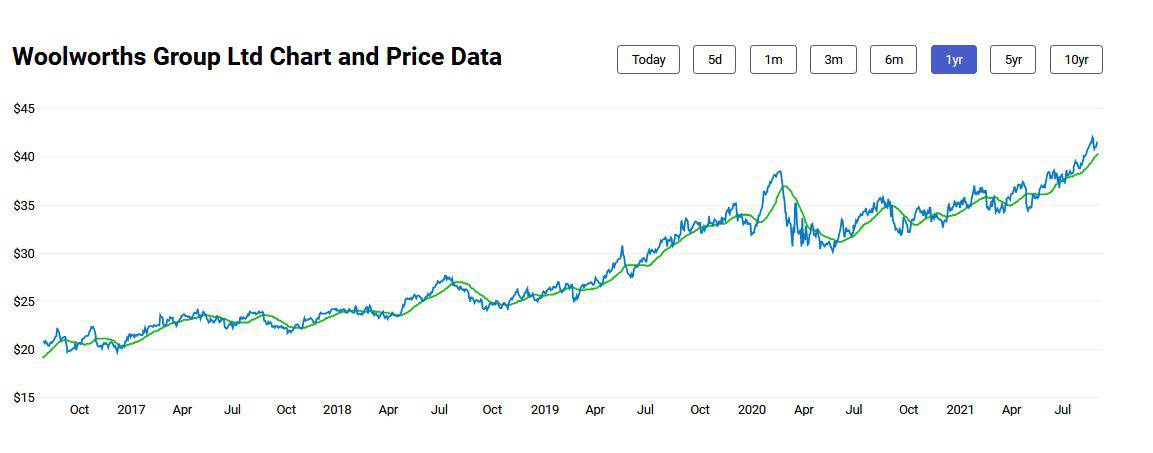
    So, to kick things off, here is a share price graph of the Woolworths share price over the past 5 years:

    WOW share price
    Woolworths 5-year Share Price Data | Source: fool.com.au

    It’s clearly been a pretty smooth run for investors in Woolworths over the past 5 years. Back at the end of August 2016, this company was asking a share price of roughly $21.80 a share. Today, at the time of writing, the Woolworths share price is sitting at $41.56. up 0.29% for the day so far.

    That means that over the past 5 years, Woolworths shares have delivered a capital return of approximately 90.6%. That compares very favourably against the S&P/ASX 200 Index (ASX: XJO) which has returned around 40% over the same period.

    But what have been the company’s biggest ups and downs over this period?

    Some ups and downs for the Woolworths share price

    Well, to start things off, it’s important to remember that in late August of 2016, Woolworths shares had just reached the bottom of what we can now call a 2-year slump.

    In August 2014, Woolies was going for around $30 a share. Yet, by July 2016, the company was under $18 a share. Looking back, we can blame this slump on the resurgence of Woolies’ arch-rival Coles Group Ltd (ASX: COL) which was beginning to fire under the management of its old parent company Wesfarmers Ltd (ASX: WES).

    But it was also the time of Woolworths’ disastrous foray into the world of hardware. Remember Masters? Woolworths’ doomed attempt to compete with Wesfarmers’ uber-successful hardware chain Bunnings?

    Well, this was around the time Woolworths was hemorrhaging cash from its expansion plans. The company ended up pulling the plug on the whole thing in December 2016, at an enormous cost to shareholders. We can see this being built into Woolies shares between 2014 and 2016. Indeed, it was only in the August of 2019 that Woolworths shares would eventually rise back to the level they were in 2014.

    Kaufland exits, and COVID enters

    In 2019 and early 2020, we saw the Woolworths share price explode. 2019 saw the company add around 25% to its value, while the period between 1 January 2020 and 14 February 2020 saw another near-20% put on top.

    At the time, we all thought that the German supermarket giant Kaufland would be entering the Australian retail space, given the company had publically announced expansion plans. But when Kaufland announced that it would be pulling the plug on its Australian plans in January 2020, the Woolworths share price rocketed.

    It was only brought back to Earth by the subsequent outbreak of the coronavirus pandemic a month later. For the first year or so of life with COVID, Woolworths shares largely trod water.

    Woolies was more or less left out of the COVID-induced share market crash of early 2020 – largely thanks to the well-publicised panic buying of essential groceries that we saw last year.

    How does the Woolworths share price look today?

    But in the past 3 months or so, investors have broken the mould and sent Woolworths shares to new heights. After a robust FY21 earnings report, the successful demerger of Endeavour Group Ltd (ASX: EDV) and a new share buyback program, things have never been better for Woolworths share price. Today, it sits pretty close to its post-spin off all-time high as we speak.

    Who knows what the future will hold for Woolworths going forward. But we do know that there is still an army of shareholders who will be paying attention!

    At the current Woolworths share price, the company has a market capitalisation of $52.53 billion. a price-to-earnings (P/E) ratio of 34 and a dividend yield of 2.61%.

    The post Woolworths (ASX:WOW) share price history: What caused the biggest ups and downs? appeared first on The Motley Fool Australia.

    Should you invest $1,000 in Woolworths right now?

    Before you consider Woolworths, you’ll want to hear this.

    Motley Fool Investing expert Scott Phillips just revealed what he believes are the 5 best stocks for investors to buy right now… and Woolworths wasn’t one of them.

    The online investing service he’s run for nearly a decade, Motley Fool Share Advisor, has provided thousands of paying members with stock picks that have doubled, tripled or even more.* And right now, Scott thinks there are 5 stocks that are better buys.

    *Returns as of August 16th 2021

    More reading

    Motley Fool contributor Sebastian Bowen has no position in any of the stocks mentioned. The Motley Fool Australia’s parent company Motley Fool Holdings Inc. has no position in any of the stocks mentioned. The Motley Fool Australia owns shares of and has recommended COLESGROUP DEF SET and Wesfarmers Limited. The Motley Fool has a disclosure policy. This article contains general investment advice only (under AFSL 400691). Authorised by Bruce Jackson.

    from The Motley Fool Australia https://ift.tt/3tdjCnL

  • Why the Qantas (ASX:QAN) share price has beaten the ASX 200 in the last year

    A woman holds her arms out as a plane flies overhead

    Despite an outbreak of the Delta variant and nationwide lockdowns, the Qantas Airways Limited (ASX: QAN) share price has flourished in the last year.

    In the past 52-weeks, shares in the airliner have soared more than 31%.

    By comparison, the broader S&P/ASX200 (ASX: XJO) Index has only climbed 26.5% higher in the same period.

    Let’s take a look at why the Qantas share price has beaten the ASX 200.

    Qantas share price rallies into reporting season

    Much of the gains in the Qantas share price have been realised in the last week.

    Since last Monday, shares in the airliner rallied more than 19% as the company approached its reporting date.

    In addition, the Qantas share price also received a boost from its incentive scheme to get more Australians vaccinated.

    As part of the program, the airliner aims to reward Australian’s who get the COVID-19 vaccine with bonus points, credits and travel vouchers.

    The incentive follows the company’s decision to mandate that Qantas employees receive the vaccine by 15 November 2021.

    How did Qantas perform in FY21?

    Qantas released its full-year results for FY21 late last week.

    The airliner’s report was headlined by a statutory loss before tax of $2.35 billion.

    Other highlights from Qantas’ full-year results included;

    The airliners management cited the difficult domestic and international conditions for the dire result.

    Qantas noted that in FY21, only 30 days were free of any state domestic border restrictions.

    The outlook for Qantas

    The Qantas share price has continued its bullish price action heading into this week.

    Shares in the airliner have been buoyed by plans to potentially resume international travel by December of 2021.

    In line with the National Cabinet’s plan, Qantas expects the resumption of the trans-Tasman travel bubble and other routes in the Asia Pacific.

    Leading broker Citi has also painted an optimistic outlook on the Qantas share price.

    Analysts recently retained their buy rating and increased their price target on the airliners shares.

    Notwithstanding a disappointing FY21, analysts noted that guidance for FY21 implies market share gains.

    The broker acknowledged that despite uncertainty around COVID-19, Qantas is well placed to meet pent-up demand.

    At the time of writing, the Qantas share price is trading 6% for the year at $5.11.

    The post Why the Qantas (ASX:QAN) share price has beaten the ASX 200 in the last year appeared first on The Motley Fool Australia.

    Should you invest $1,000 in Qantas right now?

    Before you consider Qantas, you’ll want to hear this.

    Motley Fool Investing expert Scott Phillips just revealed what he believes are the 5 best stocks for investors to buy right now… and Qantas wasn’t one of them.

    The online investing service he’s run for nearly a decade, Motley Fool Share Advisor, has provided thousands of paying members with stock picks that have doubled, tripled or even more.* And right now, Scott thinks there are 5 stocks that are better buys.

    *Returns as of August 16th 2021

    More reading

    Motley Fool contributor Nikhil Gangaram has no position in any of the stocks mentioned. The Motley Fool Australia’s parent company Motley Fool Holdings Inc. has no position in any of the stocks mentioned. The Motley Fool Australia has no position in any of the stocks mentioned. The Motley Fool has a disclosure policy. This article contains general investment advice only (under AFSL 400691). Authorised by Bruce Jackson.

    from The Motley Fool Australia https://ift.tt/3gHyju7

  • The latest ASX shares to be hit by a broker downgrade

    ASX shares downgrade A young woman with tattoos puts both thumbs down and scrunches her face with the bad news.

    We might be emerging from one of the best reporting seasons in history, but this hasn’t brokers from downgrading ASX shares.

    The S&P/ASX 200 Index (Index:^AXJO) gained 0.5% over the past month as several ASX shares posted record earnings and dividends.

    But it isn’t all good news for the Healius Ltd (ASX: HLS) share price. Even after the medical services group posted strong growth for FY21, Goldman Sachs downgraded the Healius share price to “neutral” from “buy”.

    ASX shares downgraded for lack of new surprises

    This is largely because the broker reckons management has run out of rabbits to pull out its hat! Delivering positive surprises is key to driving outperformance for the Healius share price.

    “Commentary that the base pathology business remains ‘slightly up’ in FY22 to date is encouraging, but is likely no longer sufficient to generate positive surprise,” said Goldman.

    “Meanwhile, the Imaging business is currently held back by ongoing lockdowns but also continues to lag peers.”

    How much is the Healius share price worth?

    Sure, increased PCR testing for COVID-19 will bolster the company’s bottom line, but that’s arguably priced into the Healius share price, which is up around 65% since the start of the pandemic.

    What’s more, management has ruled out further corporate restructure in the near-term.

    Goldman’s 12-month price target on the Healius share price is $4.90 a share.

    Too much of a good thing

    Another to suffer a broker downgrade is the Mincor Resources NL (ASX: MCR) share price. The analysts at Macquarie Group Ltd (ASX: MQG) lowered its rating on the Mincor share price to “neutral” from “outperform”.

    The move comes even after the nickel miner announced two impressive exploration results at Golden Mile and Location 1.

    “We believe Golden Mile has the potential to add tonnes to our five-year production scenario with Location 1 requiring more drilling to better define its potential,” said Macquarie.

    “MCR’s share price is up ~40% since the beginning of July [vs index ASX 200 up 3%], equivalent to an increase in market capitalisation of +$170m.

    “We believe this move largely captures the potential of the discoveries at this stage.”

    Downgraded ASX shares despite positive nickel outlook

    Mincor’s production ramp-up and costs assumptions are the key risks to the broker’s forecasts for the miner.

    Macquarie’s 12-month price target on the Mincor share price is $1.40 a share.

    But this doesn’t mean the broker is turning bearish on nickel. If anything, the supply of the metal remained tight with only 273,000 tonnes of ferronickel imported to China in July.

    This is against the backdrop of the global deficit and ramp-up of Indonesian stainless output.

    The post The latest ASX shares to be hit by a broker downgrade appeared first on The Motley Fool Australia.

    Wondering where you should invest $1,000 right now?

    When investing expert Scott Phillips has a stock tip, it can pay to listen. After all, the flagship Motley Fool Share Advisor newsletter he has run for more than eight years has provided thousands of paying members with stock picks that have doubled, tripled or even more.*

    Scott just revealed what he believes could be the five best ASX stocks for investors to buy right now. These stocks are trading at near dirt-cheap prices and Scott thinks they could be great buys right now.

    *Returns as of August 16th 2021

    More reading

    Motley Fool contributor Brendon Lau owns shares of Macquarie Group Limited. The Motley Fool Australia’s parent company Motley Fool Holdings Inc. has no position in any of the stocks mentioned. The Motley Fool Australia owns shares of and has recommended Macquarie Group Limited. The Motley Fool has a disclosure policy. This article contains general investment advice only (under AFSL 400691). Authorised by Bruce Jackson.

    from The Motley Fool Australia https://ift.tt/38rA8a8